English Education: Jurnal Tadris Bahasa Inggris, Vol. 13 (1), 2020, 135
The Use of Vlog in Improving Students’ Oral Language
Production: A Case Study
Teguh Hadi Saputro1*, Ibnu Choirin Tafsirudin, Rafika Rabba Farah
Universitas Muhammadiyah Malang, Indonesia
Abstract. The analysis of using a video blog (Vlog) in language learning has been widely done. However, most of the studies only focus on investigating the students’ perception of Vlog. This study attempted to analyze the use of Vlog in improving students’ oral language production. In addition, the students’ perception after applying Vlog in language learning was also investigated. The complexity, accuracy and fluency (CAF) were the aspects analyzed from students’ performance. Further, a mixed-method was applied in this study. This study involved six participants (3 male and 3 female) who were the students of the English Language Education Department of a private university in Malang, Indonesia. A speaking test which was in the forms of vlogs and semi-structured interviews were used as the instruments for the data collection. The quantitative data from the test were calculated by using formulas of CAF and further analyzed by the descriptive statistics, while the qualitative data from the interview were analyzed to explore the benefits and challenges of learning with vlogs. The findings showed the increasing mean of the students’ accuracy while their fluency and complexity decreased. There were several factors that might impact the findings. Those were; planning time, pressures, restrictions in terms of time, and task repetition. The benefits and challenges of learning with Vlogs were discussed in this paper.
Keywords: language performance, teaching speaking, vlogs
1. INTRODUCTION
Since the technology was introduced, it has given a great contribution to language learning,
and it is inseparable from the language learning process, not to mention in this digital era. The
use of technology devices such as smartphones, laptops, and computers among the present
generation becomes a necessity and a need for them (Balakrishnan & Puteh, 2014). In addition,
today's generation is technology revelers who use those technology devices in their daily life,
and hard to leave it behind. Those who are in their school-age are the active user of the
technology. In this case, the institutions or schools and the stakeholders should be aware of
English Education: Jurnal Tadris Bahasa Inggris, Vol. 13 (1), 2020, 136
learning more effective and attractive. Further, the use of technology in language learning can
reduce teacher’s talk time in the teaching and learning process in the classroom (Balakrishnan
& Puteh, 2014).
In this globalization era, technology develops rapidly and is always linked to innovation.
One of the innovations is video blog (Vlog), a mix of video and blog, which is popular among
nowadays generation(Anil, 2016b). It is a personal diary in terms of video and audiovisual
shared with the public through an internet network. The purpose of Vlog activity is to express
someone's ideas or the information and share them to the public through video and audiovisual.
This activity reveals to be one of the interesting ways to learn English, mainly speaking, outside
the classroom, and creates an innovative language learning atmosphere(Anil, 2016a).
Vlogs facilitate language learners to practice their speaking skills outside the classroom
(Hung, 2011). They can record their speaking activities in a video format and post it on online
media such as YouTube, Dropbox, and others. Teachers can monitor the improvement of the
learner’s speaking skills through the videos. Meanwhile, the public can also give their comment
and suggestion to enrich the content and the quality of the Vlogs. This practice can be one of
the best ways to improve speaking skills outside the classroom and might be needed to cope
with the recent issues of learners’ willingness to speak and confidence in their speaking
performance. Most of the time, in the classroom context, students have minimal time to practice
their speaking as teachers need to struggle with completing the syllabus, which might ignore
the speaking practice(Anil, 2016b). Thus, using Vlog can help language learners improve their
speaking skills despite the above situations (Anil, 2016b; Shih, 2010).
Most studies have investigated learners’ perception about Vlog in speaking class. The
results mostly suggest the perceived effectiveness of Vlogs in improving the students’ speaking
skills (Anil, 2016b; Balakrishnan & Puteh, 2014; Smith & Maté, 2010). However,empirically
measurement of the improvement has not yet been done and, thus, it serves as the gap of this
present study. It attempts to provide empirical evidence of whether assigning the students to
create Vlogs is beneficial to the students’ language performance, which in this case is their
complexity, accuracy, and fluency (CAF). Another gap in this research is that only a few studies
on this topic have explored the Indonesian context. Thus, the present study also aims at
English Education: Jurnal Tadris Bahasa Inggris, Vol. 13 (1), 2020, 137
2. RESEARCH QUESTIONS
• How is the result of using Vlog on the students’ performance in terms of Complexity,
Accuracy, and Fluency (CAF)?
• How is the students’ perception of Vlog in their learning speaking?
3. LITERATURE REVIEW
3.1Language teaching and technology
Many teaching methods and media have been proposed and applied in the field of second
language teaching in order to help teachers and learners in achieving language teaching goals
(Kramsch, 2014). Further, since the late 1980s and early 1990s, the cognitive and
sociolinguistic approaches have emerged in language teaching and, to a certain extent,
suggested the integration of technology (i.e., computer) in the classroom (Tarighat &
Khodabakhsh, 2016). These days, language teaching is not limited to whatever happens in the
classroom, but also outside the classroom, with several innovations in language teaching to
facilitate it. Therefore, several methods and media in language teaching are utilized the advance
of the digital era, such as integrating more technology devices (e.g., computer, mobile, and
internet) in it (Chun, Smith, & Kern, 2016; Salaberry, 2001; Sung, Chang, & Liu, 2016; Zamari,
Adnan, Idris, & Yusof, 2012).
The role of technology in language teaching is crucial. Since the presence of technology in
society, it has helped people in doing many things in their life, until some argue that technology
assists society (Gonzalez-Acevedo, 2016). In terms of second language teaching, technology
has given its significance. Computer-Assisted Language Learning (CALL), for instance, is one
of many roles of technology in the language learning process (Gündüz, 2005; Parmaxi, Zaphiris,
& Ioannou, 2016; Tarighat & Khodabakhsh, 2016). In addition, Afshari et al. (2013), argue that
technology used in language teaching creates a good atmosphere for learning and motivates
students to learn and participates in classroom activities. Moreover, Lee (2000, as cited in Azar
& Nasiri, 2014) suggests that computer technology used in second language teaching can
provide ways for students to practice the language through experimental learning, stimulate
students to learn more, increase student accomplishment, enrich reliable materials for learning,
encourage greater interaction among stakeholders in language teaching, give emphasis on
English Education: Jurnal Tadris Bahasa Inggris, Vol. 13 (1), 2020, 138
researchers agreed that computer technology is a good and perfect tool to enhance students’
learning in English (Azar & Nasiri, 2014).
Computer technology is one of the valuable instruments in language teaching. Over the
past view decades, computer-assisted language learning (CALL) has been widely used in
teaching and learning the language. According to Beatty (2003, as cited in Afshari et al., 2013;
Oz et al., 2015) CALL is defined as any process that requires learners to use computers in
language learning to improve his or her language. In many studies, CALL facilitates language
learning and encourages a positive attitude (Grgurović, Chapelle, & Shelley, 2013; Oz et al.,
2015) as it helps learners acquire the language. Further, Warschauer (1996, as cited in Afshari
et al.) posits that computer technology helps learners in acquiring language in three ways:
computer as the instructor (tutoring the learners), computer as impetus (increase syntactic and
analytic thinking of learners), and computer as an instrument (e.g., grammar checking, word
processing, collaborative writing, and internet). In addition, Hashemi & Aziznezhad (2011)
explain that there are two advantages of involving CALL in language teaching and learning:
first, it offers a powerful self-access facility; it helps generate autonomous learners or
independent learners who will experience many things whatever they want, in learning a
language. Autonomous learners use computers to practice their language with compatible
software. Other advantages of CALL is to give a new role to teaching materials. Generally,
learners feel motivated when they are exposed with innovative and attractive teaching media
e.g., using computer. In addition, many language skill learning can be facilitated by software
(Gündüz, 2005). Gündüz (2005), believes that CALL helps the language learning when teachers
know how to optimize the use of it.
As time goes by, computer technology has somehow been replaced or possibly advanced
by mobile technology that offers high practicality and popularity. Further, the education field
has given excellent deal attention to the occurrence of wireless technology and mobile-devices
innovation that offer portability, social connectivity, context-sensitivity, and individuality
features (Sung, Chang, & Yang, 2015). Sung et al. (2015) state that mobile devices make the
learning process handy, real-time, cooperative, and all-in-one, and defines as mobile learning.
Researchers define mobile learning techniques that applied in the language learning and
teaching process as mobile-assisted language learning (MALL) (Sung et al., 2015). Tarighat &
English Education: Jurnal Tadris Bahasa Inggris, Vol. 13 (1), 2020, 139
devices (Sung et al., 2016) which leads the learners to access several learning programs in a
different context.
3.2Video Blog (Vlog)
Vlog (video blog or video log) is one of attractive media innovations in this current digital
era. This innovation was popular among digital geeks especially youth generation that
interested on visual and audiovisual. Watkins & Wilkins (2011), state that Vlog is a personal
diary in form of video and audio that shared on online media. Recent study suggests to post the
results of Vlog on the several media that connected with internet networks such as YouTube,
Dropbox, Whatsapp, email, and Facebook or others (Anil, 2016a). In addition, nowadays,
generation is inseparable from those media and the internet network, and it becomes their needs
in this era. Furthermore, Vlog aims to express someone's opinion or information to others,
personally or socially (Anil, 2016a; DeWitt, Naimie, & Siraj, 2013; Smith & Maté, 2010).
Vlogs have an essential role in improving learners speaking skills. Vlogs can be seen as a
trial and error method in learning, in which learners can practice many times before they feel
satisfied with their own performance in the video, which later is uploaded into a vlog. Watkins
& Wilkins (2011) analyzes three-time Vlogs of Vloggers, and the results show that it helps
them practice their speaking in front of the camera and build their confidence. Moreover, the
vlogs posted on online media like YouTube can make learners learn many things from the
feedbacks, comments, and viewers’ suggestions and motivate them to correct and improve the
contents of their Vlog. In conclusion, integrating vlogs in language learning is one of the best
ways to facilitate learners to improve their speaking skills and build their confidence to speak
up while exploring digital experiences in this technology era.
3.3Complexity, Accuracy, and Fluency (CAF)
Complexity is the highest level of language use. It emphasizes the language organization
and elaborates on the variety of syntax in language. The complexity in speaking is the difficult
one, where the learners have to develop their ideas orally while reconstructing as more intricate
language subsystems with the strong willingness to take a risk and experiment the language
(Foster & Skehan, 1996). Crookes (1989), states that the greater complexity of language is the
English Education: Jurnal Tadris Bahasa Inggris, Vol. 13 (1), 2020, 140
autonomous utterance providing referential or pragmatic meaning. C-unit is either a simple
independent finite clause or a dependent finite or nonfinite clause (Foster & Skehan, 1996).
To know the quality of complexity in a conversation, some experts measure the clauses and
words per utterance. The more clauses in a talk per utterance, the more complex the
conversation is. Moreover, in the study of Foster & Skehan (1996), it gives the way to measure
complexity in speaking by adapting general measurement of Robinson et al. (1995) and Crookes
(1989) that calculate the number of subordinate clauses (dependent clause) per utterance and
per T-unit. In addition, Young and Milanovic (1992, as cited in Foster, Tonkyn, &
Wigglesworth, 2000) define T-unit for oral data as ‘an independent clause and any associated
dependent clauses’. Therefore, the complexity is counted by calculating the number of
dependent clauses per utterance or how many dependent clauses that attach on independent
clause. Finally, this measurement is applied with several experts to know the complexity of
speaking.
Accuracy is one of important aspects of speaking that is dealing with the grammatical and
language form. Moradi & Talebi (2014) state that, accuracy is the understanding of language
form and structures with the accurate implementation of them in language use. Moreover,
Davies (1980) argues that accuracy is included the grammatical and syntactical structure of the
target language. In addition, other researchers claim that accuracy is freedom from the error in
every language used (Foster & Skehan, 1996). Furthermore, accuracy is much needed when it
is used in formal and some non-formal speaking condition to keep the real intention of the
speakers, because it is used to determine the real intention of the speakers in their talks or
communications. Basically, the information could be misunderstood between speakers and
interlocutors when the information is lack of accuracy. Thus, to avoid that issue, the speakers
have to know the language form or structure, pronunciation, and the correct vocabularies.
Foster & Skehan (1996), inform the way to measure accuracy in speaking is by
calculating error-free clauses in the utterance. Besides, error-free clauses are a clause that there
is no error in syntax, morphology, or word order (Foster & Skehan, 1996). This measurement
aims to know and compare the quality of speaking in oral language activities. The higher
amount of error-free in clauses, the better accuracy of speaking. Moreover, Foster & Skehan
English Education: Jurnal Tadris Bahasa Inggris, Vol. 13 (1), 2020, 141
amount of error-free in clauses. Hence, the measurement is needed to know how many errors
that occur in the clauses of speaking.
In addition, being a fluent speaker is as important as being an accurate and complex one.
In fact, it should be the first priority when it comes to learning a second language in the early
stage. Fillmore (1979, as cited in Moradi & Talebi, 2014), elaborates and conceptualizes
fluency in several ways. First, fluency is the capability to speak up at length with little pauses,
by filling the time with talk. Second, fluency is the expression of message in a coherent way.
Third, a fluent person knows what to say in appropriate contexts. Fourth, fluent speakers are
creative and imaginative when they used the language. In addition, Davies (1980) points out
fluency as the ability to express oneself adequately without undue hesitation in a given situation,
whether in speech or in writing.
Previous studies divide fluency into two categories, the first category is fluency in the
narrow sense, which is claimed as the speed and smoothness of speech delivering without
(filled) pauses repetition and repair in it. Second, fluency describes overall speaking
proficiency, which is a vital component of the speaking proficiency evaluation (De Jong et al.
2015). Thus, fluency in speaking deals with speed, smooth at length without pauses, repetition,
and repair or filling it by other talks. Further, the study of Ortega (1999) points out the
measurement of fluency by counting the number of syllables per minute without including
syllables of reformulation, false starts, hesitations, and repetitions (Ortega, 1999). This
measurement is used by several experts to know how fluent the speakers deliver their speech in
a speaking activity.
4. METHODOLOGY
This current research employed mixed methods design, quantitative and qualitative to gain
the result of both data in this research. The quantitative method was used to obtain the answer
to the first research question which investigated the participants’ CAF. Meanwhile, the
qualitative method was applied to explore the participants’ perception after using Vlog in their
speaking class by conducting a semi-structured interview.
English Education: Jurnal Tadris Bahasa Inggris, Vol. 13 (1), 2020, 142
The participants were six students of the English Language Education Department at a
private university in Malang, Indonesia. They were three female and three male students with
the age range of 18-20. Generally, they had learnt English since junior high school, or they had
learnt English for around six years. Furthermore, in the university, they had passed Basic
Speaking, Pre-Intermediate Speaking, and Intermediate Speaking prior to the course as they
participated in the study.
4.2Data collection
The data were obtained utilizing giving tasks to the participants to make the contents of
vlogs with several instructions which were on the same topic. The topic was related to language
teaching issues. The vlog task was given in every two weeks, which resulted in six vlogs. The
vlog task was given in the second, fourth, sixth, eighth, tenth, and twelfth weeks from the total
of 14 class meetings.The vlog task was the follow-up of the classroom tasks. For example, in
the second meeting, the students discussed the importance of grammar in learning English. The
students involved mainly in group work. To reinforce their understanding and practice of the
topic in the second week, they were assigned to make a 3-minute vlog about the important
grammar in learning English. Afterward, they would make a video of themselves talking about
the topic, upload the video to YouTube and share the YouTube URL link to the teacher through
a learning management system (LMS). By submitting the link to the LMS, it was expected that
other students could watch the video and give comments or feedback. The students did the same
series of activities to do the second to the sixth vlogs. The sub-topics of the vlogs were (1) the
importance of grammar in learning English, (2) how to start writing in English, (3) the
difference of learning English and being good at English, (4) how to use technology to support
language learning, (5) their opinion about world Englishes and (6) the criteria of a good English
teacher. However, for the analysis, only the first and the sixth (last) vlogs were used as the data
to check whether or not the participants made progress in terms of their complexity, accuracy
and fluency.
As for the participants’ perceptions about their vlog tasks, in-depth interviews were carried
out with the six participants individually after they completed the 6 vlogs. The interviews were
semi-structured with the primary investigation of the benefits and challenges of learning with
English Education: Jurnal Tadris Bahasa Inggris, Vol. 13 (1), 2020, 143
4.3Data analysis
The two vlogs from the second and twelfth weeks were thoroughly transcribed with the
information of the length of pause, repetition, and other details that were relevant to the further
analysis. The participants’ complexity was calculated by identifying the dependent clauses per
utterance (Foster & Skehan, 1996). In other words, the number of dependent clauses determined
the score of the complexity. Meanwhile, the accuracy score was obtained by counting the
number of error-free clauses (including syntactic, morphological, and word order) to total
clauses in percentage (Foster & Skehan, 1996). As for the fluency, Ortega (1999) formulates
the way to obtain the score by counting the syllables per minute in speech out of reformulations,
false starts, hesitations, and repetition syllables. After the scores of CAF of each individual
were obtained, the descriptive statistics were employed to investigate the increase or decrease
of CAF from the first vlog to the sixth one. For the interviews, the audio was transcribed. From
the transcription, the qualitative analysis was performed to identify and present the benefits and
challenges of the vlogs.
5. Findings
5.1Complexity, Accuracy and Fluency in Vlog
The analysis of the participants’ vlog in this current research resulted in some findings. The
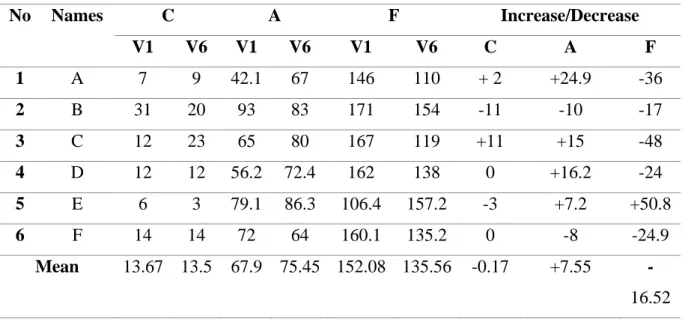
calculation results are presented in Table 1.
Table 1: Descriptive Statistic (Means) of CAF results in Vlog
*C: Complexity, A: Accuracy, F: Fluency, V1: Vlog 1, V6: Vlog 6
No Names C A F Increase/Decrease V1 V6 V1 V6 V1 V6 C A F
1 A 7 9 42.1 67 146 110 + 2 +24.9 -36
2 B 31 20 93 83 171 154 -11 -10 -17
3 C 12 23 65 80 167 119 +11 +15 -48
4 D 12 12 56.2 72.4 162 138 0 +16.2 -24
5 E 6 3 79.1 86.3 106.4 157.2 -3 +7.2 +50.8
6 F 14 14 72 64 160.1 135.2 0 -8 -24.9
Mean 13.67 13.5 67.9 75.45 152.08 135.56 -0.17 +7.55
English Education: Jurnal Tadris Bahasa Inggris, Vol. 13 (1), 2020, 144
Table 1 showed the results of CAF from the two vlogs of the six participants. For the
complexity, the mean of the first vlog was higher (13.67) than the sixth Vlog (13.5). It indicated
that in terms of the complexity, the participants’ performance decreased by 0.17 points. Even
though the complexity of Participant “A” increased by 2 points (from 7 to 9) and Participant
“B” showed an increase of his / her complexity by 11 points (from 12 to 23), their performance did not impact the overall mean of the participants’ complexity.
Unlike the complexity results, the accuracy of the participants’ performance was
increased indicated by the increase of the mean by 7.55 points (from 67.9 to 75.45). As seen
from the table, most of participants increased their accuracy from Vlog 1 to Vlog 6, but only
two did not.They were Participant ”B” (from 93 to 83)and Participant F (from 72 to 64).
Similar to the complexity, the participants’ fluency relatively showed a decrease. It can
been seen from the mean of the first vlog, 152.8, which decreased to 135.56 in the sixth vlog.
The decrease point was 16.52. However, only one participant increased his fluency from 106.4
to 157.2 (16.52 points).
5.2 Perception
5.2.1Benefits
The semi-structured interview was conducted with the six participants in this current
research and resulted in several findings. In this section, the findings of the interview
represented the benefits of Vlog and categorized into five points namely as follows: (A) Vlog
was efficient, (B) Vlog helped learners in improving speaking skill, (C) Vlog was more fun in
learning speaking, (D) Vlog helped the participants in understanding materials outside the
classroom, and (E) Vlog motivated the participants to learn more about language.
In the first point, the results of the interview claimed that Vlog was efficient. There were
two reasons that underlined this point. First, the learners could access and make the Vlog in
every time and everywhere. Second, the Vlog was considered to facilitate the learners to learn
several materials in a relatively short time while preparing the content of their Vlog.
“Usually, Vlog is used for entertainment in YouTube, but now it can be used for language
English Education: Jurnal Tadris Bahasa Inggris, Vol. 13 (1), 2020, 145
“I think Vlog is efficient, because it can extend the language learning time and give some time
to practice in speaking while making the content of it outside the classroom” (KMS, A)
For the second point, the participants stated that Vlog helped them to improve their
speaking skill. Vlog facilitated the participants to practice their speaking outside the classroom,
and habituated themselves to talk in English. In addition, the participants perceived that they
were more fluent in speaking English after applying Vlog in their speaking practice. Especially
for those less active learners in the class, Vlog was helpful in increasing their talk time outside
the classroom. Furthermore, Vlog helped them in coping with their self-distrust issue when they
did the public speaking.
“I think Vlog is very interesting. It is something new in my learning. It helps me and other shy
learners to increase our talk time or to be more active in speaking” (KMS, B)
“In my opinion, Vlog is good in familiarizing myself in speaking English or it can be a good medium for speaking practices” (IN, B)
For the third point, the participants claimed that using Vlog in learning speaking was
interesting. There were several reasons that made the use of Vlog more exciting than learning
speaking in the class. The participants felt that the use of Vlog in learning speaking was more
enjoyable because it was something new in their learning. In addition, Vlog facilitated the
learners in expressing themself freely in front of the camera without any pressure from the
lecturer supervision.
“Vlog is something new in my learning process which is interesting to use and learning about it” (SVN, C)
“Actually, I like both of learning language approach that using Vlog and language learning in
the classroom. It depends on the lecturer creativity in delivering the materials. To date, I prefer
to use Vlog in my language learning because it was more fun than traditional language learning
in the classroom that can facilitate me in expressing myself freely” (FDS, C)
The fourth point, Vlog helped the participants in understanding the materials that they
had learned in the class. In this point, vlog was claimed to facilitate the participants in reviewing
the materials that they had learned. In addition, the participants could re-explain the materials
English Education: Jurnal Tadris Bahasa Inggris, Vol. 13 (1), 2020, 146
from the Vlog and the feedbacks in their Vlog. Moreover, Vlog helped them in structuring the
materials that they want to present in their Vlog. They could plan the idea in speech as well as
they can by implementing what they had learned.
“I understood the materials that I have learned in the class precisely after making Vlog because
it makes me rethink and relearn what I have discussed in the class. Hence, I can make a good
conclusion of it in my Vlog” (IN, D)
“I prefer to use Vlog in my language learning because it can be used as a medium of reviewing
and practicing the materials that I have learned. In addition, after using Vlog in my language
learning, I could evaluate my works and make the better one in the next Vlog assignment” (KW,
D)
The next point was related to the participants’ motivation after using Vlog in their
speaking class. Vlog provided additional motivation to the participants’ language learning. The
reason was that it helped the participants to experience a way to improve their oral performance.
Also, vlog facilitated them to practice and evaluate their speaking skill progress. In addition, it
could support them to improve their progress when the environment around them did not
support them. Moreover, vlog helped the participants to create a good habit in learning language
by looking for new information and literature to support their Vlog content.
“By using vlog in my language learning, I can experience a way to improve my language, like
grammar, speaking fluency and how to develop my speaking, and vlog gives me the motivation
to learn a lot of other new things” (SVN, E)
“Vlog gives me motivation in expressing my language style and improves my speaking skill. I can practice my speaking skill even though the environment is not supporting me” (IN, E)
4.2.2 Challenges
The most challenges in this study were technical problems and topic development issues.
The first technical problem was about video editing. The most participants lacked of video
editing skill. Hence, they could not present what they perceived as a good video. Secondly,
some participants who made the video for the first time were confused about uploading and
manage it into YouTube. In addition, this problem occurred mostly in the first and the second
English Education: Jurnal Tadris Bahasa Inggris, Vol. 13 (1), 2020, 147
involved the lack of references and the anxiety of making mistakes. Some of participants found
it challenging to develop the topic in their vlog due to their lack of references. Hence, this
pushed them to look for some references to support the content of the vlog. The last issue was
their anxiety to make mistakes in their speech that caused them to limit their speech as they had
planned before in their vlog tasks. Thus, these issues led to the difficulties in developing the
topic for their vlogs.
“Vlog was not boring, but I was confused to develop the topic that I will present in the Vlog, so
then I find it hard to maximize the content in the Vlog. In addition, I feel troubled to make the
vlog more attractive” (KMS, F)
“I feel nervous in front of the camera because of my expectation that make me afraid to make mistakes in my Vlog” (IN, F)
6. DISCUSSIONS
The findings on the participants’ CAF results in this showed an increase in accuracy yet
decrease in both complexity and fluency. In terms of the complexity, Ahmadian & Tavakoli
(2011) have suggested that the repetition on the same task will affect the complexity results. In
this study, the vlog treatments seemed to have a negative effect on the complexity results. This
fact is not following the Ahmadian & Tavakoli(2011) statement, which argues that task
repetition enhances complexity and or fluency. In addition, most of the participants’ complexity
results decreased in this current study due likely to several reasons such as pressures,
restrictions in terms of time, and planning time. In this study, the participants were allowed to
present their speech freely without any pressure. In fact, some participants still felt anxious
about making mistakes in their speech. It might cause their low score in making complex oral
language. Basically, when the students have sufficient time and less-pressure conditions, they
are likely to try to make more accurate and complex language (Ahmadian & Tavakoli, 2011;
Johnson, 2017).
Although some studies report that time restriction and planning time are considerable
evidence that increases language complexity (Crookes, 1989; Foster & Skehan, 1996; Mehnert,
1998; Ortega, 1999), the current study showed different finding. The time restriction in this
study was around three up to five minutes in every vlog treatment, with weekly planning time.
English Education: Jurnal Tadris Bahasa Inggris, Vol. 13 (1), 2020, 148
Ahmadian & Tavakoli (2011) and Gass et al.(1999). The results of Gass et al. (1999), about
repetition in the same task report the gain lexical complexity and partial accuracy which
increase in two up to three days planning time. Meanwhile, Ahmadian & Tavakoli (2011),
obtain favorable results on complexity in four up to six minutes of time limitation. Moreover,
Mehnert (1998) finds that greater complexity is obtained after ten minutes of planning time
which is shorter than planning time in the Gass et al. (1999) and this present study. However,
the findings of the current study showed different directions, although the procedures of those
studies are more or less similar to the current study. Thus, those factors do not seem to have a
positive effect on the complexity of the participants in the study.
The vlog tasks seem to give positive results in terms of accuracy improvement. As this
particular task is a form of task repetitions, the participants likely tend to focus on preparing
their performance and correcting their either error or mistake several times which might affect
their accuracy. In this case, the finding of the current news is in line with the study of Bygate
(1999) and Lynch & Maclean (2003), that report the task repetition improves accuracy in
language production. This finding is also in tune with the result of Hulstijn & Hulstijn (1984),
Ellis (1987) and Ahmadian & Tavakoli (2011). Although those studies have some differences
in terms of the accuracy measures, the general concept of the measurement is similar,
calculating error-free clauses.
One may suggest that the restriction in terms of time in the Vlog treatment impacts the
results of students’ accuracy (Yuan & Ellis, 2003). In the study, a week planning time in this
current study is likely sufficient to facilitate good accuracy in every vlog tasks. Yuan & Ellis
(2003), point out that when the students are allowed to take more time in their performance,
they try to produce both more complex and accurate language. On the contrary, when the
students perform under time restrictions, they will prioritize meaning over form (Yuan & Ellis,
2003). Other experts suggest that when the students use their time without any restriction in
their performance, the production of their word order becomes more accurate (Hulstijn &
Hulstijn, 1984). According to the finding of Ahmadian & Tavakoli (2011), learners who have
ample time for task completion will produce more accurate language than those who do not.
In this section, four participants have increased accuracy while the rest decreases. Some
of the structure the idea before presenting their vlog content, and the others do. Structuring idea
English Education: Jurnal Tadris Bahasa Inggris, Vol. 13 (1), 2020, 149
oral language production (Gass et al., 1999; Skehan & Foster, 1997). Therefore, one may claim
that the time restriction has a big contribution to the accuracy result in oral language production.
When the learners are allowed to take time as they need to present the tasks, they do produce
not only accurate language but also complex and fluent language (Ahmadian & Tavakoli,
2011).
As the fluency seems to decrease from Vlog 1 to Vlog 6, several factors might underline
this finding, such as lack of preparation time. Mehnert (1998), expounds that fluency is likely
to improve when sufficient or even plenty of planning time is provided. Meanwhile, Ortega
(1999), explains that advance planning impacts language production positively, particularly on
the complexity and fluency. Therefore, it might be the case that the participants find a week
planning time is not sufficient, or they might not use it wisely to give them concise time to
prepare their performance before the submission.
From the findings, it can also be learned that the trade-off in terms of the complexity,
accuracy and fluency is noted. Some previous studies report their findings which are related to
this trade-off effect. For instance, Foster & Skehan(1996) suggest that the trade-off effect
occurs between complexity and accuracy. Nevertheless, Wendel (1997, as cited in Ahmadian
& Tavakoli, 2011) supported by Yuan & Ellis (2003) states that the trade-off includes accuracy
and fluency in which accuracy increases by the online planning and fluency increases by
pre-task planning. As for this current study, those trade-off effects occur randomly among the
participants in their vlogs. As seen in the finding, two participants,“A” and “C”, experience a
trade-off between complexity and accuracy, while Participant “E” shows a trade-off between
accuracy and fluency. Meanwhile, other participants seem to show a general or suggested
patterns of a trade-off as the scholars argue. In general, from the means of CAF, it shows that
only the accuracy shows the increase as compared to the complexity and fluency.
In addition to the CAF results, this study also explores the participants’ perception in
terms of the benefits and challenges of the vlog tasks. The benefits involve five points presented
in the finding section, while the challenges are mostly related to the technical problems and
topic development issues.
Further, the first benefit in this current study is the efficiency of vlog in language
English Education: Jurnal Tadris Bahasa Inggris, Vol. 13 (1), 2020, 150
place they like. Besides, they can also practice and monitor their performance during the vlog
making in an efficient way. In this case, Hung (2011)has stated that vlog is efficient in
enhancing speaking skills verbally and non-verbally as it can be one of practicing and
monitoring media. In addition, Vlog facilitates the students to experience and relearn the
materials while making the content of it (Combe, 2014). Some students comprehend the
materials that they have learned in the classroom after making the vlog assignment. Hence, one
may suggest that vlog facilitates the students to experience new knowledge in a relatively short
time (Sung et al., 2015).
The results of semi-structured interviews also present that vlog has a major role in
improving the speaking skill. In this respect, the role of vlog involves several aspects such as
facilitating the students to practice their speaking outside classroom (James, 1996). Moreover,
Demouy & Hulme (2010) suggest that vlog making use of mobile devices can adequately
support the practice of listening and speaking. Practicing is one of the important ways to
improve and master the English speaking (Ortega, 2009). Further, Vlog helps the students to
habituate themself in speaking English. When the students practice their English on a regular
basis, it improves their fluency and confidence at the same time (Ellis, 1987; Ortega, 1999;
Rossiter et al. 2010). Furthermore, vlog facilitates some less active students to top-up their talk
time outside the classroom (Anil, 2016b). In fact, these students, in the study, vlogs are their
way to express themselves as they are too anxious to talk during the face to face class.
The use of Vlog in language learning is also claimed to be fun as compared to traditional
classroom language learning. Although technology (e.g., CALL, MALL and blog) has been
integrated with language learning in a long time ago (Azar & Nasiri, 2014; Combe, 2016;
DeWitt et al., 2013; Stickler & Shi, 2016; Tal & Yelenevskaya, 2012), the use of vlog in
language learning is relatively new compared to the previous one i.e., Blog. In this respect, most
of the students expound that learning language using Vlog is more interesting than the
traditional classroom. In addition, a technology that involved in language learning (i.e., vlog)
supports students centered approach (Thomson, 2010).
Some of the participants point out that vlog motivates them to practice their speaking.
When the students are creating vlog, they experience a lot of new things that they do not find
in the traditional classroom—for example, new linguistics knowledge, video recording and
English Education: Jurnal Tadris Bahasa Inggris, Vol. 13 (1), 2020, 151
connection are motivating tools for language learning. Even though some students might face
some issues in creating a good vlog in the first and second tasks, they get better on the next
tasks. Further, as vlogs allow both teacher and peer feedback, it affects their motivation and
learning. Shih (2010), argues that feedback in online learning can increase the students’
motivation.
The challenges that are found in this current study are mostly about technical problems
and topic development issues. After conducting a semi-structured interview, some participants
explained that they have trouble presenting good video due to lack of experience in video
making. Most of the students are lack skills in video recording and editing. Indeed, there are
several skills and experiences needed to create an attractive and useful video, especially in
operating camera and editing applications such as window movie maker (Anil, 2016b).
Moreover, some aspects have to be included in creating a good video such as video itself, sound,
picture, text, and emotions that support the video to deliver the information (Watkins &
Wilkins, 2011). The other technical problem is related to the process of uploading the video to
YouTube. There are some regulations and technical issues that might be complicated for
first-time users of YouTube to share their videos.
The other challenge is about topic development. Most of the participants acknowledge
that they find it hard to get relevant references for their talk in the video. However, they feel
that they are getting better after doing the next tasks of the vlog. Moreover, it is likely that the
participants do not use the planning time effectively although, the preparation time in this study
is claimed to be sufficient by several studies (Mackey, 2007; Mehnert, 1998; Moradi & Talebi,
2014; Révész, 2011; Skehan, 2003). However, in this study, the participants have a different
opinion. They wish that they can have a longer time for the preparation.
7. CONCLUSIONS
This study was primarily an attempt to investigate the effects of Vlog on complexity,
accuracy and fluency of students’ oral language production and the students’ perception about
Vlog in their language learning. The use of Vlog in this current study positively affected the
participants’ accuracy while negatively affected their complexity and fluency. In addition,
several factors might be responsible to the findings, such as planning time, pressures, task
English Education: Jurnal Tadris Bahasa Inggris, Vol. 13 (1), 2020, 152
in this study were the pressures of their anxiety in making mistakes and the restrictions in terms
of time. Meanwhile, the planning time and task repetition increased the participants’ accuracy
in this study. Those two factors gave significant contributions toward their accuracy, as pointed
out by several previous studies. In addition, this study found that planning time and under
pressured performance were the main factors that decreased the students’ fluency. Further, the participants’ perception about vlog was obtained from semi structured interviews. Those
perceptions were categorized into benefits and challenges. From the findings, there are five
benefits categories and two challenges in using the vlog for learning English. Combining the
calculation of CAF and the perception of the participants in the study, it is likely that vlogs give
an excellent effect on the learning and even might even provide a better learning opportunity.
However, large-scale studies are needed to strengthen the claim of this small-scale study.
8. REFERENCES
Afshari, M., Ghavifekr, S., Siraj, S., & Jing, D. (2013). Students’ Attitudes towards
Computer-assisted Language Learning. Procedia - Social and Behavioral Sciences, 103,
852–859. https://doi.org/10.1016/j.sbspro.2013.10.407
Ahluwalia, G., Sahib, F., Aggarwal, D., & Sahib, F. (2010). Language Learning With
Internet-Based Project : A Student-Centered Approach For Engineering Students. ESP
World, 9(1), 1–12.
Ahmadian, M. J., & Tavakoli, M. (2011). The effects of simultaneous use of careful online
planning and task repetition on accuracy, complexity, and fluency in EFL learners’ oral
production. Language Teaching Research, 15(1), 35–59.
https://doi.org/10.1177/1362168810383329
Anil, B. (2016a). A study on developing speaking skills through techno-driven tasks.
Brazilian English Language Teaching Journal, 7(1), 80–93.
Anil, B. (2016b). Top-Up Students Second Language Talk Time through Vlogs. Indonesian
Journal of EFL and Linguistics, 1(2), 129–143. https://doi.org/10.21462/ijefll.v1i2.9
Azar, A. S., & Nasiri, H. (2014). Learners’ Attitudes toward the Effectiveness of Mobile
Assisted Language Learning (MALL) in L2 Listening Comprehension. Procedia - Social
English Education: Jurnal Tadris Bahasa Inggris, Vol. 13 (1), 2020, 153
Balakrishnan, V. D., & Puteh, F. (2014). Blending Face-to-Face Communication and Video
Blogging in Acquiring Public Speaking Skills. Journal of Creative Practices in
Language Learning and Teaching (CPLT), 2(1), 64–72.
Balakrishnan, V., & Gan, C. L. (2016). Students’ learning styles and their effects on the use
of social media technology for learning. Telematics and Informatics, 33(3), 808–821.
https://doi.org/10.1016/j.tele.2015.12.004
Bygate, M. (1999). Task as context for the framing, reframing and unframing of language.
System, 27(1), 33–48. https://doi.org/10.1016/S0346-251X(98)00048-7
Celik, C. (2014). Vlogues sur YouTube : un nouveau genre d’interactions multimodales, 265–
280. Retrieved from
https://impec.sciencesconf.org/conference/impec/pages/Impec2014_Combe_Celik.pdf
Chun, D., Smith, B., & Kern, R. (2016). Technology in Language Use, Language Teaching,
and Language Learning. Modern Language Journal, 100, 64–80.
https://doi.org/10.1111/modl.12302
Churchill, D. (2009). Educational applications of Web 2.0: Using blogs to support teaching
and learning: Original Articles. British Journal of Educational Technology, 40(1), 179–
183. https://doi.org/10.1111/j.1467-8535.2008.00865.x
Combe, C., & Codreanu, T. (2016). Vlogging: a new channel for language learning and
intercultural exchanges. In P. Papadima-Sophocleous, L. Bradley, & S. Thouesney
(Eds.), CALL communities and culture - short papers from EUROCALL 2016 (pp. 119–
124). https://doi.org/10.14705/rpnet.2016.EUROCALL2016.9781908416445
Crookes, G. (1989). Planning and interlanguage variation. Studies in Second Language
Acquisition, 11(4), 367–383. https://doi.org/10.1017/S0272263100008391
Davies, N. F. (1980). Language acquisition, language learning and the school curriculum.
System, 8(2), 97–102. https://doi.org/10.1016/0346-251X(80)90035-4
De Jong, N. H., Groenhout, R., Schoonen, R., & Hulstijn, J. H. (2015). Second language
fluency: Speaking style or proficiency? Correcting measures of second language fluency
English Education: Jurnal Tadris Bahasa Inggris, Vol. 13 (1), 2020, 154
https://doi.org/10.1017/S0142716413000210
Demouy, V., & Hulme, A. K. (2010). Open Learning : The Journal of Open , Distance and
e-Learning On the spot : using mobile devices for listening and speaking practice on a
French language programme. Open Learning, 25(3), 37–41.
https://doi.org/10.1080/02680513.2010.511955
DeWitt, D., Naimie, Z., & Siraj, S. (2013). Technology Applications Used by First Year
Undergraduates in a Malaysian Public University. Procedia - Social and Behavioral
Sciences, 103, 937–945. https://doi.org/10.1016/j.sbspro.2013.10.416
Ellis, R. (1987). Interlanguage variability in narrative discourse: style shifting in the use of the
past tense. St, 9, 12–20.
Foster, P., & Skehan, P. (1996). The influence of planning and task type on second language
performance. Studies in Second Language Acquisition, 18(3), 299–323.
https://doi.org/10.1017/S0272263100015047
Foster, P., Tonkyn, A., & Wigglesworth, G. (2000). Measuring spoken language: A unit for
all reasons. Applied Linguistics, 21(3), 354–375. https://doi.org/10.1093/applin/21.3.354
Gass, S., Mackey, A., Alvarez-Torres, M. J., & Fernández-García, M. (1999). The Effects of
Task Repetition on Linguistic Output. Language Learning, 49(4), 549–581.
https://doi.org/10.1111/0023-8333.00102
Gonzalez-Acevedo, N. (2016). Technology-enhanced-gadgets in the Teaching of English as a
Foreign Language to Very Young Learners. Ideas on Implementation. Procedia - Social
and Behavioral Sciences, 232(April), 507–513.
https://doi.org/10.1016/j.sbspro.2016.10.070
Grgurović, M., Chapelle, C. A., & Shelley, M. C. (2013). A meta-analysis of effectiveness
studies on computer technology-supported language learning. ReCALL, 25(2), 165–198.
https://doi.org/10.1017/S0958344013000013
Gündüz, N. (2005). Computer Assisted Language Learning. Journal of Language and
Linguistic Studies, 1(2), 193–214. https://doi.org/10.17263/jlls.24391
English Education: Jurnal Tadris Bahasa Inggris, Vol. 13 (1), 2020, 155
submission to machines? Procedia - Social and Behavioral Sciences, 28, 832–835.
https://doi.org/10.1016/j.sbspro.2011.11.152
Hulstijn, J. H., & Hulstijn, W. (1984). Grammatical Errors As a Function of Processing
Constraints and Explicit Knowledge. Language Learning, 34(1), 23–43.
https://doi.org/10.1111/j.1467-1770.1984.tb00994.x
Hung, S. T. (2011). Pedagogical applications of Vlogs: An investigation into ESP learners
perceptions. British Journal of Educational Technology, 42(5), 736–746.
https://doi.org/10.1111/j.1467-8535.2010.01086.x
James, R. (1996). CALL And The Speaking Skill. System, 24(1), 15–21.
https://doi.org/10.1016/0346-251X(95)00050-T
Johnson, M. D. (2017). Cognitive task complexity and L2 written syntactic complexity,
accuracy, lexical complexity, and fluency: A research synthesis and meta-analysis.
Journal of Second Language Writing, 37(August 2016), 13–38.
https://doi.org/10.1016/j.jslw.2017.06.001
Kramsch, C. (2014). Teaching foreign languages in an era of globalization: Introduction.
Modern Language Journal, 98(1), 296–311.
https://doi.org/10.1111/j.1540-4781.2014.12057.x
Lynch, T., & Maclean, J. (2003). Effects of Feedback on Performance: A Study of Advanced
Learners on an ESP Speaking Course.Edinburgh Working Papers in Applied Linguistics.
Retrieved from http://search.proquest.com/docview/62227676?accountid=12528 LA -
English
Mackey, A. (2007). Feedback in Child ESL Classrooms. Tesol Quarterly, 41(2), 285–312.
https://doi.org/10.1002/j.1545-7249.2007.tb00060.x
Mehnert, U. (1998). The Effects of Different Lenghts of Time For Planning On Second
Language Performence. Studies in Second Language Acquisition, 20(1), 83–108.
https://doi.org/10.1017/S0272263198001041
Moradi, Z., & Talebi, S. H. (2014). The Effect of Pre-speaking Strategies Instruction in
English Education: Jurnal Tadris Bahasa Inggris, Vol. 13 (1), 2020, 156
Lexical Resources in Speaking. Procedia - Social and Behavioral Sciences, 98, 1224–
1231. https://doi.org/10.1016/j.sbspro.2014.03.537
Ortega, L. (1999). Planning and Focus on Form in L2 Oral Performance. Studies in Second
Language Acquisition, 21(01), 109–148. https://doi.org/10.1017/S0272263199001047
Ortega, L. (2009). Understanding Second Language Acquisition. London: Hodder.
Oz, H., Demirezen, M., & Pourfeiz, J. (2015). Digital Device Ownership, Computer Literacy,
And Attitudes Toward Foreign And Computer-Assisted Language Learning. Procedia -
Social and Behavioral Sciences, 186, 359–366.
https://doi.org/10.1016/j.sbspro.2015.04.028
Parmaxi, A., Zaphiris, P., & Ioannou, A. (2016). Enacting artifact-based activities for social
technologies in language learning using a design-based research approach. Computers in
Human Behavior, 63, 556–567. https://doi.org/10.1016/j.chb.2016.05.072
Révész, A. (2011). Task Complexity, Focus on L2 Constructions, and Individual Differences:
A Classroom-Based Study. Modern Language Journal, 95, 162–181.
https://doi.org/10.1111/j.1540-4781.2011.01241.x
Rossiter, M. J., Derwing, T. M., Manimtim, L. G., & Thomson, R. I. (2010). Oral Fluency:
The Neglected Component in the Communicative Language Classroom. Canadian
Modern Language Review, 66(4), 583–606. https://doi.org/10.3138/cmlr.66.4.583
Ru-Chu Shih, V. (2010). Blended learning using video-based blogs: Public speaking for
English as a second language students. Australasian Journal of Educational Technology,
26(6), 883–897. https://doi.org/10.14742/ajet.1048
Said, E. (2014). Covering Islam. Muscle & Nerve, 49, iii–iv.
https://doi.org/10.1002/mus.24009
Salaberry, M. R. (2001). The use of technology for second language learning and teaching: A
retrospective. Modern Language Journal, 85(1), 39–56.
https://doi.org/10.1111/0026-7902.00096
Skehan, P. (2003). Review article Task-based instruction. Language And Technology, 36, 1–
English Education: Jurnal Tadris Bahasa Inggris, Vol. 13 (1), 2020, 157
Skehan, P., & Foster, P. (1997). Task type and task processing conditions as influences on
foreign language performance. Language Teaching Research, 1(3), 185–211.
https://doi.org/10.1177/136216889700100302
Smith, D., & Maté, N. (2010). Personalizing the abstract with online video watching a
documentar. Canadian Education Assosiation, 46(2), 50–52.
Stickler, U., & Shi, L. (2016). TELL us about CALL: An introduction to the Virtual Special
Issue (VSI) on the development of technology enhanced and computer assisted language
learning published in the System Journal. System, 56, 119–126.
https://doi.org/10.1016/j.system.2015.12.004
Sung, Y. T., Chang, K. E., & Liu, T. C. (2016). The effects of integrating mobile devices with
teaching and learning on students’ learning performance: A meta-analysis and research
synthesis. Computers and Education, 94(11), 252–275.
https://doi.org/10.1016/j.compedu.2015.11.008
Sung, Y. T., Chang, K. E., & Yang, J. M. (2015). How effective are mobile devices for
language learning? A meta-analysis. Educational Research Review, 16, 68–84.
https://doi.org/10.1016/j.edurev.2015.09.001
Tal, M., & Yelenevskaya, M. (2012). Computer-assisted Language Learning: Challenges in
Teaching Multilingual and Multicultural Student Populations. Procedia - Social and
Behavioral Sciences, 47(Graham 2006), 263–268.
https://doi.org/10.1016/j.sbspro.2012.06.649
Tarighat, S., & Khodabakhsh, S. (2016). Mobile-Assisted Language Assessment: Assessing
speaking. Computers in Human Behavior, 64, 409–413.
https://doi.org/10.1016/j.chb.2016.07.014
Thomson, D. L. (2010). Beyond The Classroom Walls: Teachers’ and Students’ Perspectives
on How Online Learning Can Meet the Needs of Gifted Students. Journal of Advanced
Academics, 21(4), 662–712.
Watkins, J., & Wilkins, M. (2011). Using YouTube in the EFL Classroom. Language
Education in Asia, 2(1), 113–119.
English Education: Jurnal Tadris Bahasa Inggris, Vol. 13 (1), 2020, 158
Yuan, F., & Ellis, R. (2003). The Effects of Pre-Task Planning and On-Line Planning on
Fluency, Complexity and Accuracy in L2 Monologic Oral Production. Applied
Linguistics, 24(1), 1–27+372+374. https://doi.org/10.1093/applin/24.1.1
Zamari, Z. M., Adnan, A. H. M., Idris, S. L., & Yusof, J. (2012). Students’ Perception of
using Online Language Learning Materials. Procedia - Social and Behavioral Sciences,