Sharif University of Technology
Scientia IranicaTransactions B: Mechanical Engineering http://scientiairanica.sharif.edu
Free vibration analysis of rotating functionally graded
annular disc of variable thickness using generalized
dierential quadrature method
M.H. Jalali
a, B. Shahriari
b, O. Zargar
c, M. Baghani
c;, and M. Baniassadi
c a. Department of Mechanical Engineering, Isfahan University of Technology, Isfahan, Iran.b. Department of Mechanical and Aerospace Engineering, Malek-Ashtar University of Technology, Isfahan, Iran. c. School of Mechanical Engineering, College of Engineering, University of Tehran, Tehran, Iran.
Received 5 June 2016; received in revised form 22 October 2016; accepted 20 February 2017
KEYWORDS Annular plate; Functionally graded material;
Generalized
dierential quadrature method;
Natural frequency.
Abstract. In this paper, free vibration analysis of rotating annular disc made of Functionally Graded Material (FGM) with variable thickness is presented. Elasticity modulus, density, and thickness of the disc are assumed to vary radially according to a power low function. The natural frequencies and critical speeds of the rotating FG annular disc of variable thickness with two types of boundary conditions are obtained employing the numerical Generalized Dierential Quadrature Method (GDQM). The boundary conditions considered in the analysis are both edges clamped (C-C): the inner edge clamped and outer edge free (C-F). The inuence of the graded index, thickness variation, geometric parameters, and angular velocity on the dimensionless natural frequencies and critical speeds is demonstrated. It is shown that we have higher critical speed and natural frequency using a plate with a convergent thickness prole, and lower critical speed using a divergent thickness prole. It is found that the increase in the ratio of inner-outer radii could increase the critical speed of the FG annular disk. The results of the present work could improve the design of the rotating FG annular disk in order to avoid resonance condition.
© 2018 Sharif University of Technology. All rights reserved.
1. Introduction
Functionally Graded Materials (FGM) are a new type of composite materials, which have gained considerable attention in various industries recently. Due to the special advantages of using composite materials, some mechanical structures, such wind turbine blades, are growing in size and becoming structurally more e-cient [1-3]. Mechanical properties in plates made of FG materials vary continuously in one or more
direc-*. Corresponding author. Tel.: +98 21 6111 9921; Fax: +98 21 6600 0021
E-mail address: [email protected] (M. Baghani) doi: 10.24200/sci.2017.4325
tions [4,5]. Since circular plates are extensively used in many engineering applications, many researchers have performed vibration analysis of these plates.
Lamb and Southwell [6] investigated vibrations of spinning uniform disk for the rst time. They obtained the natural frequencies of rotating, homoge-nous, constant thickness circular disk using exact solution. Southwell [7] extended the Lamb's work and analyzed the eects of rotation on the vibration of uniform homogeneous circular disk, more deeply. Deshpande and Mote [8] presented a model for in-plane vibration of rotating thin disc. Their model accounted for the stiening of the disk due to the radial expansion resulting from its rotation. Bauer and Eidel [9] obtained the lower approximate natural frequencies of a spinning circular plate. In their paper,
the plate was assumed uniform and their analysis was performed for clamped, guided and simply supported boundary conditions. Lee and Ng [10] used the assumed modes method to formulate the equations of motion of rotating homogeneous annular plates. They assumed the thickness of the plate to vary linearly and exponentially and obtained the natural frequencies and critical speeds of vibration modes consisting of radial nodal lines without any nodal circle.
Singh and Saxena [11] used Rayleigh-Ritz method to obtain the rst four natural frequencies, mode shapes, and nodal radii of a circular plate. They considered the thickness variation of the plate to be exponential in radial direction and the material of the plate to be homogeneous. Taher et al. [12] analyzed the vibration of circular and annular plates with variable thickness and combined boundary conditions. In their paper, a 3D elasticity theory was used to obtain the equations, and the plates were assumed to have linear and nonlinear thickness variations.
Kermani et al. [13] used Dierential Quadrature Method (DQM) to solve the equations of motion of rotating FG annular plates with constant thickness. They assumed the variation of the elasticity modulus and density of the plate to be exponential in radial direction. Horgan and Chan [14] investigated the stress in rotating functionally graded isotropic linearly elastic disks. The purpose of their paper was mainly discussing the eect of inhomogeneity on the stress in the rotating solid and annular FG disks. Nie and Batra [15] investigated the stress of the isotropic, linear thermo elastic, and incompressible FG rotating disks of variable thickness. They solved the ordinary dierential equation analytically and also numerically using DQ method. Mohammadsalehi et al. [16] inves-tigated the vibrations of variable thickness rectangular viscoelastic nano plate based on nonlocal theory. They used DQ method to solve the equations of motion and evaluated the eect of small-scale eect on the vibration features. Asghari and Ghafoori [17] presented a general semi-analytical solution for investigating elastic response of rotating solid and annular rotating FG disks. They showed that although the plane-stress solution satises all the governing three-dimensional equations of motion and boundary conditions, it fails to give a compatible three-dimensional strain eld. Peng and Li [18] investigated the inuence of orthotropy and gradient on the elastic response of the rotating annular functionally graded polar orthotropic disks. Bahaloo et al. [19] investigated the vibration and stress of a rotating functionally graded circular disk with an open circumferential crack. Khorasani and Hut-ton [20] investigated the vibration of rotating annular disks which were elastically restrained with rigid-body translational degrees of freedom. They discussed the eect of rotating speed on the natural frequencies of
the disk and also investigated the stability of the disks thoroughly. Guven and Celik [21] investigated the vibration of rotating functionally graded solid disks. They used Rayleigh-Ritz method to solve the equations of motion and considered the plate to be isotropic with constant thickness.
In the past few years, DQM has been applied extensively to solving engineering problems. Compared to the other numerical methods, the DQ method can lead to almost accurate results using a considerably smaller number of grid points and, hence, requiring relatively little computational eort [22,23]. The GDQ method is an improvement of the DQ method, espe-cially for solving higher order dierential equations, which is more computationally ecient and accurate. Unlike the DQ method, the GDQ method considers a general situation, where the derivatives of a function are approximated using a linear weighted sum of all the functional values and also some derivatives of the functional values [23,24]. From the above discussion on the previous papers in the literature and to the best of the authors' knowledge, the vibration analysis of rotating functionally graded thin disk with variable thickness has not been investigated so far. In this paper, the generalized dierential quadrature method is used for solving the vibration equations of motion of rotating FG annular plates with variable thickness. The variation of the Young's modulus, density, and thickness of the disk in radial direction are assumed to be graded by a power-low function, and the rst dimensionless natural frequency and dimensionless crit-ical speeds are obtained. The convergence of the method is shown by the convergence diagrams, and the boundary conditions of the disk are assumed to be Clamped-Clamped (C-C) and Clamped-Free (C-F). The eects of the graded index, thickness variation, angular velocity, and geometric parameters on the rst dimensionless natural frequencies and critical speeds are evaluated.
2. Governing equations for vibration analysis An annular FG plate with outer radius, a, inner radius, b, thickness, h, and outer surface thickness, h0, which is
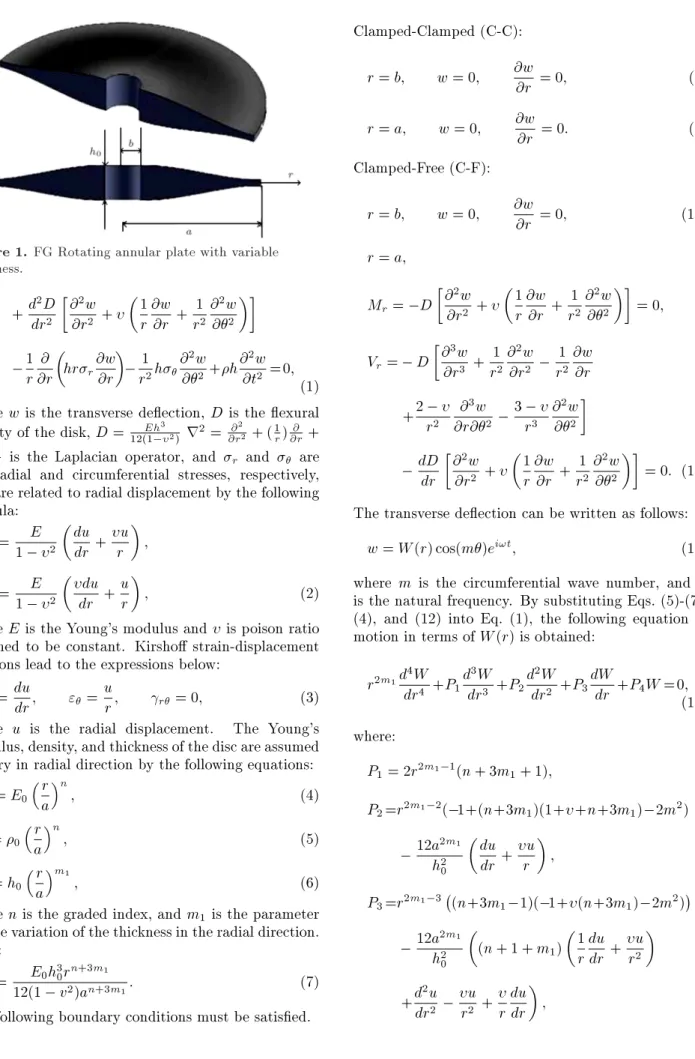
rotating with angular velocity, ~!, is shown in Figure 1. Thickness h can be variable in the radial direction.The equation of motion for transverse vibration of a ro-tating disc of variable thickness with variable material properties can be written as follows [25]:
Dr4w +dD
dr
2@r@ (r2w)
+1r
@@r2w2 +1r@w@r +r12@@2w2
Figure 1. FG Rotating annular plate with variable thickness.
+ddr2D2
@2w
@r2 +
1 r @w @r + 1 r2
@2w
@2 1 r @ @r hrr@w@r
1 r2h
@2w
@2+h
@2w
@t2 =0;
(1) where w is the transverse deection, D is the exural rigidity of the disk, D = Eh3
12(1 2) r2= @ 2
@r2 + (1r)@r@ +
1 r2 @
2
@2 is the Laplacian operator, and r and are
the radial and circumferential stresses, respectively, and are related to radial displacement by the following formula:
r= 1 E 2
du dr + u r ;
= 1 E 2
du dr + u r ; (2)
where E is the Young's modulus and is poison ratio assumed to be constant. Kirsho strain-displacement relations lead to the expressions below:
"r= dudr; "= ur; r= 0; (3)
where u is the radial displacement. The Young's modulus, density, and thickness of the disc are assumed to vary in radial direction by the following equations:
E = E0 ra
n
; (4)
= 0 ra
n
; (5)
h = h0 ra
m1
; (6)
where n is the graded index, and m1 is the parameter
for the variation of the thickness in the radial direction. Thus:
D = E0h30rn+3m1
12(1 v2)an+3m1: (7)
The following boundary conditions must be satised.
Clamped-Clamped (C-C):
r = b; w = 0; @w@r = 0; (8)
r = a; w = 0; @w
@r = 0: (9) Clamped-Free (C-F):
r = b; w = 0; @w@r = 0; (10)
r = a;
Mr= D
@2w
@r2 +
1 r @w @r + 1 r2
@2w
@2
= 0;
Vr= D
@3w
@r3 +
1 r2
@2w
@r2 1 r2 @w @r +2 r2
@3w
@r@2
3 r3
@2w
@2
dD dr
@2w
@r2 +
1 r @w @r + 1 r2
@2w
@2
= 0: (11)
The transverse deection can be written as follows: w = W (r) cos(m)ei!t; (12)
where m is the circumferential wave number, and ! is the natural frequency. By substituting Eqs. (5)-(7), (4), and (12) into Eq. (1), the following equation of motion in terms of W (r) is obtained:
r2m1d4W
dr4 +P1
d3W
dr3 +P2
d2W
dr2 +P3
dW
dr +P4W =0;(13)
where:
P1= 2r2m1 1(n + 3m1+ 1);
P2=r2m1 2( 1+(n+3m1)(1++n+3m1) 2m2)
12a2m1
h2 0 du dr + u r ;
P3=r2m1 3 (n+3m1 1)( 1+(n+3m1) 2m2)
12a2m1
h2 0
(n + 1 + m1)
1 r du dr + u r2
+ddr2u2 ur2 +rdudr
P4=r2m1 4(m4 m2(4 + (n + 3m1)( 3
+ (n + 3m1 1))))
+12m2a2m1 h2
0r2
du dr + u r
120(1 v2)a2m1
E0h20 ! 2:
(14) In addition, the boundary equations become:
Clamped-Clamped (C-C):
r = b; W = 0; dWdr = 0; (15)
r = a; W = 0; dW
dr = 0: (16) Clamped-Free (C-F):
r = b; W = 0; dWdr = 0; (17)
r = a; ddr2W2 + 1 r dW dr m2
r2 W
= 0;
d3W
dr3 +
1 + n + 3m1
r
d2W
dr2
+
1 m2(2 ) + (n + 3m 1) r2 dW dr +
m2(3 ) (n + 3m 1)m2
r2
W = 0:
(18) Introducing the following dimensionless parameters, the motion and boundary equations can be recast in a dimensionless form as follows:
R = ra; W = Wh
0; u =
u h0;
=!a2 h0
s
120(1 2)
E0 ;
~ = ~!ah2
0
s
120(1 2)
E0 : (19)
The dimensionless equation of motion is:
R2m1d4W
dR4 + P1
d3W
dR3+ P2
d2W
dR2+ P3
d W
dR+ P4W =0; (20)
in which:
P1= 2R2m1 1(n + 3m1+ 1);
P2=R2m1 2( 1+(n+3m1)(1++n+3m1) 2m2)
12a h0 du dR+ u R ;
P3=R2m1 3((n+3m1 1)( 1+(n+3m1) 2m2));
12a h0
(n + 1 + m1)
1 R du dR + R2u
+dRd2u2 Ru2 +RdRdu
;
P4=R2m1 4(m4 m2(4 + (n + 3m1)( 3
+ (n + 3m1 1)))) +12m 2a
h0R2
du dR + u R
2; (21)
and the dimensionless boundary equations are: Clamped-Clamped (C-C):
R = b=a; W = 0; d dRW = 0; (22)
R = 1; W = 0; d dRW = 0: (23) Clamped-Free (C-F):
R = b=a; W = 0; d dRW = 0; (24)
R = 1; ddR2W2 +
1 R
d W dR
m2
R2W
= 0;
d3W
dR3 +
1 + n + 3m1
R
d2W
dR2
+
1 m2(2 ) + (n + 3m1)
R2
d W
dR
+
m2(3 ) (n+3m 1)m2
R3
W =0: (25)
In order to solve the equation of motion (Eq. (20)) and obtaining the dimensionless natural frequency (!), the GDQ method is utilized.
3. Generalized Dierential Quadrature Method (GDQM)
In the numerical GDQ method, the solution domain is divided into points Ri (i = 1; 2; ; N) and derivatives of a function with the weighted summation of that function [22,23,26]. The GDQR expression for the
fourth-order boundary value dierential equation has been used as follows [23]:
W(S)(R
i) = d sW (R i)
dRs = N+2X
j=1
Eij(S)Uj;
i = 1; 2; ; N; (26) where:
fU1; U2; ; UN+2g=
n
W1; W1(1); W2; ; WN; WN(1)
o ; and Wj is the function value at point j, and W1(1) and
WN(1)are the rst-order derivatives of the dimensionless displacement function at the rst and Nth points [23]. Eij(S)are the Sth order Weighting coecients at points Ri. The GDQR explicit weighting coecients have
been derived in [22,23] and used directly in this paper. In order to discretize the solution interval, two discretization schemes (I and II) are used in this paper.
I) Equally spaced points;
II) Chebyshev-Gauss-Lobatlo discretization.
Ri= 1a
1 2
1 cos(i 1)N 1
(a b) + b
;
i = 1; 2; ; N: (27) Appling GDQM to Eq. (20), the GDQ form of the equation of motion can be obtained as follows:
HijUj= 2Wi; i = 2; 3; ; N 1; (28)
where is a (N)(N +2) matrix. The (N 2) equations are added by four boundary equations, and (N + 2) algebraic equations are constructed. An assembled form is constituted by arranging them [23]:
2
4[Sbb] [Sbd] [Sdb] [Sdd]
3 5Ub
Ud = 0 2U d ; (29) where:
Ub=
2 6 6 4 W1 W1(1)
WN
WN(1)
3 7 7
5 ; Ud=
2 6 4 W2 ... WN 1
3 7
5 : (30)
By matrix substructuring and manipulation, one ob-tains a standard eigenvalue problem [23]:
[S]Ud= 2Ud; (31)
where:
[S] = [Sdd] [Sdb] [Sbb] 1[Sbd] ;
with an order (N 2) (N 2).
The dimensionless natural frequency () can be obtained by solving the eigenvalue problem (Eq. (31)).
3.1. Application of boundary conditions in GDQM
The following boundary equations are the GDQ form of Eqs. (45) and (46) for (C-C) boundary conditions.
Clamped-Clamped (C-C):
W1= 0; U1= 0;
W1(1)= 0; U2= 0;
WN = 0; UN+1= 0;
WN(1)= 0; UN+2= 0: (32)
By separating the boundary and domain coecients in Eq. (28), we have:
Hi1U1+ Hi2U2+ HiN+1UN+1+ HiN+2UN+2
+XN
j=3
HijUj= 2Wi i = 2; ; N 1:
(33) Thus, the following submatrices are obtained:
Sbb= [I]44;
Sbd= [0]4N 2;
Sdb=Hi1 Hi2 HiN+1 HiN+2;
i = 2; ; N 1;
Sdd=Hij i=2; ; N 1; j =3; ; N: (34)
Therefore, S = Sdd and the eigenvalues of matrix
Sdd are the dimensionless natural frequencies of
(C-C) plate.
The following equations are the GDQ form of Eqs. (27) and (35) for (C-F) boundary conditions. Clamped- Free (C-F):
W1= 0; U1= 0;
W1(1)= 0; U2= 0; N+2X
j=1
ENj(2)Uj + RN
WN(1) m2 R2
N
WN = 0;
N+2X j=1
ENj(3)Uj+1 + n + 3mR 1 N
N+2X j=1
ENj(2)Uj
+
1 m2(2 v) + (n + 3m 1)
R2 N
WN(1)
+
m2(3 N) (n + 3m1)m2
R3 N
WN = 0:
Separating the boundary and domain coecients in Eq. (35) and in light of Eq. (33), the following submatrices are found:
Sbb=
2 6 6 4
1 0 0 0
0 1 0 0
EN1(2) EN2(2) ENN+1(2) m2
R2
N E
(2)
NN+2+RN
Sbb1 Sbb2 Sbb3 Sbb4
3 7 7 5 ;
where:
Sbb1 = EN(3)1 +
1 + n + 3m1
RN E (2) N1;
Sbb2 = EN(3)2 +
1 + n + 3m1
RN E (2) N2;
Sbb3 =ENN+1(3) +1 + n + 3mR 1
N E
(2) NN+1
+m2(3 ) (n + 3mR3 1)m2
N ;
Sbb4 =ENN+2(3) +1 + n + 3mR 1
N E
(2) NN+2
+ 1 m2(2 ) + (n + 3mR2 1)
N ; (36)
and: Sbd =
2 4[0]Sbd324
Sbd4
3
5 ; (37)
where Sbd3 = ENj(2) j = 3; ; N and Sbd4 = ENj(3)+ 1+n+3m1
RN E
(2)
Nj j = 3; ; N. In addition, Sdb and
Sdd are the same as Sdb and Sdd in (C-C) boundary
conditions. By obtaining the dimensionless natural frequency (), the natural frequency (!) can be calculated. The obtained natural frequency is the natural frequency in the rotating (non-inertial) co-ordinate system, attached to the rotating plate. For each rotating plate in the rotating coordinate system, there are two corresponding natural frequencies in the stationary (inertial) coordinate system. These natural frequencies are obtained as follows [13]:
!f = ! + m~!;
!b= ! m~!; (38)
where !f and !b are the forward and backward
natural frequencies, respectively. Whenever !b is
equal to zero, the critical speed might occur.
4. Results
Solving the eigenvalue problem of Eq. (31), the di-mensionless natural frequency can be obtained for dierent boundary conditions. The Young's modulus and density of the plate at the outer surface are
assumed to be 380 GPa and 3800 kg/m3, respectively,
and the poison ratio is assumed to be 0.3 and constant. The considered material properties are the same as those in [13] in order to validate our results compared to those in other papers in the literature.
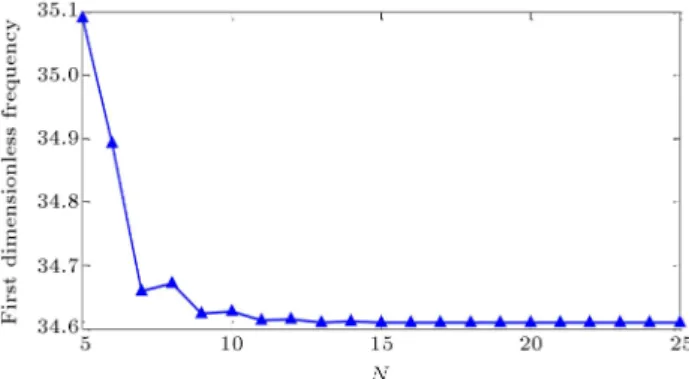
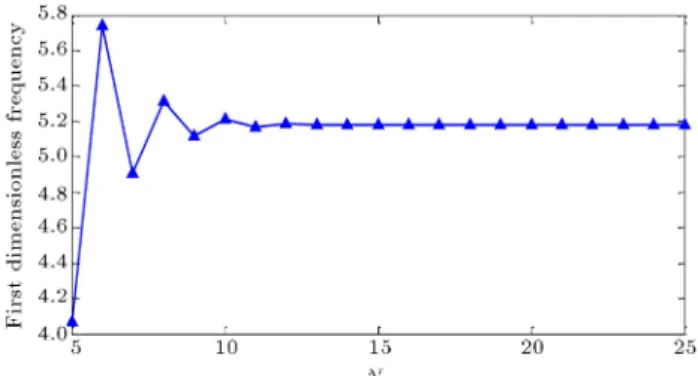
For the discretization of the plate in the radial direction, two discretization methods are used: First equally spaced discretization (I); second, using Eq. (27) (II). Figure 2 shows the convergence diagram for the rst dimensionless natural frequency using the rst discretization method (equally spaced) and for (C-C) boundary conditions. As can be seen from the gure, the results could not change appreciably if the number of discrete points (N) increases between 15 and 25. Figure 3 shows the same diagram, but for Chebyshev-Gauss-Labatlo discretization (Eq. (27)). Figures 4 and 5 show the convergence diagram for (C-F) boundary conditions. It can be seen from the gures that the convergence of the method in both discretization methods is guaranteed. It should be noted that in order to obtain the out-of-plane vibration, rst, the radial displacement should be calculated. In this paper, the radial displacement was rst obtained using a numerical method, and the results of that were used in order to obtain the out-of-plane vibration.
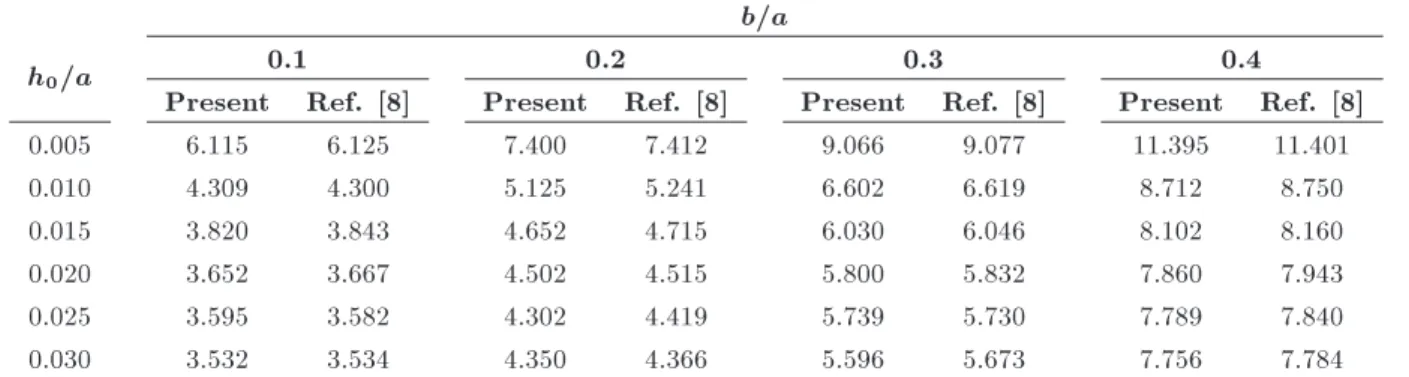
In order to validate our results, Table 1 compares the rst dimensionless natural frequencies obtained
Figure 2. Convergence diagram for (C-C) boundary condition (discretization method I).
Figure 3. Convergence diagram for (C-C) boundary condition (discretization method II).
Figure 4. Convergence diagram for (C-F) boundary condition (discretization method I).
Figure 5. Convergence diagram for (C-F) boundary condition (discretization method II).
from our study with those obtained in [13]. In this table, discretization scheme is equally spaced, rotating speed is assumed to be zero, and the disc is assumed to be homogenous (n = 0) with the (C-C) boundary
conditions. In Table 2, the same results are presented, but obtained from discretization II.
Tables 3 and 4 present the rst dimensionless natural frequency for (C-F) boundary conditions us-ing discretization I and discretization II, respectively. From Tables 1-4, we can conclude the convergence of the results, because the results are not aected sensibly by increasing (N) From 15 to 25. Also, it can validate our results, because there is good agreement between the present results and those obtained in [13]. In addition, in order to validate our results compared with those of rotating disks in the literature, the values of the rst dimensionless natural frequency of the rotating homogeneous disk with (C-F) boundary conditions are presented for various inner-to-outer radii rations; thickness-to-outer radius ratio is presented in Table 5. As seen, the increase of thickness-to-outer radius ratios decreases the dimensionless natural frequencies, but the increase of inner-to-outer radii ratio increases the dimensionless natural frequencies. As obvious, the results are in good agreement with those in [13].
Figure 6 shows the variation of the rst dimen-sionless natural frequency with the variation of the graded index for dierent thickness proles for plate with clamped edges. As can be seen, the increase in value of m1 from {1 to 1 leads to the decrease in the
value of the natural frequency. Figure 7 shows the same result, but for (C-F) boundary conditions.
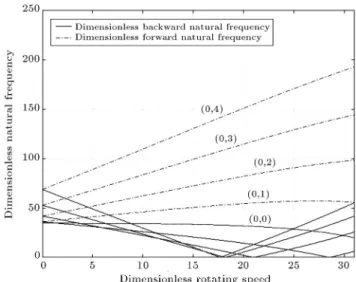
Figure 8 shows the variation of dimensionless forward and backward natural frequencies and that of the dimensionless rotating speed for a rotating uniform disk (m1 = 0) with clamped edges. In this gure
Table 1. The lowest dimensionless natural frequency against dierent numbers of nodal circles for plate with (C-C) edges (n = 0, m1 = 0, h0=a = 0:001, and b=a = 0:2) (discretization method I).
m 0 1 2 3 4 5
Present N = 15 34.609 36.203 41.822 52.619 68.360 87.907 Ref. [13] N = 15 34.609 36.104 41.821 53.389 70.256 90.854 Present N = 20 34.609 36.175 41.820 52.826 68.878 88.712 Ref. [13] N = 20 34.609 36.103 41.820 53.388 70.256 90.855 Present N = 25 34.609 36.160 41.819 52.946 69.175 89.172 Ref. [13] N = 25 34.609 36.103 41.820 53.388 70.256 90.854
Table 2. The lowest dimensionless natural frequency against dierent numbers of nodal circles for plate with (C-C) edges (n = 0, m1 = 0, h0=a = 0:001, and b=a = 0:2) (discretization method II).
m 0 1 2 3 4 5
Present N = 15 34.609 36.228 41.819 52.367 67.620 87.521 Ref. [13] N = 15 34.609 36.104 41.821 53.389 70.256 90.854 Present N = 20 34.609 36.194 41.819 52.650 68.350 88.770 Ref. [13] N = 20 34.609 36.103 41.820 53.388 70.256 90.855 Present N = 25 34.609 36.174 41.819 52.811 69.765 88.384 Ref. [13] N = 25 34.609 36.103 41.820 53.388 70.256 90.854
Table 3. The lowest dimensionless natural frequency against dierent numbers of nodal circles for plate with (C-F) edges (n = 0, m1= 0, h0=a = 0:001, and b=a = 0:2) (discretization method I).
m 0 1 2 3 4 5
Present N = 15 5.134 4.802 6.051 11.447 19.806 30.286 Ref. [13] N = 15 5.172 4.694 6.030 12.097 21.316 32.907 Present N = 20 5.185 4.939 6.502 12.099 20.551 31.115 Ref. [13] N = 20 5.215 4.822 6.360 12.417 21.535 33.029 Present N = 25 5.180 4.898 6.440 12.147 20.782 31.628 Ref. [13] N = 25 5.180 4.817 6.342 12.394 21.514 33.014
Table 4. The lowest dimensionless natural frequency against dierent numbers of nodal circles for plate with (C-F) edges (n = 0, m1= 0, h0=a = 0:001, and b=a = 0:2) (discretization method II).
m 0 1 2 3 4 5
Present N = 15 5.180 5.006 6.441 11.588 19.558 29.607 Ref. [13] N = 15 5.172 4.694 6.030 12.097 21.316 32.907 Present N = 20 5.181 4.959 6.447 11.861 20.316 30.661 Ref. [13] N = 20 5.125 4.822 6.360 12.417 21.535 33.029 Present N = 25 5.181 4.929 6.447 12.016 20.511 31.240 Ref. [13] N = 25 5.213 4.817 6.342 12.394 21.514 33.014
Table 5. The lowest dimensionless natural frequency versus dierent inner-to-outer radii ratios and dierent
thickness-to-outer radius ratios for the rotating functionally graded annular plate with clamped inner edge and free outer edge (m = 0, and ~! = 1000 rpm).
b=a
h0=a 0.1 0.2 0.3 0.4
Present Ref. [8] Present Ref. [8] Present Ref. [8] Present Ref. [8]
0.005 6.115 6.125 7.400 7.412 9.066 9.077 11.395 11.401
0.010 4.309 4.300 5.125 5.241 6.602 6.619 8.712 8.750
0.015 3.820 3.843 4.652 4.715 6.030 6.046 8.102 8.160
0.020 3.652 3.667 4.502 4.515 5.800 5.832 7.860 7.943
0.025 3.595 3.582 4.302 4.419 5.739 5.730 7.789 7.840
0.030 3.532 3.534 4.350 4.366 5.596 5.673 7.756 7.784
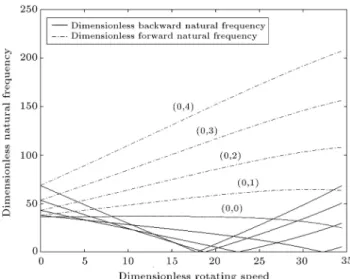
and also Figures 9-13, the mode shapes are denoted by (x; m) in which x indicates the number of nodal diameters and m indicates the number of nodal circles (excluding the boundary edges). It should be noted that all the results in the paper are based on zero nodal diameters. Figure 9 shows the same result for the plate with the inner edge clamped and outer edge free. As it was mentioned, whenever the backward natural frequency equals zero, the critical angular velocity occurs. Figure 10 shows the variation of the rst dimensionless natural frequency for a rotating disk of variable thickness with clamped edges, and Figure 11 shows the same result for the plates with the inner edge clamped and outer edge free. Figures 12 and 13 show the variation of the dimensionless natural frequencies of a rotating FG uniform disk with that of the dimension-less rotating speed with clamped edges and
clamped-free edges, respectively. The critical speed is recognized when the backward natural frequency goes to zero. At this speed, the disk has zero eective bending rigidity and cannot bear any transverse load.
From Figures 8-13, the critical speeds of the rotat-ing plate with the correspondrotat-ing material and thickness characteristics can be achieved. Table 6 presents the rst dimensionless critical speed of rotating FG uniform plate with dierent values of graded index. It can be
Table 6. First dimensionless critical speed of rotating FG plate with clamped edges (m1= 0, and b=a = 0:2).
m 1 2 3 4
n = 0 28.474 21.017 18.231 17.754 n = 1 33.120 22.771 18.878 18.018 n = 1 25.394 19.939 17.942 17.714
Figure 6. Fundamental natural frequency against graded index for (C-C) plate (b=a = 0:2, ho=a = 0:01, m = 0, and
~! = 0).
Figure 7. Fundamental natural frequency against graded index for (C-F) plate (b=a = 0:2, ho=a = 0:01, m = 0, and
~! = 0).
Figure 8. First dimensionless natural frequency as a function of dimensionless rotating speed for a rotating annular disk with clamped edges (n = 0 and m1= 0).
Figure 9. First dimensionless natural frequency as a function of dimensionless rotating speed for a rotating annular disk with clamped-free edges (n = 0 and m1= 0).
seen that the value of critical speed for n = 1 is larger than its value for n = 0 and n = 1.
In Table 7, the rst dimensionless critical speed of the rotating FG uniform plate with (C-F) boundary conditions is presented. It should be mentioned that the critical angular velocity for the wave number one (m = 1) for the plate with clamped-free edges is not
Table 7. First dimensionless critical speed of rotating FG plate with clamped-free edges (m1= 0 and b=a = 0:2).
m 2 3 4
n = 0 4.510 4.756 5.772 n = 1 6.505 5.630 6.344 n = 1 3.254 4.176 5.353
Figure 10. First dimensionless natural frequency as a function of dimensionless rotating speed for a rotating annular disk with clamped edges (n = 0 and m1= 0).
Figure 11. First dimensionless natural frequency as a function of dimensionless rotating speed for a rotating disk with clamped-free edges (n = 0 and m1= 0).
in the interval of the angular velocity considered in the analysis. The same results are also obtained in [13] for (m = 1).
In Table 8, the values of the rst dimension-less critical speed for dierent thickness proles and rotating homogenous plate with clamped edges are presented. Table 9 illustrates the same results, but for (C-F) boundary conditions. From Tables 8 and 9,
Table 8. First dimensionless critical speed of rotating plate with clamped edges (n = 0 and b=a = 0:2).
m 1 2 3 4
m1= 0 28.474 21.017 18.231 17.754
m1= 1 43.488 33.951 28.384 26.123
m1= 1 19.920 14.688 12.940 12.795
Figure 12. First dimensionless natural frequency as a function of dimensionless rotating speed for a rotating disk with clamped edges (n = 1 and m1= 0).
Figure 13. First dimensionless natural frequency as a function of dimensionless rotating speed for a rotating disk with clamped-free edges (n = 1 and m1= 0).
it can be concluded that by fabricating a plate with convergent thickness prole (m1 = 1), we can have
a higher critical speed; by fabricating a plate with a divergent thickness prole (m1 = 1), we can have
a lower critical speed. This conclusion can help to improve the design of rotating FG disk in order to avoid the resonance condition.
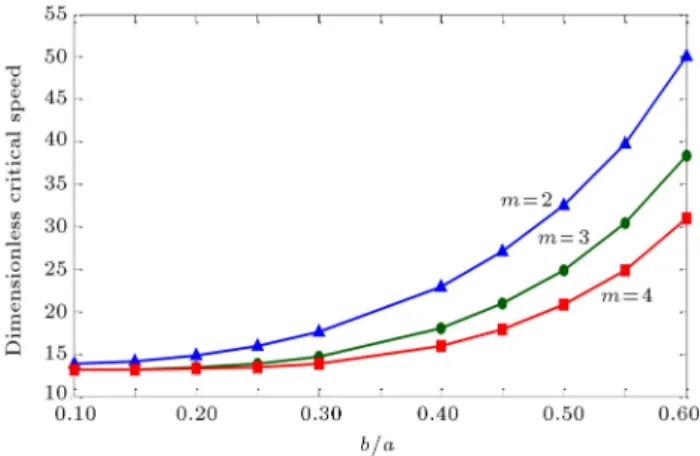
Figure 14 shows the graph of dimensionless
crit-Table 9. First dimensionless critical speed of rotating plate with (C-F) edges (n = 0 and b=a = 0:2).
m 2 3 4
m1 = 0 4.510 4.756 5.772
m1 = 1 18.055 10.243 9.447
Figure 14. Dimensionless critical speed versus inner-to-outer radius ratio for C-C boundary condition.
Figure 15. Dimensionless critical speed versus inner-to-outer radius ratio for C-C boundary condition.
ical speed versus the ratio of inner-to-outer radius for a FG plate with variable thickness and with clamped edges. Figure 15 shows the corresponding graph for a plate with the inner edge clamped and outer edge free. It can be seen that an increase in the inner-to-outer radii ratio could increase the critical speed. It suggests that we can have higher critical speed for the rotating annular disk if we design the annular disk with a bigger central hole with respect to the outer radius. It should be mentioned that the authors obtained their results for dierent values of m, n, and m1; the same
conclusion was derived.
5. Summary and conclusions
In this paper, free transverse vibration of rotating FG thin disc with variable thickness was studied. The thickness prole, elastic modulus, and density of the annular disk were considered to vary in the radial direction by a power function. The numerical generalized dierential quadrature method was used to solve the equations of motion, and the convergence of the method was proved for two types of discretization methods. The eects of material and geometric pa-rameters on the natural frequencies and critical speeds
of the rotating annular FG plate with C) and (C-F) boundary conditions were investigated, and the obtained results were compared with the available data from the literature; the results were validated. The obtained results can be used to improve the design of the rotating FG disk considering the avoidance of the resonance condition. It was shown that:
1. FG annular plate with a convergent thickness pro-le has higher critical speed than FG annular plate with uniform thickness prole, and FG annular plate with uniform thickness prole has higher crit-ical speed than FG annular plate with a divergent thickness prole. This conclusion can be used to improve the design of the rotating FG disks in order to increase or decrease the critical speed;
2. Using a convergent thickness prole can lead to higher natural frequency than using uniform and divergent thickness proles;
3. The increase in the ratio of inner-to-outer radius can lead to the increase in the critical speed of the rotating FG disk;
4. The increase of thickness-to-outer radius ratios decreases the dimensionless natural frequencies, but the increase of inner-to-outer radii ratio increases the dimensionless natural frequencies.
References
1. Sarra, A. and Mao, Z. \Statistical modeling of wavelet-transform-based features in structural health monitoring", In Model Validation and Uncertainty Quantication, 3, Springer, pp. 253-262 (2016). 2. Poozesh, P., Baqersad, J., Niezrecki, C., Avitabile, P.,
Harvey, E., and Yarala, R. \Large-area photogramme-try based testing of wind turbine blades", Mechanical Systems and Signal Processing, 86, pp. 98-115 (2017). 3. Niezrecki, C., Poozesh, P., Aizawa, K., and Heilmann, G. \Wind turbine blade health monitoring using acous-tic beamforming techniques", J. Acoust. Soc. Am., 135, pp. 2392-2393 (2014).
4. Sadeghi, H., Baghani, M., and Naghdabadi, R. \Strain gradient thermoelasticity of functionally graded cylin-ders", Scientia Iranica, Transactions B, Mechanical Engineering, 21, p. 1415 (2014).
5. Baghani, M. and Fereidoonnezhad, B. \Limit analysis of FGM circular plates subjected to arbitrary rota-tional symmetric loads using von-Mises yield crite-rion", Acta Mechanica, 224, p. 1601 (2013).
6. Lamb, H. and Southwell, R. \The vibrations of a spin-ning disk", Proceedings of the Royal Society of London Series A, Containing Papers of a Mathematical and Physical Character, 99, pp. 272-280 (1921).
7. Southwell, R. \On the free transverse vibrations of a uniform circular disc clamped at its centre; and on the eects of rotation", In Proceedings of the Royal Society
of London A: Mathematical, Physical and Engineering Sciences, The Royal Society, pp. 133-153 (1922). 8. Deshpande, M. and Mote, C. \In-plane vibrations
of a thin rotating disk", Journal of Vibration and Acoustics, 125, pp. 68-72 (2003).
9. Bauer, H.F. and Eidel, W. \Transverse vibration and stability of spinning circular plates of constant thickness and dierent boundary conditions", Journal of Sound and Vibration, 300, pp. 877-895 (2007). 10. Lee, H. and Ng, T. \Vibration and critical speeds of
a spinning annular disk of varying thickness", Journal of Sound and Vibration, 187, pp. 39-50 (1995). 11. Singh, B. and Saxena, V. \Axisymmetric vibration of
a circular plate with exponential thickness variation", Journal of Sound and Vibration, 192, pp. 35-42 (1996). 12. Taher, H.R.D., Omidi, M., Zadpoor, A., and Nikooyan, A. \Free vibration of circular and annular plates with variable thickness and dierent combinations of bound-ary conditions", Journal of Sound and Vibration, 296, pp. 1084-1092 (2006).
13. Davoodi Kermani, I., Mirdamadi, H., and Ghayour, M. \Nonlinear stability analysis of rotational dynamics and transversal vibrations of annular circular thin plates functionally graded in radial direction by dier-ential quadrature", Journal of Vibration and Control, 22, pp. 2482-2502 (2014).
14. Horgan, C. and Chan, A. \The stress response of functionally graded isotropic linearly elastic rotating disks", Journal of Elasticity, 55, pp. 219-230 (1999). 15. Nie, G. and Batra, R. \Stress analysis and material
tai-loring in isotropic linear thermoelastic incompressible functionally graded rotating disks of variable thick-ness", Composite Structures, 92, pp. 720-729 (2010). 16. Mohammadsalehi, M., Zargar, O., and Baghani, M.
\Study of non-uniform viscoelastic nanoplates vibra-tion based on nonlocal rst-order shear deformavibra-tion theory", Meccanica, 52 , pp. 1063-1077 (2017). 17. Asghari, M. and Ghafoori, E. \A three-dimensional
elasticity solution for functionally graded rotating disks", Composite Structures, 92, pp. 1092-1099 (2010).
18. Peng, X.-L. and Li, X.-F. \Elastic analysis of rotating functionally graded polar orthotropic disks", Interna-tional Journal of Mechanical Sciences, 60, pp. 84-91 (2012).
19. Bahaloo, H., Papadopolus, J., Ghosh, R., Mahdi, E., Vaziri, A., and Nayeb-Hashemi, H. \Transverse vibration and stability of a functionally graded ro-tating annular disk with a circumferential crack", International Journal of Mechanical Sciences, 113, pp. 26-35 (2016).
20. Khorasany, R.M. and Hutton, S.G. \An analytical study on the eect of rigid body translational degree of freedom on the vibration characteristics of elastically constrained rotating disks", International Journal of Mechanical Sciences, 52, pp. 1186-1192 (2010).
21. Guven, U. and Celik, A. \On transverse vibrations of functionally graded isotropic linearly elastic rotating solid disks", Mechanics Research Communications, 28, pp. 271-276 (2001).
22. Wu, T. and Liu, G. \A dierential quadrature as a numerical method to solve dierential equations", Computational Mechanics, 24, pp. 197-205 (1999). 23. Wu, T. and Liu, G. \The generalized dierential
quadrature rule for fourth-order dierential equa-tions", International Journal for Numerical Methods in Engineering, 50, pp. 1907-1929 (2001).
24. Shahriari, B., Jalali, M., and Karamooz Ravari, M. \Vibration analysis of a rotating variable thickness bladed disk for aircraft gas turbine engine using gen-eralized dierential quadrature method", Proceedings of the Institution of Mechanical Engineers, Part G: Journal of Aerospace Engineering, 231, pp. 2739-2749 (2017).
25. Irie, T., Yamada, G., and Kanda, R. \Free vibration of rotating non-uniform discs: Spline interpolation tech-nique calculations", Journal of Sound and Vibration, 66, pp. 13-23 (1979).
26. Shu, C., Dierential Quadrature and Its Application in Engineering, Springer Science & Business Media (2012).
Biographies
Mohammad Hadi Jalali received BSc and MSc degrees in Mechanical Engineering from Isfahan Uni-versity of Technology in 2011 and 2013, respectively. After the graduation, he performed some industrial and academic projects in the elds of rotor dynamics and structural dynamics. His research interests are rotor dynamics, experimental modal analysis, and vibrations in rotating machinery.
Behrooz Shahriari received BSc degree in Mechani-cal Engineering and MSc and PhD degrees in Aerospace Engineering from Malek-Ashtar University of Technol-ogy in 2002, 2012, and 2016, respectively. He has 13 years of experience in research and doing industrial and academic projects in the elds of aerospace structural design and analysis, gas turbines, and other aerospace propulsion systems. His research interests are turbo machinery structural design/test, optimization and aerospace engines design.
Omid Zargar received BSc and MSc degrees in Mechanical Engineering from Isfahan University of Technology and Tehran University in 2012 and 2015, respectively. After the graduation, he performed some academic projects in the elds of micro and nano vibration materials (MEMS and NEMS), biomechanics and harvesting energy. His research interests are vehicle concept modeling, MEMS, experimental modal
analysis, bio mechanics, and harvesting energy from piezoelectric materials.
Mostafa Baghani received his BS degree in Mechan-ical Engineering from University of Tehran, Iran in 2006, his MS and PhD degrees in Mechanical Engineer-ing from the Department of Mechanical EngineerEngineer-ing at Sharif University of Technology, Tehran, Iran in 2008 and 2012, respectively. He is now an Assistant Profes-sor in School of Mechanical Engineering, University of Tehran. His research interests include solid mechanics,
nonlinear nite-element method, and shape memory materials constitutive modeling.
Majid Baniassadi is working as an Assistant Pro-fessor in the Faculty of Mechanical Engineering at University of Tehran. He received his BSc degree from Isfahan University of Technology in 2004, his MSc from University of Tehran in 2006 and PhD from University of Strasbourg in 2011. His research interests are mainly in the area of micromechanics, nano-mechanics, and materials design.