Energy Efficient Routing Protocol for Mobile Wireless
Sensor Network
V.A.Amala Shiny
PG ScholarAdhiparasakthi Engineering College Melmaruvathur, Chennai.
ABSTRACT
In wireless sensor network, nodes are usually powered by batteries with limited amount of energy. This paper uses an Ad Hoc on Demand Multipath Routing Protocol for finding multiple paths to transfer the data from source node to destination node. The proposed work performed the energy efficient routing, when the sink node (base station) is in static state and all other neighbour nodes are in mobile state. Here gateway node acts as a relayfor transmitting data from one group of node to another group. The performance of Ad hoc on Demand Multipath Routing Protocol is compared with Ad Hoc on Demand Distance Vector Routing Protocol. The simulation result shows that the proposed energy efficient routing algorithm consumes low energy and gives high throughput.
General Terms
Ad Hoc on Demand Multipath Routing Protocol, Base station, Gateway node.
Keywords
Mobile Nodes, Energy, Sensor Network.
1.
INTRODUCTION
The mobile wireless sensor network have been applied in wide range of applications. It is used in the fields of Surveillance, Radiology, Chemical plants, Agriculture, security based applications, health monitoring systems and etc. The capacity of sensor node is very limited so it has brought many design challenges. Wireless Sensor Network (WSN) becomes more challenging when the sensor node as well as the base station is considered to be mobile. The sensor nodes are used batteries for power supply, so it has limited power, limited chip memory, limited processing capability, limited communication bandwidth etc. Wireless Sensor node has four main parts namely processing unit, sensor, transceiver, energy source unit [1]. Sensor nodes are very small in size which is used for monitoring purpose. The sensed data by the sensor node then perform some computations to extract the useful information.
Energy consumed by the sensor node is considerably reduced when the amount of transmitted data is small and the communication range decreases. Effective utilization of sources can reduce the required energy consumption. Therefore the lifetime of the sensor network is maximized [2].
V.Nagarajan
Head of the Department Adhiparasakthi Engineering CollegeMelmaruvathur, Chennai.
Deployment of sensor node is another important aspect in wireless sensor field. Efficient use of sensor node concerns not only the coverage but also the sensing performance.
When the node is active energy will gradually decrease. Node requires more energy when it is in mobile state [3].
The energy of the sensor node is powered by batteries. Link failure may happen when data transmitted. This is because of collision, death of node due to limited battery power supply, busy node and some other events. So itneeds to retransmit the data packets and thus causes more energy expenditure. When the sink node and its neighbourhood nodes are in mobile state it causes link failure due to the heavy data transmission. This research mainly focuses the simulation of static sink node, gateway node and all other nodes which are in moving state. When the sink node is very nearer to its neighbourhood nodes, the energy used to transmit the data is very less. When the neighbourhood node distance is increased from its base station then the relay node is used to transmit the data between the sink node and its neighbour nodes. Gateway node which acts as intermediate node between sink and all other nodes.
The rest of the paper organized as follows. In Section 2, a summary of different routing protocols are explained. In Section 3, the proposed work and the system model is described. In Section 4, simulation environment and results are explained. In Section 5, conclusion is discussed.
2.
RELATED WORK
In wireless sensor network, numbers of routing protocols are used. Hierarchical routing is preferred for effective utilization of energy in sensor nodes. Single gateway node is not suitable for covering large area since the sensors are not capable for wide area communication. The overload in single gateway node might cause communication latency and loss of information. Flooding and gossiping are the two mechanisms to transfer the data in sensor networks without the need of any routing algorithms [4].
LEACH (Low-Energy Adaptive Clustering Hierarchy) is a cluster based protocol. Each node chooses its own cluster. Group of nodes called clusters. Cluster head creates a TDMA (Time Division Multiple Access) schedule based on the number of nodes in the group. CDMA (Code Division Multiple Access) code is used for random communication inside the cluster. Cluster head election in LEACH is based on its threshold value. All the nodes are having same energy level so they may die at the same time. Cluster head compress the received data into single signal. LEACH is not suitable for large network areas [5].
to base station. The energy is distributed evenly among the sensor nodes present in the network field. According to PEGASIS, a node passes the data to its neighbour node, then the two nodes data are combined together and generate a single packet of data with same length and it transmits the data to its base station. It increases the life time of the node [5].PEG-Ant has better life time compared to the PEG-greedy algorithm [6].
TEEN (Threshold sensitive energy efficient sensor network protocol) is a type of hierarchical routing protocol. It is a reactive network which means it computes path on demand. It uses two types of threshold namely hard threshold and soft threshold. It is suitable for time sensing applications [7][4].
APTEEN (Adaptive Periodic Threshold Sensitive Energy Efficient Sensor Network) is a hybrid clustering-based routing protocol that allows the sensor to send their sensed data periodically and react to any sudden change in the value of the sensed attribute by reporting the corresponding values to their cluster heads. Adaptive periodic threshold sensitive energy efficient sensor network protocol has a complex logic system [8].
AODV (Ad Hoc on Demand Distance Vector Routing Protocol) is used in ad-hoc mobile networks. The routes are created only when the nodes need to send the data [9]. AODV protocol generates only one route from source to destination if any link failure occurs there is no multipath to send the data.
3.
PROPOSED WORK
This work compares AODV and AOMDV (Ad Hoc on Demand Multipath Routing Protocols) when the sink node is in static and all other nodes are in moving state. The system is divided into five batches. First batch contains 12 nodes, second batch contains 20 nodes, third batch contains 30 nodes, fourth batch contains 40 nodes and the fifth batch contains 50 nodes. For first batch the operation is performed when the sink node is static and all other nodes are in mobile and calculated the parameters such as energy, throughput, dropped packets, Packet delivery ratio and end-to-end delay. The same operation is performed for the other four batches and the parameters are calculated.
The AOMDV protocol provides multiple paths to destination node. AOMDV uses advertized hop-count to maintain multiple paths with the same destination sequence number. In AOMDV, upon the receipt of a routing request node initiates a node route table. The routing table entry of AOMDV is as follows: Destination IP address, destination sequence number, advertised hop-count,route list: {(next hop IP 1, hop-count 1), (next hop IP 2, hop-count 2),}, entry expiration time [10].
3.1
Protocol Description
The AOMDV protocol uses multipath transmission to send the data to destination. When one link fails to send the data then the data will reach the destination through other path. Advertised hop count is maintained for each node. Advertised hop count is defined as the maximum hop count in all the paths. Each node sends the route advertisement to its destination. The multiple transmission path advertisement received by a node indicates an alternative path to the destination. A Node only accepts an alternative path when it has a lower hop count than the advertised hop count for that destination. Sequence number will not be changed because of the usage of maximum count.
RREQ
RREQ
Fig 1: AOMDV Multiple Loop free reverse Path
Fig 1 Shows Multiple loop free reverse path. Route advertisement with larger sequence number for a destination needs reinitialization of advertised hop count list. AOMDV can be used to find separation of link. To find route separation, each node has duplicate RREQ (Routing Request). Each routing request contains a field called first hop which is used to represent the neighbour of the source taken by it. All the nodes are having the history of track list which contains the first hop information.
The destination node only gives response to routing requests coming from the unique neighbours. The path of each RREP (Routing Reply) may intersect at an intermediate node, but each takes a different reverse path to the source to ensure link separation. To obtain link separation paths in AOMDV, destination node can reply to multiple copies of a given RREQ, as long as they arrive via different neighbours.
3.2
System model
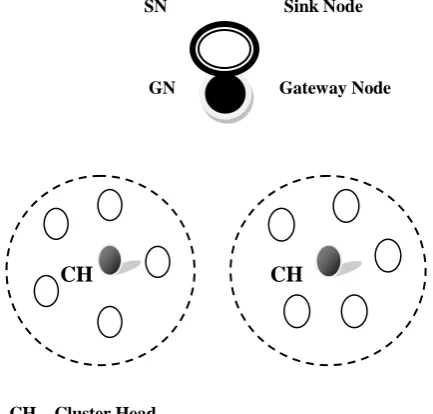
In this system, sink node and Gateway node are considered as static node while all other nodes are in moving state. Most of the data transformation and processing is held in sink node. If both sink and neighbour nodes are in mobile state then both will consume large amount of energy that may lead to chances of early node death. So the data forwarding phase nodes are divided into small groups which are called as cluster. Each cluster has a leader node called as cluster head which receives the data from the neighbour nodes then transmit the data to gateway node. Gateway node sends the data to sink node i.e., base station.
SN Sink Node
GN Gateway Node
[image:2.595.309.541.82.212.2]
CH – Cluster Head
Fig 2: Systems communication model
c
b
a
d
e
f
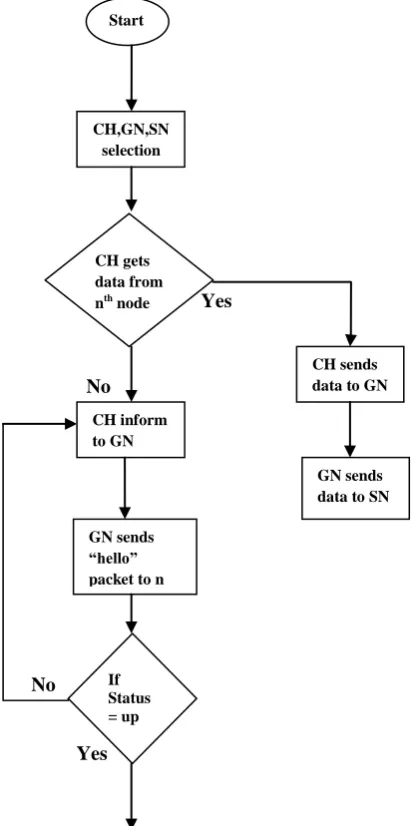
[image:2.595.311.528.533.740.2]Fig 2 represents the communication model for the proposed system. If cluster head did not receive the data from the nth node during the expected period of time then cluster head inform the message to gateway node with the missing nth node id. Gateway node send the hello message to the nth node if it gets response from nth node then it will send the location information to cluster head. Then the cluster head starts accepting the data from that node otherwise gate way node signals the cluster head to reassign the slot [11].
3.2.1
Data Transmission
Data generation occur in each node. After the generation of data it sends the data to its leader node. The system assumes that if any neighbour nodes move away from its radio propagation range then the node will lost the link among its neighbour nodes so it can not able to communicate with other nodes. If a node moves from the cluster to another group of nodes then it lost the communication of older cluster head and starts to send the data to the new cluster head node. The cluster head node forwards the collected data towards the gateway node inside the same cluster. Finally the gateway node is responsible for forwarding the data towards the sink either directly or indirectly via some other gateway node present in other clusters. Data transmission will not occur when the node losses its full energy. In my simulation model initially all the nodes are in green colour. During the execution nodes energy will gradually starts to decrease. After certain level the node colour will change to yellow which indicates that the energy level is very low. Once a node changes to red colour, it indicates that the node has failed due to lack of sufficient energy.
3.2.2
Setup Phase
During the setup phase sink node collects the information regarding other nodes location and the energy spent by each node. In this phase the nodes are separated as small groups. Each group consists of nine nodes. Before the data forwarding phase starts, the sensor network is organized and ensures it is ready for sensing the data and forwarding the information from node [12].
3.2.2.1
Intermediate node
Intermediate nodeis responsible for collecting the data from the neighbour nodes leader and then passes the data towards the base station. All the nodes in the network within the range of coverage area should be connected. If any node moves away from the coverage area then we could not able to communicate between the nodes. Intermediate node carries the element such as message type, node id, number of cluster head set and the advertised hop count. After the initial formation of nodes, cluster head identifies its neighbouring cluster heads and the appropriate path which connects them via the intermediate node. The duration for which a particular cluster set up may remain valid is known as cycle [13]. Intermediate node should have higher energy and lower mobility level. In this proposed system gateway node considered as a static node to reduce the higher energy dissipation of network.
3.2.2.2
Group Head Selection
The Base Station selects group leader nodes for each set of group. The reason for selecting cluster head nodes for each group is to reduce the complexity [14]. Another reason to consider cluster head nodes inside the same cluster is to
maintain connectivity inside the clusters in spite of the mobility of the nodes. The Base Station collects the location information from each node inside each cluster. The cluster head nodes are expected to remain within the coverage area and cluster head nodes are connected to the gateway node throughout a cycle. More than one cluster head can be used in a cluster which depends on the coverage ability of the node. Therefore all other nodes of the cluster will connect each other. In other words, it is expected that all sensor nodes in the cluster remain connected through direct links.
3.3.2.3 Routing Pattern
The sink node establishes the communication patterns for data forwarding to the neighbouring sensor nodes inside the clusters through the cluster heads [15] [13]. The cluster head node forwards the data from the neighbour nodes to gateway node. The Gateway node further forwards the data towards the Base Station. Fig 3 Show the flow chat for the data propagation for various nodes. If the Cluster Head „h‟ does not receive packets from a node n during the expected time slot for two consecutive times then h informs the gateway node. It has the id of the missing node, time slots during which packets are not received and location of the cluster head.
Yes
No
No
Yes
CH,GN,SN selection
CH gets data from nth node
CH sends data to GN
CH inform to GN
GN sends data to SN
GN sends “hello” packet to n
[image:3.595.300.507.355.769.2]Yes
[image:4.595.61.246.71.329.2]No
Fig 3: Flow chart for data propagation
4.
SIMULATION RESULTS
In this Section the simulation results of proposed system is compared with the existing system. In this paper, we make simulation using ns2 in the Linux (Ubuntu) environment.
Table 1. The Simulation Environment
Simulation Time 100ms
Size of data packets 512 bytes/sec Field Dimension 1000m x 1000m
Initial energy 200 J
CBR Interval 4 packets/sec
Nodes are randomly scattered around the network area. Two ray ground propagation model is used. The antenna used is Omni-directional antenna. The values of energy, throughput are extracted from the trace files. Traffic pattern consists of several CBR (Constant bit rate)/UDP (User defined protocol) connections between randomly chosen source-destination pairs. The performance metrics taken for evaluation is as follows.
Average energy consumption is the average of the total energy expenditure in the network system over a period of time. Throughput is a ratio between the actual numbers of packet transmitted by the nodes in the system to the numbers of successfully delivered packets at the sink. Average end-to-end delay of data packets is the average delay between the sending of the data packet by the source and its receipt at the corresponding receiver. Packet delivery ratio is the number of data packet delivered to multicast receivers over the number of data packets supposed to be delivered to multicast receivers.
Fig 4: Energy consumption
Fig 4 shows when number of nodes increases the energy consumption is lower in proposed system while compare with the existing system.
Fig 5 shows the graphical representation of Throughput with respect to number of nodes. Throughput is increasing when the network size is increased.
Fig 5: Throughput
Fig 6: Total dropped packets
Fig 7: Packet Delivery Ratio
GN computes radio range from CH & nth
node
Send data
Slot reassignment
If nthnode
is out of range
[image:4.595.319.522.76.211.2] [image:4.595.318.532.306.719.2] [image:4.595.72.262.436.506.2]Fig 8: Average End-to End Delay
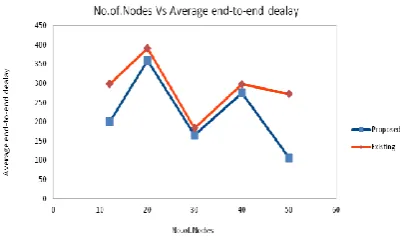
Fig 6, 7 and 8 shows total dropped packets, packet delivery ratio and average end-to-end delay. The dropped packet is less in proposed system and the packet delivery ratio is also high for proposed system.
Transmission range plays a very important role in deciding the amount of energy overhead needed for establishing connectivity among various nodes in the network. For large range of transmission leads to less hop count and there will be fewer breaks in the connectivity of the mobile nodes. AOMDV maintains connectivity even at high mobility due to multiple paths results less energy overhead for maintaining the network.
5.
CONCLUSION
The energy efficient based routing protocol was used to reduce the systems energy consumption. Static sink node avoids earlier node failure due to the heavy load than the mobile sink node. In order to reduce the energy consumption for data transmission from cluster heads to the base station, an energy efficient system model is developed using the protocol. This work conduct a multi-hop routing based on an optimal transmission range in terms of energy efficiency. Energy dissipation during data transmission can be reduced by using proposed model.
6.
REFERENCES
[1] Sunar ArifHussain and K.E. Srinivasa Murthy,”Efficient and Reliable Routing Protocol for Wireless Sensor Networks”, International Journal of Computer Science and Communication vol.2, No. 2, December 2011. [2] Khushboo Patel, Chaitali Patel, Syed S. Rizvi andElleithy,
K.M. 2007 An Efficient Approach to Reduce the Energy Consumption in wireless sensor networks through active nodes optimization. University of Bridgeport.
[3] Xue Wang and Sheng Wang, “Hierarchical Deployment Optimization for Wireless Sensor Networks”, IEEE Transactions on Mobile Computing Vol. 10, No. 7, July 2011.
[4] Kemal Akkaya and Mohamed Younis, “A Survey on Routing Protocols for Wireless Sensor Networks”, University of Maryland at Baltimore.
[5] Stephanie Lmdsey and Cauligi S. Raghavendra, ”PEGASIS:Power-Efficient Gathering in Sensor Information Systems” EEFAC p a p #242,sept 2001. [6] Wenjing Guo, Wei Zhang, Gang Lu,”PEGASIS Protocol
in Wireless Sensor Network Based on an Improved Ant Colony Algorithm”, Second International Workshop on Education Technology and Computer Science, Vol No 978, 2010.
[7] Manjeshwar and D.P. Agarwal, “TEEN: a RoutingProtocol for Enhanced Efficiency in Wireless Sensor Networks”, in Proc. of 1st Int‟l Workshop on Parallel and Distributed Computing Issues in Wireless Networks and Mobile Computing, April 2001, pp 2009-2015.
[8] Arati Manjeshwar and Dharma P. Agrawaly, APTEEN: A Hybrid Protocol for Efficient Routing and Comprehensive Information Retrieval in Wireless Sensor Networks” International Workshop on Parallel and Distributed Processing, Vole No 1530, 2002. [9] Georgy Sklyarenko,”AODV Routing Protocol”, Seminar
Technische Informatik Freie University at Berlin. [10] Xiaoqin Chen, Haley M. Jones, and Dhammika
Jayalath, ”Channel-Aware Routing in MANETs”, IEEE Transaction on Networking, Vol. 10, No. 1, January 2011.
[11] Muhammad Arshad, Naufal M. Saad, Nidal Kamel and Nasrullah Armi, ”Routing Strategies in Hierarchical Cluster Based Mobile Wireless Sensor Networks”, International Conference on Electrical, Control and Computer Engineering, June 2011.
[12] Miao Zhao, Ming Ma, and Yuanyuan Yang, “Efficient Data Gathering with Mobile Collectors and Space-Division Multiple Access Technique in Wireless Sensor Networks”, IEEE Transaction on Wireless Networks, Vol. 60, No. 3, March 2011.
[13] Hiren Kumar Deva Sarma, Avijit Kar and Rajib Mall, “Energy Efficient Routing Protocol for Wireless Sensor Networks with Node and Sink Mobility”, IEEE 2011. [14] Levente Buttyan and Tamas Holczer,”Private Cluster
Head Election in Wireless Sensor Networks” IEEE Transaction on Mobile Computing, Vol.14, No. 6, March 2009.
[15] Nidhi Batra, Anuj Jain, Surender Dhiman,”An Optimized Energy Efficient Routing Algorithm for Wireless Sensor Network” International Journal of Innovative
Technology and Creative Engineering Vol.1 No.5, May 2011
[image:5.595.62.266.75.199.2]