C
ITIZENP
ARTICIPATION IN THEP
LANNINGP
ROCESS:
A C
ASES
TUDY OF THES
TAPLETONR
EDEVELOPMENTP
ROJECTJennifer Valentine
EXECUTIVE SUMMARY
Early and consistent citizen involvement in the planning process helps ensure that a plan meets the needs of the community, creates a sense of ownership, enhances citizen buy-in and trust, educates the public, assists in avoiding confrontations by building consensus and anticipating public concerns, increases the likelihood of successful implementation, strengthens comprehensive plans, and improves overall satisfaction with the final product (Burby, 2003; Creighton, 2005). However,
despite the recognized merits of citizen participation in the planning process, in many cases planners either ignore public input or fail to adequately incorporate citizen concerns into final plans (King et al., 1998 & Lowry et al., 1997).
This research seeks to determine how planners can encourage meaningful citizen participation in the planning process, specifically for large public projects. A case study is used to examine the role of citizen involvement in planning the
redevelopment of the former Stapleton International Airport site in Denver, Colorado. The plan for Stapleton’s transformation from an airport to a mixed-use community was created with significant citizen input, with a continued
commitment to public involvement, and outreach throughout the site’s redevelopment.
Although some factors associated with the Stapleton project are fairly unique, this research affirms that early and consistent citizen involvement in the planning process can enhance public buy-in and overall satisfaction and reduce
implementation barriers. In this case, the impetus for participation was largely citizen-driven. Public involvement has been sustained as a result of committed individual citizens, supportive leadership, and the formation of durable citizen groups.
TABLE OF CONTENTS
I. INTRODUCTION ~ 5
A. THE PROBLEM B. RESEARCH QUESTION
II. CITIZEN PARTICIPATION RESEARCH ~ 7
A. JUSTIFICATION AND BENEFITS
B. ADVOCACY AND ENCOURAGING PARTICIPATION C. PUBLIC PARTICIPATION METHODS
D. PARTICIPATION IN LARGE PROJECTS E. MOTIVATION AND SCOPE
F. CHARACTERISTICS AND CRITERIA G. EVALUATION
III. RESEARCH DESIGN ~ 19
A. CASE SELECTION B. CRITERIA
C. DATA COLLECTION D. CAVEATS
IV. CASE STUDY ~ 22
A. CONTEXT ~ 22 DENVER HISTORY
DENVER TRENDS AND SOCIOECONOMICS
B. BACKGROUND ~ 25 STAPLETON AT A GLANCE STAPLETON’S ROOTS
SURROUNDING NEIGHBORHOODS
C. THE PLANNING PROCESS AND PUBLIC PARTICIPATION ~ 31 TIMING
INCLUSIVENESS FACILITATION EXPECTATIONS
CONFLICT RESOLUTION PUBLIC KNOWLEDGE
D. OUTCOMES ~ 36
IMPACT OF PUBLIC INVOLVEMENT
ONGOING PARTICIPATION
E. SUMMARY ~ 43
V. CONCLUSIONS AND RECOMMENDATIONS ~ 44
VI. REFERENCES ~ 46
I. INTRODUCTION
A. THE PROBLEM
Early and consistent citizen involvement in the planning process helps ensure that a plan meets the needs of the community, creates a sense of ownership, enhances citizen buy-in and trust, educates the public, assists in avoiding confrontations by building consensus and anticipating public concerns, increases the likelihood of successful implementation, strengthens comprehensive plans, and improves overall satisfaction with the final product (Burby, 2003; Creighton, 2005). However,
despite the recognized merits of citizen participation in the planning process, in many cases planners either ignore public input or fail to adequately incorporate citizen concerns into final plans (King et al., 1998 & Lowry et al., 1997).
Token participation and one-way flows of information are often far more common than meaningful involvement in the form of partnership, delegated power or citizen control. Arguments against more extensive public involvement schemes typically focus on the fact that creating and implementing such a program may add time and costs to the planning process; however, this initial investment is often offset by smoother interaction with the public throughout various stages of planning and ultimately uncomplicated and successful implementation (Brody et al., 2003).
The empty rituals of participation that are all too prevalent in the planning process are understandably frustrating for citizens affected by these plans and decisions; however, they also represent a significant loss for planners and society as a whole, as we are missing out on important opportunities to create better places that fulfill the needs and wants of the communities for which we are planning.
B. RESEARCH QUESTION
In order to capitalize upon these missed opportunities, planners must not only understand the importance of citizen participation in the planning process, but also be familiar with the most effective tools and processes for facilitating public involvement. By examining the various public involvement initiatives and tools used in planning the redevelopment of the former Stapleton International Airport into a mixed-use community, this research seeks to determine:
To what extent were planners and other officials able to encourage citizen participation in planning Stapleton’s redevelopment?
What methods and strategies were used to encourage meaningful public involvement in planning Stapleton’s redevelopment?
What special challenges and opportunities do large-scale redevelopment projects present for public participation?
What broader lessons can be learned from this case?
public officials think through which tools and processes may be most useful in designing a participation program.
More specifically, this research identifies a number of challenges and opportunities involved in encouraging public participation in large public projects. Despite the existence of some conditions that are relatively unique to Stapleton project, many of the types of issues encountered are common among large public projects of this type. Similarly, these types of projects often present similar opportunities;
II. CITIZEN PARTICIPATION RESEARCH
A brief review of key research related to public participation in the planning process follows. This review provides support for the importance of citizen
involvement, discusses the planner’s role as an advocate or facilitator, and reviews several key tools and methods used in public participation programs. Special emphasis is given to methods that are considered more effective and those that are especially relevant for large public projects.
A discussion of the importance of the motivation for and scope of citizen
involvement helps clarify what constitutes meaningful participation. Likewise, the next section outlines a number of characteristics common to effective programs – these attributes were used to craft the criteria used in examining this case.
A. JUSTIFICATION AND BENEFITS
Public participation is increasingly being viewed as an integral component of the planning process. Early and consistent citizen involvement helps ensure that a plan meets the needs of the community, creates a sense of ownership, enhances citizen buy-in and trust, educates the public, assists in avoiding confrontations by building consensus and anticipating public concerns, and increases the likelihood of successful implementation (Creighton, 2005; Burby, 2003). Research also shows that comprehensive plans are stronger when citizens are involved early and often in the planning process, and that there is usually greater satisfaction with the final product (Burby, 2003).
Some decisions are arguably best made by engineers, scientists or experts, namely those that are strictly technical in nature and involve minimal value judgments. However, in most cases the weighting of alternatives is driven by competing values, which should be decided by those who will be affected by the plan. In other words, “there is nothing about technical training that makes technical experts more qualified than others to make value choices” (Creighton, 2005, p.16).
Similarly, citizens possess important “ordinary knowledge” that can help planners understand local conditions and values that might not be apparent to an outsider (Innes, 1998). Seeking out citizen input can also illuminate the needs and desires of the community to ensure that facilities are well used and enjoyed (Gans, 1993).
Furthermore, the American Planning Association has created a code of ethics to guide the actions and decision of planning professionals. The first section of the American Institute of Certified Planners (AICP) Code of Ethics discusses the planner’s responsibility to the public. AICP asserts that citizen involvement is important for promoting a sense of fairness, as the public has a right to be informed about decisions that will affect their lives. AICP also stresses the
B. ADVOCACY AND ENCOURAGING PARTICIPATION
Given the importance of citizen input in the planning process and the difficulties involved in ensuring meaningful involvement, the planner may occasionally need to take the role of advocate. An important starting point of the advocacy role is ensuring that citizens are included, rather than excluded, from the planning process (Davidoff, 1965). Another component includes ensuring that citizens are informed and have multiple opportunities, as well as the ability to engage in meaningful participation. This role can be especially important when affected populations are low-income, minority or have relatively low educational
attainment. These groups are especially burdened by the potential demands of time and money required for participation, and may not be well equipped to grasp and respond to technical information. In such cases, planners may help facilitate a two-way exchange of information and reduce time and financial constraints
(Davidoff, 1965).
It is also important to keep in mind some general guidelines for facilitating participation. In a study of over 60 localities, Burby (2003) identifies several important points to consider for effective citizen participation, as well as a few specific techniques that may work well. He notes that it is generally important to focus on the following:
1. Objectives ~ to provide information and to listen; empower citizens by providing opportunities to influence decisions
2. Timing ~ early, continuous public involvement is ideal
3. Target Audience ~ seek participation from a range of stakeholders 4. Techniques ~ provide different opportunities for dialogue
5. Information ~ provide clear information, free of jargon and technical terms ~ Adapted from Burby, 2003
C. PUBLIC PARTICIPATION METHODS
There are a variety of methods that can be used to engage citizens in the planning process. These methods can be grouped by purpose, for example: outreach, information exchange, recommendations and agreement (EPA, 2005). Examples of each of these types of methods include, but are not limited to the following:
Outreach: ways to get information out to the public ~ websites, hotlines, newsletters, listserves, brochures, fact sheets, news releases, public meetings, briefings, public service announcements and open houses Information exchange: getting input from the public ~ workshops, focus groups, small public meetings, surveys, polls, question and answer sessions, roundtable discussions
Recommendation: methods to solicit citizen input ~ committees, citizen advisory groups, panels
Agreement: ways to facilitate agreements between stakeholders ~ settlements, mediation, negotiations, memoranda of understanding
Determining which methods and tools will be most effective in encouraging effective participation is a critical aspect of designing a program. The following approaches will be discussed subsequently (arguably, in most cases a combination of approaches is appropriate): advisory groups/committees, public opinion
surveys, workshops, and public meetings/hearings.
Advisory Groups/Committees
Advisory groups are typically comprised of citizens representing various interests, who will ultimately provide recommendations to an organization or entity;
however advisory committees sometimes include technical experts, namely when the decisions at hand are highly technical in nature. These groups can be
particularly effective because members become more informed about and involved in the issue – their input combines the best of both worlds: a citizen’s perspective and a more complete understanding of the situation.
Advisory groups provide an opportunity to cover large quantities of information and make decisions in an orderly fashion (Williams, 1983). Members of an advisory group have the opportunity to learn about and understand the concerns of other interested parties. They can serve as a communication link back to their constituencies, and may be better able to reach consensus than the larger public (Creighton, 2005). Advisory groups are one of the most commonly used forms of participation in large projects (Williams, 1983).
Representation, expectations, timeline and communication are the most important issues in establishing and implementing an effective advisory group.
Representation ~ ideally, the group should represent all stakeholder interests and values – this helps establish credibility and ensures maximum effectiveness. Often these groups must be somewhat large to ensure proper representation, typically ranging in size from 25 to 100 members (Williams, 1983).
Expectations ~ the role of the advisory group in the decision-making process should be clearly defined, as early in the process as possible (Creighton, 2005).
Timeline ~ the life of the advisory group and/or terms of the members should probably be limited, thus minimizing the chances that the group will become a new elite or will outlive its usefulness (Creighton, 2005). The appropriate lifespan of the committee will vary based on the project (Williams, 1983).
The level of formality in advisory groups varies, and typically influences the importance of defining membership (including a selection process), procedures and rules. Advisory group members can be chosen using several different methods:
1. A third party or group chooses members to balance interests ~ e.g. a local elected body, community leader, or consultant
2. Groups select their own representatives 3. Popular election
4. Supplement membership with volunteers ~ Adapted from Creighton, 2005
Procedural issues can be discussed during the first few advisory group meetings, or a draft of guidelines can be circulated and discussed before the initial meeting to avoid dampening enthusiasm. Typically, early meetings will be used to lay out objectives, establish an agenda and address operating procedures including: voting; attendance and member substitution policies; the formation of subcommittees or steering committees; confidentiality, observers and media
coverage; communication with constituencies; scheduling meetings, and recording minutes (Creighton, 2005). Initial meetings can also be used to educate members about the project and begin identifying issues and specific decisions that will need to be addressed.
Public Opinion Surveys
Public opinion surveys can be used to gauge public awareness, knowledge and attitudes surrounding an issue, or determine the relative importance of or interest in a project (Williams, 1983). Surveys can assess general community values or opinions surrounding a specific project.
These surveys are a versatile tool which can easily be adapted to cover different geographic areas, and are most useful when public reaction to a project is uncertain. Because mailed questionnaires take several months to conduct, telephone surveys are typically the favored survey approach. Regardless of the survey method, timing and the wording of survey questions are critical
considerations. Public opinion may vary significantly depending on the project stage, recent publicity or other events. Likewise, the phrasing of survey questions can greatly impact stated preferences. Finally, one must recognize that there are inevitable variations between individuals stated and revealed preferences – in other words, public opinions and reactions may change when a hypothetical project becomes a reality (Williams, 1983).
Workshops, Charrettes and Visioning
The National Charrette Institute (NCI) defines a charrette as “a collaborative
Charrettes can be used in a variety of situations to create or design a product, but these sessions are most commonly used in regional, comprehensive or master planning, housing developments, for buildings, and most fitting for this research, redevelopment projects (NCI, 2005). NCI in particular stresses the importance of continued feedback and community input even after the charrette is complete. Expanding on this concept, the institute outlines a three-stage dynamic planning process. The major stages of the process are research/education/preparation, which includes gathering information, involving stakeholders, working out logistics, and considering feasibility; holding the charrette, which can include a range of activities related to developing plans and alternatives, making
presentations, and visioning; and plan implementation, with special attention to refining the product, and maintaining information and relationships.
Some of the strategies the NCI asserts are important for successful community involvement mirror those identified in section B, including early involvement of all interested parties, and the importance of collaboration and feasibility
considerations. Other charrette-specific recommendations focus on compressing work sessions, communicating in short feedback loops, focusing on details as well as the big picture, monitoring progress to confirm outcomes, and holding the charrette near the site to enhance understanding/for convenient access (NCI, 2005).
Public Meetings/Hearings
Public hearings are a requirement of governmental planning at all levels, and often serve merely as a vehicle for reactionary participation towards the end of the planning process. Often these hearings are rather formal, with a presentation of the proposed project and recorded statements from interested citizens and groups. These meetings provide the public with an opportunity to question and challenge proposed projects, but can play out quite differently based upon the degree of information-sharing and public involvement earlier in the process. Public hearings can be rather heated when they represent the sole vehicle for public participation, attracting stakeholders and interest groups who feel threatened and powerless. However, “if public hearings are used only to publicize a decision to which citizen representatives have consistently contributed, then much value can be derived from the hearing process” (Williams, 1983).
Hearings can be made more effective with a prominent announcement to ensure adequate attendance and providing information in advance so participants come in with some knowledge and understanding of the project. However, the most important step towards creating successful public hearings is providing multiple opportunities for citizen input throughout the planning process, especially at key decision points (Williams, 1983).
roundtables and display areas can create a much better environment for exchanging information and ideas (Williams, 1983).
D. PARTICIPATION IN LARGE PUBLIC PROJECTS
Incorporating meaningful and significant public participation is generally a laudable goal for planning processes in general, but citizen input is particularly important when planning large public or semi-public projects. Several important factors must be considered when planning for citizen participation, including program design, participant selection and timing, and the appropriateness of an array of tools and strategies (Williams, 1983).
First, the design of the citizen participation program should be tailored to fit the needs of a project and its affected parties. The design should help surmount common barriers to effective participation including apathy, distrust, unfamiliarity with the project, negative past experiences, special interests, and the
real/opportunity costs involved. It should also consider who should participate, when their participation is appropriate, and how it can be made most effective. Both for logistical purposes and establishing credibility, the participation scheme should be designed and implemented as early in the process as possible. An important final consideration is deciding who will be in charge of coordinating citizen input. In many cases, an independent facilitator is best suited for this task – someone who is impartial and skilled in managing this type of endeavor
(Williams, 1983).
Participant selection is another important consideration in planning a citizen input scenario, and can be especially complicated when dealing with larger projects. When a project impacts a larger area, the group of affected stakeholders is consequently larger, and it becomes more difficult to involve an adequately representative group. One possible schedule for public participation follows:
Identify objectives of public participation in the process Identify information/information needed for/from the public Identify the source of this information
Identify points in the process where participation will be most valuable Evaluate methods/tools for public involvement
Select the most appropriate tools Develop a plan tied to methodology Implement the plan
Continually monitor and refine the plan ~ Adapted from Williams, 1983
E. MOTIVATION AND SCOPE
the project may use discreet investigations, surveys or polls to discover public opinion, and possibly even use these findings to guide decision-making. However, a behind-the-scenes approach has the potential to backfire, with a propensity to arouse suspicion or poorly predict the public’s response to the project as it becomes a reality (Williams, 1983). This type of approach typically is not regarded as meaningful participation – in other words, “participation does not mean mere consultation or review for the sake of appearance, nor does it mean token compliance with legal requirements…all affected and interested agencies and citizens are to be involved in defining the issues to be studied, [also known as] scoping (Williams, 1983).
To expand upon Williams’ thoughts, the scope of participation in the planning process is an equally important consideration. In a classic piece of planning literature, Sherry Arnstein (1969) describes an eight-tiered “Ladder of Citizen Participation.” The ladder begins with forms of non-participation and progresses upward towards complete citizen control and power. Specifically, the levels Arnstein identifies include:
1. Manipulation ~ citizens may be placed on “rubberstamp advisory
committees” or advisory boards in an attempt to educate them or engineer their support. This rung “signifies the distortion of participation into a public relations vehicle” by those in power (p. 218).
2. Therapy ~ the focus of this form of participation is curing participants of their “pathology” via group therapy instead of addressing the underlying causes or issues (p.218).
3. Informing ~ providing information is an important first step towards meaningful citizen participation, but the emphasis should not be on a one-way flow of information from officials to citizens. The process must also go beyond informing to bring about meaningful participation.
4. Consultation ~ soliciting citizens’ opinions is important, but there must also be some assurance that citizens concerns and ideas will be taken into consideration.
5. Placation ~ gives citizens some degree of influence through seats on a board or commission, although citizen representatives may be easily outvoted or unheard.
6. Partnership ~ at this level, power is actually redistributed – citizens and power holders share planning and decision-making responsibilities. Partnerships are most effective when citizen groups have adequate resources available.
7. Delegated Power ~ citizens have dominant decision-making authority and can assure accountability.
8. Citizen Control ~ citizen control = citizen power; increasingly demanded ~ Adapted from Arnstein, 1969
actually an extremely frustrating process for citizens, and points out the distinction between involving citizens in an empty ritual of participation and actually giving them real decision-making power (Arnstein, 1969).
More recent works reiterate Arnstein’s assertions about the importance of
meaningful citizen participation, stressing the importance of a two-way exchange of knowledge and recognizing the benefits of a commitment to openness
(Williams, 1983).
Similarly, the International Association for Public Participation (IAP2) has also developed a Public Participation Spectrum outlining increasing levels of public impact in a process.
The spectrum begins with inform – the only promise made to the public is keeping them informed. The goal is providing the public with the objective, balanced information they need to understand the problems, alternatives and solutions involved.
The next level is consult – in this scenario, decision-makers also promise to acknowledge citizen concerns and relay how their input influenced the final decision. The goal is simply to obtain public feedback on alternatives and decisions.
The middle of the spectrum is involve – the promise in this level of involvement is more significant: to ensure that citizen concerns are reflected in alternatives. The goal is working with the public throughout the process to understand and
consider their concerns.
The penultimate level is collaborate – decision-makers promise to look to the public for advice and ideas, and incorporate their suggestions into decisions whenever possible. The main goal of this level is forming a partnership with the public.
The final level of the spectrum is empower – decision-makers promise to
implement what the public decides. The final decision-making power rests in the hands of the public.
To summarize and reiterate, there is a critical distinction between token citizen participation and meaningful input and empowerment. Meaningful participation can only occur when some decision-making power is transferred to citizens, and power-holders are truly interested in a two-way flow of information and exchange of ideas. Providing citizens with the information they need is an important start, but not enough!
F. CHARACTERISTICS AND CRITERIA
1. Decision-makers use public participation to attain a mandate for action ~ in the planning arena, this characteristic might suggest that planners have gained approval from the affected population. In essence, planners are saying ‘we realize we are planning your community, so your input is needed and valued.’
2. The public participation process is integrated into the decision-making process ~ public participation should occur at appropriate times to solicit meaningful engagement and input from citizens.
3. The public is involved in all critical steps of the process ~ input should be solicited during problem definition, weighing alternatives, defining
evaluation criteria, and other important incremental steps in order for the final decision to be considered legitimate.
4. All affected stakeholders are targeted ~ ensures that all voices are heard. 5. Multiple techniques, aimed at different audiences, are used ~ helps facilitate
involvement for a range of participants. ~ Adapted from Creighton, 2005
While many locales have requirements for incorporating public participation into the planning process, citizens are often involved later in the process and play a reactionary role rather than being given the opportunity to propose ideas and goals for the future (Davidoff, 1965). Davidoff suggests that the relatively minor role often played by citizens and citizens’ organizations in the planning process is in part due to the enhanced role of government bureaucracies and a weakness of municipal political parties. He goes on to assert that “there is something very shameful to our society in the necessity to have organized ‘citizen participation.’ Such participation should be the norm in an enlightened democracy” (p. 286).
A number of values and criteria for fair, effective and inclusive public participation have also been identified in planning and public dispute resolution literature. Several points are mentioned in multiple sources, including:
Influence ~ public’s contribution should have a significant influence on decision
Representation ~ seek key stakeholders, facilitate participation
Resources ~ participants must have necessary information and resources Outcomes ~ inform participants how their input was used; clarity in decision-
making processes and outcomes
Other items of importance in creating or facilitating effective public participation schemes include:
Input ~ public should have a say in decisions that affect their lives Process ~ should communicate the interests and meet the needs of participants
Contribution ~ participants help define how they will contribute to the process
Early involvement ~ participants should be involved as early as possible Transparency ~ process should be open; inform affected populations Task definition ~ nature and scope of participation should be clearly defined
Cost-effectiveness ~ process should be cost-effective
~ Adapted from IAP2, 2003 and Frewer, Row, Marsh and Reynolds, 2001
Specific criteria used to evaluate the public participation programs examined in this research are presented in section III C.
G. EVALUATION
Evaluation of public participation can help determine whether the plan or process has been successful, what changes should be made to enhance participation during the rest of the process, and reveal lessons to improve future endeavors.
The first issue in any type of evaluation is defining the criteria for success, with a distinction between process criteria and outcome criteria. In terms of process criteria, a successful public participation program may be defined as one in which all voices were heard, everyone had a chance to participate, and the process was fair. However, when success is defined by outcome criteria, the end result is seen as more important than the actual process. The goal of such a program may be to reach agreement or influence a certain group – if this goal is not achieved the program is not seen as successful, regardless of proceedings.
Process criteria are often more easily planned and implemented. It is not unreasonable to hope that your public participation program will be seen as adequate, fair, open, visible and credible. However, in many cases, reaching consensus (an outcome criterion) is probably not the most realistic goal (Creighton, 2005).
Evaluation Approaches
Public participation programs can be evaluated based on measures and objectives generated by stakeholders, best practices, or social goals. Although the most appropriate approach will vary based by situation, any evaluation scheme will have the benefit of prompting upfront discussions about how affected parties define successful processes or outcomes.
Using stakeholder-generated goals to evaluate a public participation program necessitates thinking and planning ahead – key representatives are asked identify their goals, objectives and criteria for success before the process even begins. After each major activity, participants complete questionnaires, with a final round of interviews when the process is over. This approach has the added benefit of helping stakeholders clarify their objectives and goals from the outset, and arguably improves the quality of participation (Rosener, 1983). This method is appropriate if stakeholder reactions are a critical consideration. The major
outcome-based criteria, and therefore may not provide clear direction and lessons for future projects (Creighton, 2005).
Evaluation can also be based on best practices – this represents a process-oriented approach. One example of a set of best practices is the toolkit developed by Frewer et al. (2001). The authors identify nine criteria for evaluation, which are categorized as acceptance or process criteria:
Acceptance Criteria
Representativeness ~ all key stakeholder groups should be represented
Independence ~ the process should be unbiased
Early involvement ~ participants should be involved as early as possible
Influence ~ citizen input should have a significant influence on policy
Transparency ~ process should be open; inform affected populations
Process Criteria
Resource accessibility ~ make necessary resources available to participants
Task definition ~ nature and scope of participation should be clearly
defined
Structured decision making ~ provide mechanisms for structuring and
displaying the decision-making processes and outcomes
Cost-effectiveness ~ process should be cost-effective
~ Adapted from Frewer, Row, Marsh and Reynolds, 2001
The International Association for Public Participation (IAP2) has also identified a set of core values for public participation processes. Several of these values coincide with criteria identified by Frewer et al.
The IAP2 Core Values for the Practice of Public Participation include:
The public should have a say in decisions that affect their lives
Includes the promise that the public’s contribution will influence the
decision
Process communicates the interests and meets the needs of participants
Process seeks out and facilitates the involvement of those affected
Participants help define how they will contribute to the process
Participants are given the information they need to participate meaningfully
The process informs participants how their input affected the final decision
Although these lists represent an important set of goals, not all identified criteria are useful in every situation, and the fulfillment of these stipulations does not guarantee a successful outcome. Again, the main distinction here is whether success is defined based on the process or the outcome. Even with a successful process, intervening factors such as an unforeseen political event or a firmly divided, antagonistic public can produce an undesirable outcome (Creighton, 2005).
Alternately, evaluation can be conducted using social goals as a benchmark – this approach focuses on program outcomes. Possible social goals to consider include:
Incorporating public values into decision-making
Improving the quality of decisions and decision-making
Reducing or resolving conflict among opposing interests
Building institutional trust and relationships
Informing and educating the public
~ Adapted from Beierle and Cayford, 2002
These are well-accepted goals of public participation in general; however, the information from a social goals evaluation may have limited usefulness in guiding future efforts.
Evaluation of public participation programs and activities is typically carried out via interviews, questionnaires and/or observation. Specific evaluation tools
III. RESEARCH DESIGN
This research was carried out using a case study design to examine and evaluate the methods by which citizen participation has been encouraged and facilitated in the redevelopment of the Stapleton International Airport. A discussion of the rationale for selecting this case, data sources, criteria, and limitations of this research follows.
A. CASE SELECTION
The Stapleton redevelopment project was selected for this research as an example of a case with a relatively inclusive and effective public participation scheme. Stapleton represents a bottom-up pattern of citizen participation – shortly after hearing of the city’s plans to close Stapleton International Airport in 1985, residents in surrounding neighborhoods mobilized to begin discussing and planning the site’s redevelopment. The city “bent over backwards to ensure that residents would have a say in what happened to the old airfield…[and held] scores of public meetings” (Van De Voorde, 1997, p. 2).
The Stapleton Redevelopment Foundation, a non-profit organization intended to act as a civic vehicle to work with the city administration, was formed in 1990, after the citizen-created Stapleton Development Plan had been adopted by the city council. Forest City Inc., Stapleton’s master developer, is being held accountable for complying with the design standards set out in the Stapleton Development Plan. The developer must also comply with performance and community participation standards described in the purchase agreement.
B. CRITERIA
Previous research has identified a number critical components or attributes of successful citizen participation programs. The following criteria, based on the literature, are used to evaluate the case study investigated in this research.
PROCESS CRITERIA
1. Were conflicts aired and resolved during the process?
2. Did decision-makers receive an accurate portrayal of public opinion – initially and throughout the planning process?
3. Were all interested parties invited and encouraged to participate in the planning process?
4. Were key stakeholders/publics identified and contacted early in the planning process?
5. Were participants given the opportunity to shape their involvement in the process?
6. Were clear roles and responsibilities laid out for participants?
8. Were involved citizens given adequate resources for effective participation (e.g. staff, information, funding)
9. Was citizen participation facilitated and made convenient?
OUTCOME CRITERIA
1. Did the program meet legal requirements for citizen involvement? 2. Is/was there widespread support for the final plan?
3. Is/was there widespread support for the final project, of what has been constructed to date?
4. Did citizen participation increase levels of public knowledge about the project?
5. Do the final plan and project meet the stated goals and objectives? 6. To what extent was citizen input incorporated into plans and decisions? 7. Were participants’ expectations met (in terms of their influence on the
planning process)?
8. Did participants influence the planning process, decisions and final plan? How?
9. Did targeted or affected stakeholders/publics participate in the process? What could have been done to bolster participation?
10. Were participants informed about project outcomes and their influence?
C. DATA COLLECTION
A significant amount of information about events and processes related to the Stapleton redevelopment project is available from secondary data sources. The project’s website presents a detailed timeline of major events, key actors in the planning and redevelopment processes, significant news and awards, and the status of different phases of development.
Newspaper and magazine articles, newsletters, and the websites of related entities (e.g. the developer, city/county, redevelopment agencies and citizen groups) helped fill in a number of details, such as issues and conflicts arising during planning and development, the role of specific organizations and who was involved, and the public’s reaction at different stages of the process.
Interviews represent the final and most detailed layer of information to inform the evaluation of this case. Dialogues with individuals involved in the planning process were useful to more accurately determine the extent of and impetus for citizen involvement, participation program goals and procedures, tools and
strategies used, and the dynamics of meetings and interaction between participants and decision-makers.
D. CAVEATS
conducted. The distance, combined with resource constraints, limited the feasibility of multiple site visits and in-person interviews.
Time was also problematic in the sense that the major planning efforts for
Stapleton’s redevelopment occurred over 15 years ago. To gain the most complete picture of the planning process, it would be helpful to interview members of the Stapleton Tomorrow committee or individuals in city/county planning positions between 1985 and 1995. Unfortunately, most of these actors were no longer in their original positions; therefore any available contact information was no longer valid. A number of other key stakeholders were unresponsive. Most of the individuals interviewed have played a more significant role in more recent planning and development efforts, and had a limited perspective.
Limits on time and resources necessitated limiting the research to a single case study. Future endeavors should consider examining a number of cases or using a comparative case study research design that may be more informative and produce results than can be better generalized to locations outside the study area.
IV. CASE STUDY
A. CONTEXT
DENVER’S HISTORY
Denver, Colorado was established on November 22, 1858, by a group of
prospectors, following William Greeneberry Russell’s gold discovery earlier that year. The town was named after James W. Denver, Governor of the Kansas Territory. The Federal Government did not formally establish the Colorado territory until further gold discoveries spurred a huge influx of about 100,000 people to Colorado between 1858 and 1860.
The Colorado gold rush fueled Denver’s rapid growth in the late 19th century. This growth was facilitated by the construction of a railroad network that made Denver the banking, minting, supply and processing center for Colorado and nearby states. Largely as a result of the railroad construction, Denver’s population grew from 4,759 in 1870 to 106,713 in 1890, when it emerged as the second largest city in the West (Noel, 1997).
Denver was originally founded as a supply town for the Rocky Mountain mining camps, but soon became a regional agricultural center and manufacturing hub for ranch and farm equipment. Denver’s growth was stunted by the depression of 1893 and the repeal of the Sherman Silver Purchase Act, which had required the Federal Government to purchase more silver, and increased the amount of money in circulation, and public officials began encouraging economic diversity. After 1900, Denver’s growth slowly resumed, thanks to the emergence of brickyards, stockyards, canneries, leather, rubber goods and breweries (Noel, 1997).
World War II mobilization prompted the construction of Lowry Airfied, Fitzsimons Army Medical Center and the Rocky Mountain Arsenal (SDP). Denver’s post-World War II growth was mainly sparked by oil and gas firms’ decisions to locate their headquarters in the city. During the 1970s energy boom, the first high-rise buildings sprang up in downtown Denver, as well as suburban subdivisions, shopping malls and a secondary office core in the Denver Tech Center. However, the area’s dependence on crude oil caused major problems during the 1980’s oil bust and Denver fell into a major depression, experiencing population loss and the highest office vacancy rates in the country (Noel, 1997).
DENVER TRENDS AND SOCIOECONOMICS
Redevelopment
The total land area of Denver (the city and county are defined with the same border) is 154.63 square miles, or 98,963 acres. The site of the Stapleton
Redevelopment project covers 4,700 acres, which translates to nearly 5 percent of the city’s total land area (see images below to locate Denver in the context of the State of Colorado, and Stapleton in relation to Downtown Denver and the Denver International Airport).
Sources: Stapleton Website and Colorado County Map
In addition to Stapleton, four other major redevelopment projects are underway in and around Denver, including Gateway (4,416 acres), Lowry (1,866 acres), Central Platte Valley (1,100 acres), and Fitzsimons (578 acres). These five projects in combination total about 12,660 acres, or nearly 13 percent of the city’s total land area, that is involved in a major redevelopment project (Denver Facts).
Population and Race
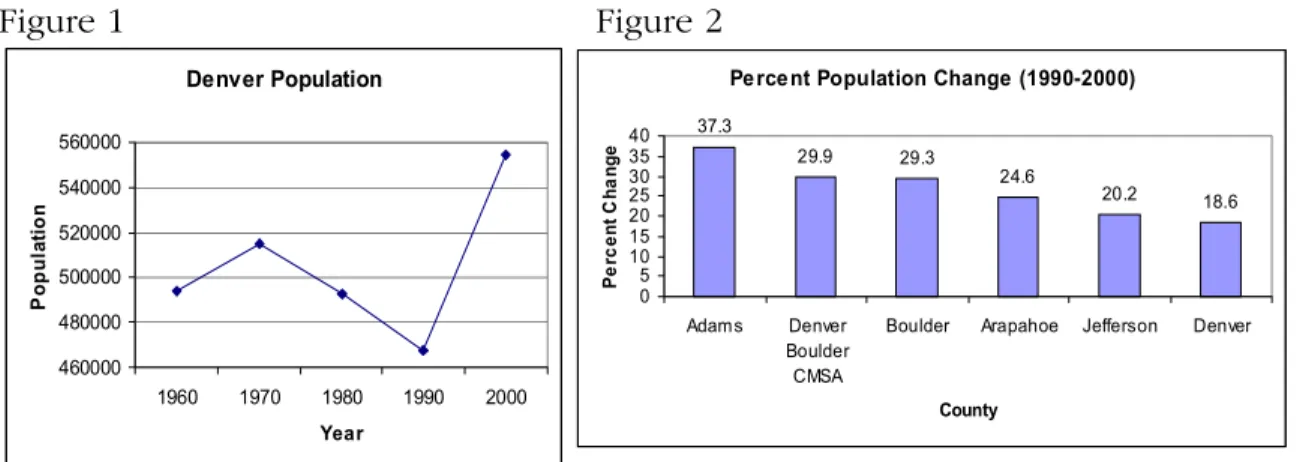
Between 1960 and 2000, the population of Denver grew by 12 percent; however this aggregate statistic hides the periods of growth and decline the city
experienced during these four decades (see Figures 1 and 2 below). The city experienced moderate growth in the 1960s, with a population increase of about 4 percent. But between 1970 and 1990 Denver lost just over 10 percent of its population.
The city rebounded at the end of the 20th
century and saw a striking growth rate of 19 percent between 1990 and 2000. However this growth rate is actually quite low compared to other counties in the Denver-Boulder CMSA that experienced
Figure 1 Figure 2
Again, comparing Denver with other counties in the Denver-Boulder CMSA brings to light some significant differences. Most strikingly, Denver has a much higher percentage of African American, American Indian and Hispanic populations than other counties in the CMSA. In 2000, the population percentages by race were as follows: 65.3 percent white, 11.1 percent African American, 1.3 percent American Indian, 2.8 percent Asian, and 19.5 percent other. Nearly one-third of the
population identified themselves as Hispanic, alone or in combination with other races (Denver Facts).
Other Indicators
In Denver, households are almost evenly divided between family and individual households (at 49.9 and 50.1 percent, respectively); however these statistics represent an interesting change over the past two decades towards a less family-oriented city. In 1980, 56 percent of households were classified as family
households with the remaining 44 percent individual households (Denver Facts).
Denver has actually seen a decline in its population’s overall educational attainment in the past decade, with 78.5 percent of the population having completed high school as of 2000 (down from 79.2 percent in 1990). However, the percentage of residents with a college degree increased from 29 percent in 1990 to 35 percent in 2000. As of 2000, Denver’s median household income was $39,500, with 11 percent of families below the poverty level, down from 13 percent in 1990 (Denver Facts).
In 2001, there were 468,392 jobs in Denver, representing exactly one third of the metro area’s employment. Unemployment rates fell between 1980 and 2000 (from 5.0 to 3.8 percent) but were back up to 4.5 percent by 2002 (Denver Facts). The average value of an owner-occupied housing unit in Denver in 2000 was $170,943. Just below 5 percent of units were vacant, 50 percent were owner-occupied, and the remaining 45 percent were renter-occupied. The average rent in the city was $605/month in 2000 (Denver Facts).
B. BACKGROUND
STAPLETON AT A GLANCE Denver Population 460000 480000 500000 520000 540000 560000
1960 1970 1980 1990 2000 Year P o pu la ti on
Percent Population Change (1990-2000)
37.3 29.9 29.3 24.6 20.2 18.6 0 5 10 15 20 25 30 35 40 Adams Denver Boulder CMSA
Boulder Arapahoe Jefferson Denver
Throughout the years, the Stapleton site has played a significant role in Denver’s history – emerging as a promising municipal airport in the late 1920’s, growing into a bustling international airport in the 1950’s and 1960’s, and most recently, undergoing a major transformation into the nation’s largest redevelopment project. The timeline below presents many of the major events in Stapleton’s history over the past 85 years.
TIMELINE
1920’s ~ Mayor Stapleton advocates for the construction of an airport; the site is selected
1928 ~ Denver City Council approves the purchase of the 640-acre plot of land for the Denver Municipal Airport
1929 ~ Construction of Denver Municipal Airport complete; airport opens
1931 ~ Amelia Erhart visits the airport
1938 ~ Airport’s first control tower opens
1944 ~ Facility is renamed Stapleton Airfield to recognize Mayor Stapleton
1950’s ~ Air traffic increases significantly, Stapleton acquires additional land from the Rocky Mountain Arsenal for expansion
1964 ~ Facility is officially renamed Stapleton International Airport
1980’s ~ Tension between Stapleton and surrounding neighborhoods mounts with increasing air traffic and expansion
1985 ~ Airport has grown to 4,700 acres
1987 – 1989 ~ Voters approve the annexation of a parcel of land in Adams County to the City and County of Denver for the proposed Denver International Airport, and endorse the plan in the 1989 election
1989 ~ Stapleton Tomorrow Committee is formed, decision to build Denver International Airport is finalized
1990 ~ Stapleton Development Foundation is formed
1991 ~ Stapleton Tomorrow finishes a concept plan for Stapleton’s redevelopment; this plan is adopted as a component of the Denver Comprehensive Plan
agreement with the City and County of Denver to provide funding and guidance for redevelopment planning and programs for the Stapleton site
1995 ~ Stapleton International Airport Closes
1996 ~ The Stapleton Development Corporation is formed, and begins working through the Stapleton Development Foundation’s plan; SDC puts out a request for proposals for early projects
1997 ~ Rezoning plan is approved (to change the site’s zoning from airport to mixed-use)
1999 ~ Forest City, Inc. is selected as the site’s master developer
2000 ~ The Stapleton Foundation for Sustainable Urban Communities is officially created (formerly the Stapleton Development Foundation)
2001 ~ Forest City purchases land from the city and the first construction of Stapleton redevelopment project begins; Stapleton parks plan announced
2002 ~ Stapleton visitor’s center, model homes, and Quebec Square Regional Retail Center open; first residents move in; construction begins on East 29th Avenue Town Center, Botanica on the Green Apartments and affordable senior housing
2003 ~ Anchors open at East 29th Avenue Town Center; Stapleton's first elementary school opens; Forest City moves to new offices in East 29th Avenue Town Center; Active Living Partnership at Stapleton receives grant from RWJF to promote active lifestyles
2004 ~ First apartment residents move in; first high school opens; construction begins on Northfield at Stapleton retail center and Denver School of Science and Technology; Forest City Stapleton receives Environmental Achievement Award
2005 ~ Forest City Stapleton receives Best in America Living Award; Stapleton receives the DRGOC Metro Vision Award; Northfield anchor opens
STAPLETON’S ROOTS
Upon its completion in 1929, the Denver Municipal Airport was considered the most modern facility in the country and was seen as a way to ensure Denver’s growth and prosperity in the future. The airport was an instant success, attracting a high-profile visit from Amelia Erhart in 1931 and boasting the opening of its first control tower in 1938. In August of 1944 the facility was renamed Stapleton Airfield to recognize the efforts of Mayor Stapleton in making it one of the best and most widely used airports in the nation. However, the facility was not officially renamed until 1964 when it was coined Stapleton International Airport (Stapleton History).
By the late 1950s, air traffic had increased significantly, and the airport felt the need to expand its runways and facilities. Denver acquired additional land from the Rocky Mountain Arsenal, and by 1985 the airport had grown to cover 4,700 acres. Concurrently, Denver neighborhoods were spreading eastward towards the airport, setting the stage for problems and complaints as air traffic increased in the 1970s and 1980s. The decision to seek out a location for a new airport was fueled by Stapleton’s inability to accommodate growth due to limited runway space and separation, a lawsuit from nearby residents over noise complaints, and threats from nearby Adams County to block further airport expansion (Stapleton History).
Early in 1985, representatives from Denver and Adams County announced their agreement to relocate commercial airline operations to a new site northeast of Stapleton. Two years later the Colorado General Assembly gave Adams County voters the authority to determine whether a 35,500-acre parcel of land could be annexed to Denver as the site of the new airport. Adams County voters approved the annexation in 1988 and Denver voters supported the plan in the May 1989 election (Stapleton History).
SURROUNDING NEIGHBORHOODS
The characteristics and composition of the neighborhoods surrounding the Stapleton site are a critical consideration for this research, as these residents have been intricately involved in the redevelopment process over the past twenty years.
Forest City Spokesman Tom Gleason noted that one of the major goals of the project is creating a “seamless connection” between Stapleton and surrounding areas and gradually dissolving barriers, both physical and social. The aim is to extend both the grid street network and the character of adjacent neighborhoods (Gleason interview).
The surrounding neighborhoods include Northeast Park Hill, North Park Hill, East Montclair, Original Aurora and Montbello. Although it would be interesting to compare the demographics of Stapleton to those of the surrounding
neighborhoods, the Stapleton Foundation does not yet have complete demographic information for Stapleton residents.
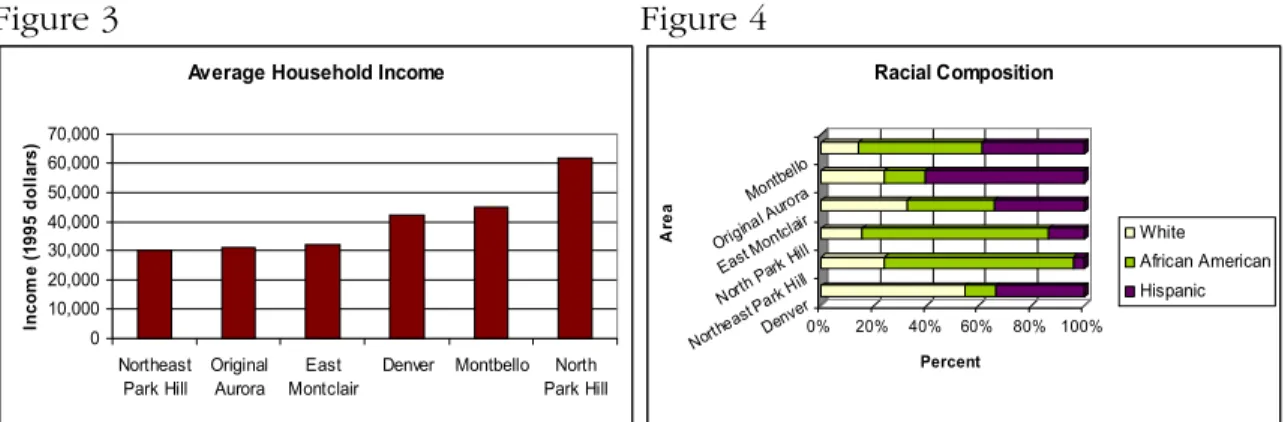
interview). Even these rough estimates illustrate that Stapleton’s racial and socioeconomic makeup is much different than that of the surrounding areas. These differences have historically been and continue to be an important
consideration for planning and development of the site. Figures 3 and 4 (below) compare the average household income and racial composition and of the five neighborhoods surrounding the Stapleton site with the city and county of Denver. A more detailed discussion of the socioeconomics and demographics of the
neighborhoods follows.
Figure 3 Figure 4
Northeast Park Hill had a population of 7,549 in 1999, and was a predominantly black neighborhood with a growing Latino population. The ethnicity breakdown shows that this neighborhood’s Black, Hispanic and White population percentages were 70.4, 23.8 and 4.2, respectively. In contrast, the city of Denver (which
already differs considerably in racial makeup from the Denver-Boulder CMSA or the state of Colorado) has population ratios of 11.1 percent Black, 31.7 percent Hispanic and 51.9 percent White. This neighborhood also has a higher percentage of seniors aged 60 – 69 but fewer adults between the ages of 25 and 39, possibly suggesting that grandparents are raising their grandchildren when parents are not in the household. Northeast Park Hill has a high percentage of family households, but a significantly higher percentage of female headed households (both with and without children) than the City of Denver (Neighborhood Resource Directory).
Homeownership rates in this neighborhood are lower than the city average, while the percentage of rental households is slightly higher. The average price of a home sold in Northeast Park Hill in 1998 was $97,403, which is approximately 77 percent lower than the city average of $172,730. Average home values in this area are about 23 percent lower than those in Denver overall ($135,000 compared to $165,800). Likewise, the neighborhood’s average household income in 1995 was $30,440, which is significantly less than the city’s average of $42,426. Adults in Northeast Park Hill have much lower educational attainment levels than those in Denver, especially for college degrees and among the Latino population. Finally, 82 percent of students in the area’s elementary school are eligible for free or reduced lunch, compared to 60 percent of students in all Denver Public Schools (Neighborhood Resource Directory).
North Park Hillis also a predominantly black neighborhood, with a racial
breakdown of 56.7 percent Black, 11.0 percent Hispanic and 12.5 percent White.
0% 20% 40% 60% 80% 100%
Percent
Denve
r
Northe
ast Pa
rk Hill
North
Park H
ill
East M
ontcla
ir
Origin
al Auro
ra Montb ello Ar e a Racial Composition White African American Hispanic Average Household Income
0 10,000 20,000 30,000 40,000 50,000 60,000 70,000 Northeast Park Hill Original Aurora East Montclair
However, the breakdown of births by race for 2001 suggest that gentrification is taking place in this area, as the percentage of White and African American births are larger and smaller than that of the overall population, respectively. This area has a relatively high percentage of children between ages 10 and 14, but a smaller percentage of young adults (age 18-29) than the City of Denver. North Park Hill houses a much higher percentage of families than Denver as a whole (67 percent compared to almost 50 percent in the city). Like Northeast Park Hill, this
neighborhood has a relatively high percentage of female headed households, with 21.8 percent; however this percentage is still one of the lowest in Northeast
Denver (Neighborhood Resource Directory).
North Park Hill has a high rate of home ownership – 83 percent in this neighborhood compared to 52.5 percent for Denver as a whole and very low vacancy. Similarly, the Black and Latino home ownership rates are also quite high – nearly double the city’s percentages. The median household income for all racial groups in North Park Hill is higher than in Denver and significantly higher for whites, which may suggest recent gentrification in the area ($62,000 for Whites in North Park Hill compared to $44,022 in Denver). However, median housing values in the area are slightly lower than the city’s average and a relatively high percentage of children in the area’s public schools are eligible for free or reduced price lunch (Neighborhood Resource Directory).
All racial groups in this neighborhood have higher educational attainment than the averages for Denver. The percentages of Whites and Latinos with college degrees in North Park Hill are significantly higher than in Denver overall, at 14.7 percent and 70.2 percent in North Park Hill compared to 7.8 percent and 47.8 percent, respectively (Neighborhood Resource Directory).
Northeast Park Hill and North Park Hill have a combined land area of about 4,058 acres, comprised mainly of single and multi-family residences. There are also a few industrial and commercial uses at the north end of the neighborhood (SDC).
East Montclairis located on the eastern edge of Denver near the Aurora city line. The neighborhood is bordered to the north and south by the Stapleton and Lowry sites, respectively. East Montclair is comprised mainly of single and multi-family residences, and is divided by the Colfax Avenue commercial corridor. This historic “Main Street” corridor is currently the target of revitalization efforts in Denver, Aurora and Lakewood.
(SDC).
In contrast to North Park Hill, this neighborhood has a relatively low rate of homeownership, and renter households actually outnumber owner households. The rate of black homeownership is quite low, while white homeownership is fairly high, compared to Denver. In 1998, East Montclair had one of the lowest average home sales prices, of $93,746 and a similarly low average household income. Again, a large percentage of children in this area’s public schools are eligible for free or reduced lunch, and the elementary school is predominantly Hispanic (62 percent) and Black (33 percent). The small percentage of White students (4 percent, compared to 22 percent in Denver overall) suggests gentrification, an older white population or that white children are enrolled in private school (Neighborhood Resource Directory).
Original Aurora is located due south of the Stapleton site, and is also composed mainly of single and multi-family residential uses (SDC). This neighborhood is one of the largest Latino communities in the Denver metro area, with a racial breakdown of 57.6 percent Hispanic, 23.2 percent White and 14.7 percent Black. The area also has a high percentage of young children, with those under age 5 comprising 11.7 percent of the population. The percentage of young adults in Original Aurora is also quite high, while the presence of baby boomers (aged 40-59) is relatively low (Neighborhood Resource Directory).
This area also has a high percentage of female-headed households, with and without children. The home ownership rate is extremely low in Original Aurora (33.6 percent) while the percentage of rental households is quite high (66.4 percent). The black home ownership rate is also especially low in this area, at 13.3 percent (Neighborhood Resource Directory).
Educational attainment in Original Aurora is low, with 52.3 percent of residents having high school diplomas. The extremely low percentage of Latinos with a high school degree suggests a large immigrant population. Overall, only 6.5 percent of residents have a college degree, with higher rates among blacks and whites and lower rates among Latinos (Neighborhood Resource Directory).
The median household income in this area is also very low, averaged at $31,000, and poverty rates are among the highest in the Denver metro area (26.7 percent overall) with higher rates for blacks and Latinos. Likewise, the median housing value in Original Aurora is among the lowest in the area, at $109,000, which explains the large immigrant population. All the area’s elementary schools have high percentages of students eligible for free or reduced price lunches, and are predominantly Hispanic in racial makeup (Neighborhood Resource Directory).
Montbello is the largest of Denver’s neighborhoods, both in population and land area, with 5,600 single family homes and 1,250 multi-family units (SDC).
Montbello is a predominantly Black and Hispanic neighborhood with a small, declining White population. The percentage of Hispanic births in the area is much higher than in the city of Denver and higher than other racial groups (48.8
60 is extremely low, about 5.9 percent compared to 14.4 percent in the city (Neighborhood Resource Directory).
This neighborhood has a high percentage of family households (80.7 percent) and families with children (47.5 percent). Similarly, the percentage of married couples with children is double that of Denver and also higher than the statewide
percentage. There are very few vacant homes in Montbello, and home ownership is quite high for all races (71.9 percent overall). For most schools in the area, the percentage of children eligible for free or reduced price lunch is fairly high, and the racial makeup is predominantly Black and Hispanic (Neighborhood Resource Directory).
The percentage of residents with a high school degree in Montbello is similar, although slightly lower than Denver overall; however educational attainment is much lower in terms of college degrees. Overall, 12 percent of residents have completed higher education, compared to 34.5 percent in Denver. The percentage for Whites is also comparatively low – 14.6 percent in Montbello and 47.8 percent in Denver. Household incomes are above city averages for all races, and are especially high for Blacks, indicating the presence of a black middle class
neighborhood. Likewise, poverty levels in Montbello are lower than the Denver averages. Finally, median housing values are lower than Denver overall ($137,000 in Montbello and $165,800 in Denver), meaning this neighborhood is more
affordable than many others in the area (Neighborhood Resource Directory).
C. THE PLANNING PROCESS AND PUBLIC PARTICIPATION
The planning process for Stapleton’s redevelopment will be organized and
discussed using the set of criteria identified in the Research Design section (III B).
TIMING – Were key stakeholders and publics identified and contacted early in the planning process?
Some stakeholders, namely the residents in neighborhoods surrounding the former airport, were self-selected early participants in shaping Stapleton’s future.
Complaints about airplane noise and continued airport expansion from Park Hill residents provided “one of the key political pretexts for shutting down Stapleton” (Van De Voorde, 1997, p.2). Likewise, “the city has been talking about how to redevelop Stapleton since at least 1989, six years before the airport was
mothballed to make room for DIA” (Van De Voorde, 1997, p.1).
Shortly after the decision to build a new airport was solidified in 1989, a group of citizens began a broad community planning exercise known as Stapleton
Tomorrow. In November of 1989, Mayor Federico Peña formalized the Stapleton Tomorrow Committee, a group of 35 citizens that conducted a large-scale
participation mainly on other citizens, as actors in the government and business arenas were already represented and involved.
INCLUSIVENESS – Was participation and input solicited from all affected parties?
Over a two year period, Stapleton Tomorrow worked to gather thoughts and opinions about Stapleton’s redevelopment from a range of Denver residents. Stapleton Tomorrow found that residents’ major concerns included job creation, the preservation of open space, and ensuring ample recreational and cultural opportunities (Stapleton website). Denver civic leaders shared the group’s vision of a “sensitively designed new Stapleton, woven as closely as possible into Denver’s urban fabric” (Peirce, 2004, p.1).
The Stapleton Development Plan was adopted by the Denver City Council as an amendment to the City’s Comprehensive Plan. This plan is the product of collaboration between the Stapleton Redevelopment Foundation, a Citizen’s Advisory Board and the City and County of Denver. Throughout the formation of the plan, over one hundred community presentations and meetings were held to solicit input and participation from the community. The Development Plan builds on the goals and objectives outlined in the Stapleton Tomorrow Concept Plan developed in 1991. The overarching goals of the plan are economic opportunity, environmental responsibility and social equity.
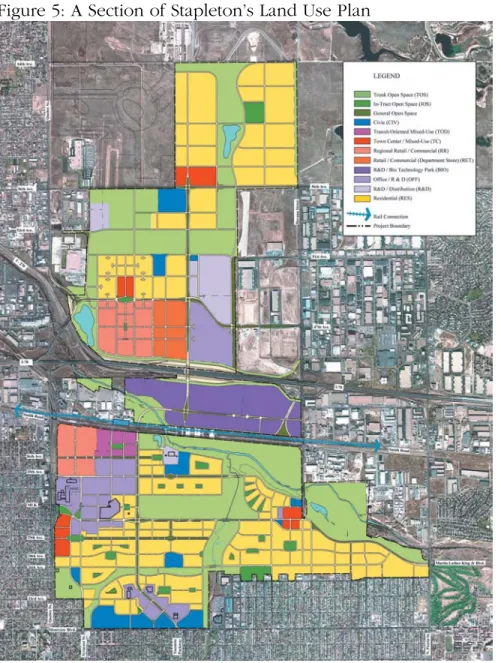
The Stapleton Development Plan was designed to represent the community’s goals and provide direction for the project’s redevelopment over a span of several
decades. The Plan organized development into eight districts, each with a distinct center and an emphasis on “the integration of employment, housing, public
transportation and walkable scale” (Stapleton Development Plan, 1995). See Appendix Section B for specific goals of the Stapleton Development Plan and Denver Comprehensive Plan.
Further investigation would be necessary to determine if input and participation was solicited from all affected parties; however, it is rarely possible to identify and seek out every person or group who may feel impacted by a project. In the case of the Stapleton redevelopment, it seems that the major stakeholders were
involved in early planning efforts. The project received input from: Stapleton Tomorrow, a representative citizens’ group; Denver residents, via community presentations, meetings and surveys; and various leaders from the City and County of Denver. More specific interested parties were given opportunities to make comments and contributions via a number of community meetings.
FACILITATION OF PUBLIC INPUT – Were opportunities for involvement convenient, and were adequate resources provided?
efforts and objectives were supported by about $4 million in funding from some of the city’s largest private companies and charitable foundations. The Stapleton Foundation raised the funds necessary to fund the planning process, which entailed resident interviews, private consulting, research and staffing.
In January of 1993, Denver Mayor Wellington Webb appointed a Citizens Advisory Board to oversee the creation of a redevelopment plan, which was composed of 42 members representing various perspectives, interests and organizations. In June of 1993, the Foundation entered an agreement with the City and County of Denver to provide funding and guidance for redevelopment planning and
programs for the site. This agreement allowed the city and county to focus their efforts on building the new airport, while the Foundation was able to establish a “well-paced, thorough, and broad-based effort” (Stapleton Foundation).
As noted under the previous criterion, over 100 community meetings and presentations were held during the planning process for Stapleton’s
redevelopment. The large number of meetings gave interested parties many opportunities to contribute and arguably provided a variety of times, dates and locations to facilitate participation.
CLARITY OF EXPECTATIONS AND OUTCOMES – Were participants given clear roles and responsibilities, a realistic picture of the extent of their influence?
The mission, specific responsibilities, and scope of influence and involvement in planning Stapleton’s redevelopment were apparent for some groups, but
somewhat ambiguous for others. It is unclear whether the ultimate influence of the Stapleton Tomorrow committee (having their concept plan integrated as a component of the Denver Comprehensive Plan) was planned at the outset. The group was originally formed to gather ideas and solicit citizen input regarding priorities for Stapleton’s redevelopment. Most likely there were no specific upfront guarantees about how their input would be used, but it seems that the general mission of the group was relatively clear. Therefore, the group seemed to have fairly clear roles and responsibilities, even if the extent of their influence was uncertain, although not misconstrued.
The expectations and responsibilities of the organizations and entities formed to implement the Stapleton Development Plan were more apparent. The Stapleton Foundation, for example, was responsible for a number of key tasks, including: raising $3 million to fulfill its mission; controlling the management and funding of the redevelopment process; advising the city on a long-term management
structure; suggesting projects for the initial phases; conducting public meetings, presentations and workshops to provide updates and solicit community input; creating the Stapleton Development Plan; and continuing to work towards upholding the principles of this plan. The Stapleton Development Foundation eventually morphed into the entity that is today known as the Stapleton