228
Developing a fuzzy expert system to predict technology
commercialization success
Jafar Yazdimoghaddam
1, Mohammad Saleh Owlia
1, Reza Bandarian
21Faculty of Industrial Engineering, Yazd University, Yazd, Iran
2Business Development Department, Research Institute of Petroleum Industry (RIPI), Tehran, Iran [email protected], [email protected], [email protected]
Abstract
A majority of efforts in terms of technology commercialization have failed; however, the issue of commercialization and its high importance are agreed upon by policymakers, entrepreneurs and researchers. This shows the high complexity of the commercialization process. One of the main solutions to overcome the commercialization problems is to predict the success of technology commercialization before its implementation. Hence, this study aims to design a fuzzy expert system to predict the technology commercialization success in the early stages of its development and before its implementation. According to the literature review and the fuzzy Delphi method, the technology commercialization success factors (TCSFs) were identified and refined. The final result of the fuzzy Delphi process consists of 32 components categorized in four dimensions: technical specifications, financial and economic specifications, market specifications and rules and regulations. These success dimensions form the inputs of the prediction model in this study. The performance of the model was evaluated by actual samples selected from different fields of technology. The accuracy of the model was estimated to be 73% according to a validation process, indicating the high accuracy of the proposed model in predicting the commercialization success. This model could be used practically by risk-taking investors, technology advocates and innovators to adopt new technology commercialization opportunities.
Keywords:
Technology commercialization, technology commercialization success factors, commercialization success predict, fuzzy expert system1- Introduction
A gap exists between the production of science and the technological advancements in a country. Scientific products should pass some steps and be developed to be converted into a viable technology in society. The commercialization process could provide this ground (Kathleen, 2003). Some researchers consider commercialization to be a process of converting technology into successful economic products, a process that transforms the created knowledge into marketable products (Brown, 1997).
*Corresponding author
ISSN: 1735-8272, Copyright c 2018 JISE. All rights reserved
Journal of Industrial and Systems Engineering
Vol. 11, No.2, pp. 228-250 Spring (April) 2018
229
Another definition considers technology commercialization as bringing an idea or an innovation to Market (Kathleen, 2003; Balachandra et al., 2004). Several years of research reveal that merely conducting investigations, without planning to develop and apply them or employing the research findings in the industry, leads to the waste of energy and capital invested for this purpose (Balachandra et al., 2004). Given the critical role of technology commercialization in the profitability of technology and research achievements, the research centers are now under pressure imposed by the state agencies and organizations to finance their own business through commercializing innovative research. Establishing a platform for the commercialization of research findings and the supply of knowledge to the market and society has resulted in the community's technical, economic and welfare growth, in addition to providing significant economic values for research organizations. Regarding the importance of this issue, many studies have been carried out on the technology commercialization and marketing at various institutions (Kumar & Jain, 2003); however, the technology commercialization path has been facing high dynamism and uncertainty. Multiple global evidences suggest that although a large number of studies have been technically successful, only a small percentage of these studies could successfully manage commercialization. The development funnel also shows that a majority of ideas and innovations do not result in a product and would not reach the market. This illustrates the high complexity of the commercialization process (Bandarian, 2007).
Different actors with a variety of capabilities are involved in the complex commercialization process. This process requires skills such as product development, market assessment, market strategies, financial resources management, production management and engineering, accounting, etc. (Kathleen, 2003; Kumar & Jain, 2003).
There are several barriers to technology commercialization, which may occur through the stages of idea generation to market. Some barriers are lack of information, inadequate human resource capabilities, economic and political barriers, structural and organizational barriers, and lack of understanding the market and customer needs, lack of environmental standards and so on. In addition, the technology itself may also have certain inherent barriers. Thus, it is difficult to establish methods to increase the likelihood of success in this significant process (Martyniuk et al., 2003). One of the main solutions proposed to overcome the technology commercialization problems is to predict their commercialization success before they are implemented. One point, however, to concern is how to predict the technology commercialization success. Given the nature of the technology commercialization success, there are two important relevant issues: one issue that the commercialization success is a multi-dimensional and obscure phenomenon, making its analysis difficult (Ravi et al., 2003); Another issue is related to the combination and integration of various commercialization success factors and the quantification of these dimensions in order to predict the technology commercialization success. In facing these two important issues, the mathematical and statistical models such as regression analysis and scoring models have difficulties in direct measuring the future success of commercialization and cannot overcome the uncertainty and complexity of this issue.
One of the well-developed methods to predict a phenomenon, especially a complex and uncertain phenomenon, is the fuzzy expert system (Haji pour, 2013). In general, the expert system is an interactive computer-based decision-making tool utilizing the knowledge gained from specialized people to solve the issues. In another definition, the expert system is called a computer program simulating the opinions of an expert to solve problems of a complex decision in a given domain (Giarratano and Riley, 2004).
The expert system could establish a knowledge-based measurement system through formulating experts' knowledge and expertise. In particular, the combination of this system with the fuzzy logic could overcome the ambiguity as well as the integration of various dimensions of the prediction commercialization success model. Accordingly, this study aimed to provide a model for predicting the technology commercialization success (TCS) using fuzzy expert system. The models which are developed to evaluate and predict the technology commercialization success, first describe the various factors affecting the technology commercialization success.
Accordingly, the literature review and the fuzzy Delphi method were used to identify and refine the technology commercialization success factors (TCSFs) in the present study. These factors included the components associated with technology and its potentials and features as well as the components associated with company commercializing technology.
230
In the present article, first the literature of the research is reviewed. In the next section, the research methodology is mentioned. Then, the collected data is analyzed. In continuation, the predicting model validation and its results are presented. Finally, the study is concluded after discussing the study findings.
2- Review of the literature
In this part of the present study, first the technology commercialization success factors are discussed based on the literature. Then, various methods adopted in previous research to assess and predict the technology commercialization are examined.
2-1- Technology commercialization success factors (TCSFs)
Considering the literature on the technology commercialization evaluation, these studies fall into three main categories. One category subsumes factors of the technology commercialization, mainly from a technology or technology product perspective. The other category consists of the studieswhich identify the factors of the successful technology commercialization, esp. from the point of view of companies which commercialize the technology. Anyhow, most research goes under the category which identifies the factors of the successful technology commercialization, from both key perspectives: technology and the company commercializing the technology.
In 1996, University of Cincinnati, U.S., presented its methodology named STEP, short for Strategic Technology Evaluation Program, strategically evaluating the commercial potentials of new technologies. In this methodology, the commercial potential is defined as the probability of the successful commercialization of a given technology. STEP is the most useful tool to evaluate the new technologies at the early stages of the technology development and before allocating time and resources. STEP describes different factors affecting the successful commercialization of technology. Based on STEP, any new technology, in order to be commercialized, requires some specific features. These features are divided into six various dimensions: technical evaluation, procedural evaluation, economic evaluation, market evaluation, perceptual/interpretive evaluation, and legal and administrative evaluation. Each dimension is composed of several components. The technical evaluation includes technical feasibility components. Technical advantages and simplicity analysis offset the complexity. Evaluation of the components of potential users’ competence technology includes the improvement of the function against shift, the testability and the probability of establishing on a small scale, and the required shift in order to enable the potential users to benefit from the technology. Economic evaluation consists of economic probability components and cost-benefit analysis. Market evaluation includes technological components compatible with the market needs, growth potential, and technology popularity in the market. Ability and user-friendliness, personal motivations and interests to commercialize and potential threat of contact-linked relationship constitute the perceptual evaluation component. Rules and regulations, persuaders and dissuaders for users, physical requirements, and cultural congruence all make up the legal and administrative evaluation (Chifos, C. & Jain, 1997; Ravi et al., 2003; Bandarian, 2007). As described on STEP model, this model focuses only on technology and its features. In a similar vein, in a study by Bandarian (2007) to measure the commercial potential of one of the most crucial research programs in Iran Oil Research Center at early stages of development and before allocating time and resources, STEP was selected out of the other relevant models. Mohannak, & Samtani (2014) tried to propose a criterion-based approach to evaluate the potential of technology transfer and commercialization of a new technology. So the evaluations criteria were identified from the literature review, models, and technology frameworks, and were classified in four categories include: technical preparation, rules and regulations, social advantages and costs, and market and economic factors. In this research, the mentioned criteria are from a technological perspective.
On the other hand, there exist studies dealing with factors influencing commercialization success evaluation form the viewpoint of the company commercializing the technology. As an instance, Zahra & Nielsen (2002) showed that a company has to progress in the four following dimensions to successfully commercialize the technology: 1. Developing and parallel presentation of process products and technologies; 2. Manufacturing novel, innovative products; 3. The speed of technology commercialization; and 4. Creating new knowledge via technology commercialization (Patent). In
231
their study “Successful development and commercialization of technical innovation: a strategy-based approach”, Slater and Mohr (2006), found out that potentialities for successful development and commercialization of technical innovation rest on the interrelationships between market strategies (exploratory, analytic, defensive), the target customer groups, and the company attitude toward market tendency (Slater & Mohr, 2006). In another similar research, Kimura (2010) studied two technologies of two seminal projects in the field of energy yield in Japan which were the most successful ones in commercialization in order to identify factors of successful commercialization. Interviewing the managers and the engineers involved in the commercialization of these technologies and reviewing the related literature, five important factors were identified in successful commercialization as follows: 1.public research and development (R & D); 2.supporting projects; 3.marketing and recognizing customers’ rights; 4.publication strategy; and 5.investing and subsidizing. Commercialization Readiness Assessment (CRA) deserves mention as one example of this category. This model was first proposed in small business new technologies commercialization research training workshops, in the Department of Homeland Security (DHS). In CRA model, commercialization readiness evaluation is defined as companies’ weaknesses and strengths evaluation regarding their current readiness for successful commercialization of a new technology. CRA model has 15 components including needs, final customers/users, customers’ knowledge, customers’ commitment, pricing, market size, popularity in market, competitors, protecting intellectual capital, marketing and selling, appropriate budgeting, business model, commercialization experience, and partners’ rules and approvals (Department Homeland Security, 2013).
Kirchberger and Pohl (2016) provided a systematic review of the current literature on technology commercialization. This study identified three main types of technology development organizations: universities and research institutes, technology startups and founded companies and focused on the different interaction channels through which developed technologies commercialization happens. This research analyzed the success factors within the related commercialization channels. Thus 13 Success factors of technology commercialization from the perspective of the technology developer identified (i.e., Innovation culture, Management techniques, Networking activities, Property rights, Technology suitability, Resource availability, Technology transfer strategy).
Most studies have distinguished factors influencing commercialization success focusing on both technology and the company commercializing of technology. Some of these studies are mentioned hereunder:
Mirghafoori et al. (2011) studied the factors playing a major role in commercializing the innovative activities and predicted their success in Yazd Province. They distinguished the influential variables in commercialization of inventions. The results showed that the demographical, personal, technical-innovative, market, financial, administrative, and legal variables influence the success of commercialization process.
Sohn and Moon (2003) presented an approach to predict the index of technology commercialization success in relation to the type of technology, the developer of technology, the recipient of technology, and environmental factors. In this study, nine variables, based on the collected data from Korean Information Technology Transfer Center, were extracted: R & D, management, application, technology transfer, market, rules, commercialization success, publication influence, and improving the company’s capability. Åstebro (2004) examined success key factors for research programs and specialized-technical companies’ improvement. In this regard, 36 parameters were identified. These parameters were categorized in four groups, taking opinions of the experts. Accordingly, prominent development expenditure parameters, unreliability of R&D, accessibility of technical resources, and product equipment and expenditure fall into tech opportunity group. Return of the expected capital, repayment time, and nominal value fall in expected profitability group. The technical improvement of the innovative potentials, the issues related to technology safety, environmental factors, legal impacts, and different criteria of demand go into development risk group. Price parameters, potential and current competition, system integrity, and superfluous costs go into predictable conditions group. In another study, Rahal & Rabelo (2006) detected the factors influencing the commercialization and licensing of university inventions. Similarly, the key factors were identified and classified into five groups: organization-related factors, inventor-related factors, technology-related factors, market- and commercialization-related factors, and the factors related to intellectual ownership. In accordance with the weight given to components, 12 of most important of them consist in intellectual capital
232
power, prominent predictable privileges, technology supremacy and uniqueness, the likelihood of market success, measurable edges and prominent quantifications, constant competitive edges, the immediate needs of market, the size of market, technical feasibility, patent transparency, intellectual capital exclusiveness, and the period of time needed to develop the technology to be presented into the market. Link and Scott (2010) devised a model to assess the commercialization success of Small Business Innovation Research (SBIR), funded by the government. To do so, some financial- and economic-oriented variables were determined such as the rate of the total private investment, the rate of private foreign investment to total investment, the rate of state budgeting to total investment, the rate of academic budgeting to total investment, the rate of individual budgeting to total investment, project budgeting timing, the number of project phases, the lifespan of project phases, devised commercial application of project results, and the total income of the company. Cho and Lee (2013), based on literature review and Delphi method identified and classified the success factors of commercializing the innovative products. These factors have four dimensions and 16 components. The dimensions are marketability, business feasibility, innovative competition, and R & D capabilities. In a study, Rostek (2014) introduced an effective financial method, similar to that of Link and Scott’s (2010), to evaluate the commercial potential of innovative projects. So, this paper scrutinized the financial principles of innovative projects, and identified some criteria to evaluate their commercial potential. These criteria are technical level, services quality, timely delivery of services, and constant relationship with customers, sales, using fixed assets, and employees’ performance. Hsu et al. (2015) identified the influential factors of academic technology transfer and their successful commercialization in Taiwan. These factors consist of dimensions of human, cultural-organizational, financial, and commercial resources. These dimensions have several components. Finally, it was specified that human and cultural-organizational resources play the most important role here. Jung et al. (2015) identified success and failure factors in technology commercialization and also examined the barriers challenging different stages of commercialization in South Korea. Success and failure factors were identified reviewing literature and 586 data transfer technology of the private companies in South Korea, i.e. marketability, cooperation with technology developers, technical improvement, satisfaction and capabilities of technology users, providing complementary technology, financial capability, market status, technology advantages, and technical capabilities of technology users. This paper identifies these factors separately.
In this regard, every new factor affecting the commercialization of technology reported in the previous related literature was extracted, which resulted in over 50 factors. In the following the success factors of commercialization that had overlap with together, factors with different names but the same meaning (e.g., ‘‘availability of technical resources’’ and ‘‘technical readiness in terms of facilities and infrastructure’’ also ‘‘economic feasibility’’ and ‘‘Cost-benefit analysis’’ ), were identified and merged. In this way, the number of factors was reduced to 37.
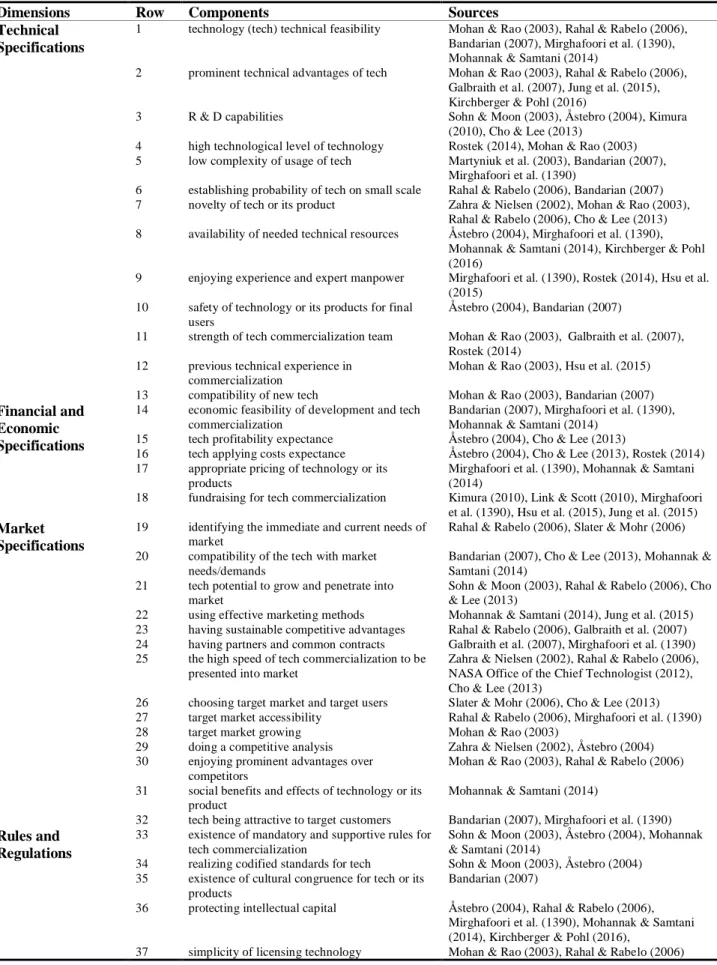
The extracted components from the previous studies, based on the literature, esp. utilizing STEP and CRA models (described in above), are categorized in four dimensions. These dimensions are named considering the components classified in each of them: technical specifications, financial and economic specifications, market specifications, and rules and regulations. The dimensions and components of technology commercialization success are shown in table1.
The listed studies in Table 1 contain research programs published from 2000 onwards, emphasizing on commercialization success. In this regard, some research programs, examining only technology transfer, were excluded. This study has also listed factors of commercialization success in relation to cases where technology developer and technology commercializing were different, since the current paper focuses on data technology commercialization transferred from the technology developing company to technology commercializing one.
233
Table 1. Influential components on technology commercialization success
Dimensions Row Components Sources
Technical Specifications
1 technology (tech) technical feasibility Mohan & Rao (2003), Rahal & Rabelo (2006), Bandarian (2007), Mirghafoori et al. (1390), Mohannak & Samtani (2014)
2 prominent technical advantages of tech Mohan & Rao (2003), Rahal & Rabelo (2006), Galbraith et al. (2007), Jung et al. (2015), Kirchberger & Pohl (2016)
3 R & D capabilities Sohn & Moon (2003), Åstebro (2004), Kimura (2010), Cho & Lee (2013)
4 high technological level of technology Rostek (2014), Mohan & Rao (2003) 5 low complexity of usage of tech Martyniuk et al. (2003), Bandarian (2007),
Mirghafoori et al. (1390)
6 establishing probability of tech on small scale Rahal & Rabelo (2006), Bandarian (2007) 7 novelty of tech or its product Zahra & Nielsen (2002), Mohan & Rao (2003),
Rahal & Rabelo (2006), Cho & Lee (2013) 8 availability of needed technical resources Åstebro (2004), Mirghafoori et al. (1390),
Mohannak & Samtani (2014), Kirchberger & Pohl (2016)
9 enjoying experience and expert manpower Mirghafoori et al. (1390), Rostek (2014), Hsu et al. (2015)
10 safety of technology or its products for final users
Åstebro (2004), Bandarian (2007)
11 strength of tech commercialization team Mohan & Rao (2003), Galbraith et al. (2007), Rostek (2014)
12 previous technical experience in commercialization
Mohan & Rao (2003), Hsu et al. (2015)
13 compatibility of new tech Mohan & Rao (2003), Bandarian (2007)
Financial and Economic Specifications
14 economic feasibility of development and tech commercialization
Bandarian (2007), Mirghafoori et al. (1390), Mohannak & Samtani (2014)
15 tech profitability expectance Åstebro (2004), Cho & Lee (2013)
16 tech applying costs expectance Åstebro (2004), Cho & Lee (2013), Rostek (2014) 17 appropriate pricing of technology or its
products
Mirghafoori et al. (1390), Mohannak & Samtani (2014)
18 fundraising for tech commercialization Kimura (2010), Link & Scott (2010), Mirghafoori et al. (1390), Hsu et al. (2015), Jung et al. (2015)
Market Specifications
19 identifying the immediate and current needs of market
Rahal & Rabelo (2006), Slater & Mohr (2006)
20 compatibility of the tech with market needs/demands
Bandarian (2007), Cho & Lee (2013), Mohannak & Samtani (2014)
21 tech potential to grow and penetrate into market
Sohn & Moon (2003), Rahal & Rabelo (2006), Cho & Lee (2013)
22 using effective marketing methods Mohannak & Samtani (2014), Jung et al. (2015) 23 having sustainable competitive advantages Rahal & Rabelo (2006), Galbraith et al. (2007) 24 having partners and common contracts Galbraith et al. (2007), Mirghafoori et al. (1390) 25 the high speed of tech commercialization to be
presented into market
Zahra & Nielsen (2002), Rahal & Rabelo (2006), NASA Office of the Chief Technologist (2012), Cho & Lee (2013)
26 choosing target market and target users Slater & Mohr (2006), Cho & Lee (2013) 27 target market accessibility Rahal & Rabelo (2006), Mirghafoori et al. (1390) 28 target market growing Mohan & Rao (2003)
29 doing a competitive analysis Zahra & Nielsen (2002), Åstebro (2004) 30 enjoying prominent advantages over
competitors
Mohan & Rao (2003), Rahal & Rabelo (2006)
31 social benefits and effects of technology or its product
Mohannak & Samtani (2014)
32 tech being attractive to target customers Bandarian (2007), Mirghafoori et al. (1390)
Rules and Regulations
33 existence of mandatory and supportive rules for tech commercialization
Sohn & Moon (2003), Åstebro (2004), Mohannak & Samtani (2014)
34 realizing codified standards for tech Sohn & Moon (2003), Åstebro (2004) 35 existence of cultural congruence for tech or its
products
Bandarian (2007)
36 protecting intellectual capital Åstebro (2004), Rahal & Rabelo (2006), Mirghafoori et al. (1390), Mohannak & Samtani (2014), Kirchberger & Pohl (2016),
234
2-2- Methods of technology commercialization evaluation and prediction
Some studies have only focused on identifying the factors affecting the technology commercialization and some other studies have prioritized these factors using different methods and based on these results, no model is developed to evaluate the technology commercialization.
The methods used in these studies include statistical methods such as regression analysis and confirmatory factor analysis (CFA) (Zahra & Nielsen, 2002), classification and regression tree (CART) as a data mining method (Jung et al., 2015), multi-criteria decision-making methods such as analytic network process (ANP) (Hsu et al., 2015), qualitative methods such as Delphi method (Mohannak, & Samtani, 2014), fuzzy Delphi (Hsu et al., 2015) and interviews with experts (Kimura, 2010).
Through identifying the factors affecting the technology commercialization and the relative importance of these factors, another category of research in this field provided a model to assess or predict the technology commercialization. The methods used to evaluate the technology commercialization in these studies are discussed below:
Åstebro (2004) in order to predict the future success of commercialization R&D projects and Rahal & Rabelo (2006) with the aim of evaluating and prioritizing academic inventions for licensing and commercialization, in their studies used the logistic regression method. Also Link and Scott (2010) devised a model to assess the commercialization success of SBIR, funded by the government using probit regression.
In a number of studies, the scoring model is presented to evaluate the technology commercialization. Criteria and factors of the scoring models are the identified factors affecting the technology commercialization. The models for evaluating the commercialization of technology in studies: Mohan & Rao (2003), Sohn & Moon (2005), Assessment model of NASA Office of the Chief Technologist (2012) and CRA model proposed by DHS (2013), are scoring models. However, criteria and factors of the scoring models have not been weighed in these studies. But in the scoring model of Cho & Lee (2013) for commercialization evaluation, all the factors were weighted using the fuzzy AHP method.
In another study, a structural equation model (SEM) was proposed to predict the technology commercialization success index (TCSI) (Sohn & Moon, 2003).
In addition to the abovementioned mathematical and statistical methods, intelligent methods (such as artificial neural network and fuzzy systems) have also been used in this area, using expert knowledge to create a knowledge-based measurement system. In this regard, Bandarian (2007) developed a fuzzy system to evaluate the commercial potential of a new technology in the early stages of its development and based on the STEP model. Mirghafoori et al. (2011) used an artificial neural network approach to predict the likelihood of the inventions commercialization success.
In some studies, several different methods have been used. Galbraith et al., (2007) in order to compare the prediction power of the experts with the research prediction model, several methods including artificial neural network, Bayesian algorithm and two regression equations used to predict the future success of technology.
According to a review of previous studies, few, if no, studies have been conducted to employ the expert system to predict the technology commercialization success, though, one of the main applications of expert systems is to predict phenomena (Giarratano and Riley, 2004). Several studies have adopted expert systems to predict complex and multi-dimensional phenomena. For example, expert systems are used to predict the outcomes of situations and conditions in the business and financial areas (Kalali, 2015; Rubell & Jessy, 2016; Hadavandi et al., 2010), risk assessment and safety (Amiri et al., 2017; Beriha, 2012) and diagnosis of diseases (Pal et al., 2012).
3- Methodology
In the proposed methodology, the fuzzy Delphi method was used to refine and evaluate the appropriateness of the commercialization success factors extracted from the relevant literature. Then in the main stage of the study, a model is presented to predict the success of technology commercialization using a fuzzy expert system. Each of these steps is systematically described below:
235
3-1- Fuzzy Delphi method for refining of TCSFs
Delphi method aims to get the most agreed-upon opinions of the experts; it does this via questionnaires and surveysfrequently according to the feedback received from them. In this method, the theoretical data of experts are turned into practical one using statistical analyses, culminating in final decisions. Delphi method enjoys both simplicity and reliability (Linstone & Turoff, 2002; Cho & Lee, 2013). Using real numbers helps in solving problems like deciding, predicting, policy making, etc. and yielding unreliable results. In some cases, it is better to use verbal variables. Therefore, real numbers should be replaced by fuzzy ones. These have created this method. The use of the Fuzzy Delphi method to make decisions and consensus on issues with not explicitly explored goals and parameters generates valuable results (Cheng et al., 2002).
In this study, attempts were made to examine the appropriateness of the commercialization success factors extracted from the relevant literature and the real context and conditions of technology commercialization in Iranian companies and industries and to refine these factors through the collective wisdom of a group of experts possessing the knowledge and experience necessary in required for the commercialization of technologies. To this end and taking the above-mentioned features into account, the Delphi method as one of the effective methods in reaching experts' group consensus (Linstone & Turoff , 2002) was used. The commercialization process involves a lot of complexities and ambiguities and cannot be evaluated by definitive methods since each commercialization success component lies within a range. Also, due to the wide scope of the problem in question, i.e. the appropriateness of the success factors with the actual conditions of technology commercialization in Iranian companies and industries, accurate information cannot be accessed. Thus, the fuzzy theory was integrated into the Delphi method in order to eliminate the inaccuracies and uncertainties in the subject (Linstone & Turoff , 2002). In addition, as experts perceived, the Fuzzy Delphi method examines and confirms the appropriateness of the factors derived from the relevant literature with the decision-making realities and conditions, especially for multi-criteria decision-making methods (Hsu et al., 2015). Accordingly, the fuzzy Delphi method was used in this study to refine and assess the appropriateness of the commercialization success factors.
The steps of the fuzzy Delphi method in the proposed methodology are as follows: 3-1-1- Experts’ selection
In this study, the experts are selected based upon their knowledge and experience; they should have at least Master’s and experience of working in projects of technology management.
Using non-stochastic sampling and judgment method, 22 experts were selected, and Initial preparation for the implementation of the plan was provided to them. The experts, categorized according to areas and companies working in them, are as follows:
- The research faculty members and experts of the vice-presidency for technology planning and international affairs of Research Institute of Petroleum Industry (RIPI), affiliated with Iran Ministry of Oil (five persons).
- Managers and experts of five Iranian companies, active in technologies commercialization of oil, gas, and petrochemical industries (ten persons).
- Managers and experts of successful Iranian knowledge-based companies, active in the fields of software and smart systems (seven persons).
3-1-2- Definition of linguistic variables
This study has devised the questionnaire related to fuzzy Delphi method, aiming to get the experts’ opinions about whether they agree to these components and dimensions. Each expert showed their satisfaction in Likert five-part spectrum using the following linguistic variables: very low, low, average, high, and very high. These variables have been defined using triangular fuzzy numbers. These numbers are shown in Table 2. Using Minkowski equation (equation (1)), the crisp values of fuzzy numbers in Table 2 are calculated as follows (Cheng et al., 2002).
3 2 1
a a
a
4
(1)
236
Table 2. Triangular fuzzy numbers of linguistic variables
linguistic variables Corresponding triangular fuzzy numbers
a , a , a
1 2 3
Crisp values of fuzzy numbers ()
Very low (0, 0, 0.25) 0.0625
Low (0, 0.25, 0.5) 0.0625
Medium (0.25, 0.5, 0.75) 0.3125
High (0.5, 0.75, 1) 0.5625
Very high (0.75, 1, 1) 0.75
3-1-3- Initial survey
In the initial stage of fuzzy Delphi method, 9 out of 22 experts, who expressed their readiness, were interviewed to examine the adequacy of components extracted from the literature, to study the independence of the components and to assess the presented classification of components (table 1). To do so, open questionnaires were distributed among them, and their opinions after interviews and questionnaires having been examined and summarized, three new components were added to previous ones. The first two new components were related to the dimension of technical specification: “existence of related and complementary technologies for the commercialization of technology in commercializing company”; “the cooperation of technology commercializing company with developing company”. The third new component was related to market and called “having the right business plan for technology”.
The result of examining the independence of the components showed these experts identified no overlap between components. Besides at this stage, there was a consensus among these experts about the components classification in the four dimensions mentioned.
3-1-4- The second survey
In this stage, based upon the factors extracted from the literature plus a new components proposed by the experts, a questionnaire was devised and handed out among 22 experts; afterwards, the experts were requested to offer their opinions about each component in the form of mentioned linguistic variables. Considering the results of this questionnaire and equation (2) and equation (3), the fuzzy mean of each component was calculated (Cheng et al., 2002). Also equation (1) calculated the defuzzification operation.
1, 2, 3
i i i i
A a a a
i 1, 2, 3, ,n
(2)
n i n i n im m1 m2 m3 1 2 3
i 1 i 1 i 1
1
1
1
A
a , a
, a
a ,
a ,
a
n
n
n
(3)
Where
A
iis opinion of ith expert and n is the number of experts. AlsoA
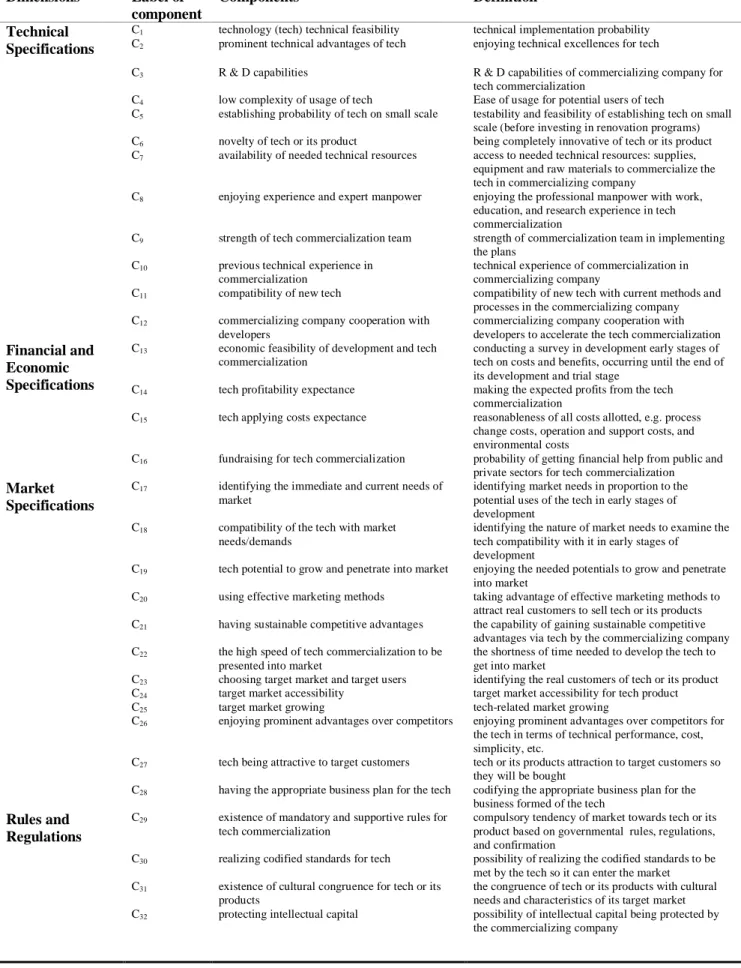
mdenotes mean of experts' opinions.Based on the defuzzified averages, the components with very low points are excluded (Cheng et al., 2002). Based on the experts’ opinions, points ranging from 0 to 0.2 are defined as very low. The following 8 components were assigned very low and so excluded: “high technological level of technology”, “safety of technology or its products for final users”, “existence of related and complementary technologies for the commercialization of technology”, “appropriate pricing of technology or its products”, “having partners and common contracts”, “doing a competitive analysis”, “social benefits and effects of technology or its product”, and “simplicity of licensing technology”. Going through two surveys according to fuzzy Delphi method, three new components were added to previous 37 ones; then 8 components were excluded, and finally 32 factors influencing technology commercialization success were specified in 4 dimensions. Table 3 as the final result of fuzzy Delphi process, shows the TCSFs with emphasis on Iran context.
237
Table 3. The final result of fuzzy Delphi process
Dimensions Label of
component
Components Definition
Technical Specifications
C1 technology (tech) technical feasibility technical implementation probability
C2 prominent technical advantages of tech enjoying technical excellences for tech
C3 R & D capabilities R & D capabilities of commercializing company for
tech commercialization
C4 low complexity of usage of tech Ease of usage for potential users of tech
C5 establishing probability of tech on small scale testability and feasibility of establishing tech on small
scale (before investing in renovation programs) C6 novelty of tech or its product being completely innovative of tech or its product
C7 availability of needed technical resources access to needed technical resources: supplies,
equipment and raw materials to commercialize the tech in commercializing company
C8 enjoying experience and expert manpower enjoying the professional manpower with work,
education, and research experience in tech commercialization
C9 strength of tech commercialization team strength of commercialization team in implementing
the plans C10 previous technical experience in
commercialization
technical experience of commercialization in commercializing company
C11 compatibility of new tech compatibility of new tech with current methods and
processes in the commercializing company C12 commercializing company cooperation with
developers
commercializing company cooperation with developers to accelerate the tech commercialization
Financial and Economic Specifications
C13 economic feasibility of development and tech
commercialization
conducting a survey in development early stages of tech on costs and benefits, occurring until the end of its development and trial stage
C14 tech profitability expectance making the expected profits from the tech
commercialization
C15 tech applying costs expectance reasonableness of all costs allotted, e.g. process
change costs, operation and support costs, and environmental costs
C16 fundraising for tech commercialization probability of getting financial help from public and
private sectors for tech commercialization
Market Specifications
C17 identifying the immediate and current needs of
market
identifying market needs in proportion to the potential uses of the tech in early stages of development
C18 compatibility of the tech with market
needs/demands
identifying the nature of market needs to examine the tech compatibility with it in early stages of
development
C19 tech potential to grow and penetrate into market enjoying the needed potentials to grow and penetrate
into market
C20 using effective marketing methods taking advantage of effective marketing methods to
attract real customers to sell tech or its products C21 having sustainable competitive advantages the capability of gaining sustainable competitive
advantages via tech by the commercializing company C22 the high speed of tech commercialization to be
presented into market
the shortness of time needed to develop the tech to get into market
C23 choosing target market and target users identifying the real customers of tech or its product
C24 target market accessibility target market accessibility for tech product
C25 target market growing tech-related market growing
C26 enjoying prominent advantages over competitors enjoying prominent advantages over competitors for
the tech in terms of technical performance, cost, simplicity, etc.
C27 tech being attractive to target customers tech or its products attraction to target customers so
they will be bought
C28 having the appropriate business plan for the tech codifying the appropriate business plan for the
business formed of the tech
Rules and Regulations
C29 existence of mandatory and supportive rules for
tech commercialization
compulsory tendency of market towards tech or its product based on governmental rules, regulations, and confirmation
C30 realizing codified standards for tech possibility of realizing the codified standards to be
met by the tech so it can enter the market C31 existence of cultural congruence for tech or its
products
the congruence of tech or its products with cultural needs and characteristics of its target market C32 protecting intellectual capital possibility of intellectual capital being protected by
238
3-2- TCS predicting Expert System
The main purpose of the current research was to develop a model to predict the technology commercialization success in the early stages of its development. To achieve this goal, selecting and applying a suitable method is of essence.
Terms such as the "high commercialization success" or "low commercialization success" found in the commercialization success assessment literature are fuzzy. Predicting the commercialization success is a multidimensional phenomenon with uncertainty and it is difficult to analyze it. In this regard, one of the main advantages of fuzzy expert systems is to consider and display uncertainty (non-statistical uncertainty). Further, the fuzzy logic is a framework to display and deal with linguistic variables and sentences in the natural language (Zadeh and Kacprzyk, 1999). This feature enables the researcher to create a knowledge-based measurement system by modeling the expert knowledge in the combination of variables and formulating obscure data into if-then rules and fuzzy membership functions, which can address and overcome the ambiguity and integration of different dimensions (Amiri et al., 2017). On the other hand, the most important advantage of using the fuzzy expert system in comparison with the mathematical models is not determining the relationship between input data and output findings by complex equations since such a relation is clarified based on a set of logical rules extracted from expert knowledge (Hadavandi et al., 2010).
In this study, MATLAB R2016a software was used for designing and running fuzzy expert system, based on the data collected.
As shown in figure 1, in the proposed methodology, the structure of the expert system to predict the technology commercialization success consists of four main stages as follows (Pal et al., 2012; Beriha et al., 2012; Siler and Buckley, 2005):
3-2-1- Fuzzification process
The input variables in our fuzzy expert system have been fuzzified. The fuzzy logic is a multi-valued logic. In the crisp approach a factor belongs to a set either fully or it doesn't belong to the set. The concept of fuzzy set theory is the concept of partial belongingness of a factor to one or more than one sets. The partial belongingness is determined by membership function where the membership value ranges from 0 to 1. In fuzzy set if the membership of an element is 1 then the element fully belongs to the set, if it is 0, in result the element does not belong to the set, if it is in between 0 and 1, then element has partial belongingness to the set. Fuzzy logic is an approach for uncertain or vague concepts (Zadeh and Kacprzyk, 1999). This is why the Fuzzification of input variables and using them in fuzzy criterion will cope with the uncertainties of the commercialization domain.
239
240 Step 1. Defining the input and output variables
Based on the final results of the fuzzy Delphi process (Table 3), the major inputs of the prediction model for the technology commercialization success (TCS), i.e. the dimensions of success, include technical specifications, financial and economic specifications, market specifications and rules and regulations. Each dimension of success consists of several components (Ci). The mathematical
relationship between each dimension of success and its components is the linear summation which is defined as the arithmetic mean. The output variable of the fuzzy expert system was defined according to the main goal of the research, i.e. the status of the technology commercialization success. Therefore, the fuzzy expert system of this study is MISO (multiple inputs, single output).
Figure 2 shows the presented MISO system. In this system, the inputs were labeled as Technical, Financial, Market, and Rules and the output was named TCS.
Step 2. Determining a reference set for each input and output variable
In this research for each of the inputs in the expert system, the reference set was a subset of real numbers with defined limits ranging from 0 to 5. For the output variable of the expert system, the reference set was a subset of real numbers with defined limits ranging from 0 to 100%.
Step 3. Specifying linguistic terms for each of the input and output variables
In this research, three linguistic terms (namely Low(L), Medium(M) & High(H)) were defined for each input of the fuzzy expert system and five linguistic terms (namely Very Low(VL), Low(L), Medium(M), High(H), & Very High(VH)) were defined for the output of the fuzzy system.
Due to the ambiguities observed in discussing commercialization prediction, determining five linguistic terms for output results in a more detailed and more precise analysis of the status of the technology commercialization success and reduces ambiguity. In this regard, the low commercialization success rate was defined as two distinct terms (low and very low) and the high commercialization success rate was also divided into two separate terms (High and Very High). This could contribute to better assessment and making more informed decisions on the technology development and commercialization.
Step 4. Defining fuzzy membership functions (MFs) for each linguistic term
The values of these fuzzy variables are defined by fuzzy membership grade that are specified by the membership function (MF).
A trapezoidal MF was selected from different types of MFs in this study because of its potential and flexibility to cover more fuzzy information.
Whereas triangular membership functions is its particular form where two vertex points are same. The equation of trapezoidal membership function is defined as (equation 4):
A
0, x a
x a
, a x b
b a
(x) 1, b x c
d x
, c x d
d c
0, x d
(4)
Where A( )x depicts the membership function of variable x which is defined over the range of
a d, witha b c d . Figure 3 shows a plot of trapezoidal membership graph.241
Fig 2. MISO system for TCS predicting
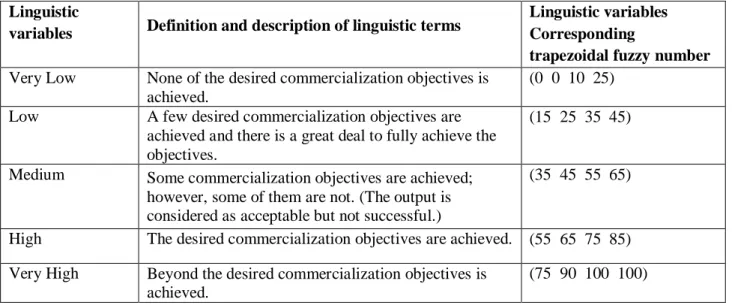
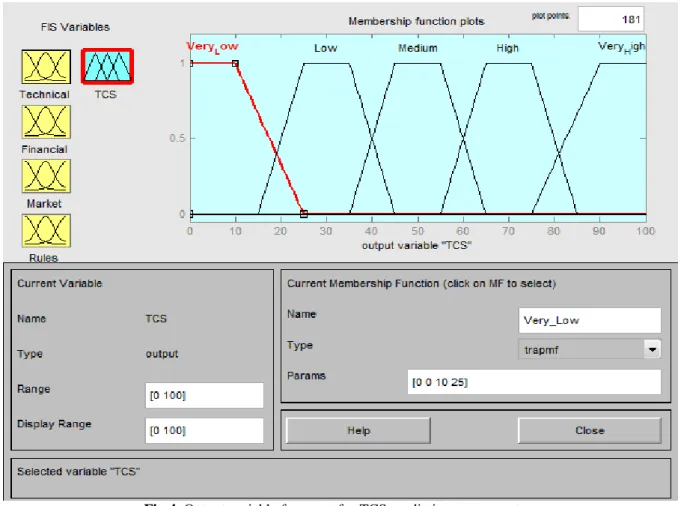
The values of a, b, c, d for each of the linguistic variables of present system inputs and output, have been determined based on opinions of experts including three university researchers in industrial engineering and computer engineering possessing the knowledge and experience required in the field of fuzzy expert systems and technology management, and considering the nature and features of the technology commercialization topics. The definition of trapezoidal MFs for input variables can be seen in table 4 and for output variable in table 5.
It should be noted that a clear definition was provided for each of these five linguistic terms based on the extent of achieving commercialization objectives due to the possible ambiguity in the
perception and conceptualization of the linguistic variables related to the system output. The definitions are listed in table 5.
At the end of this step, the fuzzy sets of input and output variables were determined. Figure 4 shows the fuzzy set of the output variable for the expert system.
242
Table 4. Linguistic variables for the inputs fuzzy trapezoidal membership functions value Linguistic variables Linguistic variables Corresponding trapezoidal fuzzy number
Low (0 0 1 2)
Medium (1.5 2 3 3.5)
High (3 4 5 5)
Table 5. Linguistic variables for the output fuzzy trapezoidal membership function value Linguistic
variables Definition and description of linguistic terms
Linguistic variables Corresponding
trapezoidal fuzzy number Very Low None of the desired commercialization objectives is
achieved.
(0 0 10 25)
Low A few desired commercialization objectives are
achieved and there is a great deal to fully achieve the objectives.
(15 25 35 45)
Medium Some commercialization objectives are achieved;
however, some of them are not. (The output is considered as acceptable but not successful.)
(35 45 55 65)
High The desired commercialization objectives are achieved. (55 65 75 85) Very High Beyond the desired commercialization objectives is
achieved.
(75 90 100 100)
3-2-2- Fuzzy Rule-base
Rule base of present system has been developed based on of the experts' knowledge and past experience. These experts enjoyed required knowledge and experience in the field of technology commercialization. After multiple rounds of structured interviews with five of these experts separately, preliminary rules was extracted. The preliminary rules were evaluated and verified by 9 other experts. In 11 of the 81 rules, there were conflicts between 9 experts.
The conflicts
for these 11 ruleswere resolved by the consensus.
There are many methods for knowledge representations like predicate calculus, frame, object-oriented technique, production rules. The present study was used fuzzy production rules to represent the extracted knowledge.
The fuzzy production rules are written in the format of "IF (condition) THEN (conclusion)". In the present fuzzy expert system, condition is fuzzy variables related to system input variables and conclusion is fuzzy variables belong to system output variable.
The number of rules of a fuzzy model depends on the number of input variables, number of sub-sets of the input variables and number of logical operators adopted in order to correlate them (Yen & Langari, 1999).
Hence, the number of rules for the developed fuzzy system is equal to:
3 3 3 3 1 81
The followings are few sample fuzzy rules that are used in the study:
Rule#12 IF Technical is Low and Financial is High and Market is Low and Rules is Medium THEN TCS is Very Low.
Rule#23 IF Technical is Medium and Financial is Medium and Market is Low and Rules is High THEN TCS is Low.
Rule#52 IF Technical is High and Financial is Low and Market is Medium and Rules is High THEN TCS is Medium.
Rule#71 IF Technical is High and Financial is Medium and Market is High and Rules is Medium THEN TCS is High.
Rule#81 IF Technical is High and Financial is High and Market is High and Rules is High THEN TCS is Very High.
243 3-2-3- Fuzzy inference
Inference engine (IE) component is the heart of expert system. The fuzzy inference module in the expert system is used to convert the input to the output. This component gets the input from the user and selects the rules from the rule base. IE incorporates the ability of logic for deciding which rules to be selected and fired for determine the status of commercialization success. Although in fuzzy expert system the structure of Knowledge base (KB) (fuzzy rule-base and fuzzy MF) depends on the nature of the problem to be solved, the fuzzy inference is independent of KB, so that IE can be used for different problems (Amiri et al., 2017).
The fuzzy inference engine of the present system selects fuzzy rules and uses Mamdani inference to produce the fuzzy commercialization success status output.
The Mamdani (max–min) inference mechanism used in the present system is as follows:
For a rule Ri: if x1is A11 and x2 is A21,….., xsis Asi then yiis Ci, i 1, 2,...,M (5)
Where M is total number of fuzzy rules, xj(j 1, 2,..., )s are input variables, yi are the output
variables, and Ajiand Ci are fuzzy sets modeled by membership functions
(
)
ji
A
x
j
and ( )i
c yi
,respectively. The aggregated output for the M rules is:
1 1 2 2
(
)
max min
(
),
(
),...,
(
)
,
i i i si
c
y
i Ax
Ax
Ax
s
i 1, 2,...,M (6)( )
i
c yi
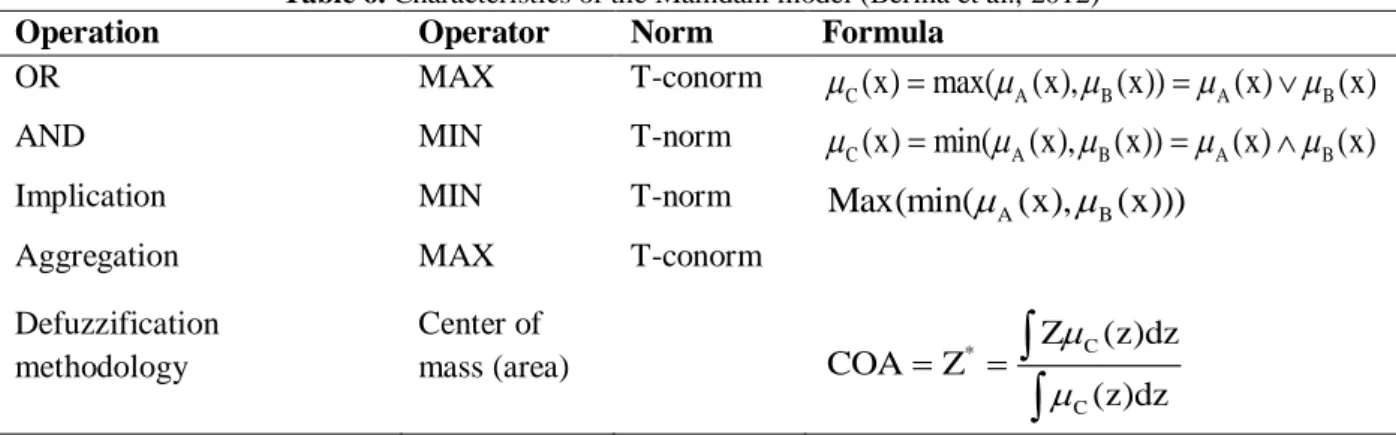
Is the fuzzy output which has to be defuzzified into crisp value by the defuzzification method stated in the next section.Characteristics of the Mamdani model for a fuzzy expert system are explained in table 6.
Table 6. Characteristics of the Mamdani model (Beriha et al., 2012)
Operation Operator Norm Formula
OR MAX T-conorm
C
(x) max(
A(x),
B(x))
A(x)
B(x)
AND MIN T-norm
C
(x)
min(
A(x),
B(x))
A(x)
B(x)
Implication MIN T-norm
A B
Max(min(
(x),
(x)))
Aggregation MAX T-conorm
Defuzzification methodology
Center of
mass (area) * C
C Z (z)dz COA Z (z)dz
3-2-4- DefuzzificationIn fuzzy expert system the output generated by the inference module is always fuzzy in nature. The job of the defuzzifier is to receive the fuzzy input and convert it to the crisp output. In operation, it works opposite to the input block. A defuzzification method combines fuzzy values into one single crisp output value. The center of gravity, one of the most popular methods for defuzzifying fuzzy output functions, is employed in this study. The equation to find the centroid of the combined outputs
i
ˆy
is given by:i i i c i i
c i y (y )dy ˆy
(y )dy
244
Fig 4. Output variable fuzzy set for TCS predicting expert system
4- Performance evaluation
There are three approaches to model validation and any combination of them may be applied as appropriate to the different dimensions of a particular model. These approaches are:
• Expert intuition
• Real system measurements • Theoretical results/analysis.
Comparison with real system measurements is the most reliable and preferred way to validate a designed model (Hillston, 2005).
Accordingly, the proposed prediction model in this study is validated according to the actual samples from several technologies commercialized in different fields that their commercialization status is specified in reality.
In order to validate the prediction model, the following steps are adopted:
4-1- Questionnaire development and sample data collection
A questionnaire containing TCSFs was developed in accordance with Table 3 (the final result of fuzzy Delphi process). The questionnaire collected information based on TCSFs about commercialized technologies. The relevant experts, who were selected from the technology development and commercialization team managers and had the required expertise about the concerned technology, scored the questionnaire components from 0 to 5. Scoring is based on the status of each success component in concerned technology commercialization. Since the questionnaire components are categorized into four different dimensions (including technical specifications, financial and economic specifications, market specifications and the rules and regulations), the components related to each of dimensions was evaluated and scored by an expert being mastered in that dimension of technology to ensure the accuracy of scoring. In some cases, an expert may be competent in two dimensions and scores components of both. For example, the components related to the financial and economic specifications and the market specifications may be scored by an expert.
245
For analyzing collected data, the arithmetic mean of components scores of each dimension is calculated and determined as the score of that dimension. The results of the collected data analysis are applied to the fuzzy expert system as inputs of the prediction model in order to obtain the technology commercialization success status in the output of the model.
As a result, the output of the model or the predicted output, is compared with the actual output obtained in reality and practice for each of the commercialized technologies. To determine the actual output, the same five linguistic terms (Very Low (VL), Low (L), Medium (M), High (H) & Very High (VH)) for the predicted output, are considered. So that the expert involved in the technology commercialization project, who has the greatest knowledge about the status of the technology (can be the manager of the technology commercialization team), determines the actual status of the technology commercialization success according to one of the five linguistic terms. The expert accurately reports the facts as the actual output and do not predict the actual output.
In this study to validate the model, 11 commercialized technologies in different fields, including catalysts, chemical oils, nanotubes, software, smart systems and ICT were investigated.
These technologies were commercialized in 6 technological institutions, including a large research institute affiliated with Iran Ministry of Oil, four private knowledge-based companies active in commercializing technologies and a technology accelerator located at one of the major industrial universities in Iran. The examined commercialized technologies have different statuses in terms of success in commercialization, ranging from very low to high.
4-2- Selecting and applying validation method
The developed fuzzy rule based system is validated using the Hold-Out method.
In this method a dataset D or hold-out set is used to test the model in order to calculate the accuracy. The Hold-out estimated accuracy is defined as:
i i
i i (v ,y ) D
1
Accuracy
(v , y )
N
(8) Where
(v, y) 1
if v = y and 0 otherwise,v
i: is the predicted value of the instance i,y
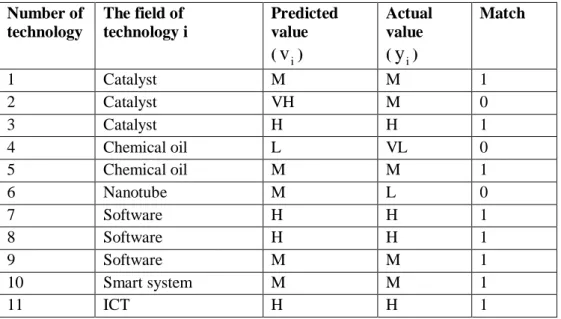
i: is the actual value of the instance i and N is the total number of technology instances examined. (Alhabashneh et al., 2017, Pal et al., 2012).To evaluate the performance of the fuzzy expert system, the predicted outputs of the model are compared with the actual results provided by the relevant experts. Table 7 shows the comparison results of these outcomes. The linguistic terms for the actual output are the same linguistic terms defined for the output of the prediction model.
The prediction model’s performance accuracy is 73%. This shows 73 % of examined technologies were correctly classified in their respective commercialization success classes. Hence, it is said that presented model can predict the status of technology commercialization success with high accuracy. In order to clarify the trend of proposed methodology, figure 1 represents a flowchart of executing the methodology of the whole study.
5- Results and discussion
With review of related literature, 37 components affecting the success of technology commercialization were extracted and classified in four categories. Fuzzy Delphi method via experts’ opinions verified the appropriateness of these factors based on the literature with the real context of technology commercialization in Iranian companies and industries.
Going through two surveys according to fuzzy Delphi method, three new components were added to previous 37 ones; then 8 components were excluded, and finally, 32 components influencing technology commercialization success were specified in four dimensions including technical specifications, financial specifications, market specifications, and rules and regulations. These dimensions of success formed the inputs of the presented prediction model.
The expert system of TCS prediction was applied to 11 commercialized technologies in different fields of technology.
246
On the other hand, the actual output related to the status of the success for the examined technologies was determined by the commercialization teams' managers in terms of the same 5 linguistic terms.
By comparing the predicted results of the model with actual results, the performance of the fuzzy expert system was evaluated and the accuracy of this system was estimated to be 73% (Table 7). The result of the evaluation of the prediction model performance, especially with considering the high dynamism and complexity of the technology commercialization process, suggests that the designed system has a high potential for predicting the commercialization success of a technology.
The prediction method used in this study has a few advantages in comparison with the methods presented in previous research. In studies using the scoring model to evaluate the technology commercialization (e.g., CRA model proposed by DHS (2013) and Cho & Lee (2013)), the scoring model is only tested for one or more sample technologies; however, no validation is performed and the accuracy of the model evaluation is not identified.
In comparison, the performance of the developed system in the present study is evaluated, and the result shows the high accuracy of the prediction.
Table 7. Samples for estimating presented model accuracy
Number of technology
The field of technology i
Predicted value (
v
i)Actual value (
y
i)Match
1 Catalyst M M 1
2 Catalyst VH M 0
3 Catalyst H H 1
4 Chemical oil L VL 0
5 Chemical oil M M 1
6 Nanotube M L 0
7 Software H H 1
8 Software H H 1
9 Software M M 1
10 Smart system M M 1
11 ICT H H 1
Rahal and Rabelo (2006) and Åstebro (2004) used the logistic regression method and Link and Scott (2010) used the probit regression method to predict the commercialization success of innovative and R & D projects. Although in these studies, the accuracy of the calculated prediction for the regression methods is high (94% and 80.9%), regression methods determine the relationship between input data and output results through complex equations and statistical relationships (Link and Scott, 2010). In the present system, the relationship between the input and output is determined by a set of fuzzy logic rules derived from expert knowledge. Furthermore, the dependent variable in the logistic regression method should be considered as binary (e.g. success or failure) (Rahal & Rabelo, 2006); however, the result of the technology commercialization in practice may be beyond these two distinct statuses. Sohn and Moon (2003) used the SEM method to predict the technology commercialization success index. The accuracy was estimated (69.61%) to be lower than the accuracy of the system developed in this study (73%). In addition, the SEM method is sensitive to the sample size. One of the main requirements of this method for the proper implementation and validity of outputs is large sample size (at least 200 samples) (Sohn & Moon, 2003). As noted in this study, 489 commercialization projects completed at the Korea's Information Technology Transfer Center over several years were employed. In the field of technology commercialization, access to such a large sample size for implementing and testing the model is complicated, time consuming and even impossible in some cases. In another study, the artificial neural network approach was used to predict the commercialization success of