The North Carolina Physical Activity
Policy Research Center:
Making Connections with North Carolina Planners
Kelly R. Evenson, Ph.D., Carrie Fesperman, Semra A. Aytur, Ph.D., Austin Brown, Daniel A. Rodríguez, Ph.D., and David Salvesen, Ph.D.
Physical activity is defi ned as any movement of the body that is produced by moving muscles (U.S. Depart-ment of Health and Human Services, 1996). Physical activities include exercise, such as jogging or bicycling for leisure, but also encompass such activities as walk-ing to the bus stop or a store, gardenwalk-ing, or takwalk-ing the stairs instead of the elevator. Health and quality of life can be substantially improved through accumulation of regular amounts of moderate-to-vigorous physical ac-tivity (U.S. Department of Health and Human Services, 1996).
Despite the importance of physical activity, the preva-lence of physical activity remains low. This is espe-cially true in North Carolina, where in 2004 almost 25 percent of adults reported no leisure activity in the past month, such as walking, bicycling, or gardening (Cen-ters for Disease Control and Prevention, 2005a). Fur-thermore, in 2003 almost 35 percent of North Carolina high school students did not participate in at least 20 minutes of vigorous physical activity on three or more of the past seven days, and did not do at least 30 min-utes of moderate physical activity on fi ve or more of
the past seven days (Centers for Disease Control and Prevention, 2005b).
Physical activity participation for youth and adults is suboptimal in North Carolina. There is growing inter-est among policy makers to promote physical activity, yet research in this area is limited. The North Carolina Physical Activity Policy Research Center was established in 2004 to conduct research on physical activity and policy. This cross-disciplinary center brings together faculty and researchers from the University of North Carolina School of Public Health and the College of Arts and Sciences. Current projects include understand-ing and documentunderstand-ing polices that affect walkunderstand-ing and bicyclunderstand-ing to school, trail development, and community planning decisions related to physical activity.
Kelly R. Evenson, Ph.D., is Research Associate Professor at UNC-Chapel Hill in the Department of Epidemiology and the Principal Investigator on this project. For further questions or information on the project, please email [email protected].
Carrie Fesperman will complete her dual master’s degree from the UNC-Chapel Hill Department of City and Regional Planning and the Department of Health Behavior and Health Education in Spring 2006.
Semra A. Aytur, Ph.D., is a Postdoctoral Fellow at UNC-Chapel Hill in the Department of Epidemiology.
Austin Brown holds a dual master’s degree from the UNC-Chapel Hill Department of City and Regional Planning and the Department of Health Behavior and Health Education.
Daniel A. Rodríguez, Ph.D., is Assistant Professor at UNC-Chapel Hill in the Department of City and Regional Planning and a Co-Inves-tigator on this project.
The decision to be physically active is infl uenced by a variety of factors. These include individual factors such as health, motivation, or enjoyment of activity; interper-sonal factors such as social support; environmental fac-tors such as living near sidewalks and trails; and policy factors. There is growing evidence that the built envi-ronment and the policies shaping it infl uence people’s opportunities to integrate physical activity into their daily lives. A report issued by the Transportation Re-search Board and Institutes of Medicine of the National Academies (Committee on Physical Activity, 2005) re-viewed studies from the areas of urban planning, travel behavior, public health, and physical activity. Although the report found that the relationship between the built environment and physical activity is complex and mul-tifaceted, it provided evidence that the built environ-ment can facilitate or hinder physical activity. Some policies that infl uence community characteristics and the built environment include sidewalk conditions, bike paths, street connectivity, population density, land use mix, school siting policies, school acreage standards, congestion, and traffi c volume. Several of these poli-cies are linked to physical activity but have yet to be systematically examined (Saelens et al, 2003; Collins and Kearns, 2003; Ewing et al, 2003). Therefore, the Centers for Disease Control and Prevention (CDC) cre-ated the Physical Activity Policy Research Network in October 2004 to develop a physical activity policy re-search agenda that would bring together interdisciplin-ary research expertise from such fi elds as public health, transportation, urban planning, and architecture.
The North Carolina Physical Activity Policy Research Network
The Network was established as part of the Prevention Research Centers’ program, with funding from the Di-vision of Nutrition and Physical Activity at CDC. As formally established, the network consists of four mem-ber centers (University of North Carolina, Harvard Uni-versity, University of South Carolina, and University
of Washington), one coordinating center and member (St. Louis University), and a group of CDC technical advisors. Since the founding, several other Prevention Research Centers have joined the network as affi liate member centers. More information can be found on-line at http://prc.slu.edu/paprn.htm. The mission of the Physical Activity Policy Research Network is to con-duct transdisciplinary policy research by:
• Identifying physical activity policies • Identifying the determinants of the policies • Describing the process of implementing policies • Determining the outcomes of physical activity
pol-icies
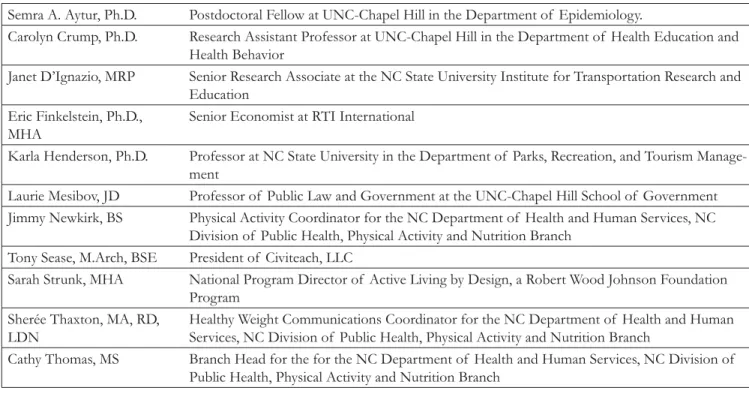
Each member center receives guidance from an advi-sory board. The adviadvi-sory board for the North Carolina Center is comprised of an interdisciplinary team with representatives from planning, transportation, architec-ture, public health, economics, parks and recreation, and law (see Table 1 for listing of current advisory board members).
The North Carolina Physical Activity Policy Research Center is presently working on four physical activity policy-related projects. The fi rst two projects involve collaboration with other centers to study 1) active trans-port to and from school, and 2) trail development. For the other two projects, the center is conducting two case studies of how policy and community planning affect physical activity and health in specifi c counties. A brief description of each project is provided next, along with a summary of research questions pertinent to planners that these projects could address (Table 2).
Project 1: Identifying Policies Affecting Active Trans-port To and From School.
walk-Semra A. Aytur, Ph.D. Postdoctoral Fellow at UNC-Chapel Hill in the Department of Epidemiology.
Carolyn Crump, Ph.D. Research Assistant Professor at UNC-Chapel Hill in the Department of Health Education and Health Behavior
Janet D’Ignazio, MRP Senior Research Associate at the NC State University Institute for Transportation Research and Education
Eric Finkelstein, Ph.D., MHA
Senior Economist at RTI International
Karla Henderson, Ph.D. Professor at NC State University in the Department of Parks, Recreation, and Tourism Manage-ment
Laurie Mesibov, JD Professor of Public Law and Government at the UNC-Chapel Hill School of Government Jimmy Newkirk, BS Physical Activity Coordinator for the NC Department of Health and Human Services, NC
Division of Public Health, Physical Activity and Nutrition Branch Tony Sease, M.Arch, BSE President of Civiteach, LLC
Sarah Strunk, MHA National Program Director of Active Living by Design, a Robert Wood Johnson Foundation Program
Sherée Thaxton, MA, RD, LDN
Healthy Weight Communications Coordinator for the NC Department of Health and Human Services, NC Division of Public Health, Physical Activity and Nutrition Branch
Cathy Thomas, MS Branch Head for the for the NC Department of Health and Human Services, NC Division of Public Health, Physical Activity and Nutrition Branch
Table 1: Advisory Board for the North Carolina Physical Activity Policy Research Center
ing and biking to school are an excellent example of physical activity policy and the commitment of com-munity and school to children’s health. The purpose of this project is to explore the barriers and enablers of active transport policies in a sample of diverse elemen-tary schools. Additionally, the researchers will com-pare and contrast policies and initiatives at the different schools across the United States. Interviews with key informants, such as principals, school board members, physical education teachers, local planners, public safe-ty offi cers, communisafe-ty coordinators, and parent repre-sentatives will provide insight on the important aspects of policies affecting transport to and from school.
Project 2: Exploring Policy Change in the Develop-ment of Community Trails
The development of a multi-use trail is an example of an intervention that could increase physical activity among community residents. The network will be conducting a multi-site case study to explore the policies involved with trail development. Specifi cally, the objectives of the study are to identify the process by which policies
are enacted or changed to facilitate the development of a community trail and to explore differences in policy changes as they relate to diverse locations and popu-lations. The methodology will include examination of historical documentation of trail development and key informant interviews.
Project 3: Community Planning for Health and Physi-cal Activity in North Carolina.
Table 2: Potential Research Questions to be Addressed by Each Project
Project 1: Identifying Policies Affecting Active Transport to and from School
Research Questions
What kind of policies, initiatives, or programs successfully encourage active transport? (e.g., transport/walk zones, school siting, city/school district level coordination with school, Safe Routes to School)
What are the barriers and enablers to active transport policies in the school-community sites being studied? (e.g., lack of adequate pedestrian signage, lack of parental support, lack of support within the school, school siting)
What conditions have to be in place for these policies, initiatives, or programs to be successful? (e.g., pedes-trian/bicycle facilities, interagency coordination, walking culture within area)
Who are the key players in the process and who needs to be included? (e.g., school offi cials, parents, planners, transportation planners)
Project 2: Exploring Policy Change in the Development of Community Trails
Research Questions
Which policies enable or hinder trail development? (e.g., land use policies, SAFETEA-LU funds, local sup-port, city/county government cooperation, zoning changes, use of rail corridors)
Who are the key players in policy change process? (e.g., community groups, city offi cials, planners, transpor-tation planners)
Are there similar factors that facilitate or hinder community trail development across sites?
Are the differences or similarities related to trail characteristics? (e.g., location, length, type, funding)
Project 3: Study Community Planning for Health and Physical Activity in North Carolina
Research Questions
How did the community collaborate with partners such as nonprofi t groups, government offi cials, and univer-sity researchers to develop the comprehensive or town plan?
How do different policy subgroups perceive benefi ts and/or costs to themselves from various aspects of the comprehensive or town plan? How do different policy subgroups perceive benefi ts or costs to other groups?
To what extent has the comprehensive or town plan been implemented?
Which groups or coalitions are still actively involved in planning or other civic processes? How has their role evolved?
How do community members or different groups perceive the value of the spaces created by the plans (e.g., greenways, soccer fi elds, ATV park, community gardens, etc.)?
What are the material (resource-based) results and what are the process-oriented results (e.g., participation in the process, capacity building, empowerment)?
Project 4: Exploring Physical Activity Policies in a Single County
Research Questions
Who are the main advocates of policies that facilitate physical activity in Montgomery County (e.g., planners, environmentalists, health advocacy groups)?
Is physical activity an explicit or an incidental outcome of planning interventions in Montgomery County?
What policies have towns in Montgomery County adopted that encourage people (both children and adults) to be more physically active?
research methods will be used to explore questions such as whether the planning process was used as a means of building community capacity for health, whether the process facilitated dialog across various community co-alitions, the extent to which plan implementation oc-curred, and how different community groups may per-ceive the value of public spaces created by the plans in different ways, especially with respect to interpretations of health.
Project 4: Exploring Physical Activity Policies in Montgomery County, Maryland
The center is also conducting a case study of Montgom-ery County, Maryland, to examine how county policies can infl uence physical activity directly or in unanticipat-ed ways. The project team began by collecting, coding, and relating the land use plans that exist in the county both presently and historically. They followed this with 26 key informant interviews in spring 2005, including land use planners, transportation planners, parks and recreation employees, county and state elected offi cials, and individuals involved in health promotion. Initial results indicate that many offi cials who are engaged in policy-making efforts that affects physical activity do not perceive their roles as being physical activity-relat-ed. In addition, the following elements were found to be important for implementing policy: knowledge and intent, commitment and capacity, coordination, and the existence of a policy champion.
Conclusion
The North Carolina Physical Activity Policy Research Center provides a venue for researchers and profession-als from various disciplines to work together to inform policy research, interventions, and dissemination to im-prove population levels of participation in physical ac-tivity. The goal to study the effectiveness of policies in changing the environment to increase physical activity and to disseminate research fi ndings to policy makers,
practitioners, and researchers is being achieved through several projects. Members of the Policy Research Cen-ter expect to contribute planning- and policy-related evidence to improve the health of North Carolinians.
Across all levels of government, land use and transpor-tation decisions and policies that planners help develop can impact the health of their community. The research conducted thus far demonstrates that planning policies that incorporate health objectives are able to accom-plish a number of other goals as well, including those of greater community sustainability and well-being. The North Carolina Physical Activity Policy Research Cen-ter is available to planners as a resource to help support and inform such policies.
Acknowledgments
Funding for this project is provided by the Centers for Disease Control and Prevention #U48/DP000059-01. Additional funding for the project “Exploring Policy Change in the Development of Community Trails” was provided by the Robert Wood Johnson Foundation Ac-tive Living Research Program.
Works Cited
Centers for Disease Control and Prevention. (2005a). 2004 Behavioral Risk Factor Surveillance System Prev-alence Data.Accessed October 26, 2005 at http://www. cdc.gov/brfss.
Centers for Disease Control and Prevention. (2005b). YRBSS: Youth Risk Behavior Surveillance System. Ac-cessed October 25, 2005 at http://www.cdc.gov/nccd-php/dash/yrbs.
Collins, D.C.A. & Kearns, R. (2001). The safe journeys of an enterprising school: negotiating landscapes of op-portunity and risk. Health & Place, 7, 293–306.
Land Use. (2005). Does the built environment infl u-ence physical activity? Examining the evidu-ence. (Spe-cial Report 282). Washington, D.C.: Transportation Research Board, Institute of Medicine of the National Academies.
Evenson, K., Huston, S., McMillen, B., Bors, P., and Ward, D. (2003). Statewide prevalence and correlates of walking and bicycling to school. Archives of Pediat-ric and Adolescent Medicine, 157, 887-892.
Ewing, R., Schmid, T., Killingsworth, R., Zlot, A., and Raudenbush, S. (2003). Relationship between urban sprawl and physical activity, obesity, and morbidity. American Journal of Health Promotion, 18 (1), 47-57.