ENVISIONING A COMPULSORY-LICENSING
SYSTEM FOR DIGITAL SAMPLES THROUGH
EMERGENT TECHNOLOGIES
CHRISTOPHER R. SABBAGH†
ABSTRACT
Despite the rapid development of modern creative culture, federal copyright law has remained largely stable, steeped in decades of tradition and history. For the most part, copyright finds strength in its stability, surviving the rise of recorded music, software programs, and, perhaps the most disruptive technology of our generation, the internet. On the other hand, copyright’s resistance to change can be detrimental, as with digital sampling. Although sampling can be a highly creative practice, and although copyright purports to promote creativity, current copyright law often interferes with the practice of sampling. The result is a largely broken system: Those who can legally sample are usually able to do so because they are wealthy, influential, or both. Those who cannot legally sample often sample illegally.
Many scholars have suggested statutory solutions to this problem. Arguably, the most workable solutions are rooted in compulsory licenses. Unfortunately, implementing these solutions is practically difficult.
Two recent developments invite us to revisit these proposals. First, with the passage of the Music Modernization Act (“MMA”), Congress has evinced a willingness to “modernize” parts of copyright law. Second, emergent technologies—from the MMA’s musical-works database to blockchain to smart contracts—can be leveraged to more easily implement a compulsory-licensing solution. This time around, rather than simply discuss why this solution is favorable, this Note will focus on how it can be implemented.
Copyright © 2019 Christopher R. Sabbagh.
INTRODUCTION
“Why must I feel like that? Why must I chase the cat?”1
On a late night in January 1982, George Clinton stumbled into a Detroit studio,2
escaping the winter cold.3
Clinton was “feeling pretty good” after a night of partying, so he careened over to the studio’s recording microphone to translate his energy into music.4
While songwriters David Spradley and Garry Shider physically supported Clinton, shifting back and forth to keep him steady in front of the microphone,5 Clinton rattled off lyrics and adlibs, including the now
famous line, “[b]ow wow wow, yippie yo, yippie yea,” creating what would become the funk classic “Atomic Dog.”6
Clinton’s “Atomic Dog” inspired generations of musicians. Its influence united even the most disparate artists, appearing as a “sample” in songs by west-coast hip-hop legend Tupac Shakur7 and
east-coast rap powerhouse The Notorious B.I.G.8
While Clinton’s record “didn’t go gold, . . . it has since helped a lot of other artists go platinum.”9
“Atomic Dog” is a story of cultural influence; the reach of Clinton’s song extends far beyond the song itself.
1. GEORGE CLINTON, Atomic Dog, on COMPUTER GAMES (Capitol Records 1982). 2. Kit O’Toole, DeepSoul: George Clinton - “Atomic Dog,” BLINDED BY SOUND (Oct. 22, 2012, 5:59 PM), blindedbysound.com/features/deepsoul/deepsoul-george-clinton-atomic-dog [https://perma.cc/5V62-KAZA].
3. Bridgeport Music, Inc. v. UMG Recordings, Inc., 585 F.3d 267, 272 (6th Cir. 2009). 4. Id.
5. Id. at 272–73. 6. Id. at 272.
7. See 2PAC, Can’t C Me, on ALL EYEZ ON ME (Death Row Records 1996).
8. BIGGIE SMALLS, Cars, Sex, Rolex, on HIP HOP CLASSICS: CONNECT THA DOT (Charly Records 2006). Clinton especially appreciates Public Enemy’s use of his songs “because when they sample[d] my music they were really clever and made new arrangements from the songs.” Michael A. Gonzales, George Clinton Talks About His Favorite Parliament-Funk Samples, COMPLEX (Jan. 31, 2012), https://www.complex.com/music/2012/01/george-clinton-talks-about-his-favorite-parliament-funkadelic-samples [https://perma.cc/A6G5-MZZX].
9. Gonzales, supra note 8. The artists who sampled Clinton’s work returned the favor by inadvertently revitalizing his career:
Sampling—the practice of taking part of a recording, potentially altering it in some way, and using it in a new recording10
—is foundational for many genres of music, primarily hip-hop and rhythm and blues.11
But why do artists sample tracks like “Atomic Dog”? Many of these musicians instinctually “chase the cat,” looking for the perfect sample to supplement their melodic or lyrical content.12
Some of hip-hop’s most famous songs were created by artists who spent hours digging through record stores, looking for forgotten songs to bring back to life.13
Other artists use samples to communicate thoughts and emotions in a way that a strictly original composition cannot. Kanye West’s “Gold Digger,”14 for example, would arguably not have had the same
cultural impact without Ray Charles’s iconic voice interjecting, “[s]he
W. Michael Schuster, Fair Use, Girl Talk, and Digital Sampling: An Empirical Study of Music Sampling’s Effect on the Market for Copyrighted Works, 67 OKLA. L. REV. 443, 445–46 (2015) (citations omitted).
10. Sampling, BLACK’S LAW DICTIONARY (10th ed. 2014). A more in-depth definition of sampling is provided in Thomas P. Wolf, Note, Toward a “New School” Licensing Regime for Digital Sampling: Disclosure, Coding, and Click-Through, 2011 STAN. TECH. L. REV. N1, N13– N16 (2011).
11. Robert Rogoyski, The Melody Machine: How To Kill Copyright, and Other Problems with Protecting Discrete Musical Elements, 88 J. PAT. & TRADEMARK OFF. SOC’Y 403, 412 (2006). 12. Interestingly, artists have recently found it difficult to uncover good, never-before-used samples. Shawn Setaro, The Musicians Behind Your Favorite Songs Are Coming for Their Credit, COMPLEX (July 30, 2018), https://www.complex.com/music/2018/07/musicians-behind-favorite-songs-coming-for-their-credit [https://perma.cc/YKR8-YNCE]. Producers are meeting this need by composing short melodies specifically made for sampling, provided the producers receive credit and payment for their work. Id. These producers are gaining notoriety and, consequently, making a living in this niche industry. Id.
13. See, e.g., Insanul Ahmed, Noah Callahan-Bever & Toshitaka Kondo, The Making of Mobb Deep’s ‘The Infamous,’ COMPLEX (Apr. 25, 2011), https://www.complex.com/music/2011/ 04/the-making-of-mobb-deep-the-infamous [https://perma.cc/8ZF5-8VVT] (“We was digging in the old record stores, getting our hands dirty, [and] dusty.”); Kathy Iandoli, The Lost Art of Cratedigging, CUEPOINT (Sept. 23, 2014), https://medium.com/cuepoint/the-lost-art-of-cratedigging-4ed652643618 [https://perma.cc/L8A3-TUNV] (“The Roosevelt Hotel Record Conventions were legendary . . . . Everyone from myself to Salaam Remi to Rashad Smith to J Dilla to DJ Premier to Lord Finesse to Showbiz to the Beatminers to 45King to Kid Capri to Q-Tip all under one roof at 7:30 am.”). Unfortunately, not everyone credited the artists of the songs they sampled. See Ahmed et al., supra (“And I’m not telling anybody what sample it was . . . . It’s good and it’s bad because I was reveling in the mystery of the sample, but if people wanted to know so bad then that just shows how much love people have for the track.”). Some of the most heavily sampled artists—like Clyde Stubblefield, whose drumming has been sampled in “over 1,300 songs”—have received next to nothing for their work. Adrian York, The Story of the Funky Drummer: The Most Exploited Man in Modern Music, CONVERSATION (Mar. 2, 2017, 5:51 AM), http://theconversation.com/the-story-of-the-funky-drummer-the-most-exploited-man-in-modern-music-73473 [https://perma.cc/4MNS-LWZ4].
gives me money when I’m in need.”15 Similarly, Selena Gomez’s “Bad
Liar”16
would likely not produce the same unsettling feeling without the Talking Heads’s eerie bass line thumping throughout the song.17
Ultimately, these incentives ushered a new art form into the forefront of American music.
By the late 1980s, sampling had permeated popular genres, like hip-hop, and forced itself into the public discourse. But the growth of sampling was met with an unfortunate reaction—over time, copyright law ate away at sampling’s prominence. Under the modern system, copyright law automatically grants protection to creative, original works upon their fixation.18
Should an artist wish to sample a copyrighted song, she must license its copyright from the copyright owner.19
If she samples the song without licensing its copyright— whether that occurs because the copyright owner refuses to license the copyright, because the license is too expensive for the artist, or because the artist chooses not to contact the copyright owner—then, the copyright owner can sue for copyright infringement.20
Unless the artist can invoke one of the available defenses to copyright infringement,21 the court may rule against the artist, issue an
injunction,22
and require the defendant to pay damages.23
Until recently, defendants often could not employ a highly-applicable defense—the de minimis defense—because of a Sixth Circuit case that
15. RAY CHARLES, I Got a Woman, on RAY CHARLES (Atlantic Records 1957). For more information on the interesting relationship that “Gold Digger” has with copyright law, see generally JAMES BOYLE, THE PUBLIC DOMAIN: ENCLOSING THE COMMONS OF THE MIND 122 (James Boyle ed., 2008).
16. SELENA GOMEZ, Bad Liar (Interscope Records 2017).
17. TALKING HEADS, Psycho Killer, on TALKING HEADS: 77 (Sire Records 1977); see Luke M. Britton, David Byrne Responds to Selena Gomez Sampling Talking Heads on ‘Bad Liar,’ NEW MUSICAL EXPRESS (May 18, 2017, 9:58 PM), https://www.nme.com/news/music/david-byrne-responds-selena-gomez-sampling-talking-heads-bad-liar-2073673 [https://perma.cc/FBW9-C2P6] (discussing the Talking Heads’s positive response to Gomez sampling its song).
18. See Copyright Act, 17 U.S.C. § 102(a) (2018) (“Copyright protection subsists, in accordance with this title, in original works of authorship fixed in any tangible medium of expression . . . .”).
19. Otherwise, the artist would infringe on one or more of the exclusive rights granted to copyright owners. Id. § 106.
20. Id. § 501(a).
21. See 4 MELVILLE B. NIMMER & DAVID NIMMER, NIMMER ON COPYRIGHT § 13.05–13.09 (2010) (detailing possible defenses).
implied sampling without a license is always illegal.24 However, in 2016,
the Ninth Circuit heard its own sampling case, affirmed a finding of de minimis use, and created a circuit split.25 Because the Supreme Court
and Congress have yet to resolve the split, the uncertainty caused by these cases has largely stymied the practice of sampling, creating two cognizable costs. First, by discouraging sampling, copyright law undermines the interest it purports to promote—creativity. Second, copyright law creates artificially high costs that can cause legal
samplers to suffer a net-monetary loss on their projects, despite commercial and critical success.
Possible legislative solutions exist. For example, compulsory licenses, which would automatically grant artists the right to use a song—without requiring approval of the copyright owner—upon the satisfaction of certain conditions, are a promising solution. In fact, a compulsory-licensing system currently fuels the market for cover songs—recordings in which an artist performs a rendition of an already existing song—and arguably benefits all parties involved. To reduce costs and truly serve the interests of copyright law, a similar system should be implemented for digital sampling.
Granted, a compulsory-licensing system for digital samples would likely be less effective than the compulsory-licensing system for cover songs. Specifically, service providers, like YouTube, Spotify, and the Harry Fox Agency, often facilitate the licensing process for covers, allowing legally unsophisticated individuals to participate in the cover market. For several reasons, providing a similar service for digital samples is more complex. This complexity could dissuade service providers from assisting legally unsophisticated individuals and ultimately leave sampling where it is today—as a pervasive, largely illegal practice. This Note argues that three emergent technologies— the Music Modernization Act (“MMA”) database, blockchain, and smart contracts—provide a workable avenue for implementing a compulsory-licensing solution despite these potential difficulties.
The argument proceeds in four parts. Part I explores how copyright law and digital sampling interact in statute and in court. Part II asserts that the current system creates two cognizable costs: (1) creative costs; and (2) financial costs. Part III describes a possible solution to this problem—a compulsory-licensing system—and outlines the difficulties in implementing this solution for digital
sampling. Finally, Part IV argues that emergent technologies, specifically the MMA database, blockchain, and smart contracts, could facilitate this solution in spite of these difficulties.
I. THE LAW: COPYRIGHT’S INCONGRUENCE WITH SAMPLING
The modern copyright system often clashes with sampling, even though copyright purports to promote creativity. This Part introduces the issue in two steps. First, it provides an overview of the portions of copyright law that govern sampling. Second, it discusses how courts have interpreted these provisions to respond to sampling’s prevalence, focusing on two divergent appellate court decisions.
A. Statutory Background
Copyright law is rooted in the constitutional power to “promote the Progress of Science and useful Arts”;26
in practice, copyright encourages creativity by granting creators limited monopolies in their original works.27
Without these government-sanctioned monopolies, the reasoning goes, individuals could easily steal and distribute creative media—from the words that compose a book to the sounds that make up a song.28 And, if this became prevalent, a slippery slope could result:
creators might generate less revenue from their works, making it harder to earn a living off their practice, potentially forcing them to stop producing any creative media at all, and, ultimately, depriving the public of creative works altogether.29 Therefore, to protect creative
expression, two copyrights are granted when an original musical work is “fixed” in a tangible medium30: (1) a sound-recording copyright,
which protects the actual audio that is stored in a music file; and (2) a
26. U.S. CONST. art. I, § 8, cl. 8.
27. Sony Corp. of Am. v. Universal City Studios, Inc., 464 U.S. 417, 429 (1984).
28. See BOYLE, supra note 15, at 2–4 (explaining that intellectual property is easy to steal because it is nonexcludable and nonrivalrous).
29. See Sony, 464 U.S. at 429 (“[The monopoly] is intended to motivate the creative activity of authors and inventors by the provision of a special reward, and to allow the public access to the products of their genius after the limited period of exclusive control has expired.”); Jennifer Jenkins, In Ambiguous Battle: The Promise (and Pathos) of Public Domain Day, 2014, 12 DUKE L. & TECH. REV. 1, 6 (2013) (“Copyright’s central economic rationale is that exclusive rights spur creativity.”). But see Glynn S. Lunney, Jr., Copyright Lost, 59 IDEA: INTELL. PROP. L. REV. 193, 198 (2018) (“Sure, copyright generated market power, . . . [b]ut, more critically, it also reduced creative authorship.”).
musical-composition copyright, which protects the sequence and pattern of notes, often represented through sheet music.31
Unlicensed sampling often infringes on at least one of these two copyrights because the sample is either an unauthorized reproduction of the original song or a derivative work based on the original.32
For many years, most musicians simply ignored copyright law and sampled freely.33
Once courts determined that sampling copyrighted works constituted prima facie copyright infringement, three options became available to potential samplers. First, they could sample works that are in the public domain. Second, these artists could attempt to license or purchase the copyrights in the sounds they sampled.34
Third, they could rely on an available copyright-infringement defense. The two most relevant defenses for sampling are fair use35
and de minimis use.36
Fair use—an “equitable rule of reason”37—is a prominent defense that
restricts copyright protections by permitting certain forms of infringement.38 Unfortunately, fair use rarely applies to samples unless
the use of the sample provides some form of commentary on the
31. Jeremy Beck, Music Composition, Sound Recordings and Digital Sampling in the 21st Century: A Legislative and Legal Framework to Balance Competing Interests, 13 UCLA ENT. L. REV. 1, 20 (2005).
32. See Newton v. Diamond, 388 F.3d 1189, 1192–93 (9th Cir. 2004) (determining that significant unauthorized use constitutes copyright infringement).
33. See Mark Tavern, 8 Possible Reasons Why De La Soul’s Problems Are ‘3 Feet High and Rising,’ DJBOOTH (Feb. 28, 2019), https://djbooth.net/features/2019-02-28-de-la-soul-three-feet-high-and-rising-contract-problems [https://perma.cc/9XZU-ANHK] (“Unauthorized samples were rampant in early hip-hop, and copyright law was untested as a means to stop them.”).
34. 17 U.S.C. § 201(d). As Part II will discuss, this option is the modern approach to legal sampling, but it carries significant costs that can diminish creativity and create a significant financial burden.
35. 17 U.S.C. § 107.
36. De minimis use is not explicitly found in the Copyright Act as it is a judicially created doctrine. See Newton, 388 F.3d at 1193 (outlining the de minimis doctrine).
37. Sony Corp. of Am. v. Universal City Studios, Inc., 464 U.S. 417, 448 (1984) (quoting H.R. REP. NO. 94-1476, at 65 (1976), as reprinted in 1976 U.S.C.C.A.N. 5659, 5679).
sampled work.39 Even then, the defense’s success is highly variable,40
making it—at best—a last resort.41
De minimis use makes sampling unactionable when the portion copied is “small and . . . insignificant” and does not result in demonstrable harm.42
While seemingly the perfect defense for most samples, judicial interpretation of the de minimis defense, as applied to the sound-recording copyright,43
has placed it in legal limbo. District courts have straddled the issue; some have permitted the de minimis defense,44
while others have denied it.45
Appellate courts have followed suit: the two courts that have addressed this issue have reached opposite conclusions, creating a circuit split and making the viability of the de minimis defense as uncertain and unreliable as fair use.
B. Case Law Background
1. “Thou Shalt Not Steal.”46
The first appellate decision on the applicability of the de minimis defense to sampling-based infringement of the sound-recording copyright came from the Sixth Circuit in
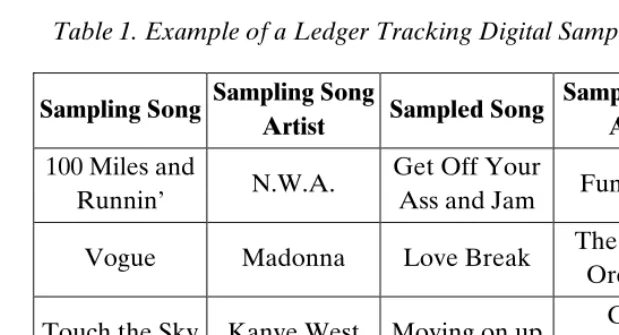
Bridgeport Music, Inc. v. Dimension Films.47 Bridgeport involved a
sample of a two-second guitar solo from “Get Off Your Ass and Jam”
39. See, e.g., Estate of Smith v. Cash Money Records, Inc., 253 F. Supp. 3d 737, 749–50 (S.D.N.Y 2017) (finding that defendant’s sample is permitted by fair use because it “fundamentally alters the message of the original work”).
40. See Max Foreman, How Music Copyright Works: Sampling, Covers, Mixtapes & Fair Use, PRO AUDIO FILES (Mar. 22, 2018), https://theproaudiofiles.com/music-copyright [https://perma.cc/7YAZ-N5WZ] (“By these guidelines, even parody artists have to walk a fine line. For example, Weird Al Yankovic’s parody songs may qualify as fair use, but he still receives written permission to parody copyrighted works . . . .”).
41. See Mike Schuster, David Mitchell & Kenneth Brown, Sampling Increases Music Sales: An Empirical Copyright Study, 56 AM. BUS. L.J. 177, 200 (2019) (“In light of the perceived unpredictability of copyright cases and harsh consequences of losing (supracompensatory damages and injunctive relief), risk averse record companies usually settled.”).
42. Warner Bros. Inc. v. Am. Broad. Cos., Inc., 720 F.2d 231, 242 (2d Cir. 1983).
43. Courts have also discussed the doctrine’s applicability to the musical-composition copyright. See, e.g., Newton v. Diamond, 388 F.3d 1189, 1190 (9th Cir. 2004) (“This appeal raises the . . . issue of whether . . . the practice of ‘sampling,’ requires a license to use . . . the composition of the original recording.”). This Note will focus on the sound-recording copyright.
44. See, e.g., Poindexter v. EMI Record Grp. Inc., No. 11 Civ. 559(LTS)(JLC), 2012 WL 1027639, at *4 (S.D.N.Y. Mar. 27, 2012) (determining that sampling a single note is a de minimis use).
45. See, e.g., Grand Upright Music Ltd. v. Warner Bros. Records, Inc., 780 F. Supp. 182, 183 (S.D.N.Y. 1991) (holding that defendants’ conduct in a music copyright case is not excusable just because “stealing is rampant in the music business”).
46. Id.
by Funkadelic,48 which was pitched down and looped throughout the
song “100 Miles and Runnin’” by N.W.A.49
At the district court level, the federal judge granted summary judgment to the defendant after finding that the sample at issue was de minimis and therefore not actionable.50 In its decision, the district court applied the “fragmented
literal similarity” test,51
which determines whether a sample is de minimis by evaluating the sample’s qualitative and quantitative significance in the original work.52
The more significant the sample is to the original source, the less likely a de minimis defense will succeed.53
The district court judge found that the sample was so quantitatively minor that “no reasonable juror, even one familiar with the works of George Clinton, would recognize the source of the sample without having been told of its source.”54
On appeal, the Sixth Circuit considered whether samplers could invoke the de minimis defense at all.55
In holding they cannot, the court turned to the Copyright Act’s provision that limits the exclusive rights granted via sound-recording copyrights.56
One of these limits permits artists to imitate copyrighted sounds as long as the imitation does not sample the original sound recording57
: “The exclusive rights of the owner of copyright in a sound recording . . . do not extend to the making or duplication of another sound recording that consists entirely
of an independent fixation of other sounds, even though such sounds
48. Ironically, given Clinton’s apparent support for artists who sample his songs, the publishing company that owns the copyrights to Clinton’s music, like “Get Off Your Ass and Jam,” is often on the plaintiff’s side of copyright-infringement cases. See, e.g., Bridgeport Music, Inc. v. UMG Recordings, Inc., 585 F.3d 267, 272 (6th Cir. 2009); Bridgeport Music, Inc. v. Rhyme Syndicate Music, 376 F.3d 615, 619 (6th Cir. 2004).
49. Bridgeport Music, Inc. v. Dimension Films, 410 F.3d at 795–96; see Archive of Songs at Issue in Bridgeport, MUSIC COPYRIGHT INFRINGEMENT RESOURCE, http://mcir.usc.edu/cases/ 2000-2009/Pages/bridgeportdimension.html [https://perma.cc/LE6W-4HQM] (providing users the ability to listen to portions of the songs at issue).
50. Bridgeport Music, Inc. v. Dimension Films, 410 F.3d at 797–98. 51. Id. at 797.
52. Mark R. Carter, Applying the Fragmented Literal Similarity Test to Musical-Work and Sound-Recording Infringement: Correcting the Bridgeport Music, Inc. v. Dimension Films Legacy, 14 MINN. J.L. SCI. & TECH. 669, 678 (2013).
53. See NIMMER, supra note 21, § 13.03[A][2][a] (“If . . . the similarity is only as to nonessential matters, then a finding of no substantial similarity should result.”).
54. Bridgeport Music, Inc. v. Dimension Films, 410 F.3d at 798. 55. Id.
56. Id.
imitate or simulate those in the copyrighted sound recording.”58 In
other words, if an artist independently recreates portions of a song with his own voice and instruments, even if the recreation sounds identical to the original recording, then he does not violate the sound-recording copyright. The Sixth Circuit then inferred the inverse of this provision’s conditional, concluding: if an artist recreates a portion of a song that is not entirely independent—by sampling—then he violates the sound-recording copyright.59
Therefore, the court reasoned, samplers cannot invoke the de minimis defense at all.60
The Sixth Circuit’s message was unequivocal—“[g]et a license or do not sample.”61
The unanimous opinion even went so far as to invoke biblical language from a prominent district court decision on digital sampling: “Thou shalt not steal.”62
Although the court emphasized that its decision was not guided solely by interests of judicial economy,63 its
desire to reduce difficult-to-decide digital-sampling litigation was evident—Bridgeport was merely one of nearly five hundred copyright-infringement claims that the plaintiffs brought against approximately eight hundred defendants.64 The Sixth Circuit specifically noted that its
easy-to-enforce rule65
would be especially helpful considering the sheer quantity of digital-sampling cases that require “mental, musicological, and technological gymnastics” to resolve.66
2. Opening the Door for De Minimis Analysis in Sampling.
Bridgeport stood for over ten years as the sole federal appellate decision on this issue. Then, in 2016, the Ninth Circuit threw its hat in the ring with its decision in VMG Salsoul, LLC v. Ciccone.67 VMG Salsoul presented the perfect case to advocate for de minimis analysis in digital sampling; at issue was a 0.23-second sample of horns from the song “Love Break” that was modified and used in two versions of
58. 17 U.S.C. § 114(b) (emphasis added).
59. See Bridgeport Music, Inc. v. Dimension Films, 410 F.3d at 800–01 (“In other words, a sound recording owner has the exclusive right to ‘sample’ his own recording.”).
60. Id. at 798. 61. Id. at 801.
62. Id. at n.12 (quoting Grand Upright Music Ltd. v. Warner Bros. Records, Inc., 780 F. Supp. 182, 183 (S.D.N.Y. 1991)).
63. Id. at 803. 64. Id. at 795. 65. Id. at 801. 66. Id. at 802.
Madonna’s “Vogue.”68 Two different “horn hits”—quick, abrupt notes
or chords played by horn instruments—are used in “Vogue”: a single horn hit, in which the chord is played one time; and a double horn hit, in which the chord is played two times in quick succession.69
In one version of “Vogue,” the horn hits are used a total of four times;70 in the
other, the horn hits are used six times.71
The Ninth Circuit determined that the sample was de minimis because a reasonable juror could not find that an average listener would recognize the horn hit sample.72
The court emphasized that the defendants, when sampling “Love Break,” truncated and transposed the horn hits and that the sample was mixed in with other sounds and effects.73 Interestingly, the court was persuaded to support the
defendants’ position by the plaintiff’s expert witness.74
Originally, the plaintiff’s expert concluded that the double horn hit was sampled directly from the plaintiff’s sound recording.75
However, after listening to an isolated version of the horn hits from both “Vogue” and “Love Break,” the expert concluded that his earlier assertion was wrong.76
The double horn hit in “Vogue” was actually a duplication of the single horn hit in “Love Break,” rather than a direct sample of the double horn hit in “Love Break.”77 The court decided that if the plaintiff’s
expert—an individual who specializes in analyzing samples—could not correctly identify the source of a sample, then an average listener would do no better.78
After determining that the sample was de minimis, the Ninth Circuit considered whether the Copyright Act permits the de minimis
68. Id. at 874. Defendants disputed the claim that they sampled from the plaintiff’s song. Id.
at 877. However, viewing the facts in the light most favorable to the plaintiff, the court found “sufficient evidence (including direct evidence) to create a genuine issue of material fact as to whether copying in fact occurred.” Id.; see Archive of Songs at Issue in VMG Salsoul, MUSIC COPYRIGHT INFRINGEMENT RESOURCE, http://mcir.usc.edu/cases/2010-2019/Pages/vmgsalsoul vmadonna.html [https://perma.cc/H6ER-WLHM] (providing users the ability to listen to portions of the songs at issue).
69. VMG Salsoul, 824 F.3d at 875–76. 70. Id. at 876.
71. Id.
72. Id. at 880. 73. Id.
74. Id.
75. Id.
76. Id.
77. Id.
defense in sampling.79 The court began by stating that no other
copyright case has abrogated the de minimis doctrine except for
Bridgeport and its progeny.80 Then, focusing on the text of the
Copyright Act, the court found that Congress intended to treat sound recordings like all other protected works.81 Thus, in the Ninth Circuit’s
view, the Sixth Circuit’s decision to differentiate sound recordings from all other mediums by denying it the de minimis defense was incorrect. The Ninth Circuit further reasoned that § 114(b), which allows artists to imitate copyrighted sounds as long as they do not sample the original recording, does not prohibit sampling generally.82 The Sixth
Circuit, the court argued, committed a logical fallacy by inferring the inverse of § 114(b)’s conditional to arrive at its conclusion.83 Rather,
the statute simply limits the existing exclusive rights granted to copyright owners by permitting artists to imitate sounds without fear of infringement.84
The court argued that legislative history supported this particular reading of the section.85 Specifically, a House Report
stated that “infringement takes place whenever all or any substantial portion of the actual sounds . . . are reproduced in phonorecords . . . .”86
By limiting infringement to “all or any substantial portion of the actual sounds,” Congress intended to secure the de minimis defense for digital samples since a de minimis sample is not, by definition, a “substantial portion” of the recording.87
II. THE PROBLEM: COSTS CREATED BY CURRENT LAW
It is difficult to determine whether, or the extent to which,
Bridgeport and VMG Salsoul have impacted digital sampling, especially since few subsequent judicial analyses have tackled the issue. Despite this dearth of opinions, some individuals contend that
Bridgeport exacerbated modern “clearance culture” and reduced
79. Id.
80. Id. at 881.
81. Id. at 881–82 (quoting Copyright Act, 17 U.S.C. § 102 (2018)). 82. Id. at 883 (quoting 17 U.S.C. § 114(b)).
83. Id. at 884; see supra notes 56–60 and accompanying text.
84. VMG Salsoul, 824 F.3d at 883. Importantly, this rule only applies to sound-recording copyrights. 17 U.S.C. § 114. An artist that wishes to mimic copyrighted sounds would likely still have to license or purchase the musical-composition copyright associated with the work.
85. VMG Salsoul, 824 F.3d at 883.
86. Id. (quoting H.R. REP. NO. 94-1476, at 106 (1976), as reprinted in 1976 U.S.C.C.A.N. 5659, 5721 (emphasis in original)).
sampling’s prevalence.88 Indeed, the decrease in mainstream musicians
participating in the practice89
and anecdotes from samplers suggest that a discord between digital sampling and copyright persists. This Part presents two of these anecdotes and discusses the costs that they identify.
A. Creative Costs
“Common are speakers who honor the scroll Scrolls written daily creates a new sound.”90
Perhaps no musical group better embraced the practice of sampling than 1980s hip-hop outfit De La Soul did on its debut album
3 Feet High and Rising. The album is composed almost entirely of samples—over seventy to be exact91—repurposing everything from
drum patterns to television skits.
Despite 3 Feet High and Rising’s cultural influence, the album is nearly impossible to legally find online;92 a result of the complexities of
copyright licenses. Although the group did license the samples on 3 Feet High and Rising and other early albums, the licenses applied only to “vinyl and cassette,” a narrow designation that does not encompass online streaming services.93 These albums are so sample-heavy that the
label that owns them is both hesitant to release them digitally and reluctant to try to “clear” all of their samples, or procure all the necessary licenses.94
These samples are likely much more expensive to
88. E.g., Christian Palmieri & Monica B. Richman, Music Sampling: Has the Tune Changed?, 35 ASS’N CORP. COUNS. DOCKET, no. 1, 2017, at 52, 54; Christopher Weldon, Note,
The De Minimis Requirement as a Safety Valve: Copyright, Creativity, and the Sampling of Sound Recordings, 92 N.Y.U. L. REV. 1261, 1277 (2017); Wolf, supra note 10, at N25. Recently, the European Court of Justice ruled on a sampling case that may further restrict sampling on an international level. See Kraftwerk Win 20-Year Sampling Case over Metal on Metal, BBC (July 30, 2019), https://www.bbc.com/news/entertainment-arts-49162546 [https://perma.cc/JTF4-LQ5G] (providing an overview of the case).
89. KEMBREW MCLEOD & PETER DICOLA, CREATIVE LICENSE: THE LAW AND CULTURE OF DIGITAL SAMPLING 161 (2011).
90. DE LA SOUL, The Magic Number, on 3 FEET HIGH AND RISING (Warner Bros. Records 1989).
91. Mark Savage, Three Feet High and Missing: Why De La Soul’s Albums Aren’t Available Online, BBC (Aug. 13, 2016), https://www.bbc.com/news/entertainment-arts-37020559 [https://perma.cc/MNF9-DHTW].
92. Id.
93. Id.
license today than they were at the time of the albums’ initial releases,95
and missing even the most minor sample could result in a costly lawsuit.96 As a result, De La Soul’s early albums can only be streamed
through illegal, low-quality sources that provide no monetary compensation to the group.97
Since confronting this legal roadblock, De La Soul has drastically changed how it creates music. On 3 Feet High and Rising and other early albums, De La Soul “honor[ed] the scroll,” or used samples to pay homage to its predecessors, ultimately “creat[ing] a new sound” that was patently its own. The group’s recent work98 sounds vastly
different, likely due to its new creative direction. Rather than gamble with sampling other artists’ music, De La Soul decided to sample its
own music.99
For three years, De La Soul recorded “free-styled, unrehearsed, jam sessions” that it later chopped up and manipulated into new music.100
While De La Soul’s revival has received generally
95. Matthew Newton, Is Sampling Dying?, SPIN (Nov. 21, 2008), https://www.spin.com/2008/11/sampling-dying [https://perma.cc/54QL-EF5A] (“‘In the old days, samples were $2,500 or $1,500,’ says RZA. ‘I paid $2,000 for a Gladys Knight sample . . . . That was a big intro, and the hook was repetitious. Something like that nowadays would cost $10,000.’”).
96. For example, the VMG Salsoul parties accrued at least three years of legal fees. See
VMG Salsoul, LLC v. Ciccone, No. CV 12-05967 BRO(CWx), 2013 WL 8600435 (C.D. Cal. Dec. 2, 2013), aff’d 824 F.3d 871 (9th Cir. 2016).
97. Savage, supra note 91. Eventually, De La Soul decided to briefly give away its unavailable works, like 3 Feet High and Rising, for free. Tom Barnes, De La Soul Talks the Group’s Bold New Album and Legendary Past, MIC (Apr. 10, 2015), https://mic.com/articles/115016/de-la-soul-talks-the-group-s-bold-new-album-and-legendary-past#.sFwk5mbtM [https://perma.cc/JZ36-3DH2]. A year following the release, the group had yet to receive any major backlash. Id. Recently, De La Soul’s record label announced it would digitally release De La Soul’s early discography. Tavern, supra note 33. However, these releases have since been postponed indefinitely. Id. A recent Facebook post from De La Soul indicates that they will never be released. De La Soul, FACEBOOK (Aug. 8, 2019), https://www.facebook.com/353220391381474/posts/2309715455731948 [https://perma.cc/XW3E-U97D].
98. De La Soul’s latest album, and the Anonymous Nobody…, was funded through a Kickstarter crowdsourcing campaign that raised over $600,000. Kickstarter Page for De La Soul’s
and the Anonymous Nobody… Campaign, KICKSTARTER, https://www.kickstarter.com/ projects/1519102394/de-la-souls-new-album [https://perma.cc/UMS6-TSHA].
99. Id.
positive reviews,101 it does not seem poised to match the cultural
impact102
or commercial success103
of De La Soul’s early albums.
Depending on one’s frame of reference, De La Soul’s metamorphosis is either a sensible adaptation or an artistic tragedy. At least from the perspective of the sampled artists, copyright served its purpose: copyright defended the artists’ work from an unauthorized, uncompensated taking and protected their pecuniary interest in the growing market for licensing samples. On the other hand, from De La Soul’s perspective, the copyright system appeared to work contrary to its animating purpose: rather than encourage De La Soul’s creative expression, copyright stifled it by preventing De La Soul from legally proliferating and monetizing its original sample-heavy style.
This balance between economic protectionism and creative stimulation is precarious, and courts and legislators should be especially cognizant of it when defining the line between infringement and noninfringement.104
Case law and legislative history indicate that a thumb is placed on the scale in favor of the De La Souls of the music industry: While the immediate effect of copyright is to compensate creators, its ultimate goal is to benefit the public by promoting
101. See, e.g., Stereo Williams, Review: De La Soul, Still Rising After All These Years on ‘and the Anonymous Nobody…,’ SPIN (Aug. 22, 2016), https://www.spin.com/2016/08/review-de-la-soul-and-the-anonymous-nobody [https://perma.cc/K9ME-L267] (“[T]he Long Island rap legends decided to forego heavy sampling and studio synth shortcuts . . . . As a result of that approach . . . De La Soul have [sic] delivered one of their [sic] most ambitious and consistently rewarding albums.”). But see Nate Patrin, De La Soul and the Anonymous Nobody… Review, PITCHFORK (Sept. 3, 2016), https://pitchfork.com/reviews/albums/22353-and-the-anonymous-nobody [https://perma.cc/8H5M-PHYH] (“The live-band production and original musical composition is a good juke around any worries about sample rights . . . . [B]ut when it takes one of the greatest producers ever . . . to make a cut sound alive, it’s easy to wish the rest of the album had more to work with.”).
102. See, e.g., 500 Greatest Albums of All Time, ROLLING STONE (May 31, 2012, 2:45 PM), https://www.rollingstone.com/music/music-lists/500-greatest-albums-of-all-time-156826/de-la-soul-3-feet-high-and-rising-47355 [https://perma.cc/CHL5-ZG5T] (listing 3 Feet High and Rising
at number 346).
103. 3 Feet High and Rising sold half a million copies in four months and is currently certified platinum (one million lifetime sales). Gold & Platinum, RIAA, https://www.riaa.com/gold-platinum [https://perma.cc/MSM7-69AV] (search “3 Feet High and Rising” and click “more details”). Although and the Anonymous Nobody… had a strong debut, it has yet to reach the half a million mark two years after its release. See id. (click “advanced search” and search “De La Soul” in the “artist” box) (listing the De La Soul albums that have sold more than 500,000 copies—a list that does not include and the Anonymous Nobody…).
creativity.105 Rewarding the copyright owner through private benefits
is “a secondary consideration.”106
Indeed, creators “must be permitted to build upon and refer to the creations of prior thinkers”107 to
“promote the Progress of Science and useful Arts.”108
Yet, for some reason, these considerations do not seem to extend to artists who sample.
B. Financial Costs
“They say I got the city on fire I ain’t boomin’, that’s a goddamn lie.”109
In late September of 2016, Detroit rapper Danny Brown released his fourth album, Atrocity Exhibition.110
The album was universally acclaimed.111 Critics ranked Atrocity Exhibition higher than some of
the year’s blockbuster albums, such as Kanye West’s The Life of Pablo112 and Ariana Grande’s Dangerous Woman,113 despite Brown’s
abrasive voice, content, and style.114
Brown seemed poised to establish
105. Sony Corp. of Am. v. Universal City Studios, Inc., 464 U.S. 417, 429, 432 (1984). 106. Id. at 429 (quoting United States v. Paramount Pictures, 334 U.S. 131, 158 (1948)).
107. Princeton Univ. Press v. Mich. Document Servs., Inc., 74 F.3d 1512, 1518 (6th Cir. 1996),
rev’d en banc on other grounds, 99 F.3d 1381 (6th Cir. 1996). 108. U.S. CONST. art. I, § 8, cl. 8.
109. DANNY BROWN, Really Doe, on ATROCITY EXHIBITION (Interscope Records 2017) (featuring a verse and chorus by Kendrick Lamar).
110. Christopher R. Weingarten, Danny Brown Details New LP ‘Atrocity Exhibition,’
ROLLING STONE (Aug. 16, 2016, 1:02 PM), https://www.rollingstone.com/music/music-news/danny-brown-details-new-lp-atrocity-exhibition-252309 [https://perma.cc/QB2D-6ZAK].
111. Reviews for Danny Brown’s Atrocity Exhibition, METACRITIC, https://www.metacritic.com/music/atrocity-exhibition/danny-brown [https://perma.cc/3VSZ-BJS8?type=image] (awarding Atrocity Exhibition a score of eighty-five as of September 10, 2019). Metacritic is a website that collects critics’ reviews for different types of media, including music albums, and compiles the scores into one “metascore.” About Metacritic, METACRITIC, https://www.metacritic.com/about-metacritic [https://perma.cc/3X54-YZW4?type=image].
112. Reviews for Kanye West’s The Life of Pablo, METACRITIC, https://www.metacritic.com/ music/the-life-of-pablo/kanye-west [https://perma.cc/5M4K-2X5F?type=image] (awarding The Life of Pablo a score of seventy-five as of September 10, 2019).
113. Reviews for Ariana Grande’s Dangerous Woman, METACRITIC, https://www.metacritic.com/music/dangerous-woman/ariana-grande [https://perma.cc/LC82-5XXY?type=image] (awarding Dangerous Woman a score of seventy-six as of September 10, 2019).
himself as a top artist in hip-hop, but monetary concerns would soon threaten to jeopardize the unique quality of his work. Almost two years after the release of his album, Danny Brown tweeted (and subsequently deleted): “Never spend 70k on samples for an album that no one buys cause you will be in debt.”115
Although some courts insisted that the market for samples would self-regulate,116
the sampling industry has instead created an artificially high financial barrier to entry. Rather than toe an uncertainly drawn line and risk costly litigation, established musicians are forced to shell out big money for licenses and frequently delay albums to clear samples.117
For smaller artists, licensing is often not an option. First, many smaller artists are outright denied the opportunity to negotiate a licensing fee.118
Those who are permitted to negotiate usually must produce a recording that demonstrates how and what percentage of the song is going to be sampled prior to receiving permission.119
If the
115. See Brian “Z” Zisook, Danny Brown: “Never Spend $70k on Samples for an Album That No One Buys,” DJBOOTH (July 8, 2018), https://djbooth.net/features/2018-07-08-danny-brown-regrets-spending-70k-on-samples [https://perma.cc/ER56-XA28] (immortalizing Danny Brown’s words).
116. See Bridgeport Music, Inc. v. Dimension Films, 410 F.3d 792, 801 (6th Cir. 2005) (“[T]he market will control the license price and keep it within bounds. The sound recording copyright owner cannot exact a license fee greater than what it would cost the person seeking the license to just duplicate the sample in the course of making the new recording.”).
117. E.g., Miles Bowe, Kamaiyah’s Don’t Ever Get It Twisted Mixtape Delayed due to Sample Clearance Issues, FACT (Apr. 20, 2017), https://www.factmag.com/2017/04/20/kamaiyah-dont-ever-get-it-twisted-mixtape-delayed-due-to-sample-clearance-issues
[https://perma.cc/83L7-6Z3N]; Josiah Hughes, Wale’s Attention Deficit Gets Delayed over Sample-Clearance Issues, EXCLAIM! (Aug. 17, 2009), http://exclaim.ca/music/article/ wales_attention_deficit_gets_delayed_over_sample-clearance_issues [https://perma.cc/6RUR-BWT9]; Nicolas James, ScHoolboy Q’s “Oxymoron” Delayed due to Sample Clearance Issues, New Leak Coming Soon, HOTNEWHIPHOP (Sept. 21, 2013), https://www.hotnewhiphop.com/ schoolboy-q-s-oxymoron-delayed-due-to-sample-clearance-issues-news.7335.html
[https://perma.cc/JQ52-VJK5?type=image]; French Montana (@FrencHMonTanA), TWITTER (Aug. 16, 2016, 3:53 PM), https://twitter.com/frenchmontana/status/765652756979998720 [https://perma.cc/LBV2-W3BN] (“Due to some sample clearances that are still being worked out, I have to move the album release date. - FM #MC4”); Sam Sodomsky, Nicki Minaj Delays Release of New Album Queen, PITCHFORK (Aug. 1, 2018), https://pitchfork.com/news/nicki-minaj-delays-release-of-new-album-queen [https://perma.cc/VF8S-V8PK].
118. Chris Robley, Can I Sample Copyrighted Music If It’s Less Than 6 Seconds?, DIY MUSICIAN (June 4, 2015), https://diymusician.cdbaby.com/music-rights/clear-samples-to-copyrighted-music [https://perma.cc/KXM4-KK9W] (“Lots of times, big labels and publishers don’t want to bother with independent artists’ sample clearance requests. (‘Come back when you’re signed, and maybe we’ll negotiate with you then!’)”).
copyright owner denies permission, the sampler must either edit out the sample or abandon his work entirely—two time-consuming and drastic changes.
Second, even if the artist gets a foot in the door, licenses are prohibitively expensive.120
A musician looking to sample must obtain two clearances: one for the sound-recording copyright and one for the musical-composition copyright.121
The first clearance usually requires an advance payment in the range of $250 to $5000 and a percentage of the income generated by the song, often between 15 and 50 percent.122
The second clearance usually requires an advance payment, often at least $1000, and a rollover payment made when sales reach a certain threshold.123 Other costs, like identifying the copyright owner, paying
an advance to meet with the copyright owner, and hiring an attorney to negotiate a reasonable licensing cost, only make matters worse.124
Properly licensing one sample-heavy song could end up costing more than half of the profit generated by the entire album that features the song.125
Indeed, “musicians who use multiple samples per song . . . cannot hope to obtain the necessary licenses without pushing their revenue to zero or less.”126
Thus, most small artists either do not sample or sample illegally, without permission from the copyright owner.127
Danny Brown found himself somewhere in between the large and small artists, able to license his samples but unable to keep up with the financial costs they created. Critics praised his album, but to say that it
in Music Production, DJ TECHTOOLS (Nov. 28, 2013), https://djtechtools.com/2013/11/28/a-guide-to-clearing-samples-in-music-production [https://perma.cc/ETR8-QQ89] (advising artists to include “what [they] sampled (how long the sampled portion is, time, seconds/bars)” when attempting to license a copyrighted work).
120. See Lucas Garrison, This Woman Clears the Samples on Your Favorite Albums, Here’s How, DJBOOTH (May 24, 2016), https://djbooth.net/features/2015-05-24-how-sample-clearance-works [https://perma.cc/S58Z-KRR2] (“When you’re putting together a budget for an album, you’re going to put together $100,000 to $150,000 in upfront fees to clear your samples . . . .”).
121. Richard Stim, When You Need Permission to Sample Others’ Music, NOLO, https://www.nolo.com/legal-encyclopedia/permission-sampled-music-sample-clearance-30165.html [https://perma.cc/D4XF-FRLZ].
122. Id.
123. Id.
124. See MCLEOD & DICOLA, supra note 89, at 150, 158–63 (describing the various enormous costs of sample clearance).
125. TIM GRIERSON, PUBLIC ENEMY: INSIDE THE TERRORDOME 160 (2015).
126. Peter DiCola, Faculty Working Paper, Sequential Musical Creation and Sample Licensing 20–21 (Nw. U. L. & Econ. Series, Research Paper No. 10-06).
was “boomin’” would have been a “lie.” Still, Brown’s story is unfinished; his fifth album will be released concurrently with this Note.128 Whether Brown will continue to sample and incur more debt,
or change his sound—à la De La Soul—will be interesting to monitor.
III. THE SOLUTION: A COMPULSORY-LICENSING SYSTEM FOR DIGITAL SAMPLES
As time goes on, the sampling process becomes more cumbersome and expensive, pricing out an increasing number of artists from legally sampling.129
Because of this, many artists choose to sample illegally,130
perpetuating a largely broken system.131 One proposed solution is to
take a page from the copyright law that governs cover songs132
and develop a compulsory-licensing system. This Part describes how that system works, how it could be adapted for digital samples, and the problems inherent in implementing it.
A. Compulsory Licenses133
“I’ll be your Hova, you could be my Destiny’s Child . . . So don’t stress . . . we don’t need no wings to fly.”134
In 2008, a young and then-unknown Justin Bieber recorded several covers of popular songs, including “With You” by Chris
128. Jonathan Sawyer, Danny Brown Details New Album ‘uknowhatimsayin¿’ & Shares First Single, HIGHSNOBIETY (Sept. 6, 2019), https://www.highsnobiety.com/p/danny-brown-uknowhatimsayin-album-release-date-details [https://perma.cc/R8WJ-GXPT] (“A followup to 2016’s Atrocity Exhibition, [uknowhatimsayin¿] is scheduled to arrive October 4 . . . .”).
129. See MCLEOD & DICOLA, supra note 89, at 159 (“[T]he publishers and labels want more and more money. It has literally knocked the smaller artists out of the game altogether.”). 130. See id. at 162 (describing one artist’s approach of licensing major samples and ignoring minor samples on a sample-heavy track).
131. See BOYLE, supra note 15, at 157 (“A system that can only function well through repeated lawbreaking is an unstable and dangerous one.”).
132. A cover song, colloquially referred to as a “cover,” is a recording in which an artist makes her own rendition of an original work. For an example of a cover of a well-recognized song, see PANIC! AT THE DISCO, Bohemian Rhapsody, on SUICIDE SQUAD: THE ALBUM (Atlantic Recording Corp. 2016) (covering QUEEN, Bohemian Rhapsody, on A NIGHT AT THE OPERA (Hollywood Records, Inc. 1975)).
133. Compulsory licenses are also referred to as statutory licenses, blanket licenses, and liability rules. For consistency’s sake, this Note will only refer to them as compulsory licenses.
Brown135 and “Cry Me a River” by Justin Timberlake.136 His music was
soon discovered by Scooter Braun, who convinced Bieber’s mom to fly the cover artist to Atlanta. A week later, Bieber was singing for Usher.137
Over ten years later, Bieber’s meteoric rise to fame is well-known; he currently boasts six number one albums138 and numerous
awards.139
But within Bieber’s story lies a copyright conundrum: Why was Bieber not liable for copyright infringement for recording renditions of other artists’ songs? The Copyright Act’s answer is a “[c]ompulsory license for making and distributing phonorecords.”140
A compulsory license is “[a] statutorily created license that allows certain parties to use copyrighted material without the explicit permission of the copyright owner in exchange for a specified royalty.”141
To obtain a license under such a system, the party seeking the license must only satisfy the conditions set forth by the governing statute.142
Once these requirements are met, the owner of the copyrighted work cannot object to the use of his material and block the license.143
135. Justin Bieber, With You - Chris Brown Cover - Justin Singing, YOUTUBE (Feb. 10, 2008), https://www.youtube.com/watch?v=eQOFRZ1wNLw [https://perma.cc/WT3Z-5RMN].
136. Justin Bieber, Cry Me a River - Justin Timberlake Cover - Justin Singing (Justin Bieber), YOUTUBE (Feb. 19, 2008), https://www.youtube.com/watch?v=KJWZSEkCrAM [https://perma.cc/T25F-DR8S].
137. Casey Lewis, The Rise and Fall (and Rise) of Justin Bieber: A Timeline, TEEN VOGUE (Nov. 16, 2015), https://www.teenvogue.com/story/justin-bieber-career-timeline?verso=true [https://perma.cc/M8XR-AENW].
138. Chart History for Justin Bieber, BILLBOARD, https://www.billboard.com/music/justin-bieber/chart-history/billboard-200 [https://perma.cc/C8CU-F34N].
139. Awards Won by Justin Bieber, IMDB, https://www.imdb.com/name/nm3595501/awards [https://perma.cc/SK6W-Z74Y].
140. Copyright Act, 17 U.S.C. § 115 (2018). Two other provisions also play a major role in this situation. First, the Digital Millennium Copyright Act’s notice-and-takedown provision ensures that service providers that host covers are not liable for potential copyright infringement if they meet specific conditions. Digital Millennium Copyright Act, 17 U.S.C. § 512 (2018). Second, while the sound recording of covers can be protected by § 115, artists who supplement their covers with videos also need to procure a “synch license” to avoid infringement. Peter K. Yu, How Copyright Law May Affect Pop Music Without Our Knowing It, 83 UMKC L. REV. 363, 392–93 (2014). For brevity and clarity, this Note will not discuss these provisions.
141. License, BLACK’S LAW DICTIONARY (10th ed. 2014). 142. 17 U.S.C. § 115(a).
The compulsory-licensing system is a paradigmatic example of a scheme that furthers the purpose of copyright. It arguably benefits all parties involved144: the musicians who create the covers receive
exposure and, if they monetize their covers, generate revenue without having to pay for exorbitantly priced licenses;145 the artists who create
the original songs also receive exposure that can increase their profits;146 the public is given new creative works that would not
otherwise be created;147
and the websites that host the covers earn money from advertisements. The system works so well that music-based service providers are helping legally unsophisticated individuals comply with the statute. For example, YouTube has implemented an algorithm that identifies cover songs and, if possible, shares the revenue that each cover generates with the copyright owner through a prenegotiated licensing deal.148
Spotify recently purchased a company that helps users comply with the compulsory-license requirements for cover songs.149
Because of compulsory licenses, aspiring musicians are given the opportunity to be the “Destiny’s Child”150 to Bieber’s
144. Of course, some parties might receive fewer benefits, or denounce the benefits that they receive, in the proposed compulsory-licensing system than they would in a traditional copyright system. See Eriq Gardner, Prince Wants Laws Changed to Eliminate Song Covers (Video), HOLLYWOOD REP. (Apr. 22, 2011), https://www.hollywoodreporter.com/thr-esq/prince-wants-laws-changed-eliminate-181477 [https://perma.cc/6EPQ-THZS] (detailing Prince’s displeasure with the compulsory-licensing system for cover songs).
145. See supra notes 134–40 and accompanying text.
146. See Ashley Fetters, How Leonard Cohen’s ‘Hallelujah’ Became Everybody’s ‘Hallelujah,’ ATLANTIC (Dec. 4, 2012), https://www.theatlantic.com/entertainment/archive/ 2012/12/how-leonard-cohens-hallelujah-became-everybodys-hallelujah/265900 [https://perma.cc/ H5US-NXXZ] (“[A]n obscure Leonard Cohen song from 1984 was resurrected in the ‘90s, then repurposed and reinvented by other artists so many times it became a latter-day secular hymn . . . .”).
147. Some of these works can become immensely popular. See, e.g., Disturbed, Disturbed -The Sound of Silence [Official Music Video], YOUTUBE (Dec. 8, 2015), https://www.youtube.com/ watch?v=u9Dg-g7t2l4 [https://perma.cc/KUT5-KNDP] (displaying 550 million views as of September 2019).
148. See Lesson: Know How Music Rights Are Managed on YouTube, YOUTUBE, https://creatoracademy.youtube.com/page/lesson/artist-copyright#strategies-zippy-link-3 [https://perma.cc/92SK-F868] (“Thanks to agreements between YouTube and music publishers, you may be able to share in the revenue from eligible cover song videos on your channel.”). 149. See Eric Auchard & Helena Soderpalm, Spotify Buys ‘Cover Song’ Licensing Firm to Tackle Copyright Risks, REUTERS (Apr. 12, 2018, 2:29 PM), https://www.reuters.com/article/us-spotify-tech-licensing/spotify-buys-cover-song-licensing-firm-to-tackle-copyright-risks-id USKBN1HJ3BJ [https://perma.cc/62KE-E9Y3] (“The company offers a system for automatically acquiring mechanical licenses . . . which do not require musicians to engage in up-front licensing negotiations before performing songs by other artists.”).
“Hova,” to connect with artists whom they admire, and to share their creations with the world—all without the need for prohibitive licensing negotiations, legal expertise, or “wings to fly.”
B. Applying a Compulsory-Licensing System to Digital Sampling
Compulsory licenses would improve the digital-sampling market by minimizing transaction costs, allowing less-prominent artists to participate in the market,151 benefitting the sampled musicians,152
simplifying the law, and reducing litigation.153
Most importantly, the proposed system would loosen the overly restrictive grip that copyright law and music labels have on the creative process of sampling.154
Indeed, the benefits are so palpable that Congress even considered including a compulsory-licensing system for sound recordings, which would have covered digital sampling, when it first created the recording copyright in 1971.155
Unfortunately, compulsory licenses can be detrimental as well. Some of these costs are potentially unavoidable since creators would have to sacrifice some of their rights for the sake of increased efficiency.156 Specifically, copyright owners would lose their ability to
decline requests to sample their works, which would impair the highly profitable nature of the current licensing system.157 Because federal
copyright law does not formally recognize natural rights158
—rights
151. García, supra note 143, at 1127.
152. See Schuster, supra note 9, at 444 (analyzing the market effect that a sample-heavy album had on the original works and finding “to a 92.5% degree of statistical significance—the copyrighted songs sold better in the year after being sampled relative to the year before”).
153. Robert M. Vrana, Note, The Remix Artist’s Catch-22: A Proposal for Compulsory Licensing for Transformative, Sampling-Based Music, 68 WASH. & LEE L. REV. 811, 852 (2011);
see Michael L. Baroni, A Pirate’s Palette: The Dilemmas of Digital Sound Sampling and a Proposed Compulsory License Solution, 11 U. MIAMI ENT. & SPORTS L. REV. 65, 93 (1993) (“Because compulsory license provisions are clearly spelled out in the Copyright Act, ‘they have not given rise to litigation.’” (quoting HOWARD B. ABRAMS, THE LAW OF COPYRIGHT § 5.03(C)(2)(a) (1991))).
154. Tonya M. Evans, Sampling, Looping, and Mashing . . . Oh My!: How Hip Hop Music Is Scratching More Than the Surface of Copyright Law, 21 FORDHAM INTELL. PROP. MEDIA & ENT. L.J. 843, 868 (2011).
155. H.R. REP. NO. 92-487, at 4 (1971), as reprinted in 1971 U.S.C.C.A.N. 1566, 1569–70. 156. Cody Duncan, Note, The Case for CAPSL: Architectural Solutions to Licensing and Distribution in Emerging Music Markets, 13 DUKE L. & TECH. REV. 162, 169 (2015) (quoting MCLEOD & DICOLA, supra note 89, at 228).
157. Id.
inherent to creators upon creation of a work159—critics also worry that
a compulsory-licensing system would only further diminish artists’ already limited capacity to protect the “artistic integrity” of their music.160
Most critically, because a traditional compulsory-licensing system does not distinguish between important and insignificant samples,161
some critics fear that musicians would no longer have the choice to prohibit samples that take the essence of their work—the portion that is most recognizable to listeners.162
Some costs will have to be accepted as a byproduct of a more efficient and creativity-oriented system. Congress can address others by defining the contours of the system.163
Ultimately, while concerns about a compulsory-licensing system are valid, they are not fatal.
C. Why a Compulsory-Licensing System for Digital Samples May Be Difficult to Implement
Other problems cannot be disregarded or adequately addressed via careful statutory construction. Specifically, the actual
implementation of the system could prove extremely challenging. In fact, although Congress deliberated over creating a compulsory-licensing system for sound recordings,164
it ultimately decided against doing so because the system would be difficult to administer, despite its possible benefits.165
Implementation would be difficult for several reasons. First, artists often create covers of famous works that have copyright owners who are easy to identify, while samples tend to use more obscure songs with
159. Right, BLACK’S LAW DICTIONARY (10th ed. 2014).
160. E.g., Vrana, supra note 153, at 858–59 (citing AL KOHN & BOB KOHN, KOHN ON MUSIC LICENSING 16–18 (3d ed. 2002)).
161. Wolf, supra note 10, at N35.
162. Lucille M. Ponte, The Emperor Has No Clothes: How Digital Sampling Infringement Cases Are Exposing Weaknesses in Traditional Copyright Law and the Need for Statutory Reform, 43 AM. BUS. L.J. 515, 551–52 (2006).
163. Several papers have suggested potential solutions. E.g., Kenneth M. Achenbach, Grey Area: How Recent Developments in Digital Music Production Have Necessitated the Reexamination of Compulsory Licensing for Sample-Based Works, 6 N.C. J.L. & TECH. 187, 214– 22 (2004); Baroni, supra note 153, at 97–101; Chris Johnstone, Underground Appeal: A Sample of the Chronic Questions in Copyright Law Pertaining to the Transformative Use of Digital Music in a Civil Society, 77 S. CAL. L. REV. 397, 426–32 (2004).
164. See supra note 155 and accompanying text.
unknown or difficult-to-find copyright owners.166 Second, once the
original copyright owner is identified, keeping track of subsequent owners amidst transfers and sales of copyright is difficult, especially considering the large volume of samples in modern music.167
Third, unlike covers, which require licenses for only one musical work, songs with samples could require licenses for dozens of original compositions.168
For sophisticated parties, a compulsory-licensing system for digital samples would likely operate as a slightly more complicated version of the compulsory-licensing system for covers. But the calculus is entirely different for unsophisticated parties. These less affluent entities largely rely on the efforts of internet giants like YouTube169 and Spotify170 to
identify and procure the necessary licenses, or turn to companies like the Harry Fox Agency to “issue licenses and collect and distribute royalties.”171
These service providers might be less willing to service samples than covers, as the former would demand significantly more effort to identify copyright owners, maintain a database of ownership information, and negotiate licenses with obscure owners.
IV. THE TECHNOLOGY: HOW EMERGENT TECHNOLOGIES CAN FACILITATE THE PROPOSED SOLUTION
Fortunately, a promising array of technologies can be used to more easily implement a compulsory-licensing system for digital samples. This Part argues that the Music Modernization Act’s (“MMA”) musical-works database provides a stable foundation for a compulsory-licensing system. It also suggests that amendments to the MMA could make the database even more capable and robust. Finally, once the database is fully functional, this Part asserts that blockchain and smart contracts can then build off the database to implement a workable compulsory-licensing solution.
166. See MCLEOD & DICOLA, supra note 89, at 150 (“Researching and tracking down the copyright owners can be a time-consuming part of clearing a sample. . . . [E]specially . . . with samples of older records, when the original publisher or record label no longer exists, companies have merged or gone bankrupt, or copyrights have been sold to an aggregator . . . .”).
167. See About Us, WHOSAMPLED, https://www.whosampled.com/about [https://perma.cc/ TFT5-7A3L] (documenting over 300,000 samples).
168. See supra note 91 and accompanying text. 169. See supra note 148 and accompanying text. 170. See supra note 149 and accompanying text.
A. The MMA Database
In an event that proved bipartisan unity can exist in a divisive political climate, Congress unanimously passed the MMA in September 2018.172
The MMA was designed to bridge the continually widening gap between music-copyright law and music-industry practices.173
In addition to facilitating the development and operation of online streaming services,174 the MMA requires the creation of a
musical-works database.175
The purpose of this database is to store musical-composition information like the identity and location of copyright owners.176
Even unmatched works that have no identified or located copyright owner177 will be included in the database.178 If
information is discovered while searching for the copyright owners of these unmatched works, the database will be updated.179 Perhaps most
excitingly, the database will be made available to the public in a free and searchable online form.180
Having existed for almost sixty years,181 databases may seem like
an archaic and obsolete technology, but they can be a surprisingly powerful tool. Databases serve as the backbone for many machine-learning applications, allowing developers to easily construct datasets to test, improve, and ultimately deploy their algorithms.182 While the
public will only get bare-bones access to the MMA database—likely limited to search and retrieval of basic information—different entities
172. Music Modernization Act, Pub. L. No. 115-264, 132 Stat. 3676 (codified as amended at 17 U.S.C. § 115).
173. S. REP. NO. 115-339, at 1–2 (2018).
174. The MMA serves to facilitate the development of streaming technologies like “Spotify, Apple Music, or Pandora.” Id. at 29.
175. Music Modernization Act, 17 U.S.C. § 115(d)(3)(E) (2018).
176. Id. § 115(d)(3)(E)(i). The database must also include the title of the work, the percentage of ownership of each copyright owner, and other information prescribed by legislation from the Register of Copyrights. Id. § 115(d)(3)(E)(ii)(I)–(V).
177. Id. § 115(e)(35). 178. Id. § 115(d)(3)(E)(iii).
179. Id. § 115(d)(3)(E)(i). 180. Id. § 115(d)(3)(E)(v).
181. A Timeline of Database History, QUICK BASE, https://www.quickbase.com/articles/ timeline-of-database-history [https://perma.cc/4LZB-FLHQ].