Buccal misoprostol with or without laminaria for cervical preparation
prior to second trimester pregnancy termination: Analysis of risk
factors associated with Serious Adverse Events.
Khalil Carter
Supported by funding from Planned Parenthood Federation of America
A Master's Paper submitted to the faculty of The University of North Carolina at Chapel Hill. In partial fulfillment of the requirements for The degree of Master of Public Health
in The Public Health Leadership Program
Chapell Hill 2004
Advisor
Second Reader
Buccal misoprostol with or without laminaria for cervical preparation
prior to second trimester pregnancy termination: Analysis of risk
factors associated with Serious Adverse Events.
Khalil Carter
Supported by funding from Planned Parenthood Federation of America
A Master's Paper submitted to the faculty of The University of North Carolina at Chapel Hill. In partial fulfillment of the requirements for The degree of Master of Public Health
in The Public Health Leadership Program
Chapell Hill
2004
Date
r--Abstract:
Introduction: Dilation and evacuation is the most common method of second-trimester
pregnancy termination procedures. Studies have shown the mortality rate of these
procedures to be 4.9/100,000. Patient safety during an abortion is a vital component of
women's health. Second-trimester abortions have been shown to have an increased risk
of adverse events over first-trimester procedures. This implies there may be an increased
risk of adverse events with increasing gestational age within the second-trimester. This
study investigates the influence of gestational age on the risk of serious adverse outcome
of second-trimester surgical abortions.
Methods: Retrospective analysis of active surveillance of adverse event data from 2,218
women presenting for second-trimester termination procedures at 18 Planned Parenthood
Federation of America sites was performed to analyze the risk for serious adverse event
among patients with gestational ages 12-15 6/7 weeks compared to 16-23 6/7 weeks.
Patient care was not changed in any manner during the data collection. Age of patient,
parity, history of C-section, and BMI and treatment regimen were included in the
analysis.
Results: Preliminary results show 10 serious adverse events for the 2, 218 procedures: 6
hemorrhages greater than 500 cc, 1 cervical laceration requiring repair, 1 incomplete
abortion, 1 infection, and 1 case of shaking/nausea/chills requiring admission for
observation. Risk Ratios, adjusted for confounding of a second characteristic, are
Conclusions: Dilation and evacuation is a safe method of second-trimester pregnancy
termination, but we should continue to analyze risk factors of adverse events in order to
increase safety ofthe procedure.
l
I i
~
I
Introduction:
Dilation and evacuation is one of the most common forms of therapeutic abortion.
Dilation and evacuation, like all medical procedures does incur some risk to the patient.
Many researchers have investigated many different aspects of therapeutic abortion safety.
There has been little research on the effect of misoprostol on ripening of the cervix for
second trimester procedures. Theoretically misoprostol softens the cervix and allows for
dilatation safer than without. In the past laminaria tents have been used to dilate the cervix adequately.
Despite these improvements in dilatation technique, there is still a need to discover the
risk factors of serious adverse events. Patients who have serious adverse events are rare,
but their characteristics may help researchers discover which type of patients are
increased risk of adverse event following a second trimester procedure.
Purpose:
The purpose of this study is to evaluate the relative risk of increasing gestational age in
second-trimester abortions on the occurrence of serious adverse events.
Hypothesis: The risk of adverse events increases with gestational age. We will compare
the rate of serious adverse events between the lower 12-15 6/7 weeks and gestational ages
16-23 6/7 weeks. These data will provide an estimate of the risk of pregnancy
termination at higher gestational ages, which can be used to educate patients, as well as
add to our current knowledge of pregnancy termination safety. These data will also lead
to further studies that have the potential to further evaluate the gestational ages that may
Background & Significance
Studies have shown that second-trimester dilation and evacuation abortions are safe
procedures with mortality risks of 4.91100,000 procedures.1 Although this is a very safe
medical procedure, researchers and clinicians still are searching for methods to make this
procedure safer. Second-trimester abortions have been reported to be associated with an
increase risk of adverse events compared to first trimester procedures. 2 Since the
legalization oftherapeutic abortions, the number of abortions performed in the United
States has increased dramatically. In addition, the ratio of first-trimester abortions to second-trimester abortions has increased due to increased access to services. This trend
is favorable considering the increased risk of complications associated with
second-trimester procedures. 3 Second-trimester pregnancy terminations have a significantly
higher rate of serious complications than first trimester abortions. A retrospective review
found that the uterine perforation rate in first-trimester procedures was 0.05% while
second-trimester procedures had a uterine perforation rate of 0.31 %. 4 Despite this
increase risk in complication rate, there continues to be a need for second-trimester
termination procedures. Since there is a significant increase in risk with gestation age
from first-trimester procedures to second-trimester procedures, it follows that late
second-trimester abortions may have an increased risk of adverse events over early
second-trimester abortions. This question has yet to be investigated thoroughly.
Although second-trimester abortions comprise only 12% of the reported abortion cases,
gestational age. 5 Even with the extremely low complication rates, the large volume of
second-trimester pregnancy terminations makes the morbidity of these procedures a
significant issue in women's health.
Adverse events:
This study will investigate the increase risk of serious adverse events as the
gestational age increases in second-trimester abortions. The serious adverse events
include hemorrhage and cervical laceration which have been shown to be significant risk
factors for hysterectomy and death after abortion. 6 Cervical laceration can be life
threatening due to hemorrhage and also may require hysterectomy. 7 Excessive
hemorrhage is also a concerning adverse event and can lead to diagnostic surgeries,
hysterectomy and other high morbidity outcomes. 8 With the data suggesting an increased
incidence ofthese risk factors for adverse outcomes for second-trimester abortions over
first trimester abortions, data are needed to evaluate the increase risk as gestational age
increases in the second-trimester.
Mortality
Mortality is a rare complication of abortion accounting for 0.6 deaths per 100,000
procedures.9 Although this is extremely rare and well below the maternal mortality rate
of carrying the pregnancy to term, this is still a very significant adverse event because of
the severity. Reducing the risk factors, such as hemorrhage and uterine perforation
should reduce the mortality rate as well. Since the mortality rate is so low, this is a
+---challenging outcome for research purposes. This is why we chose hemorrhage, uterine
perforation, and cervical laceration markers for increased risk of mortality.
The rate of significant hemorrhage is difficult to assess because of lack of a
standard definition of severe/significant hemorrhage. Many authors have used
hemorrhage requiring transfusion as a standard, but this is still ambiguous because of the
variation in transfusion practices per provider, over time, and at different institutions. In
addition, hematocrit For the purpose of this study, we will define excessive hemorrhage
as greater than 500 ml as estimated by the operator.
Cervical laceration/Uterine Perforation
Although rare, uterine perforation is associated with hemorrhage, infection, and
injury to the intestines and other abdominal organs. In addition, uterine perforation increased the risk of death by 100 fold, and uterine perforations also are identified as the
cause of two-thirds of hysterectomies from abortions. 10 Reported rates of uterine
perforation may be grossly underestimated. Adequate cervical dilation is key to
preventing such injuries.11
Long-term consequences of uterine perforation may include uterine rupture in
subsequent pregnancies. In a retrospective study of 13,907 women, Pridmore and Chambers analyzed the risk factors of uterine rupture in surgical pregnancy termination.
The study found an increase risk in perforation rates with an increase in gestational ages
in the second-trimester 0.2% for 13-16 weeks and 1.7% for 17-20 weeks. History of
previous Ceasarean section (C-section) also increased the risk of uterine perforation from
0.26% to 5%.12 Cervical laceration usually occurs when the tenaculum falls off of the
cervix, usually during dilation. Proper pre-procedural dilation is the best method for
Future pregnancy loss: It has been postulated that second-trimester abortions may lead to cervical incompetence and an increase in spontaneous abortions and
premature births in subsequent pregnancies.14 In a retrospective review, Kalish eta! reported no increase in pregnancy loss among 600 patients who underwent
second-trimester surgical abortions. Of these 600 women, 96 subsequent pregnancies were
noted. These cases were compared to controls at the hospital and were not found to have
an increase risk of fetal loss, cervical incompetence, or pre-term delivery. The authors
did note a correlation between earlier gestational age at time of pregnancy termination
and subsequent term delivery. The authors postulated this was due to less
pre-procedure dilation, and subsequent intra-procedural cervical trauma.15 Frank et. a! also
found no significant increase in subsequent pregnancy loss after second-trimester
abortion, with a relative risk of 1.01 (95% CI 0.81-1.27)
Procedure Methods:
Induction oflabor:
Evidence of induction of labor for termination of pregnancy traces back to ancient
Egyptian writings, Greek philosophy, Biblical references in the New Testament and early
Islamic law of 1000-1400 AD. Early laws allowed for abortions, until the onset of
quickening. Many of the early concoctions utilized for induction were later proven to be
without merit, but the Acacia plant used by ancient Egyptians is currently used as
contraceptive in some developing countries today. In twentieth-century America, induction methods of abortion were developed and widely utilized, especially for
Hypertonic Saline Instillation:
Hypertonic Saline Instillation was used in the late 1960's and early 1970's as the method
of choice for second-trimester abortions. The procedure involves the removal of 50-250
ml of amniotic fluid, followed by the instillation of 50-250 m1 of20% hypertonic saline
by either a trans-abdominal, or trans-cervical approach. This method was fairly effective
with 97% of women delivering within 72 hours. The procedure had a high morbidity rate
with patient discomfort, hypernatremia, coagulopathy, hemorrhage, infection, uterine
rupture, and cervicallaceration.17
Prostaglandin infusion:
Later prostaglandin infusion was introduced with the following advantages over
hypertonic saline infusion: Low dose infusion with minimal complications if
inadvertently injected intravascularly, increased ease of procedure during the
early-second trimester, lower coagulopathy rate, and lower cervical laceration rate. The
disadvantage of this procedure is the requirement of repeated injections and the presence
of an indwelling catheter that increases the risk of infection.18
Hyperosmolar urea infusion:
Hyperosmolar urea infusion was also utilized as an alternative induction oflabor method.
The advantages of this technique included predictable injection to time of abortion
intervals, ease of technique, limited coagulation and hematological changes, and a low
frequency oflife-threatening complications. However, the technique usually required
adjunctive prostaglandin injection, and still carried a 30-40% rate of incomplete abortion,
requiring curettage. 19
Hysterotomy involved a surgical opening of the uterus and manual emptying, followed
by repair of the uterus. This method involved excessive morbidity and mortality, and
excessive cost, and was abandoned early.
Dilation and evacuation:
Dilation and evacuation was developed because of the drawbacks of the induction of
labor methods. Dilation and evacuation involves mechanical dilation of the cervix,
followed by traction of the fetal parts. Dilation and evacuation allows for a quick,
definitive abortion, without the excessive risk of hysterotomy, or the unpredictable,
!
'prolonged course of induction techniques. The use oflaminaria for dilation increased the
~
ease of the procedure and decreased the side effects as well.20
Grimes and Schulz analyzed the relative safety of different second-trimester procedure
methods, hysterotomy and hysterectomy, dilation and evacuation, and induction methods.
Dilation and evacuation procedures had a mortality rate of 4.9 per 100,000 procedures,
9.6 per 100,000 for induction methods, and over 60 for hysterotomy and hysterectomy.
Dilation and evacuation procedures also were associated with lower stress levels to the
patient. Local anesthesia and adequate pre-procedural cervical dilation were also found
to be associated with less risk. 21
Autry et al found that surgical dilation and evacuation was associated with less risk of
complications than medical induction for second-trimester abortion. Included in the
complications was the need for dilation and evacuation of retained products of
conception, which occurred, in 21% of medical abortions. This study also showed that
patients with a prior uterine scar and those with less laminaria were at increased risk of
also more likely to be associated with blood loss greater than 500 cc (OR 6.4; 95% CI
) 22
1.9-21.8 .
Innovations in D&E:
For dilation and evacuation procedures pre-procedural cervical dilation has been shown
to decrease morbidity and mortality. Osmotic dilators, such as laminaria, have been used
as the standard method of pre-procedural dilation?3 Recently misoprostol, a synthetic
prostaglandin El analogue, has been used in adjunct to and in replacement oflaminaria
for pre-procedural cervical dilation. Misoprostol has been shown to provide equal or
greater cervical dilation to laminaria. In addition, misoprostol administration is associated with less pain than laminaria.24 Originally, misoprostol was administered
vaginally for cervical priming in abortion procedures. Other routes of administration
have been postulated to have advantages over vaginal administration. Carbonell et. a!
investigated vaginal versus oral administration. The authors found that oral
administration of misoprostol was associated with less discomfort than vaginal
administration, but vaginal administration generated significantly higher cervical dilation
8.1cm vs. 8.5 em (p=0.0001).25
The administration of fetocidal agents prior to procedure has also been shown to ease
dilation and evacuation procedures. Transabdominal injection of digoxin into the
amniotic fluid or fetus is safe and effective in causing fetal demise. Early fetal demise
allows for softening of the cortical bone of the fetus allowing easier passage through the
. 26
Methods: Between June 2002 and April2003, Planned Parenthood Federation of
America participated in active surveillance of adverse events for patients receiving buccal
misoprostol as a primary cervical ripening agent, or as an adjunct to laminaria for
cervical ripening in second-trimester surgical abortions. Patient care was not changed in
any way during the study. Data for 2,218 women at 18 affiliate sites were compiled into
a computerized data set for analysis. Hemorrhage greater than 500cc (as determined by
the surgeon), cervical laceration, uterine perforation, fever, and other adverse events were
recorded. In addition, demographic data, such as age, parity, history of c-section, and gestational age at time of procedure were also recorded. Procedures were performed
following usual practice among the affiliates using the PPF A Standards and Guidelines
along with some clinician preference. Some patients received supplementallaminaria the
day before and, often, the day of the procedure. A separate Adverse Event Report was
completed for each noted possible adverse event. The adverse events were categorized as
serious or non-serious by independent review by four physicians. In cases of conflict, the cases were reviewed by 3 physicians until a consensus was reached. The patients were
then stratified into two groups based on gestational age, 12-15 6/7 weeks and 16-23 6/7
weeks. These two groups were analyzed for the occurrence of serious adverse events.
Chi-square tests and Fisher's exact tests were performed to test the primary hypothesis.
Relative risk and trend analyses will examine the strength of association. A probability
of 0.05 will be used as a cutoff for statistical significance. Since this is an exploratory
Results:
Data for 2,154 women were collected. Table -One displays the demographic data of the
data set. Subjects are divided by gestational age, age, parity, history of c-section, and
type of anesthesia. The number of subjects in gestational age ranges, 12-15 6/7, and
16-23 weeks is shown. Age is depicted as agel4-21 years and age greater than 21 years.
Body Mass Index is divided into <24.9 and greater than or equal to 25. The number and
percent of nulliparous and mulitparous women is also displayed as well as women with a
history of a c-section.
Figure 1 depicts the distribution of gestational age in the sample, the number of subjects
in gestational age ranges, 12-13 6/7, 14-15 6/7, 16-17 6/7, 18-19 6/7, and >20 weeks is
shown.
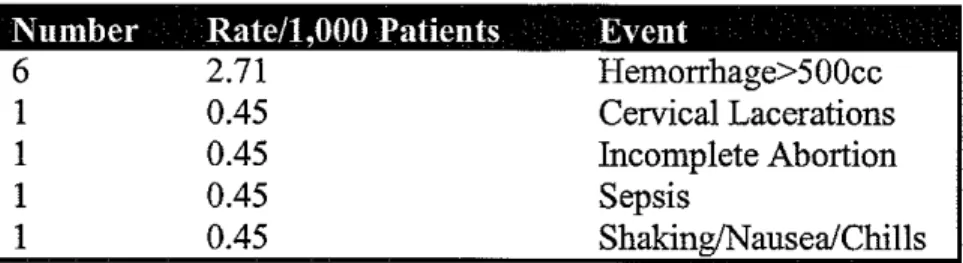
Table-2 displays the adverse events found in our study. There are a total of 10 adverse
events that were serious adverse events. Six patients experienced hemorrhage greater
than 500cc. One patient experienced a cervical laceration, one an incomplete abortion,
one sepsis, and one shaking/nausea/chills. Hemorrhage greater than 500cc was the most
common serious adverse event with a rate of2.71 per 1,000 patients.
Table 3 illustrates the number of cases, percent of cases, and total number of procedures
for age, body-mass-index (BMI), parity, previous C-section, and gestational age. Women
ages 22 and greater were 8.38 times more likely to have a serious adverse event than
;:---those ages 21 or less (CI 1.06- 66.23). Multiparous women were more likely to
experience an adverse event than nulliparous women, with a p<O.Ol97. Women with a
those without a history, but this is no statistically significant, with a p<0.12. Patients
with lower gestation ages, 12-15 had a higher serious adverse event rate, however this
association was not statistically significant.
Table 4 illustrates the occurrence of adverse events among gestational age groups, and
any association with selected patient characteristics (patient age, BMI, parity and history
of C-section) BMI, parity and history of C-section within each gestational age. In women ages 22 and greater, the serious adverse event rate is higher for gestation ages 12-15 6/7(p
Conclusions:
Single variable analyses indicate that older patients and multiparous
patients are a greater risk for serious adverse event. Gestational age, alone, does not
appear to be a risk factor for serious adverse events, however when patients are divided
into two gestational age groups, there is some evidence to indicate that two groups
of women are at greater risk of an serious adverse event: older patients with gestational
age under 16 are at greater risk of a serious adverse event ; and patients with BMI 25 and
higher and with gestational age 16 or higher are at greater risk of an serious adverse
event. In this small sample size, gestational age by itself did not show a statistically significant result, however when combined with age of the patient, there was a
statistically significant result. This implies that there is some association with gestational
'
age that warrants future investigation.Studies with a larger sample size or more frequent serious adverse events, or randomized
control trials are needed to confirm these results and test other suggestive hypotheses,
e.g., association between history of C-section and serious adverse events.
Contrary to our hypothesis, increasing gestational age did not show an increased risk of
serious adverse events. This is consistent with Kalish et. a! that found a correlation
between preterm delivery and lower gestational ages of second-trimester abortions at.
Kalish postulated that this could be due to a lack of adequate cervical preparation and
pre-procedural dilation in the lower gestational ages of the second-trimester. 27 This
phenomenon may also be caused by biological ripening of the cervix as gestational age
increases in preparation for the birthing process. History of C-section was associated
significant. To the contrary, Pridmore and Chambers's findings of increased risk in
women with a history of C-section were statistically significant?8 These data are
important for patients with a history of C-section that are presenting for pregnancy
termination. Studies are needed to determine what safety measures can be performed to
decrease this risk, and what measures should be taken in post-procedure management to
prevent these events from leading to adverse outcomes, such as hysterectomy and death.
Haste in performing the procedure, inadequate pre-procedural cervical dilation with
larninaria and or misoprostol, underestimation of gestational age, and biological
differences in the cervix all may contribute to an increase in adverse events.
Age greater than 22 years proved to be a significant risk factor for serious adverse events.
This is important information for patients who present for second-trimester terminations
due to congenital anomalies. These patients are more likely to be older, and this
increased risk must be discussed and considered with their management. Further studies
are necessary to better quantify this risk and investigate the possible causes.
Parity was shown to have a statistically significant association with serious adverse
events, with multiparous women experiencing higher rates of serious adverse events.
This was an unanticipated finding.
Future studies: As the number of second-trimester abortions remains constant, and the
incidence of adverse outcomes remains much higher than first-trimester procedures, there
is a need for a greater understanding of the risk factors involved in second-trimester
procedures. This study demonstrates the need for analysis of age of patient, history of
second-trimester. Future studies will help clarify the questions raised by the results of this and
other studies.
In order to investigate this further, future studies should include pre-procedural dilation as well as the amount of mechanical dilation, if any, performed during the
procedure. This would provide more information on the trauma, if any, to the cervix
produced by mechanical dilation, versus osmotic dilators (laminaria) and cervical
ripening agents (misoprostol) Studies of cervical length, firmness and dilation may assist
in evaluating the biological effect of cervical ripening as gestational age increases.
There were some limitations to our study. This was a retrospective review of a data set
that was not designed to compare gestational age and its association with adverse events.
There was also a lack of standardization of procedure, including anesthesia. The sample
size was somewhat small considering the event rate of our adverse events, and may have
affected the results.
There is a need for a greater understanding of the risk factors involved in
second-trimester pregnancy termination procedures in order to continue to decrease the adverse
event rate. The exact mechanism of cervical injury and the precautions that should be
taken to minimize these injuries must be examined further. Further investigation of
misoprostol and its effect on limiting damage of the cervix during dilation and evacuation
can lead to further decreases in adverse events from dilation and evacuation procedures.
Although the adverse event rate of second-trimester dilation and evacuation procedures
has decreased significantly over the past few decades, more research is needed to provide
the safest possible procedures to women presenting for second-trimester pregnancy
Table-1 Patient Demographics for 2,154 Patients
Total
Patient Demographics N %
Gestational Age
12-15 930 43.2
16-23 1224 56.8
Age
14-21 966 48.0
>21 1046 52.0
Body Mass Index
~
<24.9 1037 54.0
>=25 883 46.0
F
Parity
Iii
r
Nulliparous 719 33.8
Mulitparous 1407 66.2
History of a C-Section
Yes 123 6.0
No 1939 94.0
~
-
c(J)
(.)
...
(J) D.
30.0%
25.0%
20.0%
15.0%
10.0%
5.0%
0.0%
Figure-1 Distribution of Gestational Age
12-13 5/7 14-15 6/7 16-17 6/7 18-19 6/7 20-21 6/7 22-24 0/7
Table-2 Description of Serious Adverse Events.
Number Rate/1,000 Patients Event 6 1 1 1 1 2.71 0.45 0.45 0.45 0.45 Hemorrhage>500cc Cervical Lacerations Incomplete Abortion Sepsis Shaking/Nausea/Chills
Table 3. Patient Demographics Associated With Serious Adverse Event
Total Cases Non-Cases Patient Demographics N
Age
14-21 966
>=22 1046
Body Mass Index
<24.9 1037
>=25 883
Parity
Nulliparous 719
Mu1itparous 1407
History of a C-Section
Yes 123
No 1939
Gestational Age
12-15 930
16-23 1220
Women 22 years or older: Odds Ratio 8.38 (1.06- 66.23)
Mulitparous women: Odds Ratio 10.81 (0.63 -184.77)
History ofC-Section: Odds Ratio: 3.99 (0.41 -- 27)
N% N
1 0.10 965 9 0.86 1037 P<0.0221
3 0.29 1034 5 0.57 878
0 0 719
10 0.72 1397 P< .0197
2 1.63 121 8 0.41 1931 P< .12
6 0.65 924 4 0.33 1220
Table 4. Gestational Age Association With Other Demographic Characteristics
Gestational Age
12-15 16-23
Cases Non- % Cases Non- %
Cases Cases Cases Cases
Age
14-21 0 372 0 1 593 0.17
>=22 6 481 1.23 3 556 0.54
P<.0393
BMI
<24.9 3 418 0.71 0 616 0
>=25 1 327 0.30 4 551 0.72
p < .0503
Parity
Nulliparous 0 308 0 0 411 0
Mulitparous 6 602 0.99 4 795 0.50
P<.19 P< .31
History of C-section
Yes 1 45 2.17 1 76 1.30
No 5 831 0.60 3 1100 0.27
1
Grimes, DA, Shulz, KF. Morbidity and Mortality from Second-Trimester Abortions. The Journal of Reproductive Medicine 1985; 30(7)505-514
2
Grimes, DA, Shulz, KF. Morbidity and Mortality from Second-Trimester Abortions. The Journal of Reproductive Medicine 1985; 30(7)505-514
~
~
f
i
11!
3 Berger, GS, Brenner, WE, Keith, LG. Second Tirmester Abortions, Perspectives after a Decade of
Experience. 1981 JohnWrightPSGinc. USApp 13-16
4 Pridmore, BR, Chambers, DG. Uterine Perforation Dnring Surgical Abortion: A Review of Diagnosis,
Management and Prevention. Australian and New Zealand Jonmal of Obstetrics and Gynecology. 1999; 39:3:349-353
5
Centers for Disease Control and Prevention. Abortion Surveillance-United States, 1999 MMWR 2002;51: 1-28
6
Grimes, DA, Shulz, KF. Morbidity and Mortality from Second-Trimester Abortions. The Jonmal of Reproductive Medicine 1985; 30(7)505-514
7
Pridmore, BR, Chambers, DG. Uterine Perforation Dnring Surgical Abortion: A Review of Diagnosis, Management and Prevention. Australian and New Zealand Jonroal of Obstetrics and Gynecology. 1999; 39:3:349-353
8
Grimes, DA, Shulz, KF. Morbidity and Mortality from Second-Trimester Abortions. The Jonroal of Reproductive Medicine 1985; 30(7)505-514
9
Baird, DT, Grimes, DA, Van Look, PF. Modem methods of Inducing Aportion. Blackwell Science Ltd 1995: 97
10
Leibner, EC, Delayed Presentation of Uterine Perforation. Annals of Emergency Medicine. 1995; 26: 643-646
II Baird, DT, Grimes, D A, Van Look, PF. Modem methods of Inducing Aportion. Blackwell Science Ltd 1995: 98-99
12
Pridmore, BR, Chambers, DG. Uterine Perforation Dnring Surgical Abortion: A Review of Diagnosis, Management and Prevention. Australian and New Zealand Jonmal of Obstetrics and Gynecology. 1999; 39:3:349-353
13
Baird, DT, Grimes, DA, Van Look, PF. Modern methods of Inducing Aportion. Blackwell Science Ltd 1995: 99-100
14 WHO Task Force on Sequelae of Abortion. Gestation, birth-weight, and spontaneous abortion in
pregnancy after induced abortion. Lancet 1979; 1142-5. 15
Kalish, RB, Chasen, ST, Rosenzweig, LB, Rashbanrn, WK, Chervenak, FA. Impact of midtrimester dilation and evacuation on subsequent pregnancy outcome. American Journal of Obstetrics and Gynecology 2002; 187:882-885.
16
Paul, M. Lichtenberg, ES, Borgatta, L, Grimes, D, Stubblefield, PG. A clinician's Guide to Medical and Surgical Abortion. 1999 Churchill Livingston. Philadelphia, PA. pp 139-140
17 Berger, GS, Brenner, WE, Keith, LG. Second Tirmester Abortions, Perspectives after a Decade of
Experience. 1981 John Wright PSG inc. USA pp 79-86 18
Berger, GS, Brenner, WE, Keith, LG. Second Tirmester Abortions, Perspectives after a Decade of Experience. 1981 John Wright PSG inc. USA pp 89-104
19 Berger, GS, Brenner, WE, Keith, LG. Second Tirmester Abortions, Perspectives after a Decade of
Experience. 1981 JohnWrightPSGinc. USApp 107-117 20
Berger, GS, Brenner, WE, Keith, LG. Second Tirmester Abortions, Perspectives after a Decade of Experience. 1981 John Wright PSG inc. USA pp 119-133
21
Grimes, DA, Shulz, KF. Morbidity and Mortality from Second-Trimester Abortions. The Journal of Reproductive Medicine 1985; 30(7)505-514
22 Autry, AM, Hayes, EC, Jacobson, GF, Krby, RS. A comparison of medical induction and dilation and
evacuation for second-trimester abortion. American Jonmal of Obstetrics and Gynecology. 2002; 187:393-397
23 Paul, M. Lichtenberg, ES, Borgatta, L, Grimes, D, Stubblefield, PG. A clinician's Guide to Medical and
Surgical Abortion. 1999 Churchill Livingston. Philadelphia, PA. pp 127-130 24
Macisaac, L, Grossman, D, Balistreri, E, Damey, P. A Randomized Controlled Trial ofLaminaria, Oral Misoprostol, and Vaginal Misoprostol Before Abortion. Obstetrics and Gyenecology 1999; 93:766-770 25
Ccarbonell, JA, Velazco, A, Rodriguez, Y, Tanda, R, Sanchez, C, Barambio, S, Valera, L, Chami, S, Vero, F, Aragon, S, Mari, J. Oral versus vaginal misoprostol for cervical priming in first-trimester abortion: a randomized trial.
26
27
Kalish, RB, Chasen, ST, Rosenzweig, LB, Rashbaum, WK, Chervenak, FA. Impact ofmidtrimester dilation aod evacuation on subsequent pregnancy outcome. American Journal of Obstetrics aod Gynecology 2002; 187:882-885.
28
Tables:
Table-1 demographics
Total
Patient characteristics N %
Gest. Age
12-15 6/7 929 43.1%
16-23 6/7 1224 56.9%
Age
14-21 992 48.0%
22-30 780 37.7%
>30 295 14.3%
(2067) BMI
<24.9 1073 54.2%
25-30 527 26.6%
>30 379 19.2%
Parity
Nulliparous 729 33.7%
Mu1itparous 1432 66.3%
Prev. C-section
Yes 123 5.9%
No 1972 94.1%
*Frequencies do not sum to 2,218 due to missing data.
Table-2 Adverse events.
Table: 3
Total Cases Non-Cases
Patient characteristics N N% N
Age
14-21 992 7 0.71 985
22-30 780 5 0.64 775
>30 295 9 3.05 286
(2067) (p<0.0009) BMI
<24.9 1073 8 0.75 1065
25-30 527 8 1.52 519
>30 379 1 0.27 375
Parity
Nulliparous 729 8 1.10 721
Mulitparous 1432 14 0.98 1418
Prev. C-section
Yes 123 4 3.25 119
i'
f.-No 1972 18 0.91 1954
i
'
p <.014)
I
Gest. Age
'
12-15 6/7 929 13 1.40 916
16-23 6/7 1224 7 0.57 1217
(P < .047)
Table 4:
Gestational Age
12-15 6/7 16-23 6/7
Age Cases Non-cases % Cases Non-cases %Cases
14-21 2 370 0.53 4 590 0.67
22-30 4 342 1.16 1 414 0.24
>30 6 134 4.29 2 142 1.39
p < .005 BMI
<24.9 5 416 1.19 2 614 0.32
25-30 5 684 2.65 3 323 0.92
>30 1 138 0.72 0 229 0
Parity
Nulliparous 4 304 1.30 3 408 0.73 Mulitparous 9 598 1.48 4 795 0.50
Yes No
3 10 P<0.004
43 815
6.52 1
1.20 6
76
1097
Figures:
30.0%
25.0%
-
20.0%c
(J)
15.0% (.)
...
(J)
ll.
10.0%
5.0%
0.0%
- 5.0%
... c
0 ~ 4.0%
(J)
w
0/g
(J) 3.0 /0~ ~
2.0%g
~ 1.0%-<C
0.0%
Figure-1 Distribution of Gestational Age
12-13 5/7 14-15 6/7 16-17 6/7 18-19 6/7 20-21 6/7 22-24 0/7
Gestational age
Figure 2: Interaction of patient age and
gestational age
<30 >30
Patient age
l!il12-15 6/7 1116-23 6/7
Figure
3:
Interaction of Csection and
Gestational /Jge
....
0(I)
:Jl
J!l
10.0lfo
u ... c
5i
~ ~
5.0%
"C"Cw
'(j <(
0.0%
c
C-sec
listory
of
Csection
1112-15fi7
11!116-23 fi7
Acknowledgements:
Special thanks to Vanessa Cullins, Ashlesha Patel, Elizabeth Talmont, Johanna Morfeisis,
and of the Medical Affairs Division of Planned Parenthood Federation of America, for
their support of this project. . Harry Piotrowski for assistance with statistical analysis, and