Written Communication Interventions for Children with Autism Spectrum Disorder – Occupational Therapy Involvement and Implementation
Shelby Rae Davis
University of North Carolina at Chapel Hill Undergraduate Honors Thesis
School of Education 2017
Approved by:
______________________________________________________ Jennifer Diliberto, Ph.D. – Thesis Advisor ______________________________________________________
Abstract
With a growing prevalence of children diagnosed with Autism Spectrum Disorder (ASD), it is important to take into consideration the impacts this has on a child’s education. One
challenge that children with ASD face is the task of handwriting. Research suggests that there are a number of interventions that are effective in assisting in young children with written
communication. However, there is a scarcity of research that has studied the available written communication interventions used for children with ASD. This research investigated the written communication interventions used by Occupational Therapists (OTs) and Certified Occupational Therapy Assistants (COTAs) working in North Carolina public school systems with children with ASD ages four to eight. One hundred and thirty-five OTs and COTAs responded to an online survey to determine the extent to which they address handwriting in children with ASD; the types of written communication interventions they use with children with ASD ages four through eight; their perceived effectiveness of these interventions; and their perspectives on the interventions and their work with this population. Results showed that OTs and COTAs address handwriting needs for children with ASD on their caseload, as many of these children have written communication goals on their IEPs. The study also found that there are numerous written communication interventions used with this population. The top five interventions used were found to be fine motor activities, alternative types of paper, Handwriting Without Tears, word processing or keyboarding, and visual supports. The results of this research study can help inform occupational therapists on interventions available and implementation of these interventions with children with ASD ages four to eight.
Table of Contents
Abstract 2
Introduction 4
Literature Review 12
Methodology 29
Results 37
Discussion 60
References 73
Appendix A 78
Written Communication Interventions for Children with Autism Spectrum Disorder – Occupational Therapy Involvement and Implementation
Handwriting is the act of writing with a utensil, such as a pen or pencil, and is
individualized in terms of script style (Merriam-Webster.com, 2017). It is a task that is principal in a child’s life during school years and continues to be for one’s lifespan, and written
communication activities often take up, for many children, half of their school day (Gophna, 2009, & Zylstra & Pfeiffer, 2016). The skill of handwriting is a complex task that is achieved by the combination of multiple processes. One’s sensory, perceptual or cognitive, and motor
systems work together to result in successful achievement of handwriting (Taras, Brennan, Gilbert, & Reed, 2011). When deficiencies are present in these processes, handwriting is often times compromised. Children with Autism Spectrum Disorder (ASD) often have challenges with the systems needed for the task of handwriting, leading to difficulties in production of functional handwriting (Kushki, Chau & Anagnostou, 2011).
Autism Spectrum Disorder (ASD)
individual in his/her prime developmental years. Symptoms result in deficits in functional areas of an individual’s occupations, including their social relationships, daily tasks, etc., as well as in motor skills, which may include stiff, catatonic movements, clumsiness, or gait abnormalities (American Psychiatric Association, 2013). Additionally, skills that are significant in nonverbal communication ability, including gesturing and eye contact, may be affected.
As noted, ASD often develops in early developmental years. The primary symptoms that typically arise first include language and communication delays or abnormalities, and play patterns that are atypical (American Psychiatric Association, 2013). The characteristic criterion of ASD, behavior repetition, becomes more evident and frequent. Although the disorder
develops in childhood, it is not a progressive disorder that results in further deterioration of one’s skills and abilities.
Individuals with ASD have functional impairments in regards to their daily occupations. This may involve issues with communication and social interactions, difficulties with adaptive, coping and/or planning skills, and academic setbacks due to a possible presence of intellectual disability (American Psychiatric Association, 2013). Academic challenges can be present in areas, such as handwriting, and stem from varying sources, such as motor movement difficulties (Broun, 2009).
Handwriting Evaluation & Assessment Tools
legibility, including letter size, word alignment on paper, spacing between words and letters, formation of the letters. In addition to these, the tool examines the child’s use of the writing utensils and supplies based on their motor and sensory abilities, which can be determined through measurements of pencil handling, including grip and control, and classroom
observations. The population intended for this handwriting examination includes “any child who is experiencing handwriting problems, although it has been designed primarily for children with mild developmental delays, learning disabilities and mild neuromuscular impairments”
(Amundson, 1995, p. 2). While children with autism may fall on a spectrum in terms of the severity of their disorder, the ETCH tool points out key aspects of autism contributing to functionality of handwriting.
Other examples of handwriting assessment tools that are common include the Minnesota Handwriting Test, the Test of Legible Handwriting, the Children’s Handwriting Evaluation Scale-Manuscript, and the Diagnosis and Remediation of Handwriting Problems (Feder & Majnemer, 2009). The Minnesota Handwriting Test is one that allows researchers to determine a student’s in-hand manipulation skill with writing utensils (Cornhill & Case-Smith, 1996). The Test of Handwriting Legibility is another test that ascertains handwriting legibility, yet another aspect of handwriting that researchers may incorporate into a study of handwriting (Ashburnery, Ziviani, Pennington, 2012). Each of these handwriting evaluation tools allow researchers to investigate various aspects of handwriting.
Handwriting of Individuals with ASD
There is a dearth of literature addressing and measuring the components of handwriting of individuals with ASD. Cornhill and Case-Smith (1996) conducted a study in which
coordination of the hand and eye, hand control with respect to the writing utensil, visual-motor assimilation, and measurements of skill and performance. The first-grade children involved in this study’s sample were divided into groups of good or poor hand-writers according to their teachers. Data were collected through measurements of handwriting, such as the Minnesota Handwriting Test (MHT), and the Developmental Test of Visual-Motor Integration (VMI). Results indicated that the skill of handwriting was highly correlated with the ability for an individual to manipulate the utensil in his/her hand (Cornhill & Case-Smith, 1996).
visual-spatial issues that are often present in children with ASD (Fuentes, Mostofsky, & Bastian, 2009).
Other investigations of handwriting challenges for children with ASD have examined the same categories, as previously mentioned, contributing to legibility in handwriting, as well as speed of handwriting itself. Kushki, Chau, and Anagnostou (2011) reviewed various studies regarding the challenges the children with ASD face, and drew several conclusions about what factors were consistently important. They described several aspects that play a role in an individual’s ability to perform the act of handwriting, including one’s visual motor integration, motor abilities, and visual perception, but often children with ASD do not have complete control or ability in these areas. As a result, it has been found that legibility is often an aspect that is compromised for children with ASD. Within legibility, the feature that children with ASD most often struggle with includes formation of letters. Other additional factors that were found to correlate with challenges in handwriting was the presence of issues with cognitive processing of executive function used for completing tasks, which in this case includes the task of
self-expression. Overall, the researchers concluded that children with ASD face handwriting challenges (Kushki, et al., 2011).
Impacts of Handwriting Deficits on Occupation
negative effects on emotional wellbeing, learning and success later down the child’s educational path, and social relationships (Kushki, et al., 2011).
Occupational Therapy as a Resource
As a result of written communication difficulties, it is common for occupational therapists to receive referrals for children who have challenges with handwriting (Amundson, 1995). Occupational therapy is a practice that assists individuals of all ages with their
occupations in daily life, depending on the support they need. Specifically, they work with populations of people who are aging, who have disabilities, and who are in need of returning to their occupation from injury (American Occupational Therapy Association, 2017). In regards to occupational therapy and the work that is done with children in school settings, occupational therapists have to step in when children are having issues completing tasks functionally or to the full extent. In the case of handwriting, OTs address at the factors that play a role in the
challenges children are facing for this task, including physical, cognitive, emotional, or outside influences (Amundson, 1995). Occupational therapists often assess and will intervene in various ways, depending on the individual child’s need and education plan. Their roles entail
setting rather than in a separate space. The researchers noted that through the incorporation of the CI model, teachers in both general and special education classrooms felt that implementation of services improved (Marston & Heistad, 1994).
Furthermore, with the addition of the English Language Arts section of the Common Core State Standards, impacting children in states across the country, there is a growing desire for children to succeed in reading and writing areas in school (Handwriting Without Tears, 2017). Despite the added category in the Common Core State Standards, some researchers point out that handwriting is not as highly emphasized in schools, due to the emphasis placed on standardized testing and achievement in math, language arts and literacy (Delegato, McLaughlin, Derby & Schuster, 2013). Nonetheless, handwriting plays an important role in written literacy and written communication and is the focus of this study.
Purpose of the Study
There is a large variety of occupational therapy interventions that are directed towards children in regards to their challenges with handwriting; however, research on these
interventions largely investigated children who are on the typical developmental trajectory. The purpose of this study is to examine the present interventions for children with ASD ages four through eight. Previous research was reviewed and compared to determine the handwriting interventions that already are in use with elementary school children with ASD
Carolina who had worked or currently work in public schools with children with ASD, ages four through eight.
The research questions guiding this study are:
1. To what extent do occupational therapists address handwriting in children with ASD? 2. What interventions are most commonly used for children with ASD ages four through eight to address written communication goals?
3. How effective do the occupational therapists perceive the interventions are that they use?
4. What are occupational therapists’ perspectives on these interventions and their work with this population?
Literature Review
As noted in the previously discussed studies, children with ASD face various handwriting difficulties, which impede with their daily living activities and occupations (Cornhill and Case-Smith, 1996, Fuentes et al., 2009, & Kushki, et al., 2011). Because of this, occupational
therapists often step in, helping to intervene with the aim of increasing handwriting performance levels of children who are unable to fully achieve their occupations (Humphry & Wakeford, 2008). With respect to this study, the population includes children with ASD and their written communication challenges. There have been a small variety of studies that have taken place regarding the handwriting interventions that are presently implemented, as well as their efficiency and validity; however, the studies are mostly implemented with children who are typically developing. Of the studies that have subjects with varying disabilities, none of which are focused specifically on children with Autism Spectrum Disorders ages four through eight. Additionally, there have been few studies that observe interventions in international settings, yet still not with the population of children with ASD. Nonetheless, these studies are still essential for determining the interventions that are presently being implemented.
Interventions for Children Who are Typically Developing
When searching for previous literature that has been completed on this topic, several of these studies found regarded children who were typically developing. These studies, though, on children who are developing on a classic trajectory, still helped to distinguish the types of written communication interventions present and being used.
educational settings, including general and special education. Occupational therapists, with these two services, are able to provide more individualized and appropriate educational services for children of varying grade levels. The researchers discuss the Individuals With Disabilities Education Act (IDEA) and American Occupational Therapy Association (AOTA) Partnership, one that promotes the importance of both RtI and EIS as a common resource for occupational therapists. It also emphasizes the significance of collaboration between occupational therapists and other individuals in general education (Clark & Polichino, 2010).
RtI is a concept that has changed and been expanded on over the years and by many researchers. Overall, it encompasses behavioral or emotional shifts a child may face and because of those changes, the adjustment of educational quality, resources, and supports (p. CE-2). The intention is to assist those children who have disabilities with additional needs for support above the foundational educational practices meeting with success for the majority of the children in a classroom. EIS is a similar concept that is intended to determine if students need special
therapy interventions implemented for students and what intervention services children have a right to, based on their needs.
Donica (2015) discussed the use of RtI and EIS services in her study of an intervention called Handwriting Without Tears (HWT), a program that is designed for individualized intervention for written communication. With the impact of IDEA, RtI, and EIS, occupational therapists are able to collaborate amongst varying school staff and professionals as mentioned earlier, which is significant in promoting more successful interventions. In her pilot study, Donica sought to explore HWT and its success when applied to general education kindergarten classrooms. There were three groups, two experimental, consisting of 20 students per group, and one control group of 19 children. The control group was a cohort of kindergarten students from the year before HWT was implemented, and they received the D’Nealian style of writing, a typical handwriting curriculum performed by teachers in general education classrooms. The experimental groups received the HWT program lesson in full, as executed by one occupational therapist and two graduate students in an occupational therapy intervention program. It is also important to note that three kindergarten teachers supported the OTs in the implementation of the HWT program. The research study incorporated the use of the Test of Handwriting
Skills-Revised (THS-R) in order to determine legibility of writing from all groups involved in the study. Various findings indicated the HWT curricula to be effective. Donica found that the control group performed less successfully as compared to each of the experimental groups, and this was consistent across six out of ten subsets in the THS-R but also as a whole on the
In another study Taras, Brennan, Gilbert, and Reed (2011) examined the effectiveness of a handwriting intervention program called Write Direction (WD). The investigators used a convenience sample from a total of 12 schools across the San Diego Unified School District. Across these 12 schools, there were 14 classrooms included, with 211 kindergarten students as participants. The researchers highlighted the effectiveness of the WD program on sensory-motor based program interventions that were designed to focus on improving written communication issues. Specifically, the Write Direction intervention in intended to be implemented in general education classrooms. The researchers’s methodology consisted of a pre- and posttest design, and there were two groups involved in the experiment, an intervention group and a control group. The experimental group received the Write Direction program, a 14-week program implemented by occupational therapists. The control group of students received handwriting instruction from their teachers through their typical techniques. The evaluation tool used in this study was a “routine district-level functional measurement tool” (p. 240) in order to avoid approval from individuals on the Board of Education for use with a standardized tool.
Sensory integration is another type of intervention available for occupational therapists. American Occupational Therapy Association (2015) discuss that sensory integration
assessment as well (Alhusaini et al., 2016). The study highlights the need for more research on the topic of SM interventions but also demonstrates the short-term benefits of implementing SM strategies.
Interventions for Children with Disabilities
Various interventions for written communication have also been researched with the subjects of the studies being children with disabilities. Written communication interventions and strategies for these children focus on two main areas of the task of written communication, that of pre-writing or writing readiness or of writing skill improvement. When using these strategies or interventions, OTs or COTAs refer to a child’s individualized education program (IEP), which is a document that includes the services and support to be provided for a child with a disability. It is composed with the efforts of therapists, family members, teachers or other administrative staff, and occasionally the student (Hensley & Hosp, 2014).
Pre-writing and writing readiness. Various studies worth mentioning have been done in regards to intervention programs for pre-writing or writing readiness for children with
scales, such as the Peabody Development Motor Scale and the Bruinicks-Oseretsky Motor Test of Proficiency. The interventions used for this study included a two-part therapy program, the first included 30-minute therapy sessions involving direct interactions with the OT. This
included incorporating weighted exercises for wrist strengthening, using varied writing utensils and strategies (i.e. chalk), and incorporating in activities, such as beading, to assist in fine motor control through sensory stimulation. An additional part of the program consisted of a
supplementary program of triweekly 10-minute sessions, with activities such as basic letter writing exercises. The data analysis consisted of using the developmental test of Visual Motor Integration-Revised (VMI-R) before the intervention and one year following implementation. The researcher discussed several significant findings, which began with all the individuals within group one completing all components on the VMI-R successfully. Group two had the most improved average gain on VMI-R scores compared to other groups. Group three had the most gains or improvements in the areas of sensorimotor preparedness. Lastly, they found that there was a notable sex effect among the scores within group three. The male children in the group demonstrated higher overall average gains on their scores as compared to the girls. The researcher also highlighted that through the collaboration of individuals including teachers, parents, etc., learning of new skills have the potential to be facilitated through consistent practice (Oliver, 1990).
education schools, as they were “deemed unfit to attend a regular school, not even in a special needs class” due to the severity of their disabilities (Gophna, 2009, p. 31). OT, with the help of the children’s teachers and parents, primarily led the intervention. Prior to implementing the intervention, the OT began by monitoring a child in his or her classroom setting, watching him/her engage in both writing, sensorimotor and fine motor tasks, like beading, lacing threads or incorporating games that require pinching for fine motor practice, and block building and solving puzzles for perceptual motor skill practice. The intervention then was broken down into four components per each session. The initial phase was implementation of writing and physical activity into games, the second was memory-drawing games, the third included a similar
structure of memory-drawing games but on varied surfaces with multiple utensils, and last was a clean up session. The researchers used the VMI-R again in this study for evaluation and data analysis. After one year, there were significant improvements in the areas of grip ability, prewriting and writing readiness. Gophna discussed that these children still were at average academic levels compared to other peers their age because of outside factors, including severity of disability and socioeconomic status, which led to continued therapy after the program. However, there were lasting effects on the children in the study, allowing for academic growth that was not seen in children who did not participate (Gophna, 2009).
Interventions for writing skill improvement. Other studies reviewed were more focused on writing ability as well as or opposed to solely aiming to improve prewriting and writing readiness skills. Delegato, McLaughlin, Derby and Schuster (2013), for example, focused on both prewriting ability and handwriting skills. The study included a sample of five children with disabilities in preschool. The researchers incorporated the intervention program
five participants) and the lack of incorporation of it with the HWT program (n=2). Two therapists, including an OT and a Speech Language Pathologist (SLP), one teacher, two
assistants, and one student in the process of becoming a teacher, implemented the intervention. Both groups received HWT, incorporating varied paper materials in the writing process, and the group of three students received the handwriting racetrack, which a tool that included the use of a timer and 24 blocks making up the track for the child to work through. Prewriting techniques for practice in the intervention included tracing, and some children worked on writing their name. Researchers performed data collection with the use of a writing skill worksheet for the child to fill out after working in each session, and sessions occurred in five to ten minute sessions, four times a week, for a length of six weeks. The researchers found that the HWT program benefited four out of the five students in regards to their writing readiness skills. However, there were mixed results. One child’s handwriting skills decreased after incorporation of the HWT intervention. The handwriting racetrack that used various handwriting activities was seemingly successful in improvement of writing readiness skills, but some performed better on their writing scores when the HWT program was used alone.
Similarly, a study by Moore et al. (2013) also employed strategies in hopes to gain
and direction of the person watching. Backwards chaining consisted of dividing and simplifying a task so that it was in more basic steps, then the simplified steps were taught in backwards order.
There was one participant included in the case study who was five years of age and had the diagnosis of both Attention Deficit Hyperactive Disorder (ADHD) and Autism Spectrum Disorder. The researchers performed the intervention with the purpose of teaching her the specific letters within her name so that the child, Kiera, could successfully write it on her own. Previously, she had skill holding a writing utensil in her hand, but she could not complete successful writing of letters. The intervention consisted of videos, which were four minutes in duration or ten seconds demonstrating the action of forming a letter in her name for a repeated reference. The first video began with the last letter of her name, as it used the backward chaining technique. The following videos continued on this same pattern, beginning with repeated practice of the previous letter(s) learned, then the new letter. The video based interventions took place on average four times a week, two times a day, totaling for 60 sessions. A token economy system was also used for positive reinforcement, meaning when she was successful, she would have the opportunity to receive a reward. The results of this study that incorporated several interventions to teach one individual to write her name showed that Kiera was successful in writing her name in terms of legibility. The researchers claim effectiveness for their technique of video modeling, but they also state that more reinforcement may be required in the future for master of additional letter formation (Moore et al., 2013).
support services and had their own IEPs or RtIs. Opposed to this, there were 12 students in the control group, and they were in general education with no supports. Theories including the motivation theory and the motor learning theory formed the foundation of the SMHP handwriting intervention, and as a result, the program incorporates techniques, including
repetitive, engaging activities. The program intervention was employed to the kindergarteners in the intervention group for 16 weeks, two times a week for 30 minutes sessions. The sessions were led by an Occupational Therapist within the children’s support classrooms. Letters in the alphabet are categorized into one of three sizes: size one included large and tall letters (capital letters as well), size two included smaller and shorter letters (lower case letters and those below the halfway point on a line), and size three were letters, such as g or p, the go below the baseline of a line. The program began with size one letters, and two letters were often times address per session. The tests that researchers Zylstra and Pfeiffer incorporated into their study included the Test of Handwriting Skills-Revised (THS-R), as well as the North Dakota Title I Kindergarten Reading Standards Assessment. After the intervention was employed, the researchers found that overall both groups had comparative or similar scores in the aspect of legibility of their
handwriting. One difference they did find was that the intervention group showed more growth in their scores between the pretest and posttest, as compared to the control group of
kindergarteners. Aspects that they compared to each other in included sound identification of letters, and in general lower and upper case recognition. SMHP, according to the researchers findings, was effective when implemented with this included sample (Zylstra & Pfeiffer, 2016).
used a pre- and posttest design, as other researchers have similarly used when assessing
handwriting interventions. The researchers begin by discussing the Occupational Therapy School Based Consultation model (OTSBC), which consists of a collaborative approach for addressing students’ needs, including the OT, the student, parents, teachers, etc., and this was the model analyzed in the researchers’ two-year study. The sample included students of varying grades, types of schooling (i.e. public or private), language spoken of both child and caregivers in home setting, and other educational needs (i.e. therapy). The Occupational Therapists using the
OTSBC supports helped to implement strategies such as writing activity or printing adaptations, and the most common problems addressed were handwriting/printing skills, as well as challenges with organizing and carrying out desk-based activities (i.e. cutting, gluing, etc.). Both the
Teacher Awareness Scale (TAS) and Canadian Occupational Performance Measure (COPM) were used in this study, as well as a Client Feedback Questionnaire (CFQ), in hopes to observe teacher and parent satisfaction, teacher awareness of student challenges and teacher involvement with the issues. COPM incorporates the use of both a satisfaction scale and one that assesses students’ performance. The researchers found that when there was a lower score in a teacher’s assessment of a student, then there would be greater improvements in the student’s occupational performance areas on the COPM, for example in areas of skills where they needed to improve. Additionally, when the Occupational Therapist implemented more consistent interventions with a student, then the more increased growth a student would have on the COPM scale (Reid et al., 2006).
through a survey design, and there were a total of n=476 participants who responded to the survey, despite it being sent to 982 Occupational Therapists across the nation. They randomized their sample so that Occupational Therapists across the U.S. were included. Barnes et al. defined emotional disturbances with the definition included in the Individuals with Disabilities
Educational Act of 1997 (IDEA). Their survey was titled “School Occupational Therapy Practice for Students with Emotional Disturbances Questionnaire,” and it was distributed in a technique that will be modeled in this study, including a preliminary contact, a contact to distribute the survey, and additional follow-up contacts. This survey technique was done through the mail, and the survey asked Occupational Therapists of the ways in which they treat children of this
population, the views of others about OTs who work with this population and what challenges they have come across. The researchers found various significant results. About half of the OTs who responded stated that the areas that they worked with these children included areas such as school activities of test taking, social skills, school setting or classroom adaptations, etc. Their specific treatments for working in these areas with the children ranged from sensory motor or sensory integration techniques, visuomotor techniques and activities, etc. Lastly, challenges they faced included various avenues, such as lack of appropriate and collaborative teaming, issues with the child due to the way in which emotional disturbances affect a child, and more (Barnes et al., 2003). The study by Barnes et al. (2003) was a model for this study on written
communication interventions for children with Autism Spectrum Disorder as implemented by Occupational Therapists.
difficulties. Portable word processors were previously more used than laptops as they were more cost effective; however, keyboarding is also a growing trend for students with disabilities to use as an alternative to handwriting. The purpose of this study was to analyze the intervention of keyboarding, and specifically see how children’s motivation was affected with its use, compare it to keyboarding, and compare keyboarding to handwriting performed without the assistive
technology. The researchers included a sample of n=22 students with ASD from elementary grade levels, as well as a sample of n=20 teachers and n=22 parents to complete questionnaires. The students involved in the study were chosen on the behalf of their diagnosis and due to their use of a word processor for 6 months or more. Teachers and parents both received questionnaires asking about student motivation, student’s individual needs, student’s frequency of use of the assistive technologies, perceived effectiveness of devices, etc. The student questionnaire asked similar questions about motivation, usage of the devices and qualities that they did not like about both keyboarding and handwriting. In addition to the questionnaire for the students, the
Handwriting Speed Test, a keyboarding speed test, a written composition assessment, and the Test of Legible Handwriting were given to assess qualities of the student’s handwriting and keyboarding. The researcher’s procedures also incorporated positive reinforcement and visual supports through the use of schedules, to aid and engage the students when sending out the questionnaire.
handwriting as compared to keyboarding, including feeling uncomfortable or having sensory discomfort. Keyboarding and word processors were both determined to be helpful or effective, and keyboarding was noted to improve aspects of handwriting that students with ASD often struggle with, including legibility, speed, etc. While many preferred keyboarding, only few indicated actual use of keyboarding in the classroom more often than they used handwriting (Ashburner et al., 2012).
Smith, McLaughlin, Neyman, and Rinaldi (2013) studied the effects that several
strategies can have on the handwriting of children with disabilities, including the type of paper, visual and motor cues, including prompting, tracing, and fading, and positive reinforcement. The purpose of the study was to determine the apparent effectiveness of the visual and motor cues. The students in the study included n=2 preschoolers who have fine motor IEP goals and who received the diagnosis of having developmental delays. One participant was a 5 ½ year old boy with developmental delays, and the second participant was a 4 ½ year old female with a
diagnosis of both ASD and developmental delays. The study occurred in the Pacific Northwest region of the country in a public elementary school. Interventions occurred in a separate and contained special education classroom. The researchers were collecting data on the student’s handwriting in the areas of letter size, letter slant, and letter formation (Smith et al., 2013).
lined paper. After this, samples on lined paper were taken two more times but with two different levels of traced letters. The tracing 1 including 8-9 stages of tracing done by the researcher, and as the stages progressed on the lines the written and visual prompt was faded slightly until the final stage. In total throughout the 8-9 stages, the participant’s names were written a total of 24 times. This gave the student an idea of how the letters looked. Tracing 2 with the lined paper was less segmented into stages. The results of this study indicated that each of the participants was more aware and capable of writing their names at the end. Results also determined that the tracing and fading visual prompts were appropriate for the students. Additionally, positive reinforcement was determined to be effective, as participant 1 worked more eagerly and effectively with positive reinforcements, like sticker stars (Smith et al., 2013).
Adding on to the findings in the previous study, visual supports have been found to be an effective intervention strategy for children with ASD. As noted by Rao and Gagie (2006), visual supports and aids can help this population in aspects of communication, organization, focus, conceptualization, etc. Examples of these include flow charts, color-coding, visual icons for schedules, etc. A program that implements visual supports includes PECS, a system that fosters communication to improve functionality and speed of communication for individuals. Social stories are also used, which are stories written with cues and situational guidelines, to aid in understanding of various events, occasions, etc. The therapists highlight the importance of visual cues as supports that draw in a student’s focus and can be altered to a child’s individual needs or interests (Rao & Gagie, 2006).
ADHD and other comorbidities, such as speech disorders, and a normal control. Participants were taken from second and third grade classrooms in schools in a South German school district. N=114 students from 2nd grade regulation education classes, n=103 students from 2nd grade classrooms of schools for children with speech disorders, and n=73 students from third grade classrooms of schools for children with learning disabilities were included in the study. Of those students, n=19 children with ADHD from regular education classroom, n=28 children with ADHD from schools for children with speech disorders, and n=19 children from schools for children with learning disabilities were included. The researchers presented the students with two texts in cursive, given a week apart, present on overhead transparency screens. The students were required to copy the texts exactly, paying specific attention to certain words. Students could choose the writing utensil of choice, and either received a white piece of paper or a colored one. Of the colored paper, students could choose the specific color, which ranged from muted pastel colors to neon colors. The researchers assessed the texts in the aspects of letter formation, alignment, slant, spacing, and neatness. The researcher found that multiple aspects of
Methodology
The methods section outlines the design of the study that aimed to investigate the written communication interventions used by Occupational Therapists (OTs) and Certified Occupational Therapy Assistants (COTAs) working in the North Carolina public school system with children with Autism Spectrum Disorder ages four through eight. Additionally, the section outlines the survey process of convenience sampling respondents for the survey and describes the
instrumentation use for data collection. Research Design
This exploratory study had the purpose of analyzing the present interventions for children with ASD ages four through eight. To collect information about this topic, Occupational
Therapists and Certified Occupational Therapy Assistants from North Carolina public schools completed an online survey that they received through email. This data was collected in the late Spring and early Summer of 2017 through an online survey. This survey was designed using the UNC Qualtrics online software program. Various experts aided in the design of the survey. These individuals include survey experts working at UNC’s Odum Institute and a faculty member in the UNC Chapel Hill Master of Science in Occupational Therapy (MSOT)
department. The faculty member assisted in the creation of questions regarding OT interventions for children with ASD. The survey included a range of questions, such as close-ended multiple choice, open-ended fill in the blank, and Likert-Scale questions.
Obtaining Institutional Review Board Approval
principal investigator, as well as the faculty member listed as the thesis advisor, has completed the Collaborative Institutional Training Initiative’s Group 2 Social and Behavioral Research training. The survey data was determined to be under Level 1 security and was kept confidential accordingly.
Instrumentation
Instrumentation of this research study included an online Qualtrics survey created to gain knowledge on the following areas: (a) demographic information on Occupational Therapists in the NC school system; (b) general statistics on the numbers of students the OTs and COTAs have on their caseload; (c) types of interventions used by OTs and COTAs for written communication; (d) perceived effectiveness of interventions used and why; and (e) additional information
regarding the use of these interventions (see Appendix A for entire survey). If the therapists clicked the survey link included in the email, they were initially prompted with information regarding the survey’s purpose and intentions. The letter indicated that all responses would be shared as group data and that as a participant they were able to skip responses or stop the survey at any point. At the bottom of this information was a question asking to obtain their informed consent with a “yes” or “no” question. If they clicked yes they were taken to the survey.
and how many years he or she had been in school-based practice. The types of questions in this part of the survey consisted of closed-ended multiple-choice questions and open-ended fill in the blank or sliding scale questions.
General caseload statistics. The next block of questions contained more content-specific information relating to the study, and it began with four questions prompting for information about the therapist’s caseload. This included three fill in the blank questions asking about caseload size, number of children with ASD on the caseload, and how often written
communication goals are worked on weekly. An additional multiple-choice question asked about percentage of children who have written communication goals on their IEPs.
Types of interventions used. Within the intervention-specific section of the survey, the third focus area was regarding the types of interventions used by OTs and COTAs with children with ASD. To explore this, a check all that apply question was included in the survey, following the questions regarding general caseload information. This list included interventions from the literature, as well as interventions suggested by the UNC MSOT faculty member. Interventions included specific programs, various activities and supports. On some strategies, specification was required and was prompted with a fill in the blank next to the strategy option.
Perceived effectiveness of interventions. Following the main question regarding types of interventions used by the therapists, they were prompted with a 4-point Likert-Scale question. The question included all the intervention options listed in the previous question. The scale ranged from “(1) not effective” to “(4) very effective,” with an option of “NA” or “not
years. After this question, there was an open-ended, short answer question asking for the survey participant to elaborate on what factors in his or her opinion contributed to effectiveness.
Additional information regarding these interventions. The final set of questions included questions asking more about intervention usage. The first two of these questions inquired about where the intervention took place and with whom the OT or COTA collaborated with on written communication goals. The questions were close-ended multiple-choice
questions. The final survey question was a free-response question prompting for additional feedback regarding the topic of written communication interventions used with children with ASD. The goal of incorporating this question was to allow the researcher to gain any supporting insight from the therapists that may not have been touched on yet.
Participant Recruitment
The survey respondents came from a convenience sample of Occupational Therapists and Certified Occupational Therapy Assistants who work in public elementary schools across North Carolina. The emailed survey was emailed to approximately 570 therapists using the North Carolina Department of Public Instruction Exceptional Children Division’s Occupational Therapy listserv. An OT who is a representative of the North Carolina Department of Public Instruction Exceptional Children Division (NC DPI ECD) OTs and who is also on faculty in the UNC Chapel Hill Master’s of Science Occupational Therapy program, sent the emails that gave the purpose of the study and a link to the survey. This allowed for the confidentiality of survey respondents and their emails.
Survey Distribution
This method suggests a sequence of contacts to promote increased response rates. The contacts consisted of: (a) a preliminary email discussing the intention of the upcoming survey without the survey link; (b) an email with the recruitment and consent letter and the survey link; (c) two additional follow up emails; and (d) one last email stating this is that last opportunity to participate in the study and thanking individuals for their participation (see Appendix B for Dillman’s letters).
As followed by Dillman’s methodology (2004), the survey was sent out a total of four times with the Dillman’s survey method, with an initial email indicating the survey’s coming. The OT representative emailed the listserv on the following dates May 16th, May 19th, May 25th, June 1st, and June 7th, 2017. Dillman’s methodology called for the survey contacts to be sent out on the following days: day one with the initial contact, day 4, day 10, day 18, day 22. The survey methodology was adjusted slightly due to communication delays between emails contacts of the researcher and the OT representative.
The survey response rates were as follows. On day 1, the initial contact was sent out detailing the survey’s purpose and describing the survey that would be sent out in the following email contacts. On day 4, after the initial contact, a second contact was made that included the approval of informed consent and the survey link. Before the third contact was sent out, 33 respondents filled out the survey. Following that, on day 10 a follow-up email was sent
individuals responded. Out of this total number only those who gave consent, identified as an OT at any licensure level, and completed the survey were included in the data analysis.
Data Analysis
The quantitative survey data was gathered from questions of various types, including multiple-choice, yes/no, drop down and sliding scale questions. The survey questions were analyzed through the Qualtrics survey program. Demographic questions included year of birth, race, ethnicity, gender, highest degree earned, licensure, whether they were currently practicing in a school system, and the county in which the survey respondent practiced.
Data on the NC public school system where the OTs were working was analyzed by determining the region that each school system was by using the eight regions established by the North Carolina Department of Public Instruction (NC DPI). The school systems in Region 1, the Northeast region, and Region 2, the Southeast region, were combined and named the eastern region. The central region was composed of Region 4, North Central, Region 5, Sandills, and Region 6, Piedmont Triad. The western region included Region 6, the Southwest region, Region 7, the Northwest region, and Region 8, the Western region.
The researcher also asked the respondents about how many years they had been an OT or COTA, as well as how many years they had been in school based practice. These questions used a sliding scale in which respondents could select the years of practice. With this, the researcher used Qualtrics and Excel to analyze the data using basic statistic measures, which included determining maximum, minimum, mean, and standard deviation.
asked how many of the children with ASD on their caseloads had written communication goals on their IEP, and how many children with ASD were worked with weekly on written
communication goals. For the caseload questions, the researcher found the maximum, minimum, average and mode.
Types of interventions used by the respondents were looked at in the next question. Survey respondents were able to select all of the interventions that they used or have used within the past two years. There were also opportunities for the respondents to specify further the interventions used, or to write additional interventions not included in the list. Additional questions prompting for more information on the location of use and individuals the therapists collaborated with while using the interventions was also asked in the survey. This provided further insight into how these interventions were used.
One question was collected through a four-point Likert scale. The Likert scale was coded with the following options “not effective” (1) to “very effective” (4). The researcher examined perceived effectiveness of the interventions used by therapists through this four-point scale. The data was analyzed with this by determining the average rated effectiveness of each intervention.
interventions being used, as well as commentary on an OT’s role in written communication goals with these children in general.
Results
The purpose of this study was to analyze the present interventions for children with ASD ages 4-8. Also, the frequency of intervention use and the perceived effectiveness of intervention were examined through survey methodology and review of the literature. The specific questions guiding the survey were:
1. To what extent do occupational therapists address handwriting in children with ASD? 2. What interventions are most commonly used for children with ASD ages four through eight to address written communication goals?
3. How effective do the occupational therapists perceive the interventions are that they use?
4. What are occupational therapists’ perspectives on interventions and their work with this population?
The results section presents findings regarding the survey response rates, demographics of the respondents, caseload information, types of interventions used, and the additional
information regarding the intervention usage. Additionally, a statistical breakdown of the Likert Scale question on the OTs perceived effectiveness of interventions is discussed. Responses to the open-ended questions are presented as supplementary data on how respondents felt about written communication interventions and the perceived effectiveness of interventions. The survey questions are included in Appendix A for reference.
Survey Respondents
a licensed OT of any degree (i.e., COTA, OT/L, OTA/L, etc.). Of the individuals who completed the survey and gave consent (n=136) one individual who stated he/she was a Speech Language Pathologist (SLP) and was therefore excluded from the data, leaving the final total of
respondents included in data analysis to be (n=135). Respondents were not required to answer each question. Therefore, the number of responses within questions varies.
Demographics of Survey Respondents
Demographics reported included age, race, ethnicity, and gender of the survey
respondents. Also, the education level, number of years working as an OT or COTA, and number of years working in a NC public school were collected. The respondents also shared the public school system in which they were working. Percentages were calculated out of the total number of respondents who reached the end of the survey (n=135).
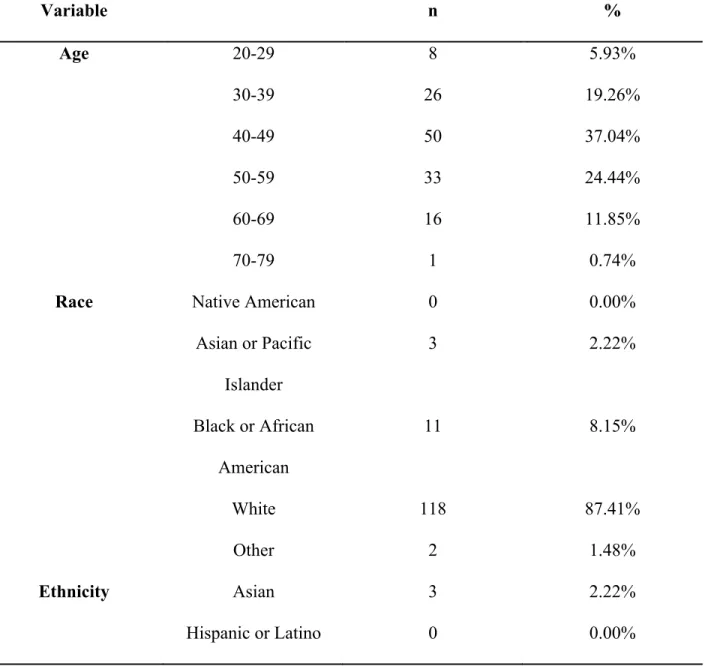
Age. The age of the respondents ranged from 27 years old to 70 years old. The age group that was most represented included those within the age range of 40-49 (37%). One respondent (0.7%) did not indicate their age.
Race. The vast majority of survey respondents when reporting race stated that they were White (n=118, 87%), followed by 11 (8%) individuals stating they identified as Black or
African-American, 3 (2%) stating they identified as Asian or Pacific Islander, and 2 (1%) stating they were other, and more specifically Indian. No individuals identified themselves American Indian or Native American. One individual (0.7%) did not respond.
Caucasian, and White. No individual identified himself or herself as Hispanic or Latino. Seventeen (13%) of survey respondents did not complete this question.
Gender. Regarding gender, out of the 134 respondents who answered this question, 130 (96%) were female and 4 (3%) were male. One respondent (0.7%) did not answer this question. A summary of the above mentioned demographic questions can be found below in Table 4.1. Table 4.1.
Demographic Information
Variable n %
Age 20-29 8 5.93%
30-39 26 19.26%
40-49 50 37.04%
50-59 33 24.44%
60-69 16 11.85%
70-79 1 0.74%
Race Native American 0 0.00%
Asian or Pacific Islander
3 2.22%
Black or African American
11 8.15%
White 118 87.41%
Other 2 1.48%
Ethnicity Asian 3 2.22%
Not Hispanic or Latino
102 75.56%
Other 13 9.63%
Gender Male 4 2.96%
Female 130 96.30%
Education level. The next set of questions within the demographic section included questions regarding education level, licensure and occupational background. In terms of
educational background, 66 (49%) respondents indicated having their Bachelor’s degree. Forty-eight respondents (36%) noted having their Master’s degree. A smaller portion of individual’s stated that they had their Associate’s degree (n=16, 12%). Two respondents (1%) stated that they had their Doctoral degree, while three (2%) noted they were in the process of completing it. All respondents completed this question.
Occupation. Most individuals (n=111, 82%) whose responses were included in the data analysis consisted of licensed OTs (OT/L). Twenty-three respondents (17%) stated that they were Certified Occupational Therapy Assistant. One individual (0.7%) selected “Other” and specified that he or she was an Accredited and Licensed OT (OTA/L).
Public School System. A yes/no question then followed and asked about the location of current practice, more specifically if it was in a public school system. All respondents (100%) stated they were currently working in public school systems.
Fifty-one (44%) out of 116 public school systems in NC were represented, as surveyed from 122 survey respondents who answered this question. The school systems that were most largely represented included Wake (n=13, 10.66%), Durham (n=8, 6.56%),
the size of these school systems, as Wake, Charlotte and Guilford are the three largest systems in NC. Sixty-three individuals (52%) indicated they worked in the Central region; 14 respondents (12%) indicated the worked in the Eastern region; and 45 individuals (37%) indicated they worked in the Western region.
Number of years as a school based OT or COTA. Two sliding scale questions were included at the end of the demographic section to analyze years as an OTR/L or COTA, as well as years in school based practice. The minimum amount of years that respondents have been in school-based practice was 1.00 year, while the maximum was 42.00 years, and the mean or average was 18.47 years (M=18.47, SD=9.52). The amount of years respondents have been in school-based practice is similar. The minimum was 1.00 year, the maximum was 41.00 years, and the mean was 13.68 years (M=13.68, SD=8.61).
Data from the survey’s demographic questions related to the highest degree and licensure is displayed in Table 4.2. Information pertaining to working in NC Public schools and the current school systems where the respondents worked is summarized in Table 4.3.
Table 4.2.
Demographic Information Regarding Education & Practice
Variable n %
Highest Degree Associate’s 16 11.85%
Bachelor’s 66 48.89%
Master’s 48 35.56%
Doctoral 2 1.48%
Other 3 2.22%
Certified Occupational Therapy Assistant
(COTA)
23 17.04%
Retired OT/L 0 0.00%
Retired COTA 0 0.00%
Neither: Specify 1 0.74%
Currently Practicing In School System
Yes 135 100.00%
No 0 0.00%
School Districts by Region
Central 63 51.60%
East 14 11.50%
West 45 36.90%
Table 4.3.
Number of Years as OT or COTA and Number of Years in School Based Practice
Min Max Mean Std
Deviation Count Number of Years as
OT or COTA
1 42 18.47 9.52 135
Number of Years in School Based
Practice
Caseload Information
The survey also asked respondents how many children were on their caseload.
Additionally, the OTs were asked how many children on their caseload were children with ASD. Overall Caseload. Of the respondents surveyed, the minimum number of children found to be on a caseload was 10 children. The maximum number reported was 119; however, this number was indicated as the total department caseload number and therefore was removed from the analyses given the intent to represent individual OT caseload size. The next largest caseload size reported was 85 students (n=85). Some respondents provided approximate responses, in which case the number the individual reported was the number included in calculating the mean. Other individuals provided a range for the children on their caseload. The numbers in the range were averaged to use in the mean calculation. One survey participant reported a number of children on their caseload, while also mentioning that they worked part time. One respondent included a number of children they saw on their caseload, while also mentioning that this number included the students also seen by the OT assistant they supervised. The mode or two most frequent caseload numbers included 40 students (n=40) and 50 students (n=50).
Number of Children with ASD on Caseload. Survey respondents were then prompted to answer a question regarding the number of children on their caseload who have been
identified with ASD. One hundred and twenty-three respondents completed this question. The minimum number of children with ASD reported to be on a caseload was 0 students, but this survey respondent who selected zero students was basing his/her answers on experiences in the past two years. The maximum number was 47. Estimates and approximate ranges were treated the same as the previous caseload question responses. The mode was n=10, with some
with ASD. However, this respondent also had a population of preschool students at their school with the diagnosis of developmental disability but this number would be likely higher if they were identified as having ASD. Another individual stated they had 10 students directly on their caseload. He/she also stated they worked with other individuals, such as special education teachers and speech therapists, for additional supportive services and that if this number were included it would be around 20 additional students.
Percent of Children with ASD with Written Communication IEP Goals. Survey respondents were also asked to determine the percentage of the children with ASD on the therapists’ caseloads who have written communication goals on their IEP. The researcher calculated percentages for 119 survey respondents based on the number of children with ASD who they reported as having handwriting IEP goals divided by the total number of children with ASD on their caseload. The minimum percentage of children with written communication goals on an OTs caseload was 0%, while the maximum was 100%. The most common percentage was 100%. The mean percentage was 62.23, while standard deviation was 27.76.
Number of Children with ASD Seen Weekly for Written Communication IEP
reported, “I work with preschool students. Their written “communication” goals are usually embedded with tool use and art activities.” In this particular instance, the research removed this phrase when calculating quantitative data. Responses to all of the caseload questions are below in Table 4.4.
Table 4.4.
Caseload Information
n Min Max Mean SD Mode
Number on Caseload 133 10 85 48 14.03 40 & 50
Number on Caseload with ASD 123 0 47 14.89 8.46 10
Percent of Children with ASD seen for Written
Communication IEP Goals
119 0 100 62.23 27.76 100
Children Worked with Weekly on Written Communication
Goals
124 0 36 8.98 6.44 3
Types of Interventions Used
One of the main goals of the current study was to explore the types of written
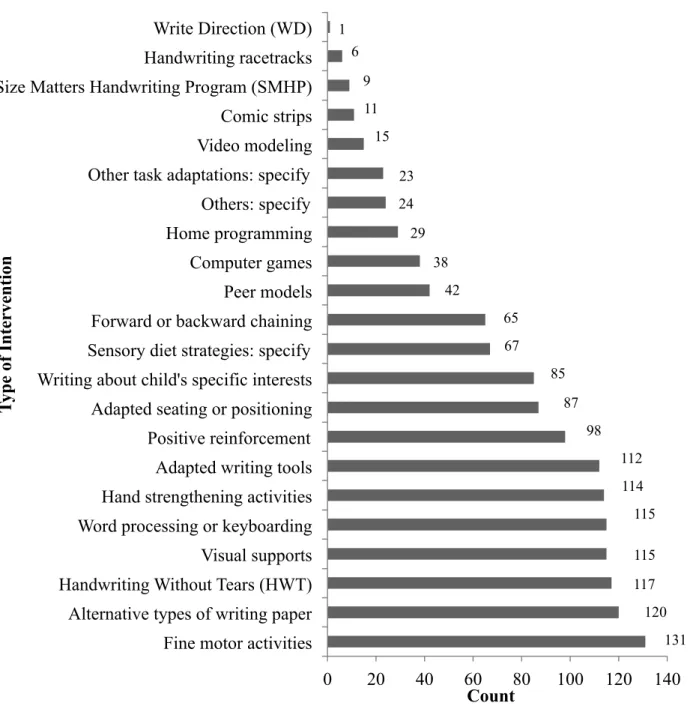
communication interventions being used by OTs with children with ASD. The question asked the OTs to respond based on interventions used in the past two years. The question took the form of a check-all that applies question that allowed the OTs to indicate if they used multiple
processing or keyboarding (n=115), and visual supports (n=115). The other two interventions that were largely reported included hand strengthening activities (n=114), as well as adapted writing tools (n=112). See Figure 4.1 for data on the types of interventions therapist used. Figure 4.1. Types of Written Communication Interventions used by OT Respondents
131 120 117 115 115 114 112 98 87 85 67 65 42 38 29 24 23 15 11 9 6
0 20 40 60 80 100 120 140 Fine motor activities
Alternative types of writing paper Handwriting Without Tears (HWT) Visual supports Word processing or keyboarding Hand strengthening activities Adapted writing tools Positive reinforcement Adapted seating or positioning Writing about child's specific interests Sensory diet strategies: specify Forward or backward chaining Peer models Computer games Home programming Others: specify Other task adaptations: specify Video modeling Comic strips Size Matters Handwriting Program (SMHP) Handwriting racetracks Write Direction (WD)
Count
T
yp
e of I
Respondents were also asked to report any other interventions being used that were not included on the list. Sixty-seven (49%) OTs noted using sensory diet strategies, 23 respondents stated that there were other task adaptations they used with the children, and 24 individuals reported there were other interventions outside of task adaptations being used. Of the individuals who chose one of the three choices where they were asked to specify further the intervention being used, all respondents who chose other task adaptations or other interventions in general specified further. Of the 67 individuals who selected sensory diet strategies, 59 specified further what interventions they were using.
Sensory diet strategies specified included sensory integration strategies. The reported responses include taking breaks that include physical activity of some sort, “heavy work” using weighted and tactile stimulation, such as vests or moveable seating, oral input, such as “pencil chewies,” and “writing in a textured medium like sand [or] rice.” Additional task adaptations written in by the respondents included “environmental modifications at the work area,”
“Pix:Writer Read Write app Chrone,” “slant boards,” “visual boundaries,” and “voice dictation.” Other additional interventions reported consisted of rewards such as the following, rewards including tokens or stickers, technology such as an iPad with apps for printing and pre-writing tasks, schedules such as “1st-then schedules,” music for the purpose of “incorporating song and high affect responses to link emotion with learning,” and other unspecified visual, motor or proprioceptive tasks.
participant stated he/she incorporated “writing games such as rolling a die to then use the number for the first part of a sentence and then repeat until the silly sentence is complete.”
Additional information regarding the interventions. At the end of the survey, several questions asked about additional information regarding the use of the interventions, including where these interventions were used with the child and with whom the therapist collaborated. Survey respondents were able to check all options that applied.
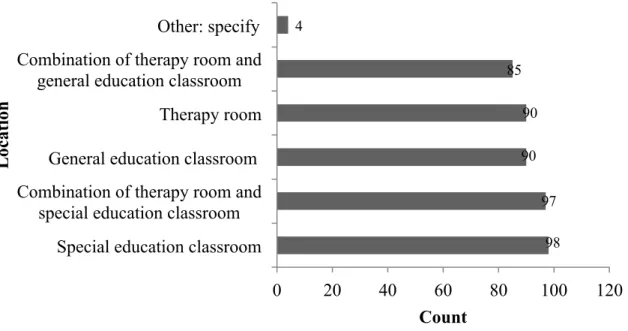
Location. The most reported location was a special education classroom (n=98).
Ninety-seven individuals indicated that they worked in a combination of a therapy room as well as a special education room. Survey respondents had the opportunity to describe other locations of implementation as well. Four individuals specified different locations in which they provided therapy: (a) “Other areas of school,” (b) “no pull out sessions,” (c) “Home,” and (d)
“playground, cafeteria, halls.” See Figure 4.2 for the data for this question. Figure 4.2. Location of Intervention Implementation
98 97 90 90 85 4
0 20 40 60 80 100 120
Special education classroom Combination of therapy room and
special education classroom General education classroom
Therapy room Combination of therapy room and
general education classroom Other: specify
Count
Loc
ati
Collaboration. Respondents were also asked with whom they collaborated on the written
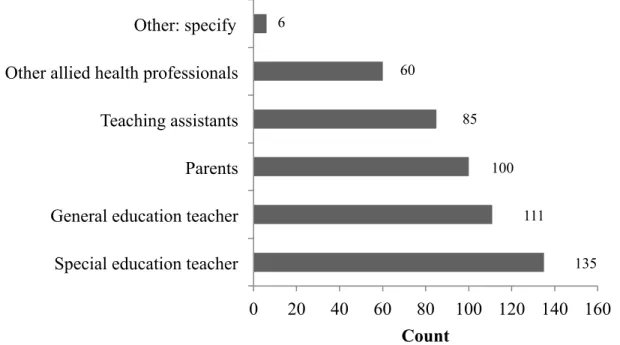
communication goals of the children. The question was a check all that applies in order to encompass the collaboration that likely takes place when working on written communication goals. One hundred percent (n=135) selected that they collaborate with special education
teachers. General education teachers was selected by 111 respondents. Parents was noted by 100 respondents. Sixty survey respondents stated that they worked with other allied health
professionals, and six individuals selected that they work with other individuals not included in the above choices. Four individuals specified that they worked with a “supervising OT.” Two stated they also collaborate with the student on these goals. Other individuals mentioned were “special area teachers (computer, art, etc.),” “child care providers,” and a “community based OT.” Figure 4.3 provides a graphic of the data found from the question asking survey
respondents with whom they collaborated on these goals. Figure 4.3. Collaborators on Written Communication Goals
135 111
100 85 60
6
0 20 40 60 80 100 120 140 160 Special education teacher
General education teacher Parents Teaching assistants Other allied health professionals Other: specify
Count
C
ol
lab
or
ator
Perceived Effectiveness of Intervention Strategy
A Likert Scale question was included on the survey to gauge the respondents’
perspectives on the effectiveness of reported interventions they selected. The possible answer choices included: “Not effective” was given the value of 1, “minimally effective” received a value of 2, “moderately effective” was 3, and “very effective” was 4. N/A was chosen if the survey respondent had not used the intervention in the past two years. The averages are presented of the effectiveness, as well as the total number of respondents for the specified interventions, are presented in Table 4.8.
Fine motor activities. Out of the 131 respondents who rated the perceived effectiveness of this intervention, 88.57% responded that this strategy was either moderately or very effective. The average perceived effectiveness rating for fine motor activities was 3.33, a top rated
intervention (M=3.33, SD=0.67).
Alternative types of writing paper. One-hundred thirty individuals rated the
intervention of alternative types of writing paper. This number is slightly higher than those who reported using this intervention as seen in Figure 4.1. However, this is perhaps possible due to the fact some individuals placed this intervention under the specified section of sensory diet strategies. 91.54% of respondents stated this intervention was either moderately or very effective. The average perceived effectiveness rating was 3.40, one of the top five perceived effectiveness ratings (M=3.40, SD=0.64).
(34.71%) felt it was very effective. HWT earned a 3.17 average perceived effectiveness rating (M=3.17, SD=0.72).
Word processing or keyboarding. This intervention was also among the top rated through the Likert scale. One hundred nineteen survey respondents rated this intervention strategy, and the majority of individuals (n= 71, 59.66%) rated word processing or keyboarding as being moderately effective. The rating of average perceived effectiveness was 3.21 (M=3.21, SD=0.62).
Visual supports. Visual supports was the last intervention of the top five interventions that survey respondents reported using with children with ASD on their caseload. One hundred twenty-three respondents completed the Likert scale on perceived effectiveness for this
intervention. This was the intervention with the highest percentage reporting “very effective” on any intervention, aside from the “other” option. 61.79% or 76 individuals reported this
intervention was very effective, and 34.96% or 43 survey respondents stated it was moderately effective. Visual supports had an average perceived effectiveness rating of 3.59 (M=3.59, SD=0.56). This was the intervention that earned the second highest average perceived effectiveness rating, aside from “others: specify.”
Table 4.5.
Perceived Effectiveness of Interventions Used by Survey Respondents
Intervention Count of
Usage
Average Effectiveness
n SD
Write Direction (WD) 1 2 2 1.41
Comic strips 11 2.64 14 0.63
Handwriting racetracks 6 2.8 10 0.79
Home programming 29 2.8 40 0.76
Computer games 38 2.86 51 0.69
Peer models 42 3.06 53 0.79
Size Matters Handwriting Program (SMHP) 9 3.1 10 0.99
Sensory diet strategies: specify 67 3.13 85 0.59
Adapted seating or positioning 87 3.14 100 0.68
Handwriting Without Tears (HWT) 117 3.17 121 0.72
Hand strengthening activities 114 3.18 114 0.76
Adapted writing tools 112 3.19 126 0.73
Word processing or keyboarding 115 3.21 119 0.62
Forward or backward chaining 65 3.25 73 0.62
Video modeling 15 3.26 19 0.73
Other task adaptations: specify 23 3.31 36 0.67
Fine motor activities 131 3.33 131 0.67
Alternative types of writing paper 120 3.4 130 0.64