ON CONTRACEPTION DECISIONS AMONG EMERGING ADULTS
by
Laetitia Lemoine
A paper presented to the faculty of The University of North Carolina at Chapel Hill in partial fulfillment of the requirements for the
degree of Master of Public Health
in the Department of Maternal and Child Health.
Chapel Hill, N.C.
April 18, 2011
Abstract
Emerging adults (age 18-25) are at high risk for unplanned pregnancy because of
their relatively low use of contraception. The purpose of this paper is to examine the role
of religion and religiosity on contraceptive behaviors among emerging adults. Using
different search criteria and databases, thirteen studies were selected for review. Overall,
there appears to be negligible influence of religion on contraceptive use among emerging
adults. Religiosity had an effect to a certain extent, but there is not enough evidence to
make any firm conclusions. None of the studies examined non-student emerging adults,
which was an important limitation. Yet, the findings have implications for religious
communities and for providers who offer birth control counseling. Further research is
Table of Contents
I. Problem Statement
a. Emerging adulthood ... p.4
b. Barriers to contraceptive use ... p.6
c. Objectives of the paper ... p.7
II. Religions and Their Views on Contraception
a. Religion in the United States ... p.8
b. Christianity ... p.10
c. Judaism ... p.11
d. Islam ... p.12
e. Hinduism ... p.13
f. Buddhism ... p.13
g. Chinese Religious Traditions ... p.14
h. Mormonism ... p.14
III. Religion and Contraception
a. Methods for selecting articles ... p.14
b. Religious denominations ... p.17
c. Religious service attendance ... p.20
d. Importance of religion ... p.21
e. Emergency contraception ... p.24
f. Limitations and future directions ... p.25
IV. Implications
a. Implications for contraception counseling ... p.26
b. Implications for religious communities... p.27
V. Conclusion ... p.28
VI. References ... p.31
Problem Statement Emerging adulthood
When the average age of marriage and parenthood rose steeply over the past
decades, developmental psychologists perceived a need to create a distinct life stage; in
1950 the median age of marriage in the United Sates was 20 for women and 22 for men,
but by 2000 the typical age of marriage was 25 for women and 27 for men. (1) The
dramatic rise in the average age of marriage and parenthood is in part a result of the
invention of the birth control pill, in combination with less stringent standards of sexual
morality after the sexual revolution of the 1960s and early 1970s, which meant that
young people no longer felt the social pressure to enter marriage in order to have a
regular sexual relationship. (1) Thus, the term emerging adulthood was developed to
designate the period between adolescence and complete adulthood, typically between the
ages 18 and 25. (1) According to Arnett, (1) who coined the term describing this new
stage, there are five essential qualities that characterize this period: exploring the identity,
feeling instable, leading self-focused lives, feeling in-between, and perusing the
possibilities. In addition, these years are marked by important milestones, such as the
right to vote, the right to purchase and consume alcohol, and the right to bear arms.
Many emerging adults will also leave the home of their parents or guardians by the time
they reach 18 or 19 in order to assume their newfound independence, attend college, or
find employment. (1)
Many emerging adults are at risk for unintended pregnancy. Seventy-one percent
of women age 18-19 have had sexual intercourse, and over 90% of women aged 22 and
than birth rates for younger teen girls. (3) In 2008, the birth rates among 18-19 and 20-24
year olds were 70.7 and 103.1 per 1,000 women, respectively. (4) However, birth rates do not reflect the number of pregnancies that were terminated. Women in their twenties
made up more than half of all abortions in 2007; 33% of all abortions in the United States
that year were from women age 20-24. (5) This suggests that unplanned pregnancy is rather common among emerging adults. As illustrated in Table 1, the National Survey of
Family Growth (NSFG) data show that slightly over half of women 20-24 were using a
method of birth control at the time of the interview, which is lower than older age groups.
(6) Lower use of contraception may be related to less access to reproductive health
services. According to Suellentrop, (3) emerging adults, particularly those age 18-19,
have limited access to reproductive health services, prevention programs, and thorough
research on how to best meet their needs is lacking.
Table 1. Percent distribution of women aged 15-44 by current contraceptive status and
method according to age at interview Data from the National Survey of Family Growth;
Barriers to contraceptive use
The characteristics associated with contraceptive non-use have been well
documented. In a study by Frost, (7) the following were associated with high rates of
contraceptive non-use among women 18-44: being older, specifically between the ages of
35 and 44; being Hispanic or black; having a lower education or not finishing college;
having infrequent sexual intercourse (less than once a month); being uninsured; and
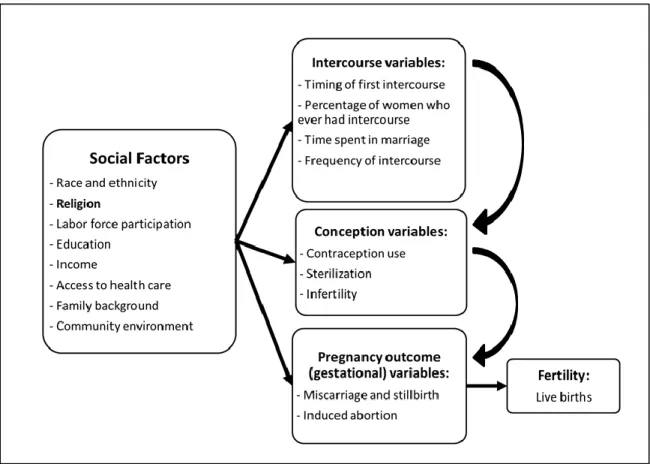
viewing avoiding pregnancy as very important. As can be seen in Figure 1, the 2002
NSFG report presents information on the factors that affect contraception, and thus
fertility; several social determinants, including beliefs and values that can be shaped by
religion, affect decisions about intercourse, and therefore contraceptive use. (2) The
effect of religion on sexual debut and contraceptive use has been primarily studied among
the adolescent population. (8) During adolescence, religion acts as a protective factor for
sexual initiation among females particularly; results have been mixed regarding the role
of religion on sexual debut among adolescent males. Research findings have also been
mixed regarding religion and its effect on contraceptive behavior among teens. A study
using Add Health data found that religiosity was not a significant predictor of
contraceptive use at first intercourse among non-Black adolescents. (9) Another study
using the 1997 National Longitudinal Survey of Youth concluded that high participation
in family religious activities was associated with lower odds of using contraception at
first sex. (10) However, both of these studies have distinct study samples and their
independent variables are measured differently, which could account for the difference in
findings. Other studies report significant correlations between more conservative
adolescent girls. (11,12) Rostosky et al. (8) report multiple limitations that may cloud our
understanding of the effect of religion on contraceptive use during adolescence: paucity
of studies, lack of longitudinal designs, divergence among measures, samples, and
findings. Furthermore, the evidence of religious effects on contraception essentially stops
at adolescence; the extent to which religion influences contraceptive use among emerging
adults has not been widely studied, if at all.
Figure 1. Causal model of the social and intermediate factors leading to live births. (2)
Objective of the paper
Emerging adulthood is an important transition period in the life of an individual.
As expected, the majority of 18-25 year olds have had sex and many emerging adults are
at high risk for unintended pregnancy. Thus, it is important to understand the factors that
this paper is to examine the role of religion and religiosity on contraceptive behavior
among emerging adults. I will review the research literature and summarize the findings
of studies that have examined religion and contraception use among 18-25 year olds. In
addition to providing guidance for future research, the findings from the literature review
will also enable a discussion of their implications for health care providers who provide
contraceptive counseling, as well as for religious communities. If important findings and
patterns emerge, religious communities should be educated about these conclusions and
an analysis for future directions would be appropriate.
Religions and Their Views on Contraception Religion in the United States
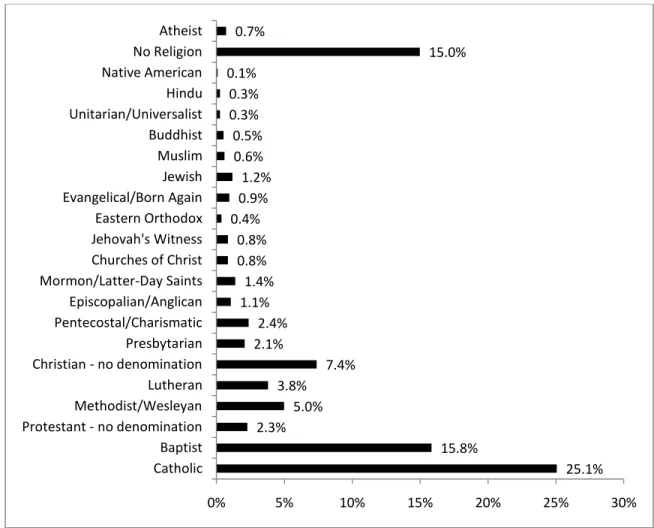
In 2008, 80% of the U.S. adult population identified with a religion. A large
majority (76%) of Americans identified with a Christian denomination, particularly
Catholic (25%) and Baptist (15%); 15% of adults in the United States reported either
being atheist, agnostic, or having no religion. (13) Figure 2 provides additional
information on the population distribution by religious denomination.
The data presented in Figure 2 should be interpreted with caution. A group of
people may identify with a certain religion, but their individual level of religiosity may
vary greatly within that religious group. Furthermore, the concept of “religiosity” is also
a complex variable to measure; there are different ways to interpret and measure it. In any
case, religion could potentially influence a woman at many stages of her sexual and
reproductive life. These might include values and priorities learned before sexual debut;
timing of her sexual debut; views on the relationship between sex, childbearing and
important to consider the different religions and their views or beliefs regarding
contraception and abortion.
Figure 2. Percent distribution of adults by religious affiliation. Data from the U.S. Census
Bureau; United States, 2008. (13)
During emerging adulthood, religion, religiosity, or spirituality is subject to
change. In actuality, there is little relationship between the values conveyed through
religious training received during childhood and the religious beliefs held by the time
individuals reach emerging adulthood. (1) The diverse religious beliefs among emerging
adults fell into four categories defined by the authors: 22% agnostic or atheist, 28% deist,
27% liberal believer, and 23% conservative believer. (1) Many of the individuals 25.1% 15.8% 2.3% 5.0% 3.8% 7.4% 2.1% 2.4% 1.1% 1.4% 0.8% 0.8% 0.4% 0.9% 1.2% 0.6% 0.5% 0.3% 0.3% 0.1% 15.0% 0.7%
0% 5% 10% 15% 20% 25% 30%
interviewed in Arnett’s book (1) reported various beliefs but did not endorse much
defined religious views. Many saw religion more as “one shoe does not fit all”, meaning
that people rarely strictly adhere to the religious beliefs of a particular religious
denomination; people may need guidance from a religious group but their beliefs and
actions may be shaped by many external factors outside of the religion. When we talk
about the period of emerging adulthood, this period, like any other, is very cultural. (1) In
certain religious groups, such as Mormons, there is a cultural push for a shorter emerging
adulthood period where individuals are encouraged to get married and initiate parenthood
at an earlier age than the average modern emerging adult. Thus, it is important not to omit
the cultural context of emerging adulthood and its influence on the way we interpret any
findings. Furthermore, each religious branch holds its own beliefs and sanctions
regarding sex, contraception, and abortion. The following sections will describe some of
the core beliefs held by the most common religious denominations in North America, as
described by Srikanthan & Reid. (15)
Christianity
Christianity contains three major dominations: Roman Catholic, Eastern
Orthodoxy, and Protestantism. Within Catholicism, every act of intercourse, which is
only allowed within the realm of marriage, is seen as a potential for conception. (16)
Scripture does not prohibit married couples from using a method to prevent pregnancy.
The only notable exception is the Roman Catholic Church, which bans hormonal and
barrier methods of contraception because they are deemed unnatural; (17) abstinence and
the rhythm method are the only officially approved methods of contraception and should
unless a morally justifiable reason exists. (19) Abortion and emergency contraception are
prohibited, unless it is to save a mother. (17)
Conservative Protestants, such as Evangelical and Fundamentalist Protestants,
generally disapprove of contraception. However, there are no prohibitions against using
contraception within a marriage that already has children. (17) The permissibility of
abortion and emergency contraception varies between denominations. Conservative
Protestants prohibit all abortions, yet most mainstream conservative Protestants permit
terminations to save a mother’s life. Liberal Protestants allow a woman to make her own
decision regardless of the situation. (17)
Judaism
Judaism can be broken down into four denominations: Orthodox, Conservative,
Reform, and Reconstructionist. More liberal Jewish denominations, such as Reform,
permit birth control use by men and women, even outside of marriage. (20) Reform
Judaism believes that it is a woman’s right to decide to have an abortion and use
emergency contraception. (20)
Orthodox Judaism is stricter, as it forbids the “spilling” of male seeds and thus
prohibits the use of contraception by men, such as coitus interruptus and condoms.
However, women are not bound by this prohibition. (20) Because a woman’s conjugal
rights (the rights of a woman to regular, voluntary intercourse) should not be frustrated,
abstinence is prohibited and the rhythm method is considered unacceptable. It is
forbidden to impair the male reproductive system, thus male sterilization is prohibited.
(16) Oral contraceptive pills are the most permissible method, along with diaphragms,
because they may prevent implantation of a fertilized egg, which equates to a form of
abortion. Interestingly, the Orthodox practice of niddah further influences contraceptive
choices, such as Implanon, because problems can arise with sporadic spotting, causing
potential barriers to women’s conjugal rights. Niddah is “the spiritual state induced in a
woman by uterine bleeding, typically as a result of menstruation or childbirth, during
which time she and her husband maintain physical separation. To end the status, a woman
counts seven days after the bleeding has stopped completely, then immerses in a mikveh
(a type of bath).” (21) Within Orthodox Judaism, terminations are only permitted when
the mother’s life is threatened through either physical or mental illness, and Conservative
Judaism is generally more lenient on the topic. (20) The permissibility of emergency
contraception is similar to the permissibility of terminations. (22)
Islam
Islamic jurists classify human actions as obligatory, recommended, permitted,
disapproved but not forbidden, or forbidden. (23) Sex is permitted, but only within
marriage. Because Muslims traditionally believe that the exclusive purpose of each
sexual act does not need to be for procreation, the majority of Islamic jurists indicate that
family planning is not forbidden. (24) The classification of contraception ranges from
permissible to disapproved, and this depends on the varying opinions of Muslims.
Historically, coitus interruptus has been permitted in the Quran. (24) While some
fundamentalist Muslims are against any form of contraception, temporary, safe, and legal
modern methods of contraception are permitted. (18) Any device that does not induce
abortion and is reversible may be used, which is why irreversible sterilization methods
use of continuous hormonal contraception methods. (20) Abortion is considered a serious
crime equivalent to that of murder. Emergency contraception is also condemned.
However, the prevailing view is that both are permissible in certain situations (i.e. risk of
maternal mortality, a deformed or non-viable fetus, rape, and economic indications). (25)
Hinduism
Sexual relationships are to be experienced and mutually enjoyed within the realm
of marriage, and they can be for procreation and pleasure. (26)There are no official
prohibitions or obligations with respect to contraception. Thus, all contraceptive methods
are acceptable, including continuous contraception, as long as the contraceptive intent is
morally acceptable. (18, 27) Abortion and emergency contraception are condemned.
However, there is some flexibility; Hinduism has traditionally rejected absolutism and
encourages individuals to act in accordance to their beliefs. (28) An important
consideration is that discussions about contraception, sex, abortion, and other sexual
health matters are often considered a taboo topic in traditional Indian families. (29)
Buddhism
Buddhism traditionally does not stress procreation. Marriage and sexuality are
positively viewed, but marriage is not a religious duty. (29) The Buddhist attitude
towards family planning allows both men and women the right to use any non-violent
form of contraception as long as the intent to use contraception is morally acceptable.
(30) Typically, abstinence is the method of choice, but other methods, including
permanent sterilization and modern hormonal methods are permissible. Abortion and
emergency contraception are generally forbidden but both are acceptable in certain
Chinese Religious Traditions
Chinese religious traditions value family planning as a way to promote healthy
families and children. (32) There is no general religious opposition to any contraceptive
method; all modern contraceptive methods are permissible. (32) Because of beliefs
regarding harmony with nature, natural methods of contraception are preferred among
traditional ethnic Chinese. Generally, abortion and emergency contraception are not
permitted, but neither is explicitly prohibited. (32)
Mormonism
Many of the rules for sexual conduct are derived from their biblically rooted New
England Heritage. Sexual relations are permitted within the realm of marriage only, and
the primary purpose of sex is procreation, although a husband and wife may have sex to
express their love. (33) Mormonism encourages procreation and large families, but the
decision to use birth control is essentially left to the married couple. The Mormon Church
is generally opposed to abortion, but certain exceptions apply (i.e. rape, incest,
compromised health of the mother, and severe medical defects of the fetus). (33)
Religion and Contraception Methods for selecting articles
Many studies have investigated the relationship between religion and
contraception among adolescents. Yet, few studies have looked at this relationship among
emerging adults only. Several studies surveyed college students, but they do not portray a
complete picture of emerging adults 18-25. In 2007, 39% of emerging adults 18-24 were
enrolled in a degree-granting institution, (34) thus studies surveying college students
searched for articles with a participant pool that included emerging adults. However,
multiple studies examined adults up to 40 years old and others included participants as
young as 15. As a result, I decided to include these articles for the review as long as a
portion of the participants were 18-25 years old.
I searched for articles in the following databases: PubMed, PsycInfo, Google
Scholar, and CINAHL. Keywords that were used included: contraception, birth control,
contraceptive, condom, religion, religiosity, Jewish, Islam, Fundamentalist. I did not use
any key words related to age groups as I preferred to examine all articles pertaining to
contraception and religion, and from there eliminate the ones that did not include 18-25
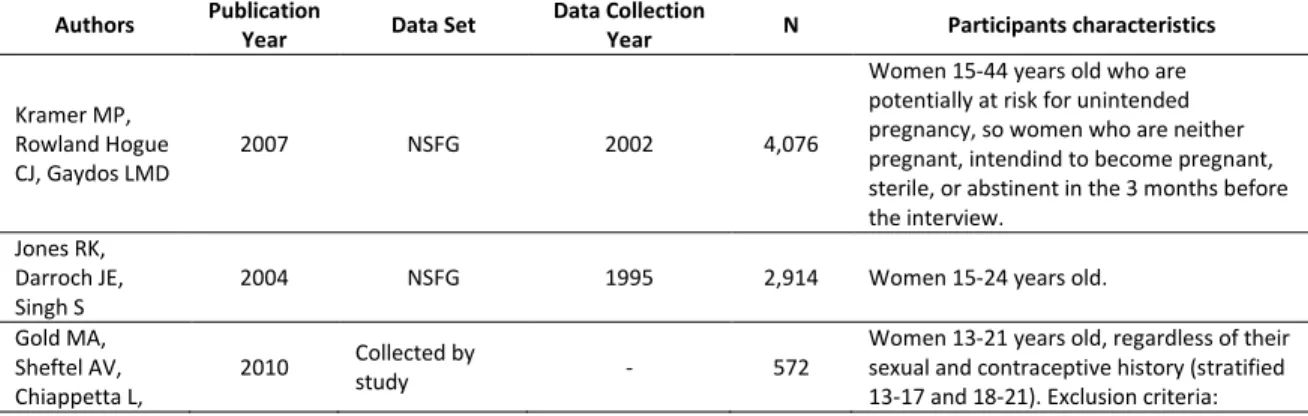
year olds. A total of 13 articles were selected based on the presence of religious and
contraceptive measures, their analyses to test the relationship between these measures,
and the inclusion of the population of interest. Table 2 provides information on each of
the studies; authors, date of publication, data information, and participant characteristics.
Several articles examined emergency contraception, and these are addressed in a separate
section since the use of this method of birth control is controversial among certain
religious communities.
Table 2. Study and participant information of the 13 articles selected for review.
Authors Publication
Year Data Set
Data Collection
Year N Participants characteristics
Kramer MP, Rowland Hogue CJ, Gaydos LMD
2007 NSFG 2002 4,076
Women 15-44 years old who are potentially at risk for unintended pregnancy, so women who are neither pregnant, intendind to become pregnant, sterile, or abstinent in the 3 months before the interview.
Jones RK, Darroch JE, Singh S
2004 NSFG 1995 2,914 Women 15-24 years old.
Gold MA, Sheftel AV, Chiappetta L,
2010 Collected by
study - 572
Young AJ, Zuckoff A, DiClemente CC, Primack BA
inability to speak English, being pregnant or intending to become pregnant in the next 18 months, being sterile, having a contraceptive implant or IUD, planning exclusively same-gender sexual relationships in the future, being in jail or on house arrest, being in foster care, or having visual or hearing impairment that would interfere with counseling and study interviews.
Raine T, Minnis
AM, Padian NS 2003
Collected by study from San Francisco bay area clinics
1996-1999 405
Sexually active (defined as having vaginal sex at least three times in the previous 3 months) women 15-24 years old who were not pregnant or trying to get pregnant.
Romo LF, Berenson AB, Segars A
2004
Collected by study at two university reproductive health clinics in Texas
- 234
Pregnant women age 18-40 (mean was 27.2) who self-identified as Latina mostly from low-income and low-educational backgrounds. Lefkowitz ES, Gillen MM, Shearer CL, Boone TL 2004 Collected by study from university in Eastern United States
- 205 Male and female undergraduate students
18-25 years old.
Venkat P, Masch R, Ng E, Cremer M, Richman S, Arslan A
2008
Collected by study from a hospital in NYC
2004 102 Latina women age 16-70 (67% fell under
the 16-30 age range).
Romo LF, Berenson AB, Wu ZH
2004
Collected by study from two university reproductive health clinics in Texas
- 297
Latina women age 18-44 (mean age was 27.4) mostly from income and low-educational backgrounds who responded questions about Emergency Contraception. 76% of sample was pregnant at the time of the survey.
Fehring RJ,
Ohlendorf J 2007 NSFG 2002 9,885
Married and unmarried women (mean age was 29.5; SD=8.43) who answered questions about contraceptive practices. Goldscheider C,
Misher WD 1991 NSFG 1988 8,450 Married and unmarried women age 15-44.
Jemmott LS, Jemmott JB, Villarruel AM
2002 Collected by
study - 199
Male and female Latino undergraduate and graduate students. Mean age was 23.2 (SD=5.2). Participants were unmarried and reported never being sexually involved with a same-gender partner.
Zaleski EH,
Schiaffino KM 2000
Collected by study from an urban Catholic university
- 231 Male and female college freshmen age
16-20 (mean age was 17.9)
Dodge B, Sandfort TGM, Yarber WL, de Wit J
2005
Collected by study from one large public university in Mid-western United States and one large public university in the Netherlands
2002 242
Religious denominations
Few studies examined multiple religious denominations other than the most
common branches of Christianity. Overall, results show that religious affiliation by
denomination has little, if any, influence on contraceptive behavior. A study conducted
by Kramer et al. (14) used 2002 NSFG data and looked at childhood religion and current
religion among participants age 15-44. Catholics, Fundamentalist Protestants and those
who report no religion were found to be greater risk-takers (having sexual intercourse
within 3 months of interview without using a method of contraception) than mainline
Protestants and those from other religious groups. Participants who reported being
Catholics or Fundamentalists during childhood had increased crude odds ratios for not
contracepting compared to those who reported being mainline Protestants as a child.
However, participants who reported being Catholic at the time of the interview did not
have an increased crude odds ratio for not contracepting when compared to mainline
Protestants, but participants who reported being Fundamentalist Protestants at the time of
the interview did have an increased crude odds ratio for not contracepting. The
researchers concluded that religion had an effect on the nonuse of contraception during
adolescence but not adulthood. (14) However, 55.7% of the study sample was 25 or older
and 18% of the sample was 19 or younger; the large participation of older participants
and adolescents make it difficult to interpret the results for emerging adults only. Another
study using 2002 NSFG data, with the majority of its female participants being over age
25, compared Roman Catholics and other American women. (35) Although significance
levels were not calculated, Roman Catholic women, when compared to other American
natural family planning method, were less likely to use surgical sterilization (male and
female combined), and were equally likely to be using condoms. Other findings from
NSFG data collected in 1998 indicate that a lower proportion of Fundamentalist
Protestants use methods of contraception than other Protestants (among contraceptors,
Fundamentalist Protestants have a higher proportion of female sterilization use), although
Fundamentalist Protestants also have lower proportions of sexual activity. (36)
Several studies examined the population of interest, emerging adults. Raine et al.
(37) found that women age 15-24 raised with a religion were significantly less likely to
use a hormonal method of contraception. The authors concluded that these women may
feel more uncomfortable taking the necessary steps to obtain hormonal birth control
because of the sanctions of their religion, which may make them less likely to
acknowledge or anticipate their sexual behaviors. On the other hand, Lefkowitz et al.
(38), who interviewed college students age 18-25, found no difference between religious
groups (Catholic, Protestants, nonbelievers, Jewish, Muslim, Hindu, Buddhist, although
the last 3 made up 5% of sample) in condom use, but nonbelievers reported marginally
higher confidence in their ability to talk to a partner about condoms than did Protestants
or Catholics. Emerging adults may know about the importance of using condoms, but
those who are affiliated with a religion may have been less exposed to open discussions
regarding the use of condoms, and are therefore less comfortable talking about condom
use with sexual partners.
Kramer et al. (14) found differences between religious groups when participants
were divided by poverty level (less than 100% of poverty line, 100-199% of poverty line,
play. For current religious affiliation, when comparing coital interruptus and commercial
birth control, the odds ratios were very close between religious groups among the
wealthiest and poorest thirds. However, among the moderately poor, Fundamentalist
Protestants had an increased odds ratio of using coitus interruptus (versus commercial
birth control) compared to other religious groups in the study. (14) For childhood
religious affiliation, results still show no difference between religious groups among the
wealthiest third, when comparing coitus interruptus and commercial birth control use.
However, there were differences among the poorest and the moderately poor groups;
poor Fundamentalist Protestants and those with no religion had increased odds ratios of
using coitus interruptus when compared to other low-income participants from other
religious groups, and moderately poor Catholics had an increased odds ratio of using
coitus interruptus when compared to other moderately poor religious groups (including
those with no religion). (14) If religion were to influence the use of effective commercial
contraceptive methods, which are more expensive, similar odds ratios should have been
observed among all income groups. However, the fact that no difference was found
among the wealthiest group, and not among the other groups, may suggest that income
may be one of the factors influencing effective contraceptive use. Another study, (39)
which used 1995 NSFG data of 2,914 women age 15-24, included multiple factors in its
statistical model and found that when they controlled for mother's education, race and
ethnicity, family structure, and timing of first sex, religious affiliation was not associated
with contraceptive use at first sex. However, it is important to consider that “first sex”
might have occurred during adolescence. Race and ethnicity were not consistently
contraceptive use. When surveying Latinas 18-40 years old, Romo et al. (40) found that
religion was not directly associated with consistency of contraceptive use.
Religious service attendance
The impact of religious service attendance on contraceptive behavior varies, but
overall it appears to have little influence. Frequency of religious service attendance is
intended to measure some aspect of religiosity, with the idea that individuals who
frequently attend religious services are more likely to adhere to the beliefs and values of
their religious denomination. Kramer et al. (14) and Jones et al. (39) found that the
frequency of religious service attendance was hardly associated with contraceptive use.
Jones et al. (39) controlled for race and ethnicity, mother's education, family structure,
timing of first sex, and attendance of religious services at 14; they found that there was
no association between the frequency of religious service attendance and contraceptive
use at first sex. However, they did find that among sexually active women age 20-24,
those who attended religious services less frequently while growing up were significantly
less likely than those who did so every week to be using contraception.
Other studies found evidence that the frequency of religious service attendance
may affect contraceptive behavior. Women age 18-44 with high church attendance were
38% more likely to be sterilized, 51% more likely to have a male partner who was
sterilized, and 188% more likely ever to have used the natural family planning method.
(35) The same women with high church attendance were 48% less likely ever to have
used condoms compared to women who were classified as “low church attendance,” but
there was no difference in the frequency of lifetime oral contraceptive pill use. (35) The
condom use among more religious (in this case, defined by high religious service
attendance) women could be a result of their married status, where the prevention of
sexually transmitted infections (STI) may not be deemed necessary so an alternative
contraceptive method can be used. Other evidence shows that Catholics who attend
church more regularly are less likely to use a method of contraception. (36) Interestingly,
among contraceptors, Catholics who attend religious services more frequently are more
likely to use condoms and male sterilization than Catholics with “low” church
attendance, but are less likely to use the pill. When broken down by race and ethnicity
(Catholic non-Hispanic white, Catholic non-Hispanic black, and Catholic Hispanic), the
same significant differences in contraceptive use between “high” and “low” church
attendance were found among non-Hispanic whites, but not among the other ethnicities,
with the exception that Hispanics with “high” church attendance are more likely to use
condoms than those with “low” church attendance. (36) The two studies above show
some contrasting findings, although both are using NSFG data but from two different
collection periods.
Among Latinas, church attendance was not directly associated with consistent
contraceptive use, (40) and did not significantly affect beliefs about safety and efficacy of
contraceptive methods with the exception of Depo-Provera (DMPA), which was thought
to be more harmful among weekly church attendees, and the Patch, which was thought
less effective by weekly church attendees. (41)
Importance of religion
Importance of religion, or sometimes referred to as “religiosity”, is a measure
questions about the role of religion in one’s life. Several studies have found that the
importance of religion has no significant association with contraceptive use. A study by
Gold et al. (42) surveying women 13-21 years old found that compared with those in the
low religiosity group (religiosity is based on 4 items and not only on importance of
religion), those in the medium and high religiosity groups were not more likely to have
used contraception at last sex, or to plan on using contraception at next sex. It is
important to note that the above sample is quite young and thus other factors that are
particularly influential during adolescence but not as much in adulthood (e.g. sexual
history, being a minor and having limited access to contraceptive options) may play a
role.
Several studies examined condom use specifically. Condom use is particularly
important during emerging adulthood due to its benefit of preventing pregnancy and
STIs, especially since individuals age 18-24 are particularly at risk for STIs. Among
university students 18-25 years old, there was no association between religiosity and
regularity of condom use. (38) However, when they examined behaviors and attitudes
surrounding condom use, they found that individuals who followed their religion more
closely were less likely to believe that condoms could prevent negative outcomes such as
STIs or pregnancy. This could be because the analysis includes the attituded of people
who have never been sexually active, and thus have never thought about using a condom.
Furthermore, individuals who perceived that their religions have more sanctions against
sexual behaviors had less self-efficacy (i.e. communicating with partner about using
condoms) for using and buying condoms. (38) Individuals who adhered more strongly to
condoms around). (38) Another study looked at intrinsic and extrinsic religiosity among
freshmen students at a Catholic University. (43) According to Allport et al. (44), who
first studied these two types of religiosity, extrinsically motivated persons use their
religion, whereas intrinsically motivated persons live their religion, but most people fall
upon a continuum between those two types. The results indicate that sexually active
students with high levels of intrinsic and extrinsic religious identification were less likely
to use condoms. (43) Latino students who scored higher in religiosity had stronger
intentions to use condoms and were more likely to use condoms the most recent time they
had anal intercourse, while Hispanic ethnicity was unrelated to intentions and
self-reported condom use. (45) Although unrelated to preventing pregnancy, unprotected anal
sex is important to address because it places individuals at risk for STIs.
Other studies found that religious importance had some effect on the use of
contraceptive methods other than condoms. Fehring & Ohlendorf (35) observed that
women who viewed religion as very important were 21% less likely ever to have used the
pill and 50% less likely ever to have used the male condom than women who reported
religion as not very important. When compared to those who reported religion as not very
important, women who reported religion as very important were 164% more likely ever
to have used the natural family planning method and 68% more likely to be sterilized, but
there is no statistical difference in frequency of having a male partner who has been
sterilized. (35) However, the mean age for this study was 29, so these results, specifically
around sterilization, should be considered carefully as older women are more likely to be
may be less inclined to using condoms with their partner, so the results above should be
interpreted conservatively.
One of the studies examined and compared male college students in the United
States and in the Netherlands. In both cultures, those who reported a higher importance of
religion were less likely to use adequate contraception (inadequate contraception was
defined as either not using a method to prevent pregnancy or using coitus interruptus) and
were more likely to have impregnated a partner. (46) In multivariate analyses, national
culture as a predictor disappeared, which demonstrates that the variable religiosity
functions in similar ways within both the United States and the Netherlands.
Emergency contraception
As mentioned in the section describing the different religious views, many
religious denominations frown upon the use of emergency contraception. In fact, most
view the use of emergency contraception as “sinful” as the act of terminating a
pregnancy. Thus, the role of religion in the use of emergency contraception may be
exacerbated among emerging adults.
There are numerous misconceptions regarding the way the emergency
contraception, or the “morning after pill”, works. In actuality, there is no consensus on
how emergency contraception works, except that we know it tricks the ovaries into
sensing that ovulation has already occurred so no eggs may mature, and it thickens
cervical mucus to hinder sperm from traveling upwards. (47) A study examining the
association between religious views and knowledge about emergency contraception, as
well as willingness to use it, reported surprising results. (48) Study participants were
statistical difference between both groups in their knowledge about the method. The
group that was most unwilling to use the morning after pill expressed higher levels of
agreement that religious or moral factors were barriers to emergency contraception use
compared to women in the willing group. However, morality concerns regarding
emergency contraception did not correlate with frequency of church attendance nor their
affiliation.
Limitations and future directions
It must first be noted that this literature review consists of important limitations,
which could drastically hinder the ability to have a clear understanding of the role of
religion in contraceptive use and beliefs. The main limitation is the limited availability of
research studies examining emerging adults only. Most of the studies include adolescents,
older adults, or only college students. Future studies should truly consider the importance
of examining all emerging adults, and not solely those who attend college. I would expect
that religion plays a lesser role on sexual attitudes and experiences among emerging
adulthood than it does during adolescence, particularly as sexually active 18-25 year olds
are waiting longer to get married. However, I believe that religion may be particularly
influential in emerging adults’ knowledge and use of contraception, especially hormonal
methods (e.g. pills Implanon, IUD). As a result of the limited reproductive health services
and pregnancy prevention programs targeting emerging adults, it is important to
understand what places emerging adults at risk for unplanned pregnancy so that effective
programs can be developed in the future.
Among most studies, religiosity is a difficult concept to measure and researchers
there was no consistency in this crucial variable. Furthermore, there was poor
representation from many religious groups. Jewish, Muslim, Mormons, Hindi and other
religious groups were frequently all clustered together and labeled as “other religions”. It
would be valuable to examine these religious groups separately, in order to shed some
light on their birth control needs. The majority of studies examined Protestants and
Catholics. Whereas these two groups make up the majority of the U.S. population,
researchers should nonetheless consider oversampling other religious groups. Moreover,
researchers should make a distinction between religiosity and spirituality, which is
uncommon in past research.
Implications
Implications for contraception counseling
Providers in many different settings may encounter emerging adults who may
need to be counseled about birth control. Although results from this literature review
demonstrate that religion does not play a major role in determining contraceptive use, the
picture is currently incomplete. Jones et al. (39) found that religious affiliation and
frequency of religious attendance were not significant predictors of family planning visits
within 6 months of intercourse for women age 15-24, thus it can be expected that
religious sexually active women may seek birth control counseling. Counselors should
not only consider a patient’s religion or spirituality and their associated “rules” that
govern sexual behaviors and contraceptive use, but also the traditions that may make the
use of birth control more complicated. For instance, among Orthodox Jewish women,
niddah may make the use of progestin only methods less practical. Gold et al. (42)
beliefs on sexual behaviors. It is important that providers feel comfortable asking about
patients’ religious beliefs, as stereotypes can result in inadequate provision of services,
even when the provider has the best intentions to respect presumed cultural differences.
(40)Thatbeing said, health care providers are not required to know about all religions
and their associated beliefs. It is only suggested that clinicians ask if religious or other
beliefs should be taken into account when discussing birth control or sexuality.
When discussing birth control methods, STIs may not come to mind. However,
condom use was shown to vary slightly between religious groups and religious behaviors.
This has important implications not only for unplanned pregnancy but for STIs and
access to testing and treatment services. Sexually transmitted infections can be
transmitted through oral, anal, as well as vaginal sex. Thus, even if the risk for pregnancy
is not a concern, there remains a risk for STIs. Patients who report “not having sex”
because of religious beliefs may be referring only to vaginal sex, and may therefore be
engaging in other types of risky sex. Thus, in addition to inquiring about religion and
religiosity, it is important to clarify any terms that are used, so as to not make any
assumptions and premature conclusions.
Implications for religious communities
Considering how abortion is often times perceived as a “sin” and how many
pregnancies end in abortion among women age 18-24, avoiding an unplanned pregnancy,
and thus abortion might be very important to many women. It would be valuable for
religious communities to know the proportion of followers that are having sex without
the intention of becoming pregnant. From there, thorough and accurate education of the
concerning the way the morning after pill works. Leftowitz et al. (38) found that
individuals who perceived that their religions have more sanctions against sexual
behaviors had less self-efficacy (i.e. communicating with partner about using condoms)
for using and buying condoms. Thus, educational sessions should also include partner
communication skills, and other self-efficacy skills. Proper education can result in fewer
unplanned pregnancies and reduce STI incidence. However, this can be especially
difficult to implement among religious denominations that ban intercourse and
contraception outside the realm of marriage. Public health professionals may need to
show evidence of the proportion of unmarried emerging adults in the more conservative
religious communities who are having sex, and the rates of unplanned pregnancy and
abortion. With clear data, public health professionals may be able to work with the more
conservative religious groups to incorporate adequate education, if the data indicate that
it would be beneficial.
Conclusion
There appears to be negligible influence of religion on contraceptive behavior
among emerging adults. However, there is clearly still a lack of evidence to make such a
firm conclusion. Of the 13 studies selected, several important findings emerged. Overall,
Fundamentalist Protestants surfaced as the religious group less likely to use contraception
when compared to other Protestants. Among emerging adults, those who were raised with
a religion were less likely to use a hormonal, and therefore effective, method of
contraception. Women who reported “low” religious service attendance while growing up
were less likely to use contraception currently. However, women with present “high”
“traditional” methods, such as natural family planning and sterilization. As pointed out
earlier, the latter is particularly popular among older women, and thus should probably
not be interpreted as relevant to emerging adults. Religiosity was largely non-influential
on the use of contraception and condoms. However, emerging adults in college with
higher religiosity were less likely to believe that condoms prevent HIV and pregnancy,
and perceived more barriers to condom use. Few studies looked at other factors, such as
socioeconomic status, race and ethnicity, age, gender, etc. Three of the studies selected
surveyed Latinos and found that religion and church attendance had no effect on
contraceptive use, but that increased religiosity had a positive effect on recent condom
use and intention to use condoms in the future.
Although the results remain largely inconclusive, the implications are nonetheless
important for contraception counseling and education among religious communities.
Future research should investigate the relationship between religion and contraception
among all emerging adults, and not merely college students. College students often times
have adequate access to family planning services and numerous colleges make efforts to
raise awareness on their campus. As public health professionals, we strive to address the
needs of every population and this is best accomplished with a clear understanding of
those needs. Populations and their beliefs, values, and behaviors are constantly and
progressively shifting. Thus, it is important for research and programs to follow such
progress.
Several religious groups and communities in the United States are becoming more
progressive in their views, and thus religiosity may no longer be impacting contraception
factor when counseling individuals on contraception and other topics of sexuality.
Personal views should be carefully accounted for in every visit, despite assumptions. It is
important to consider that race and ethnicity, as well as education may be more
influential and be better proxies for assessing disparities in contraceptive use among
emerging adults. For instance, race and ethnicity within religious denominations alone
show significant differences in sexual and reproductive behaviors. (49) This paper
examined contraception use only. It is possible that religion influences other sexual
behaviors as well (i.e. first sex, number of sexual partners, gender of sexual partners, and
type of sex) among emerging adults.
References
1. Arnett JJ. Emerging adulthood: the winding road from late teens through the
twenties. New York: Oxford University Press; 2004.
2. Chandra A, Martinez GM, Mosher WD, Abma JC, Jones J. Fertility, family
planning, and reproductive health of U.S. women: Data from the 2002 National
Survey of Family Growth. National Center for Health Statistics. Vital Health
Statistics 2005; 23(25).
3. Suellentrop, K. The odyssey years: preventing teen pregnancy among older teens.
Washington, DC: The National Campaign to Prevent Teen and Unplanned
Pregnancy; 2010.
4. Hamilton BE, Martin JA, Ventura SJ. Births: preliminary data for 2008.
Hyattsville, MD: National Center for Health Statistics. National Vital Statistics
Report 2010; 58(16).
5. Centers for Disease Control and Prevention. Abortion surveillance – United
States, 2007. MMWR 2011; 60(1): 1-39.
6. Mosher WD, Jones J. Use of contraception in the United States: 1982–2008.
National Center for Health Statistics. Vital Health Stat 2010; 23(29).
7. Frost JJ, Singh S, Finer LB. Factors associated with contraceptive use and nonuse,
United States, 2004. Perspectives on Sexual and Reproductive Health 2007;
39(2): 90-99.
8. Rostosky SS, Wilcox BL, Comer Wright ML, Randall BA. The impact of
religiosity on adolescent sexual behavior: a review of the evidence. Journal of
9. Bearman PS, Bruckner H. Promising the future: Virginity pledges and the
transition to first intercourse. American Journal of Sociology 2001; 106(4):
859-912.
10.Manlove JS, Terry-Humen E, Ikramullah EN, Moore KA. The role of parent
religiosity in teens’ transitions to sex and contraception. Journal of Adolescent
Health 2006; 39: 578-587.
11.Brewster KL, Cooksey EC, Guilkey DK, Rindfuss RR. The changing impact of
religion on the sexual and contraceptive behavior of adolescent women in the
United States. Journal of Marriage and the Family 1998; 60: 493-504.
12.Cooksey EC, Rindfuss RR, Guilkey DK. The initiation of adolescent sexual and
contraceptive behavior during changing times. Journal of Health and Social
Behavior 1996; 37: 59-74.
13.U.S. Census Bureau. The 2011 statistical abstract: self-described religious
identification of adult population 1990 to 2008. [Internet] 2011 Jan 20 [cited 2011
Mar 1]. Available from:http://www.census.gov/compendia/statab/2011/tables/
11s0075.pdf
14.. Kramer MR, Rowland Hogue CJ, Gaydos LMD. Noncontracepting behavior in
women at risk for unintended pregnancy: what’s religion got to do with it? Annals
of Epidemiology 2007; 17: 327-334.
15.Srikanthan A, Reid RL. Religious and cultural influences on contraception.
Journal of Obstetrics and Gynecology Canada 2008; 30(2): 129-137.
16.Schenker JG. Women’s reproductive health: monotheistic religious perspectives.
17.Manning C, Zuckerman P. Sex and religion. 1st ed. Toronto: Thomson
Wadsworth; 2005. LoPresti AF, Chapter 6, Christianity; p.117-141.
18.Schenker JG, Rabenou V. Family planning: cultural and religious perspectives.
Human Reproduction 1993; 8(6): 969–76.
19.Draper E. Attitudes of different religions. In: Birth control in the modern world.
Baltimore, Maryland: Penguin Books; 1965: p.142–78.
20.Manning C, Zuckerman P. Sex and religion. 1st ed. Toronto: Thomson
Wadsworth; 2005. Geller B, Chapter 5, Judaism; p.93-116.
21.The Couple’s Guide to Jewish fertility Challenges. Niddah. [Internet] 2011 [cited
2011 Mar 28]. Available from: http://www.jewishfertility.org/niddah.php?
popup=1
22.Okun BS. Religiosity and contraceptive method choice: The Jewish population of
Israel. European Journal of Population 2000; 16: 109–32.
23.Hasna F. Islam, social traditions and family planning. Advances in Nursing
Science 2003; 37(2): 181–97.
24.Manning C, Zuckerman P. Sex and religion. 1st ed. Toronto: Thomson
Wadsworth; 2005. Poston L, Chapter 9, Islam; p.181–197.
25.Pennachio DL. Caring for your Muslim patients: stereotypes and
misunderstandings affect the care of patients from the Middle East and other parts
of the Islamic world. Medical Economics 2005; 82(9): 46–50.
26.Manning C, Zuckerman P. Sex and religion. 1st ed. Toronto: Thomson
Wadsworth; 2005. Sherma RD, Chapter 2, Hinduism; p.18-40.
28.Jain S. The right to family planning, contraception and abortion: the Hindu view.
In: Maguire DC, ed. Sacred rights: the case for contraception and abortion in
world religions. New York: Oxford University Press; 2003: p.129–44.
29.Aggarwal O, Sharma AK, Chhabra P. Study in sexuality of medical college
students in India. International Journal of Adolescent Medicine and Health 2000;
26: 226–9.
30.Manning C, Zuckerman P. Sex and religion. 1st ed. Toronto: Thomson
Wadsworth; 2005. Sponberg A, Chapter 3, Buddhism; p.41–59.
31.Gnanawimala B. The Buddhist view: free to choose. Asiaweek 1993; 54: 54.
32.Shang G. Excess, lack, and harmony. In: Maguire DC, ed. Sacred rights: the case
for contraception and abortion in world religions. New York: Oxford University
Press; 2003: p.217–35.
33.Manning C, Zuckerman P. Sex and religion. 1st ed. Toronto: Thomson
Wadsworth; 2005. Hansen KJ, Chapter 7, Mormonism; p.142-159.
34.U.S Department of Education: Institute of Education Sciences. Digest of
education statistics. [Internet] 2008 [cited 2011 Mar 9]. Available from:
http://nces.ed.gov/programs/digest/d08/tables/dt08_204.asp
35.Ohlendorf J, Fehring RJ. The influence of religiosity on contraceptive use among
Roman Catholic women in the United States. The Linacre Quarterly 2007; 74(2):
135-144.
36.Goldscheider C, Mosher WD. Patterns of contraceptive use in the United States:
the importance of religious factors. Studies in Family Planning 1991; 22(2):
37.Raine T, Minnis AM, Padian NS. Determinants of contraceptive method among
young women at risk for unintended pregnancy and sexually transmitted
infections. Contraception 2003; 68: 19-25.
38.Leftowitz ES, Gillen MM, Shearer CL, Boone TL. Religiosity, sexual behaviors,
and sexual attitudes during emerging adulthood. The Journal of Sex Research
2004; 41(2): 150-159.
39.Jones RK, Darroch JE, Singh S. Religious differentials in the sexual and
reproductive behaviors of young women in the United States. Journal of
Adolescent Health 2005; 36: 279-288.
40.Romo LF, Berenson AB, Segars A. Sociocultural and religious influences on the
normative contraceptive practices of Latino women in the United States.
Contraception 2004; 69: 219-225.
41.Venkat P, Masch R, Ng E, Cremer M, Richman S, Arslam A. Knowledge and
beliefs about contraception in urban Latina women. Journal of Community Health
2008; 33: 357-362.
42.Gold MA, Sheftel AV, Chiappetta L, Young AJ, Zuckoff A, DiClemente CC, et
al. Associations between religiosity and sexual contraceptive behaviors. Journal
of Pediatric and Adolescent Gynecology 2010; 23: 290-297.
43.Zaleski EH, Schiaffino KM. Religiosity and sexual risk-taking behavior during
the transition to college. Journal of Adolescence 2000; 23: 223-227.
44.Allport GW, Ross MJ. Personal religious orientations and prejudice. Journal of
45.Jemmott LS, Jemmott JB, Villarruel AM. Predicting intentions and condom use
among Latino college students. Journal of the Association of Nurses in AIDS
Care 2002; 13(2): 59-69.
46.Dodge B, Sandfort TGM, Yarber WL, de Wit J. Sexual health among male
college students in the United States and the Netherlands. American Journal of
Health Behaviors 2005; 29(2): 172-182.
47.Ackerman T. Emergency contraception: science and religion collide. Annals of
Emergency Medicine 2006; 47(2): 154-157.
48.Romo LF, Berenson AB, Wu ZH. The role of misconceptions on Latino women’s
acceptance of emergency contraceptive pills. Contraception 2004; 69: 227-235.
49.The National Campaign to Prevent Teen and Unplanned Pregnancy. DCR report
section J: religiosity and its association with sexual activity, childbearing, and
marriage among young adults age 20-29. [Internet] 2011 [cited 2011 Mar 6].
Available from: http://www.thenationalcampaign.org/resources/dcr/SectionJ/
Acknowledgements
I thank Claudia Fernandez and Carolyn Halpern for their invaluable reviews and