Breastfeeding Resources Available to the Eight American Indian Tribes with Territory in North Carolina
By Amber Christis
A paper presented to the faculty of The University of North Carolina at
Chapel Hill in partial fulfillment of the requirements for the degree of Master of Public Health in the Department of Maternal and Child Health.
Chapel Hill, N.C.
May 17, 2017
ABSTRACT
Breastfeeding is an important health behavior and intervention with benefits for both mother and baby. Risk of overweight, obesity, and diabetes mellitus is increased in those not breastfed as compared to those who are breastfed.1 American Indians have high rates of diabetes and obesity and low rates of breastfeeding initiation and duration. Federally recognized tribes receive benefits and health services through the Indian Health Services while non-federally recognized tribes must rely on health and social services that may not cater to their specific needs.
Methods: Breastfeeding resources were mapped by counties of tribal residence in NC to determine geographic accessibility. WIC Breastfeeding Coordinators in relevant counties were interviewed as key informants on available resources, and American Indian use and response to services.
Results: The Eastern Band of Cherokee has the most comprehensive services directly targeting enrolled members of the tribe. The Cherokee and Lumbee Tribes have access to American Indian peer counselors in their local WIC offices. The Occaneechi Band of Sapponi are the closest geographically to the plethora of resources that saturate Orange County. The majority of breastfeeding coordinators in counties with tribal territory are not familiar with the tribe in their area.
TABLE OF CONTENTS
List of Abbreviations
………...………
.4
List of Tables
………...……….
..4
List of Figures.
………...
.4
Background
……….…………..5
Methods
………..……..
Results
……….……...….1
Discussion
………..………….……
22
Acknowledgements
……….……….…
26
Appendix
………..………..…
27
List of Abbreviations
EBCI- Eastern Band of Cherokee Indians
IBCLC- Internationally Board Certified Lactation Consultant CLC- Certified Lactation Counselor
CLE- Certified Lactation Educator
WIC- The Special Supplemental Nutrition Program for Women, Infants, and Children
List of Figures
FIGURE 1: Tribal Territory by County i NC………...9 FIGURE 2: Density of IBCLCs, CLC/CLEs, and Breastfeeding Support Groups in Zipmilk by
Tri e a d Affiliated Cou ty i NC………..10
FIGURE 3: Breastfeeding Friendly Organizations by Tri e i NC………..11
FIGURE : Breastfeedi g Frie dly Orga izatio s i Ala a e a d Ora ge Cou ties………11
List of Tables
TABLE 1: Zip Codes by County………..12 TABLE 2: Breastfeeding Initiation Rates, Resources, and Breastfeeding Friendly Organizations
by Tribe and County………..14
TABLE : Ra ki g of Resour es y Tri e………
TABLE 4: Racial distribution for Infants by county affiliated with state recognized tribes, as
BACKGROUND
American Indian communities experience a burden of disease greater than the general population.2 American Indians have a life expectancy that is 4.4 years less than the U.S. average for all races.2 Sudden infant death syndrome, type 2 Diabetes, and childhood obesity are among the health disparities experienced in the American Indian community.2 Breastfeeding has been shown to be to associated with reduced severe lower respiratory tract infections, obesity, type 1 and 2 diabetes, sudden infant death syndrome, and necrotizing enterocolitis.1 Increased breastfeeding duration is associated with reduced incidence of maternal type 2 diabetes.3 There is also evidence breastfeeding may be associated with a reduction in risk of hyperlipidemia, hypertension, and cardiovascular disease in
mothers.5,6 Breastfeeding has been shown to have potential health benefits for all mothers and children, however breastfeeding support can be a crucial primary health intervention for populations at greater risk for these specific negative health outcomes.
The United States National Immunization Survey found that American Indian and Alaska Natives had the second lowest breastfeeding initiation rates, 68.3%, in 2013. The trend continued at six months duration, 41.3%, and 12 months, 21.6%.7 Barriers to successful breastfeeding are plentiful: lack of maternity leave, limited social support, embarrassment, and limited knowledge of the benefits vs. risks of formula. For some racial and ethnic minority women, these barriers can be compounded further by added social, political, and economic factors. For low income, rural, American Indian women, there may be added geographic and financial barriers in accessing breastfeeding resources. Other potential barriers include distrust of the medical community and the communal experience of historical trauma.
lands8,9,10,11,12,13, lack of formal tribal recognition and sovereignty8,9,12,13, forced separation of families with its corresponding loss of culture and language8,9,10,11,12,13, and continued institutional and structural racism.8,9,10,11,12,13,14 This trauma impacts at the individual, intergenerational, and community levels.8,9 Any and all aspects of this intergenerational experience could negatively impact health
outcomes.8,9,10,11,12,13,14,15 Further, the forced separation of families through boarding school attendance has had a clear impact on the ability of American Indian families to pass on cultural knowledge and familial norms.9,13,15A ai purpose of the oardi g s hool syste as to kill the i dia i the hild through forced assimilation and elimination of tribal languages, customs, diet, and beliefs.8,9,13 Physical, emotional, and sexual abuse was common in the schools.8,9,13 Sexual abuse alone creates unique challenges to the breastfeeding relationship.16 The separation of the family unit and eradication of tribal language also created a significant barrier to passing on infant feeding and breastfeeding knowledge between generations.9
It is difficult to ascertain approximately how many of the tribes in NC were affected by forced
separation and boarding school attendance. According to Lawrence Locklear, member of the Lumbee
Tribe and Program Coordinator for Southeast American Indian Studies Program at The University of
North Carolina at Pembroke, approximately nine Lumbee students attended Carlisle between 1910 and
… their atte da e as olu tary … ost of the students stayed about one month . It is well
documented that members of the Eastern Band of Cherokee were sent to the Carlisle School in
Pennsylvania. There are records of at least 100 students in the Carlisle Indian School digital resource
center.17
NC, primarily near the border of York County, SC. Since Catawba tribal territory is in SC, they are not included in this research paper.
The Eastern Band of Cherokee Indians (EBCI) is made up of 14,000 enrolled members who live primarily in Graham, Swain, Jackson, and Cherokee counties.19 The EBCI is descended from members of the Cherokee Tribe who remained in NC after the 1830 Indian Removal Act and the Trail of Tears.19 Many members live within the Qualla Boundary, a land trust owned by the EBCI.19 The tribe is governed by an executive branch led by Principal Chief Lambert, a 12 member Tribal Council, and a Judicial branch.20 As a federally recognized tribe, members of the EBCI are entitled to benefits through the Bureau of Indian Affairs and the Indian Health Service. As such, the ECBI have their own Public Health and Human Services Department (PHHS). The PHHS provides a long list of services which include WIC,
Head “tart, Early Head “tart, Wo e ’s Well ess, Nurse-Family Partnership, Domestic Violence services
and shelter, and diabetes prevention program known as Cherokee Choices.21 The tribe owns a revenue generating casino. According to one of their websites, the casino generated $441 million in 2008, 34.8 million of which went towards services for the community.22
The Coharie tribe is located in Harnett and Sampson counties.18 They have lived continuously as a tribe in their present location since 1746.18 The modern tribe organizes itself around four churches: Holly Grove, New Bethel, Shiloh, and Antioch.22 The tribe is governed by the elected members of the Coharie Intra-Tribal Council.21 There are monthly community meetings, annual pageants and pow wows, and programs for youth and seniors.22
The Lumbee tribe is the second largest tribe in the North Carolina with 55,000 enrolled members.18The Federal Lu ee A t of re og ized the Nati e A eri a s of Ro eso a d adjoi i g ou ties as the Lu ee I dia s of North Caroli a hile si ulta eously aki g the
ineligible for benefits through the Bureau of Indian Affairs.18 The tribe continues to seek full recognition and benefits. The Lumbee in North Carolina currently live in Robeson, Hoke, and Scotland counties.17 There are some Lumbee also living in SC.25 The tribe is governed by the Tribal Chair, Harvey Godwin Jr, and a Tribal Council with 21 elected members.25 The Tribal government includes executive, legislative, and judicial branches guided by a constitution.25 The Tribal Administration oversees veteran services, housing services, youth services, vocation rehabilitation for members with disabilities, and household energy initiatives.25
The Meherrin Nation refer to the sel es as People of the Water a d share allegia e,
ulture, traditio s, a d la guage ith the Iroquois Confederacy.18 The Meherrin are governed by Chief
Wayne Brown and seven elected Tribal Council members.26 Members of the tribe largely live in Hertford County neat the Virginia border and conduct an annual pow wow.26
The Occaneechi Band of the Saponi Nation (OBSN) currently live in Alamance and Orange Counties.18 The OBSN are governed by their Tribal Chairperson, William Hayes, and a Tribal Council.27 The OBSN are the smallest of NCs state recognized tribes and conduct an annual Pow Wow.18 Events at their gathering space include a Sacred Hoop of Healing and Wellbeing Talking Circle and Yoga for Healthy Natives.27 The tribe initiated the Occaneechi Homeland Preservation Project in 2002. The
proje t oordi ated a pur hase of a res of the tri e’s a estral la d. A per a e t ere o ial grou d
was completed on the land in 2005. Other aspects of the project include tribal orchards, nature trails, a community meeting area, and a tribal museum.27
families, or clans, that make up the community of the tribe.28 One person from each family serves on the seven member council.28The issio of the ou il is to offer and promote educational, economic,
a d so ial opportu ities hile ai tai i g a d preser i g our history as I dia people .28
The Waccamaw Siouan Indian Tribe currently live in Bladen and Columbus Counties and refer to
the sel es as the People ofthe Falli g “tar .18 The tribe is governed by an elected seven member
Tribal Council and Tribal Chief.29 An Elders Review Committee conducts monthly meetings. The tribe maintains a tribal housing initiative, childcare services, and a youth drum circle.29
METHODS
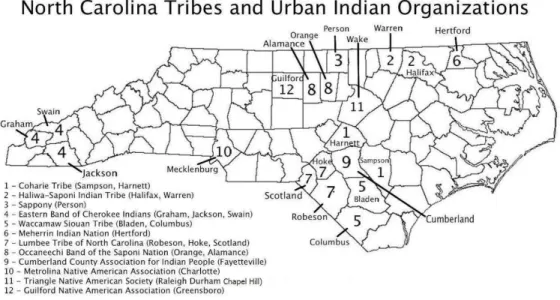
The following breastfeeding resources were selected: IBCLCs, CLCs/CLEs, breastfeeding support groups, Baby-Friendly Hospitals, NC Maternity Center Breastfeeding-Friendly Designation Awardees, Breastfeeding-Friendly Child Care Designation Awardees, Breastfeeding-friendly Business Awardees, and Golden Bow Awardees. Counties of residence to specific tribes were located using a map from the UNC American Indian Center, seen in Figure 1.
NC Maternity Center Breastfeeding-Friendly Designation Awardees and Breastfeeding Friendly Child Care Designation Awardees were located through the NC Division of Public Health Nutrition Services Branch website. Golden Bow Awardees and Breastfeeding-Friendly Business Awardees were located on the website for the North Carolina Breastfeeding Coalition. Breastfeeding-Friendly Business Awardees were also located through the Breastfeeding Family Friendly Communities Designation for
Chapel Hill a d Carr oro’s re ords. These breastfeeding friendly organizations are shown by county and
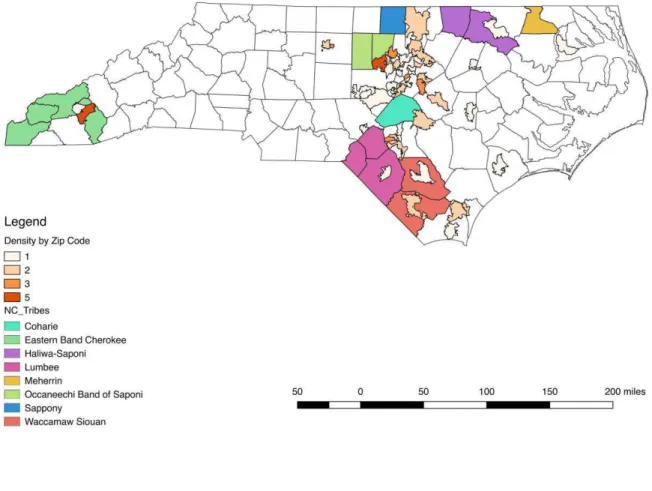
affiliated tribe in Figure 2, Figure 3, and Table 3.
FIGURE 3: Breastfeeding Friendly Organizations by Tribe in NC
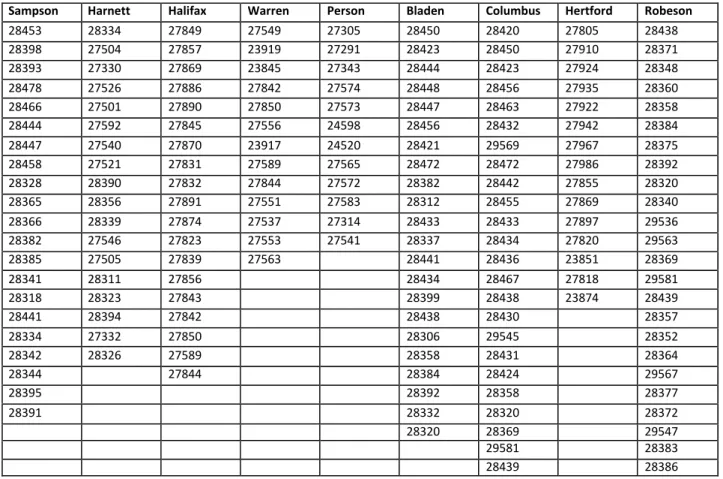
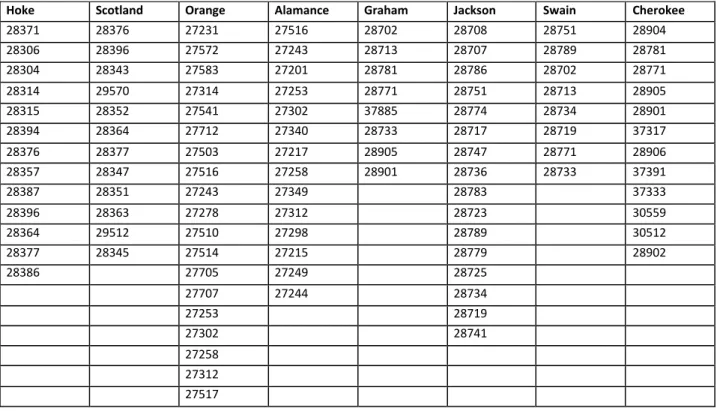
IBCLCs, CLCs/CLEs, and breastfeeding support groups were located through zipmilk.org. The zip codes per county were located from US Census data. Zipcode shapefiles and county boundary shapefiles were downloaded from https://www.census.gov/geo/maps-data/data/tiger.html and spatially joined. Zip codes per county are shown in Table 1.
TABLE 1: Zip Codes by County
Sampson Harnett Halifax Warren Person Bladen Columbus Hertford Robeson
28453 28334 27849 27549 27305 28450 28420 27805 28438
28398 27504 27857 23919 27291 28423 28450 27910 28371
28393 27330 27869 23845 27343 28444 28423 27924 28348
28478 27526 27886 27842 27574 28448 28456 27935 28360
28466 27501 27890 27850 27573 28447 28463 27922 28358
28444 27592 27845 27556 24598 28456 28432 27942 28384
28447 27540 27870 23917 24520 28421 29569 27967 28375
28458 27521 27831 27589 27565 28472 28472 27986 28392
28328 28390 27832 27844 27572 28382 28442 27855 28320
28365 28356 27891 27551 27583 28312 28455 27869 28340
28366 28339 27874 27537 27314 28433 28433 27897 29536
28382 27546 27823 27553 27541 28337 28434 27820 29563
28385 27505 27839 27563 28441 28436 23851 28369
28341 28311 27856 28434 28467 27818 29581
28318 28323 27843 28399 28438 23874 28439
28441 28394 27842 28438 28430 28357
28334 27332 27850 28306 29545 28352
28342 28326 27589 28358 28431 28364
28344 27844 28384 28424 29567
28395 28392 28358 28377
28391 28332 28320 28372
28320 28369 29547
29581 28383
TABLE 1: Zip Codes by County, continued
In Table 2, IBCLCs, CLCs/CLEs, and support groups from zipmilk are marked in counties where they appeared within 20 miles from one or more zip codes. Some individual resources are within 20 miles of more than one zip code, so there is overlap between some zip codes. Resources that
overlapped between zip codes in a county were only counted once in the total for the county. Resources that overlapped between counties relevant to the same tribe were only counted once in the total for the tribe.
Hoke Scotland Orange Alamance Graham Jackson Swain Cherokee
28371 28376 27231 27516 28702 28708 28751 28904
28306 28396 27572 27243 28713 28707 28789 28781
28304 28343 27583 27201 28781 28786 28702 28771
28314 29570 27314 27253 28771 28751 28713 28905
28315 28352 27541 27302 37885 28774 28734 28901
28394 28364 27712 27340 28733 28717 28719 37317
28376 28377 27503 27217 28905 28747 28771 28906
28357 28347 27516 27258 28901 28736 28733 37391
28387 28351 27243 27349 28783 37333
28396 28363 27278 27312 28723 30559
28364 29512 27510 27298 28789 30512
28377 28345 27514 27215 28779 28902
28386 27705 27249 28725
27707 27244 28734
27253 28719
27302 28741
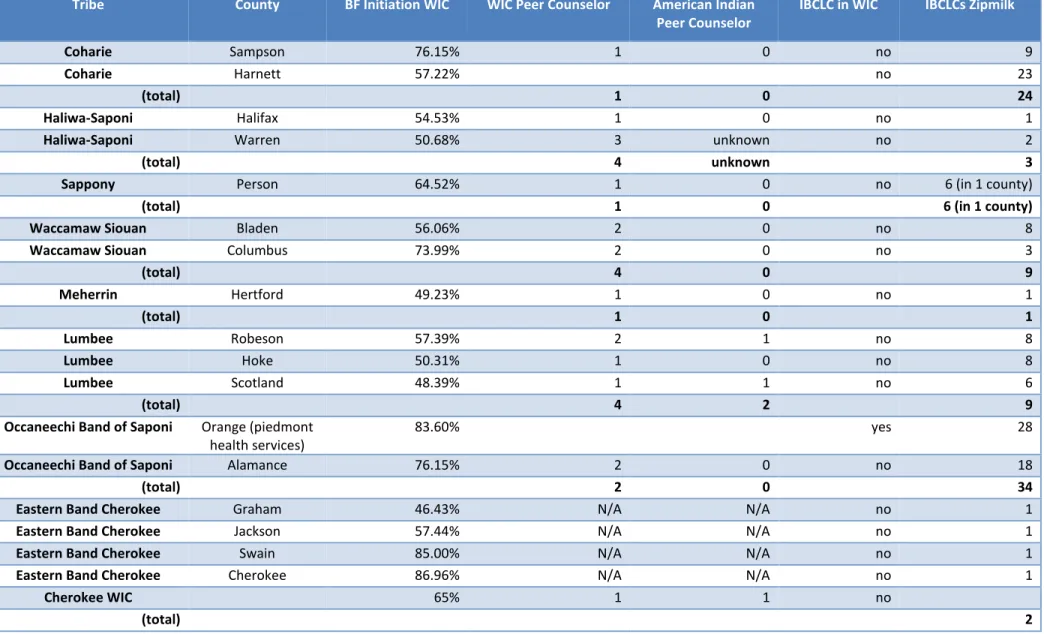
TABLE 2: Breastfeeding Initiation Rates, Resources, and Breastfeeding Friendly Organizations by Tribe and County
Tribe County BF Initiation WIC WIC Peer Counselor American Indian
Peer Counselor
IBCLC in WIC IBCLCs Zipmilk
Coharie Sampson 76.15% 1 0 no 9
Coharie Harnett 57.22% no 23
(total) 1 0 24
Haliwa-Saponi Halifax 54.53% 1 0 no 1
Haliwa-Saponi Warren 50.68% 3 unknown no 2
(total) 4 unknown 3
Sappony Person 64.52% 1 0 no 6 (in 1 county)
(total) 1 0 6 (in 1 county)
Waccamaw Siouan Bladen 56.06% 2 0 no 8
Waccamaw Siouan Columbus 73.99% 2 0 no 3
(total) 4 0 9
Meherrin Hertford 49.23% 1 0 no 1
(total) 1 0 1
Lumbee Robeson 57.39% 2 1 no 8
Lumbee Hoke 50.31% 1 0 no 8
Lumbee Scotland 48.39% 1 1 no 6
(total) 4 2 9
Occaneechi Band of Saponi Orange (piedmont
health services)
83.60% yes 28
Occaneechi Band of Saponi Alamance 76.15% 2 0 no 18
(total) 2 0 34
Eastern Band Cherokee Graham 46.43% N/A N/A no 1
Eastern Band Cherokee Jackson 57.44% N/A N/A no 1
Eastern Band Cherokee Swain 85.00% N/A N/A no 1
Eastern Band Cherokee Cherokee 86.96% N/A N/A no 1
Cherokee WIC 65% 1 1 no
TABLE 2: Breastfeeding Initiation Rates, Resources, and Breastfeeding Friendly Organizations by Tribe and County, Continued
Tribe County CLC/CLE Support groups Childcare Businesses BF Hospital Golden Bow
Award
Coharie Sampson 5 4 0 0 0 0
Coharie Harnett 3 7 or 8 (3 fort bragg) 0 0 0 0
(total) 5 7 0 0 0 0
Haliwa-Saponi Halifax 0 0 0 0 0 1
Haliwa-Saponi Warren 2 1 0 0 0 0
(total) 2 1 0 0 0 1
Sappony Person 1 2 0 0 0 0
(total) 1 2 0 0 0 0
Waccamaw Siouan Bladen 6 4 0 0 0 0
Waccamaw Siouan Columbus 4 2 0 0 1 (3star) 1
(total) 6 5 0 0 1 1
Meherrin Hertford 0 0 0 0 0 1
(total) 0 0 0 0 0 1
Lumbee Robeson 4 3 (fort bragg) 1 (2 block) 5 0 1
Lumbee Hoke 2 4 (3 in fort bragg) 0 0 0 0
Lumbee Scotland 1 3 (fort bragg) 0 0 0 0
(total) 4 4 1 5 0 1
Occaneechi Band of Saponi Orange (piedmont health
services)
2 7 2 (4/3block) 21 2 (5star) 2
Occaneechi Band of Saponi Alamance 1 5 1 ( 5 block) 1 0 1
(total) 2 9 3 21 2 3
Eastern Band Cherokee Graham 3 0 2 ( 1 block) 0 0 0
Eastern Band Cherokee Jackson 2 1 0 2 1 (4star) 1
Eastern Band Cherokee Swain 3 1 0 0 0 0
Eastern Band Cherokee Cherokee 2 1 0 0 0 0
Cherokee WIC ?
To rank the tribes by available resources, the tribes were compared by presence of IBCLCs at their local WIC, resources through zipmilk, number of American Indian peer counselors at their local WIC, presence of Breastfeeding-Friendly Child Care Designation Awardees, Breastfeeding-friendly Business Awardees, Baby-Friendly Hospitals, and NC Maternity Center Breastfeeding-Friendly
TABLE 3: Ranking of Resources by Tribe
Tribe IBCLC/
WIC IBCLC ZIpmilk CLC/ CLE Support Group American Indian Peer Counselor
Child Care Businesses Hospital Golden Bow Total
Coharie
0 2 1 1 1 0 0 0 0
5
Haliwa-Saponi
0 0 1 1 0 0 0 0 1
3
Sappony
0 0 1 1 0 0 0 0 0
2
Waccamaw Siouan
0 1 1 1 0 0 0 3 1
7
Meherrin
0 0 0 0 0 0 0 0 1
1
Lumbee
0 1 1 1 2 1 1 0 1
8
Occaneechi Band of Saponi
1 2 1 1 0 1 1 10 1
28
Eastern Band Cherokee
0 0 1 1 1 1 1 4 1
Key informant interviews were also conducted with the WIC Breastfeeding Coordinators of relevant counties. The majority of interviews were conducted by telephone. Four interviews were conducted via email questionnaire. The questionnaire used for both phone and email interviews can be found in the Appendix.
RESULTS
Interviews
Of the 14 Breastfeeding Coordinators contacted, 12 were interviewed. At least one coordinator per tribe was interviewed. All relevant coordinators for the Haliwa-Saponi, Sappony, Waccamaw Siouan, Lumbee, Eastern Band of Cherokee, and Meherrin tribes were interviewed. The Coharie and Occaneechi Band of Saponi have two coordinators each, and one was interviewed per tribe.
Of the six non-federally recognized tribes, only two of them were mentioned by name by their local breastfeeding coordinators during the interview: the Lumbee and the Haliwa-Saponi. However the Haliwa-Saponi were referred to as the Saponi or Sappony. This indicates the possibility of some
confusion over which tribe they were working with. The breastfeeding coordinator for the Eastern Band of Cherokee WIC was of course familiar with the tribe as this WIC program is specifically for them.
Year 2015-2016, is shown in Table 4. The counties selected are those affiliated with the state recognized
tribes. It is assumed that all infants engaged with the Eastern Band of Cherokee WIC are tribal members.
TABLE 4: Racial distribution for Infants by county affiliated with state recognized tribes, as collected
through the NC Crossroads WIC System for Fiscal Year 2015-2016
County of Residence
American Indian
African
American Asian
Native
Hawaiian White
Tribe
Coharie SAMPSON 1.10% 30.20% 0.50% 0.20% 68.20%
Coharie HARNETT 0.20% 33.10% 0.60% 0.30% 65.80%
Haliwa-Saponi WARREN 0.70% 72.10% 0.00% 0.00% 27.20%
Haliwa-Saponi HALIFAX 4.00% 69.10% 0.20% 0.00% 26.70%
Lumbee ROBESON 42.60% 27.40% 0.60% 0.50% 28.90%
Lumbee SCOTLAND 16.80% 55.40% 0.00% 0.00% 27.80%
Lumbee HOKE 8.50% 40.80% 1.80% 0.60% 48.30%
Meherrin HERTFORD 0.60% 81.80% 1.10% 0.00% 16.50%
Occaneechi Band of Saponi
ALAMANCE 0.80% 34.80% 1.30% 0.00% 63.20%
Occaneechi Band of Saponi
ORANGE 0.20% 26.90% 11.10% 0.00% 61.80%
Sappony PERSON 0.80% 50.80% 0.40% 0.00% 48.10%
Waccamaw Siouan
BLADEN 1.80% 44.30% 0.00% 0.40% 53.50%
Four of the 11 coordinators in counties containing non-federally recognized tribal territory could recall specific information on working with American Indian mothers and the challenges that they have. They are also the coordinators who named the tribe from their area.
include returning to work, lack of social support for breastfeeding, and geographic distance to services for rural populations. One coordinator expressed concern that non-federally recognized tribes had less access to services than those with federal recognition. She also expressed difficulty as a outsider in
fi di g a ay i to work with them . She described her initial assumption that maybe (breastfeeding)
ould e a o rai er for the . Like, it as part of their heritage a d roots .
None of the coordinators saw a difference in response to their programs between American Indian mothers and mothers of other racial or ethnic groups (eleven said no, two said they ere ’t sure). Granted, one of them did say she found it difficult to work with them as an outsider in response to a differently worded question.
All 11 coordinators in counties containing non-federally recognized tribal territory stated they did not have any collaboration with other agencies in regard to addressing the needs of American Indian families. All eleven also stated they were not aware of any community breastfeeding resources in their region that focused on American Indian mothers and families. The breastfeeding coordinator for the Eastern Band of Cherokee WIC stated she was not aware of other community breastfeeding resources for the tribe apart from WIC. She also noted that the tribe has their own social work agencies and treatment facilities for enrolled members . There was a Tribal Home Visiting program through mid-summer 2016 that names WIC as one of its community partners.30
Highlights:
Be ause e ha e su h a s all populatio here, e do ’t deal ith them any differently. We
do ’t ha e progra s spe ifi ally for the .
We o e t ith our lo al hospital, pediatrics, and OBGYNs. But not around American Indian
fa ilies spe ifi ally.
We do ’t ha e a y olla oratio s that are spe ifi for Nati e A eri ans. Really our
collaborations are moreso general focused, just trying to build knowledge about breastfeeding
period. I our lo atio our reastfeedi g rates are lo a ross the oard.
None of the coordinators knew of any American Indian lactation consultants. Areas serving the Sappony, Waccamaw Siouan, Coharie, and the Occaneechi Band of Saponi tribes did not have
breastfeeding peer counselors who were identified as American Indian. One of the Haliwa-Saponi counties does not have an American Indian peer counselor, while the other county left their peer
ou selor’s de ographi u ide tified. The Eastern Band of Cherokee WIC has one peer counselor and
she is a member of the tribe. There are two American Indian peer counselors in Lumbee counties, one in Scotland and one in Robeson.
All the coordinators said they were not aware of any differences in contraceptive recommendations in regard to age or race/ethnic demographics.
Highlights:
This ou ty is ery s all, our health department is very small. WIC, Young Families Connect, Pregnancy Care Management, we all work together and our message is the sa e a d it does ’t matter what age or their ethnicity. It’s birth control. Do you have it? It’s a dis ussio that needs
to happe . We’re pretty o siste t.
The really depe ds o the other a d the do tor’s decision. Most of the time they leave the hospital ith the o tra epti e already i pla e.
“a e as other pla es, o differe es regardi g ra e or age. IUD’s a d depo are used ost.
Seven of the oordi ators stated they did ’t see a y differe es i le gth of ater ity lea e between American Indian and non-American Indian mothers. Four stated they were not sure. One
oted, it’s pro a ly about the same, very short. Three days to eight weeks. Six weeks is pretty
common. The oordi ator i “ otla d Cou ty oted that a y of their parti ipa ts are not currently
orki g . The coordinator for the Eastern Band of Cherokee WIC stated the typical maternity leave
among their participants is two to three months.
and County School Systems had breastfeeding friendly policies in place. There are five breastfeeding friendly businesses in Robeson County that are mentioned on the North Carolina Breastfeeding
Coalitio ’s e site. The Easter Ba d of Cherokee WIC reastfeedi g oordinator noted that their
casino and most of their tribal offi es support reastfeedi g , ut they ha e ot applied for a y of the state or coalition awards.
DISCUSSION
Resource Rankings by Tribe
The urre t ra ki g of resour es does ’t fully sho the differe es i a ailable services. Table 3,
Figure 2, and Figure 3 provide a much more comprehensive picture of what is available. The Eastern Band of Cherokee has the most comprehensive services directly targeting enrolled members of the tribe. The Cherokee and Lumbee Tribes have the only access to American Indian peer counselors in their local WIC offices. The Occaneechi Band of Sapponi are the closest geographically to the plethora of resources that saturate Orange County. The majority of breastfeeding coordinators in counties with tribal territory are not familiar with the tribe in their area. It is important to note the empty zipcodes in Person County, where the Sappony tribal territory is located. Person County had IBCLCs within 20 miles of only one zip code out of 12.
It is important to note that while Baby-Friendly Hospitals, NC Maternity Center Friendly Designation Awardees, Friendly Child Care Designation Awardees,
Breastfeeding-frie dly Busi ess A ardees, Golde Bo A ardees, a d IBCLC’s a d peer ou selors at WIC are
breastfeeding coordinator is required to attend the NC Lactation Educator Training Program. This 69 CERP program does not award an credential, but does provide more educational hours than the CLC credential provides.
The Cherokee Indian Hospital, in Cherokee NC, serves the health care needs of enrolled members of the Eastern Band of Cherokee. While Indian Health “er i es has o itted it’s o stetric hospitals to achieve Baby-Friendly status, the Cherokee Indian Hospital is not an obstetric hospital and therefore is not required to comply with Baby-Friendly standards. Harris Regional Hospital, in Sylva, is commonly used by enrolled members when they give birth. Harris Regional has achieved a Four-Star Breastfeeding-Friendly Designation from the NC Maternity Center Breastfeeding-Friendly Designation. The Four Star Designation is awarded when eight of the ten steps towards achieving Baby-Friendly are accomplished. This program is loosely based on the Baby-Friendly national designation implemented by Baby-Friendly USA, Inc.
Key Informant Interviews
The majority of the interviewees are unclear on how many American Indians participate in their local WIC program. Most of the coordinators do ’t thi k there are any differences in need between the populations that they work with and are not aware of any specific resources directly targeting American Indians. This points to an opportunity for education on equity and a need for future research on what kind of breastfeeding support tribal members would like to experience. Many coordinators mentioned the desire to treat everyone the same. With a health equity lens, it is understood that individuals and communities who are disadvantaged need tailored health interventions in order to reach equality in optimal health outcomes.
Strengths
geographic location and density of certain resources, the key informant interviews add another layer and help illuminate what is available, what is known and what is not known. The mixed methods design allows for a greater depth of contextual understanding of the landscape of breastfeeding resources for the tribes of NC. This collection of resources by tribe and contextual data from key informants can advise current public health practice and policies and help guide future research in this area. Weakness
There is not readily available information on American Indian breastfeeding initiation or duration rates in NC. Access to the data requires specific reports from the state WIC office. It is difficult therefore to compare the available initiation rates with the resource rankings generated in this paper. Likewise, it could also be difficult for local WIC offices to analyze the needs of the American Indian community they are working with. In Table 3, the WIC participant breastfeeding initiation rates per county show rates for all WIC participants regardless of their race or ethnicity. The Initiation rate for the Eastern Band of Cherokee WIC directly measures tribal members.
The quality of the data from the key informant interviews would have been improved if all breastfeeding coordinators had been reached by phone. Coordinators from Harnett and Orange counties were not interviewed for the current study. Four interviews were conducted via email, which does not allow for clarifying questions as easily as a phone interview.
Future Research
ACKNOWLEDGEMENTS
I would like to thank Amy Locklear Hertel and Christina Theodorou from the UNC American Indian Center; Lawrence Locklear from the Southeast American Indian Studies Program at The University of North Carolina at Pembroke; Dr. Bharathi Zvara and Dr. Catherine Sposito Sullivan from the UNC
APPENDIX 1
Questions For Breastfeeding Coordinators
1. What is the assigned caseload for your county?
2. How many peer counselors do you supervise? Do you have any American Indian peer counselors?
3. Can you share with me approximately what percentage of WIC participants in your county are American Indian?
4. Have you found any particular challenges in working with American Indian mothers and families?
5. Have you found any differences in response to your programs between American Indian families and other families?
6. Have you observed any gaps in general health care use between American Indian WIC participants and other participants? Have you observed any gaps in clinical breastfeeding resources or community resources between American Indian families and other families?
7. Is there a typical length of maternity leave you see American Indian mothers taking before returning to work? Does this differ from other WIC participants in your county?
8. What kind of collaboration do you have with nearby hospitals or other health care/social work agencies in regards to addressing the needs of American Indian families?
9. Are you aware of contraceptive recommendations given to the mothers that you work with? Are there specific recommendations for different age groups or racial/ethnic groups?
11. Are you aware of any community breastfeeding resources in your region that are specific to American Indians?
12. Do you know of any breastfeeding friendly businesses in your area?
REFERENCES
1. Ip S, Chung M, Raman G, et al. Breastfeeding and maternal and infant health outcomes in developed countries. Evid Rep Technol Assess. 2007;(153):1–186.
2. Murphy, Susan. A perspective from indian health service— supporting breastfeeding. Breastfeeding Medicine. 2011;6(5) DOI: 10.1089/bfm.2011.006
3. Disparities Factsheet. Indian Health Service Web site.
https://www.ihs.gov/newsroom/factsheets/disparities/ updated March 2016. Accessed March 2017.
4. Stuebe AM, Rich-Edwards JW, Willet WC, et al. Duration of lactation and incidence of type 2 diabetes. JAMA 2005;294: 2601–2610.
5. Schwarz EB, Ray RM, Stuebe AM, et al. Duration of lactation and risk factors for maternal cardiovascular disease. Obstet Gynecol 2009;113:974–982.
6. Stuebe AM, Schwarz EB, Grewen K, et al. Duration of lactation and incidence of maternal hypertension: A longitudinal cohort study. Am J Epidemiol. 2011 Nov 15;174(10):1147-58. doi: 10.1093/aje/kwr227.
7. Rates of any and exclusive breastfeeding by socio-demographics among children born in 2013. National Immunization Survey. Centers for Disease Control and Prevention Web site.
https://www.cdc.gov/breastfeeding/data/nis_data/rates-any-exclusive-bf-socio-dem-2013.htm. Accessed May 2017.
8. Evans-Campbell T. Historical trauma in american indian/ native Alaska communities: a multilevel framework for exploring impacts on individuals, families, and communities. Journal of
Interpersonal Violence. 2008 March:23(3) 316-338. doi: 10.1177/0886260507312290 9. Goldhammer C. Breastfeeding as Social Justice: Historical Trauma. Oral presentation at:
Breastfeeding and Feminism International Conference; March, 2017; Chapel Hill, NC.
10. Mohatt NV, Tebes, K. (2014). Historical trauma as public narrative: A conceptual review of how history impacts present day health. Social Science & Medicine. 2014;106: 128-136. DOI: 10.1016/j.socscimed.2014.01.043
12. Bombay A, Matheson K, Anisman H. The intergenerational effects of Indian residential schools: Implications for the concept of historical trauma. Transcultural Psychiatry. 2014;51(3): 320-338. doi:10.1177/136346151350 3380
13. Czyzewski K. Colonialism as a broader social determinant of health. The International Indigenous Policy Journal. 2011; 2(1). DOI: 10.18584/iipj.2011.2.1.5
14. Williams DR, Yu Y, Jackson JS, et al. Racial differences in physical and mental health:
Socioeconomic status, stress, and discrimination. Journal of Health Psychology. 1997;2(3)35-351.
15. Roy A. Intergenerational trauma and Aboriginal women: Implications for mental health during pregnancy. First Peoples Child & Family Review. 2014; 9(1): 7-21.
16. Elgen C, Hangenbuch N, Gorres G, et al. Breastfeeding in women having experienced childhood sexual abuse. Journal of Human Lactation. 2017;33(3):119-127. Doi:10.1177/0890334416680789 17. Cherokee (Eastern) All Records. Carlisle Indian School Digital Resource Center website.
http://carlisleindian.dickinson.edu/nation/cherokee-eastern. Accessed May 2017. 18. About NC native communities. UNC American Indian Center Web site.
http://americanindiancenter.unc.edu/resources/about-nc-native-communities/ Accessed February 2017.
19. Take a journey to the home of the eastern band of cherokee Indians. Eastern Band of Cherokee Web site. http://visitcherokeenc.com/eastern-band-of-the-cherokee/ Accessed February 2017 20. Learn about the Cherokee government and our proud history. Eastern Band of Cherokee Web
site. https://ebci.com/chief-lambert/government/ Accessed March 2017.
21. WIC Special Supplemental Nutrition Program. Eastern Band of Cherokee Indians Public Health and Human Services Web site. http://cherokee-hmd.com/wic/ Accessed February 2017. 22. Where the casino money goes. Cherokee Nation Enterprises Website.
http://www.cherokee.org/Portals/0/Documents/2009/06/09_CNE_WTMG_final.pdf . Accessed May 2017.
23. Coharie tribe. Coharie Tribe web site. http://www.coharietribe.org. Accessed February 2017. 24. Haliwa-Saponi Tribe Web site. http://haliwa-saponi.com/. Accessed February 2017.
29. Waccamaw Siouan Tribe Web site. http://www.waccamaw-siouan.com/. Accessed February 2017.
30. Tribal Home Visiting. Administration for children and families web site.