Paul D Farrell. Automating Author Gender Identification from Blogs. A Master’s Paper
for the M.S. in IS degree. April, 2015. 27 pages. Advisor: Stephanie Haas
The rapid growth of public blogging on the Internet has opened up a vast trove of
information that can be text mined for potential insights. This study explores the potential
of automating blog author gender based on differences in lexical expressions. The results
of this study were mixed, and further refinement is needed.
Headings:
Text Mining
AUTOMATING AUTHOR GENDER INDENTIFICATION FROM BLOGS
by
Paul David Farrell
A Master's paper submitted to the faculty
of the School of Information and Library Science
of the University of North Carolina at Chapel Hill
in partial fulfillment of the requirements
for the degree of Master of Science in
Information Science.
Chapel Hill, North Carolina
April, 2015
Approved by:
________________________
TABLE OF CONTENTS
INTRODUCTION... 2
LITERATURE REVIEW ... 3
METHODOLOGY ... 8
S
ECTION3.1
D
ATAP
REPARATION... 8
S
ECTION3.2
D
ATA MINING TOOLS... 9
RESULTS ... 11
SECTION
4.1
T
EST RESULTS OVERVIEW... 11
S
ECTION4.2
T
ESTR
ESULTSA
CCURACY ANDK
APPA... 12
S
ECTION4.3
R
ECALL,
P
RECISION,
AND F-
SCORE PERFORMANCE BY GENDER... 15
S
ECTION4.4
TOP CORRELATED WORDS FOR EACH GENDER(C
ONFIGURATION1) ... 18
DISCUSSION ... 19
CONCLSUION ... 21
Introduction:
The demand for online blogging services has grown to be a popular medium for
people to express their views on the Internet. Blogs are typically noted for their casual
and informal writing style. The rapid rise of blogging poses interesting new ways to study
informal online communication. One area of active research is trying to identify the
gender identification of blog writers. Do men and women express themselves lexically
differently on blogs, and if so what are the differences in forms of expression? The vast
growth of public blogs has provided a trove of information that can be text mined for
potential patterns, but does pose a challenge due to the high volume of data. If a highly
accurate classifier that can detect author gender identification from blog postings could
be created then you could quickly automate new blog postings based on differences in
lexical expression. One use case for exploring a single classifier approach is for
marketing. Burger, Henderson, Kim, and Zarrella (2011) state that “accurate prediction of
these features would be useful for marketing and personalization concerns, as well as for
legal investigation” (pg. 1). The potential for creating an automatized classifier for author
gender classification is one area actively being developed for commercialization.
Mukherjee and Liu (2010) point out:
It can help the user find what topics or products are most talked about by males
and females, and what products and services are liked or disliked by men and
women. Knowing this information is crucial for market intelligence because the
information can be exploited in targeted advertising and also product
The current trend in blogging suggests that many of the active bloggers are young
adults according to Newson and Oberlander (2006), “while each gender accounts for
about half of all weblogs, personal blogs are dominated by females of teen age and
preferred by females in general” (p.2). This young adult demographic is a prime area for
marketers to target their advertisements. Indeed having such a system would be a
powerful tool that would allow businesses and information professionals to track their
online presence with men or women, and potentially structure their messages to each
gender respectively.
Literature Review:
There has been a large research interest in the natural language processing (NLP)
and text mining communities about how to leverage the rich information found in blogs.
Zhang and Zhang (2010), state that “from a research perspective, blog author
classification is also an interesting problem. Blogs differ tremendously from formal texts,
since they have many informal sentences, grammar errors, slang words, and phrases, and
wrong spellings” (p.1). All of these characteristics make automated author gender
classification a challenging endeavor.
Researchers have shown that there are semantic differences between how men
and women write in blogs. According to Goswami, Sarkar, and Rustagi (2009), “female
authors tend to use pronouns with high frequency, and male authors tend to use numeral
and representation related numbers with high frequency” (p. 214). Herring and Paolillo
(2006) add that “determiners are more common among male writers” (pg. 444).
that “scaling existing solutions with the huge, and increasing number of authors is a
challenge” (pg. 2).
Researchers have tried tackling the problem of automating blog author gender
detection in several ways. Schler, Koppel, Argamon, and Pennebaker (2005), frame the
problem that “broadly speaking, two different kinds of potential distinguishing features
can be considered: style-related and content-related” (p. 1). Style related features are
“selected parts-of-speech, function words and blogging specific features such as “blog
words” and hyperlinks.” (Schler, Koppel, Argamon, and Pennebaker, 2005, p.1). “Blog
words” refers to common abbreviations or slang found in many blogs informal language
usage. Another style feature is average sentence length. However, Rustagi, Prasath,
Goswami, and Sarkar,(2009) found that “average sentence length itself is not a good
feature to predict the variation as there is a wide variation in sentence length in informal
writing”(pg. 211). Variation in this context refers to the fact that average sentence length
alone is not a sufficiently distinguishing feature for a model, but one of many feature
indicators for an author gender model. With content features you are measuring the
frequency of specific terms in the corpus by each gender.
Current popular classifiers utilized for blog author gender classification fall into
either Naive Bayes or Support Vector Machine (SVM), along with 10 fold cross
features in order to avoid the problem of overfitting, which is useful when dealing with
large dimensions as encountered in the area of text mining”(pg. 5). The common metrics
used for evaluation of accuracy in the literature are precision, recall, and F-measure.
Another critical component is using POS n-grams to try and identify common
words that may be used by males and females. POS stands for parts of speech and refers
to the grammatical classes of words such as verbs, nouns, etc. POS n-grams help
statistically track the frequency and distribution of these grammatical classes in a text.
The methods and approaches listed above have all provided possible solutions to
automating blog author identification. However, Mukherjee and Liu (2010) note that
“although there have been several existing papers studying the problem, the current
accuracy is still far from ideal” (p. 216). Mohtasseb and Ahmed point out that “the
complexity of text and the high percentage of new words motivate us to focus more on
these new or misspelling words that could appear in the text”(pg. 2). Adding an
additional layer of complexity, Perseus asserts “the majority of blogs started are
dissolving into static, abandoned web pages”(as cited in Pendersen and Macafee, 2007).
If any such single classifier is feasible it will face persistent needs for refinement due to
the mix of both current blogs emerging with new words balanced against potentially
outdated lexical expressions found in stagnant older blogs.
Preparing a balanced gender dataset across blog domains is a difficult endeavor.
Mukherjee and Liu (2010) outline their data preparation for testing in the following
manner:
engines, e.g., blogger.com, technorati.com, etc. The data set consists of 3100
blogs. Each blog is labeled with the gender of its author. The gender of the author
was determined by visiting the profile of the author. Profile pictures or avatars
associated with the profile were also helpful in confirming the gender especially
when the gender information was not available explicitly. To ensure quality of the
labels, one group of students collected the blogs and did the initial labeling, and
the other group double-checked the labels by visiting the actual blog pages. Out of
3100 posts, 1588 (51.2%) were written by men and 1512 (48.8%) were written by
women. The average post length is 250 words for men and 330 words for
women.(p. 214)
Mukherjee and Liu crafted the corpus to be “ as general as possible”. This poses a
potential problem since the dataset does not take into consideration domain balancing.
These 3100 blog posts were drawn from various blogging sites that covered different
domains. The domains in the corpus ranged from travel blogs to technology. In order to
have a highly accurate classifier that covers various domains, it is imperative to have a
sizable amount of balanced instances.
Another limitation to Mukherjee and Liu’s corpus is that the blog author age was
not taken into consideration. The potential for capturing a disproportionate amount of
younger bloggers is high. To craft a truly generalizable classifier for detecting blog
authors genders it is imperative to have a balanced amount of instances across all age
demographics. Kobayashi, Matsumura, Ishizuka (2006) describe “trends for men and for
women are definitely different in most domains, and the same can be said for bloggers’
age, residential area etc. The problem is derived from the lack of bloggers’ personal
information because such information is not opened to the public in general”(pg. 1).
Argamon, Koppel, Pennebaker, and Schler(2007) research found “
that a number of
stylistic and content–based indicators are significantly affected by both age and gender,
and that the main difference between older and younger bloggers, and between male and
directed”(pg. 1).
Not having the blog authors’ ages eliminates any possibility of
identifying gender author nuances across age ranges.
3. Methodology:
3.1 Data Preparation
Table 1: Number of posts in each corpus before and after gender balancing
Original Corpus Size
Gender Balanced Corpus
3,100 3,024
Table 2: Number of posts in the training and testing partitions
Corpus Partition
Training Posts
Testing Posts
80% Train 20% Test
2,420 604
90% Train 10% Test
2,722 302
3.2 Data Mining Tools
The main tool I used was a free open source product called LightSIDE (Mayfield
& Rose, 2012). LightSide supports a variety of features, such as Words/POS, and line
length, it supports the most common algorithms, as well as a variable number of folds for
cross-validation. Additionally, I selected Weka, a popular text mining program for my
testing. I selected Weka to provide as a contrast to LightSIDE to see if there was any
difference in model performance by algorithm.
I used the following for performance measures for my classifier evaluation:
Accuracy, Kappa, Recall, Precision, F-Score, and Correlation. Accuracy is the
correct items that are selected, for example, the proportion of actual female-authored
posts identified as such by the system. Conversely, Precision is the percentage of selected
items that are correct, for example, the proportion of positively predicted male-author
posts that were identified as correct by the model. F-Score is a balanced average between
precision and recall. An F-Score of 1 is the highest score and 0 is the lowest. The higher
the F-Score the better the predictive power of the classification procedure, for example,
an F-Score of 1 for male-author posts means that the classification procedure is perfect.
Finally, correlation is a measure of relation between two or more variables. A correlation
of 1 is the best score, and indicates one variable can be predicted to be the value of the
other variable, for example a classifier identifies the word “mother” has a correlation of 1
for female-author posts. That would mean every time the word “mother” appeared in a
text the system would identify the text as being a female-author post. A correlation of -1
is equally important, it indicates an inverse relationship between variables. A correlation
of 0 indicates absolutely no correlation between variables.
I used Naive Bayes and Support Vector Machine (SVM) classifiers for my
experiment. The literature review noted that these are the two most common classifiers
used by researchers. I also tried different configuration options to try to glean the best
performance.
●
Configuration 1: unigrams, Words/POS, Include Punctuation, Ignore All
Stopword in N grams, and Track Feature Hits.
●
Configuration 3: trigrams, Words/POS, Include Punctuation, and Track
Feature Hits.
Additionally, I used 10 fold Cross Validation to test the model performance and set a
benchmark for comparison. The features were the individual words in the corpuses and I
used a word frequency threshold of five. In other words, if a particular word occurred less
than five times in the training corpus, it would not be counted as a feature when creating
the classification model.
4. Results:
4.1 Test Results Overview
The following tests were run from February 3, 2015 to February 6, 2015.
Configuration 1 which included unigrams, Words/POS, Include Punctuation, Ignore All
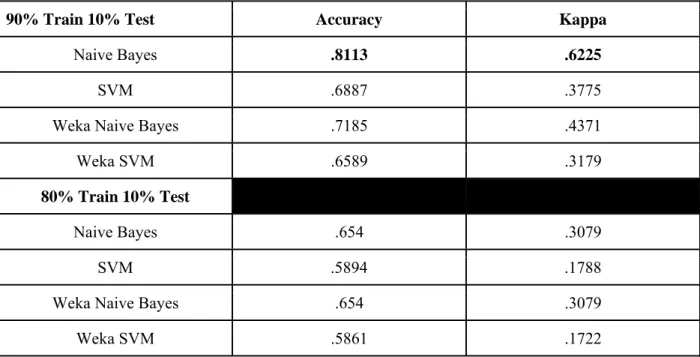
Stopword in N grams, and Track Feature Hits gave the best performance. Naive Bayes
was the best performing classifier overall configurations with the 90% training and 10%
testing performing the best. Below are the results for each configuration. The first set of
tables gives Accuracy and Kappa scores for each configuration, broken out by
4.2 Test Results Accuracy and Kappa
Table 3: Configuration 1, (unigrams, Words/POS, Include Punctuation, Ignore All Stopword in
N grams, and Track Feature Hits)
90% Train 10% Test Accuracy Kappa
Naive Bayes .8113 .6225
SVM .6887 .3775 Weka Naive Bayes .7185 .4371
Weka SVM .6589 .3179
80% Train 10% Test
Naive Bayes .654 .3079
SVM .5894 .1788 Weka Naive Bayes .654 .3079
Weka SVM .5861 .1722
Table 4: Configuration 2, (bigrams, Words/POS, Include Punctuation, Ignore All Stopword in N
grams, and Track Feature Hits)
90% Train 10% Test
Accuracy
Kappa
Naive Bayes
.8046
.6093
SVM
.7285
.457
Weka Naive Bayes
.8046
.6093
Weka SVM
.6722
.3444
80% Train 20% Test
Naive Bayes
.6093
.2185
Weka Naive Bayes
.6093
.2185
Weka SVM
.5844
.1689
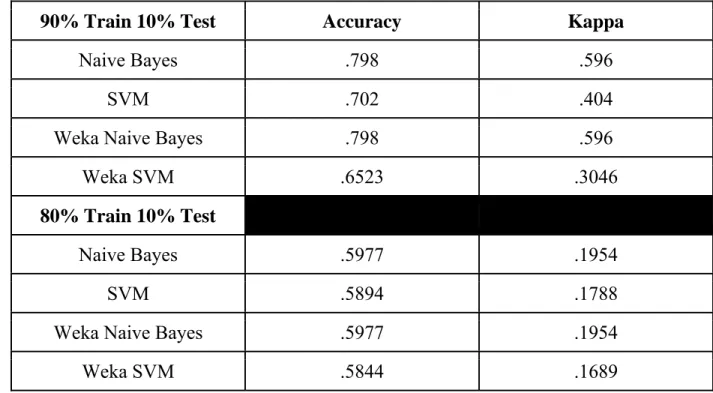
Table 5: Configuration 3, (trigrams, Words/POS, Include Punctuation, Ignore All Stopword in N
grams, and Track Feature Hits)
90% Train 10% Test
Accuracy
Kappa
Naive Bayes
.798
.596
SVM
.702
.404
Weka Naive Bayes
.798
.596
Weka SVM
.6523
.3046
80% Train 10% Test
Naive Bayes
.5977
.1954
SVM
.5894
.1788
Weka Naive Bayes
.5977
.1954
Weka SVM
.5844
.1689
4.3 Recall, Precision, and F-Score Performance by Gender
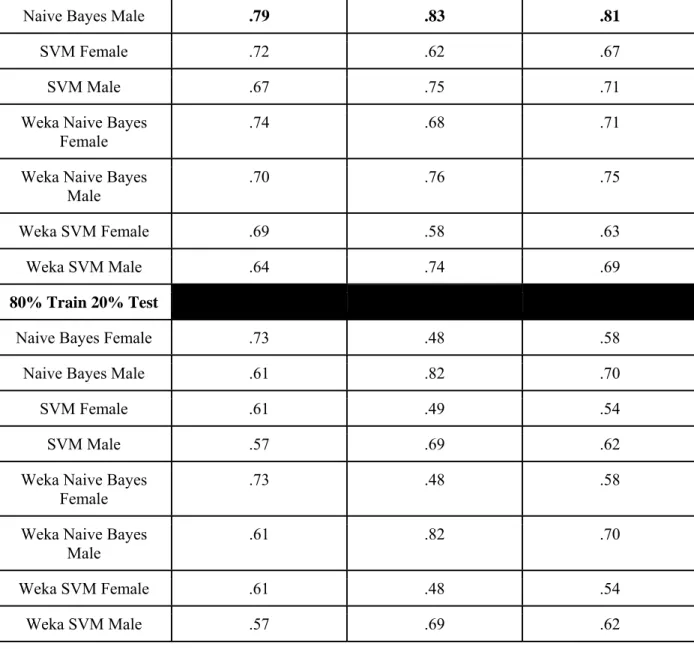
Table 6: Configuration 1, (unigrams, Words/POS, Include Punctuation, Ignore All Stopword in N
grams, and Track Feature Hits)
90% Train 10% Test Recall Precision F-Score
Naive Bayes Male .79 .83 .81
SVM Female .72 .62 .67
SVM Male .67 .75 .71
Weka Naive Bayes Female
.74 .68 .71
Weka Naive Bayes Male
.70 .76 .75
Weka SVM Female .69 .58 .63 Weka SVM Male .64 .74 .69
80% Train 20% Test
Naive Bayes Female .73 .48 .58 Naive Bayes Male .61 .82 .70
SVM Female .61 .49 .54
SVM Male .57 .69 .62
Weka Naive Bayes Female
.73 .48 .58
Weka Naive Bayes Male
.61 .82 .70
Weka SVM Female .61 .48 .54 Weka SVM Male .57 .69 .62
Table 7: Configuration 2, (bigrams, Words/POS, Include Punctuation, Ignore All Stopword in N
grams, and Track Feature Hits)
90% Train 10% Test Recall Precision F-Score
SVM Female .76 .69 .72
SVM Male .70 .79 .74
Weka Naive Bayes Female
.82 .74 .78
Weka Naive Bayes Male
.77 .82 .79
Weka SVM Female .87 .40 .55 Weka SVM Male .61 .94 .74
80% Train 20% Test
Naive Bayes Female .71 .37 .49 Naive Bayes Male .57 .84 .68
SVM Female .63 .49 .55
SVM Male .58 .72 .64
Weka Naive Bayes Female
.71 .37 .49
Weka Naive Bayes Male
.57 .84 .68
Weka SVM Female .61 .48 .54 Weka SVM Male .57 .69 .62
Table 8: Configuration 3, (trigrams, Words/POS, Include Punctuation, Ignore All Stopword in N
grams, and Track Feature Hits)
90% Train 10% Test Recall Precision F-Score
Naive Bayes Male .86 .76 .80
SVM Female .73 .65 .69
SVM Male .68 .75 .71
Weka Naive Bayes Female
.85 .73 .79
Weka Naive Bayes Male
.86 .76 .80
Weka SVM Female .88 .35 .50 Weka SVM Male .60 .95 .74
80% Train 20% Test
Naive Bayes Female .70 .34 .46 Naive Bayes Male .56 .86 .68
SVM Female .62 .47 .53
SVM Male .57 .71 .63
Weka Naive Bayes Female
.70 .34 .46
Weka Naive Bayes Male
.56 .86 .68
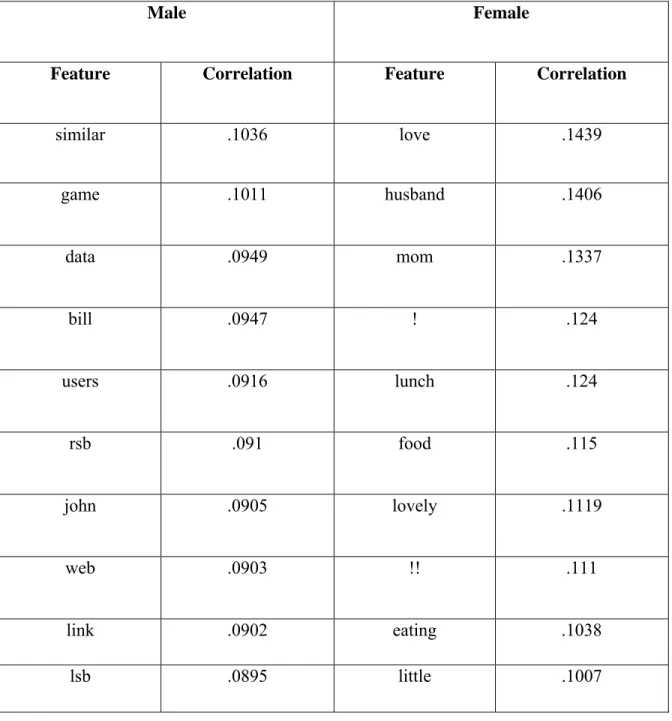
4.4 Top Correlated Words for each Gender
Table 9: Top 10 Positively Correlated Words for each Gender (Configuration 1):