Simple Network Management
Protocol (SNMP)
Contents
1 SNMP User's Guide 1
1.1 SNMP Introduction . . . 1
1.1.1 Scope and Purpose . . . 1
1.1.2 Prerequisites . . . 1
1.1.3 About This Manual . . . 2
1.1.4 Where to Find More Information . . . 2
1.2 Functional Description . . . 3
1.2.1 Definitions . . . 3
1.2.2 Features . . . 4
1.2.3 SNMPv1, SNMPv2 and SNMPv3 . . . 4
1.2.4 Operation . . . 5
1.2.5 Subagents and MIB Loading . . . 8
1.2.6 Contexts and Communities . . . 9
1.2.7 Management of the Agent . . . 9
1.2.8 Notifications . . . 15
1.3 Instrumentation Functions . . . 16
1.3.1 Instrumentation Functions . . . 17
1.3.2 Using the ExtraArgument . . . 22
1.3.3 Default Instrumentation . . . 22
1.3.4 Atomic Set . . . 23
1.4 The MIB Compiler . . . 24
1.4.1 Operation . . . 24
1.4.2 Importing MIBs . . . 24
1.4.3 MIB Consistency Checking . . . 25
1.4.4 .hrl File Generation . . . 25
1.4.5 Emacs Integration . . . 25
1.4.6 Compiling from a Shell or a Makefile . . . 26
1.4.7 Deviations from the Standard . . . 26
1.5 Running the Agent . . . 27
1.5.4 Debugging the Agent . . . 30
1.6 Implementation Example . . . 31
1.6.1 MIB . . . 31
1.6.2 Default Implementation . . . 32
1.6.3 Manual Implementation . . . 34
1.7 Advanced Topics . . . 39
1.7.1 When to use a Subagent . . . 39
1.7.2 Agent Semantics . . . 40
1.7.3 Subagents and Dependencies . . . 41
1.7.4 Distributed Tables . . . 41
1.7.5 Fault Tolerance . . . 41
1.7.6 Using Mnesia Tables as SNMP Tables . . . 42
1.7.7 Audit Trail Logging . . . 45
1.7.8 Deviations from the Standard . . . 45
1.8 Definition of Configuration Files . . . 46
1.8.1 Agent Information . . . 46
1.8.2 Contexts . . . 47
1.8.3 System Information . . . 47
1.8.4 Communities . . . 47
1.8.5 MIB Views for VACM . . . 48
1.8.6 Security data for USM . . . 48
1.8.7 Notify Definitions . . . 49
1.8.8 Target Address Definitions . . . 49
1.8.9 Target Parameters Definitions . . . 50
1.9 Definition of Instrumentation Functions . . . 50
1.9.1 Variable Instrumentation . . . 50
1.9.2 Table Instrumentation . . . 52
1.10 Definition of Net if . . . 55
1.10.1 Mandatory Functions . . . 56
1.10.2 Messages . . . 56
1.11 SNMP Appendix A . . . 58
1.11.1 Appendix A . . . 58
1.12 SNMP Appendix B . . . 59
1.12.1 Appendix B . . . 59
1.13 SNMP Release Notes . . . 68
1.13.1 SNMP Development Toolkit v3.4.12 . . . 68
1.13.2 SNMP Development Toolkit v3.4.11 . . . 68
1.13.4 SNMP Development Toolkit v3.4.9 . . . 69
1.13.5 SNMP Development Toolkit v3.4.8 . . . 70
1.13.6 SNMP Development Toolkit v3.4.7 . . . 70
1.13.7 SNMP Development Toolkit v3.4.6 . . . 71
1.13.8 SNMP Development Toolkit v3.4.5 . . . 71
1.13.9 SNMP Development Toolkit v3.4.4 . . . 72
1.13.10SNMP Development Toolkit v3.4.3 . . . 72
1.13.11SNMP Development Toolkit v3.4.2 . . . 73
1.13.12SNMP Development Toolkit v3.4.1 . . . 74
1.13.13SNMP Development Toolkit v3.4 . . . 74
1.13.14SNMP Development Toolkit v3.3.8 . . . 75
1.13.15SNMP Development Toolkit v3.3.7 . . . 75
1.13.16SNMP Development Toolkit v3.3.6 . . . 75
1.13.17SNMP Development Toolkit v3.3.5 . . . 76
1.13.18SNMP Development Toolkit v3.3.4 . . . 77
1.13.19SNMP Development Toolkit v3.3.3 . . . 77
1.13.20SNMP Development Toolkit v3.3.2 . . . 77
1.13.21SNMP Development Toolkit v3.3.1 . . . 78
1.13.22SNMP Development Toolkit v3.3.0 . . . 78
1.13.23SNMP Development Toolkit v3.2.2 . . . 79
1.13.24SNMP Development Toolkit v3.2.1 . . . 80
1.13.25SNMP Development Toolkit v3.2.0 . . . 80
1.13.26SNMP Development Toolkit v3.1.4 . . . 80
1.13.27SNMP Development Toolkit v3.1.3 . . . 81
1.13.28SNMP Development Toolkit v3.1.2 . . . 82
1.13.29SNMP Development Toolkit v3.1.1 . . . 83
2.2 snmp . . . 98
2.3 snmp community mib . . . 110
2.4 snmp error . . . 112
2.5 snmp error io . . . 113
2.6 snmp error report . . . 114
2.7 snmp framework mib . . . 115
2.8 snmp generic . . . 117
2.9 snmp index . . . 121
2.10 snmp local db . . . 125
2.11 snmp mgr . . . 128
2.12 snmp mpd . . . 133
2.13 snmp notification mib . . . 135
2.14 snmp pdus . . . 137
2.15 snmp standard mib . . . 140
2.16 snmp supervisor . . . 142
2.17 snmp target mib . . . 144
2.18 snmp user based sm mib . . . 147
2.19 snmp view based acm mib . . . 149
List of Figures
153
Chapter 1
SNMP User's Guide
A multilingual Simple Network Management Protocol Extensible Agent, featuring a MIB compiler and facilities for implementing SNMP MIBs etc.
1.1
SNMP Introduction
The SNMP development tool provides an environment for rapid agent prototyping and construction. With the following information provided, this tool is used to set up a running multi-lingual SNMP agent:
a description of a Management Information Base (MIB) in Abstract Syntax Notation One (ASN.1) instrumentation functions for the managed objects in the MIB, written in Erlang.
The advantage of using an extensible agent toolkit is to remove details such as type-checking, access rights, Protocol Data Unit (PDU), encoding, decoding, and trap distribution from the programmer, who only has to write the instrumentation functions, which implement the MIBs. Theget-nextfunction only has to be implemented for tables, and not for every variable in the global naming tree. This information can be deduced from the ASN.1 file.
1.1.1
Scope and Purpose
This manual describes the SNMP development tool, as a component of the Erlang/Open Telecom Platform development environment. It is assumed that the reader is familiar with the Erlang Development Environment, which is described in a separate User's Guide.
1.1.2
Prerequisites
The following prerequisites is required for understanding the material in the SNMP User's Guide:
the basics of the Simple Network Management Protocol version 1 (SNMPv1)
the basics of the community-based Simple Network Management Protocol version 2 (SNMPv2c) the basics of the Simple Network Management Protocol version 3 (SNMPv3)
the knowledge of defining MIBs using SMIv1 and SMIv2 familiarity with the Erlang system and Erlang programming
1.1.3
About This Manual
In addition to this introductory chapter, the SNMP User's Guide contains the following chapters:
Chapter 2: “Functional Description” describes the features and operation of the SNMP
development toolkit. It includes topics on Subagents and MIB loading, Internal MIBs, and Traps.
Chapter 3: “Instrumentation Functions” describes how instrumentation functions should be
defined in Erlang for the different operations.
Chapter 4: “The MIB Compiler” describes the features and the operation of the MIB compiler. Chapter 5: “Running the Agent” describes how to start and configure the agent. Topics on how to
debug the agent are also included.
Chapter 6: “Implementation Example” describes how an MIB can be implemented with the
SNMP Development Toolkit. Implementation examples are included.
Chapter 7: “Advanced Topics” describes subagents, agent semantics, audit trail logging, and the
consideration of distributed tables.
Chapter 8: “Definition of Configuration Files” is a reference chapter, which contains more
detailed information about the configuration files.
Chapter 9: “Definition of Instrumentation Functions” is a reference chapter which contains more
detailed information about the instrumentation functions.
Chapter 10: “Definition of Net if” is a reference chapter, which describes the Net if function in
detail.
Appendix A describes the conversion of SNMPv2 to SNMPv1 error messages. Appendix B contains the RFC1903 text onRowStatus.
1.1.4
Where to Find More Information
Refer to the following documentation for more information about SNMP and about the Erlang/OTP development system:
Marshall T. Rose (1991), “The Simple Book - An Introduction to Internet Management”,
Prentice-Hall
Evan McGinnis and David Perkins (1997), “Understanding SNMP MIBs”, Prentice-Hall RFC1155, 1157, 1212 and 1215 (SNMPv1)
RFC1901-1907 (SNMPv2c)
RFC1908, 2089 (coexistence between SNMPv1 and SNMPv2) RFC2271, RFC2273 (SNMP std MIBs)
the Mnesia User's Guide
the Erlang 4.4 Extensions User's Guide the Reference Manual
the Erlang Embedded Systems User's Guide
the System Architecture Support Libraries (SASL) User's Guide the Installation Guide
the Asn1 User's Guide
1.2: Functional Description
1.2
Functional Description
The SNMP development toolkit contains the following parts:
An Extensible multi-lingual SNMP agent, which understands SNMPv1 (RFC1157), SNMPv2c
(RFC1901, 1905, 1906 and 1907), SNMPv3 (RFC2271, 2272, 2273, 2274 and 2275), or any combination of these protocols.
A MIB compiler, which understands SMIv1 (RFC1155, 1212, and 1215) and SMIv2 (RFC1902,
1903, and 1904).
A multi-lingual SNMP manager, which can be used for simple interactive testing and for writing
test suites.
The SNMP agent system consists of one Master Agent and optional Subagents.
The tool makes it easy to dynamically extend an SNMP agent in runtime. MIBs can be loaded and unloaded at any time. It is also easy to change the implementation of an MIB in runtime, without having to recompile the MIB. The MIB implementation is clearly separated from the agent.
To facilitate incremental MIB implementation, the tool can generate a prototype implementation for a whole MIB, or parts thereof. This allows different MIBs and management applications to be developed at the same time.
1.2.1
Definitions
The following definitions are used in the SNMP User's Guide.
MIB The conceptual repository for management information is called the Management Information Base (MIB). It does not hold any data, merely a definition of what data can be accessed. A definition of an MIB is a description of a collection of managed objects.
SMI The MIB is specified in an adapted subset of the Abstract Syntax Notation One (ASN.1) language. This adapted subset is called the Structure of Management Information (SMI).
ASN.1 ASN.1 is used in two different ways in SNMP. The SMI is based on ASN.1, and the messages in the protocol are defined by using ASN.1.
Managed object A resource to be managed is represented by a managed object, which resides in the MIB. In an SNMP MIB, the managed objects are either:
scalar variables, which have only one instance per context. They have single values, not
multiple values like vectors or structures.
tables, which can grow dynamically.
a table element, which is a special type of scalar variable.
Operations SNMP relies on the three basic operations: get (object), set (object, value) and get-next (object).
Instrumentation function An instrumentation function is associated with each managed object. This is the function, which actually implements the operations and will be called by the agent when it receives a request from the management station.
Manager A manager generates commands and receives notifications from agents. There usually are only a few managers in a system.
Agent An agent responds to commands from the manager, and sends notification to the manager. There are potentially many agents in a systrem.
1.2.2
Features
To implement an agent, the programmer writes instrumentation functions for the variables and the tables in the MIBs that the agent is going to support. A running prototype which handlesset,get, and get-nextcan be created without any programming.
The toolkit provides the following:
multi-lingual multi-threaded extensible SNMP agent
easy writing of instrumentation functions with a high-level programming language basic fault handling such as automatic type checking
access control authentication
privacy through encryption
loading and unloading of MIBs in runtime
the ability to change instrumentation functions without recompiling the MIB
rapid prototyping environment where the MIB compiler can use generic instrumentation
functions, which later can be refined by the programmer
a simple and extensible model for transaction handling and consistency checking of set-requests support of the subagent concept via distributed Erlang
a mechanism for sending notifications (traps and informs) support for implementing SNMP tables in the Mnesia DBMS.
1.2.3
SNMPv1, SNMPv2 and SNMPv3
The SNMP development toolkit works with all three versions of Standard Internet Management Framework; SNMPv1, SNMPv2 and SNMPv3. They all share the same basic structure and components. And they follow the same architecture.
The versions are defined in following RFCs
SNMPv1 RFC 1555, 1157 1212, 1213 and 1215 SNMPv2 RFC 1902 - 1907
SNMPv3 RFC 2570 - 2575
Over time, as the Framework has evolved from SNMPv1 , through SNMPv2, to SNMPv3 the
definitions of each of these architectural components have become richer and more clearly defined, but the fundamental architecture has remained consistent.
The main features of SNMPv2 compared to SNMPv1 are:
Theget-bulkoperation for transferring large amounts of data. Enhanced error codes.
1.2: Functional Description
The standard documents that define SNMPv2 are incomplete, in the sense that they do not specify how an SNMPv2 message looks like. The message format and security issues are left to a special
Administrative Framework. One such framework is the Community-based SNMPv2 Framework (SNMPv2c), which uses the same message format and framework as SNMPv1. Other experimental frameworks as exist, e.g. SNMPv2u and SNMPv2*.
The SNMPv3 specifications take a modular approach to SNMP. All modules are separated from each other, and can be extended or replaced individually. Examples of modules are Message definition, Security and Access Control. The main features of SNMPv3 are:
Encryption and authentication is added. MIBs for agent configuration are defined.
All these specifications are commonly referred to as “SNMPv3”, but it is actually only the Message module, which defines a new message format, and Security module, which takes care of encryption and authentication, that cannot be used with SNMPv1 or SNMPv2c. In this version of the agent toolkit, all the standard MIBs for agent configuration are used. This includes MIBs for definition of management targets for notifications. These MIBs are used regardless of which SNMP version the agent is configured to use.
The extensible agent in this toolkit understands the SNMPv1, SNMPv2c and SNMPv3. Recall that SNMP consists of two separate parts, the MIB definition language (SMI), and the protocol. On the protocol level, the agent can be configured to speak v1, v2c, v3 or any combination of them at the same time, i.e. a v1 request gets an v1 reply, a v2c request gets a v2c reply, and a v3 request gets a v3 reply. On the MIB level, the MIB compiler can compile both SMIv1 and SMIv2 MIBs. Once compiled, any of the formats can be loaded into the agent, regardless of which protocol version the agent is configured to use. This means that the agent translates from v2 notifications to v1 traps, and vice versa. For example, v2 MIBs can be loaded into an agent that speaks v1 only. The procedures for the translation between the two protocols are described in RFC 1908 and RFC 2089.
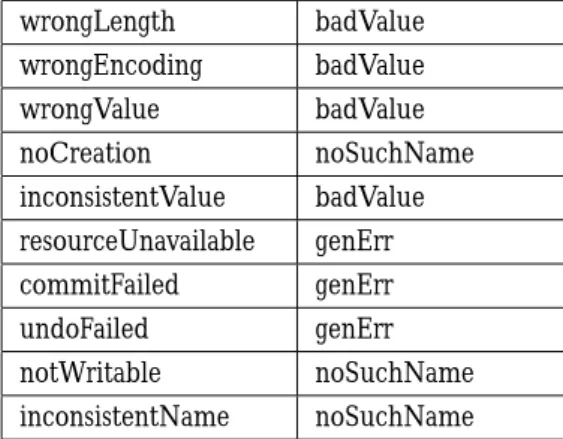
In order for an implementation to make full use of the enhanced SNMPv2 error codes, it is essential that the instrumentation functions always return SNMPv2 error codes, in case of error. These are translated into the corresponding SNMPv1 error codes by the agent, if necessary.
Note:
The translation from an SMIv1 MIB to an SNMPv2c or SNMPv3 reply is always very straightforward, but the translation from a v2 MIB to a v1 reply is somewhat more complicated. There is one data type in SMIv2, calledCounter64, that an SNMPv1 manager cannot decode correctly. Therefore, an agent may never send aCounter64object to an SNMPv1 manager. The common practice in these situations is to simple ignore anyCounter64objects, when sending a reply or a trap to an SNMPv1 manager. For example, if an SNMPv1 manager tries to GET an object of typeCounter64, he will get anoSuchNameerror, while an SNMPv2 manager would get a correct value.
1.2.4
Operation
The following steps are needed to get a running agent: 1. Write your MIB in SMI in a text file.
2. Write the instrumentation functions in Erlang and compile them. 3. Put their names in the association file.
5. Configure the agent. 6. Start the agent.
7. Load the compiled MIB into the agent.
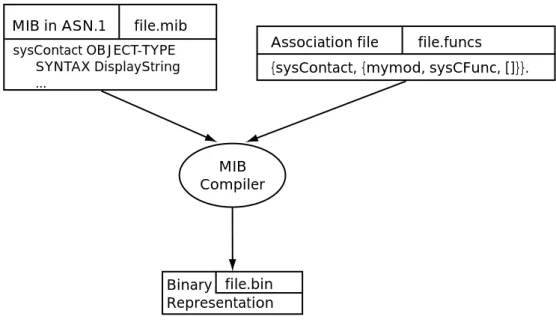
The figures in this section illustrate the steps involved in the development of an SNMP agent.
MIB in ASN.1 file.mib
sysContact OBJECT-TYPE SYNTAX DisplayString ...
Association file
{sysContact, {mymod, sysCFunc, []}}.
Binary
Representation file.bin
file.funcs
MIB Compiler
Figure 1.1: MIB Compiler Principles
The compiler parses the SMI file and associates each table or variable with an instrumentation function (see the figure MIB Compiler Principles [page 6]). The actual instrumentation functions are not needed at MIB compile time, only their names.
The binary output file produced by the compiler is read by the agent at MIB load time (see the figure Starting the Agent [page 6]). The instrumentation is ordinary Erlang code which is loaded explicitly or automatically the first time it is called.
Binary
Representation file.bin
Instrumentation
sysCFunc(get, ...) -> <code>;
sysCFunc(set, ...) -> <code>.
mymod.jam
Agent
1.2: Functional Description
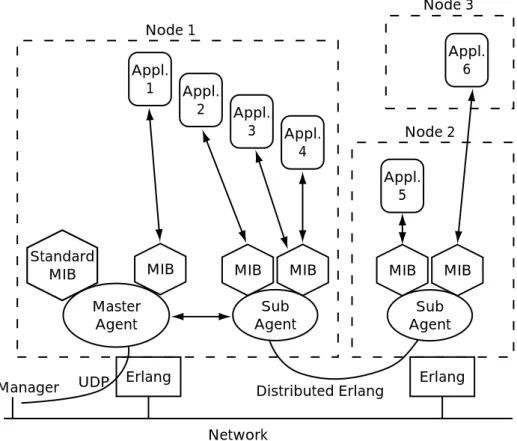
The SNMP agent system consists of one Master Agent and optional subagents. The Master Agent can be seen as a special kind of subagent. It implements the core agent functionality, UDP packet
processing, type checking, access control, trap distribution, and so on. From a user perspective, it is used as an ordinary subagent.
Subagents are only needed if your application requires special support for distribution from the SNMP toolkit. A subagent can also be used if the application requires a more complex set transaction scheme than is found in the master agent.
The following illustration shows how a system can look in runtime.
Standard
MIB MIB MIB MIB Master
Agent
Sub Agent
Manager Erlang Erlang Appl.
1 Appl.
2 Appl.
3 Appl. 4
Appl. 5
Appl. 6 Node 1
Node 3
Node 2
Network UDP
Distributed Erlang
MIB MIB Sub Agent
Figure 1.3: Architecture
A typical operation could include the following steps: 1. The Manager sends a request to the Agent.
2. The Master Agent decodes the incoming UDP packet.
3. The Master Agent determines which items in the request that should be processed here and which items should be forwarded to its subagent.
4. Step 3 is repeated by all subagents.
5. Each subagent calls the instrumentation for its loaded MIBs.
6. The results of calling the instrumentation are propagated back to the Master Agent. 7. The answer to the request is encoded to a UDP Protocol Data Unit (PDU).
The sequence of steps shown is probably more complex than normal, but it illustrates the amount of functionality which is available. The following points should be noted:
An agent can have many MIBs loaded at the same time.
Subagents can also have subagents. Each subagent can have an arbitrary number of child
subagents registered, forming a hierarchy.
One MIB can communicate with many applications.
Instrumentation can use Distributed Erlang to communicate with an application.
Most applications only need the Master Agent because an agent can have multiple MIBs loaded at the same time.
1.2.5
Subagents and MIB Loading
Since applications tend to be transient (they are dynamically loaded and unloaded), the management of these applications must be dynamic as well. For example, if we have an equipment MIB for a rack and different MIBs for boards, which can be installed in the rack, the MIB for a card should be loaded when the card is inserted, and unloaded when the card is removed.
In this agent system, there are two ways to dynamically install management information. The most common way is to load an MIB into an agent. The other way is to use a subagent, which is controlled by the application and is able to register and de-register itself. A subagent can register itself for maniging a sub-tree (not to be mixed up witherlang:register). The sub-tree is identified by an Object Identifier. When a subagent is registered, it receives all requests for this particular sub-tree and it is responsible for answering them. It should also be noted that a subagent can be started and stopped at any time.
Compared to other SNMP agent packages, there is a significant difference in this way of using
subagents. Other packages normally use subagents to load and unload MIBs in runtime. In Erlang, it is easy to load code in runtime and it is possible to load an MIB into an existing subagent. It is not necessary to create a new process for handling a new MIB.
Subagents are used for the following reasons:
to provide a more complex set-transaction scheme than master agent to avoid unnecessary process communication
to provide a more lightweight mechanism for loading and unloading MIBs in runtime to provide interaction with other SNMP agent toolkits.
Refer to the chapter Advanced Topics [page 39] in this User's Guide for more information about these topics.
The communication protocol between subagents is the normal message passing which is used in distributed Erlang systems. This implies that subagent communication is very efficient compared to SMUX, DPI, AgentX, and similar protocols.
1.2: Functional Description
1.2.6
Contexts and Communities
A context is a collection of management information accessible by an SNMP entity. An instance of a management object may exist in more than one context. An SNMP entity potentially has access to many contexts.
Each managed object can exist in many instances within a SNMP entity. To identify the instances, specified by an MIB module, a method to distinguish the actual instance by its 'scope' or context is used. Often the context is a physical or a logical device. It can include multiple devices, a subset of a single device or a subset of multiple devices, but the context is always defined as a subset of a single SNMP entity. To be able to identify a specific item of management information within an SNMP entity, the context, the object type and its instance must be used.
For example, the managed object typeifDescrfrom RFC1573, is defined as the description of a network interface. To identify the description of device-X's first network interface, four pieces of information are needed: the snmpEngineID of the SNMP entity which provides access to the management information at device-X, thecontextName(device-X), the managed object type (ifDescr), and the instance (“1”).
In SNMPv1 and SNMPv2c, the community string in the message was used for (at least) three different purposes:
to identify the context to provide authentication to identify a set of trap targets
In SNMPv3, each of these usage areas has its own unique mechanism. A context is identified by the name of the SNMP entity,contextEngineID, and the name of the context,contextName. Each SNMPv3 message contains values for these two parameters.
There is a MIB, SNMP-COMMUNITY-MIB, which maps a community string to acontextEngineID andcontextName. Thus, each message, an SNMPv1, SNMPv2c or an SNMPv3 message, always uniquely identifies a context.
For an agent, thecontextEngineIDidentified by a received message, is always equal to the snmpEngineIDof the agent. Otherwise, the message was not intended for the agent. If the agent is configured with more than one context, the instrumentation code must be able to figure out for which context the request was intended. There is a functionsnmp:current context/0provided for this purpose.
By default, the agent has no knowledge of any other contexts than the default context,"". If it is to support more contexts, these must be explicitly added, by using an appropriate configuration file Configuration Files [page 27].
1.2.7
Management of the Agent
There is a set of standard MIBs, which are used to control and configure an SNMP agent. All of these MIBs, with the exception of the optional SNMP-PROXY-MIB (which is only used for proxy agents), are implemented in this agent. Further, it is configurable which of these MIBs are actually loaded, and thus made visible to SNMP managers. For example, in a non-secure environment, it might be a good idea to not make MIBs that define access control visible. Note, the data the MIBs define is used internally in the agent, even if the MIBs not are loaded. This chapter describes these standard MIBs, and some aspects of their implementation.
Any SNMP agent must implement thesystemgroup and thesnmpgroup, defined in MIB-II. The definitions of these groups have changed from SNMPv1 to SNMPv2. MIBs and implementations for both of these versions are Provided in the distribution. The MIB file for SNMPv1 is called
STANDARD-MIB, and the corresponding for SNMPv2 is called SNMPv2-MIB. If the agent is
configured for SNMPv1 only, the STANDARD-MIB is loaded by default; otherwise, the SNMPv2-MIB is loaded by default. It is possible to override this default behavior, by explicitly loading another version of this MIB, for example, you could choose to implement the union of all objects in these two MIBs. An SNMPv3 agent must implement the SNMP-FRAMEWORK-MIB and SNMP-MPD-MIB. These MIBs are loaded by default, if the agent is configured for SNMPv3. These MIBs can be loaded for other versions as well.
There are five other standard MIBs, which also may be loaded into the agent. These MIBs are:
SNMP-TARGET-MIB and SNMP-NOTIFICATION-MIB, which defines managed objects for
configuration of management targets, i.e. receivers of notifications (traps and informs). These MIBs can be used with any SNMP version.
SNMP-VIEW-BASED-ACM-MIB, which defined managed objects for access control. This MIB
can be used with any SNMP version.
SNMP-COMMUNITY-MIB, which defines managed objects for coexistence of SNMPv1 and
SNMPv2c with SNMPv3. This MIB is only useful if SNMPv1 or SNMPv2c is used, possibly in combination with SNMPv3.
SNMP-USER-BASED-SM-MIB, which defines managed objects for authentication and privacy.
This MIB is only useful with SNMPv3.
All of these MIBs should be loaded into the Master Agent. Once loaded, these MIBs are always available in all contexts.
The ASN.1 code, the Erlang source code, and the generated.hrlfiles for them are provided in the distributionand are placed in the directoriesmibs,src, andinclude, respectively, in thesnmp application.
The.hrlfiles are generated withsnmp:mib to hrl/1. Include these files in your code as in the following example:
-include_lib("snmp/include/SNMPv2-MIB.hrl").
The initial values for the managed objects defined in these tables, are read at startup from a set of configuration files. These are described in Configuration Files [page 27].
STANDARD-MIB and SNMPv2-MIB
These MIBs contain thesnmp-andsystemgroups from MIB-II which is defined in RFC1213
(STANDARD-MIB) or RFC1907 (SNMPv2-MIB). They are implemented in thesnmp standard mib module. Thesnmpcounters all reside in volatile memory and thesystemandsnmpEnableAuthenTraps variables in persistent memory, using the SNMP built-in database (refer to the Reference Manual, sectionsnmp, modulesnmp local dbfor more details).
If another implementation of any of these variables is needed, e.g. to store the persistent variables in a Mnesia database, an own implementation of the variables must be made. That MIB will be compiled and loaded instead of the default MIB. The new compiled MIB must have the same name as the original MIB (i.e. STANDARD-MIB or SNMPv2-MIB), and be located in the SNMP configuration directory (see Configuration Files [page 27].)
One of these MIBs is always loaded. If only SNMPv1 is used, STANDARD-MIB is loaded, otherwise SNMPv2-MIB is loaded.
1.2: Functional Description Data Types There are some new data types in SNMPv2 that are useful in SNMPv1 as well. In the STANDARD-MIB, three data types are defined,RowStatus,TruthValueandDateAndTime. These data types are originally defined as textual conventions in SNMPv2-TC (RFC1903).
SNMP-FRAMEWORK-MIB and SNMP-MPD-MIB
The SNMP-FRAMEWORK-MIB and SNMP-MPD-MIB define additional read-only managed objects, which is used in the generic SNMP framework defined in RFC2271 and the generic message processing and dispatching module defined in RFC2272. They are generic in the sense that they are not tied to any specific SNMP version.
The objects in these MIBs are implemented in the modulessnmp framework miband
snmp standard mib, respectively. All objects reside in volatile memory, and the configuration files are always reread at startup.
If SNMPv3 is used, these MIBs are loaded by default.
SNMP-TARGET-MIB and SNMP-NOTIFICATION-MIB
The SNMP-TARGET-MIB and SNMP-NOTIFICATION-MIB define managed objects for configuration of notification receivers. They are described in detail in RFC2273. Only a brief description is given here. The SNMP-NOTIFICATION-MIB is implemented according tosnmpNotifyBasicCompliance. It means, the notification filtering is not implemented.
All tables in these MIBs have a column of typeStorageType. The value of this column specifies how each row is stored, and what happens in case of a restart of the agent. The implementation supports the valuesvolatileandnonVolatile. When the tables are initially filled with data from the configuration files, these rows will automatically have storage typenonVolatile. Should the agent restart, all
nonVolatilerows survive the restart, while thevolatilerows are lost. The configuration files are not read at restart, by default.
These MIBs are not loaded by default.
snmpNotifyTable An entry in thesnmpNotifyTableselects a set of management targets, which should receive notifications, as well as the type (trap or inform) of notification that should be sent to each selected management target. When an application sends a notification using the function send notification/5or the functionsend trapthe parameterNotifyName, specified in the call, is used as an index in the table. The notification is sent to the management targets selected by that entry.
snmpTargetAddrTable An entry in thesnmpTargetAddrTabledefines transport parameters (such as IP address and UDP port) for each management target. Each row in thesnmpNotifyTablerefers to potentially many rows in thesnmpTargetAddrTable. Each row in thesnmpTargetAddrTablerefers to an entry in thesnmpTargetParamsTable.
snmpTargetParamsTable An entry in thesnmpTargetParamsTabledefines which SNMP version to use, and which security parameters to use.
Which SNMP version to use is implicitly defined by specifying the Message Processing Model. This version of the agent handles the modelsv1,v2candv3.
SNMP-VIEW-BASED-ACM-MIB
The SNMP-VIEW-BASED-ACM-MIB defines managed objects to control access to the the managed objects for the managers. The View Based Access Control Module (VACM) can be used with any SNMP version. However, if it is used with SNMPv1 or SNMPv2c, the SNMP-COMMUNITY-MIB defines additional objects to map community strings to VACM parameters.
All tables in this MIB have a column of typeStorageType. The value of this column specifies how each row is stored, and what happens in case of a restart of the agent. The implementation supports the valuesvolatileandnonVolatile. When the tables are initially filled with data from the configuration files, these rows will automatically have storage typenonVolatile. Should the agent restart, all
nonVolatilerows survive the restart, while thevolatilerows are lost. The configuration files are not read at restart by default.
This MIB is not loaded by default.
VACM is described in detail in RFC2275. Here is only a brief description given.
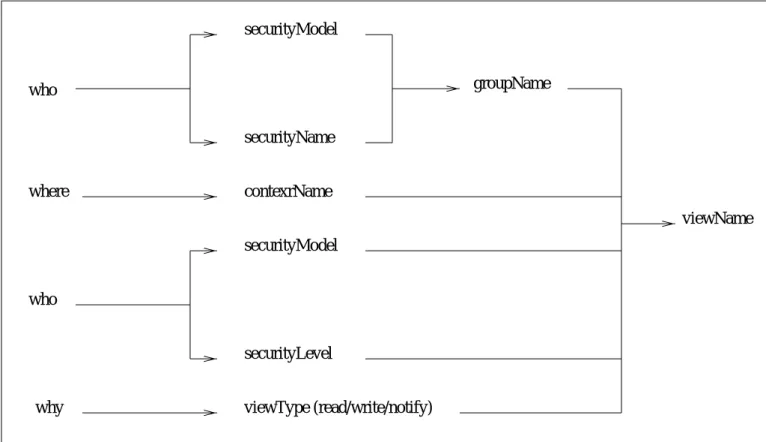
The basic concept is that of a MIB view. An MIB view is a subset of all the objects implemented by an agent. A manager has access to a certain MIB view, depending on which security parameters are used, in which context the request is made, and which type of request is made.
The following picture gives an overview of the mechanism to select an MIB view:
who
where
groupName
contexrName
who
why
viewName securityModel
securityName
securityModel
securityLevel
viewType (read/write/notify)
Figure 1.4: Overview of the mechanism of MIB selection
1.2: Functional Description vacmSecurityToGroupTable ThevacmSecurityToGroupTablemaps asecurityModeland a securityNameto agroupName.
vacmAccessTable ThevacmAccessTablemaps thegroupName(found in
vacmSecurityToGroupTable),contextName,securityModel, andsecurityLevelto an MIB view for each type of operation (read, write, or notify). The MIB view is represented as aviewName. The definition of the MIB view represented by theviewNameis found in thevacmViewTreeFamilyTable
vacmViewTreeFamilyTable ThevacmViewTreeFamilyTableis indexed by theviewName, and defines which objects are included in the MIB view.
The MIB definition for the table looks as follows: VacmViewTreeFamilyEntry ::= SEQUENCE
f
vacmViewTreeFamilyViewName SnmpAdminString, vacmViewTreeFamilySubtree OBJECT IDENTIFIER, vacmViewTreeFamilyMask OCTET STRING, vacmViewTreeFamilyType INTEGER, vacmViewTreeFamilyStorageType StorageType, vacmViewTreeFamilyStatus RowStatus
g
INDEX f vacmViewTreeFamilyViewName,
vacmViewTreeFamilySubtree
g
EachvacmViewTreeFamilyViewNamerefers to a collection of sub-trees.
MIB View Semantics An MIB view is a collection of included and excluded sub-trees. A sub-tree is identified by an OBJECT IDENTIFIER. A mask is associated with each sub-tree.
For each possible MIB object instance, the instance belongs to a sub-tree if:
the OBJECT IDENTIFIER name of that MIB object instance comprises at least as many
sub-identifiers as does the sub-tree, and
each sub-identifier in the name of that MIB object instance matches the corresponding
sub-identifier of the sub-tree whenever the corresponding bit of the associated mask is 1 (0 is a wild card that matches anything).
Membership of an object instance in an MIB view is determined by the following algorithm:
If an MIB object instance does not belong to any of the relevant sub-trees, then the instance is not
in the MIB view.
If an MIB object instance belongs to exactly one sub-tree, then the instance is included in, or
excluded from, the relevant MIB view according to the type of that entry.
If an MIB object instance belongs to more than one sub-tree, then the sub-tree which comprises
Note:
If the OBJECT IDENTIFIER is longer than an OBJECT IDENTIFIER of an object type in the MIB, it refers to object instances. Because of this, it is possible to control whether or not particular rows in a table shall be visible.
SNMP-COMMUNITY-MIB
The SNMP-COMMUNITY-MIB defines managed objects that is used for coexistence between SNMPv1 and SNMPv2c with SNMPv3. Specifically, it contains objects for mapping between
community strings and version-independent SNMP message parameters. In addition, this MIB provides a mechanism for performing source address validation on incoming requests, and for selecting
community strings based on target addresses for outgoing notifications.
All tables in this MIB have a column of typeStorageType. The value of this column specifies how each row is stored, and what happens in case of a restart of the agent. The implementation supports the valuesvolatileandnonVolatile. When the tables are initially filled with data from the configuration files, these rows will automatically have storage typenonVolatile. Should the agent restart, all
nonVolatilerows survive the restart, while thevolatilerows are lost. The configuration files are not read at restart, by default.
This MIB is not loaded by default.
SNMP-USER-BASED-SM-MIB
The SNMP-USER-BASED-SM-MIB defines managed objects that is used for the User-Based Security Model.
All tables in this MIB have a column of typeStorageType. The value of the column specifies how each row is stored, and what happens in case of a restart of the agent. The implementation supports the valuesvolatileandnonVolatile. When the tables are initially filled with data from the configuration files, these rows will automatically have storage typenonVolatile. Should the agent restart, all
nonVolatilerows survive the restart, while thevolatilerows are lost. The configuration files are not read at restart, by default.
This MIB is not loaded by default.
OTP-SNMPEA-MIB
The OTP-SNMPEA-MIB was used in earlier versions of the agent, before standard MIBs existed for access control, MIB views, and trap target specification. All objects in this MIB are now obsolete.
1.2: Functional Description
1.2.8
Notifications
Notifications are defined in SMIv1 with the TRAP-TYPE macro in the definition of an MIB (see RFC1215). The corresponding macro in SMIv2 is NOTIFICATION-TYPE. When an application decides to send a notification, it calls one of the following functions:
snmp:send_notification(Agent,Notification,Receiver
[,NotifyName,ContextName,Varbinds])
snmp:send_trap(Agent,Notification,Community [,Receiver,Varbinds])
providing the registered name or process identifier of the agent where the MIB, which defines the notification is loaded and the symbolic name of the notification.
If thesend notification/3,4function is used, all management targets are selected, as defined in RFC2273. TheReceiverparameter defines where the agent should send information about the delivery of inform requests.
If thesend notification/5function is used, anNotifyNamemust be provided. This parameter is used as an index in thesnmpNotifyTable, and the management targets defined by that single entry is used. Thesend notification/6function is the most general version of the function. AContextNamemust be specified, from which the notification will be sent. If this parameter is not specified, the default context ("") is used.
The functionsend trapis kept for backwards compatibility and should not be used in new code. Applications that use this function will continue to work. ThesnmpNotifyNameis used as the community string by the agent when a notification is sent.
Notification Sending
The simplest way to send a notification is to call the functionsnmp:send notification(Agent, Notification, no receiver). In this case, the agent performs a get-operation to retrieve the object values that are defined in the notification specification (with the TRAP-TYPE or
NOTIFICATION-TYPE macros). The notification is sent to all managers defined in the target and notify tables, either unacknowledged as traps, or acknowledged as inform requests.
If the caller of the function wants to know whether or not acknowledgements are received for a certain notification (provided it is sent as an inform), theReceiverparameter can be specified asfTag,
ProcessNameg(refer to the Reference Manual, section snmp, modulesnmpfor more details). In this
case, the agent send a messagefsnmp notification, Tag, fgot response, ManagerAddrggor fsnmp notification, Tag, fno response, ManagerAddrggfor each management target.
Sometimes it is not possible to retrieve the values for some of the objects in the notification
specification with a get-operation. However, they are known when thesend notificationfunction is called. This is the case if an object is an element in a table. It is possible to give the values of some objects to thesend notificationfunctionsnmp:send notification(Agent, Notification, Receiver, Varbinds). In this function,Varbindsis a list ofVarbind, where eachVarbindis one of:
fVariable, Valueg, whereVariableis the symbolic name of a scalar variable referred to in the
notification specification.
fColumn, RowIndex, Valueg, whereColumnis the symbolic name of a column variable.
RowIndexis a list of indices for the specified element. If this is the case, the OBJECT
IDENTIFIER sent in the trap is theRowIndexappended to the OBJECT IDENTIFIER for the table column. This is the OBJECT IDENTIFIER which specifies the element.
fOID, Valueg, whereOIDis the OBJECT IDENTIFIER for an instance of an object, scalar
For example, to specify thatsysLocationshould have the value"upstairs"in the notification, we could use one of:
fsysLocation, "upstairs"gor f[1,3,6,1,2,1,1,6,0], "upstairs"g
It is also possible to specify names and values for extra variables that should be sent in the notification, but were not defined in the notification specification.
The notification is sent to all management targets found in the tables. However, make sure that each manager has access to the variables in the notification. If a variable is outside a manager's MIB view, this manager will not receive the notification.
Note:
By definition, it is not possible to send objects with ACCESSnot-accessiblein notifications. However, historically this is often done and for this reason we allow it in notification sending. If a variable has ACCESSnot-accessible, the user must provide a value for the variable in the Varbindslist. It is not possible for the agent to perform a get-operation to retrieve this value.
Subagent Path
If a value for an object is not given to thesend notificationfunction, the subagent will perform a get-operation to retrieve it. If the object is not implemented in this subagent, its parent agent tries to perform a get-operation to retrieve it. If the object is not implemented in this agent either, it forwards the object to its parent, and so on. Eventually the Master Agent is reached and at this point all unknown object values must be resolved. If some object is unknown even to the Master Agent, this is regarded as an error and is reported with a call touser err/2of the error report module. No
notifications are sent in this case.
For a given notification, the variables, which are referred to in the notification specification, must be implemented by the agent that has the MIB loaded, or by some parent to this agent. If not, the application must provide values for the unknown variables. The application must also provide values for all elements in tables.
1.3
Instrumentation Functions
A user-defined instrumentation function for each object attaches the managed objects to real resources. This function is called by the agent on agetorsetoperation. The function could read some hardware register, perform a calculation, or whatever is necessary to implement the semantics associated with the conceptual variable. These functions must be written both for scalar variables and for tables. They are specified in the association file, which is a text file. In this file, theOBJECT IDENTIFIER, or symbolic name for each managed object, is associated with an Erlang tuplefModule, Function,
ListOfExtraArgumentsg.
When a managed object is referenced in an SNMP operation, the associatedfModule, Function,
ListOfExtraArgumentsgis called. The function is applied to some standard arguments (for example,
the operation type) and the extra arguments supplied by the user.
Instrumentation functions must be written forgetandsetfor scalar variables and tables, and for get-nextfor tables only. Theget-bulkoperation is translated into a series of calles toget-next.
1.3: Instrumentation Functions
1.3.1
Instrumentation Functions
The following sections describe how the instrumentation functions should be defined in Erlang for the different operations. In the following,RowIndexis a list of key values for the table, andColumnis a column number.
These functions are described in detail in Definition of Instrumentation Functions [page 50].
New / Delete Operations
For scalar variables:
variable_access(new [, ExtraArg1, ...]) variable_access(delete [, ExtraArg1, ...]) For tables:
table_access(new [, ExtraArg1, ...]) table_access(delete [, ExtraArg1, ...])
These functions are called for each object in an MIB when the MIB is unloaded or loaded, respectively.
Get Operation
For scalar variables:
variable_access(get [, ExtraArg1, ...]) For tables:
table_access(get,RowIndex,Cols [,ExtraArg1, ...])
Colsis a list ofColumn. The agent will sort incoming variables so that all operations on one row (same index) will be supplied at the same time. The reason for this is that a database normally retrieves information row by row.
These functions must return the current values of the associated variables.
Set Operation
For scalar variables:
variable_access(set, NewValue [, ExtraArg1, ...]) For tables:
table_access(set, RowIndex, Cols [, ExtraArg1,..]) Colsis a list of tuplesfColumn, NewValueg.
Is-set-ok Operation
As a complement to thesetoperation, it is possible to specify a test function. This function has the same syntax as the set operation above, except that the first argument isis set okinstead ofset. This function is called before the variable is set. Its purpose is to ensure that it is permissible to set the variable to the new value.
variable_access(is_set_ok, NewValue [, ExtraArg1, ...]) For tables:
table_access(set, RowIndex, Cols [, ExtraArg1,..]) Colsis a list of tuplesfColumn, NewValueg.
Undo Operation
A function which has been called withis set okwill be called again, either withsetif there was no error, or withundo, if an error occurred. In this way, resources can be reserved in theis set ok operation, released in theundooperation, or made permanent in thesetoperation.
variable_access(undo, NewValue [, ExtraArg1, ...]) For tables:
table_access(set, RowIndex, Cols [, ExtraArg1,..]) Colsis a list of tuplesfColumn, NewValueg.
GetNext Operation
The GetNext Operation operation should only be defined for tables since the agent can find the next instance of plain variables in the MIB and call the instrumentation with thegetoperation.
table_access(get_next, RowIndex, Cols [, ExtraArg1, ...])
Colsis a list of integers, all greater than or equal to zero. This indicates that the instrumentation should find the next accessible instance. This function returns the tuplefNextOid, NextValueg, or
endOfTable.NextOidshould be the lexicographically next accessible instance of a managed object in the table. It should be a list of integers, where the first integer is the column, and the rest of the list is the indices for the next row. IfendOfTableis returned, the agent continues to search for the next instance among the other variables and tables.
RowIndexmay be an empty list, an incompletely specified row index, or the index for an unspecified row.
1.3: Instrumentation Functions GetNext Example A table calledmyTablehas five columns. The first two are keys (not accessible), and the table has three rows. The instrumentation function for this table is calledmy table.
key 1 key 2 col 3 col 4 col 5 1
1 2
1 2 1
a d g
b e N/A
c f i
Figure 1.5: Contents of my table
Note:
N/A means not accessible.
The manager issues the followinggetNextrequest: getNext{ myTable.myTableEntry.3.1.1,
myTable.myTableEntry.5.1.1 }
Since both operations involve the 1.1 index, this is transformed into one call tomy table: my_table(get_next, [1, 1], [3, 5])
In this call,[1, 1]is theRowIndex, where key 1 has value 1, and key 2 has value 1, and[3, 5]is the list of requested columns. The function should now return the lexicographically next elements: [{[3, 1, 2], d}, {[5, 1, 2], f}]
key 1 key 2 col 3 col 4 col 5 1
1 2
1 2 1
a d g
b e N/A
c f i
Figure 1.6: GetNext from [3,1,1] and [5,1,1].
The manager now issues the followinggetNextrequest: getNext{ myTable.myTableEntry.3.2.1,
myTable.myTableEntry.5.2.1 } This is transformed into one call tomy table: my_table(get_next, [2, 1], [3, 5]) The function should now return:
[{[4, 1, 1], b}, endOfTable] This is illustrated in the following table:
key 1 key 2 col 3 col 4 col 5 1
1 2
1 2 1
a d g
b e N/A
c f i
endOfTable
Figure 1.7: GetNext from [3,2,1] and [5,2,1].
1.3: Instrumentation Functions
getNext{ myTable.myTableEntry.3.1.2, myTable.myTableEntry.4.1.2 } This will be transform into one call tomy table: my_table(get_next, [1, 2], [3, 4]) The function should now return:
[{[3, 2, 1], g}, {[5, 1, 1], c}] This is illustrated in the following table:
key 1 key 2 col 3 col 4 col 5 1
1 2
1 2 1
a d g
b e N/A
c f i
Figure 1.8: GetNext from [3,1,2] and [4,1,2].
The manager now issues the followinggetNextrequest: getNext{ myTable.myTableEntry,
myTable.myTableEntry.1.3.2 } This will be transform into two calls tomy table: my_table(get_next, [], [0]) and
my_table(get_next, [3, 2], [1]) The function should now return: [{[3, 1, 1], a}] and
[{[3, 1, 1], a}]
In both cases, the first accessible element in the table should be returned. As the key columns are not accessible, this means that the third column is the first row.
Note:
Normally, the functions described above behave exactly as shown, but they are free to perform other actions. For example, a get-request may have side effects such as setting some other variable, perhaps a globallastAccessedvariable.
1.3.2
Using the ExtraArgument
TheListOfExtraArgumentscan be used to write generic functions. This list is appended to the standard arguments for each function. Consider two read-only variables for a device,ipAdrandname with object identifiers 1.1.23.4 and 1.1.7 respectively. To access these variables, one could implement the two Erlang functionsip accessandname access, which will be in the MIB. The functions could be specified in a text file as follows:
{ipAdr, {my_module, ip_access, []}}. % Or using the oid syntax for ’name’ {[1,1,7], {my_module, name_access, []}}.
TheExtraArgumentparameter is the empty list. For example, when the agent receives a get-request for theipAdrvariable, a call will be made toip access(get). The value returned by this function is the answer to the get-request.
Ifip accessandname accessare implemented similarly, we could write ageneric accessfunction using theListOfExtraArguments:
{ipAdr, {my_module, generic_access, [’IPADR’]}}. % The mnemonic ’name’ is more convenient than 1.1.7 {name, {my_module, generic_access, [’NAME’]}}.
When the agent receives the same get-request as above, a call will be made togeneric access(get, 'IPADR’).
Yet another possibility, closer to the hardware, could be: {ipAdr, {my_module, generic_access, [16#2543]}}. {name, {my_module, generic_access, [16#A2B3]}}.
1.3.3
Default Instrumentation
When the MIB definition work is finished, there are two major issues left.
Implementing the MIB
Implementing a Manager Application.
Implementing an MIB can be a tedious task. Most probably, there is a need to test the agent before all tables and variables are implemented. In this case, the default instrumentation functions are useful. The toolkit can generate default instrumentation functions for variables as well as for tables. Consequently, a running prototype agent, which can handleset,get,get-nextand table operations, is generated without any programming.
The agent stores the values in an internal volatile database, which is based on the standard moduleets. However, it is possible to let the MIB compiler generate functions which use an internal, persistent database, or the Mnesia DBMS. Refer to the Mnesia User Guide and the Reference Manual, section SNMP, modulesnmp genericfor more information.
When parts of the MIB are implemented, you recompile it and continue on by using default functions. With this approach, the SNMP agent can be developed incrementally.
The default instrumentation allows the application on the manager side to be developed and tested simultaneously with the agent. As soon as the ASN.1 file is completed, let the MIB compiler generate a default implementation and develop the management application from this.
1.3: Instrumentation Functions Table Operations
The generation of default functions for tables works for tables which use theRowStatustextual convention from SNMPv2, defined in STANDARD-MIB and SNMPv2-TC.
Note:
We strongly encourage the use of theRowStatusconvention for every table that can be modified from the manager, even for newly designed SNMPv1 MIBs. In SNMPv1, everybody has invented their own scheme for emulating table operations, which has led to numerous inconsistencies. The convention in SNMPv2 is flexible and powerful and has been tested successfully. If the table is read only, no RowStatus column should be used.
1.3.4
Atomic Set
In SNMP, thesetoperation is atomic. Either all variables which are specified in asetoperation are changed, or none are changed. Therefore, thesetoperation is divided into two phases. In the first phase, the new value of each variable is checked against the definition of the variable in the MIB. The following definitions are checked:
the type the length the range
the variable is writable and within the MIB view.
At the end of phase one, the user definedis set okfunctions are called for each scalar variable, and for each group of table operations.
If no error occurs, the second phase is performed. This phase calls the user definedsetfunction for all variables.
If an error occurs, either in theis set okphase, or in thesetphase, all functions which were called withis set okbut notset, are called withundo.
There are limitations with this transaction mechanism. If complex dependencies exist between variables, for example betweenmonthandday, another mechanism is needed. Setting the date to 'Feb 31' can be avoided by a somewhat more generic transaction mechanism. You can continue and find more and more complex situations and construct an N-phase set-mechanism. This toolkit only contains a trivial mechanism.
The most common application of transaction mechanisms is to keep row operations together. Since our agent sorts row operations, the mechanism implemented in combination with the RowStatus
1.4
The MIB Compiler
The chapter The MIB Compiler describes the MIB compiler and contains the following topics:
Operation Import
Consistency checking between MIBs .hrl file generation
Emacs integration
Deviations from the standard
Note:
When importing MIBs, ensure that the imported MIBs as well as the importing MIB are compiled using the same version of the SNMP-compiler.
1.4.1
Operation
The MIB must be written as a text file in SMIv1 or SMIv2 using an ASN.1 notation before it will be compiled. This text file must have the same name as the MIB, but with the suffix.mib. This is necessary for handling theIMPORTstatement.
The association file, which contains the names of instrumentation functions for the MIB, should have the suffix.funcs. If the compiler does not find the association file, it gives a warning message and uses default instrumentation functions. (See Default Instrumentation [page 22] for more details).
The MIB compiler is started with a call tosnmp:c(<mibname>).For example:
snmp:c("RFC1213-MIB").
The output is a new file which is called<mibname>.bin.
The MIB compiler understands both SMIv1 and SMIv2 MIBs. It uses the MODULE-IDENTITY statement to determinate if the MIB is written in SMI version 1 or 2.
1.4.2
Importing MIBs
The compiler handles theIMPORTstatement. It is important to import the compiled file and not the ASN.1 file. A MIB must be recompiled to make changes visible to other MIBs importing it.
The compiled files of the imported MIBs must be present in the current directory, or a directory in the current path. The path is supplied with thefi, Pathgoption, for example:
snmp:c("MY-MIB",
[{i, ["friend_mibs/", "../standard_mibs/"]}]).
It is also possible to import MIBs from OTP applications in an"include lib"like fashion with theil option. Example:
1.4: The MIB Compiler
snmp:c("MY-MIB",
[{il, ["snmp/priv/mibs/", "myapp/priv/mibs/"]}]).
finds the lastest version of thesnmpandmyappapplications in the OTP system and uses the expanded paths as include paths.
Note that an SMIv2 MIB can import an SMIv1 MIB and vice versa.
The following MIBs are built-ins of the Erlang SNMP compiler: SNMPv2-SMI, RFC-1215, RFC-1212, SNMPv2-TC, SNMPv2-CONF, and RFC1155-SMI. They cannot therefore be compiled separately.
1.4.3
MIB Consistency Checking
When an MIB is compiled, the compiler detects if several managed objects use the sameOBJECT IDENTIFIER. If that is the case, it issues an error message. However, the compiler cannot detect Oid conflicts between different MIBs. These kinds of conflicts generate an error at load time. To avoid this, the following function can be used to do consistency checking between MIBs:
erl>snmp:is consistent(ListOfMibNames).
ListOfMibNamesis a list of compiled MIBs, for example["RFC1213-MIB", "MY-MIB"]. The function also performs consistency checking of trap definitions.
1.4.4
.hrl File Generation
It is possible to generate an.hrlfile which contains definitions of Erlang constants from a compiled MIB file. This file can then be included in Erlang source code. The file will contain constants for:
object Identifiers for tables, table entries and variables column numbers
enumerated values
default values for variables and table columns.
Use the following command to generate a .hrl file from an MIB: erl>snmp:mib to hrl(MibName).
1.4.5
Emacs Integration
With the Emacs editor, thenext-error(C-X ‘) function can be used indicate where a compilation error occurred, provided the error message is described by a line number.
UseM-x compileto compile an MIB from inside Emacs, and enter: erl -s snmp c <MibName> -noshell
1.4.6
Compiling from a Shell or a Makefile
Theerlccommands can be used to compile SNMP MIBs. Example: erlc MY-MIB.mib
All the standarderlcflags are supported, e.g. erlc -I mymibs -o mymibs -W MY-MIB.mib
The flags specific to the MIB compiler can be specified by using the+syntax: erlc +’fgroup check,falseg’ MY-MIB.mib
1.4.7
Deviations from the Standard
In some aspects the Erlang MIB compiler does not follow or implement the SMI fully. Here are the differences:
Tables must be written in the following order:tableObject,entryObject,column1, ...,columnN
(in order).
Integer values, for example in theSIZEexpression must be entered in decimal syntax, not in hex
or bit syntax.
Symbolic names must be unique within a MIB and within a system.
Hyphens are allowed in SMIv2 (a pragmatic approach). The reason for this is that according to
SMIv2, hyphens are allowed for objects converted from SMIv1, but not for others. This is impossible to check for the compiler.
If a word is a keyword in any of SMIv1 or SMIv2, it is a keyword in the compiler (deviates from
SMIv1 only).
Indexes in a table must be objects, not types (deviates from SMIv1 only).
A subset of all semantic checks on types are implemented. For example, strictly theTimeTicks
may not be sub-classed but the compiler allows this (standard MIBs must pass through the compiler) (deviates from SMIv2 only).
TheMIB.Objectsyntax is not implemented (since all objects must be unique anyway). Two different names cannot define the same OBJECT IDENTIFIER.
The type checking in the SEQUENCE construct is non-strict (i.e. subtypes may be specified).
The reason for this is that some standard MIBs use this.
A definition has normally a status field. When the status field has the value deprecated, then the
MIB-compiler will ignore this definition. With the MIB-compiler optionfdeprecated,truegthe
MIB-compiler does not ignore the deprecated definitions.
An object has a DESCRIPTIONS field. The descriptions-field will not be included in the
compiled mib by default. In order to get the description, the mib must be compiled with the optionfdescription,trueg.
1.5: Running the Agent
1.5
Running the Agent
The chapter Running the Agent describes how the agent is configured and started. The topics include:
configuration directories and parameters modifying the configuration files
starting the agent debugging the agent.
Refer also to the chapter Definition of Configuration Files [page 46] which contains more detailed information about the configuration files.
1.5.1
Configuring the Agent
The following two directories must exist in the system:
the configuration directory stores all configuration files (refer to the chapter Definition of
Configuration Files [page 46] for more information).
the database directory stores the internal database files.
The agent uses application configuration parameters to find out where these directories are located. The parameters should be defined in an Erlang system configuration file. The following configuration parameters are defined for the SNMP application:
audit trail log = false | write log | read write log <optional> Specifies if an audit trail
log should be used. Thedisk logmodule is used to maintain a wrap log. Ifwrite logis specified, only set requests are logged. Ifread write log, all requests are logged. Default is false.
audit trail log dir = string() <optional> Specifies where the audit trail log should be stored.
Ifaudit trail logspecifies that logging should take place, this parameter must be defined. audit trail log size = fMaxBytes, MaxFilesg <optional> Specifies the size of the audit trail
log. This parameter is sent todisk log. Ifaudit trail logspecifies that logging should take place, this parameter must be defined.
bind to ip address = bool() <optional> Iftruethe agent binds to the agent IP adress. Iffalse
the agent listens on any IP address on the host where it is running. Default isfalse.
force config load = bool() <optional> Iftruethe configuration files are re-read during startup,
and the contents of the configuration database ignored. Thus, iftrue, changes to the configuration database are lost upon reboot of the agent. Default isfalse.
no reuse address = bool() <optional> Iftruethe agent does not specify that the IP and port
address should be reusable. Iffalsethe agent the address is set to reusable. Default isfalse. snmp agent type = master | sub <optional> Ifmaster, one master agent is started. Otherwise,
no agents are started. Default ismaster.
snmp config dir = string() <mandatory> Defines where the SNMP configuration files and the
compiled master agent MIB files are stored.
snmp db dir = string() <mandatory> Defines where the SNMP internal db files are stored.
snmp master agent mibs = [string()] <optional> Specifies a list of MIB names and defines
which MIBs are initially loaded into the SNMP master agent. These MIBs are loaded from snmp config dir.
snmp multi threaded = bool() <optional> Iftrue, the agent is multi-threaded, with one thread
for each get request. Default isfalse.
snmp req limit = integer() | infinity <optional> The number of simultaneous requests (get,
get-next and get-bulk) the agent will allow. Default isinfinity.
snmp priority = atom() <optional> Defines the Erlang priority for all SNMP processes. Default is
normal.
v1 = bool() <optional> Defines if the agent shall speak SNMPv1. Default istrue.
v2 = bool() <optional> Defines if the agent shall speak SNMPv2c. Default istrue.
v3 = bool() <optional> Defines if the agent shall speak SNMPv3. Default istrue.
snmp local db auto repair = false | true | true verbose <optional> When starting
snmp local db it always tries to open an existing database. Iffalse, and some errors occur, a new datebase is created instead. Iftrue, erroneous transactions (in the logfile) are ignored. If
true verbose, erroneous transactions (in the logfile) are igored and an error message is written. Default istrue.
snmp mibentry override = bool() <optional> If this value is false, then when loading a mib each
mib- entry is checked prior to installation of the mib. The perpose of the check is to prevent that the same symbolic mibentry name is used for in different oid's. Default isfalse.
snmp trapentry override = bool() <optional> If this value is false, then when loading a mib each
trap is checked prior to installation of the mib. The perpose of the check is to prevent that the same symbolic trap name is used for in different trap's. Default isfalse.
snmp error report mod = atom() <optional> Defines an error report module, other then the
default. Two modules are provided with the toolkit:snmp errorandsnmp error io. Default is snmp error.
snmp master agent verbosity = silence | info | log | debug | trace <optional> Specifies
the startup verbosity for the SNMP master agent. Default issilence.
snmp symbolic store verbosity = silence | info | log | debug | trace <optional>
Specifies the startup verbosity for the SNMP symbolic store. Default issilence.
snmp note store verbosity = silence | info | log | debug | trace <optional> Specifies
the startup verbosity for the SNMP note store. Default issilence.
snmp net if verbosity = silence | info | log | debug | trace <optional> Specifies the
startup verbosity for the SNMP net if. Default issilence.
snmp mibserver verbosity = silence | info | log | debug | trace <optional> Specifies
the startup verbosity for the SNMP mib server. Default issilence.
snmp mib storage = ets | fdets,Dirg | fdets,Dir,Actiong | fmnesia,Nodesg | fmnesia,Nodes,Actiong <option
Specifies how info retrieved from the mibs will be stored. Default isets. Dir = string(). Dir is the directory where the (dets) files will be created. Nodes = [node()]. If Nodes = [] then the own node is assumed.
Action = clear | keep. Default iskeep.Actionis used to specify what shall be done if the mnesia table already exist.
1.5.2
Modifying the Configuration Files
To to start the agent, the agent configuration files must be modified and there are two ways of doing this. Either edit the files manually, or run the configuration tool as follows.
If authentication or encryption is used (SNMPv3 only), start thecryptoapplication. 1> application:start(crypto).
1.5: Running the Agent
ok
2> snmp:config().
Simple SNMP configuration tool (v3.0)
---Note: Non-trivial configurations still has to be done manually.
IP addresses may be entered as dront.ericsson.se (UNIX only) or 123.12.13.23 1. System name (sysName standard variable) [mbj’s agent]
2. Engine ID (snmpEngineID standard variable)[mbj’s engine] 3. The UDP port the agent listens to. (standard 161) [4000] 4. IP address for the agent (only used as id
when sending traps) [dront.ericsson.se]
5. IP address for the manager (only this manager will have access to the agent, traps are sent to this one) [dront.ericsson.se] 6. To what UDP port at the manager should traps
be sent (standard 162)? [5000]
7. What SNMP version should be used (1,2,3,1&2,1&2&3,2&3)? [3] 7b. Should notifications be sent as traps or informs? [trap] 8. Do you want a none- minimum- or semi-secure configuration?
Note that if you chose v1 or v2, you will not get any security for these requests (none, minimum, semi) [minimum]
8b. Give a password of at least length 8. It is used to generate private keys for the configuration.secretpasswd
9. Where is the configuration directory (absolute)? [/home/mbj/snmp conf] 10. Current configuration files will now be overwritten. Ok [y]/n?
---Info: 1. SecurityName "initial" has noAuthNoPriv read access and authenticated write access to the "restricted" subtree.
2. SecurityName "all-rights" has noAuthNoPriv read/write access to the "internet" subtree.
3. Standard traps are sent to the manager.
The following files were written: agent.conf, community.conf, standard.conf, target addr.conf, target params.conf,
notify.conf vacm.conf, sys.config, usm.conf
---ok
1.5.3
Starting the Agent
Start Erlang with the command:erl -config /home/mbj/snmp_conf/sys
If authentication or encryption is used (SNMPv3 only), start thecryptoapplication. If this step is forgotten, the agent will not start, but report afconfig error,funsupported crypto,ggerror.
1> application:start(crypto).
2> application:start(snmp).
ok
1.5.4
Debugging the Agent
It is possible to debug every process of the agent (possibly with the exception of the net if module, which could be supplied by a user of the application). This can be done in two ways. Either by calling thesnmp:verbosity/2function or using configuration parameters [page 27]. The verbosity itself has several levels:silence | info | log | debug | trace. For the lowest verbositysilence, nothing is printed. The higher the verbosity, the more is printed. Default value is alwayssilence.
The old debugging is still available and produces more or less the same output, i.e. the debug flag can be turned on to verify that the configuration is correct and that the instrumentation functions behave as expected. The agent then shows all network communication (incoming/outgoing traffic), and calls to the instrumentation functions.
3> snmp:debug(snmp master agent, true).
ok 4>
%% Example of output from the agent when a get-next-request arrives: ** SNMP NET-IF LOG:
got paket from f147,12,12,12g:5000
** SNMP NET-IF MPD LOG: v1, community: all-rights ** SNMP NET-IF LOG:
got pdu from f147,12,12,12g:5000 fpdu, ’get-next-request’,
62612569,noError,0,
[fvarbind,[1,1],’NULL’,’NULL’,1g]g
** SNMP MASTER-AGENT LOG:
apply: snmp generic,variable func,[get,fsysDescr,persistentg]
** SNMP MASTER-AGENT LOG:
returned: fvalue,"Erlang SNMP agent"g
** SNMP NET-IF LOG:
reply pdu: fpdu,’get-response’,62612569,noError,0,
[fvarbind,[1,3,6,1,2,1,1,1,0],
’OCTET STRING’,
"Erlang SNMP agent",1g]g
** SNMP NET-IF INFO: time in agent: 19711 mysec
Another useful function for debugging issnmp local db:print/0,1,2. For example, this function can show the counterssnmpInPktsandsnmpOutPkts. Enter the following command:
4> snmp local db:print().
![Figure 1.8: GetNext from [3,1,2] and [4,1,2].](https://thumb-us.123doks.com/thumbv2/123dok_us/8510036.2279958/27.892.210.705.405.560/figure-getnext-from-and.webp)