Packaging as source of efficient and sustainable advantages in supply
chain management. An analysis of milk cartons.
García-Arca, J.a,i, González-Portela Garrido, A.T.b,iii and Prado-Prado, J.C.a,ii a Grupo de Ingeniería de Organización (GIO), Departamento de Organización de Empresas y Marketing.
Escuela de Ingeniería Industrial, Universidad de Vigo. Campus Lagoas-Marcosende, C/ Maxwell, 36310-Vigo. Spain.
i [email protected] ii [email protected]
b Departamento de Organización de Empresas y Marketing.
Escuela Universitaria de Estudios Empresariales, Universidad de Vigo. Campus Ciudad, C/ Torrecedeira, 105, 36208-Vigo. Spain.
Abstract: In higher competitive markets, the suitable supply chain management (particularly, in logistic and productive processes) and the adoption of sustainability programs are strategic points in companies. In this context, no many companies have devoted special attention to the impact of packaging design on logistic efficiency and sustainability. Thus, the integration of logistics and the packaging design has been conceptualized in the term «packaging logistics», particularly emphasizing its operational and organizational impact on supply chain performance. Going beyond, authors consider that a greater emphasis should be given to the important strategic connotations to do with packaging design, in many cases this being one of the supports of competitive advantages in the supply chain management from an overall perspective of efficiency and sustainability. To illustrate this statement, in this paper, not only the conceptual field of this concept is developed, but also its application, analysing different alternatives of products packed in cartons (“briks”) and based on case study methodology. Key words: packaging, supply chain, logistics, sustainability, carton.
1. Packaging and supply chain
Companies must face with the challenges, not only in terms of new products and processes, shorter life cycles or increased commercial range, but also in terms of the demand for ever lower prices, with increasingly improved quality and service standards. In this context, many organizations are searching for a more efficient management of their supply chains as a source of competitiveness (Christopher, 2000). In the last few years, companies also have to deal with two situations of strong impact on supply chains’ efficiency: globalization of supply chains and the continuous increased costs of raw materials, particularly, the oil.
The combination of these two phenomena is important because, strategically, underscores the
urgency of action in pursuit of maximum performance in logistics activities undertaken across the supply chain (transport, handling, storage, production, ...), eliminating activities that do not add value to the market (in line with "Lean Manufacturing" approach) but also developing and implementing innovations in processes and products.
On the other hand, the growing sensitivity in society as regards a responsible management should imply that the supply chain management should be enlarged to take in the concept of sustainability and its three pillars associated: environmental, economic and social (Ciliberti et al., 2008).
designing and implementing logistic processes that can be considered as sustainable (Ciliberti et al., 2008; Carter and Rogers, 2008; Seuring and Müller, 2008; Andersen et al., 2009). Thus, sustainability and efficiency should be considered as complementary (Mejías-Sacaluga et al., 2011).
In the context commented previously, packaging arises as one of the key elements that makes it possible the combined implementation of efficiency and sustainability strategies (Jahre and Hatteland, 2004; Klevas, 2005; Verghese and Lewis, 2007; Azzi et al., 2012).
Beyond the traditional (but nonetheless important) view of packaging as a means of protecting products (Williams et al., 2008), over the last few years, new design requirements have been added for packaging: on the one hand, to improve the differentiation capacity of the product (commercial function), and on the other, to improve the efficiency of the product at logistic and productive level (logistic function). This contribution of packaging to logistic and productive efficiency should be considered not only in terms of its direct view (in the processes of supplying, packing, handling, storing and transport), but also reversely (re-use, recycling and/or recovery waste from packaging). All this has, in practice, meant the development of specific legislations (e.g. European Directive 94/62/EC; 1994 and its updated version 2004/12/EC) and introduces the environmental function, not only in reverse logistics, but also in direct logistics.
Authors such as Saghir (2002), García-Arca and Prado-Prado (2008a), Bramklev (2009) and Azzi et al., (2012) identify in packaging three main functions: the commercial function, the logistics function and the environmental function.
Also, in order to put these functions into practice, it is essential to consider the packaging as a system comprising three levels (Saghir, 2002): the primary packaging (“consumer packaging”), the secondary packaging (“transport packaging”; tipically, boxes) and the tertiary packaging (several primary or secondary packages grouped together on a pallet). When considering packaging from a global perspective, the interaction among different levels would become manifest, depicting the dependence among them. In fact, the adaptation of a set level of packaging should not be contemplated if the integration of the set of all the levels of grouped form is not also considered
The choice of the type of packaging is usually subject only to considerations involving cost reduction. Thus, packaging design affects costs both directly (costs of purchasing and waste management) and indirectly (packing, handling, storage and transport). It is precisely this indirect way that makes difficult an adequate under-standing of the repercussions of certain decisions in packaging design (García-Arca and Prado-Prado, 2008a).
García-Arca and Prado-Prado’s study (2008b) of more than 300 companies in the supply chain of the Spanish food industry, shows that logistics costs (direct or indirect) due to packaging were approximately 40% of packing companies’ revenue (14% direct and 26% indirect), and 10% of distributors’ revenue.
This percentage of distributors’ costs does not include the logistic costs at the point of sale. Some studies calculate the handling cost at the point of sale to be 10% of the product’s price (Saghir and Jönson, 2001).
In this line, Azzi et al. (2012), in their literature review comment that approximately 9% of the cost of any product is likely to be the cost of its packaging. This study also shows that hidden costs associated with overpackaging in Europe, seem to be 20 times higher than the cost of excessive packaging materials itself.
On the other hand, García-Arca and Prado-Prado’s study (2008b) shows that at least 18% pallets employed downstream in the supply chain were inefficient in terms of volume and/or weight.
An European study (2009) on consumer markets, carried out in five European countries, points out that the wasted volume between the primary and secondary packaging varied between 34% and 50%. Between the secondary packaging, which is typically a box, and the pallets, the unoccupied space varies between 46% and 64%.
With this broader view of packaging, over the last few years, the integration of logistics and the packaging design has been conceptualized in the term “packaging logistics”, particularly emphasizing the operational and organizational repercussions (Hellström and Saghir, 2006; García-Arca and Prado-Prado, 2008a).
or disposal and related information combined with maximizing consumer value, sales and hence profit”. As a result of the packaging logistics implementation, it is possible to deal with the search for packaging able to meet the needs of the companies based on the possibilities associated with the combinations in the packaging structure (primary, secondary and tertiary packaging) and with the four main decisions to be taken in design: selection of the materials, dimensions, groupings (the number of packs/ package) and “graphic artwork” (or the aesthetic design of the packaging).
2. Research Method
With the conceptual definition of the “Packaging Logistics” in mind, the main objective of this paper is to illustrate the potential of applying this approach in the supply chain of milk cartons (“Briks”). This paper is based on a previous paper presented at CIO 2013 Conference in Valladolid (Spain).
The “Brik” was developed by Ruben Rausing in 1951 in Lund (Sweden). It can be made for up to six different layers and for guidance, a brick pack would comprise 75% cardboard, 20% plastic (Polyethylene) and 5% of aluminum.
Despite its usefulness to preserve perishable liquid foods (including milk) without refrigeration and preservatives and its good logistical efficiency (volumetric occupation), this package is still blames environmental misbehavior. However, this difficulty of recycling has improved as technology evolves in separation of layers.
For theory testing, the authors have adopted the “action research” approach, directly participating in the “packaging logistics” implementation process in a dairy company. Thanks to this approach (action research), the researchers have the opportunity to witness the process, not only as mere observers, but also as real “agents of change” in intervention and know-how compiling processes (Maull et al., 1995; Prado-Prado, 2000).
Action research can be seen as a variant of case research (Yin, 2002), but whereas a case researcher is an independent observer, an action researcher “…is a participant in the implementation, but simultaneously wants to evaluate a certain intervention technique...” (Coughlan and Coghlan, 2002). The analysis was complemented by a literature review and a field study of dairy products (based on cartons) in three supermarkets chains in Galicia (Northwest Spain).
3. Action Research Analysis
The analyzed company, based in Galicia (Northwest Spain), is one of the most important manufacturers in dairy Spanish market (among the 12 main manufacturers), with an annual turnover of over 100 million euros and over 250 employees. This company produces and distributes various dairy products such as milk, liquid yoghurts, cream and butter, milkshakes and cheeses.
In the analysis, the authors have focused on the products packaged in milk cartons. In this kind of product, the company packs more than 100 million liters/year). Particularly, we have focused on the 1 liter milk carton with cap (primary packaging), grouped in packs of 6 cartons (secondary packaging) and palletized in EUR pallet (tertiary packaging). The logistics of milk cartons does not demand special requirements of conservation (temperature) as it happens with other milky products like cheese, yoghurt and cream (with a specific supply chain, due to temperature-controlled conditions).
So, the supply chain of the dairy company selected could summed up including processes from packaging purchases, packing and physical distribution to reverse logistics.
Thus, the cost associated to this last supply chain could be summarized in the following categories: Packaging purchases, Packing, Handling, storage and picking in manufacturer´s warehouse, Transport (mainly full truck) from manufacturer to distributors, Handling, storage and picking in distributors´ warehouses, Transport (mainly combined truck) from distributor and supermarkets, Handling and storage in supermarkets and, finally, Reverse Logistics (Green Dot).
Furthermore, in the analysis 4 milk carton formats were selected (see Figure 1; A, B, C and D) as well as 5 of the most widely used formats of packs (see table 1 at the end of the paper; A.1, A.2, B.1, C.1 and D.1).
table 3 at the end of the paper), although, also would be affected by the number of layers and the type of material of each layer.
Also, the cost of pack (secondary packaging) is determined by the type of materials, their weight and by the number of cartons/pack. Furthermore, the packing process is highly automated, although their flexibility and adaptation to different formats of cartons and packs is low (high impact of setup).
Figure 1. Alternatives of carton formats analysed.
Figure 2. Alternatives of grouping cartons in packs.
Table 3. Improvements in a “wrap-around” box, reducing
the flaps length.
Flaps size
(mm) Cardboard surface (m2)
Initial stage 85 0.445
First change 50 0.407 (–9%)
Second change 60 0.389 (–13%)
This aspect limits, in general, the coexistence of various formats of cartons and packs in the same manufacturing line so that, in practice, these lines are specialized.
In the last few years the amount of raw materials used in packs has been reduced thanks to technology and design improvements. For example, in table 3 and figure 3 the reduction of flaps in “wrap-around” boxes are presented (“wrap-around” box is a kind of box especially designed for automating the packing process).
Figure 3. Development of a wrap-around box
(source: AFCO).
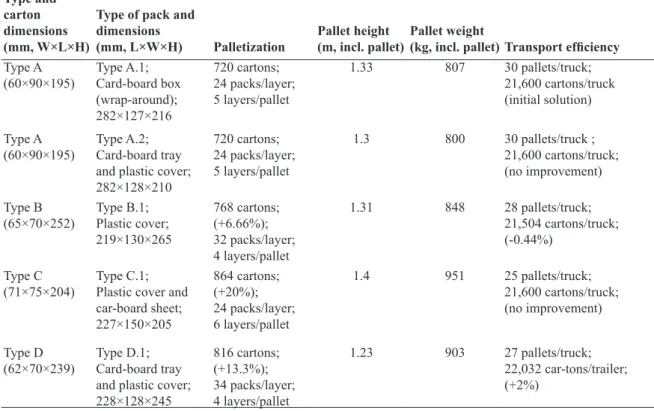
With regard to the physical distribution (handling, storage and transport), the efficiency of palletizing is conditioned by the type of carton but also by the part of the supply chain that focuses on the analysis (see table 1 at the end of the paper). In this sense, the milk cartons pallet has a high density and high consumption.
of pallet (although there are significant differences as shown in table 2), since the weight determines the maximum number of pallets per truck. In fact, in the company, the number of pallets per truck does not exceed 30.
All this significantly affects, not only to the efficiency of handling and storage in the ware-houses of the manufacturer, distributors and supermarkets, but also in transport between distributors´ warehouses and supermarkets.
In particular, in the latter transport, the type of truck changes, not only in the capacity (typically with less capacity vehicles), but also in the configuration of goods, due to mill pallets are combined with other pallets of products food with lower densities (mono-reference and / or multi-(mono-reference pallets).
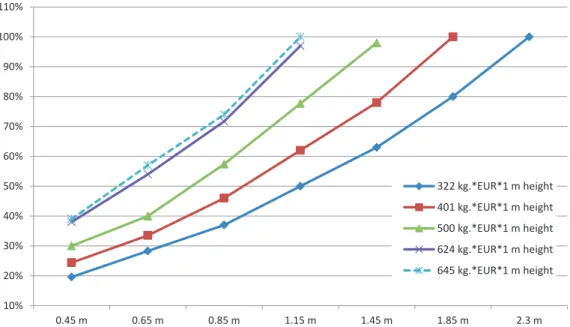
By combining these different kinds of products, generally, the average weight in each pallet on this new truck is reduced, enabling a priori a better pallet volume. In figure 4, the filling rate in trucks (%) is presented according to density of products and the designed height in pallets.
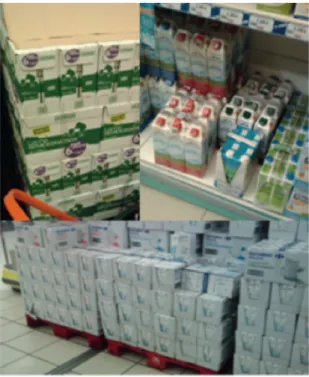
This brings additional advantages in supermarkets that have opted to present directly at the point of sale the milk pallet (minor handling and better occupancy in supermarkets).
Even, company can adopt alternatives that reduce the weight of traditional wooden pallet (25 kilograms per pallet) to gain useful load capacity on trucks. Among these alternatives are: the plastic pallet (6 kg), the cardboard pallet (12 kg), the "loading ledge" (1.5 kg)
or the “slip sheets” (1 kg approximately). In an initial full load truck (30 pallets), the analyzed manufacturer could earn more than 700 kilograms (option with loading ledge and slip sheets), equivalent to an additional pallet on each truck (3.33%).
In the other options, also an additional pallet per truck is load except in the option D. However, any of these alternatives would require a change in the pool system (exchange of pallets or "loading ledges"). Besides, the “loading ledges” and “slip sheets”, moreover, requires changes in the palletizing system at the manufacturer's premises and in the handling machines. Therefore, it has not been considered all these options in the final analysis.
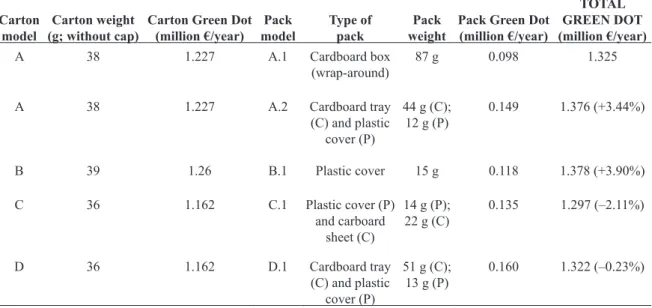
Finally, at the level of reverse logistics, the Green Dot cost also depends on the selection of the carton and the pack. Table 2, at the end of the paper, summarizes the total costs of Green Dot per each alternative. The Ecoembes fees in 2014 are: 0.323 €/ kg carton; 0.068 €/kg cardboard; 0.472 €/kg plastic.
4. Results and discussion
As a final decision, it was decided to choose the most efficient carton format in logistics (format D), since is the alternative with major level of total savings (see tables 2 and 3). This alternative involves no substantial changes in the system of packing in carton and pack and implies savings in handling and storage of over 16,000 pallets a year (a reduction of 11.7%).
10% 20% 30% 40% 50% 60% 70% 80% 90% 100% 110%
0.45 m 0.65 m 0.85 m 1.15 m 1.45 m 1.85 m 2.3 m
322 kg.*EUR*1 m height 401 kg.*EUR*1 m height 500 kg.*EUR*1 m height 624 kg.*EUR*1 m height 645 kg.*EUR*1 m height
10% 20% 30% 40% 50% 60% 70% 80% 90% 100% 110%
0.45 m 0.65 m 0.85 m 1.15 m 1.45 m 1.85 m 2.3 m
322 kg.*EUR*1 m height 401 kg.*EUR*1 m height 500 kg.*EUR*1 m height 624 kg.*EUR*1 m height 645 kg.*EUR*1 m height
This improvement is also an annual reduction in the number of full trucks to 92 trucks (2% reduction). Only in transport between the manufacturer and distributors, this change should involve saving of 60,000 euros/year (at least, total savings of 35,000 euros/year).
Additional savings could be achieved thanks to the reduction of handling and storage in manufacturers, distributors and supermarkets, but also of the transport costs between the distributors' warehouses and supermarkets.
In summary, Packaging design could be considered as a “microworld” where every millimeter and gram counts in the context of overall supply chain efficiency and sustainability.
Going beyond, redesigning packaging can lead not only to savings, but also increased sales. To achieve this, the global impact of design decisions must be measured in the whole chain.
In this context, the key to achieving efficient and sustainable packaging is the coordination and collaboration between all areas, departments or companies throughout the supply chain.
This last statement implies that packaging formats selected should not be considered ‘fixed’, but rather
a solution that can be constantly improved. Thereby, design decisions should be regularly revised in case commercial, logistic or environmental requirements change, or if new innovations in materials and/ or technical solutions occur within the packaging industry.
On the other hand, the role of “change agents” (the authors of this paper), as promotors of “packaging logistics” implementation in line with the scientific approach “action research,” must be outlined.
5. Conclusions
In a competitive and global world, companies should face supply chain design from a sustainable and efficient perspective. The real challenge for companies is how to integrate, proactively and strategically, both concepts.
In this scenario, redesigning packaging by applying the “Packaging Logistics” concept is an example of this integration as it was illustrated in the dairy company with cartons analysis. As described in this paper, the supply chain as a whole has also succeeded in making substantial savings at logistics and environmental level.
Table 1. Logistics comparison among carton alternatives.
Type and carton dimensions (mm, W×L×H)
Type of pack and dimensions
(mm, L×W×H) Palletization Pallet height (m, incl. pallet) Pallet weight (kg, incl. pallet) Transport efficiency
Type A
(60×90×195) Type A.1; Card-board box (wrap-around); 282×127×216
720 cartons; 24 packs/layer; 5 layers/pallet
1.33 807 30 pallets/truck;
21,600 cartons/truck (initial solution)
Type A
(60×90×195) Type A.2; Card-board tray and plastic cover; 282×128×210
720 cartons; 24 packs/layer; 5 layers/pallet
1.3 800 30 pallets/truck ;
21,600 cartons/truck; (no improvement)
Type B
(65×70×252) Type B.1; Plastic cover; 219×130×265
768 cartons; (+6.66%); 32 packs/layer; 4 layers/pallet
1.31 848 28 pallets/truck;
21,504 cartons/truck; (-0.44%)
Type C
(71×75×204) Type C.1; Plastic cover and car-board sheet; 227×150×205
864 cartons; (+20%); 24 packs/layer; 6 layers/pallet
1.4 951 25 pallets/truck;
21,600 cartons/truck; (no improvement)
Type D
(62×70×239) Type D.1; Card-board tray and plastic cover; 228×128×245
816 cartons; (+13.3%); 34 packs/layer; 4 layers/pallet
1.23 903 27 pallets/truck;
The path taken by the company in the implementation of the "packaging logistics" combining logistics efficiency and sustainability (strategy "Lean and Green"), could be assimilated and adapted by other companies, regardless of sector or size, as it would contribute to improving competitiveness through
innovation of products and processes within the supply chain.
In fact, the adoption of the Packaging Logistics reinforces the initial vision that efficiency and sustainability are not incompatible terms but, rather, are complementary terms.
Table 2. Sustainable comparison among cartons alternatives.
Carton
model (g; without cap)Carton weight Carton Green Dot (million €/year) modelPack Type of pack weightPack Pack Green Dot (million €/year)
TOTAL GREEN DOT (million €/year)
A 38 1.227 A.1 Cardboard box
(wrap-around) 87 g 0.098 1.325
A 38 1.227 A.2 Cardboard tray
(C) and plastic cover (P)
44 g (C);
12 g (P) 0.149 1.376 (+3.44%)
B 39 1.26 B.1 Plastic cover 15 g 0.118 1.378 (+3.90%)
C 36 1.162 C.1 Plastic cover (P)
and carboard sheet (C)
14 g (P);
22 g (C) 0.135 1.297 (–2.11%)
D 36 1.162 D.1 Cardboard tray
(C) and plastic cover (P)
51 g (C);
13 g (P) 0.160 1.322 (–0.23%)
References
Andersen, M., Skjoett-Larsen, T. (2009). Corporate social responsibility in global supply chains. Supply chain management: An International Journal, 14(2), 75-86. doi:10.1108/13598540910941948
Azzi, A., Battini, D., Persona, A., Sgarbossa, F. (2012). Packaging Design: General Framework and Research Agenda. Packaging Technology and Science, 25(8), 435-456. doi:10.1002/pts.993
Bramklev, C. (2009). On a proposal for a generic package development process. Packaging Technology and Science, 22(3), 171-186. doi:10.1002/pts.850
Carter, C.R., Rogers, D.S. (2008). A framework of sustainable supply chain management: moving toward new theory. International Journal of Physical Distribution & Logistics Management, 38(5), 360-387. doi:10.1108/09600030810882816
Ciliberti, F., Portrandolfo, P., Scozzi, B. (2008). Logistics social responsibility: Standard adoption and practices in Italian companies. International Journal of Production Economics, 113(1), 88-106. doi:10.1016/j.ijpe.2007.02.049
Christopher, M. (2005). Logistics and Supply Chain management strategies for reducing cost and improving service. 3ª edition, Financial Times Pitman Publishing, London, UK.
Coughlan, P., Coghlan, D. (2002). Action research for operations management. International Journal of Operations & Production Management, 22(2), 220-240. doi:10.1108/01443570210417515
Europen. (2009), The European Shopping Baskets, Europen and Packforsk, Brussels, Belgium.
García-Arca, J., Prado-Prado, J.C. (2008a). Packaging as source of competitive advantages. Universia Business Review, 17, 64-79. García-Arca, J., Prado-Prado, J.C. (2008b). Packaging design model from a supply chain approach. Supply Chain Management: An
International Journal, 13(5), 375-380. doi:10.1108/13598540810894960
Hellström, D. Saghir, M. (2006). Packaging and logistics interactions in retail supply chain. Packaging Technology and Science, 20(3), 197-216. doi:10.1002/pts.754
Jahre, M., Hatteland, C.J. (2004). Packages and physical distribution: Implications for integration and standardization. International Journal of Physical Distribution and Logistics Management, 34(2), 123-139. doi:10.1108/09600030410526923
of Operations and Production Management, 15(11), 37-52. doi:10.1108/01443579510102882
Mejías-Sacaluga, A., García-Arca, J., Prado-Prado, J.C., Fernández-González, A.F., Comesaña, J.A. (2011). Modelo para la aplicación de la Responsabilidad Social Corporativa en la Gestión de la Cadena de Suministro. Dirección y Organización, 45, 20-31.
Prado-Prado, J.C. (2000). El proceso de mejora continua en la empresa. Pirámide, Madrid, Spain. Saghir, M. (2002). Packaging Logistics Evaluation in the Swedish supply Chain. Lund University, Sweden.
Saghir, M., Jönson, G. (2001). Packaging handling evaluation methods in the grocery retail industry. Packaging Technology and Science, 14(1), 21-29. doi:10.1002/pts.523
Seuring, S., Müller, M. (2008). From a literature review to a conceptual framework for sustainable supply chain management. Journal of Cleaner Production, 16(15), 1699-1710. doi:10.1016/j.jclepro.2008.04.020
Verghese, K., Lewis, H. (2007). Environmental innovation in industrial packaging: a supply chain approach. International Journal of Production Research, 45(18-19), 4381-4401. doi:10.1080/00207540701450211
Williams, H., Wikström, F., Löfgren, M. (2008). A life cycle perspective on environmental effects of customer focused packaging development. Journal of Cleaner Production, 16(7), 853-859. doi:10.1016/j.jclepro.2007.05.006