Quantification of lung surface area using
computed tomography
Yuan
et al.
R E S E A R C H
Open Access
Quantification of lung surface area using
computed tomography
Ren Yuan
1,2, Taishi Nagao
1, Peter D Paré
1,3, James C Hogg
1,4, Don D Sin
1, Mark W Elliott
1, Leanna Loy
1, Li Xing
1,
Steven E Kalloger
1, John C English
5, John R Mayo
2, Harvey O Coxson
1,2*Abstract
Objective:To refine the CT prediction of emphysema by comparing histology and CT for specific regions of lung. To incorporate both regional lung density measured by CT and cluster analysis of low attenuation areas for comparison with histological measurement of surface area per unit lung volume.
Methods:The histological surface area per unit lung volume was estimated for 140 samples taken from resected lung specimens of fourteen subjects. The region of the lung sampled for histology was located on the pre-operative CT scan; the regional CT median lung density and emphysematous lesion size were calculated using the X-ray attenuation values and a low attenuation cluster analysis. Linear mixed models were used to examine the relationships between histological surface area per unit lung volume and CT measures.
Results:The median CT lung density, low attenuation cluster analysis, and the combination of both were
important predictors of surface area per unit lung volume measured by histology (p < 0.0001). Akaike’s information criterion showed the model incorporating both parameters provided the most accurate prediction of emphysema.
Conclusion:Combining CT measures of lung density and emphysematous lesion size provides a more accurate estimate of lung surface area per unit lung volume than either measure alone.
Background
The major pathological components responsible for the decrease in maximal expiratory flow that characterize Chronic Obstructive Pulmonary Disease (COPD) include an increase in airway resistance due to small airway remodeling and obliteration, and a decrease in elastic recoil secondary to the parenchymal tissue destruction which characterizes emphysema [1-3]. Separating the contribution of each of these two components can pro-vide better understanding of the natural history of dis-ease, allow monitoring of disease progression, evaluate the impact of a therapeutic intervention and potentially guide the most appropriate therapeutic target in indivi-dual patients. The fact that pulmonary function tests cannot separate these structural changes [4], and because pathological estimates can only do so in surgical or postmortem specimens, has led to attempts to use chest CT scans to measure these changesin vivo.
A number of quantitative CT lung densitometry mea-surements have been employed to measure the extent of emphysema including, 1) the relative area of lung with attenuation values lower than various thresholds [5-10], 2) a specific percentile point on the frequency-attenua-tion distribufrequency-attenua-tion curve [8,9,11], and 3) median lung inflation [12]. However, measurement of lung density may not be the most efficient way to detect emphysema if tissue destruction is accompanied by “remodeling” of the lung parenchyma, such as fibrosis [13-15]. Mishima was the first to introduce cluster analysis of low attenua-tion areas - a method to measure the size distribuattenua-tion of low attenuation regions [16]. Although validation of this parameter against pathologic standards is controversial [8], we postulated that cluster analysis would supple-ment lung densitometry in the detection and quantifica-tion of emphysema since it is less likely to be affected by tissue deposition.
In the present study, we tested the relationship between the histopathologic reference standard for emphysema -airspace surface area per unit lung volume (SA/V), and two CT measurements: CT lung densitometry (median * Correspondence: [email protected]
1
University of British Columbia James Hogg Research Centre and the Heart and Lung Institute, St. Paul’s Hospital; Burrard Street, Vancouver, Canada Full list of author information is available at the end of the article
lung density) and CT cluster analysis. We hypothesized that the combination of the two CT measurements will be superior to the sole use of either in the prediction of SA/V.
Methods Subject Selection
Fourteen subjects (9 men, 5 women) were included in the present study (Table 1). Ten patients underwent lobectomy and four underwent pneumonectomy for lung cancers. Preoperatively, all subjects had spirometry measurements and the diffusing capacity (DLco) was measured by the single-breath method of Miller and associates [17]. The study was approved by the hospital and university ethical review boards and all subjects provided written informed consent for the use of all materials and data.
CT Technique
All subjects received a pre-operative, non-contrast heli-cal CT scan in the supine position at the end of full inspiration. 11 subjects were scanned using a GE Light-Speed Ultra CT scanner (General Electric Medical Sys-tems, Milwaukee, WI) with the following settings: 120 kVp, 114 mAs, and 5 mm slices thickness; and 3 sub-jects were scanned using a Siemens Sensation 16 CT scanner (Siemens Medical Solutions; Erlangen, Ger-many) with the following parameters: 120 kVp, 115 mAs, and 5 mm slice thickness. The scanners were cali-brated regularly using standard water and air phantoms to allow for comparisons between individuals and between scanners.
Quantitative Histology
Following surgery, the resected specimen was trans-ferred directly from the operating room to the labora-tory. The specimen was inflated with Bouin fixative at a constant distending pressure of 25 cm of water and
immersed in formalin overnight. After fixation, each specimen was cut into ten slices with 5-8 mm thickness in the axial plane and photographed using a digital cam-era (Nikon Coolpix, Nikon Corp., Japan). A grid of 2 × 2 cm squares was superimposed over each lung slice, one square was randomly selected and the tissue beneath it was excised, embedded in paraffin, sectioned and stained with haematoxylin and eosin, which resulted in 140 tissue samples in total. Ten random images per histology section were captured using a light microscope (Nikon Microphot) equipped with a digital camera (JVC3-CCD KY F-70, Diagnostic Instruments). The digi-tal images were analyzed using stereologic techniques and a custom program written for Image Pro Plus® digi-tal-image-analysis software (Media Cybernetics) as described elsewhere [18]. Briefly, each image was binar-ized and a grid of lines was superimposed on the image. The program automatically counts the number of inter-sections between the superimposed lines and the alveo-lar walls (i.e., tissue-air interface), the number of line endpoints in one image (i.e.,ΣP total), as well as the number of line endpoints that fall on tissue (i.e., Σ Ptis-sue). Surface area per unit lung volume (SA/V) was cal-culated using the following equations as previously described [12]:
(SA/ )V surface density of the tissue air interface volume
= ×
−
ffraction of tissue, (1)
in which, surface density of the tissue-air interface [19]:
Sv tis( )=(4 L/ )×(Σ ΣI/ Ptissue)=2 mean linear intercept/ (2)
where L = the length of the grid unit line, ΣI = the number of intersections counted, ΣP tissue is the num-ber of line end points that fall on tissue.
The volume fraction of tissue:
Vv tis
( )
= ΣP tissue/ΣP total, (3)where ΣP total is the number of line end points counted in one image.
SA/V for each of the samples was corrected for shrinkage. The shrinkage factor was determined by mea-suring the length of one side of the blocks prior to fixa-tion processing and then dividing by the length of that side of the cut sections post-fixation (shrinkage factor: 1.30 ± 0.13)
Quantitative CT
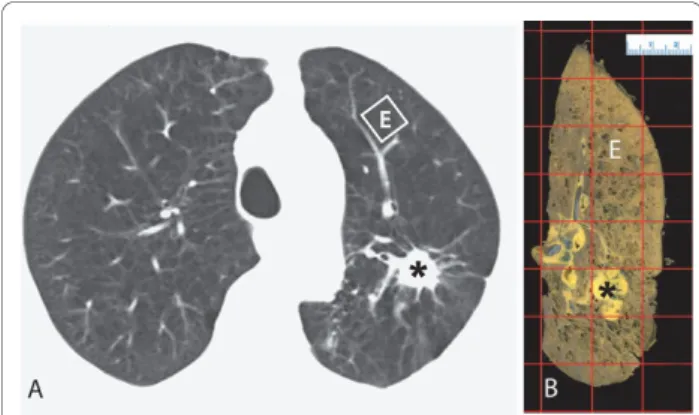
The region of lung where the histology samples were taken was identified on the CT image by comparing anatomic landmarks on the cut surface of the gross lung specimen and CT images as shown in Figure 1. The Table 1 Subjects Demographics
Mean ± SD Range
Age (yrs) 67.0 ± 3.1 61.8 - 72.0 Gender 5 female:9 male
Smoking (pack yrs) 59.6 ± 44.4 24.8 - 173.0 Height (cm) 169.1 ± 7.2 157.0 - 180.0 Weight (kg) 66.6 ± 12.5 44.0 - 90.0 Post-FEV1%pred (%) 78.7 ± 16.1 46.7 - 114.5 Post-FEV1/FVC 67.5 ± 8.8 45.9 - 79.0 DLCO % pred 70.4 ± 10.3 47.8 - 90.6
Post-FEV1%pred: post-bronchodilator forced expiratory flow in one second/ predicted value.
Post-FEV1/FVC: post-bronchodilator forced expiratory flow in one second/post-bronchodilator forced vital capacity.
DLco: Diffusing capacity.
Yuanet al.Respiratory Research2010,11:153 http://respiratory-research.com/content/11/1/153
difference in lung inflation between thein vivo andin vitrostate was determined by comparing the area of the cut surface on the lung specimen, measured using Ima-geJ, (Rasband, W.S., ImaIma-geJ, U. S. National Institutes of Health, Bethesda, Maryland, USA, http://rsb.info.nih. gov/ij/, 1997-2007) to the area of the lung on the in vivo CT image measured using custom software (EmphylxJ, UBC James Hogg Research Centre, Vancou-ver, B.C, http://www.flintbox.com) as described else-where [20]. Then, a square, size-corrected for inflation was superimposed upon the CT image. For each voxel within that square, the apparent X-ray attenuation value (Hounsfield Unit, HU) was obtained and converted to gravimetric density (g/ml) by adding 1000 to the HU value and dividing by 1000 [21]. The median CT lung density value was chosen from the frequency distribu-tion curve of lung density within each square since the curve is skewed to the right [12]. We estimated the dis-tribution of sizes of the emphysematous lesions within each square using a low attenuation cluster analysis [16,22]. In the low attenuation cluster analysis the inverse slope of the log-log relationship of the size of the low attenuation cluster (number of contiguous vox-els <-856 HU) versus the number of clusters of that size is the power-law exponent (D). -856HU was chosen to identify“emphysematous” because it converts to 6.0 ml/ g, which has been previously shown to represent the boundary between normal and mildly emphysematous
lung [12] (See additional file 1: Converting 6.0 ml/g to -856HU).
Statistical Analysis
The primary outcome was the histologically measured SA/V and the independent variables included the med-ian CT lung density and the CT cluster analysis value D. We used a linear mixed model (the REstricted Maxi-mum Likelihood method, REML) to incorporate the within subject variance of the measurements since ten measurements were made from each lung specimen [23], and we examined the association between the out-come and the two independent variables with the gen-der, age and patient’s body mass index (BMI) being covariates. To test whether CT cluster analysis could supplement lung densitometry (i.e., median lung density) in detecting histological emphysema, we compared the prediction of SA/V using median CT lung density or the CT cluster analysis value D to a third model, which incorporated both variables using Akaike’s Information Criterion (AIC) based on the Maximum Likelihood Esti-mation [24]. The model with the smallest AIC value is considered to be the best model [25]. Analyses were performed using SAS version 9.1 (Carey, N.C.). Statisti-cal significance was defined at a p-value less than 0.05. Continuous variables are expressed as mean ± SD.
Results
Subject Characteristics
The subject demographics are shown in Table 1. The level of airway obstruction of the subjects was relatively mild with only one subject in stage 3 according to the Global Initiative for Obstructive Lung Disease (GOLD) categories [26]. Five subjects were stage 2, two stage 1, and the remaining six subjects had normal lung function.
Quantitative Histology and Quantitative CT Measurements
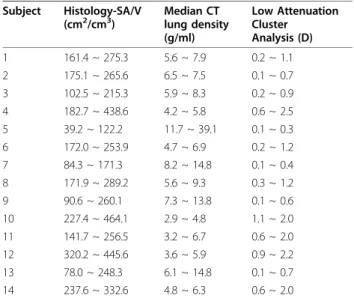
The histological measurements of SA/V and quantitative CT measurements for all 140 tissue samples from 14 cases are summarized in Table 2. These data show that there is a wide variation in both histological and quanti-tative CT measurements within each individual.
Linear mixed models showed that the median CT lung density and the CT cluster analysis value D were signifi-cantly associated with histological SA/V (both p < 0.0001) (Figures 2 and 3). The prediction equations of SA/V using CT lung density alone, CT cluster analysis alone, and the combination of these two measurements were:
SA/V = 4.62 + 1631.99 × median CT lung density; SA/V = 168.44 + 69.21 × CT cluster analysis value D; Figure 1Matching CT Images and Lung Specimens. A CT image
of a representative subject is shown in Figure 1A and the
corresponding slice of the resected specimen is shown in Figure 1B. For reference and orientation, the tumor is marked by a star (*). A
SA/V = 6.04 + 1597.05 × median CT lung density + 11.19 × CT cluster analysis value D.
A comparison of the three models using the Akaike’s Information Criterion showed that the model incorpor-ating both CT lung density and low attenuation cluster analysis yielded the smallest AIC value indicating that it is the best model for predicting SA/V (the AIC was 904 for CT lung density alone, 927 for CT cluster ana-lysis alone and 897 for the model incorporating both variables).
Discussion
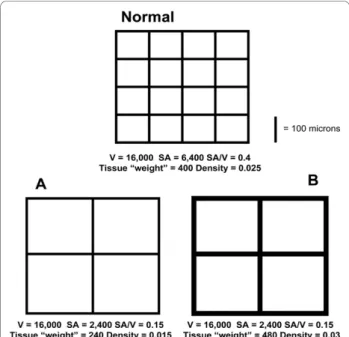
The most important finding of the present study is that although CT lung densitometry (i.e., median lung den-sity in the current study) was a valid estimate of the his-tological measurement of airspace enlargement and/or alveolar wall destruction (airspace surface area per unit lung volume, SA/V), its accuracy was significantly improved by combining it with CT cluster analysis of lower attenuation areas. Basing an estimate of emphy-sema solely on a measure of lung density assumes that the decrease in alveolar surface area which accompanies emphysema is mirrored by a proportional reduction in lung tissue mass. Although it is clear that tissue destruc-tion is part of the process, there is increasing evidence that emphysema is also accompanied by“remodeling”of the lung parenchyma which may be associated with fibrosis [13-15]. The extent of this “remodeling” will confound the relationship between lung density and SA/ V. This phenomenon is illustrated in Figure 4. In this schematic, normal lung architecture (Normal) and two examples of “emphysema” (A and B) are shown. In example A, there is a loss of alveolar walls with a corre-sponding loss of lung mass. In example B, there is a similar loss of the number of alveolar walls but a thick-ening of the retained alveolar walls such that the mass of the lung is comparable to Normal and greater than in A although both A and B have comparable loss in lung SA/V.
CT cluster analysis of low attenuation areas is a method to describe and quantify the distribution of emphysematous spaces by determining whether low Table 2 Histological and Quantitative CT Measurements
for 140 Tissue Samples from 14 Subjects
Subject Histology-SA/V
(cm2/cm3) Median CTlung density
(g/ml)
Low Attenuation Cluster
Analysis (D)
1 161.4 ~ 275.3 5.6 ~ 7.9 0.2 ~ 1.1 2 175.1 ~ 265.6 6.5 ~ 7.5 0.1 ~ 0.7 3 102.5 ~ 215.3 5.9 ~ 8.3 0.2 ~ 0.9 4 182.7 ~ 438.6 4.2 ~ 5.8 0.6 ~ 2.5 5 39.2 ~ 122.2 11.7 ~ 39.1 0.1 ~ 0.3 6 172.0 ~ 253.9 4.7 ~ 6.9 0.2 ~ 1.2 7 84.3 ~ 171.3 8.2 ~ 14.8 0.1 ~ 0.4 8 171.9 ~ 289.2 5.6 ~ 9.3 0.3 ~ 1.2 9 90.6 ~ 260.1 7.3 ~ 13.8 0.1 ~ 0.6 10 227.4 ~ 464.1 2.9 ~ 4.8 1.1 ~ 2.0 11 141.7 ~ 256.5 3.2 ~ 6.7 0.6 ~ 2.0 12 320.2 ~ 445.6 3.6 ~ 5.9 0.9 ~ 2.2 13 78.0 ~ 248.3 6.1 ~ 14.8 0.1 ~ 0.7 14 237.6 ~ 332.6 4.8 ~ 6.3 0.6 ~ 2.0
Figure 2Association between the Histological SA/V and CT Median Lung Density. There is a significant association between the SA/V (cm2/cm3) measured histologically and the CT median lung density (g/ml) (r = 0.82, p < 0.0001). All subjects are shown using different symbols. Data point A and B refer to samples with comparable SA/V value but very different CT density measurement (sample A: SA/V = 247 cm2/cm3, CT density = 0.14 g/ml; sample B: SA/V = 258 cm2/cm3, CT density = 0.24 g/ml). A and B refer to the
same samples in Figure 2, 3, and 5.
Figure 3Association between the Histological SA/V and CT Cluster Analysis Value D. There is a significant association between the SA/V (cm2/cm3) measured histologically and the CT
cluster analysis D value (r = 0.74, p < 0.0001). All subjects are shown using different symbols. Data point A and B have comparable value for SA/V and CT cluster analysis (sample A: SA/V = 247 cm2/cm3, D
= 0.91; sample B: SA/V = 258 cm2/cm3, D = 1.17). A and B refer to
the same samples in Figure 2, 3, and 5.
Yuanet al.Respiratory Research2010,11:153 http://respiratory-research.com/content/11/1/153
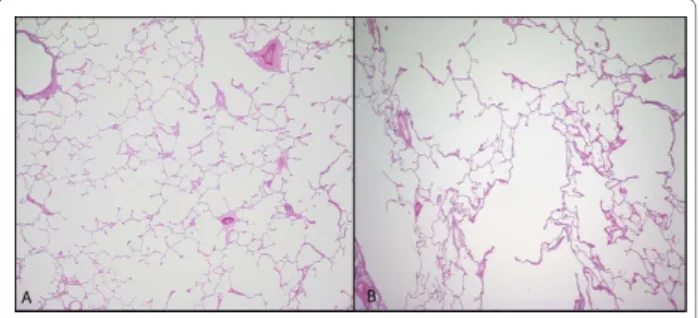
attenuation voxels are clustered into large lesions or present as diffuse small ones. It has been shown that there is an inverse power law relationship between the size and number of clusters where the slope of this rela-tionship (D) becomes smaller with increasing lesion size [16]. This variable is less likely to be affected by the accumulation of connective tissue that may accompany emphysema since it measures clustering of low attenua-tion areas. Examples of these theoretical consideraattenua-tions were observed in our data. For example, points A and B in Figure 2 and 3 represent two samples with compar-able values for histological SA/V and CT cluster analysis but very different CT lung density. The examination of the histology in these two samples shown in Figure 5 is consistent with the theory illustrated in Figure 4. For sample B CT cluster analysis provides a more accurate estimate of histological SA/V than does CT lung density, because tissue deposition accompanies tissue destruc-tion. Additionally the cluster analysis likely detects true
tissue destruction with the formation of low attenuation areas larger than single CT voxels while measures of density can be affected by simple hyperinflation of lung tissue without alveolar wall destruction. Such hyperinfla-tion may be a precursor of the tissue destruchyperinfla-tion which characterizes emphysema but would have less effect on the histological surface area to volume ratio than true tissue disruption.
The current data also suggest that the cluster analysis value D, per se, is a valid quantitative CT estimate of emphysema because it significantly, and independently, correlated with the histological measurement of surface area per unit lung volume (Figure 3). This finding is at variance with that of Madani et al [8]. We think this discrepancy might be because we chose a different HU cutoff to define the “low attenuation cluster”. Madani et al chose -960HU and 1stpercentile point as the cutoff whereas we used a relatively higher HU value: -856HU. As we explained in the methods section that -856 HU is converted from a lung tissue inflation value of 6.0 ml/g, which was previously shown to represent the boundary between normal and mild emphysematous lung [12].
In the current study, we chose surface area per unit lung volume (i.e., SA/V) as the histological reference. This variable has been shown to separate normal lung from emphysematous tissue [12], and its calculation (Equation 1 and 2) is linearly related to the mean linear intercept (i.e.,Lm), which has been used by other groups to estimate emphysema microscopically [9].
One challenge for validation of CT measurements is the marked heterogeneity of the emphysematous process. Even in lungs severely affected by emphysema, some regions still maintain normal architecture making sam-pling for pathological examination critical as shown in Figure 6. In many of the previous validation studies, Figure 4A Schematic Showing the Relationship between Lung
SA/V and Density under two scenarios. The top panel represents normal lung architecture with the dimensions of each“alveolus”being 100 × 100μm yielding a total volume of the“lung”= 16,000μm3with a surface area of 6,400μm2and a SA/V of 0.4. If we assign a mass of 10 units to each 100μm length of“alveolar wall”this“lung”has a mass of 400 units and a density of 0.025 units/μm3(= 400 units/16,000μm3). In A, the volume and thickness of the“alveolar walls”remains the same as those in“normal lung architecture”but the surface area is decreased due to destruction of“alveolar walls”. In this scenario, the reduction in SA/V and density are proportional. However in scenario B, the thickness of the“alveolar walls”is doubled therefore increasing the mass. The resultant SA/V is the same as in A whereas the density is higher than in A and even higher than the Normal. Thus if there is addition of tissue, the relationship between SA/V and density is disrupted.
Figure 5 Hematoxylin and Eosin-stained Images of Tissue Samples A and B in Figures 2, 3. The tissue shown in A has a SA/ V of 247 mm2/mm3and a CT density of 0.14 g/ml while the area in
B has a SA/V of 258 mm2/mm3and a CT density of 0.24 g/ml. Thus
including our previous work, the commonly applied approach is to randomly sample tissue from lungs, calcu-late the averaged value from these random samples to obtain one single histological measurement for each sub-ject, and compare this value to one single CT measure-ment obtained from the whole lung of that subject [6,8,9,11,12]. However, by doing so, the CT measurement is global, incorporating all regions, diseased or relatively normal, whereas the histological measurement is aver-aged from a limited number of samples taken from differ-ent regions of the surgically resected lungs. In the presdiffer-ent study, we have refined this approach by using a modified computer program, which enables us to obtain regional CT measurements from the exact regions of the lung where the histological measurements were taken and compare this regional CT measurement to the histologi-cal measurement of the same region. We think this pre-cise matching can provide a more accurate comparison between CT and histological measurements. Also, in this way, we were testing our hypothesis in 140 tissue samples rather than in 14 subjects. Nevertheless, we cannot con-sider 140 tissue samples as 140 independent samples since ten samples were taken from each individual. Therefore, in the statistical analysis, we applied a linear mixed modeling approach to account for the random effects arising from inter-individual variance and to obtain prediction equations at the group level [23].
This study has some limitations. First, in the current study, we only used one CT densitometry measurement, median lung density. While Gevenois has shown using thin slice CT scans (1 mm) that -950 HU detects both macroscopic and microscopic emphysema they also showed that using this cut-off 6.8% would be the upper limit of normal and therefore the threshold between normal and diseased [6]. However, previous studies using thick slice CT scans shows that threshold cut-offs such as -910 HU only pick up large emphysematous holes in the lung [27] while a threshold of -856 HU
estimates the small holes [12]. Therefore, with this data in mind, we chose the mean lung density threshold, because of the small size of pathologic specimens (2 × 2 cm2) that we were comparing to the thick slice CT values and the relatively mild degree of emphysema pre-sent in our subjects and specimens. We cannot com-ment on the supplecom-mentary role of CT cluster analysis to other more traditional whole lung CT densitometry measurements of emphysema, such as low attenuation area and percentile point, etc. However, we believe it is reasonable to assume that CT cluster analysis would supplement the other CT densitometry measurements since all such measurements rely on choosing a cutoff value from the X-ray attenuation distribution histogram, either along the X axis (i.e., low attenuation area) or along the Y axis (i.e., percentile point). The extent, to which, CT cluster analysis supplements the different CT densitometry measurements might vary depending on the threshold use and, therefore, further studies includ-ing other densitometry measurements may provide more information. Secondly, we used -856HU, based on our previous experience with thick slice CT scans that identified this HU threshold as effective in identifying mild emphysematous areas [12]. We realize that CT scan slices in our previous study were of 10 mm thick-ness whereas in the current study were of 5 mm slice thickness. Due to limitations in CT scanner technology, we are not able to test whether this threshold is equally effective using either slice thickness. Lastly, the pre-surgery CT images were acquired using two different CT scanners could have introduced errors in CT lung density measurement. However since the X-ray radiation dose is similar (120 kVp and 114 mAs on GE scanner; 120 kVp and 115 mAs on Siemens scanner), we believe this effect is small. Moreover we have previously shown that CT densitometry measurements using similar acquisition protocols are comparable between these CT scanners [20].
The difference in Akaike’s Information Criterion (AIC) between the models appears small but this does not mean that the added information of the combined model is small. The AIC cannot be interpreted using a traditional “hypothesis testing” statistical paradigm. It does not generate a P value, does not reach conclusions about“statistical significance”, and does not“reject” any model. AIC determines how well the data supports each model, taking into account both the goodness-of-fit (sum-of-squares) and the number of parameters in the model. Ultimately, the model with the smallest AIC is considered the best, although the AIC value itself is not meaningful [28].
In conclusion, the results of this study show that an accurate comparison between CT and histological mea-surements can be achieved by precisely mapping the Figure 6Heterogeneity of Lung Tissue Destruction. Examples of
hematoxylin and eosin-stained images of tissue samples taken from the same individual but different lung regions. A: Normal tissue with SA/V = 439 cm2/cm3, tissue density = 0.19 g/ml, B: emphysematous
tissue with SA/V = 183 cm2/cm3, tissue density = 0.14 g/ml.
Yuanet al.Respiratory Research2010,11:153 http://respiratory-research.com/content/11/1/153
location of the histological sample to itsin vivo location on the CT. In addition, the CT cluster analysis value D can supplement CT densitometry in detecting and quan-tifying emphysema. The additional benefit may be due to the fact that cluster analysis is more sensitive to true tissue destruction and immune to the artifact caused by the deposition of connective tissue that may accompany the emphysematous process.
Additional material
Additional file 1: Conversion of 6.0 ml/g to -856HU. This file outlines the method to convert lung inflation values, measured as ml of gas per g tissue, into X-ray attenuation values.
Acknowledgements
The authors thank Anh-Toan Tran, BSc and Ida Chan, MD for technical assistance in developing and supporting the lung analysis application. PDP is a Michael Smith Foundation for Health Research Distinguished scholar and the Jacob Churg Distinguished Researcher. DDS is a Canada Research Chair in COPD and a Senior Scholar with the Michael Smith Foundation for Health Research. HOC was Parker B Francis Fellow in Pulmonary Research during the time of this research. HOC is currently a Canadian Institutes of Health Research (CIHR)/British Columbia Lung Association New Investigator. HOC is also supported, in part, by the University of Pittsburgh COPD SCCOR NIH 1P50 HL084948 and R01 HL085096 from the National Heart, Lung, and Blood Institute, National Institutes of Health, Bethesda, MD to the University of Pittsburgh. This project was funded by a CIHR Industry partnership grant with GlaxoSmithKline.
Author details
1
University of British Columbia James Hogg Research Centre and the Heart and Lung Institute, St. Paul’s Hospital; Burrard Street, Vancouver, Canada.
2
UBC Department of Radiology, Vancouver General Hospital; West 12thAve. Vancouver, Canada.3UBC Department of Medicine St. Paul’s Hospital; Burrard
Street, Vancouver, Canada.4UBC Department of Pathology, St. Paul’s Hospital; Burrard Street, Vancouver, Canada.5UBC Department of Pathology,
Vancouver General Hospital, West 12thAve. Vancouver, Canada.
Authors’contributions
RY and TN carried out the quantitative CT analysis. WME and LL carried out the quantitative histological analysis. DS and LX performed the statistical analysis. PP is the principal investigator of the project, obtained funding for and supervised the project. PP, JH, and HC participated in the design of the study. RY, PP, JH and HC drafted the manuscript. SK, JE and JM participated in the coordination of the study and helped to draft the manuscript. All authors read and approved the final manuscript.
Competing interests
PD Paré is the principal investigator of a project funded by GSK to develop CT based algorithms to quantify emphysema and airway disease in COPD. With collaborators he has received ~ $300,000 to develop and validate these techniques. These funds he have been applied solely to the research to support programmers and technicians. Peter Pare was also PI of a Merck Frosst supported research program to investigate gene expression in the lungs of patients who have COPD. He and collaborators have received ~ $200,000 for this project. These funds have supported the technical personnel and expendables involved in the project. PP has established a new contract with Merck to discover genetic predictors of gene expression in lung tissue. With collaborators he will receive $95,000 over the next year to do this work. The funds will support personnel and buy supplies. PP sits on an advisory board for Talecris Biotherapeutics who make anti-one antitrypsin replacement therapy.
JC Hogg has served as a consultant, given lectures and participated in advisory boards of several major pharmaceutical companies in the past five years. The total reimbursement for these activities is less than $20000.00. His University (UBC) has also received industry sponsored grants from GSK and Merck on which he serve as the PI.
DD Sin has received research funding from GlaxoSmithKline and AstraZeneca for projects on chronic obstruction pulmonary disease. DD Sin has also received honoraria for speaking engagements for talks on COPD sponsored by these organizations.
HO Coxson received $4800 in 2006 - 2008 for serving on the steering committee for the ECLIPSE project for GSK. In addition HC is the co-investigator on two multi-center studies sponsored by GSK and has received travel expenses to attend meetings related to the project. HC has three contract service agreements with GSK to quantify the CT scans in subjects with COPD and a service agreement with Spiration Inc to measure changes in lung volume in subjects with severe emphysema. A percentage of HC’s salary between 2003 and 2006 (15,000 US $/year) derives from contract funds provided to a colleague PD Pare by GSK for the development of validated methods to measure emphysema and airway disease using computed tomography. HC is the co-investigator (DD Sin PI) on a Canadian Institutes of Health - Industry (Wyeth) partnership grant.
R Yuan, T Nagao, WM Elliott, L Loy, L Xing, S Kalloger, J English, and J Mayo have no competing interests in the content of this manuscript.
Received: 15 June 2010 Accepted: 31 October 2010 Published: 31 October 2010
References
1. Burrows B, Knudson RJ, Cline MG, Lebowitz MD:Quantitative relationships between cigarette smoking and ventilatory function.Am Rev Respir Dis 1977,115:195-205.
2. Hogg JC, Macklem PT, Thurlbeck WM:Site and nature of airway obstruction in chronic obstructive lung disease.N Engl J Med1968,
278:1355-1360.
3. Macklem PT, Mead J:Resistance of central and peripheral airways measured by a retrograde catheter.J Appl Physiol1967,22:395-401. 4. Fraser RS, Paré PD, Colman NC, Muller NL:Diagnosis of Diseases of the Chest
Philadelphia: Saunders, Fourth 1999.
5. Bankier AA, De Maertelaer V, Keyzer C, Gevenois PA:Pulmonary emphysema: subjective visual grading versus objective quantification with macroscopic morphometry and thin-section CT densitometry.
Radiology1999,211:851-858.
6. Gevenois PA, De Vuyst P, de Maertelaer V, Zanen J, Jacobovitz D, Cosio MG, Yernault JC:Comparison of computed density and microscopic morphometry in pulmonary emphysema.Am J Respir Crit Care Med1996,
154:187-192.
7. Hayhurst MD, MacNee W, Flenley DC, Wright D, McLean A, Lamb D, Wightman AJ, Best J:Diagnosis of pulmonary emphysema by computerised tomography.Lancet1984,2:320-322.
8. Madani A, Van Muylem A, de Maertelaer V, Zanen J, Gevenois PA:
Pulmonary emphysema: size distribution of emphysematous spaces on multidetector CT images-comparison with macroscopic and microscopic morphometry.Radiology2008,248:1036-1041.
9. Madani A, Zanen J, de Maertelaer V, Gevenois PA:Pulmonary emphysema: objective quantification at multi-detector row CT–comparison with macroscopic and microscopic morphometry.Radiology2006,
238:1036-1043.
10. Muller NL, Staples CA, Miller RR, Abboud RT:“Density mask”. An objective method to quantitate emphysema using computed tomography.Chest 1988,94:782-787.
11. Gould GA, MacNee W, McLean A, Warren PM, Redpath A, Best JJ, Lamb D, Flenley DC:CT measurements of lung density in life can quantitate distal airspace enlargement - an essential defining feature of human emphysema.Am Rev Respir Dis1988,137:380-392.
12. Coxson HO, Rogers RM, Whittall KP, D’Yachkova Y, Pare PD, Sciurba FC, Hogg JC:A quantification of the lung surface area in emphysema using computed tomography.Am J Respir Crit Care Med1999,159:851-856. 13. Lang MR, Fiaux GW, Gillooly M, Stewart JA, Hulmes DJ, Lamb D:Collagen
14. Tonelli M, Stern EJ, Glenny RW:HRCT evident fibrosis in isolated pulmonary emphysema.J Comput Assist Tomogr1997,21:322-323. 15. Cardoso WV, Sekhon HS, Hyde DM, Thurlbeck WM:Collagen and elastin in
human pulmonary emphysema.Am Rev Respir Dis1993,147:975-981. 16. Mishima M, Hirai T, Itoh H, Nakano Y, Sakai H, Muro S, Nishimura K, Oku Y,
Chin K, Ohi M,et al:Complexity of terminal airspace geometry assessed by lung computed tomography in normal subjects and patients with chronic obstructive pulmonary disease.Proc Natl Acad Sci USA1999,
96:8829-8834.
17. Miller A, Thornton JC, Warshaw R, Anderson H, Teirstein AS, Selikoff IJ:
Single breath diffusing capacity in a representative sample of the population of Michigan, a large industrial state. Predicted values, lower limits of normal, and frequencies of abnormality by smoking history.Am Rev Respir Dis1983,127:270-277.
18. Hogg JC, Chu F, Utokaparch S, Woods R, Elliott WM, Buzatu L,
Cherniack RM, Rogers RM, Sciurba FC, Coxson HO, Pare PD:The nature of small-airway obstruction in chronic obstructive pulmonary disease.N Engl J Med2004,350:2645-2653.
19. Howard CV, Reed MG:Unbiased Stereology: Three-Dimensional Measurement in Microscopy, Second Edition SummaryLiverpool, UK: Taylor & Francis Inc, Second 2004.
20. Yuan R, Mayo JR, Hogg JC, Pare PD, McWilliams AM, Lam S, Coxson HO:
The Effects of Radiation Dose and CT Manufacturer on Measurements of Lung Densitometry.Chest2007,132:617-623.
21. Hedlund LW, Vock P, Effmann EL:Evaluating lung density by computed tomography.Semin Respir Med1983,5:76-87.
22. Coxson HO, Whittall KP, Nakano Y, Rogers RM, Sciurba FC, Keenan RJ, Hogg JC:Selection of patients for lung volume reduction surgery using a power law analysis of the computed tomographic scan.Thorax2003,
58:510-514.
23. Feldman HA:Families of lines: random effects in linear regression analysis.J Appl Physiol1988,64:1721-1732.
24. Verbeke G, Molenberghs G:Linear Mixed Models for Longitudinal Data Springer-Verlag New York 2000.
25. Ljung L:System Identification: Theory for the UserUpper Saddle River, NJ: Prentice-Hal PTR 1999.
26. Rabe KF, Hurd S, Anzueto A, Barnes PJ, Buist SA, Calverley P, Fukuchi Y, Jenkins C, Rodriguez-Roisin R, van Weel C, Zielinski J:Global strategy for the diagnosis, management, and prevention of chronic obstructive pulmonary disease: GOLD executive summary.Am J Respir Crit Care Med 2007,176:532-555.
27. Miller RR, Muller NL, Vedal S, Morrison NJ, Staples CA:Limitations of computed tomography in the assessment of emphysema.Am Rev Respir Dis1989,139:980-983.
28. Lindsey JK, Jones B:Choosing among generalized linear models applied to medical data.Stat Med1998,17:59-68.
doi:10.1186/1465-9921-11-153
Cite this article as:Yuanet al.:Quantification of lung surface area using computed tomography.Respiratory Research201011:153.
Submit your next manuscript to BioMed Central and take full advantage of:
• Convenient online submission
• Thorough peer review
• No space constraints or color figure charges
• Immediate publication on acceptance
• Inclusion in PubMed, CAS, Scopus and Google Scholar • Research which is freely available for redistribution
Submit your manuscript at www.biomedcentral.com/submit
Yuanet al.Respiratory Research2010,11:153 http://respiratory-research.com/content/11/1/153