Implementing Secure Authorized Deduplication
Technique in Hybrid Cloud
Padyala Anusha1, G. Syam Prasad2
1M.Tech (CSE)&2Head of the Department (CSE)
Usha Rama College of Engineering and Technology, A.P., India.
Abstract — Using the cloud resources optimally, like reducing the amount of storage space and saving bandwidth, is a challenging task. This can be highly achieved by adopting one of the important data compression techniques for eliminating duplicate copies of repeating data called data de-duplication, and has been widely used in cloud storage to. To protect the confidentiality of sensitive data while supporting de-duplication, the convergent encryption technique has been proposed to encrypt the data before outsourcing. To better protect data security, this paper makes the first attempt to formally address the problem of authorized data de-duplication. Different from traditional de-duplication systems, the differential privileges of users are further considered in duplicate check besides the data itself. We also present several new de-duplication constructions supporting authorized duplicate check in a hybrid cloud architecture. Security analysis demonstrates that our scheme is secure in terms of the definitions specified in the proposed security model. As a proof of concept, we implement a prototype of our proposed authorized duplicate check scheme and conduct test-bed experiments using our prototype. We show that our proposed authorized duplicate check scheme incurs minimal overhead compared to normal operations.
Keywords — Deduplication, authorized duplicate check, confidentiality, hybrid cloud
I.INTRODUCTION
Cloud Computing is an innovative technology that is revolutionizing the way we do computing. The key concept of cloud computing is that you don't buy the hardware, or even the software, you need anymore, rather you rent some computational power, storage, databases, and any other resource you need by a provider according to a pay-as-you-go model, making your investment smaller and oriented to operations rather than to assets acquisition. But there is much more than that, of course, and there are many different ways how this approach can be put in action. Cloud computing
provides apparently indefinite “virtualized”
resources to users as services across the whole Internet, while hiding platform and implementation
details. Today’s cloud service providers offer both
highly available storage and massively parallel computing resources at relatively low costs. As
cloud computing becomes prevalent, an increasing amount of data is being stored in the cloud and shared by users with specified privileges, which define the access rights of the stored data. One critical challenge of cloud storage services is the management of the ever-increasing volume of data. To make data management scalable in cloud computing, de-duplication [1] has been a well-known technique and has attracted more and more attention recently. Data de-duplication is a specialized data compression technique for eliminating duplicate copies of repeating data in storage. The technique is used to improve storage utilization and can also be applied to network data transfers to reduce the number of bytes that must be sent. Instead of keeping multiple data copies with the same content, de-duplication eliminates redundant data by keeping only one physical copy and referring other redundant data to that copy. Deduplication can take place at either the file level or the block level. For file level de-duplication, it eliminates duplicate copies of the same file. Deduplication can also take place at the block level, which eliminates duplicate blocks of data that occur in non-identical files.
Although data de-duplication brings a lot of benefits, security and privacy concerns arise as
users’ sensitive data are susceptible to both insider and outsider attacks. Traditional encryption, while providing data confidentiality, is incompatible with data de-duplication. Specifically, traditional encryption requires different users to encrypt their data with their own keys. Thus, identical data copies of different users will lead to different cipher texts, making de-duplication impossible. Convergent encryption [2] has been proposed to enforce data confidentiality while making de-duplication feasible. It encrypts/decrypts a data copy with a convergent key, which is obtained by computing the cryptographic hash value of the content of the data copy. After key generation and data encryption, users retain the keys and send the cipher text to the cloud. Since the encryption operation is deterministic and is derived from the data content, identical data copies will generate the same convergent key and hence the same cipher text.
the proof that the user indeed owns the same file when a duplicate is found. After the proof, subsequent users with the same file will be provided a pointer from the
server without needing to upload the same file. A user can download the encrypted file with the pointer from the server, which can only be decrypted by the corresponding data owners with their convergent keys. Thus, convergent encryption allows the cloud to perform de-duplication on the ciphertexts and the proof of ownership prevents the unauthorized user to access the file.
However, previous de-duplication systems cannot support differential authorization duplicate check, which is important in many applications. In such an authorized de-duplication system, each user is issued a set of privileges during system initialization (in Section 3, we elaborate the definition of a privilege with examples). Each file uploaded to the cloud is also bounded by a set of privileges to specify which kind of users is allowed to perform the duplicate check and access the files. Before submitting his duplicate check request for some file, the user needs to take this file and his own privileges as inputs. The user is able to find a duplicate for this file if and only if there is a copy of this file and a matched privilege stored in cloud. For example, in a company, many different privileges will be assigned to employees. In order to save cost and efficiently management, the data will be moved to the storage server provider (SCSP) in the public cloud with specified privileges and the de-duplication technique will be applied to store only one copy of the same file. Because of privacy consideration, some files will be encrypted and allowed the duplicate check by employees with specified privileges to realize the access control. Traditional de-duplication systems based on convergent encryption, although providing confidentiality to some extent, do not support the duplicate check with differential privileges. In other words, no differential privileges have been considered in the de-duplication based on convergent encryption technique. It seems to be contradicted if we want to realize both de-duplication and differential authorization duplicate check at the same time.
Contributions
In this paper, aiming at efficiently solving the problem of de-duplication with differential privileges in cloud computing, we consider a hybrid cloud architecture consisting of a public cloud and a private cloud. Unlike existing data de-duplication systems, the private cloud is involved as a proxy to allow data owner/users to securely perform duplicate check with differential privileges. Such architecture is practical and has attracted much attention from researchers. The data owners only outsource their data storage by utilizing public cloud while the data operation is
managed in private cloud. A new Deduplication system supporting differential duplicate check is proposed under this hybrid cloud architecture where the S-CSP resides in the public cloud. The user is only allowed to perform the duplicate check for files marked with the corresponding privileges.
II.SYSTEMMODEL
Hybrid Architecture for Secure Deduplication
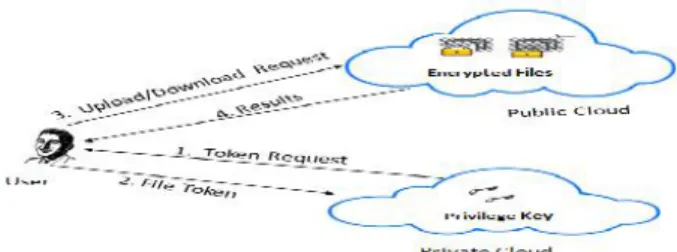
At a high level, our setting of interest is an enterprise network, consisting of a group of affiliated clients (for example, employees of a company) who will use the S-CSP and store data with duplication technique. In this setting, de-duplication can be frequently used in these settings for data backup and disaster recovery applications while greatly reducing storage space. Such systems are widespread and are often more suitable to user file backup and synchronization applications than richer storage abstractions. There are three entities defined in our system, that is, users, private cloud and S-CSP in public cloud as shown in Fig 1. The S-CSP performs de-duplication by checking if the contents of two files are the same and stores only one of them.
Figure 1 Architecture of Authorized Deduplication
The access right to a file is defined based on a set of privileges. The exact definition of a privilege varies across applications. For example, we may define a role-based privilege [9], [19] according to job positions (e.g., Director, Project Lead, and Engineer), or we may define a time-based privilege that specifies a valid time period (e.g., 2014-01-01 to 2014-01-31) within which a file can be accessed. A user, say Alice, may be assigned two privileges
“Director” and “access right valid on 2014- 01-01”,
so that she can access any file whose access role is
“Director” and accessible time period covers 2014 -01- 01. Each privilege is represented in the form of a short message called token. Each file is associated with some file tokens, which denote the tag with specified privileges (see the definition of a tag in Section 2). A user computes and sends duplicate-check tokens to the public cloud for authorized duplicate check.
Users are also provisioned with per-user encryption keys and credentials (e.g., user certificates). In this paper, we will only consider the file-level de-duplication for simplicity. In another word, we refer a data copy to be a whole file and file-level Deduplication which eliminates the storage of any redundant files. Actually, block-level de-duplication can be easily deduced from file-level de-duplication, which is similar
to [4]. Specifically, to upload a file, a user first performs the file-level duplicate check. If the file is a duplicate, then all its blocks must be duplicates as well; otherwise, the user further performs the block-level duplicate check and identifies the unique blocks to be uploaded. Each data copy (i.e., a file or a block) is associated with a token for the duplicate check.
S-CSP. This is an entity that provides a data storage service in public cloud. The S-CSP provides the data outsourcing service and stores data on behalf of the users. To reduce the storage cost, the S-CSP eliminates the storage of redundant data via Deduplication and keeps only unique data. In this paper, we assume that S-CSP is always online and has abundant storage capacity and computation power.
Data Users. A user is an entity that wants to outsource data storage to the S-CSP and access the data later. In a storage system supporting de-duplication, the user only uploads unique data but does not upload any duplicate data to save the upload bandwidth, which may be owned by the same user or different users. In the authorized Deduplication system, each user is issued a set of privileges in the setup of the system. Each file is protected with the convergent encryption key and privilege keys to realize the authorized de-duplication with differential privileges.
Private Cloud. Compared with the traditional Deduplication architecture in cloud computing, this is a new entity introduced for facilitating
user’s secure usage of cloud service. Specifically, since the computing resources at data user/owner side are restricted and the public cloud is not fully trusted in practice, private cloud is able to provide data user/owner with an execution environment and infrastructure working as an interface between user and the public cloud. The private keys for the privileges are managed by the private cloud, who answers the file token requests from the users. The interface offered by the private cloud allows user to submit files and queries to be securely stored and computed respectively.
Notice that this is a novel architecture for data Deduplication in cloud computing, which consists of a twin clouds (i.e., the public cloud and the
private cloud). Actually, this hybrid cloud setting has attracted more and more attention recently. For example, an enterprise might use a public cloud service, such as Amazon S3, for archived data, but continue to maintain in-house storage for operational customer data. Alternatively, the trusted private cloud could be a cluster of virtualized cryptographic co-processors, which are offered as a service by a third party and provide the necessary hardware based security features to implement a remote execution environment trusted by the users.
Adversary Model
Typically, we assume that the public cloud and
private cloud are both “honest-but-curious”.
Specifically they will follow our proposed protocol, but try to find out as much secret information as possible based on their possessions. Users would try to access data either within or out of the scopes of their privileges. In this paper, we suppose that all the files are sensitive and needed to be fully protected against both public cloud and private cloud. Under the assumption, two kinds of adversaries are considered, that is, 1) external adversaries which aim to extract secret information as much as possible from both public cloud and private cloud; 2) internal adversaries who aim to obtain more information on the file from the public cloud and duplicate-check token information from the private cloud outside of their scopes. Such adversaries may include S-CSP, private cloud server and authorized users.
Design Goals
In this paper, we address the problem of privacy preserving de-duplication in cloud computing and propose a new de-duplication system supporting for
Differential Authorization. Each authorized user is able to get his/her individual token of his file to perform duplicate check based on his privileges. Under this assumption, any user cannot generate a token for duplicate check out of his privileges or without the aid from the private cloud server.
Authorized Duplicate Check. Authorized user is able to use his/her individual private keys to generate query for certain file and the privileges he/she owned with the help of private cloud, while the public cloud performs duplicate check directly and tells the user if there is any duplicate.
III.PROPOSEDSYSTEMDESCRIPTION
cannot share these private keys of privileges in this proposed construction, which means that it can prevent the privilege key sharing among users in the above straightforward construction. To get a file token, the user needs to send a request to the private cloud server. The intuition of this construction can be described as follows. To perform the duplicate check for some file, the user needs to get the file token from the private cloud server. The private cloud server will also check the
user’s identity before issuing the corresponding file
token to the user. The authorized duplicate check for this file can be performed by the user with the public cloud before uploading this file. Based on the results of duplicate check, the user either uploads this file or runs PoW.
Before giving our construction of the Deduplication system, we define a binary relation R = f((p, p′)g as follows. Given two privileges p
and p′, we say that p matches p′ if and only if R(p,
p′) = 1. This kind of a generic binary relation
definition could be instantiated based on the background of applications, such as the common hierarchical relation. More precisely, in a hierarchical relation, p matches p′ if p is a higher -level privilege. For example, in an enterprise management system, three hierarchical privilege levels are defined as Director, Project lead, and Engineer, where Director is at the top level and Engineer is at the bottom level. Obviously, in this simple example, the privilege of Director matches the privileges of Project lead and Engineer.
IV.RELATEDWORK
Secure Deduplication. With the advent of cloud computing, secure data de-duplication has attracted much attention recently from research community. Yuan et al. [5] proposed a de-duplication system in the cloud storage to reduce the storage size of the tags for integrity check. To enhance the security of de-duplication and protect the data confidentiality, Bellare et al. [6] showed how to protect the data confidentiality by transforming the predictable message into un-predictable message. In their system, another third party called key server is introduced to generate the file tag for duplicate check. Stanek et al. [7] presented a novel encryption scheme that provides differential security for popular data and unpopular data. For popular data that are not particularly sensitive, the traditional conventional encryption is performed. Another two-layered encryption scheme with stronger security while supporting de-duplication is proposed for unpopular data. In this way, they achieved better tradeoff between the efficiency and security of the outsourced data. Li et al. [8] addressed the key management issue in block-level de-duplication by distributing these keys across multiple servers after encrypting the files.
Convergent Encryption. Convergent encryption [8] ensures data privacy in de-duplication. Bellare
et al. [9] formalized this primitive as message-locked encryption, and explored its application in space-efficient secure outsourced storage. Xu et al. [3] also addressed the problem and showed a secure convergent encryption for efficient encryption, without considering issues of the key-management and block-level de-duplication. There are also several implementations of convergent implementations of different convergent encryption variants for secure de-duplication (e.g., [2], [10], [11]). It is known that some commercial cloud storage providers, such as Bitcasa, also deploy convergent encryption.
V.CONCLUSION
In this paper, the notion of authorized data Deduplication was proposed to protect the data security by including differential privileges of users in the duplicate check. We also presented several new Deduplication constructions supporting authorized duplicate check in hybrid cloud architecture, in which the duplicate-check tokens of files are generated by the private cloud server with private keys. Security analysis demonstrates that our schemes are secure in terms of insider and outsider attacks specified in the proposed security model. As a proof of concept, we implemented a prototype of our proposed authorized duplicate check scheme and conduct test-bed experiments on our prototype. We showed that our authorized duplicate check scheme incurs minimal overhead compared to convergent encryption and network transfer.
VI.REFERENCES
[1] S. Quinlan and S. Dorward. Venti: a new approach to archival storage. In Proc. USENIX FAST, Jan 2002.
[2] P. Anderson and L. Zhang. Fast and secure laptop backups with encrypted de-duplication. In Proc. of USENIX LISA, 2010.
[3] M. Bellare, S. Keelveedhi, and T. Ristenpart. Dupless: Serveraided encryption for deduplicated storage. In USENIX Security Symposium, 2013. [4] M. Bellare, S. Keelveedhi, and T. Ristenpart.
Message-locked encryption and secure
deduplication. In EUROCRYPT, pages 296– 312, 2013.
[5] M. Bellare, C. Namprempre, and G. Neven. Security proofs for identity-based identification and signature schemes. J. Cryptology,22(1):1–61, 2009. [6] M. Bellare and A. Palacio. Gq and schnorr identification schemes: Proofs of security against impersonation under active and concurrent attacks. In CRYPTO, pages 162–177, 2002.
duplicate files in a serverless distributed file system. In ICDCS, pages 617–624, 2002.
[9] D. Ferraiolo and R. Kuhn. Role-based access controls. In 15th NIST-NCSC National Computer Security Conf., 1992.
[10] GNU Libmicrohttpd.