http://www.scirp.org/journal/ajps ISSN Online: 2158-2750
ISSN Print: 2158-2742
DOI: 10.4236/ajps.2017.810159 Sep. 6, 2017 2367 American Journal of Plant Sciences
Using Pyroxasulfone for Downy Brome (
Bromus
tectorum
L.) Control in Winter Wheat
Vipan Kumar
1*, Prashant Jha
1, Amit J. Jhala
21Department of Research Centers, Southern Agricultural Research Center, Montana State University, Bozeman,
MT, USA
2Department of Agronomy and Horticulture, University of Nebraska-Lincoln, Lincoln, NE, USA
Abstract
Downy brome is one of the most troublesome weeds in no-till wheat produc-tion systems of the US Great Plains. Pyroxasulfone is a relatively new, soil- applied residual herbicide (root/shoot growth inhibitor) labeled for use in wheat. Multiple field experiments were conducted near Huntley, MT from 2012 through 2016 to determine the efficacy of pyroxasulfone to control downy brome in imidazolinone (IMI)-tolerant (Clearfield™) winter wheat. Pyrox-asulfone did not cause any injury to wheat in any of the three studies. Downy brome injury with pyroxasulfone preemergence (PRE) only program did not differ between 89 or 178 g∙ai (active ingredient)∙ha−1 rates, and averaged 82%
and 84% in 2 separate studies. In a preplant (PP) burndown program, the ad-dition of pyroxasulfone (178 g∙ai∙ha−1) to glyphosate improved downy brome
end-season injury from 15% to 74%. In a separate study, the end-season in-jury with pyroxasulfone was greater when applied PRE (84%) compared to the delayed PRE (DPRE) timing (74%). In addition, the water dispersible granule (WDG) formulation of pyroxasulfone performed slightly better than the sus-pension concentrate (SC) formulation for downy brome injury. Pyroxasulfone applied PRE in the fall at a rate of 89 g∙ai∙ha−1 followed by (fb) imazamox (44
g∙ai∙ha−1 rate) applied postemergence (POST) in the spring effectively
con-trolled downy brome (99% end-season injury). Furthermore, the injury was consistent with the standard program comprising of propoxycarbazone (29 g∙ai∙ha−1) PRE fb imazamox POST in IMI-tolerant winter wheat. In
conclu-sion, pyroxasulfone applied PRE in the fall can be effectively utilized in con-junction with a standard acetolactate synthase (ALS)-inhibitor-based POST herbicide program for a season-long downy brome management in winter wheat.
Keywords
Downy Brome, Pyroxasulfone, Soil-Applied Herbicide, Herbicide Rate, How to cite this paper: Kumar, V., Jha, P.
and Jhala, A.J. (2017) Using Pyroxasulfone for Downy Brome (Bromus tectorum L.) Con-trol in Winter Wheat. American Journal of Plant Sciences, 8, 2367-2378.
https://doi.org/10.4236/ajps.2017.810159
Received: July 25, 2017 Accepted: September 3, 2017 Published: September 6, 2017
Copyright © 2017 by authors and Scientific Research Publishing Inc. This work is licensed under the Creative Commons Attribution International License (CC BY 4.0).
http://creativecommons.org/licenses/by/4.0/
DOI: 10.4236/ajps.2017.810159 2368 American Journal of Plant Sciences
Application Timing, Formulation, Wheat
1. Introduction
Wheat (Triticum aestivum L.) is an important cereal grain crop well suited for dryland cropping systems of the northwestern United States, including Montana. In 2015, Montana ranked third among the wheat producing states, accounting for 9% of the total US wheat production [1]. About 75% of the total wheat grown in the United States is winter wheat [2], which is primarily grown in rotation with chemical fallow, pulse crops (dry pea, chickpea, or lentil), or canola in this region. Weed management is a major obstacle in successful winter wheat pro-duction [3], and a season-long weed infestation can cause severe reductions in yield and grain quality of winter wheat [4][5].
Downy brome (commonly known as cheatgrass) is an invasive, self-pollinated, winter annual grass weed, widespread in rangeland and winter wheat production areas of this region [6]. It is a native of Mediterranean region of Europe, and was first identified in the United States in 1861 in New York and Pennsylvania [7]. Currently, downy brome infests 23 million hectares in 17 states in the northwes-tern United States [8]. The increased downy brome abundance in the semi-arid wheat production systems is attributed to the adoption of no-till practice, mainly for soil moisture conservation and soil erosion prevention, and limited selective herbicides for downy brome management [6]. Downy brome seeds are short-lived (1 to 2 years), best germinating at 20˚C, and seedlings emerge from shallow soil depths (1 to 5 cm) [9][10]. Fall-emerging downy brome seedlings overwinter in a semi-dormant state and resume growth in the spring after winter vernalization. Those plants attain physiological maturity by mid-June in this region [11]. Downy brome is a prolific seed producer (up to 2.6 billion seeds ha−1) [12].
Downy brome interference in winter wheat has been studied extensively, and moderate to severe grain yield reductions have been reported [9][13][14][15]. Downy brome at densities of 24, 40, and 65 plants∙m−2 reduced winter wheat
yields by 10%, 15%, and 20%, respectively [15]. In a study conducted in Wash-ington, a moderate infestation of downy brome at a density of 54 plants∙m−2
re-duced winter wheat yield by 28% [14]. High levels of downy brome infestation (>500 plants∙m−2) can cause near-total (>92%) yield loss in winter wheat [14].
The timing of downy brome emergence has a greater influence on wheat yield reductions than the plant density [8][15]. The early-emerging cohorts of downy brome (that emerged between planting and 1 to 2 weeks after winter wheat emergence) were found to be more competitive than the late-emerging cohorts (that emerged after 3 weeks of winter wheat emergence) [13][15]. For instance, downy brome at densities of 200 to 400 plants∙m−2 that emerged in the fall with
DOI: 10.4236/ajps.2017.810159 2369 American Journal of Plant Sciences
plants∙m−2 were not controlled by early spring; however, the yield loss was only 6%
when those plants were removed by March [9].
Growers rely on selective herbicides for downy brome management in wheat. A majority of these herbicides belong to five different ALS-inhibiting herbicide fami-lies, including sulfonylureas (SU), imidazolinones (IMI), triazolopyrimidines (TP), pyrimidinylthiobenzoates (PTB), and sulfonylamino-carbonyl-triazolinones (SCT). However, the intensive use of these ALS-inhibiting herbicides has resulted in the evolution of ALS-resistant downy brome biotypes [16]. For instance, a downy brome biotype with cross-resistance to imazamox (IMI), propoxycarbazone-sodium (SCT), and pyroxsulam (TP) has recently been reported from an IMI-tolerant winter wheat field in Montana [17]. Similarly, downy brome biotypes with cross-resistance to primisulfuron, sulfosulfuron, imazamox, and propoxycarbazone have been docu-mented from Kentucky bluegrass fields in Oregon [18][19], suggesting the need to revisit effective weed control programs and investigate alternative herbicide chemistries for downy brome management.
Pyroxasulfone is a relatively new soil-applied premergence (PRE) herbicide that acts as a root/shoot growth inhibitor in germinating seedlings of both grassy and broadleaf weeds [20]. It is registered in several crops including wheat, corn
(Zea mays L.), soybean [Glycine max (L.) Merr.], sunflower (Helianthus annuus
L.), and dry bean [21] [22] [23]. Pyroxasulfone applied PRE in wheat controls grass weeds such as, Italian ryegrass (Lolium perenne ssp. multiflorum) and ri-gid ryegrass (Loliumrigidum) [21][24][25]. However, there is very little infor-mation available on the effectiveness of pyroxasulfone for downy brome man-agement in wheat. The objectives of this research were: 1) to evaluate pyroxasul-fone applied PRE standalone or followed by (fb) a standard POST herbicide program; 2) compare the effectiveness of pyroxasulfone with other standard prep-lant (PP) glyphosate-based herbicide programs (standalone) or fb a POST herbi-cide program; and 3) compare the efficacy of pyroxasulfone formulation, rate and application timing for crop safety and season-long downy brome injury and grain yields in IMI-tolerant (Clearfield®) winter wheat.
2. Materials and Methods
Three separate field experiments were conducted at the Montana State Univer-sity Southern Agricultural Research Center (MSU-SARC) near Huntley, MT, during 2012 through 2016 to achieve the aforementioned objectives (1, 2, and 3). Soil was a Fort Collins clay loam (fine loamy, mixed, superactive, mesic Aridic Haplustalfs) with a pH of 7.8% and 2.1% organic matter. Monthly mean air temperature (˚C) and total precipitation (mm) were recorded at a weather sta-tion located approximately 1 km from the test site. Plots were 3 m wide by 9 m long. An IMI-tolerant winter wheat cultivar “Clearstone CL 2” was seeded 2.5 cm deep in 19-cm rows at a rate of 67 kg∙ha−1 using a no-till drill in the first
DOI: 10.4236/ajps.2017.810159 2370 American Journal of Plant Sciences
downy brome at densities of 60 to 65 plants∙m−2. All herbicide treatments were
applied with a CO2-pressurized hand-held sprayer equipped with four flat-fan
spray nozzles (TeeJetTP8001, TeeJet Technologies, Wheaton, IL 60189) cali-brated to deliver 94 L∙ha−1 at 276 kPa. Herbicides used in the three experiments
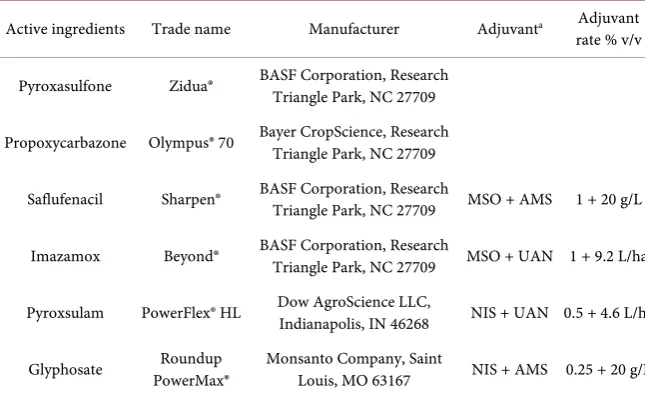
are presented in Table 1. The herbicide application rates were selected based on the labeled rates in IMI-tolerant winter wheat. In all experiments, a nontreated check was included for comparison. The winter wheat crop was harvested using a small-plot combine (Wintersteiger Ag) and wheat grain samples were cleaned, and yields were adjusted to 13% moisture.
2.1. Pyroxasulfone Preemergence
Field experiments were conducted in 2012/2013 and 2013/2014 winter wheat growing seasons, and were set up in a randomized complete block design with four replications. The study included three fall-applied preemergence (PRE) standalone treatments, two spring-applied postemergence (POST) standalone treatments, and two PRE followed by (fb) POST treatments. PRE standalone treatments included pyroxasulfone at either 89 or 178 g∙ai∙ha−1 in comparison to
propoxycarbazone at 29 g∙ai∙ha−1 (local standard), and were applied immediately
after winter wheat planting on October 12 in 2012 and October 7 in 2013. POST treatments included imazamox at 44 g∙ai∙ha−1 or pyroxsulam at 18 g∙ai∙ha−1, and
[image:4.595.209.532.500.699.2]were applied on May 10 in 2013 and May 14 in 2014 when winter wheat and downy brome had broken their winter dormancy and resumed growth (ap-proximately 4- to 5-tiller stage of winter wheat). Injury data on crop and downy brome were visually assessed on a scale of 0 to 100%, with 0 representing no in-jury and 100 representing complete plant death at 2, 5, and 8 weeks after the POST (WAPOST) herbicide application.
Table 1. List of tested herbicides along with adjuvants.
Active ingredients Trade name Manufacturer Adjuvanta Adjuvant rate % v/v
Pyroxasulfone Zidua® BASF Corporation, Research Triangle Park, NC 27709
Propoxycarbazone Olympus® 70 Bayer CropScience, Research Triangle Park, NC 27709
Saflufenacil Sharpen® BASF Corporation, Research Triangle Park, NC 27709 MSO + AMS 1 + 20 g/L
Imazamox Beyond® BASF Corporation, Research Triangle Park, NC 27709 MSO + UAN 1 + 9.2 L/ha
Pyroxsulam PowerFlex® HL Dow AgroScience LLC, Indianapolis, IN 46268 NIS + UAN 0.5 + 4.6 L/ha
Glyphosate PowerMax®Roundup Monsanto Company, Saint Louis, MO 63167 NIS + AMS 0.25 + 20 g/L
DOI: 10.4236/ajps.2017.810159 2371 American Journal of Plant Sciences
2.2. Pyroxasulfone Preplant
Ten preplant (PP) standalone or PP followed by (fb) standard POST herbi-cide treatments were evaluated for injury on crop and downy brome during the 2013/2014 and 2014/2015 winter wheat growing seasons. Treatments were ar-ranged in a randomized complete block design, with four replications. Treat-ments included glyphosate applied preplant (PP) at 870 g∙ai∙ha−1 alone or in
combination with pyroxasulfone at 89 or 178 g∙ai∙ha−1 or propoxycarbazone at
29 g∙ai∙ha−1 (local standard), in combination with pyroxasulfone at 89 g∙ai∙ha−1
plus saflufenacil at 25 g∙ai∙ha−1; and glyphosate (870 g∙ai∙ha−1) PP fb imazamox
(44 g aiha-1) POST or pyroxsulam (18 g∙ai∙ha−1) POST. The PP treatments were
applied a day before winter wheat planting on October 7 in 2013 and October 10 in 2014, while POST treatments were applied on May 5 in 2014 and May 10 in 2015. Treatments were visually assessed for injury on crop and downy brome at 21 weeks after the PP (WAPP) herbicide application, and 4 and 8 weeks after the POST (WAPOST) herbicide application, using the rating scale as previously de-scribed.
2.3. Pyroxasulfone Rate, Application Timing and Formulation
Field experiments were conducted in 2014/2015 and 2015/2016, and were set up in a randomized complete block design with a factorial arrangement of treat-ments, and four replications. Factors included pyroxasulfone formulation, rate, and application timing. Pyroxasulfone formulations tested were water-dispersible granule (WDG) and suspension concentrate (SC). Pyroxasulfone rates included 89 or 178 g∙ai∙ha−1. The application timings tested were PRE (immediately afterwinter wheat planting) and delayed PRE (DPRE; when 80% of germinated wheat seeds had a shoot at least 1.2 cm long until wheat spiking). Data on crop and downy brome injury were visually assessed at 24 and 32 weeks after the PRE (WAPRE) application using the rating scale as previously described.
2.4. Statistical Analyses
All data were subjected to ANOVA using PROC MIXED in SAS 9.3 (SAS Insti-tute, Inc., SAS Campus Dr., Cary, NC 27513) to test the significance of fixed ef-fects, i.e., year, treatment (herbicide treatment in experiment 1 and 2 and herbi-cide rate, formulation, or timing in experiment 3), and their interactions. Repli-cation and interactions involving repliRepli-cation were random effects in the model. Downy brome percent injury data from the nontreated check plots were ex-cluded from the analysis, while the wheat yield data from the nontreated check plots were included for comparison. Residual analyses were performed using PROC UNIVARIATE and the homogeneity of variance assumption was tested. All data met ANOVA requirements. Treatment means were separated using Fisher’s protected LSD at P ≤ 0.05.
3. Results and Discussion
DOI: 10.4236/ajps.2017.810159 2372 American Journal of Plant Sciences
and 2014/2015 growing seasons (Table 2). However, the interaction of treatment by year was not significant on downy brome injury or winter wheat grain yield in any of the three experiments; hence, data were pooled over the two years.
3.1. Pyroxasulfone Preemergence
No winter wheat injury was observed with any of the PRE standalone, POST standalone, or PRE fb POST herbicide program. Among all treatments, pyrox-asulfone (89 g∙ha−1) or propoxycarbazone (29 g∙ai∙ha−1) PRE followed by
imaza-mox (44 g∙ai∙ha−1) POST were the most effective treatments (>97% injury) for
managing downy brome in IMI-tolerant wheat at 2, 5, and 8 WAPOST (Table 3). Downy brome injury with pyroxasulfone (89 or 178 g∙ai∙ha−1) PRE alone was
greater than propoxycarbazone PRE alone, but comparable to imazamox (44 g∙ha−1) POST standalone treatment across all evaluation dates, and averaged 81%
at 8 WAPOST. Although there is no published information on pyroxasulfone ef-ficacy on downy brome, up to 94% control of Italian ryegrass has been reported with a PRE application of pyroxasulfone (150 g∙ai∙ha−1) in winter wheat [21].
Si-milarly, pyroxasulfone at rates ≥150 g∙ha−1 had up to 90% control of rigid
[image:6.595.56.540.467.731.2]rye-grass (Loliumrigidum Gaud.) in wheat [27]. Consistent with our results, up to 64% injury of downy brome has been reported with a fall application of propoxycar-bazone PRE at a similar rate in winter wheat, in a study conducted in North Dakota, USA [28]. With imazamox POST, applied even at a lower rate of 35 g∙ai∙ha−1, up to 82% injury of downy brome has been documented in spring
Table 2. Monthly mean air temperature (˚C) and total precipitation for the winter wheat growing periods in 2012-2016 at the MSU Southern Agricultural Research Center near Huntley, MT. The months of October–July represent the critical winter wheat growing season in southcentral Montana.
2012-2013 2013-2014 2014-2015 2015-2016
Temperature
(˚C) Precipitation (mm) Temperature (˚C) Precipitation (mm) Temperature (˚C) Precipitation (mm) Temperature (˚C) Precipitation (mm)
Oct. 7.1 29.9 6.6 63.8 10.1 6.4 10.9 57.4
Nov. 2.3 11.1 0.9 5.1 −1.5 12.5 1.3 14.3
Dec. −3.6 2 −6.6 23.7 −2.3 8.9 −3.3 8.4
Jan. −3.2 5.4 −1.5 3.6 −1.1 5.1 −2.9 7.4
Feb. 0.4 4.8 −7.9 7.4 −0.2 51.9 4.2 4.6
Mar. 2.5 5.9 0.4 40.7 6.8 3.6 5.4 43.7
Apr. 5.7 29.8 8.3 29.8 8.9 29.0 9.7 45.3
May 14.3 154.2 13.7 62.8 12.6 79.1 13.4 75.0
Jun. 17.6 34.1 16.7 70.7 20.8 50.9 21.0 99.1
Jul. 22.9 15.5 22.8 11.2 22.2 26.4 22.7 12.0
DOI: 10.4236/ajps.2017.810159 2373 American Journal of Plant Sciences Table 3. Comparison of pyroxasulfone preemergence with standard herbicide treatments for downy brome injury and grain yield in imidazolinone-tolerant (IMI-tolerant) winter wheat near Huntley, MT in 2012 and 2013a,b.
Downy brome injuryc,d
Herbicide(s) Rate Timing 2 WAPOST 5 WAPOST 8 WAPOST Yield
(g∙ai∙ha−1) % kg∙ha−1
Pyroxasulfone 89 PRE 85 b 83 b 80 b 2092 b
Pyroxasulfone 178 PRE 88 b 86 b 84 b 2049 b
Propoxycarbazone 29 PRE 78 c 76 c 71 c 1942 b
Imazamox 44 POST 87 b 85 b 80 b 2003 b
Pyroxsulam 18 POST 74 c 69 d 61 d 1700 c
Pyroxasulfone fb imazamox 89 fb 44 PRE fb POST 98 a 98 a 99 a 2635 a Propoxycarbazone by imazamox 29 fb 44 PRE fb POST 97 a 98 a 98 a 2712 a
Nontreated check - - - 884 d
aYear-by-treatment interactions for downy brome injury and wheat grain yield were not significant; therefore, data were combined across the two years; bAbbreviations: PRE, preemergence; POST, postemergence; WAPOST, weeks after POST herbicide application; fb, followed by; g∙ai∙ha−1, gram active
ingre-dient per hectare; cMeans within a column followed by same letters are not significantly different according to Fisher’s protected LSD test at P ≤ 0.05.
wheat [28]. However, the POST standalone treatment of pyroxsulam at 18 g∙ai∙ha−1
was the least effective treatment (61%) for downy brome injury in our study conducted in winter wheat.
Consistent with an excellent downy brome injury, winter wheat yield with pyroxasulfone or propoxycarbazone PRE followed by imazamox POST was higher (averaged 2673 kg∙ha−1) than all other treatments. The season-long infestation of
downy brome reduced winter wheat yield by an average of 67% in the non treated check plots compared to the PRE fb POST programs. Winter wheat yield with pyroxasulfone (89 or 178 g∙ai∙ha−1) or propoxycarbazone (29 g∙ai∙ha−1) PRE
standalone program was comparable to imazamox POST standalone program, averaging 2021 kg∙ha−1, but was higher than the yield obtained from pyroxsulam
POST standalone program.
3.2. Pyroxasulfone Preplant
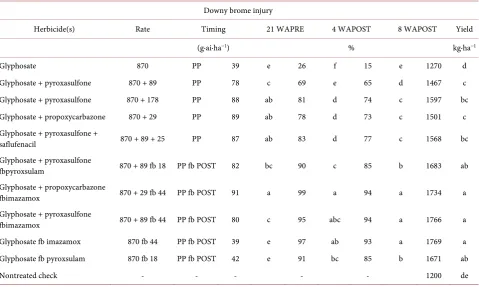
Pyroxasulfone applied PP did not cause any visual injury to winter wheat, irres-pective of the rate. The glyphosate (870 g∙ai∙ha−1) PP fb imazamox (44 g∙ai∙ha−1)
POST program caused 93% injury to downy brome at 8 WAPOST. There was no additional advantage of tank mixing pyroxasulfone (89 g∙ai∙ha−1) or
propoxycar-bazone (29 g∙ai∙ha−1) with glyphosate PP when fb imazamox POST for downy
brome injury (Table 4). Similarly, there was no additional benefit of adding py-roxasulfone (89 g∙ai∙ha−1) to glyphosate PP when fb pyroxsulam (18 g∙ai∙ha−1),
DOI: 10.4236/ajps.2017.810159 2374 American Journal of Plant Sciences Table 4. Comparison of pyroxasulfone with standard glyphosate-based burn down (preplant) programs for downy brome injury and grain yield in imidazolinone-tolerant (IMI-tolerant) winter wheat near Huntley, MT in 2013 and 2014.a,b,c
Downy brome injury
Herbicide(s) Rate Timing 21 WAPRE 4 WAPOST 8 WAPOST Yield
(g∙ai∙ha−1) % kg∙ha−1
Glyphosate 870 PP 39 e 26 f 15 e 1270 d
Glyphosate + pyroxasulfone 870 + 89 PP 78 c 69 e 65 d 1467 c
Glyphosate + pyroxasulfone 870 + 178 PP 88 ab 81 d 74 c 1597 bc
Glyphosate + propoxycarbazone 870 + 29 PP 89 ab 78 d 73 c 1501 c
Glyphosate + pyroxasulfone +
saflufenacil 870 + 89 + 25 PP 87 ab 83 d 77 c 1568 bc
Glyphosate + pyroxasulfone
fbpyroxsulam 870 + 89 fb 18 PP fb POST 82 bc 90 c 85 b 1683 ab
Glyphosate + propoxycarbazone
fbimazamox 870 + 29 fb 44 PP fb POST 91 a 99 a 94 a 1734 a
Glyphosate + pyroxasulfone
fbimazamox 870 + 89 fb 44 PP fb POST 80 c 95 abc 94 a 1766 a
Glyphosate fb imazamox 870 fb 44 PP fb POST 39 e 97 ab 93 a 1769 a Glyphosate fb pyroxsulam 870 fb 18 PP fb POST 42 e 91 bc 85 b 1671 ab
Nontreated check - - - 1200 de
aYear-by-treatment interactions for downy brome injury and wheat grain yield were not significant; therefore, data were combined across the two years. bAbbreviations: PP, preplant; POST, postemergence; WAPP, weeks after PP application; WAPOST, weeks after POST application; fb, followed by; g∙ai∙ha−1,
gram active ingredient per hectare. cMeans within a column followed by same letters are not significantly different according to Fisher’s protected LSD test at P ≤ 0.05.
reported when glyphosate was applied alone PP in spring wheat [28]. In our study, tank mixing pyroxasulfone (178 g∙ai∙ha−1) with or without saflufenacil (25
g∙ai∙ha−1) or propoxycarbazone (29 g∙ai∙ha−1) with glyphosate applied PP
(stan-dalone program), improved the end-season downy brome injury (averaged 73% injury) in winter wheat, indicating the excellent residual activity of those soil-applied herbicides on downy brome.
Wheat grain yields ranged from 1671 to 1769 kg∙ha−1 when glyphosate with or
without pyroxasulfone (89 g∙ai∙ha−1) or propoxycarbazone (29 g∙ai∙ha−1) PP was
followed by imazamox or pyroxsulam POST (Table 4). In contrast to these gly-phosate-based PP fb POST programs, grain yield with a glygly-phosate-based PP standalone program comprising of pyroxasulfone (89 or 178 g∙ai∙ha−1),
propox-ycarbazone (29 g∙ai∙ha−1), or pyroxasulfone + saflufenacil (25 g∙ai∙ha−1) averaged
1533 kg∙ha−1. This indicates that a follow up POST herbicide program was
needed to prevent wheat yield reductions from downy brome interference, ir-respective of the addition of pyroxasulfone or propoxycarbazone with glyphosate applied PP. However, a poor downy brome injury in the absence of pyroxasul-fone or propoxycarbazone in the glyphosate PP standalone program resulted in the lowest yield (1270 kg∙ha−1), which did not differ from the nontreated check
DOI: 10.4236/ajps.2017.810159 2375 American Journal of Plant Sciences
3.3. Pyroxasulfone Rate, Application Timing and Formulation
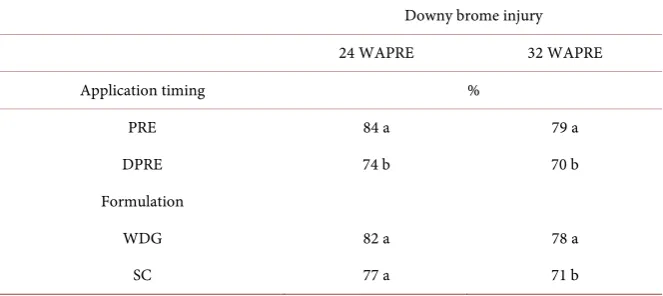
There was no visible crop injury observed with any of the pyroxasulfone formu-lations, rates, and application timings tested. Only the main effects of application timing and formulation were significant for downy brome injury. Averaged across pyroxasulfone formulations and application rates, downy brome injury was higher with the PRE compared to the DPRE application timing at both the evaluation dates (Table 5). For instance, at 24 and 32 WAPRE, the PRE application of py-roxasulfone provided 84 and 79% injury to downy brome, respectively, compared with the DPRE treatment with 74% and 70% injury, respectively (Table 5). Al-though downy brome injury did not differ between WDG and SC formulations at 24 WAPRE, the WDG formulation performed slightly better (78% vs 71%) than the SC formulation for end-season (32 WAPRE) downy brome injury. There were no significant effects of pyroxasulfone formulation, rate, application timing, and their interactions on winter wheat grain yield (data not shown). [image:9.595.207.539.513.661.2]It is worth emphasizing that the recent evolution of downy brome biotypes with >100-fold level of resistance to imazamox and cross-resistance to SCT and TP families of ALS inhibitor soriginating in IMI-tolerant (Clearfield®) winter wheat sys-tem in Montana, is a concern for wheat producers [17]. Therefore, the use of py-roxasulfone as an alternative, effective site-of-action herbicide for downy brome management may aid in reducing the selection pressure for resistance develop-ment from repeated applications (fall and spring) of ALS-inhibitors in winter wheat. Based on the results from this research, pyroxasulfone when applied PP or PRE in the fall had extended residual activity on downy brome; however, a follow up POST application of pyroxsulam or imazamox (in IMI-tolerant wheat) in the spring was needed to achieve a season-long downy brome management
Table 5. Effect of pyroxasulfone application timing and formulation on downy brome injury in imidazolinone-tolerant (IMI-tolerant) winter wheat near Huntley, MT in 2015 and 2016.a,b,c
Downy brome injury
24 WAPRE 32 WAPRE
Application timing %
PRE 84 a 79 a
DPRE 74 b 70 b
Formulation
WDG 82 a 78 a
SC 77 a 71 b
DOI: 10.4236/ajps.2017.810159 2376 American Journal of Plant Sciences
in winter wheat. This PRE/PP fb POST program can potentially prevent downy brome seed additions to the soil seed bank (Jha, personal observation) in winter wheat, which is an important consideration for herbicide resistance management. Pyroxasulfone would potentially be a good fit in the current weed control pro-grams in cereal-based cropping systems of the NGP where pulse crops (dry pea, chickpea, and lentil) have increasingly become common in rotation with winter wheat. Although only wild oat (Avena fatua L.) with resistance to pyroxasulfone has been documented so far (Heap 2017), there is a potential risk of evolving re-sistance to pyroxasulfone in other weed species including downy brome, if not used proactively. Therefore, appropriate product stewardship and diverse weed control tactics should be implemented to maintain the long-term utility of py-roxasulfone for downy brome injury in winter wheat.
4. Conclusion
Results from this study highlight that pyroxasulfone applied PP or PRE at use rates of 89 or 178 g∙ai∙ha−1 in the fall followed by a POST treatment of imazamox
at 44 g∙ai∙ha−1 in the spring can be safely used in Clearfield® winter wheat to
ef-fectively manage downy brome. The WDG formulation of pyroxasulfone may be slightly superior to the SC formulation, and the PRE timing can potentially pro-vide better early-season downy brome management than the DPRE application timing. Utilizing this relatively new PRE herbicide would add diversity (multiple sites of action) to downy brome management programs in winter wheat.
Acknowledgements
We thank Nicholas Reichard, Shane Leland, and Charlemagne A. Lim for their assistance in conducting the field research. We also thank BASF for providing funds to conduct this research.
References
[1] USDA-NASS (United States Department of Agriculture National Agricultural Sta-tistics Service) (2017) Montana Agricultural Facts 2016. USDA-NASS, Helena, MT. https://www.nass.usda.gov/Statistics_by_State/Montana/Publications/Special_Intere st_Reports/agfacts.pdf
[2] Reddy, S.S., Stahlman, P.W. and Geier, P.W. (2013) Downy Brome ( Bromustecto-rum L.) and Broadleaf Weed Control in Winter Wheat with Acetolactate Syn-thase-Inhibiting Herbicides. Agronomy, 3, 340-348.
https://doi.org/10.3390/agronomy3020340
[3] Derksen, D.A., Anderson, R.L., Blackshaw, R.E. and Maxwell, B. (2002) Weed Dy-namics and Management Strategies for Cropping Systems in the Northern Great Plains. Agronomy Journal,94, 174-185. https://doi.org/10.2134/agronj2002.0174 [4] Bell, A.R. and Nalewaja, J.D. (1968) Competition of Wild Oat in Wheat and Barley.
Weed Science, 16, 505-508.
DOI: 10.4236/ajps.2017.810159 2377 American Journal of Plant Sciences [6] Morrow, L.A. and Stahlman, P.W. (1984) The History and Distribution of Downy
Brome (Bromustectorum) in North America. Weed Science, 32, 2-6.
[7] Hitchcock, A.S. (1950) Manual of the Grasses of the United States. 2nd Edition, United States Government Printing Office, Washington DC, 1051.
[8] Rice, P.M. (2005) Downy Brome. In: Duncan, C.L. and Clark, J.K., Eds., Invasive Plants of Range and Wildlands and Their Environmental, Economic, and Societal Impacts, Weed Science Society of America, Lawrence, KS, 147-170.
[9] Rydrych, D.J. (1974) Competition between Winter Wheat and Downy Brome. Weed Science, 22, 211-214.
[10] Wicks, G.A., Burnside, O.C. and Fenster, C.R. (1971) Influence of Soil Type and Depth of Planting on Downy Brome Seeds. Weed Science, 19, 82-86.
[11] Thill, D.C., Beck, K.G. and Callihan, R.H. (1984) The Biology of Downy Brome (Bromus tectorum). Weed Science,32, 7-12.
[12] Sheley, R.L. and Petroff, J.K., Eds. (1999) Biology and Management of Noxious Rangeland Weeds. Oregon State University Press, Corvallis, 428.
[13] Blackshaw, R.E. (1993) Downy Brome (Bromus tectorum) Density and Relative Time of Emergence Affects Interference in Winter Wheat (Triticum aestivum). Weed Science,41, 551-556.
[14] Rydrych, D.J. and Muzik, T.J. (1968) Downy Brome Competition and Control in Dryland Wheat. Agronomy Journal,60, 279-280.
https://doi.org/10.2134/agronj1968.00021962006000030010x
[15] Stahlman, P.W. and Miller, S.D. (1990) Downy Brome (Bromus tectorum) Interfe-rence and Economic Thresholds in Winter Wheat (Triticum aestivum). Weed Science, 38, 221-228.
[16] Heap, I.M. (2017) The International Survey of Herbicide Resistant Weeds. http://www.weedscience.org
[17] Kumar, V. and Jha, P. (2017) First Report of Ser653Asn Mutation Endowing High-Level
Resistance to Imazamox in Downy Brome (Bromus tectorum L.). Pest Management Science.https://doi.org/10.1002/ps.4673
[18] Park, K.W., Fandrich, L. and Mallory-Smith, C.A. (2004) Absorption, Transloca-tion, and Metabolism of Propoxycarbazone-Sodium in ALS-Inhibitor Resistant Bro-mus tectorum Biotypes. Pesticide Biochemistry and Physiology,79, 18-24. https://doi.org/10.1016/j.pestbp.2003.11.002
[19] Park, K.W. and Mallory-Smith, C.A. (2004) Physiological and Molecular Basis for ALS Inhibitor Resistance in Bromus tectorum Biotypes. Weed Research, 44, 71-77. https://doi.org/10.1111/j.1365-3180.2003.00374.x
[20] Tanetani, Y., Kaku, K., Kawai, K., Fujioka, T. and Shimizu, T. (2009) Action Me-chanism of a Novel Herbicide, Pyroxasulfone. Pesticide Biochemistry and Physiol-ogy, 95, 47-55. https://doi.org/10.1016/j.pestbp.2009.06.003
[21] Hulting, A.G., Dauer, J.T., Hinds-Cook, B., Curtis, D., Koepke-Hill, R.M. and Mal-lory-Smith, C. (2012) Management of Italian Ryegrass (Lolium perenne ssp. multif-lorum) in Western Oregon with Preemergence Applications of Pyroxasulfone in Winter Wheat. Weed Technology,26, 230-235.
https://doi.org/10.1614/WT-D-11-00059.1
[22] Jha, P., Kumar, V., Garcia, J. and Reichard, N. (2015) Tank Mixing Pendimethalin with Pyroxasulfone and Chloroacetamide Herbicides Enhances In-Season Residual Weed Control in Corn. Weed Technology,29, 198-206.
DOI: 10.4236/ajps.2017.810159 2378 American Journal of Plant Sciences [23] Tidemann, B.D., Hall, L.M., Johnson, E.N., Beckie, H.J., Sapsford, K.L. and Raatz, L.L. (2014) Efficacy of Fall- and Spring-Applied Pyroxasulfone for Herbicide-Resistant Weeds in Field Pea. Weed Technology, 28, 351-360.
https://doi.org/10.1614/WT-D-13-00140.1
[24] Boutsalis, P., Gill, G.S. and Preston, C. (2014) Control of Rigid Ryegrass in Austral-ian Wheat Production with Pyroxasulfone. Weed Technology,28, 332-339. https://doi.org/10.1614/WT-D-13-00094.1
[25] Westra, E.P., Shaner, D.L., Westra, P.H. and Chapman, P.L. (2014) Dissipation and Leaching of Pyroxasulfone and S-Metolachlor. Weed Technology,28, 72-81. https://doi.org/10.1614/WT-D-13-00047.1
[26] Jacobsen, J., Jackson, G. and Jones, C. (2005) Fertilizer Guidelines for Montana Crops. Montana State University Extension Service Publication, Montana, EB 161. [27] Walsh, M.J., Fowler, T.M., Crowe, B., Ambe, T. and Powles, S.B. (2011) The
Poten-tial for Pyroxasulfone to Selectively Control Resistant and Susceptible Rigid Rye-grass (Lolium rigidum) Biotypes in Australian Grain Crop Production Systems. Weed Technology, 25, 30-37. https://doi.org/10.1614/WT-D-10-00091.1
[28] Ostlie, M.H. and Howatt, K.A. (2013) Downy Brome (Bromustec torum) Competi-tion and Control in No-Till Spring Wheat. Weed Technology,27, 502-508. https://doi.org/10.1614/WT-D-11-00033.1
Submit or recommend next manuscript to SCIRP and we will provide best service for you:
Accepting pre-submission inquiries through Email, Facebook, LinkedIn, Twitter, etc. A wide selection of journals (inclusive of 9 subjects, more than 200 journals)
Providing 24-hour high-quality service User-friendly online submission system Fair and swift peer-review system
Efficient typesetting and proofreading procedure
Display of the result of downloads and visits, as well as the number of cited articles Maximum dissemination of your research work
Submit your manuscript at: http://papersubmission.scirp.org/