87
RESULTS REGARDING THE BEHAVIOURAL INDICATORS DURING THE
AUTOMATIC MILKING OF THE DAIRY CATTLE EXPLOITED AT S.C.D.A.
ȘIMNIC CRAIOVA
MUGUREL COLĂ
University of Craiova Faculty of Agronomy
Key words: pulse; respiratory rhythm; automatic milking; animal behaviour;
ABSTRACT
Respiratory rate accelerates during this action both at the morning milking and at the evening milking, which proves that automatic milking is stressful both during milking and after milking. During milking, the animals’ pulse is altered and its rate increases significantly, especially during the evening milking. The milk production of Holstein Friesian cattle is about 35 litres/day, among which 53.48 % from the morning milking and 46.52 % from the evening milking. The values of the milking duration, both in the morning and in the evening, are registered in the framework of the limits of action of the hormone called oxytocin, that controls the milk secretion. The speed of milk removal may be considered as adequate for the morning milking, but it is under the limits of the minimum requirements for the evening milking.
INTRODUCTION
Considering that the milk production is the main goal of breeding and exploiting cattle within the farm of SCDA Simnic Craiova, studying the behaviour during automatic milking is extremely useful.
Even if the behavioural manifestations during automatic milking have many different aspects, this work studies only some of the indicators, namely: respiratory rate, pulse rate, milking duration and milking speed.
In order to have more details on these behavioural indicators, the analysis was made on dairy cattle, in the following moments of observation: before milking (B.M.), during milking (D.M.) and after milking (A.M.), 3-5 minutes after removing the cups from the teats. The behaviour studies want to establish optimal limits of feeding, of water, of the rest place, of the number of animals in the lot and also the way the exploited animals react to different stressful factors specific to different exploiting technologies.
MATERIAL AND METHOD
This work wants to approach some of the numerous behavioural aspects of the Holstein Friesian cattle from the farm of the Station of Agricultural Research-Development of Șimnic Craiova.
One of the important factors of the technology of exploiting cattle is the biologic material populating the farm. This should fulfil both productively and behaviourally the requirements imposed by the exploitation technology.
The research was accomplished during the years 2014-2015, on a set of 50 Hosltein Friesian cows selected randomly from the farm cattle.
88
in order to produce meat as well. The improvement means were: breeding as a clean race, by forming numerous lines and families, and guiding the copulation.
The primary data for respiratory rate were collected based on auscultation and the pulse rate, based on timers. In order to establish the other indicators, we used proceedings of directly observing the animals and the timing method.
In order to establish the average values of the observed behavioural characteristics, the primary data have been statistically processed, determining thus the following statistical indicators: average (X ,) variance (s2), standard deviation of the average (s), variability coefficient (s %) and standard error of the average (.sX).
RESULTS AND DISCUSSIONS
1. Respiratory rate during the milking process
For cattle, the respiratory rate is of 24-32 breaths per minute. This respiratory rate may be altered by many factors: digestion, muscle activity, fever, etc.
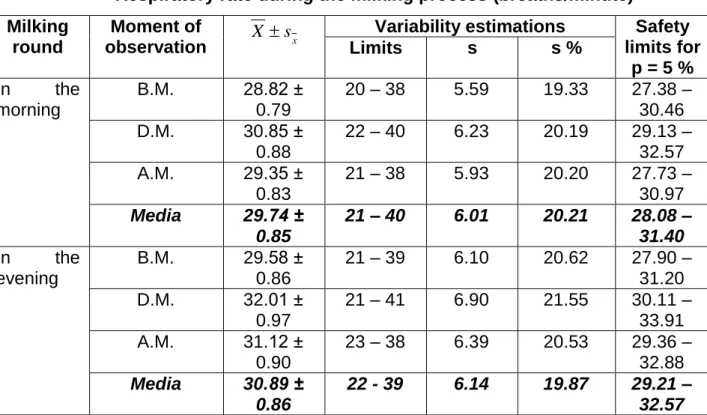
After our research, it results that the milking process also produces alterations of the respiratory rhythm rate. Therefore, based on the data of table 1, we may see that for the Holstein-Friesian cattle the average respiratory rate in the morning, before milking, is X = 28,82 ± 0,79 breaths/minute. It accelerates during milking up to an average value of X = 30,85 ± 0,88 breaths/minute, that is 2,02 breaths/minute higher (6,54 %).
Table 1
Respiratory rate during the milking process (breaths/minute)
Milking round
Moment of
observation X sx
Variability estimations Safety limits for
p = 5 %
Limits s s %
In the
morning
B.M. 28.82 ±
0.79
20 – 38 5.59 19.33 27.38 –
30.46
D.M. 30.85 ±
0.88
22 – 40 6.23 20.19 29.13 –
32.57
A.M. 29.35 ±
0.83
21 – 38 5.93 20.20 27.73 –
30.97
Media 29.74 ±
0.85
21 – 40 6.01 20.21 28.08 –
31.40
In the
evening
B.M. 29.58 ±
0.86
21 – 39 6.10 20.62 27.90 –
31.20
D.M. 32.01 ±
0.97
21 – 41 6.90 21.55 30.11 –
33.91
A.M. 31.12 ±
0.90
23 – 38 6.39 20.53 29.36 –
32.88
Media 30.89 ±
0.86
22 - 39 6.14 19.87 29.21 –
32.57
After milking, the respiratory rhythm is reduced to the average value of X = 30.85 ± 0.88.which is 0.53 breaths/minutehigher than the rate established for the initial moment.
89
breaths/minute before milking.X = 32.01 ± 0.97 breaths/minute during milking and X = 31.12 ± 0.90 breaths/minuteafter milking).
The fact that the number of respiratory movement accelerates during milking proves that automatic milking is a stressful factor whose influence is felt both during and after milking.
Considering the average of the three milking moments (X = 29.74 ± 0.85 breaths/minute), we may state that the Holstein-Friesian cattle from S.C.D.A. Șimnichave a high respiratory rate, illustrating intense metabolic processes specific to dairy cattle.
2. Pulse rate during the milking process
The number of beats per minute varies depending on the species; for cows, the values are between 60 and 80 beats/minute.
Pulse also depends on sex, age, temper, the physiological state of the animal, whether the animal is asleep or working etc.
From the analysis of the data from chart 1, we may observe that the average values of the pulse rate, both in the morning and in the evening, are within the limits mentioned by the specialty literature.
Chart 1. Pulse rate during the milking process (beats/minute
We found significant differences between the morning milking and the evening milking; we should mention that the pulse rate is slightly higher during the evening milking (X = 67.82 ± 0.71 beats/minutecompared to X = 66.81 ± 0.68 beats/minute).
Regarding the moments of observation, the pulse rate is higher during milking than before milking, both for the morning milking (X = 70.01 ± 0.70 beats/minutecompared to X = 64.43 ± 0.64 beats/minute) and for the evening milking (X = 70.83 ± 0.75 beats/minutecompared to X = 65.62 ± 0.66 beats/minute).
Based on the values we found, we may state that milking is also stressful for the animals concerning the respiratory rhythm rate; this effect and the fatigue accumulated by cattle during the day determine a higher pulse rate during the evening milking.
3. Indicators of the milking duration and speed
90
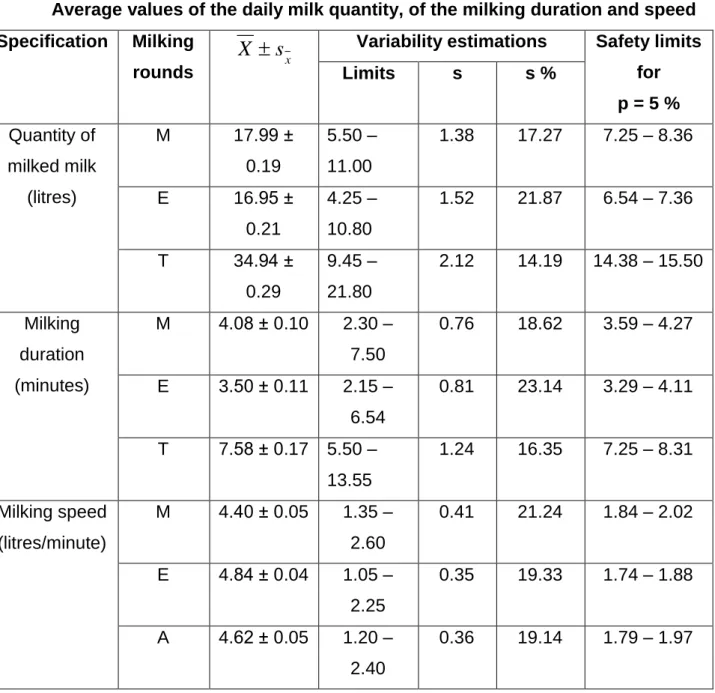
The milking duration has values of X = 4.08 ± 0.10 minutes for the morning milking and X = 3.50 ± 0.11 minutes for the evening milking. We may see that both values are within the limits of the action duration of oxytocin, a hormone which controls milk secretion. This is extremely important in practice whereas it has a favourable influence on the speed of milk removal.
The indicator of the milking speed has an average value of X = 1.88 ± 0.05 litres/minute, with slight oscillations between the morning milking and the evening milking (
X = 1.93 ± 0.05 litres/minuteand, respectively,X = 1.81 ± 0.04 litres/minute).
If we compare the established values with the minimum requirements for dairy cattle (1.9-2.2 litres/minute), we may see that the observed Holstein-Freisian cattle have an adequate milking speed for the morning milking and a speed which is slightly under the limit for the evening milking.
Table 2
Average values of the daily milk quantity, of the milking duration and speed
Specification Milking
rounds x
s
X
Variability estimations Safety limitsfor
p = 5 %
Limits s s %
Quantity of
milked milk
(litres)
M 17.99 ±
0.19
5.50 –
11.00
1.38 17.27 7.25 – 8.36
E 16.95 ±
0.21
4.25 –
10.80
1.52 21.87 6.54 – 7.36
T 34.94 ±
0.29
9.45 –
21.80
2.12 14.19 14.38 – 15.50
Milking
duration
(minutes)
M 4.08 ± 0.10 2.30 –
7.50
0.76 18.62 3.59 – 4.27
E 3.50 ± 0.11 2.15 –
6.54
0.81 23.14 3.29 – 4.11
T 7.58 ± 0.17 5.50 –
13.55
1.24 16.35 7.25 – 8.31
Milking speed
(litres/minute)
M 4.40 ± 0.05 1.35 –
2.60
0.41 21.24 1.84 – 2.02
E 4.84 ± 0.04 1.05 –
2.25
0.35 19.33 1.74 – 1.88
A 4.62 ± 0.05 1.20 –
2.40
0.36 19.14 1.79 – 1.97
91
CONCLUSIONS
Based on our research and its results regarding some behavioural aspects manifested by the Holstein-Freisian cattle from S.C.D.A. Șimnic, we may draw the following conclusions:
1. Both for the morning milking and for the evening milking, the respiratory rate accelerates during this activity, which proves that automatic milking is stressful during this activity and after it, as well.
2. During milking, the animals’ pulse is altered; their pulse rate is significantly higher, especially during the evening milking.
3. The milk production of the Holstein-Freisian cattle has values of about 35 litres per day, among which 53.48 % are from the morning milking and 46.52 % from the evening milking.
4. The values of the milking duration, both in the morning and in the evening, are within the action limits of the hormone called oxytocin, that controls milk secretion.
5. The speed of milk removal may be considered as adequate for the morning milking, but it is under the limits of the minimum requirements for the evening milking.
BIBLIOGRAPHY
1. Acatincăi, S. – Producţiile bovinelor, Ediţia a II-a, Editura Eurobit, 2004,Timişoara. 2. Colă, M., - Zootehnie generală". Editura UNIVERSITARIA,2003, Craiova.
3. Colă F, 2013- Îndrumător zootehnie generală. Editura Sitech, 2013, Craiova 4. Dinescu, S., - Creşterea vacilor pentru lapte". Editura CERES, 2002, Bucureşti 5. Dudouet C. – Manipuler et contenir les bovins. 2e Editions, Edition France agricole,
2002, 75010 Paris.
6. Georgescu, Gh. Şi colab. - Tratat de creşterea bovinelor, vol. I 1988, vol. II 1989, vol. III 1995, vol. IV 1998, Editura Ceres, Bucureşti.
7. Luca, I., Ştef Lavinia - Practicum de alimentaţia animalelor, Editura Marineasa, 2000, Timişoara.
8. Stanciu, G. – Tehnologia creşterii bovinelor, Editura Brumar,1999, Timişoara. 9. Velea C., Mărginean Gh. - Producţia, reproducţia şi ameliorarea taurinelor. Editura