Journal of Global Pharma Technology
Available Online at:
www.jgpt.co.in
RESEARCH ARTICLE
Long Term Use of Ovarian Stimulation Drugs May Affect Thyroid
Function
Ajile Elttayef
1,Buthainah Al-Azzawi
Biochemistry Department, College of Medicine, University of Al-Qadisiyah, Al-Qadisiyah. Iraq.
Abstract
Background: The use of ovarian stimulation drugs has increased worldwide; this is associated with physiological and biochemical alteration in different body systems. This study aims to evaluate the impact of different types of ovarian stimulation programs on thyroid hormone levels through different time exposure. Methods: Eighty women were involved in this study. Twenty women were considered as a control group (volunteers with no history of any health problems). The rest show no sign or symptom for thyroid impairment, they were divided into three groups, Group (A) contain twenty women treated with Clomid only, group (B) another twenty women treated with pergonal only, and the last twenty women group (C) were treated with both Clomid and pergonal (Mix). Measurement of TSH, T3, and T4 concentration before and after administration of different ovarian stimulation drugs and for a different time exposure. Results: This study proved a variation in thyroid hormone level during different time exposure and with different drugs used, some of them show no significant difference in the levels of thyroid hormones for two month after administration (group A) as compared to the control group, while in group (C) the increased of TSH hormone was significant (P<0.05) from the first month, as well as the decrement in T3 and T4 (P<0.05) as compared to control.. Conclusions: The current study showed a strong relationship between controlled ovarian hyperstimulation and thyroid function.
Keywords: Ovarian stimulation drugs, Thyroid hormones, Thyroid disorder.
Introduction
One of the important integral parts in almost all assisted reproduction procedures is ovarian stimulation programs which may include a down-regulation of the gonadal-pituitary axis to stimulate the final maturation of oocyte [1]. Some studies confirm the impact of ovarian stimulation programs on the thyroid gland causing impairment in it is functions. However, the relevant pathophysiology has not been elucidated [2]. Several hypotheses have been proposed to explain the relationship between ovarian stimulation and thyroid function impairment.
One of these theories is the rapid increase in serum estrogen concentration that will result in the increment of thyroxin binding globulin production by the liver [2, 3]. The increase in thyroxin binding globulin tends to reduce free thyroxin (T4) concentrations which can induce TSH production from the pituitary gland this will trigger an additional strain on the hypothalamic-pituitary-thyroid axis
resulting in impair thyroid hormone distribution and kinetics, besides that it is well known that human menopausal gonadotropin (HCG) and TSH hormones have some similarity in their chemical structure, thus HCG may show a thyrotrophic effects [4]. Most of the ovarian stimulation programs end in increasing HCG either directly by using HCG containing- gonadotropins or through triggering final oocyte maturation. The increase in the HCG hormone could stimulate the thyroid either functionally (by lowering TSH serum concentration) or anatomically (by increasing thyroid volume) 5.
This study aimed to compare the impact of different ovarian stimulation programs on thyroid hormone levels at a different exposure time.
Materials and Methods
Patients
Eighty women were involved in this study. Twenty women of them were completely healthy, they were considered as a control group. The rest show no signs or symptoms of thyroid impairment. However, all of them were under ovarian stimulation programs at Institution of Embryo Research and Infertility treatment due to different gynecological reasons. The age of all the women ranged from 25-30 years old and their body mass index (BMI) range from 22-26 kg/m2.
Reproductive Hormonal Assay
As baseline thyroid hormones were assessed for all women before the administration of any ovarian stimulation drugs. Hormones were assayed again after drug administration at cycle day 12 for the next three months. The assay was performed using the enzyme link fluorescent assay technique (ELISA) (Kits were bought from Abbexa company, UK).
Ovarian Stimulation Drugs
Three different ovarian stimulation programs were used. The first group (A) involved the administration of clomiphene citrate (100 mg, Serono company, Italy) given from day two to day six of the menstrual cycle. The second group (B) program involved the use of human menopausal gonadotropin (pergonal 75 IU FSH, 75 IU LH/ampoule, Serono Company, Italy) from cycle day two to cycle day seven. The last program group (C) was based on using the two drugs above in a timely manner through beginning with clomiphene citrate from cycle day 2-6 then followed by human menopausal gonadotropin from cycle day 7-12.
Statistical Analysis
Data are presented as mean plus or minus standard deviation (SD) for a given number of observations. Groups of data were compared using one way ANOVA test and two-tailed unpaired Student t-tests (GraphPad, PRISM software, USA), with significance being accepted if P<0.05.
Results
Baseline Hormonal Assay
A comparison between the control group and all other groups (A, B, and C) was done by using one-way ANOVA test for baseline hormonal levels, no significant changes were noticed among the groups as shown in Figure 1.
Evaluation of Thyroid Hormones Levels Through Time
First Month
In the first month of using ovarian
stimulation programs, the levels of TSH hormone were not significantly different (P>0.05) for A (Clomid) and B (Pergonal) groups as compared to control. While in the C (Mix) group a significant increase (P<0.05) in the serum levels of TSH was noticed as compared to the control group as shown in Figure -2-).
For T3 and T4 hormones, again no
significant difference in both A and B groups (P>0.05) as compared to control, while a significant decrease was noticed for the T4 hormone level (P<0.05) in group C shown in (Figure -2- ).
The Second Month
The increment in TSH hormone level that
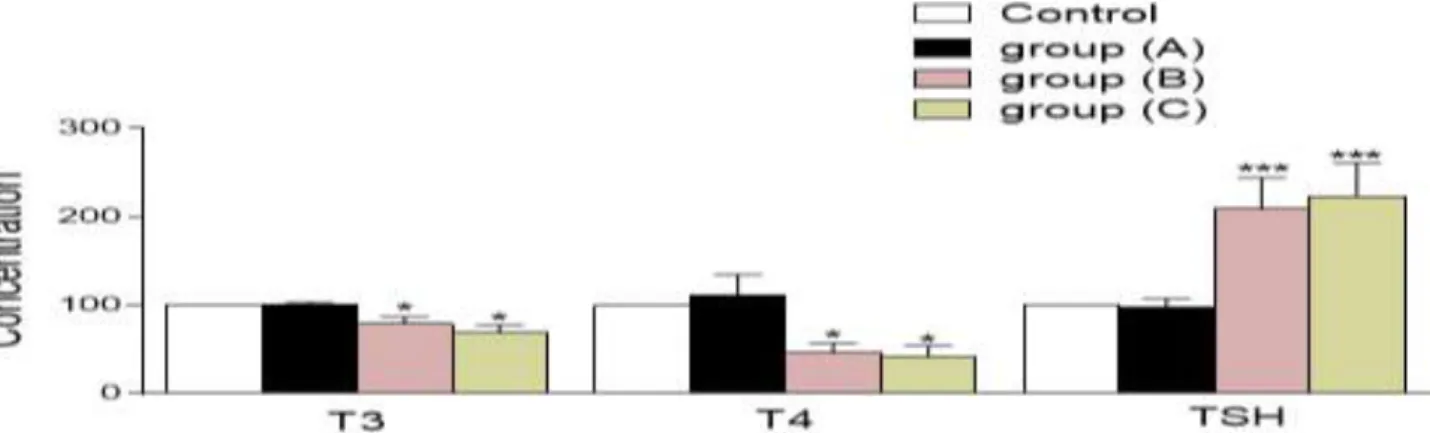
was noticed from the first month after the administration of mixed program in (group C) continue to increase in the second month as well, and it involves groups A and B, both groups showed a significant increase (P<0.05) in the level of TSH hormone as compared to control group shown in (Figure-3-)
The increment in the TSH level was
accompanied by a significant decrement in T3 and T4 (P<0.05) levels for B and C groups (Figure-3- ). No significant difference in the group (A) as compared to control.
Third Month
The level of TSH hormone continues to
increase. A significant increase (P<0.05) was noticed for A and B groups as well as the C group shown in Figure 4.
Significant decrement (P<0.05) was noted
Figure 1: The levels of T3, T4, and TSH hormones were measured for the three different ovarian stimulation program groups (A, B, and C). No significant difference was found in measuring the baseline hormone among the different groups as compared to the control group. A refers to (Clomid group), B refers to (Pergonal group), and (C) refers to (Mix group)
Figure 2: The levels of T3, T4, and TSH hormones were measured for the three different ovarian stimulation program groups (A, B, and C). A significant increase in the level of TSH hormone (P<0.05) was noted in the C group from the first month after ovarian stimulation as compared to the control group. This was associated with a significant decrease (P<0.05) for the T4 hormone level, while T3 show no significant difference. A (Clomid group), B (Pergonal group), and (C) (Mix group)
Figure 3: The levels of T3, T4, and TSH hormones were measured for the three different ovarian stimulation program groups (A, B, and C). A significant increase in the level of TSH hormone (P<0.05) was noted in the B and C groups in the second month after ovarian stimulation as compared to the control group. This was associated with a significant decrease (P<0.05) for T4 and T3 hormone levels. A (Clomid group), B (Pergonal group), and (C) (Mix group)
Discussion
For fifteen years the relation between ovarian stimulation program and thyroid function has been a topic of debate. It has been believed that thyroid function has an impact on the outcome of ovarian stimulation program, if this hypothesis is true it means that in completely healthy women the axis that includes thyroid- Pituitary- hypothalamus can counteract these changes through increasing thyroid hormone synthesis and release [9].
Some studies related to the presence of auto-immune antibodies against thyroid to the adverse outcomes in women undergoing ovarian stimulation. However, it has not been confirmed whether the presence of thyroid auto-anti-bodies or TSH increments after ovarian stimulation affect the quality of ova, fertilization, pregnancy, and the rate of living birth [10].
One of the important findings of this study is that different types of ovarian stimulation programs which are applied through different time duration will result in different levels of TSH, T3, and T4 concentration, for example, group (A) in this study who used only Clomid (100 mg/day starting from the 2nd day and for five days) showed no significant difference (P>0.05) in the concentration of TSH hormone as compared with control group for two months of Clomid administration.
However, this finding disagrees with several other studies that also investigated the effect of Clomid on thyroid functionwhere most of them confirm the increase of TSH hormone concentration which indicates a decrease in T3 and T4 concentration [11,12]. There was a different story for women in the group (B) who used Human menopausal gonadotropin, the measurement of hormones level at first month after ovarian stimulation showed no
significant difference in the level of TSH, T3, and T4. In the second month, a significant decrease (P<0.05) in the level of T3 and T4 were noticed as compared to the control group. However, the concentration of TSH remains within the normal range.
The ovarian stimulation with Human menopausal gonadotropin for the third month results in significant increase (P<0.05) in TSH level per contra T3 and T4 levels they were significantly decreased (P<0.05) as compared to control group, this finding agrees with many other studies that confirm the impact of ovarian stimulation programs on thyroid function [13].
Finally, the women in group (C) who used a mix drugs, Clomid with human menopausal gonadotropin showed a rise in the level of TSH (P<0.05) from the beginning of the stimulation and for the successive three month of the administration ovarian stimulation, which is similar to other finding from many studies that investigated thyroid function in women undergoing controlled ovarian stimulation[14,15].
Conclusions
The current study confirms a strong relationship between the type of ovarian stimulation applied and the level of thyroid hormones in the blood based on the duration of exposure to ovarian stimulation drugs. The increase in the TSH hormone may be noticed in the first month of drug administration or within three months of stimulation. More research and investigation are needed to further explore the relation between thyroid function and different types of ovarian stimulation drugs and to explore the effect of thyroid auto-antibodies on the function of thyroid hormones and reproductive outcomes in women having controlled ovarian hyperstimulation. ain text paragraph.
References
1. Pacchiarotti A, Selman H, Valeri C, Napoletano S, Sbracia M, Antonini G, et al (2016) Ovarian Stimulation Protocol in IVF: An Up-to-Date Review of the Literature. Curr. Pharm. Biotechnol., 17(4):303-15.
2. Muller AF, Verhoeff A, Mantel MJ, De Jong FH, Berghout A (2000) Decrease of free thyroxine levels after controlled
ovarian hyperstimulation. J. Clin Endocrinol Metab., 85(2):545-8.
4. Mariotti S, Beck-Peccoz P (2000) Physiology of the Hypothalamic-Pituitary-Thyroid Axis. In: Feingold KR, Anawalt B, Boyce A, Chrousos G, Dungan K, Grossman A, et al., editors. Endotext [Internet]. South Dartmouth (MA): MDText.com, Inc.; [cited 2019 Oct 29].
Available from:
http://www.ncbi.nlm.nih.gov/books/NBK27 8958/
5. Zhang J, Wang Y, Mao X, Chen Q, Hong Q, Cai R, et al (2017) Dual trigger of final oocyte maturation in poor ovarian responders undergoing IVF/ICSI cycles. Reprod Biomed Online, 1: 35(6):701-7.
6. Du Y-J, Xin X, Cui N, Jiang L, Yang A-M, Hao G-M, et al (2019) Effects of controlled ovarian stimulation on thyroid stimulating hormone in infertile women. Eur. J. Obstet. Gynecol. Reprod Biol., 234: 207-12.
7. Gracia CR, Morse CB, Chan G, Schilling S, Prewitt M, Sammel MD, et al (2012) Thyroid function during controlled ovarian hyperstimulation as part of in vitro fertilization. Fertil. Steril., 97(3):585-91.
8. Reh A, Chaudhry S, Mendelsohn F, Im S, Rolnitzky L, Amarosa A, et al (2011) Effect of autoimmune thyroid disease in older euthyroid infertile woman during the first 35 days of an IVF cycle. Fertil. Steril., 1: 95(3):1178-81.
9. Haller K, Sarapik A, Talja I, Salumets A, Uibo R (2006) Controlled Ovarian Hyperstimulation Changes the Prevalence of Serum Autoantibodies in In Vitro Fertilization Patients. Am J. Reprod. Immunol., 56(5-6):364-70.
10. Aljarad M, Alhalabi N, Hamad A, Nmr N, Abbas F, Alkhatib A, et al (2019) Prevalence of Thyroid Autoimmune Antibodies in Women Seeking Fertility Care in Damascus, Syria. Cureus [Internet]. [Cited 2019 Nov 3];11(8).
Available from:
https://www.ncbi.nlm.nih.gov/pmc/articles/ PMC6773447/
11. Henawi WM, Aljahdali MO (2018) Effect of Clomiphene Citrate on Thyroid Hormones T3, T4 and TSH Levels in Mice Offspring. Endocrinol Diabetes Res [Internet]. 2018 Apr 26 [cited 2019 Nov 3];2018. Available from:https://www.scitechnol.com/abstract/e ffect-of-clomiphene-citrate-on-thyroid- hormones-t3-t4-and-tsh-levels-in-mice-offspring-7268.html
12. Mild Low Thyroid Levels May Affect a Woman’s Fertility [Internet]. [Cited 2019 Nov 3]. Available from: https://www.webmd.com/infertility-and- reproduction/news/20171220/mild-low- thyroid-levels-may-affect-a-womans-fertility#1
13. A B, January 5 et al (2016) EP 2015 doi: 10 4158/EP15933 O, Controlled ovarian hyperstimulation may affect TSH levels [Internet]. [cited 2019 Nov 3]. Available from:
https://www.healio.com/endocrinology/thyr oid/news/online/{2e723bb3-bc1b-4d18- a123-9ba6116cc21d}/controlled-ovarian-hyperstimulation-may-affect-tsh-levels
14. Akhtar MA, Agrawal R, Brown J, Sajjad Y, Craciunas L (2019) Thyroxine replacement for subfertile women with euthyroid autoimmune thyroid disease or subclinical hypothyroidism. Cochrane Database Syst. Rev. [Internet]. [cited 2019 Nov 3];(6).
Available from:
https://www.cochranelibrary.com/cdsr/doi/ 10.1002/14651858.CD011009.pub2/referen ces