CONCEPTS AND SIGNIFICANT INDICATORS FOROPTIMIZATION OF
INTEGRATION CORPORATIONS SUBJECT TO INNOVATION IN THE
CONTEXT OF DIGITAL ECONOMY
RADU O.1)
1))INMA Bucharest / Romania
E-mail:[email protected]
Keywords:digital economy, optimization, innovation, systems engineering.
ABSTRACT
Application integration indicators to optimize the significant subject to corporate innovation in the digital economy will succeed only in companies based computer systems knowledge. Companies under subject innovation-based knowledge systems can be called pillars of intelligent digital economy which ensures competence, actions and sustainable performance, competence and performance is achieved through innovation, learning and interactivity partnership .
INTRODUCTION
European Commission included the digital economy in Europe 2020 growth strategy as one of the pillars of the EU's economic recovery. Several other legislative proposals to address certain deficiencies in the Digital Single Market ranges from online payment services from regulations on data protection.(1)
The digital economy resulting from computers interaction, communication networks, Internet and applied electronic techniques for economic-engineering systems.
Characteristic features of the digital economy are mainly the following:
Creating a new business model based on e-business, e-commerce, e-banking, which operates via Intranet and Internet and realize greater efficiency in the entire structure production- market.
Estimate requests for products and services based on consumer needs and desires. The consumer becomes the new context a source of innovative ideas for the producer idea of expanding the market and to sustaining economic development.
The interaction between competition and cooperation based on the correlation between supply and demand. Competition gives priority to consumer needs and desires so that it compels competitors to cooperate.
Higher consumption of work in domain products conception and quality services and pricing options offered competitive market based on new added value.
Compliance with the following principles - as many people are involved in the digital economy so everyone's advantage increases supporting the development of digital economy through persuasion, through accessibility, through availability, through rational use of available resources and through adequacy.
The digital economy is based on information technology and communications techniques which require: increased computerization expenses compensated by increasing productivity by 300%;introducingcomputer-aided re-enginering to reduce manufacturing costs, financial markets must be opened to innovativefinance; incrising entrepreneurship by encouraging practical computer assisted systems and adjusting monetary policy by reducing interest on engaged loans (2).
Microeconomic consequences of digital economy development aimes:
of infrastructure in accordance with international standards; development of dynamic interactions between suppliers and consumers; correlation between competition practical requirements - fair competition and cooperation; citizens' behavior transformation from reactive to practical action which increases their chance of creativity and innovation; electrical trade development (e-Commerce) locally and globally.
The main steps to go of local and global electronic commerce are:
local and global electronic commerce refers to the exchange of products and services over the internet between national and international partners on the competitive market.
the investigations made show that after a first wave of global approaches have emerged and developed multiple uses local electronic commerce which led to the emergence of electronic market type business - "business", that with time it will turn in global electronics commercial environments; marketing strategies tend to become global based on holistic models business; electronic markets based currently on global structure will get a global infrastructure based on export associations.
rapid transition to the new digital economy is imperative to align at the development of knowledge based societies (3).
Main characteristics and laws governing the digital economy of engineering systems may be presented in the next synthesis of new dynamic ideas such as:
new economy is found in specialized literature under the following names: digital economy or computerized economy; informational economy or electronic economy, global economy;economy of communication networks. Regardless of name the rational core of the new digital economy refers to communities where people work with brains instead of hands, appeared a new world where innovation is more important than mass production; a world where rapid change has become a constant, a world so different from everything that has been and that can be described as a digital revolution.
digital revolution is based on network economy stronger than the levels of progress generated by hard-softw correlation known at the beginning of the new millennium.network economy creates wealth faster than the traditional economy. it relies communications between computers link together through network creating relational economy with high dynamic connections in the detriment of computerization. the core of this economy is present communication based on knowledge which causes an expansion of inovativ communication relations (find and invent, teach and educate, destroy the old and build the new, saves time based on work designed by the brain etc).
technology did not led to an explosion in productivity (4).
This must be focused on co-investing in workforce qualification, in infrastructure transformation through innovation, by extending the innovations and inventions at all levels of technological-managerial, and stimulating collaboration with all active and potential partners. New digital economy operates with the following synthetic descriptors: dynamic market; global competition; relational logistics (entrepreneurial); high mobility business; flexible production based on innovation and knowledge and digital technology that gives quality and competitive prices); relationships based on alliance and collaboration; salaries payable depending on results, continuous learning for multiple training; risk avoidance, use of flexible market instruments, training and use managers working on converging re-enginnering coordinates with maximum responsibility.
Indicators co-measuring the digital economy are classified as:
Indicators of quantifying structural transformations on industrial and occupational mix, globalization, entrepreneurial dynamism and information technology revolution.
The degree use of advanced technologies in all fields of an evolving economy. Indicators of measuring export of products and services.
Co-measuring the number of workplaces that relate to the needs of the new economy.
Indicators quantifying brain effort in creating and achieving products and services. Indicators for the informatization of work processes to determine the number and
success managers coaches in determining the level of performers education. Indicators for profitability tele- leadership business process (production-marketing)
capable of adding value to products and services offered competitive market. Indicators for promoting innovation in order to increase labor productivity based
on knowledge.
Indicators for determining the degree of capital markets globalization to integrate national firms in the global economy.
Indicators for determining the share of workforce engaged in manufacturing of products and services for export and determine the weight of workforce employed in companies owned by non autochthonous investors.
Indicators of innovations and inventions infusion in the technological - managerial field and specialists experience in diverse business sectors multifunction view to adopting modern industrial practices required by the digital economy.
Indicators measuring employment in the dynamic companies (gazelle thread) which increased annual sales by over 20%.
Indicators of quantifying the economic agitation followed by the emergence of new performing companies and bankrupting traditional business.
Indicators for determining the degree of penetration of information technology in various sectors of education and how to use computers to deliver services to the competitive market.
Indicators quantifying the number of specialists (scientists, engineers, managers) who created and applied its own inventions, which are involved in development and R & D investments and avoid the country risk.
Indicators determining the contribution of new information technologies to GDP growth.
MATERIAL AND METHOD
The principlesof economy informatics based on knowledge (relational digital economy built on communication networks) can be synthesized in the following operational forms (5):
1. The principle of delineated human resources in the Planet Earth to conquer outer space.
2. The principle of reintegration of human in nature to work in harmony with it.
3. The principle of non environmental degradation and increasing biodiversity and bioproductivity.
4. The principle of integrated conservation and rational use of resources. 5. The principle of integrated conservation and rational use of resources.
6. Principle of global economic efficiency that takes into account all efforts to restore activity due interactive nature of humans in relation to the ambient.
7. The principle of social equity to reduce disparities in income, avoid discrimination including ensuring equality of opportunity for affirmation for the entire human community.
8. The principle assertion state establishment and functioning the new economy that will move the gravity center for the public interest.
9. The principle of conservation technocracy based on ensuring priorities in education and scientific research.
10. The principle of ensuring continuity and complementarity to economic -engineering approaches for integrating development processes subject to globalization.
Applying these guidelines and indicators will only be successful in the companies based on computer- knowledge systems.Campaigns based knowledge systems are the pillars of intelligent relational digital economy ensuring competence, actions and sustainable performance.Competence and performance ensures through innovation, learning and partnership interactivity.
These purposes applied in multifunction systems based on knowledge enable the development-processes creating knowledge simultaneously with their learning by managers and performers idea to extend interactivity partnership through innovation, learning and applying new decision with the aim of designing organizations agile that lead to success for all activity through operability approaches stemming from knowledge.
between goals, means and results in relation to the environment to interact coordinated in relation to common values.
These corporations understand that fund knowledge is the performance key but in the field of overall strategy. Intellectual-intensive processes are not only predominant but also decisive for development of its new structure in which managers and performers have exceptional responsibility in knowledge management and in building an organizational culture based on innovation, creativity, competence, learning and communication dynamics.
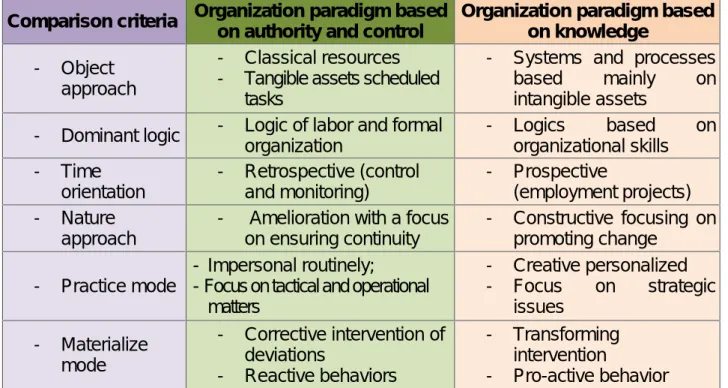
The succession of leading models organizations in the dynamic evolution of functional structures meet the following hierarchy:Functionalhierarchy, divisional hierarchy; strategic business units; logistics matrix and logistics type network.Corporations attributions based on knowledge are mainly the following: logistics type network where each post has functional connections with all existing posts in organizational management; strategy is oriented towards intellectual intensive knowledge; dynamic changing has a kaleidoscopic character; performance is based on capacitive intellectual impact on technological and managerial structures; quality of human resources is notable by professionals who self-lead; efficient functioning of corporations is based on knowledge flows from / to outside, technology has in its structure intelligent knowledge processors. Comparison managerial practices can be followed in Table 1:
Table 1 Comparison criteria Organization paradigm based
on authority and control
Organization paradigm based on knowledge
- Object
approach
- Classical resources - Tangible assets scheduled
tasks
- Systems and processes
based mainly on
intangible assets
- Dominant logic - Logic of labor and formal
organization
- Logics based on
organizational skills
- Time
orientation
- Retrospective (control and monitoring)
- Prospective
(employment projects)
- Nature
approach
- Amelioration with a focus on ensuring continuity
- Constructive focusing on promoting change
- Practice mode
- Impersonal routinely;
- Focus on tactical and operational matters
- Creative personalized
- Focus on strategic
issues
- Materialize mode
- Corrective intervention of deviations
- Reactive behaviors
- Transforming
intervention
- Pro-active behavior
From the analysis of these practices we highlight the company centered on memory:
-type dominant ofmanagerial relationship based on multilateral cooperation;
RESULTS AND DISSCUSSIONS
Organizational knowledge management is a strategic approach - calls the cognitive abilities of human resources and the degree of incorporation of artificial intelligence programs including how they apply to the management of digital units in order to achieve quality products at a competitive price. Organizational knowledge has two training modes, namely articulated knowledge (explicit) and tacit knowledge (the default setting (6).
The new management guidelines such as company management based on knowledge, organizational learning, developing intelligent systems that attest knowledge of originality in diversity.Thus, a number of companies have transformed their business in knowledge centers or have become firm universities.
The application of new knowledge management solutions have led to outstanding achievements and create companies producing normal intellectual assets (bonds consulting, research laboratories and intellectual-intensive products (specialized electronic products, dedicated software products etc).In this context libraries have created of neuro-informatic programs, maintenance of dictionaries to unify specific language to the creation of forums for field development and elaborationof educational products-programme, development of skills in knowledge management; including international projects in the field of knowledge management, innovation and organizational learning such as MACIS European project studying the impact of knowledge on the curriculum of higher education management.
Other concerns to the practical applications of knowledge management refers to the following trends: creating forums with relevant functions in knowledge field so as to expand the initiative -Europe innovation, establishment of the World Bank functions for economic development based on knowledge, the creation of open organizations such as:European Consortium for the Learning Organizaţion, Federation for Entreprise Knowledge Development, Global Knowledge Economics Concept.
The endorsement by managers and performers of ethics legitimacy responsible for their actions on the idea of opening knowledge to cooperation based on partnership.
Centering behavior of human resource on community value of professionals.
- Assimilation and expansion of management practices of advanced generation specific in knowledge areas.
- Adoption at management level of the oriented style towards facilitating specialists actions with outstanding results in knowledge.
- Support production of knowledge at corporate level by: setting up creativity workshops, building intelligent systems of management skills, facilitating the development of organizational learning processes, companies development as a professional community and organization work projects.
Digital companies relevance based on knowledge in our country derives from tasks that we have on sustainable development of the whole economy. Is risky the assumption of prejudice that such companies on the future would cost enormous.It is known that the Romanian organizational environment did not make an exception to the orientation towards knowledge, but the trend was manifested only within firms without covering the sphere of cooperation between companies. Creating Romanian organizations based on knowledge is necessary for asserting indigenous creativity as primary source of competitiveness in the international environment with clear trends of globalization. Ensuring the feasibility of development projects of Romanian companies based on knowledge requires compliance with the priority of the following requirements:
- Creating trainers for new skill profiles.
- Implementation at national level of new curricula designed to deepenknowledge management.
- Designing specialized pathways through special programs to increase the quality of the human factor (MSc, MBA, PhD).
- The development of knowledge based companies through energy scenarios and strategic scenarios.
- Creation of knowledge based societies is conditional on the existence of intelligent organizations that have the capacity to manage their collective skills as sources of performance and dynamic excellence.
- Projects for the establishment of knowledge based organizations requires strategic engagement and managerial ingenuity in combining intelligent informatization practices on innovation, learning and partnership interactivity.
New forms of employment in the knowledge-based multifunction systems are mainly the following: telework, teleactivities and cybernarketingul. On large systems level that shape digital economy emerge and develop various e-activities such as e-education, e-business, e-commerce, e-medicine, e-governance. A new approach they fall within the concept called Teleactivities.
Intelligent networks that can shape information systems of economic engineering in the design phase and the exploatation phase and of evolution phase that have the following features:
- Information infrastructure capable of stimulating creation providing competitive advantages as intelligent networks are high-speed information.
- Revolutionizing communications capabilities specialists creating conditions for the development of new products and services including the creation of new work places.
- Support the development of new trends in ensuring the digital services anywhere, at any time and an intelligent environment that enables the transformation of knowledge into goods and possible approaches used for decision for innovation and technological- material structures development of market integrated firms.
- Conceptual model of intelligent network comprises four levels, namely: the service plan with all the operational facilities, functional plan that includes process based dialing knowledge of informatics;distributed activities plan that include functional units, independent service blocks in correspondence with the operational entities;and physical plane that reflects physical the architecture variants and applications protocol.
Functional vectors of multipurpose systems based on knowledge refers to the following activities:
Knowledge management systems in typical and atypical organizations and companies.
Moral use management of knowledge at global level,
Knowledge of biological, genomics and functions that determine human genes.
Systems of disease eradication at various social levels.
Ensuring sustainable development of information society based on knowledge and environmental protection management.
Strengthening knowledge of new technology based on nanoelectronics.
Developping innovative culture based on knowledge.
Designing an education system based on knowledge (e-Leaming) stemming from neurexpert systems applications.
In this perspective will be researched hidden reservoirs of knowledge that must be extracted, captured, organized and transferred to help increase the efficiency of the whole arsenal of functional activities including the potential ones.Modes to address (potential) strategic knowledge by some authors are the following:knowledge is a product that must be valued; knowledge transfer to be achieved by the most effective methods; knowledge deliver results when is focus towards the client;the human being responsibility for knowledge must be maximized,management strategy of intellectual asset must be designed on creativity and continues innovation to make effective use of the intellectual capital of the entire staff (professionals, managers, performers, brokers, financiers, etc.) (7).
Moral management use of knowledge at global level should be done taking into account the following information:
- The danger of knowledge based systems can be outlined the idea of expanding to the full the privatization of knowledge.
- Balance between economic and moral use of knowledge must fall within the concern of the office manager of knowledge within companies.
Wide dissemination of knowledge to be made free of charge or at a very low price. This trend is blocked by intellectual property introduced in national and international laws in recent years.
- Knowledge privatization contempt should be encouraged. In this endeavor the MIT Boston University who edited on the Internet all its courses without charging knowledge acquisition the contents of 50 university textbooks.
In the context of the digital economy is focus on economy of intangible assets as a basis for economic thinking based on efficient knowledge. So the new economy will become powerful if it comprises digital economy based on Internetplus the intangibles assets value, including their performance use plus ensure the socity sustainability related with the environment and new rules for applying new concepts.It appeared along these coordinates and will develop a top era the knowledge of value creation transformation of multifunction systems in evolution.
For the combined approach of knowledge based systems and those based on computer consciousness shapes they need at Romanian economy level subject to innovation to be apply the following guidelines:
- Developping a programme of combining strategy of informatic systems with the knowing and knowledge based on European economies guidelines.
- Developing cooperation in this area with European Union and USA-JAPAN to develop digital economy (creation of information society, knowledge society and society joined systemic conscience).
- Use of electronic books and the development of trade via the Internet is indicative vectors for the construction and development of the digital society (informatics, knowledge, consciousness).
- The introduction of information technology courses in university education and doctoral training specialists in the digital economy field.
- Internet use in preparing the Romanian economy's globalization strategy taking into account the self-organization of world society.
- Developping a policy of knowledge and innovation for all companies based on European Union models.
- Establishing and developing a performing concept of knowledge management and appling it across Romanian economy.
establishment of offices of knowing in the companies and training managers as coaches who will work coordinates converged engineering.
Indicators for assessing informationale companies refer to the following operational aspects (7):
Information infrastructure class including access to network.
Educational class for structure and functionality of information systems. Social class and organizations subject to informatization.
Economy class informatic assisted.
Class regulatory of integration systems under political aspect. Class with absorption potential of communication technologies.
Class with assessing potential of achieving products and services based on information technology.
Class with synthetic indicators of socio-educational issues, information infrastructure problems,computer-aided engineering and economic problems. Class of hierarchy indicators of design solutions of industrial and social and
economic objectives.
Class of indicators for managerial operators to support sustainable development.
In the first five class structure indicators aim to quantify the following effects: the effect of information infrastructure on the economy subject innovation through Internet redundancies taking into account the cost of access, quality and speed of communication networks, functionality of informatic support hardware and software, etc.
Group of indicators on education through an information system quantifies the following effects: the number of computers per school unit allowing students access of two students to each computer,human resources to be scheduled to specialized online courses;the number of domains registered on the Internet 20-1000 inhabitants, information technology in their work should contribute to increasing labor productivity (100-5-300)%. Group of indicators on economy under political restrictions quantifies the following effects: employment opportunities in information technology after specificity of the third millennium - everyone at display, e-commerce development nationwide to worldwide with quality goods and services, fully liberalized trade and political risk reduced production.
Liberalized electronic commerce requires building global electronic markets both nationally and globally.
CONCLUSIONS
Unique approaches of optimal innovation under economically-managerial aspects present in applicable research at profitable companies subject innovation are mainly the following:
- Completing the current structure of economico-financial and technologically-managerially indicators with new complex relationship dictated by increasing the value of products for the competitive market.
- The success of states in the new digital economy will be determined by how they manage to boost technological innovation, entrepreneurial relationships, specialized qualifications with shifting public and private companies from the bureaucratic hierarchy at networks empathy based on continuous learning and applications generating new utility values.
- Optimal development of new businesses assisted by intelligent agents that ensure efficient deployment of computerized marketing;
BIBLIOGRAPHY
1. OPRESCU Ghe., ELEODOR D., International Conference of the Institute for Business Administration in Bucharest, 2014,The Digital Economy: Challenge or Growth Driver for SMinEs and Corporations?
2. M. Hammer, J. Champy, 1998, Reengineering the Corporation: It's time to Rething Your Assumptions, Executive Book Summaries
3. M. Sănduleac, 1993, Reţeleneuronale „feed-forward" şiKohonen - implementation solutions and behavioral studies (soluţii de implementareşistudii de comportament);Energetica Publishing no.
4. Manolea B. 2003 Introduction to e-commerce(,,,Introducere in comertul electronic”),Training session,, - E-commerce and Legal Challenges " Sesiunii de
training ,,Comertul electronic - ProvocariJuridice”, ELSA Romania
(http://www.legiinternet.ro/);
5. Bergeron B,2003,Essentials of Knowledge Management,Publishing No.1, ISBN 978-0-471-28113-9; Wiley
6. Marin A., 2011, Expert and neuroexpert system applicable to the level of integrated business processes (Sistemul expert şineuroexpertaplicabile la nivelulproceselor integrate de afaceri),Management Magazine and Engineering Management