Abstract—A series of NiO/ZnO/HZSM-5 catalysts were prepared by impregnation method with varying ZnO loading ranging from 0-2 wt% and keeping 4 wt% NiO loading constant. It was found that the ZnO/NiO modified HZSM-5 catalyst was highly active and selective towards ethanol conversion to hydrocarbons at 410 °C, WHSV = 3.5 hr-1 and pressure = 1 atm. A comparison has been done to study conversion and yield of different wt% of ZnO/NiO over HZSM-5 catalyst. The performance of catalysts was evaluated by conducting experimental run in fixed bed reactor under identical conditions. The major products of the reaction were methane, ethylene, propylene, ethylmethyl ether, toluene, ethyl benzene, xylene, isopropyl benzene, ethyl toluene, and trimethyl benzene and tetra methylbenzene.
It was observed that ZnO and NiO modified HZSM-5 reduces the rate of deactivation of catalyst. It was also observed that 1.5 wt% ZnO/4 wt% NiO/ HZSM-5 catalyst was highly reactive for ethanol conversion to hydrocarbons. In addition HZ (1.5 Zn/4 Ni) modified catalyst suppressed the coke deposition without affecting product yield and conversion.
Index Terms—Ethanol, HZSM-5, catalyst deactivation, doping with NiO and ZnO.
I. INTRODUCTION
Depletion of fossil fuel and energy crises have led to high demand of hydrocarbons and this in turn has resulted into research relating to production of biofuel such as conversion of bio-ethanol into hydrocarbons. Ethanol can be obtained in large quantity by fermentation of byproduct of sugar industry. In countries like India, production of ethanol can be enhanced because there is plenty of sugarcane. Thus it can be used as raw material for the production of ethanol. Ethanol is produced from plant and residue such as agricultural crop, municipal waste and agricultural and forestry by product. Ethanol can directly be converted into hydrocarbons.
The ethanol obtained by fermentation of vegetable biomass and agricultural residues can be used as an alternative to petroleum as a result it proves to be beneficial for both agricultural activity and the local fermentation industry [1].
ZSM-5 catalyst had been used in the conversion of cheap and readily available compound such as biomass into more valuable hydrocarbons [1]-[7]. Propylene is mainly produced
Manuscript received June 4, 2015; revised July 16, 2015.
Hasan Akhtar Zaidi was with the University School of Chemical Technology Guru Gobind Singh Indraprastha University Sector 16-C Dwarka New Delhi, 110078 India. He is now with the Department of Chemical Engineering, Z.H. College of Engineering and Technology, Aligarh Muslim University, Aligarh 202002, India (e-mail: [email protected]).
Thamer Adnan Abdullah is with the Applied Sciences Department, University of Technology, Baghdad, Iraq.
as a co-product of ethylene by the steam cracking of naphtha. Increasing oil prices and effort for environmental protection has lead to development of other routes for propylene production, especially from bio-ethanol by the fermentation of biomass.
Phosphorous treated catalyst has high activity and selectivity to ethylene [8], [9]. At present catalytic conversion of ethanol to olefins using ZSM-5 catalysts has been studied due to increase in worldwide demand of ethylene and propylene in the market [8], [10]. Ethanol can naturally be added to gasoline pool but incorporation at high levels requires modification of motorization system. Bioethanol conversion into hydrocarbons has been studied using HZSM-5 [1]-[3], [7], [11]. Catalytic dehydration of ethanol to ethylene has been investigated [1], [2], [4], [9], [12]. ZSM-5 catalyst modified with various metals has been used for conversion of ethanol to hydrocarbons. It was investigated that moderate surface acidity was optimum for the production of hydrocarbons [1], [3]-[11]. ZSM-5 modified with lanthanum and phosphorous over HZSM-5 catalyst at 573K, gives higher conversion and reduce coking [8]. H3PO4/H-ZSM-5 catalyst was prepared by impregnation
method by varying H3PO4 loadings from 5 to 20 wt% [12].
In this study the influence of ZnO/NiO loading over HZSM-5 catalyst has been investigated for the selective conversion of ethanol and hydrocarbon yield. Effect of ZnO/NiO loading over HZSM-5 catalyst was also investigated for improvement of catalyst activity and selectivity for ETH process. The catalysts were characterized by different technique including BET surface area analyzer, Scanning Electron Microscopy (SEM), X-ray diffraction (XRD) and thermo gravimetric analysis (TGA).
II. EXPERIMENTAL A. Catalyst Preparation
HZSM-5 (Si/Al = 80) is the catalyst used for ethanol to hydrocarbon conversion was supplied by Süd Chemie (Germany). The starting HZSM-5 was used as a support for zinc oxide and nickel oxide respectively. Other starting material such as zinc nitrate salt and nickel nitrate salt was procured from Merck (Germany). Catalyst was prepared by doping separately prepared by impregnation techniques. The final solution was stirred for 12 h at 303 K. The final catalyst slurry was transferred to a rotary evaporator to remove excess water under vacuum at 353 K followed by drying in an oven at 393 K for 12 h. The dried pellets were calcined in a furnace at 823 K for 5 h to decompose zinc and nickel complex to ZnO and NiO.
Effect of ZnO and NiO Modified HZSM-5 Catalyst for
Ethanol Conversion to Hydrocarbons
B. Catalyst Characterization
The prepared catalysts were characterized by X-ray diffraction (XRD), Surface area and pore size analyzer, Metal trace analyzer and Scanning electron microscopy (SEM). The surface areas and pore volumes of the catalysts were determined by using ASAP 2010 (Micromeritics, USA) by adsorption with nitrogen (99.99 % purity) at 77 K, employing the static volumetric technique. Prior to the analysis the catalysts samples were degassed for 6 h at 383 K under vacuum. The samples were placed in the evacuated sample tube, cooled to cryogenic temperature and then exposed to the analysis gas at precisely controlled pressures. With each incremental pressure, the number of gas molecules adsorbed on the surface increases. The pressure at which adsorption equilibrium occurs was measured and quantity of gas adsorbed was determined. Adsorption/desorption sets of data were used to describe the isotherms. Analysis of the isotherm gave information about the surface characteristics of the material and was done by microcomputer processing software (ASAP 2010).X-ray diffraction patterns (XRD) of all the catalysts were taken in order to characterize the phases present and also the crystallinity of the catalyst. The diffraction patterns were measured by X ray diffraction method using Bruker D-8 advance X-ray diffractometer with monochromatic CuK- radiation and scanning 2θ from 00 to 400. The wavelength of adsorption was kept 1.54 A0. Catalysts samples were crushed and ground to fine powder for the analysis. The distance between crystal planes were calculated using Bragg’s law: nλ=2d sin θ where λ=1.54 A0 and 2θ were taken at particular peak height.To determine the actual amount of NiO and ZnO doped over HZSM-5, and the Si/Al ratio, the catalyst samples were digested with nitric acid at 353 K for 2 h under reflux. The final metal content on the catalyst was determined by a metal trace analyzer (Metrohm 757 VA Computrace, Switzerland). A standard solution of zinc nitrite and nickel nitrates was used for calibration for this purpose.To obtain surface textural details of the support, scanning electron microscopy (SEM) of fresh and used samples were done. The morphology and structure of the catalysts were studied using Hitachi S-3700N scanning electron microscope (SEM). TGA was used to analyze weight loss during heat treatment and to estimate the coke deposited on the catalyst surface after reaction. Thermo gravimetric profiles were recorded on a (TA Q-500 instruments, USA). The TGA was performed with the heating rate of 10 °C/min to attain final temperature of 800 °C and air was passed at a controlled rate. The variation in mass of the catalyst was determined with the increase in temperature.
C.Catalyst Testing
ETH reaction was conducted at 410 °C in fixed bed reactor. All the catalysts were compared for their performance for ethanol conversion by conducting experiments under identical conditions. The reaction temperature was measured by K type thermocouple inserted in the reactor through thermocouple well. Prior to reaction, the samples were pre-treated in nitrogen at 410°C for 2 h. Liquid ethanol was evaporated by preheater at 200°C. Ethanol was fed to reactor by a dosing pump and vaporized ethanol was made to enter in reactor at WHSV=3.5 h-1.The reactor effluent was analyzed
by two gas chromatographs equipped with flame ionization detector and thermal conductivity detector. In flame ionization detector the capillary column was used to determine the C1-C12 hydrocarbons.
III. RESULTS AND DISCUSSIONS A. Catalyst Characterization
XRD pattern of HZSM-5 catalyst doped with nickel oxide and zinc oxide are shown in Fig 1. All samples have shown similar structure of HZSM-5 catalyst. The XRD pattern shows crystalline phase. The crystalline phase does not show characteristic peak of ZnO and NiO and the crystal phase of new species cannot be observed by XRD. With increase in ZnO loading, there is a slight decrease in the intensity of the peak. Loading of ZnO and NiO over HZSM-5 catalyst does not change the structure of HZSM-5 Catalyst [13]-[20]. It was observed that over all structure of the catalyst remained same.
Fig. 1. XRD patterns of HZ (0), HZ (1.5Zn/4Ni) and HZ(2Zn/4Ni) catalysts.
TABLEI:PHYSICAL PROPERTIES OF THE CATALYSTS
Catalyst Metal content (wt%)
ZnO NiO
SBET
(m2/g) Fresh Coked *
Pore volume
(cm3/g) Fresh Coked*
HZ(2Zn/4Ni) 2 4
185.4 178.5 0.270 0.268
HZ(1.5Zn/4Ni) 1.5 4
198 190.4 0272 0270
HZ(Zn/4Ni) 1 4
204.6 195.4 0.273 0.271
HZ(0.5Zn/4Ni) 0.5 4
210 201.5 0.274 0.273
HZ(0) 0 0
227 219 0.278 0.274
*Run time 30 h
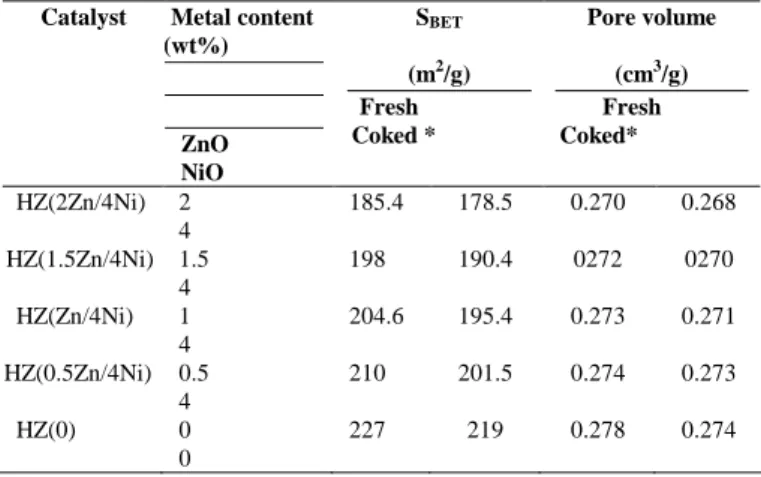
decreased on increasing ZnO and NiO loading [32], [34], [35]. Volume of N2 adsorbed decreased with increasing in Zinc
oxide and Nickel oxide content due to partial coverage of surface area with ZnO and NiO. The decrease in pore volume of the catalyst is due to the penetration of zinc oxide and nickel oxide in the pores of the HZSM-5 catalyst as can be seen in the Table I.
Fig. 2. SEM micro graphs of the sample (a) HZ (0) and (b) HZ (1.5Zn/4Ni) catalyst.
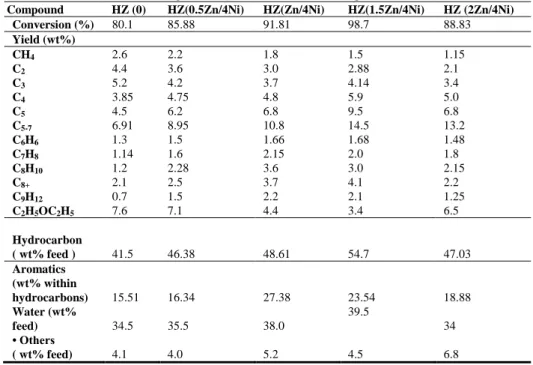
The surface area decreases from 227 m2/gm on HZ(0) to 185.4 m2/gm on HZ(2Zn/4Ni) with increase in ZnO doping and keeping 4 wt % NiO constant. The total pore volume is reduced from 0.274 to 0.268 cm3/gm with increase in metal oxide content. During experimental run, it was found that coke further filled the pores of the catalyst because of which there is decrease in pore volume and surface area. It was observed that the surface area and pore volume of HZ (2Zn/4Ni) was lower as compared to HZ (0), HZ (0.5Zn/4Ni), HZ (Zn/4Ni), and HZ (1.5 Zn / 4Ni) after an experimental of 30 hr under identical conditions. The detailed product distribution with all the catalysts is compared in Table II. The major products of the reaction were methane, ethylene, propylene, ethylmethyl ether, toluene, ethyl benzene, xylene, isopropyl benzene, ethyl toluene, and trimethyl benzene and tetra methylbenzene.
Fig. 3. SEM Photographs of (a) HZ(1.5Zn/4Ni) and (b) HZ (2Zn/4Ni) catalysts after 30 h Run.
The TG analysis was performed to study the coke deposition on, HZ (1.5 Zn/4 Ni) and HZ (2Zn/4 Ni) catalyst after a run of 30 hr where HZ (0) was taken as a fresh catalyst. Fig. 4 shows a similar trend in the total weight loss up to 670 ˚C shows similar trend i.e 4.3 wt% lose, 8.7 wt% lose and 11.12 wt% loss for HZ (0), HZ (1.5 Zn/4 Ni) and HZ (2 Zn/4 Ni) respectively.
Fig. 4. TG profiles of HZ(0), HZ(1.5Zn/4Ni) and HZ(2Zn/4Ni) catatyst.
The weight loss below 200 °C is mainly due to the physically adsorbed water in the porous material. The weight loss in 200 - 400 ˚C was due to desorption of light coke and weight loss in 400 - 670 ˚C is due to the burning of heavy coke. The amount of coke deposition over the HZ (2 Zn/4 Ni) is more than HZ (0) and HZ (1.5 Zn/4 Ni). Fig. 4 shows that optimum loading of ZnO up to 1.5 wt% 0f 4 wt% NiO/HZSM-5 reduce coke deposition, which can enhance catalyst stability. Table II shows that there is a decrease in aromatic hydrocarbons yield on addition of ZnO upto 1.5wt% over 4wt%NiO/ HZSM-5 catalyst. The aromatic content causes coke deposition which at the end causes catalyst deactivation.
Fig. 5. Conversion of ethanol versus time on stream. Reaction condition [ T=410˚C, P=1 atm and WHSV=3.5 h-1].
Fig. 6. Yield of hydrocarbons versus time on stream, reaction condition [T=410 ˚C, P=1 atm and WHSV=3.5 h-1
TABLEII:EFFECT OF ZINC OXIDE AND NICKEL OXIDE LOADING OVER HZSM-5CATALYST ON THE PRODUCT DISTRIBUTION
[T=410˚C,WHSV=3.5 H-1,P=1 ATM]
Compound HZ (0) HZ(0.5Zn/4Ni) HZ(Zn/4Ni) HZ(1.5Zn/4Ni) HZ (2Zn/4Ni)
Conversion (%) 80.1 85.88 91.81 98.7 88.83
Yield (wt%)
CH4 2.6 2.2 1.8 1.5 1.15
C2 4.4 3.6 3.0 2.88 2.1
C3 5.2 4.2 3.7 4.14 3.4
C4 3.85 4.75 4.8 5.9 5.0
C5 4.5 6.2 6.8 9.5 6.8
C5-7 6.91 8.95 10.8 14.5 13.2
C6H6 1.3 1.5 1.66 1.68 1.48
C7H8 1.14 1.6 2.15 2.0 1.8
C8H10 1.2 2.28 3.6 3.0 2.15
C8+ 2.1 2.5 3.7 4.1 2.2
C9H12 0.7 1.5 2.2 2.1 1.25
C2H5OC2H5 7.6 7.1 4.4 3.4 6.5
Hydrocarbon
( wt% feed ) 41.5 46.38 48.61 54.7 47.03
Aromatics (wt% within
hydrocarbons) 15.51 16.34 27.38 23.54 18.88
Water (wt%
feed) 34.5 35.5 38.0
39.5
34 • Others
( wt% feed) 4.1 4.0 5.2 4.5 6.8
•Others include CO and CO2
B. Catalytic Activity
Experimental results show that HZ(1.5Zn/4Ni) acted as outstanding catalyst and helped in less coke deposition[35]. Effect of run time was studied to investigate the catalyst activity.It was observed that catalyst with 2 wt % ZnO over 4wt% Ni /HZSM-5 lose its activity faster as compared 1.5 wt% ZnO over HZ (4Ni). The higher amount of coke was deposited on increasing loading of ZnO from 1.5wt% to 2wt% ZnO over HZ (4Ni). Effect of ZnO and NiO doping over HZSM-5 catalyst on conversion and product yield as a function of time on stream has been shown in Fig. 5 and Fig. 6.
Incorporation of 1.5 wt% ZnO on to HZ (4Ni) catalyst shows resistant to deactivation as compared to HZ (0), HZ (2Zn/4Ni), and HZ (Zn/4Ni). There was increase in conversion and hydrocarbon yield was observed with HZ (Zn/4Ni), HZ (2Zn/4Ni), HZ (1.5Zn/4Ni) and HZ (2 Zn / 4 Ni) as compared to HZSM-5 catalyst. The initial conversion of HZ (1.5Zn/4Ni) and HZ (0) catalyst were 98.7% and 80.1% respectively but after 30 hr run the conversion reduces to 80.2% and 49.7% respectively. The hydrocarbon product yield also decrease with run time i.e for the run time of 30 hr the total product yield reduced from 54.7 wt% to 43.9 wt% on HZ (1.5Zn/4Ni) catalyst. Fig. 5 shows comparison of effect of run time on conversion with HZ (0), HZ (0.5Zn/4Ni), HZ (Zn/4Ni), HZ(1.5Zn/4Ni) and HZ (2Zn/4Ni). As can be seen in Fig. 5, conversion of ethanol decreases with increase in time on stream.
Fig. 6 shows yield of hydrocarbon with respect to time [34]. The increase in time of stream also results in the decrease in yield of hydrocarbons. HZ (1.5Zn/4Ni) shows relatively lower decrease in the yield of hydrocarbons with run time compared to HZ (0), HZ (0.5Zn/4Ni), HZ(Zn/4Ni) and HZ (2 Zn/4 Ni).
The results indicate that incorporation of ZnO upto 1.5 wt% to HZ (4Ni) significantly reduces the deactivation rate
but further increase of ZnO to 2 wt% over HZ (4Ni) increase the rate of deactivation.It indicates that ZnO loading higher than 1.5wt% had less influence in ethanol to hydrocarbon conversion under present condition.
IV. CONCLUSIONS
ZnO/NiO modified HZSM-5 catalysts prepared by impregnation method showed very high activity and stability in ethanol conversion and hydrocarbon yield. Decrease in surface area due to coke deposition is shown in Table I and SEM images also show the coke deposition over the surface of catalyst after 30 hr run. HZ (1.5 Zn/4 Ni) modified catalyst showed higher stability and resistance to coke formation. The major products of the reaction were methane, ethylene, propylene, ethylmethyl ether, toluene, ethyl benzene, xylene, isopropyl benzene, ethyl toluene, and trimethyl benzene and tetra methylbenzene. A decrease in aromatic hydrocarbons yield and resistance to deactivation was observed on addition of ZnO up to 1.5wt% over 4wt%NiO/HZSM-5 catalyst. The coke deposition which takes place is mainly because of production of aromatic content during conversion of ethanol to hydrocarbon. It was also observed that there was conversion of higher amount of ethanol to hydrocarbons by HZ(1.5Zn/4Ni) catalyst before the complete deactivation of the catalyst.
ACKNOWLEDGEMENT
One of the authors (Thamer Adnan Abdullah) would like to express his appreciation to the Ministry of Higher Education and Scientific Research in Iraq and Guru Gobind Singh Indraprastha University in India for supporting this work.
REFERENCES
presenting similarBrønsted acidity,” Appl Catal.,vol. 367, pp. 39–46, 2009
[2] V. F. Tret’yakov, Y. I. Makarfi, K. V. Tret’yakov, N. A. Frantsuzova, and R. M. Talyshinskii, “The catalytic conversion of bioethanol to hydrocarbon fuel: A review and study,” Catal in Indust, vol. 2, pp. 402–420, 2010.
[3] Y. I. Makarfia, M. S. Yakimovab, A. S. Lermontov, V. I. Erofeevc, M. L. Koval, and V. F. Tretiyakov, “Conversion of bioethanol over zeolites,” Chem Engg Journ, vol. 154, pp. 396–400, 2009.
[4] A. K. Talukdar, K. G. Bhattacharyya, and S. Sivasanker, “HZSM-5 catalysed conversion of aqueous ethanol to hydrocarbons,” Appl Catal; vol. 48, pp 357–371.,1997
[5] F. F. Madeira, K. B. Tayeb, L. Pinard, H. Vezin, S. Maury, and N. Cadran, “Ethanol transformation into hydrocarbons on ZSM-5 zeolites: Influence of Si/Al ratio on catalytic performances and deactivation rate. Study of the radical species role,” Applied Catalysis, vol. 444, pp 171–180, 2012.
[6] M. Inaba, K. Murata, M Saito, and I. Takahara, “Ethanol conversion to aromatic hydrocarbons over several zeolite catalyst,” React. Kinet. Catal. Lett., vol. 88, pp. 135–142, 2006.
[7] J. Ouyang, F. Kong, G. Su, Y. Hu, and Q. Song, “Catalytic conversion of bio-ethanol to ethylene over La-modified HZSM-5 catalysts in a bioreactor,” Catalysis letters, vol. 132, pp. 64–74, 2009.
[8] J. Bi, M. Liu, C. Song, X. Wang, and G. X. Guo, “C2–C4 light olefins
from bioethanol catalyzed by Ce-modified nanocrystallineHZSM-5 zeolite catalysts,” Applied Catalysis, vol. 107, pp. 68–76, 2011. [9] J. Lu and Y. Liu, “Effects of P content in a P/HZSM-5 catalyst on the
conversion of ethanol to hydrocarbons,” Journal of Nat Gas Chem, vol. 20, pp. 162–166, 2011.
[10] D. Goto, Y. Harada, Y. Furumotoa, A. Takahashib, T. Fujitani, Y. Oumia, M. Sadakane, and T. Sano, “Conversion of ethanol to propylene over HZSM-5 type zeolites containing alkaline earth metals,” Appl Catal., vol. 383, pp. 89–95, 2010.
[11] W. Xia, A. Takahashi, I. Nakamura, H. Shimada, and T. Fujitani, “Study of active sites on the MFI zeolite catalysts for the transformation of ethanol into propylene,” Journal of Mol Catal.,vol. 328, pp. 114–118,2010.
[12] Q. Sheng, K. Ling, Z. Li, and L. Zhao, “Effect of steam treatment on catalytic performance of HZSM-5 catalyst for ethanol dehydration to ethylene,” Fuel Proc Tech., vol. 110, pp. 73–78, 2013.
[13] Y. Furumoto, J. N. Tsuno, Y. Ide, M. Sadakane, and I. Sano, “Conversion of ethanol to propylene over HZSM-5 (Ga) co-modified with lanthanum and phosphorous,” Appl Catal A: General, vol. 418, pp. 137–144, 2012.
[14] T. Meng, D. Mao, Q. Guo, and G. Lu, “The effect of crystal sizes of HZSM-5 zeolites in ethanol conversion to propylene," Catalysis
Communications, vol. 21, pp. 52–57, 2012.
[15] M. Zhang and Y. Yu, “Dehydration of ethanol to ethylene,” Industrial
and Engineering Research, vol. 52, pp. 9505-9514, 2013.
[16] A. G. Gayubo, A. Alonso, B. Valle, A. T. Aguayo, M. Olazar, and J. Bilbao, “Hydrothermal stability of HZSM-5 catalysts modified with Ni for the transformation of bioethanol into hydrocarbons,” Fuel, vol. 89, pp. 3365–3372, 2010.
[17] N. Zhan, Y. Hu, H. Li, D. Yu, Y. Han, and H. Huang, “Lanthanum–phosphorous modified HZSM-5 catalysts in dehydration of ethanolto ethylene: A comparative analysis,” Catal Commun., vol. 11, pp. 633–637, 2010.
[18] G. Song, A. Takahashi, I. Nakamura, and T. Fujitani, “Phosphorus-modified ZSM-5 for conversion of ethanol to propylene,”
Appl Catal., vol.384, pp. 201–205, 2010.
[19] K. Ramesh, C. Jie, Y. F. Han, and A. Borgna, “Synthesis, characterization, and catalytic activity of phosphorus modified H-ZSM-5 catalysts in selective ethanol dehydration,” Indust and Engg
Chem Res., vol. 49, pp. 4080–4090, 2010.
[20] T. Xia, W. I. Nakamura, H. Shimada, and T. Fujitani, “Effects of added phosphorus on conversion of ethanol to propylene over ZSM-5 catalysts,” Appl Catal., vol. 424, pp. 162–167, 2012.
[21] K. Ramesh, L. M. Hui, Y. F. Han, and A. Borgn, “Structure and reactivity of phosphorous modified H-ZSM-5 catalysts for ethanol dehydration,” Catal Commun., vol. 10, pp. 567–571,2009. [22] Y. Furumotoa, Y. Harada, N. Tsunoji, A. Takahashi, T. Fujitani, Y.
Idea, M. Sadakane, and T. Sanoa, “Effect of acidity of ZSM-5 zeolite on conversion of ethanol to propylene,” Appl Catal., vol. 399, pp. 262–267, 2011.
[23] W. Huang, M. Gong, Q. Zhai, C. Hong, and L. Quanxin, “Production of light olefins by catalytic conversion of lignocellulosic biomass with HZSM-5 zeolite impregnated with 6 wt.% lanthanum,” Bio. Tech., vol. 121, pp. 248–255, 2012.
[24] Y. Ni, W. Peng, A. Sun, W. Mo, J. Hu, T. Li, and G. Li, “High selective and stable performance of catalytic aromatization of alcohols and ethers over La/Zn/HZSM-5 catalysts,” Journal of Indust and Engg
Chem., vol. 16, pp. 503–505, 2010.
[25] R. C. F. Machado, V. Calsavaraa, G. C. Astrathb, C. K. Matsuda, A. B. Junior, and M. L. Baesso, “Obtaining hydrocarbons from ethanol over iron-modified ZSM-5 zeolites,” Fuel, vol. 84, pp. 2064–2070, 2004. [26] N. R. Machado, V. Calsavara, B. N. G. Astrath, A. M. Neto, and M. L.
Baesso, “Hydrocarbons from ethanol using [Fe,Al] ZSM-5 zeolites obtained by direct synthesis,” Applied Catalysis, vol. 311, pp. 193–198, 2006.
[27] A. G. Gayubo, A. Alonso, B. Valle, A. T. Aguayo, and J. Bilbao, “Selective production of olefins from bioethanol on HZSM-5 zeolite catalysts treated with NaOH,” Appl Catal., vol.97, pp. 299-306, 2010. [28] S. K. Saha and S. Sivasanker, “Influence of Zn-and Ga-doping on the conversion of ethanol to hydrocarbons over ZSM-5,” Catal Lett., vol. 15, pp. 413–418, 1992.
[29] N. Viswanadham, S. K. Saxena, J. Kumar, P Sreenivasulu, and D. Nandan, “Catalytic performance of nano crystalline H-ZSM-5 in ethanol to gasoline (ETG) reaction,” Fuel, vol. 95, pp. 298–304, 2012. [30] N. Regina, C. F. Machado, V. Calsavara, N. G. C. Astrath, A. Medina, and M. L. Baesso, “Hydrocarbons from ethanol using [Fe,Al] ZSM-5 zeolites obtained by direct synthesis,” Applied Catalysis A: General, vol. 311, pp. 193–198, 2006.
[31] P. Rybak, B. Tomaszewska, A. Machocki, W. Grzegorczyk, and A. Denis, “Conversion of ethanol over supported cobalt oxide catalysts,”
Catal Today, vol. 176, pp. 14–20, 2011.
[32] A. G. Gayubo, A. Alonso, B. Valle, T. Andrés, M. Olazar, and J. Bilbao, “Kinetic modelling for the transformation of bioethanol into olefins on ahydrothermally stable Ni–HZSM-5 catalyst considering the deactivation by coke,” Chem Engg Journ., vol. 167, pp. 262–277, 2011.
[33] V. Calsvara, M. L. Baesso, and N. R. Machado, “Transformation of ethanol into hydrocarbons on ZSM-5 zeolites modified with iron in different ways,” Fuel, vol. 87, pp. 1628–1636, 2008.
[34] K. Ramesh, L. M. Hui, Y. Han, and A. Borgna, “Structure and reactivity of phosphorous modified HZSM-5 catalysts for ethanol dehydration,” Catal. Commun, vol. 10, pp. 567–571, 2009. [35] H.A. Zaidi and K. K. Pant, “Catalytic conversion of methanol to
gasoline range hydrocarbons,” Catal Today, vol.96, pp. 155–160, 2004.
![Fig. 6. Yield of hydrocarbons versus time on stream, reaction condition [T=410 ˚C, P=1 atm and WHSV=3.5 h -1 ]](https://thumb-us.123doks.com/thumbv2/123dok_us/8070373.2137752/3.892.515.768.960.1149/fig-yield-hydrocarbons-versus-stream-reaction-condition-whsv.webp)