Cross-Lingual Sentiment Analysis Without (Good) Translation
Mohamed Abdalla and Graeme Hirst
msa@ and [email protected]
Department of Computer Science, University of Toronto Toronto, Canada
Abstract
Current approaches to cross-lingual senti-ment analysis try to leverage the wealth of labeled English data using bilingual lexi-cons, bilingual vector space embeddings, or machine translation systems. Here we show that it is possible to use a sin-gle linear transformation, with as few as 2000 word pairs, to capture fine-grained sentiment relationships between words in a cross-lingual setting. We apply these cross-lingual sentiment models to a di-verse set of tasks to demonstrate their functionality in a non-English context. By effectively leveraging English sentiment knowledge without the need for accurate translation, we can analyze and extract features from other languages with scarce data at a very low cost, thus making sen-timent and related analyses for many lan-guages inexpensive.
1 Introduction
Methods for sentiment analysis and classification have largely been limited to English, making use of large amounts of labeled data to produce senti-ment classification. As a consequence, many de-veloped approaches cannot be readily applied to other languages, which usually do not have the wealth of labeled data that is exclusive to English. Therefore many approaches which deal with other languages often: i) experiment with small datasets that are limited in domain or size of training and testing sets (Lee and Renganathan,2011;Tan and Zhang,2008), or ii) attempt to elucidate sentiment lexicons for their respective languages ( Moham-mad et al.,2016).
A growing number of publications attempt to leverage labeled English data to compensate for
the relative lack of training material in the other languages. This is usually done through the use of either bilingual lexicons (Balamurali et al.,2012), machine translation (MT) systems (Salameh et al., 2015;Zhou et al.,2016), or more recently, through the use of bilingual vector space embeddings (Chen et al.,2016).
Unfortunately, in some cases such data is still expensive to obtain. Many languages do not have good, or sometimes any, MT systems, and the cost of producing word alignments or sen-tence alignments for training bilingual word em-beddings (BWE) (Zou et al., 2013; Bengio and Corrado,2015) or similar techniques (Jain and Ba-tra,2015) is prohibitive for data-poor languages.
Here we introduce a high-performance, low-cost approach to cross-lingual sentiment classifi-cation, which can be used to benchmark more ex-pensive methods. We demonstrate the utility of this approach by highlighting how very limited training data suffices for effective cross-lingual sentiment analysis in various contexts (both at the word and sentence/document level). Our approach relies on the simple vector space translation matrix method (Mikolov et al., 2013a), which computes a matrix to convert from the vector space of one language to that of another. It hinges on the obser-vation that sentiment is highly “preserved” even in the face of poor translation accuracy. We ob-served that a sentiment classifier trained only with word vectors from English (hereafter referred to as the target language) performs well on unseen words from other unseen languages (referred to as the source languages) that are translated into the English vector space through the simple matrix method, even with very poor translation scores.1
1This work involves transfers in both directions between English and other languages. We will take the perspective of the translation matrix (section 3.2) and refer to English as the target language and the others as source languages.
We quantitatively evaluate our methods by training on English and testing on words from Spanish and Chinese. We chose these languages in order to show: i) the robustness of the tech-nique irrespective of the grammar of the source and target languages and, ii) the ability to validate the technique (i.e.,as baselines for experiments). We emphasize that, regardless of the source lan-guages used, we treated them as if they had no MT systems. We made use of only 2000, 4500, or 8500 word pairs – a task easily accomplished by a human translator on a data-poor language. We experiment with differing amounts of data during training to show the robustness of our observation. We then apply the fine-grained sentiment regres-sor to the task of review classification as done by Chen et al.(2016), and show that our na¨ıve algo-rithm achieves results similar to their benchmark but at a much lower cost.
2 Previous Work
2.1 Cross-Lingual Word Embeddings
Monolingual word embedding algorithms use large unlabeled datasets to learn useful features about the given language (Pennington et al.,2014; Mikolov et al., 2013b). These algorithms learn vector representations for the words of the lan-guage — an encoding that has proven utility in a variety of NLP tasks including sentiment anal-ysis (Maas et al., 2011) and machine translation (Mikolov et al.,2013a).
When working with more than one language, we seek to satisfy two objectives: i) monolin-gually, similar words of the same language have similar embeddings; and ii) cross-lingually, simi-lar words across languages also have simisimi-lar em-beddings. Satisfying these two criteria would al-low us to use algorithms trained for the embed-dings of a single language (such as English, with a wealth of labeled data) for other languages as well. Below we discuss algorithms to achieve the cross-lingual objective, their costs, performance, and the rationale underlying our algorithm design.
2.1.1 Offline Alignment
The simplest approach to achieving the cross-lingual objective is to train each monocross-lingual ob-jective separately (create a model for each lan-guage), and then learn a transformation to enforce the second objective. This approach uses a dic-tionary of paired words in order to learn a
trans-formation or ‘alignment’ from the vector space of one language to that of another.
First introduced byMikolov et al.(2013a), and later extended by Faruqui and Dyer (2014), this offline alignment is fast and low cost, but does not achieve a high translation accuracy. A big draw-back of these approaches is that using a dictionary ignores the polysemic nature of languages. It is also not clear or proven that a single transforma-tion would be able to capture the relatransforma-tionship be-tween all the words in a cross-lingual setting.
We opt to use offline alignment to show that such a low-cost approach does, in fact, capture a significant part of the relationship between words of different languages when it comes to sentiment. That is, a single transformation (linear in the case of our work) is sufficient to learn a projection which allows one to use labeled English data to aid in sentiment analysis.
2.1.2 Parallel-Only
An alternative approach to offline alignment is the parallel-only approach. Approaches which fall into this group, such as BiCVM (Hermann and Blunsom,2013) and bilingual auto-encoder (BAE) (Sarath Chandar et al.,2014), rely exclusively on sentence-aligned parallel data to train a model with similar representations. Such approaches can be effective, but require extremely expensive data. Another drawback is that these approaches can be affected by the writing style of the parallel text (Bengio and Corrado,2015).
2.1.3 Jointly-Trained Model
Combining the offline alignment and parallel-only algorithms is a third class of jointly-trained ap-proaches. These approaches jointly optimize the monolingual objective at the same time as the cross-lingual objective, making use of both mono-lingual and parallel data. Approaches like those ofKlementiev et al.(2012) and Zou et al.(2013) use word-aligned data in order to learn the fine-grained cross-lingual features and tend to be quite slow. Other approaches (including that of Ben-gio and Corrado(2015)) rely on sentence-aligned data and are faster than those using word-aligned data. While these models are more cost-efficient than parallel-only approaches, it remains expen-sive and sometimes prohibitive to obtain sentence alignments for many languages (a problem that we seek to avoid).
jointly trained models was proposed by Duong et al.(2016) and later used to project multiple lan-guages in the same vector space (Duong et al., 2017). The model involved creating and mak-ing use of translations produced usmak-ing a bilmak-ingual dictionary during training. Using expectation-maximization–inspired training, sentence transla-tions were produced by selecting translatransla-tions of words based on context to deal with polysemy, and this approach demonstrated improvements on the simple linear transformation method. However, even this model uses a significantly larger amount of data than the methods used in this work, with its smallest dictionary being composed of 35,000 word pairs compared to our approach, which can use as little as 2000 words for both translation and sentiment regression.
2.2 Cross-Lingual Sentiment Analysis
Previous approaches to cross-lingual sentiment analysis can be classified into two main cate-gories: i) those that rely on parallel corpora to train BWE’s (i.e., they use pre-trained embed-dings) (Chen et al., 2016;Sarath Chandar et al., 2014;Tang and Wan,2014), and ii) those that use translation systems (Zhou et al., 2015, 2016) in order to obtain aligned inputs to learn to extract features which work on both languages. Both ap-proaches allow the sentiment portion of training and testing data to be in the same vector space. However, many languages have no MT system, and it is extremely expensive to create one on a language-by-language basis.
Our proposed approach is simpler in that it re-quires only a small word-list to learn both the em-bedding and the sentiment classification, the du-ality of which cannot be claimed by previous ap-proaches.
3 Methods and Data
3.1 Data
3.1.1 Vector Space Data
English Vector Space ModelFor English we used a model pre-trained on part of the Google News dataset (which is composed of approximately 100 billion words).2 The words are represented by
300-dimensional vectors.
Spanish Vector Space Model For the Span-ish word embeddings we opted to use a model
2https://code.google.com/archive/p/word2vec/
pre-trained on the Spanish Billion Word Corpus (Cardellino, 2016). It consists of just under 1.5 billion words compiled from a variety of Spanish resources. As with the English model, the words are represented by 300-dimensional vectors.
Chinese Vector Space ModelFor Chinese word embeddings we learned our own vector represen-tations using a Wikimedia dump3 composed of
around 150 million words from 250,000 articles in both simplified and traditional Chinese. We used OpenCC4 to translate the articles in
simpli-fied Chinese to traditional. To segment the text into tokens we used Jieba5. Finally, to create
the actual word embedding model, we used Gen-sim (ˇReh˚uˇrek and Sojka,2011) with the minimum count set to 1, using continuous bag of words (CBOW), a window of 8, and vector dimension set to 300.
3.1.2 Word Lists
Translation Word ListFor the process of learn-ing a translation matrix from one language to the other, a lexicon of approximately 10,000 English words was obtained online by scraping the most commonly used words as determined by n-gram frequency analysis in Google’s “Trillion Word Corpus”6. The lexicon was then translated using
Google Translate7 in order to obtain
correspond-ing words in Spanish and Chinese. For alignment lists of smaller sizes during experimentation, a random subset of the larger list was selected. Dur-ing the randomized selection, we discarded any words which were not in the target language vector space and whose translation was not in the source language(s) vector space(s).
Binary Sentiment Word ListFor the task of bi-nary sentiment classification we used a list8
cu-rated byHu and Liu(2004) containing both posi-tive and negaposi-tive English opinion words (or senti-ment words). Google Translate was used to trans-late the list into the other languages to obtain cross-lingual word pairs. During training and test-ing we made sure to balance the dataset and to dis-card words that were not in the vector space of the target language or whose translation was not in the vector space of the source language(s).
3https://dumps.wikimedia.org/zhwiki/latest/ 4https://github.com/BYVoid/OpenCC 5https://github.com/fxsjy/Jieba
6https://github.com/first20hours/google-10000-english 7https://translate.google.com/
Low Stimulus High Stimulus Arousal relaxed(2.39) infatuation(7.02)
Dominance victim(2.69) confident(7.68)
Valence death(1.61) beauty(7.82)
Table 1: Examples of words on each end of the spectrum for each of the three dimensions of ANEW. Numeric stimulus value is shown in parentheses.
3.1.3 Fine-Grained Data
For fine-grained sentiment regression, we used Affective Norms for English Words (ANEW) (Bradley and Lang,1999). The creators of ANEW sought to provide emotional ratings for a large number of words in the English language.
ANEW proposes that all human emotion can be organized in a vector space with three basic un-derlying dimensions (or axes). The first dimen-sion,valence, ranges frompleasanttounpleasant; the second dimension,arousal, ranges fromcalm to excited; and the third dimension, dominance, ranges from in-control to out-of-control. Exam-ples are shown in Table1.
Bradley and Lang(1999) used a nonverbal pic-tographic measure, the Self-Assessment Manikin (SAM) (Bradley and Lang, 1994), to measure stimuli across these three dimensions. The fig-ures in the SAM consist of bipolar scales depicting different values along each of the three emotional dimensions. For example, when considering va-lence, SAM ranges from a frowning unhappy fig-ure to a smiling happy figfig-ure. Similar ranges are extended across the two other dimensions. Using this test, Bradley and Lang were able to arrive at a numerical value representing a word’s stimulus for each dimension ranging from 1 to 9; where 1 is the low value (unpleasant, calm, in-control) and 9 is the high value (pleasant, excited, out-of-control).
3.1.4 Review Data
In this subsection, we discuss the data used to replicate the review classification task done by Chen et al. (2016) as a means of validating the utility of our model. This experiment was done using only English and Chinese because there was no Spanish data for this task and the Arabic review data-set thatChen et al.(2016) used was not freely available.
Labeled English ReviewsFollowingChen et al. (2016), we obtained a balanced dataset of 700,000 reviews of businesses on Yelp from Zhang et al.
(2015) with their sentiment ratings as labels rang-ing from 1 for very negative to 5 for very positive.
Labeled Chinese ReviewsHere we use a dataset from Lin et al.(2015). Their work provides ho-tel reviews, with labels ranging from 1 for very negative to 5 for very positive. In order to fairly compare our work with that ofChen et al.(2016), we use 10,000 reviews for model selection, and another unseen 10,000 as our test set.
3.2 Translation Matrix Technique
As described byMikolov et al.(2013a), the trans-lation matrix technique assumes that we are given a set of word pairs and their associated vector space representations. More specifically, we are given j word pairs, {xi,zi}ij=1 where xi ∈Rn is
a vector from the source language of word iand zi ∈Rm is the vector representation of the
corre-sponding translated word in the target language. We then want to find a transformation matrixW such thatWxi approximates zi. We learn this by
solving the following optimization problem:
min
W j
∑
i=1||Wxi−zi|| 2
Instead of solving with stochastic gradient de-scent, we instead opt to use the closed-form so-lution.
To translate a word from source language to tar-get language, we can map it using z=Wx, and then find the closest word in that language space using cosine similarity as the measure of distance. The method of testing was Monte Carlo cross-validation run 10 times with a split of 90% training data and 10% test data.
3.3 Models
3.3.1 Binary Sentiment Analysis Model
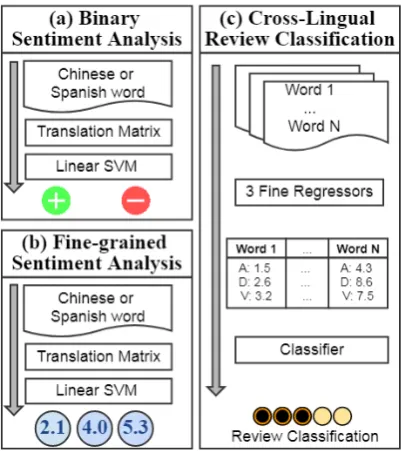
The sentiment analysis model, Figure 1(a), is a simple linear support vector machine (SVM) clas-sifier. Implemented using Sci-kit Learn’s SGD-Classifier function (Pedregosa et al., 2011), this model takes a word represented as a vector with dimension of 300 and outputs a prediction of ei-ther −1 or+1 (for negative and positive respec-tively). The classifier itself performs stochastic gradient descent (SGD) with l2 regularization to arrive at the best classification.
Figure 1: The three models used in the experi-ments.
the target language but tested on embeddings re-turned by the translation of words originally from the source language(s). We made sure that the En-glish translation of the test words had not been seen before in training. The training/testing split was changed to 80% and 20% from the previous 90%/10% to account for the smaller number of ex-amples in the dataset (and the fact that we wanted to test on a representative sample of the data).
3.3.2 Fine-Grained Sentiment Analysis Model
The fine-grained sentiment analysis model in Fig-ure 1(b) is a regression model to predict the ANEW values for each of the three dimensions. For this task, we built a regressor for each of the three dimensions whose input is a 300-dimension vector and whose output is a real number from 1 to 9. The regressor used was a Bayesian Ridge re-gressor, which estimates a probabilistic model of the regression problem. The prior for the parame-terwis given by a spherical Gaussian:
p(w|λ) =N (w|0,λ−1I
p).
The model is similar to that of the Ridge regres-sion. The model was implemented using Sci-kit Learn’s with hyperparameters alpha 1 and alpha 2 set to 1.
The training procedure of this model is quite simple and similar to that of the previous model.
[image:5.595.89.290.82.308.2]1000 WORDS 4500 WORDS 8500 WORDS Translation P@1 P@5 P@1 P@5 P@1 P@5 EN→ES 20.3 34.6 33.42 46.13 34.79 47.79 EN→CN 2.4 11.6 7.60 20.29 8.87 23.01
Table 2:Accuracy of the word translation method. P@1 and P@5 represent Top-1 and Top-5 accu-racy respectively.
Again, it only trains on the vector of the target language, and is tested purely on words from the source language whose translation into the target language was not seen in the training of the re-gressor (so that there may be no chance of skew-ing the results). The trainskew-ing/testskew-ing split here was 75%/25%.
3.3.3 Review Classification Model
For the task of review classification, another model Figure 1(c), was built to make use of the previously described fine-grained sentiment anal-ysis model. The classifier used for this task is a lo-gistic regression classifier. For a given reviewriin
the target language, composed ofnwords, we con-struct a 1×Max length sentiment vector (where Max lengthis the number of words of the longest target review). We construct this vector by pass-ing in the word embeddpass-ing for every word into the sentiment analysis model and placing the resulting values (of 1 to 9) into the constructed array. The array is then padded with 0’s in order to make it of lengthMax length.
For reviews in the source language, the pro-cess is similar, with the only change being that the words are first translated from their original vec-tor space to that of the target language before be-ing passed into the sentiment classifier. Once the review vector has been constructed, it is passed to the classifier to produce a classification of 1 to 5.
As with the previous classifier, the training pro-cedure is quite simple and involves only the tar-get language (i.e., the classifier is trained only on reviews which are originally from the target lan-guage, but it is tested on reviews only from the source language).
4 Results
4.1 Translation Accuracy
Figure 2: Top-1 and Top-5 accuracy for Span-ish and Chinese using various amounts of training data.
expected, and ii) quantifying how much sentiment is preserved with low translation accuracy (by ex-plicitly noting the poor accuracy of the transla-tion). The data used is described in section 2.1. Table2shows the effect of training size (number of words) on the accuracy of the translation matrix method. As expected (and previously shown by Mikolov et al. (2013a)), the translation accuracy increases with more training examples, as shown in Figure 2. The data and methods used in this work are further validated as the translation accu-racy results closely approximate those ofMikolov et al. (2013a), with English-Spanish translational accuracy achieving 35% and 48% accuracy for P@1 and P@5 respectively when compared to the original 33% and 51%. This concordance is fur-ther validation of the method. It is also interest-ing to note that Chinese, which is less like En-glish than Spanish is, also suffers a lower trans-lation score across both categories. However, we see that this large drop is not represented signifi-cantly in later portions.
4.2 Binary Word Sentiment Classification
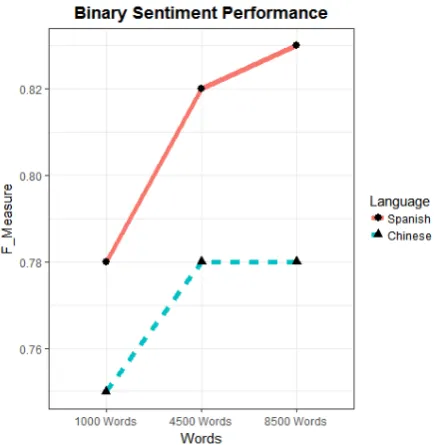
[image:6.595.80.291.64.286.2]The second experiment tested the binary cross-lingual sentiment classification capabilities of the matrix translation method, i.e., how well can we differentiate between positive and negative words of a language we have not seen before using a model trained only on English words? Here we
Figure 3: F-measure of binary sentiment classi-fier with varying amounts of training data for both Spanish and Chinese.
used the binary sentiment word list described in section 2.1.2 in order to assess whether or not the translation matrix would preserve sentiment even with poor translation accuracy scores. Given that the classifier is trained only on the target language vectors, we used the translation matrices produced previously to translate a word from source to target language embedding space.
As we can see in Table 3 and Figure 3, even with low translation accuracy, such as the 1000-word Chinese translation matrix, we are able to achieve good binary sentiment classification. We also noted that a significant drop in translation ac-curacy results in only a relatively small drop in sentiment classification performance.
4.3 Fine-Grained Sentiment Analysis
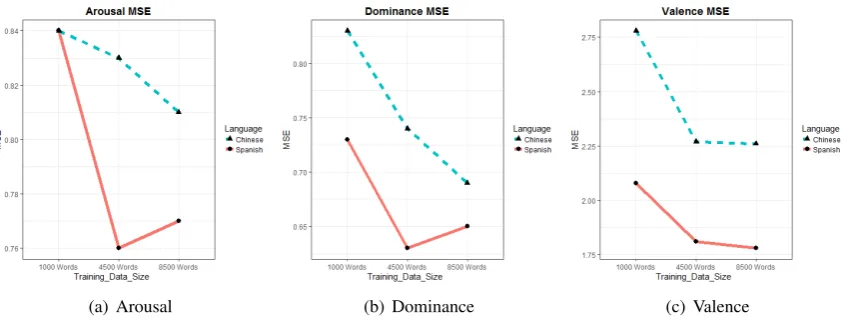
visual-(a) Arousal (b) Dominance (c) Valence
Figure 4:Mean squared error for each regression problem with varying amounts of training data for all three of the ANEW dimensions. (Lower is better).
Spanish Chinese 1000 Words
Precision 0.77 0.76
Recall 0.79 0.74
F-measure 0.78 0.75
4500 Words
Precision 0.82 0.79
Recall 0.82 0.77
F-measure 0.82 0.78
8500 Words
Precision 0.83 0.80
Recall 0.83 0.77
[image:7.595.108.249.281.482.2]F-measure 0.83 0.78
Table 3: Results of the binary sentiment classifi-cation task for each language with each translation matrix.
ized in Figure4. Given the data’s scale from 1 to 9 with an average standard deviation among par-ticipants for each word of 2.02, an average mean squared error of approximately 1 shows that our model has high predictive power.
4.4 Sentiment Classification of Reviews
In the fourth experiment, we sought to show that the regressor developed in section 3.3.2 could be used as a feature extractor in performing other tasks. To this end, we replicated the experiment byChen et al.(2016), who predicted hotel ratings from Chinese reviews using a model trained only on English restaurant reviews.
Chen et al. (2016) had two baseline models which they beat with their new model: i) a
lo-Spanish Chinese 1000 Words
Arousal 0.24 (0.84) 0.24 (0.84) Dominance 0.31 (0.73) 0.23 (0.83) Valence 0.48 (2.08) 0.32 (2.78)
4500 Words
Arousal 0.33 (0.76) 0.28 (0.83) Dominance 0.39 (0.63) 0.28 (0.74) Valence 0.54 (1.81) 0.44 (2.27)
8500 Words
Arousal 0.33 (0.77) 0.29 (0.81) Dominance 0.38 (0.65) 0.31 (0.69) Valence 0.54 (1.78) 0.43 (2.26)
Table 4:Results of the fine-grained sentiment re-gression task for each language with each transla-tion matrix, in the form ofr2(MSE).
Approach Accuracy
Logistic regression (BWE) 30.58% Deep averaging network (DAN) 29.11% Logistic regression (ANEW) 28.05%
Table 5: Model performance on sentiment ex-tracted vectors versus previous approaches. Lo-gistic regression on predicted sentiment (ANEW) values preformed similariy to both regression and DAN on BWEs.
Table 5 shows that we were able to closely match the accuracy of the baseline systems imple-mented byChen et al.(2016) for Chinese reviews. These results demonstrate that our sentiment re-gressors encoded enough information into the sen-tence vectors to achieve similar results to the base-line models which took bilingual word embedding as input, and that the fine-grained sentiment model can be used to extract sentiment-based features for other tasks in languages where aligned data might be expensive to obtain.
5 Discussion and Future Work
We have shown that the matrix translation method can be used to infer and predict cross-lingual senti-ment. More notably we observed that: i) sentiment is preserved accurately even with sub-par trans-lations, and ii) this low-cost approach also main-tained fine-grained sentiment information between languages.
We further cemented these observations through a variety of experiments. The first experiment pre-formed was testing the translation accuracy of the method presented to verify validity of the algo-rithm. The second experiment, was binary word classification into either positive and negative for words in Chinese or Spanish, given a model that was trained only with English. With a translation P@5 as low as 11%, our linear classifier was still able to predict with 75% precision and recall the polarity of a word’s sentiment. The third experi-ment, in which we were able to predict a word’s position on the three-dimensional ANEW 9-point scale with an error margin of 1 (per dimension), lent further credibility to the validity and data-efficiency of our approach. Our fine-grained senti-ment analysis with the ANEW scale is notable as it demonstrates how the algorithm works at the word level — useful in building sentiment lexicons in an automated fashion at a very low cost and with lit-tle manual effort. Our last experiment, Chinese
review classification, further highlighted the ro-bustness of our model, by showing that vectors created using the regressor encoded enough senti-ment information to match the baseline methods of passing in bilingual word embeddings to a trained model. We showed how competitive the proposed approach is when compared to much more expen-sive methods and that it can directly be applied to sentiment classification tasks for data-poor lan-guages.
Throughout the experiments, we saw the gen-eral trend of reduced error and increased accuracy with more training data. However the increase in accuracy starts to diminish with around 8500 words. The root of this leveling of accuracy could be the inherent limitation of either the translation technique used or the classification or regression algorithms used or both.
A surprising finding was how well sentence vec-tors composed of ANEW values for each word performed when compared to the baselines of Chen et al.(2016), Table5. Achieving similar re-sults to the previous baseline using the same clas-sification algorithm (logistic regression) means that the sentence vectors composed of ANEW val-ues encode enough (and as much) information as the BWE, or that the classification algorithm used on the BWEs isn’t strong enough to extract more meaningful relationships between the values. The truth is probably a mixture of both reasons.
By choosing the number and type of languages selected we have shown that this observation holds across languages with different roots and different grammar systems, which is further re-affirmed by the fact that we train our models only on English data, but test purely on Chinese and Spanish.
Chinese Word
(English) ComputedEnglish Translation True Valence(Predicted Valence) (Hungry) Mugabe misrule 3.58 (2.85)
Boo hoo Quagmire Chikwanine Sylvain Angerlotte
(Incentive) Circumstances dictate 7.00 (6.17) Selfless sacrifices
Humilty President Obama EquityMarketReport
(Kindness) Really hateful lemmings 7.81 (6.84) Loving
Dad
Flowering orchids Dear robin
(Misery) Violence begets violence 1.93 (3.91) Indignations
[image:9.595.75.288.60.275.2]Sufferings Sincerely Unconfessed sin
Table 6: Four poorly translated Chinese words, their accompanying true English translation, the five nearest English words to the translated vector, and the true (English) valence with the accompa-nying predicted valence of the translated vector.
embedding space, which we term topological sen-timent map, has two properties: i) it is maintained through linear transformation, and ii) it is “flat” enough that highly accurate mapping (read: trans-lation) between languages is not required to ar-rive at usable sentiment classification. This second property allows for the sentiment analysis of lan-guages where a large amount of labeled material is not available at an extremely low cost, and can also be used to aid in many cross-lingual sentiment related tasks.
In the future we hope to extend both the analysis and experiments discussed here to other languages and applications. For example the cross-lingual fine-grained sentiment analysis techniques could possibly be used to study the change in sentiment of words in a single language over time, leading to new insights or re-affirming old ones. Future analysis could compare different transformations and their effect on sentiment analysis. The ability to produce a “stable” topographic sentiment map could also be used to evaluate algorithms which create the vector spaces as well.
Lastly, future work will focus on developing other low-cost approaches, possibly by imple-menting Duong et al. (2016)’s technique to im-prove the accuracy and precision of sentiment re-gression. This would serve to demonstrate the (ex-pected) limits of the linear transformation model’s
in handling polysemy and subsequently its impact on the topological mapping of sentiment in vector space.
Acknowledgements
We would like to thank Moustafa Abdalla for his help and discussions. The work was financially supported by the Natural Sciences and Engineer-ing Research Council of Canada.
References
AR Balamurali, Aditya Joshi, and Pushpak Bhat-tacharyya. 2012. Cross-lingual sentiment analysis for Indian languages using linked WordNets. In Pro-ceedings of the International Conference on Compu-tational Linguistics (COLING), pages 73–82. Asso-ciation for Computational Linguistics.
Yoshua Bengio and Greg Corrado. 2015. BilBOWA: Fast bilingual distributed representations without word alignments.arXiv:1410.2455.
Margaret M Bradley and Peter J Lang. 1994. Measur-ing emotion: The self-assessment manikin and the semantic differential. Journal of Behavior Therapy and Experimental Psychiatry, 25(1):49–59.
Margaret M Bradley and Peter J Lang. 1999. Affec-tive norms for English words (ANEW): Instruction manual and affective ratings. Technical report, Cen-ter for Research in Psychophysiology, University of Florida.
Cristian Cardellino. 2016.Spanish Billion Words Cor-pus and Embeddings.
Xilun Chen, Ben Athiwaratkun, Yu Sun, Kilian Q Weinberger, and Claire Cardie. 2016. Adversarial deep averaging networks for cross-lingual sentiment classification.arXiv:1606.01614.
Long Duong, Hiroshi Kanayama, Tengfei Ma, Steven Bird, and Trevor Cohn. 2016. Learning crosslin-gual word embeddings without bilincrosslin-gual corpora. In Proceedings of the 2016 Conference on Em-pirical Methods in Natural Language Processing
(EMNLP), pages 1285–1295.
Long Duong, Hiroshi Kanayama, Tengfei Ma, Steven Bird, and Trevor Cohn. 2017. Multilingual training of crosslingual word embeddings. InProceedings of the 15th Conference of the European Chapter of the Association for Computational Linguistics(EACL), pages 893–903.
Karl Moritz Hermann and Phil Blunsom. 2013. Mul-tilingual distributed representations without word alignment.arXiv:1312.6173.
Minqing Hu and Bing Liu. 2004. Mining and summa-rizing customer reviews. InProceedings of the ACM SIGKDD International Conference on Knowledge Discovery and Data Mining (KDD-2004), pages 168–177. ACM.
Sarthak Jain and Shashank Batra. 2015. Cross-lingual sentiment analysis using modified BRAE. In Pro-ceedings of the 2015 Conference on Empirical Meth-ods in Natural Language Processing (EMNLP), pages 159–168.
Alexandre Klementiev, Ivan Titov, and Binod Bhat-tarai. 2012. Inducing crosslingual distributed repre-sentations of words. InProceedings of the 24th In-ternational Conference on Computational Linguis-tics(COLING), pages 1459–1474.
Huey Yee Lee and Hemnaath Renganathan. 2011. Chi-nese sentiment analysis using maximum entropy. In
Proceedings of the Workshop on Sentiment Analysis where AI meets Psychology(SAAIP), page 89. Yiou Lin, Hang Lei, Jia Wu, and Xiaoyu Li.
2015. An empirical study on sentiment classifi-cation of Chinese review using word embedding.
arXiv:1511.01665.
Andrew L Maas, Raymond E Daly, Peter T Pham, Dan Huang, Andrew Y Ng, and Christopher Potts. 2011. Learning word vectors for sentiment analysis. In
Proceedings of the 49th Annual Meeting of the Asso-ciation for Computational Linguistics: Human Lan-guage Technologies(ACL-HLT), pages 142–150. Tomas Mikolov, Quoc V Le, and Ilya Stuskever. 2013a.
Exploiting similarities among languages for ma-chine translation. arXiv:1309.4168.
Tomas Mikolov, Ilya Sutskever, Kai Chen, Greg S Cor-rado, and Jeff Dean. 2013b. Distributed representa-tions of words and phrases and their compositional-ity. InAdvances in Neural Information Processing Systems(NIPS), pages 3111–3119.
Saif M Mohammad, Mohammad Salameh, and Svet-lana Kiritchenko. 2016. Sentiment lexicons for Ara-bic social media. In Proceedings of the Interna-tional Conference on Language Resources and Eval-uation(LREC), pages 33–37.
F Pedregosa, G Varoquaux, A Gramfort, V Michel, B Thirion, O Grisel, M Blondel, P Prettenhofer, R Weiss, V Dubourg, J Vanderplas, A Passos, D Cournapeau, M Brucher, M Perrot, and E Duch-esnay. 2011. Scikit-learn: Machine learning in Python. Journal of Machine Learning Research, 12:2825–2830.
Jeffrey Pennington, Richard Socher, and Christopher D Manning. 2014. GloVe: Global vectors for word
representation. InProceedings of the 2014 Confer-ence on Empirical Methods on Natural Language Processing (EMNLP), volume 14, pages 1532– 1543.
R ˇReh˚uˇrek and P Sojka. 2011. Gensim - Python frame-work for vector space modelling. Technical report, NLP Centre, Faculty of Informatics, Masaryk Uni-versity, Brno, Czech Republic.
Mohammad Salameh, Saif M Mohammad, and Svet-lana Kiritchenko. 2015. Sentiment after transla-tion: A case-study on Arabic social media posts. InProceedings of the 2015 Conference of the North American Chapter of the Association for Computa-tional Linguistics: Human Language Technologies
(NAACL—HLT).
AP Sarath Chandar, Stanislas Lauly, Hugo Larochelle, Mitesh Khapra, Balaraman Ravindran, Vikas C Raykar, and Amrita Saha. 2014. An autoencoder approach to learning bilingual word representations. InAdvances in Neural Information Processing Sys-tems(NIPS).
Songbo Tan and Jin Zhang. 2008. An empirical study of sentiment analysis for Chinese documents. Ex-pert Systems with Applications, 34(4):2622–2629. Xuewei Tang and Xiaojun Wan. 2014. Learning
bilin-gual embedding model for cross-language senti-ment classification. In Proceedings of the 2014 IEEE/WIC/ACM International Joint Conferences on Web Intelligence (WI) and Intelligent Agent Tech-nologies (IAT)-Volume 02, pages 134–141. IEEE Computer Society.
Xiang Zhang, Junbo Zhao, and Yann LeCun. 2015. Character-level convolutional networks for text clas-sification. InAdvances in Neural Information Pro-cessing Systems(NIPS), pages 649–657.
Huiwei Zhou, Long Chen, Fulin Shi, and Degen Huang. 2015. Learning bilingual sentiment word embeddings for cross-language sentiment classifi-cation. In Proceedings of the 53rd Annual Meet-ing of the Association for Computational LMeet-inguistics
(ACL), pages 430–440.
Xinjie Zhou, Xianjun Wan, and Jianguo Xiao. 2016. Cross-lingual sentiment classification with bilingual document representation learning. In Proceed-ings of the 54th Annual Meeting of the Association for Computational Linguistics(ACL), pages 1403– 1412.