Performance Evaluation of Different Implementation Schemes
of an Iterative Flow Solver on Modern Vector Machines
Kenta Yamaguchi1,2, Takashi Soga2,4, Yoichi Shimomura2,4, Thorsten Reimann3, Kazuhiko Komatsu2, Ryusuke Egawa2, Akihiro Musa2,4, Hiroyuki Takizawa2, Hiroaki Kobayashi5
c
The Authors 2019. This paper is published with open access at SuperFri.org
Modern supercomputers consist of multi-core processors, and these processors have recently employed vector instructions, or so-called SIMD instructions, to improve performances. Numeri-cal simulations need to be vectorized in order to achieve higher performance on these processors. Various legacy numerical simulation codes that have been utilized for a long time often contain two versions of source codes: a non-vectorized version and a vectorized version that is optimized for old vector supercomputers. It is important to clarify which version is better for modern super-computers in order to achieve higher performance. In this paper, we evaluate the performances of a legacy fluid dynamics simulation code called FASTEST on modern supercomputers in order to provide a guidepost for migrating such codes to modern supercomputers. The solver has a non-vectorized version and a non-vectorized version, and the latter uses the hyperplane ordering method for vectorization. For the evaluation, we also implement the red-black ordering method, which is another way to vectorize the solver. Then, we examine the performance on NEC ACE, SX-Aurora TSUBASA, Intel Xeon Gold, and Xeon Phi. The results show that the shortest execution times are with the red-black ordering method on SX-ACE and SX-Aurora TSUBASA, and with the non-vectorized version on Xeon Gold and Xeon Phi. Therefore, achieving a higher performance on multiple modern supercomputers potentially requires maintenance of multiple code versions. We also show that the red-black ordering method is more promising to achieve high performance on modern supercomputers.
Keywords: performance evaluation, legacy code, numerical fluid dynamics simulation, vector-ization, hyperplane method, red-black method.
Introduction
Numerical simulations of fluid dynamics can solve many of the important problems the scientific and engineering field faces today. Simulations for analyzing and understanding more complex problems require higher performance supercomputers. Modern supercomputers consist of multi-core processors such as Intel Xeon and Xeon Phi processors to increase the degree of parallelism. Moreover, modern supercomputers have employed vector instructions to exploit the loop-level parallelism. Thus, in order to achieve a higher performance on these processors, it is necessary to vectorize the simulation codes. In this paper, the supercomputers composed of processors employing vector instructions are referred to as modern vector machines.
Many numerical simulations of fluid dynamics utilize implicit methods for stably solving large-scale models. However, the implicit methods generally have loop-carried dependencies on stencil calculations, and these simulations cannot be vectorized in a straightforward way. The hyperplane ordering method [1] was devised to vectorize them, and until recently this method was widely used for vectorizing the implicit methods on vector supercomputers. Accordingly,
1
NEC Solution Innovators, Tokyo, Japan 2
Cyberscience Center, Tohoku University, Sendai, Japan 3
Technische Universit¨at Darmstadt, Darmstadt, Germany 4
NEC Corporation, Tokyo, Japan
5Graduate School of Information Science, Tohoku University, Sendai, Japan
some legacy numerical simulation codes (called old vectorized codes) often have two versions of source codes: non-vectorized version (called naive version) and vectorized version.
As the hyperplane ordering method generally increases memory loads, Soga et al. [2] uti-lized the red-black ordering method to vectorize the successive over-relaxation method, and then demonstrated that both of the vector supercomputer SX-9 system and Intel Xeon proces-sor (Nehalem-EX) can achieve higher performance by using the red-black ordering method in comparison with the hyperplane ordering method. Therefore, old vectorized codes may require another vector optimization (i.e., red-black ordering) to achieve a higher performance on modern vector machines.
In this paper, we evaluate the performances of the naive version, hyperplane, and red-black ordering methods on modern vector machines, NEC SX-ACE, SX-Aurora TSUBASA (hereafter: SX-Aurora), Intel Xeon Gold, and Xeon Phi (Knights Landing), so as to clarify which method achieves higher performance. Here, the finite-volume solver FASTEST [3] serves as basis for our evaluation.
In Section 1, we present related work regarding optimization and performance evaluations of FASTEST. Section 2 explains the system architecture of four modern vector machines. Section 3 provides an overview of the FASTEST code. Section 4 presents the results of performance evaluations. We conclude in Summary section with a brief summary and mention of future work.
1. Related Work
FASTEST is a legacy fluid dynamics code and was originally developed in the 1990s. Scheit and Becker [4] optimized the FASTEST-3D code for multi-core processors and evaluated its performance on an Intel Xeon eight-cores processor (Sandy Bridge) and six-cores processor (Westmere). They found that the code was mostly memory-bound and that the solver of Stone’s strongly implicit (SIP) method [5] was the main performance bottleneck. In order to decrease the memory load, they used single-precision floating-point data, and avoided unnecessary re-computation of the incomplete LU factorization to solve the SIP method. This improved the performance by about 40 %. They also utilized non-blocking MPI functions and showed that the scalability improved, i.e. the number of nodes of the optimized code was 2.8 times more than that of the non-optimized code when each parallel efficiency was50 %.
Burger et al. [6] examined optimizations of memory access on the sipsol subroutine and found, similarly, that the solver of the SIP method was memory intensive and was the most time-consuming. In particular, the memory access on the vectorized version of the solver was inefficient due to memory accesses along a plane, called thehyperplane, which is a skew cutting plane across the three-dimensional space. The solver needs long-interval accesses. They packed data elements on a three-dimensional array into two two-dimensional arrays in sequential memory access and showed that the performance becomes double on an AMD Opteron twelve-cores processor.
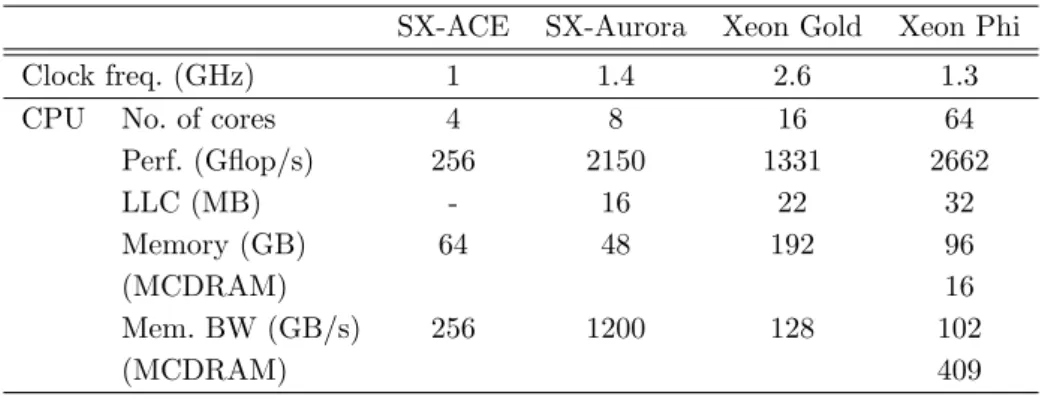
Table 1.Specifications of each machine used in the evaluation
SX-ACE SX-Aurora Xeon Gold Xeon Phi
Clock freq. (GHz) 1 1.4 2.6 1.3
CPU No. of cores 4 8 16 64
Perf. (Gflop/s) 256 2150 1331 2662
LLC (MB) - 16 22 32
Memory (GB) 64 48 192 96
(MCDRAM) 16
Mem. BW (GB/s) 256 1200 128 102
(MCDRAM) 409
2. Modern Vector Machines
Modern supercomputers consist of many processors and accelerators employing multi-core technologies. For example, the world’s fastest supercomputer in the top 500 list in June 2018 [7] is equipped with 2,397,824 cores and achieved the theoretical peak-performance of 200.8 Pflop/s. Recently, scalar processors have provided support for vector instruction sets such as Stream-ing SIMD Extensions (SSE), Advanced Vector Extensions (AVX), and AVX-512 instructions. Thanks to these vector instructions, numerical simulations have been accelerated not only on vector supercomputers but also on scalar supercomputers. In this section, we give overviews of modern vector machines, NEC SX-ACE, SX-Aurora TSUBASA, Intel Xeon Gold, and Xeon Phi. Table 1 lists the hardware configurations of each machine used in the evaluation.
2.1. SX-ACE
2.2. SX-Aurora TSUBASA
SX-Aurora TSUBASA was released in 2017 [10, 11]. An SX-Aurora TSUBASA system is comprised of a vector host (VH) and a vector engine (VE). A VE is implemented as a PCI Express (PCIe) card equipped with a vector processor, i.e., the card is connected to the VH via PCIe. One VH can control eight VEs. The vector processor consists of eight vector cores, a 16 MB last-level cache (LLC), and six High Bandwidth Memory 2 (HBM2) memory modules. The SX-Aurora TSUBASA’s VPU has three fused multiply add (VFMA) units and each VFMA unit has 32 vector pipelines. The vector length of SX-Aurora TSUBASA is 256, which is the same as that of SX-ACE. Thus, a VPU can execute 256 operations by a single vector instruction in eight clock cycles. As the clock frequency of the VE is 1.4 GHz, a single core provides 268.8 Gflop/s (32 operations in one clock cycle×two floating-point operations (add and multiply) by VFMA
×3 VFMA units ×1.4 GHz). Hence, a vector processor, which consists of eight cores, achieves 2.15 Tflop/s. The LLC is directly connected to the vector registers of each core, and shared by eight cores. The six HBM2 memory modules deliver the high memory bandwidth of 1.288 TB/s in total. This memory architecture enables a high sustained performance especially in executing memory-intensive applications.
2.3. Intel Xeon Gold
Intel Xeon Gold is marketed as a 6th-generation Intel core. In this paper, we evaluate the performance of the application using a Xeon Gold 6142 processor, which consists of 16 cores. On the previous generations of Intel Xeon processor families, cores, last-level cache (LLC), memory controller, IO controller, and inter-socket Intel QuickPath Interconnect (Intel QPI) ports are connected together using a ring architecture. In contrast, the 6-th generation Xeon Gold processor introduces a mesh architecture that encompasses an array of vertical and horizontal communication paths. This architecture allows traversal from one core to another through the shortest path. The processor interconnect is Intel Ultra Path Interconnect (Intel UPI) which replaced the Intel QPI. Modern scalar processors such as the Xeon Gold processor introduce SIMD instructions. For example, AVX-512 instructions, which are supported by Xeon Gold, provide 512-bit-wide vector instructions, 32 logical registers, eight mask registers, and indirect vector access via gathers and scatters. A single AVX-512 instruction can execute 32 single-precision or 16 double-single-precision floating-point operations per cycle. AVX-512 instructions are classified into five categories: foundation instructions (AVX-512F), which are the base 512-bit extensions; conflict-detection instructions (AVX-512CD); doubleword and quadword instructions 512DQ); byte and word instructions 512BW); and vector length extensions (AVX-512VL) [12].
2.4. Intel Xeon Phi
do k=2,nkblk-1
lkk=(k-1)*nijblk
do i=2,niblk-1
lki=ijksblk+lkk+(i-1)*njblk
do ijk=lki+2,lki+njblk-1
res(ijk)=ae(ijk)*fi(ijk+njblk)+aw(ijk)*fi(ijk-njblk)+an(ijk)*fi(ijk+1)+as(ijk)*fi(ijk-1) &
+at(ijk)*fi(ijk+nijblk)+ab(ijk)*fi(ijk-nijblk)+su(ijk)-ap(ijk)*fi(ijk)
rhelp(m)=rhelp(m)+abs(res(ijk))
res(ijk)=(res(ijk)-bb(ijk)*res(ijk-nijblk)-bw(ijk)*res(ijk-njblk)-bs(ijk)*res(ijk-1))*bp(ijk)
end do; end do; end do
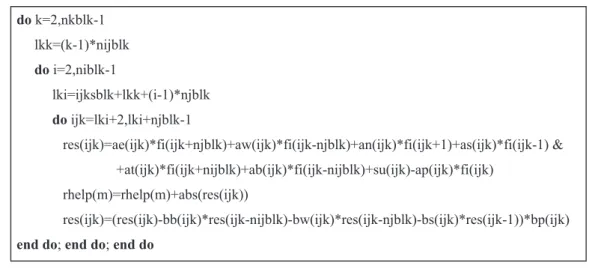
Figure 1.Source code of the naive version
provide three memory modes, which are selectable through the BIOS setting at boot time. One mode is the cache mode in which MCDRAM is used as a cache for the DDR memory. Another mode is the flat mode, which handles both MCDRAM and DDR in the same way to organize one memory space. The other is the hybrid mode, in which either 25 % or 50 % of MCDRAM is used as cache and the rest is used as memory. In this work, the flat mode is selected for the evalua-tion. As with Xeon Gold, the Xeon Phi’s VPU also provides support for AVX-512 instructions. Xeon Phi’s AVX-512 instructions fall into four categories. AVX-512F and AVX-512CD are the same as those in Xeon Gold. Two additional categories – exponential and reciprocal instructions (AVX-512ER) and prefetch instructions (AVX-PF) – are only provided by Xeon Phi [13].
3. Incompressible Flow Solver, FASTEST
FASTEST is a three-dimensional incompressible flow solver [6]. Several academic developers have independently enhanced it to simulate various flow phenomena and multi-physics couplings. In this paper, we use the code developed at Technische Universit¨at Darmstadt, whose codes are parallelized by using MPI and OpenMP.
The solver is based on the Semi-Implicit method for the Pressure Linked Equations (SIM-PLE) method [14], which iteratively solves the momentum and pressure-correction equations. These equations are discretized using a second-order finite-volume scheme on a block-structured grid. The resulting linear equation system is solved using the SIP method, which is based on an incomplete LU factorization. The subroutine containing the SIP method (calledsipsol subrou-tine) is the main performance bottleneck and holds two different implementations [6]. The first, called the naive version, is shown in Fig. 1. This code calculates the residual calculations after the LU decomposition in the sipsol subroutine. Each data element in the figure is saved in a linearized one-dimensional array. All elements are calculated along the three coordinate axes via a nested loop using variables lkk and lki. The variable lkk indicates the start points of k. Simi-larly, the variable lki also indicates the start points of i. Here, a loop-carried dependency exists between the left-hand array res(ijk) and the right-hand arraysres(ijk-nijblk),res(ijk-njblk), and
res(ijk-1) in the second line from the bottom in Fig. 1. Hence, thisdoloop cannot be vectorized. The second one, called the HP version, utilizes the hyperplane ordering method. The firstdo
loop in Fig. 2 converts a triple-nesteddo loop in Fig. 1 into a singledoloop. The second nested
do ijk=ijksblk+nijblk+njblk+2,ijksblk+(nkblk-2)*nijblk+njblk*(niblk-2)+njblk-1
res(ijk)=ae(ijk)*fi(ijk+njblk)+aw(ijk)*fi(ijk-njblk)+an(ijk)*fi(ijk+1)+as(ijk)*fi(ijk-1) &
+at(ijk)*fi(ijk+nijblk)+ab(ijk)*fi(ijk-nijblk)+su(ijk)-ap(ijk)*fi(ijk)
rhelp(m)=rhelp(m)+abs(res(ijk))
end do
do ndia=1,numdia(ngr,m)
do npoi=npsta(ndia,ngr,m)+1,npsta(ndia+1,ngr,m)
ijk=ijkdia(npoi)
res(ijk)=(res(ijk)-bb(npoi)*res(ijk-nijblk)-bw(npoi)*res(ijk-njblk)-bs(npoi)*res(ijk-1))*bp(npoi)
end do; end do
Figure 2.Source code of the HP version
i
j
k
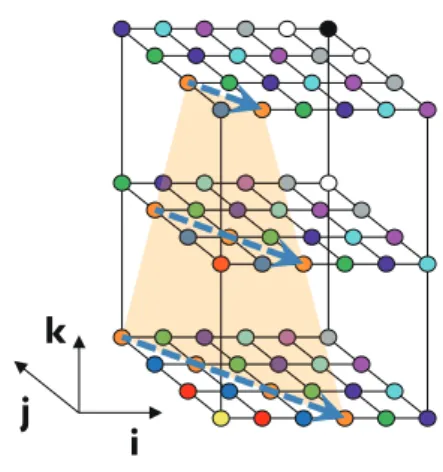
Figure 3. Diagram of a hyperplane
k = constant. The plane is a skew cutting plane across the three-dimensional space. The orange plane in Fig. 3 is one of these hyperplanes that consist of the same color across the grid in three-dimensional space. Then, the inner do loop calculates the data elements on the planes. Since this calculation does not have any loop-carried dependency, the code of the sipsol subroutine is then vectorized. However, the hyperplane ordering method generally increases the number of memory loads. This is because the memory accesses of array res(ijk) are stride accesses due to access along the planes, and they have a long access latency. Moreover, the length of loop npoi
is a variable and the efficiency of vectorized calculation becomes low whennpoi is small. We implement the red-black ordering method (called the RB version), the memory loads of which are lower than those of the hyperplane ordering method, as shown in Fig. 4. However, the number of iterations required for convergence is generally increased on the red-black ordering method. Thus there is a performance trade-off with increasing the number of iterations. Thedo
loop in the second line from the top in Fig. 4 is a switch ofRed and Black executions using the
do m2=ijkgit(ngr,m)+1,ijkgit(ngr,m)+njblk*niblk*nkblk,iblk
do n2=1,2
do ijk=m2,min(m2+iblk-1,ijkgit(ngr,m)+njblk*niblk*nkblk)
if(itbl(ijk-ijkgit(ngr,m),1,1,n2,m).ne.1) cycle
res(ijk)=ae(ijk)*fi(ijk+njblk)+aw(ijk)*fi(ijk-njblk)+an(ijk)*fi(ijk+1)+as(ijk)*fi(ijk-1) &
+at(ijk)*fi(ijk+nijblk)+ab(ijk)*fi(ijk-nijblk)+su(ijk)-ap(ijk)*fi(ijk)
rhelp(m)=rhelp(m)+abs(res(ijk))
res(ijk)=(res(ijk)-bb(ijk)*res(ijk-nijblk)-bw(ijk)*res(ijk-njblk)-bs(ijk)*res(ijk+rb_jm1))*bp(ijk)
end do; end do; end do
Figure 4.Source code of the RB version
increase the length of the innermost loop. This code also uses cache blocking to improve the performance of memory accesses. This is possible because the data loaded at iteration n2=1 (Red) can be reused at iteration n2=2 (Black). Here, the variable iblk is the size of a cache block.
4. Performance Evaluation
4.1. Experimental Setup
The performance of FASTEST is evaluated by using four modern vector machines: NEC SX-ACE, SX-Aurora TSUBASA, Intel Xeon Gold, and Xeon Phi. The evaluated codes are the naive version, the HP version, and the RB version, which are parallelized with OpenMP. Here, we evaluate performances of a single processor on each machine because the performance per processor is a key factor to achieve high performance on a large-scale parallel simulation. Then, since modern HPC applications are usually written with considering the cache memory, we use the model size of (32×32×53) per processor so that the data potentially fit in the cache memory of each processor. Here, the maximum degree of parallelism using OpenMP is 16 determined from the model size. Thus, the code is executed on four cores of ACE, eight cores of SX-Aurora, 16 cores of Xeon Gold, and 16 cores of Xeon Phi. The memory mode of Xeon Phi is set to the flat mode.
Table 2 shows the versions and options of each machine’s Fortran compiler. The options are high-level optimizations and inlining functions and subroutines. The codes are parallelized by using OpenMP. Table 3 lists the compiler directives for each code on each machine. The
sipsol subroutine is vectorized by using the compiler directives: nodep, ivdep, and simd. SX-ACE and SX-Aurora use the optimization directives: vovertake,gthreorder, and gather reorder, which optimize the operation sequences of memory accesses. Here, the codes are executed with double precision floating-point operations.
4.2. Experimental Results and Discussion
FASTEST iteratively computes the momentum and pressure-correction equations from ini-tial values of pressure and velocity at each point to their converged values. The number of iterations varies with optimized and vectorized methods. We measure the execution time of the
ver-Table 2.Versions and options of each compiler
Machine Versions Options
SX-ACE FORTRAN90/SX Rev.534 -Popenmp -Chopt -pi
SX-Aurora NEC Fortran 1.5.1 -fopenmp -O3 -msched-block -finline-functions
Xeon Gold Intel Fortran 18.0.2.199 -qopenmp -O3 -xCORE-AVX512 -ipo -no-prec-div -fp-model fast=2 Xeon Phi Intel Fortran 18.0.2.199 -qopenmp -O3 -xMIC-AVX512
-ipo -no-prec-div -fp-model fast=2
Table 3.Compiler directives of each code
Machine Naive HP RB
SX-ACE - nodep, vovertake, gthreorder nodep, vovertake SX-Aurora - ivdep, vovertake, gather reorder ivdep, vovertake
Xeon Gold - ivdep, simd ivdep, simd
Xeon Phi - ivdep, simd ivdep, simd
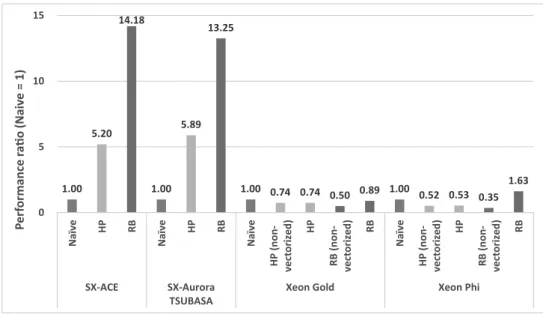
sions to the naive version (the performance ratio = the execution time of naive version ÷ the execution time of HP (RB) version). Here, the execution times of the naive version are 0.156 seconds on SX-ACE, 0.053 seconds on SX-Aurora TSUBASA, 0.017 seconds on Xeon Gold, and 0.039 seconds on Xeon Phi. HP(non-vectorized) and RB(non-vectorized) indicate that the codes are not vectorized, and hence the performance differences between HP/RB and HP(non-vectorized)/RB(non-vectorized) indicate the performance gain by vectorization in Xeon Gold and Xeon Phi.
1.00 5.20 14.18 1.00 5.89 13.25
1.00 0.74 0.74 0.50 0.89 1.00 0.52 0.53 0.35 1.63 0 5 10 15 N a ïv e H P R B N a ïv e H P R B N a ïv e H P ( n o n -v e ct o ri ze d ) H P R B ( n o n -v e ct o ri ze d ) R B N a ïv e H P ( n o n -v e ct o ri ze d ) H P R B ( n o n -v e ct o ri ze d ) R B SX-ACE SX-Aurora TSUBASA
Xeon Gold Xeon Phi
P e rf o rm a n ce r a ! o ( N a iv e = 1 )
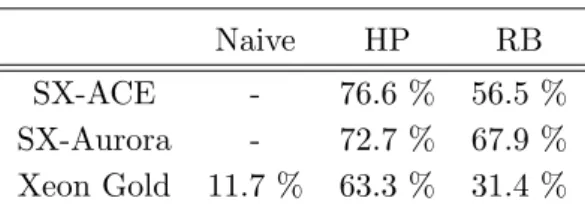
SX-ACE and SX-Aurora have the same performance characteristics. The vectorized codes, HP version and RB version, can achieve a higher performance than the naive version. In the case of SX-Aurora, the HP and RB versions are 5.89 and 13.25 times faster than the naive version, respectively. In other words, SX-ACE and SX-Aurora cannot achieve high performance unless codes are vectorized. Meanwhile, although both the HP and RB versions are vectorized, the performances of the HP version on SX-ACE and SX-Aurora are lower than that of the RB version, respectively. This is because the HP version needs indirect memory access and its memory access latency is longer than that of 2-stride memory access used in the RB version. Moreover, the efficiency of vectorized calculations becomes lower as the length of npoi is small. Table 4 lists the ratios of stall time of the processor to total execution time on SX-ACE, SX-Aurora and Xeon Gold. Here, the execution statistics of all the versions on Xeon Phi and the naive version on SX-ACE and SX-Aurora cannot be measured by performance tools. This table shows that the stall time of the HP version is larger than that of the others, and then the HP version is inefficient on these machines.
Table 4. Ratio of stall time of processor on SX-ACE and Xeon Gold
Naive HP RB
SX-ACE - 76.6 % 56.5 % SX-Aurora - 72.7 % 67.9 % Xeon Gold 11.7 % 63.3 % 31.4 %
In Xeon Gold and Xeon Phi, vectorization does not improve the performance of the HP version. The execution time is almost unchanged by enabling vectorization. In contrast, the vectorized RB version is 1.78 and 4.66 times faster than its non-vectorized version in Xeon Gold and Xeon Phi, respectively. Especially, the vectorized RB version on Xeon Phi is faster than the naive version. Meanwhile, as the clock frequency of Xeon Gold decreases, the performance gain of Xeon Gold by the vectorization is not high. However, this demonstrates that vectorization is important to achieve high performance even on Xeon Gold and Xeon Phi processors.
Table 5.Number of iterations on each method
Naive HP RB
Number of iterations 10,004 10,004 17,516
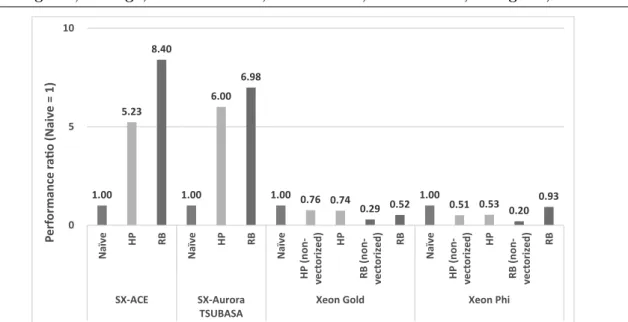
Table 5 shows the number of iterations required by each method for convergence. The RB version requires 1.8 times more iterations than the naive and HP versions. The total execu-tion times of the sipsol subroutine increase. Figure 6 shows the performance ratio of HP and RB versions to naive version (the performance ratio = the execution time of naive version ÷
1.00 5.23 8.40 1.00 6.00 6.98
1.00 0.76 0.74
0.29 0.52 1.00
0.51 0.53 0.20 0.93 0 5 10 N a ïv e H P R B N a ïv e H P R B N a ïv e H P ( n o n -v e ct o ri ze d ) H P R B ( n o n -v e ct o ri ze d ) R B N a ïv e H P ( n o n -v e ct o ri ze d ) H P R B ( n o n -v e ct o ri ze d ) R B SX-ACE SX-Aurora TSUBASA
Xeon Gold Xeon Phi
P e rf o rm a n ce r a ! o ( N a iv e = 1 )
Figure 6. Performance ratio of HP and RB versions to naive version of the sipsol subroutine with the total execution times on each machine
In SX-ACE and SX-Aurora, the RB version can achieve the shortest execution time, in spite of an increase in the number of iterations. These results indicate that the red-black method is suitable to vectorize FASTET for SX-ACE and SX-Aurora. On the other hand, the naive version achieves the shortest execution time on Xeon Gold and Xeon Phi. These results show that, in case of the RB version, there is a trade-off between the performance degradation by needing more iterations and the performance improvement by using vectorization. Therefore, achieving a higher performance on multiple modern vector machines will require maintenance of multiple code versions. As a result, it will be more important to consider how to manage the code complexity in a systematic way in the future. We have been working on this problem [15, 16], and will further discuss such a methodology in our future work.
Summary
Processors of modern supercomputers have employed vector instructions to exploit loop-level parallelism efficiently, and the vector lengths are increasing, resulting in increasing the importance of vectorization to fully exploit the system performance. Various legacy numerical simulation codes have been vectorized considering old vector machines in mind, and hence the simulations have two different code versions of their kernel codes: non-vectorized version and vectorized version. In this paper, we evaluate the performances of such a legacy code called FASTEST, which is vectorized by the hyperplane and red-black ordering methods, using four modern vector machines (SX-ACE, SX-Aurora, Xeon Gold, and Xeon Phi) in order to provide which version is suitable for the modern vector machines.
In this work, we showed that the maintenance of multiple code versions is required to achieve higher performance on multiple modern vector machines. We will pursue our methodology of maintenance of multiple code versions. Moreover, since the number of cores on modern machines has increased year by year, our future work will investigate performance characteristics of thread-level parallelism such as OpenMP and OpenACC in order to achieve high performance on legacy numerical simulation codes.
Acknowledgements
This research was conducted as a joint project of Tohoku University and NEC Corporation. This research is partially supported by JST CREST “An Evolutionary Approach to Construction of a Software Development Environment for Massively-Parallel Heterogeneous Systems”, DFG SPPEXA ExaFSA project, and Grant-in-Aid for Scientific Research(B) #16H02822. We are grateful for the use of NEC SX-ACE at Cyberscience Center at Tohoku University.
This paper is distributed under the terms of the Creative Commons Attribution-Non Com-mercial 3.0 License which permits non-comCom-mercial use, reproduction and distribution of the work without further permission provided the original work is properly cited.
References
1. Fujino, S., Mori, M., Takeuchi, T.: Performance of Hyperplane ordering on vector computers, Journal of Computational and Applied Mathematics 38, 125–136 (1991), DOI: 10.1016/0377-0427(91)90165-G
2. Soga, T., Musa, A., Okabe, K., Komatsu, K., Egawa, R., Takizawa, H., Kobayashi, H., Takahashi, S., Sasaki, D., Nakahashi, K.: Performance of SOR Methods on Modern Vec-tor and Scalar Processors, Journal of the Computers & Fluids 45(1), 215–221 (2011), DOI: 10.1016/j.compfluid.2010.12.024
3. Project Site for Fastest at Technische Universit¨at Darmsadt. https://www.fnb.
tu-darmstadt.de/forschung_fnb/software_fnb/software_fnb.en.jsp, accessed:
2019-01-21
4. Scheit, C., Becker, S., Hager, G., Treibig, J., Wellein, G.: Optimization of FASTEST-3D for Modern Multicore System. https://arxiv.org/pdf/1303.4538, accessed: 2019-01-21
5. Stone, H.L.: Iterative solution of implicit approximations of multidimensional par-tial differenpar-tial equations, SIAM Journal on Numerical Analysis 5(3), 530–558 (1968), DOI: 10.1137/0705044
6. Burger, M., Bischof, C.: Optimizing the memory access performance of FASTEST’s sipsol routine. In: 6th European Conference on Computational Fluid Dynamics, ECFD VI, July 2014, Barcelona, Spain. DOI: 10.13140/RG.2.2.32568.14089
7. Top 500 supercomputers sites. https://www.top500.org/, accessed: 2019-01-21
9. Egawa, R., Komatsu, K., Momose, S., Isobe, Y., Musa, A., Takizawa, H., Kobayashi, H.: Potential of a Modern Vector Supercomputer for Practical Applications - Perfor-mance Evaluation of SX-ACE , The Journal of Supercomputing 73(9), 3948–3976 (2017), DOI: 10.1007/s11227-017-1993-y
10. Yamada Y., Momose, S.: Vector Engine Processor of NEC’s Brand-New Supercomputer SX-Aurora TSUBASA. In: Proceedings of A Symposium on High Performance Chips, Hot Chips 30, Cupertino, California, USA, August 19–21, 2018
11. Komatsu, K., Momose, S., Isobe, Y., Sato, M., Musa, A., Kobayashi, H.: Early Evalua-tion of a New Vector Processor SX-Aurora TSUBASA. In: Research Poster of ISC Higher Performance 2018, ISC 18, Frankfurt, Germany, June 24–28, 2018
12. Mulnix, D.: Intel Xeon Processor Scalable Family Tech-nical Overview. https://software.intel.com/en-us/articles/
intel-xeon-processor-scalable-family-technical-overview, accessed:
2019-01-21
13. Sodani, A., Gramunt, R., Corbal, J., Kim, H.-S., Vinod, K., Chinthamani, S., Hutsell, S., Agarwal, R., Liu, Y.-C.: Knight Landing: Second-Generation Intel Xeon Phi Product, IEEE Micro 36(2), 34–46 (2016), DOI: 10.1109/MM.2016.25
14. Patankar, S.V.: Numerical heat transfer and fluid flow, Hemisphere Publishing Corporation (1980)
15. Takizawa, H., Hirasawa, S., Hayashi, Y., Egawa, R., Kobayashi, H.: Xevolver: An XML-based code translation framework for supporting HPC application migration. In: Proceed-ings of IEEE International Conference on High Performance Computing, HiPC 2014, Goa, India, December 17–20, 2014, vol. 1, pp. 1–11 (2014)