79
All Rights Reserved © 2012 IJARCSEE
ENERGY CONSERVED FAULT TOLERANT
CLUSTERS WITH QoS ROUTING IN WIRELESS
AD HOC NETWORK
Dr. Thangaraj. P 1, Renuka. M 2, Dr.S.N.Sivanandam 3
Abstract - Currently, wireless networks are fetching more fashionable and it can be employed in all genuine world applications. So it is required to present a good Quality of Service (QOS) for distributing a video, voice and data. To present diverse varieties of priority to diverse types of applications, QoS will present numerous mechanisms and the examination is chiefly utilized in the fields such as defense, military and so on. MANET, a Wireless Ad hoc network possibly would not be capable to present a good QoS as it has communications less environment. Because the mobility of nodes is self-sufficient, the topology of the network modifies recurrently. Numerous routing protocols are accessible to present the QoS service for MANET, however in all those techniques path link or communication link transparency increases. This tends to decline in the existence of the network. To progress the existence of the network and to diminish the path link failure, here in this work we are going to provide a novel technique which preserves the energy altitude of the network to balance both energy level and mobility rate. The proposed work will provide the finest QoS in MANET in the way of clustering the network based on energy consumption, fault tolerance rate, and mobility rate. The clustering approach judges only the restricted fault tolerant fairly than comprehensive fault tolerant to notice and process the rate of mobility of the nodes in the network. This energy conserved clustering on QoS for MANET will progress the life span of both the nodes and the network. An experimental evaluation is carried out to estimate the performance of the proposed Energy Conserved Fault-tolerant Clusters with QoS Routing in wireless ad-hoc networks [ECFCR] in terms of communication overhead, recovery time, failure rate.
Index Terms : Clustering approach, Energy Conserved Protocol, Fault-tolerant distributed routing, mobile computing, wireless networks.
1 Professor & HOD, Department of Computer Science and Engineering,
Bannari Amman Institute of Technology, Sathyamangalam, Tamilnadu, India
2 Asst.Professor, Department of Applied Science, SSM College of
Engineering, Komarapalayam, Tamilnadu, India.
3 Professor & HOD, Department of Computer Science and
Engineering(Retired).
1. INTRODUCTION
Wireless networks are mounting increasingly widespread sorting from analog to digital telephony to dependency propagation. Consequently, providing a soaring Quality of Service (QoS) in distributing video, voice and data has turn into obvious as one of the most significant confront. Quality of Service (QoS) is a defined point of presentation in a communications network essential by a kind of network traffic. Severe QoS necessities are identified in numerous network conditions, for instance in decisive communications control and martial communication. An efficient mobile ad-hoc network (MANETs) requires QoS potentials that present fault tolerance and fast revival when links be unsuccessful on an irregular or eternal basis.
Quality of service concerned the method to present diverse varieties of priority to diverse users, applications, or data flows. Some of the parameters to be considered are delay and jitter, bit rate, packet dropping possibility or bit error rate. The necessities of QoS have been suffered in the fields such as defense, military and so on. Whenever link has a broken or everlasting source there ought to be a method to present fault tolerance in Mobile Ad Hoc networks. MANET topologies are frequently vulnerable to transform. Node mobility in MANET might basis QoS necessities to develop into unreachable with the swell in node mobility to origin changes in topology. This is said to be combinatorial immovability. It deliberates regarding the combinatorial strength and recoverability feature.
Normally, QoS addresses immovability and recoverability, two major issues in routing QoS traffic in mobile networks. The first concern is stability. With most ad hoc wireless networks that maintain QoS, each node proceeds as a router. In numerous dispersed reactive routing systems, if a node does not recognize the QoS limitations of its neighbors it transmits the route request packet and the neighboring nodes distribute their QoS parameters utilizing transmit packets. The transmitted packets employed to determine the QoS parameters of nodes’ neighbors and discuss QoS paths can submerge the network.
80
All Rights Reserved © 2012 IJARCSEE sustaining node be unsuccessful when traffic is routed
during multiple hops subsequently, in the nastiest case, the association must be rerouted from the foundation. This universal fault-recovery technique needs that the source renegotiates a novel QoS path, which is valuable in calculation and communication. If several sources were employing the disastrous node in QoS paths after that every source must discuss a novel path.
In this work, we are going to provide a novel technique which preserves the energy altitude of the network to balance both energy level and mobility rate. The proposed work will provide the finest QoS in MANET in the way of clustering the network based on energy consumption, fault tolerance rate, and mobility rate. The clustering approach judges only the restricted fault tolerant fairly than comprehensive fault tolerant to notice and process the rate of mobility of the nodes in the network. This energy conserved clustering on QoS for MANET will progress the life span of both the nodes and the network.
2. LITERATURE REVIEW
Many QoS routing algorithms are used for effective communication. Credit-Based Routing (CBR) utilizes a tribute system that plunders a course for stream receipt and punishes dismissal. Path collection is supported on path acclaims where superior credit paths are chosen. CBR also checks flow jamming possibilities for every path to employ in prospect paths [1]. Quality-Based Routing (QBR) decides paths supported on QoS metric principles [2]. QBR checks a path and interprets stream values into average trail behavior. The dissimilarity is that CBR allocates acclaims supported on jamming possibilities whilst QBR utilizes average path superiority. Delay-Based QoS Routing (DBR) employs the normal delay on a lane to construct its routing choices [3]. The standard path wait is used to calculate the path’s superiority, and, upon stream coming, the path with the slightest average stoppage is used to redirect the inward traffic. Steady and Delay measures Routing (SDCR) [4] plants in routing detection and preservation.
Multi-Protocol Label Switching (MPLS) is a QoS sustain system where packets can be tagged. Routers utilize the tags to ahead packets beside predefined trails. MPLS is frequently utilized with a multi-commodity stream optimizer, which identifies routes supported on flow principles [5]. Every cluster in the routing algorithm has the possible to acquire gateway nodes, which sustain communiqué with contiguous clusters using the operations. Abundant schemes survive for collecting nodes in MANETs. QoS algorithms builds nonoverlapping clusters supported on bandwidth and stoppage factors for every link [6]. The Virtual Grid Construction (VGA) [7] utilizes position information from the worldwide Positioning scheme to group nodes into a preset rectilinear practical topology to create routing and system management as competent as possible.
Better cluster sizes characteristically capitulates tall communication overhead and require assortment from further networks respecting changing control conditions [8]. Our system does not utilize criticism implosion prevention, but there are numerous techniques that can be utilized. For network feedback, [9] is originally presented an empty message line that trails the most current network advice. Another technique to mitigate feedback implosion is Hierarchical ARQ (H-ARQ) [10]. In this work, energy conserved fault-tolerant clusters with QoS routing in wireless ad-hoc networks is presented for an efficient communication among the nodes in the network.
3. PROPOSED ENERGY CONSERVED FAULT
TOLERANT CLUSTERS WITH QoS ROUTING IN
WIRELESS AD-HOC NETWORK
The proposed work is efficiently designed with the endeavor of providing fault tolerance, which is a significant characteristic in providing QoS in the connection failure-prone atmosphere of mobile networks. In order to support applications with quality of service requirements, the desired amount of bandwidth is taken to consideration and is represented in different ways. The proposed energy conserved fault-tolerant clusters with QoS routing in wireless ad-hoc networks is processed under two different phases. The first phase describes the process of measuring the Fault Tolerance Rate, Energy Consumption, Mobility rate of the nodes in the network. The second phase describes the process of clustering the network environment based on the outcome of first phase. The architecture diagram of the proposed energy conserved fault-tolerant clusters with QoS routing in wireless ad-hoc networks [ECFCR] is shown in fig 3.1.
The first phase describes the process of measuring the fault tolerance rate, energy consumption, mobility rate of the nodes in the network. The fault tolerance rate is measured based on the number of failed links in QoS path.
The second phase describes the process of clustering the network environment based on the fault tolerance rate, mobility rate and energy drain rate obtained by the nodes in the network.
81
All Rights Reserved © 2012 IJARCSEE circumvent the CH being unsuccessful, this work presented
a technique named ECFCR (energy conserved fault-tolerant clusters with QoS routing in wireless ad-hoc networks) is presented here.
3.1 Process of clustering
Propose a network that gathers the fault tolerance necessities of its planned application, it is essential to describe a measure of fault tolerance suitable for that particular relevance, and to review the evaluation for different network configurations. For the nodes in the network, the fault tolerance rate is measured in terms of number of failed communication links at QoS path. The fault tolerance rate (f) for N nodes is expressed as,
1
/
numberofno
desaccessi
bletocommu
nication
N
f
…… (1)
With no failure of generality, the fault tolerance rate (f) is computed based on the probability of the nodes in the network P (k) where k number of nodes is accessible. The measure f is expressed in terms of P (k) is expressed as,
11
)
(
1
1
Nk
k
P
N
f
…… (2)If a node is prepared to recognize all route requests only since it presently has sufficient capability, much traffic load will be introduced during that node. In this logic, the genuine energy drain rates of the node will be likely to be high, ensuing in a quick diminution of energy. As
significance, it could weaken the node’s energy supply fast. Even though the number of packets defended in the node’s queue can be employed to determine the traffic load, it is not inconsequential to develop an efficient energy drain rate of the nodes. Energy drain rateas a mode to report for the charge at which energy gets self-indulgent at a specified node. Each node supervises its energy utilization and preserves its drain rate value as DRi by averaging the quantity of energy utilization and processing the energy indulgence per second through the specified past interval. DRi indicates how much standard energy is devoted by node ni per second through the interval. With the energy drain rate, the maximum lifetime of the network is analyzed over the network environment.
The maximum lifetime lp of a given communication path cp is computed by the lowest value of energy drain rate of the nodes over the path, that is:
i i cp
n
DR
RBP
lp
i
min
………… (3)Where,
RBP - Residual Battery Power of the nodes.
For the point of estimating the consequence of eavesdrop, ns-2 energy representation permit the battery power to be frenzied by eavesdropping the communication channel. The total amount of energy, E (ni), obtained at a node ni is computed as:
)
(
)
1
(
)
(
)
(
)
(
n
iE
txn
iE
rxn
iN
E
on
iE
…(4)Where Etx, Erx, and Eo signify the quantity of energy spending by communication, response, and eavesdropping of a packet, correspondingly. N symbolizes the average number of adjoining nodes exaggerated by a communication from node ni. Furthermore, in a model, all nodes contain their primary energy values arbitrarily chosen. In addition, while some node with small energy might not endeavor to initiate the communication, we consigned more primary energy to the source and objective nodes than the others.
82
All Rights Reserved © 2012 IJARCSEE intended to j on the straight path, while Di (j) indicates the
distance of the straight path from i to j. The access in next hop table NEXTi which spot to destination figure a new table called LMDVi. In addition, one or more communication link may be distinct and used to determine the shortest path based on a precise metric, probably with constraints. With the path of the communication link, mobility rate of the nodes in the network is identified.
3.2 Clustering based on QoS Metric Measures
Clustering of nodes in the network is done based on the measures like fault tolerance rate, mobility rate and energy consumption. A node in the network first analyze the fault tolerance rate, mobility rate and energy consumption of its neighbor nodes in the network. After analysis, a node forms its cluster according to the assumption values of the fault tolerance rate, mobility rate and energy consumption. A cluster head in the cluster is chosen based on the node which has higher energy, less mobility rate and high fault tolerance rate.
The cluster head (CH) has been selected based on the energy level. Decide the Cluster path which utilizes less energy for steering the data packet from source to destination. If the CH fails, then the complete cluster in the network should be changed. So, here fault tolerant techniques will be used to recognize the better CH based on cluster entry values and figure the network over. This will preserve less energy and it also decreases the communication overhead and exceeds the packet with no interruption.
The ECFCR algorithm is described as follows:
4. EXPERIMENTAL EVALUATION
Due to ECFCR’s distributed nature, it is flexible to several factors which change network link. ECFCR has the resources to restore an unsuccessful association or not. For
this motivation, bandwidth is a key in factor when deciding possible paths. Cluster topology is an aspect because this position of edges should be measured when discovering possible paths. When allowing for ECFCR, numerous factors concern it because its failure management is centralized. One is the distance from source to destination. The message advising the basis of an abortive association should build its way from the cluster-head to the source. During steering, cooperation messages have got to move from the source to applicable clusters. The communication overhead forces ECFCR’s performance.
Using NS2, the proposed energy conserved fault-tolerant clusters with QoS routing in wireless ad-hoc networks is configured efficiently. Each node has a simulated best effort omni-directional interface (for cluster maintenance) in addition to a QoS sustaining directional crossing point. At simulation set up, all QoS associations include the capability to sustain any one of the demanded QoS connections, except once a QoS association has been recognized the connected intermediary nodes may or may not contain the bandwidth obtainable to sustain further QoS requests. The arrows point to gateway node and probable gateway node associations. Clusters are processed at recreation initialization. The objective is to equalize the gateway interconnections, the number of group, and the general size and difficulty in the situation tested. Once a source-destination association has been recognized, and the source commences to broadcast the data, an intermediary node is arbitrarily unconcerned. This forces the routing algorithm to both redirects the traffic from the source (FDCB) or effort to reinstate the association in the cluster connected with the detached node. In the case where the source and destination are divided only by a particular node, it is probable that the confined association reinstallation choice will be just as expensive (in terms of recovery time) as containing the source recalculate a route. As more nodes and clusters are added linking the source and destination, the restricted algorithm will exist in terms of time required to reinstate the path. The performance of the proposed energy conserved fault-tolerant clusters with QoS routing in wireless ad-hoc networks is measured in terms of
i) Communication overhead, ii) Recovery time,
iii) Failure rate
Step 1: Transmit a signal to all neighbor nodes in the communication range.
Step 2: Process the signals established from the neighbor nodes in the network
Step 3: Form the association link for cluster.
Step 4: Calculate Energy E(i),
Faulty node value (f) and
Mobility rate of nodes in the MANET topology.
Step 5: Transmit values to all its neighbor nodes.
Step 6: Process the signals established from the neighbor nodes in the network.
Step 7: Recognize the attribute values of the neighbors.
Step 8: Discover the node with maximum attribute values among the neighborhood.
Step 9: If (value is high) …
Step 10: preference goes to energy, faulty and finally to mobility
Step 11: Declare itself as the Cluster-head;
Step 12: Else
Step 13: Send request to join the Cluster formed by the neighbor with nearest E(i), f, mobility values.
Step 14: End If
83
All Rights Reserved © 2012 IJARCSEE 5. RESULTS AND DISCUSSION
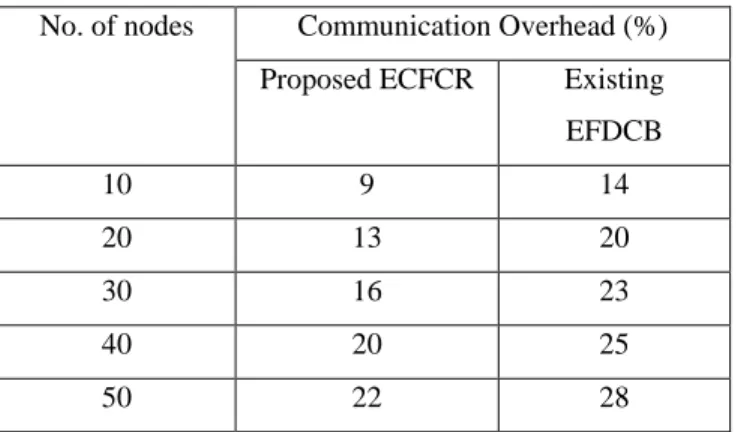
Compared to an existing distributed fault tolerant quality of wireless ad-hoc networks, the proposed energy conserved fault-tolerant clusters with QoS routing efficiently performed the clustering of nodes in the network. Clustering of nodes in the network is done based on the nodes fault tolerance and mobility rate. The below table and graph describes the performance of the proposed energy conserved fault-tolerant clusters with QoS routing in wireless ad-hoc networks.
Table 5.1 No. of nodes vs. Communication overhead
No. of nodes Communication Overhead (%)
Proposed ECFCR Existing
EFDCB
10 9 14
20 13 20
30 16 23
40 20 25
50 22 28
The above table (table 5.1) describes the efficiency of communication based on the number of nodes in the network. The communication overhead obtained for the proposed energy conserved fault-tolerant clusters with QoS routing is compared with an existing distributed fault tolerant quality of wireless ad-hoc networks.
10 20
30 40
50
Proposed ECFCR 0
5 10 15 20 25 30
Communication overhead (%)
No. of nodes
Proposed ECFCR Existing EFDCB
Fig 5.1 No. of Nodes vs. Communication overhead
Fig 5.1 describes the efficiency of communication based on the number of nodes in the network. Communication overhead is those bits of data that have to be derived to communicate information as regards, for instance, where the information created and where it is being derived to, how it is to be processed any other information representing the genuine contented to be conversed. The ECFCR method is analogous to hierarchical course-plotting in that each one cluster node only sustains QoS information for further
cluster members, a portion of the network. As a result, an increase in nodes is supposed to not considerably increase memory or runtime. Further, as global network condition is common and preserved by all, the communication overhead is really condensed. Compared to an existing distributed fault tolerant quality of wireless ad-hoc networks, the proposed energy conserved fault-tolerant clusters provides less communication overhead and the variance is 30-40 % low in the proposed ECFCR.
Table 5.2 No. of failures vs. Recovery time
Failures per
second
Recovery time
Proposed ECFCR Existing
EFDCB
5 9 14
10 13 20
15 16 23
20 20 25
25 22 28
The above table (table 5.2) describes the recovery time based on the number of failures occurred in the network. The recovery time obtained for the proposed energy conserved fault-tolerant clusters with QoS routing is compared with an existing distributed fault tolerant quality of wireless ad-hoc networks.
5 10
15 20 25
Proposed ECFCR 0
5 10 15 20 25 30
Recovery time
Failures per second
Proposed ECFCR Existing EFDCB
Fig 5.2 No. of failures vs. Recovery time
84
All Rights Reserved © 2012 IJARCSEE time is traced for EFDCB than for ECFCR. This makes
intelligence as more hops earns more packets must be derived for route cooperation with intermediary clusters, and more broadcasted packets means more meting out and proliferation time.
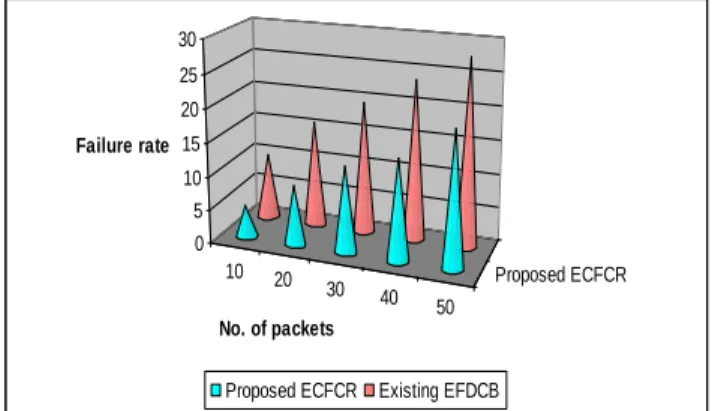
Table 5.3 No. of packets vs. Failure rate
No. of packets Failure rate
Proposed ECFCR Existing
EFDCB
10 5 10
20 9 16
30 13 20
40 15 24
50 20 28
The above table (table 5.3) describes the failure rate based on the number of packets occurred in the network. The failure rate obtained for the proposed energy conserved fault-tolerant clusters with QoS routing is compared with an existing distributed fault tolerant quality of wireless ad-hoc networks.
10 20
30 40 50
Proposed ECFCR 0
5 10 15 20 25 30
Failure rate
No. of packets
Proposed ECFCR Existing EFDCB
Fig 5.3 No. of packets vs. Failure rate
Fig 5.3 describes the failure rate based on the number of packets occurred in the network. Since the clustering process is done with the Neighbor node’s fault tolerance rate and mobility rate, the effectiveness of communication is high. So, the failure rate of the nodes in the network is becoming less in the proposed energy conserved fault-tolerant clusters with QoS routing. Compared to an existing distributed fault tolerant quality of wireless ad-hoc networks, the proposed energy conserved fault-tolerant clusters provides less failure rate and the variance is 35-45 % low in the proposed ECFCR.
Finally it is being observed that the proposed energy conserved fault-tolerant clusters with QoS routing provides a better clustering process and if network link failures occurs, local repairing of nodes are done efficiently. Then
the fault tolerance and mobility rate of the nodes are processed and ranked. According to that, clustering process is achieved efficiently.
6. CONCLUSION
The work presented energy conserved fault-tolerant clusters with QoS routing in wireless ad-hoc networks to enhance an effective communication. Clustering is done effectively based on node’s fault tolerance rate, energy consumption and mobility rate. Energy conserved clustering on QoS metrics progress node’s life time, network life time and minimizes path link breakdown and variation of node’s changeable mobility. Since fault tolerance rate is measured in terms of number of failed links in QoS path, a local repairing of intermediary nodes has been automatically. Mobility rate of the nodes in the QoS Paths are sustained at a threshold to preserve node’s sign range ease of access. Cluster head is chosen with node containing senior energy, less mobility rate and high fault tolerance rate. It progress the QoS routing path in wireless ad hoc network on preferential QoS metrics decrease interruption rate and packet losses and expands QoS routing throughput. An experimental evaluation has shown that the proposed energy conserved fault-tolerant clusters with QoS routing in wireless ad-hoc networks provides an efficient clustering of nodes to progress a node communication among the nodes in the network environment.
REFERENCES
[1]S.H. Alabbad and M.E. Woodward, “Localised Credit Based QoS Routing,” IEE Proc.—Comm., vol. 153, no. 6, pp. 787-796, Dec. 2006. [2] A.H. Mohammad and M.E. Woodward, “Localized Quality Based QoS Routing,” Proc. Performance Evaluation of Computer and Telecomm. Systems (SPECTS), pp. 209-216, 2008.
[3] A.S. Alzahrani and M.E. Woodward, “End-to-End Delay in Localized QoS Routing,” Proc. IEEE Int’l Conf. Comm. Systems (ICCS), pp. 1700-1706, 2008.
[4] P. Yang and B. Huang, “QoS Routing Protocol Based on Link Stability with Dynamic Delay Prediction in MANET,” Proc. Pacific- Asia Workshop Computational Intelligence and Industrial Applications (PACIIA), pp. 515-518, 2008.
[5] A. Mellouk, “Quality of Service Dynamic Routing Schemes for Real Time Systems in IP Network,” Proc. Networking Int’l Conf.Systems and Int’l Conf. Mobile Comm. and Learning Technologies ICN/ ICONS/MCL, p. 93, 2006.
[6] J.N. Al-Karaki, A.E. Kamal, and R. Ul-Mustafa, “On the Optimal Clustering in Mobile Ad Hoc Networks,” Proc. IEEE Consumer Comm. and Networking Conf., pp. 71-76, 2004.
[7] Y. Wang and M.S. Kim, “Bandwidth-Adaptive Clustering for Mobile Ad Hoc Networks,” Proc. Int’l Conf. Computer Comm. And Networks, pp. 103-108, 2007.
[8] A.H. Thamrin, H. Kusumoto, and J. Murai, “Scaling Multicast Communications by Tracking Feedback Sensors,” Proc. Int’l
Conf. Advanced Information Networking and Applications (AINA), pp. 1-6, 2006.
[9] L. Gu, Z. Niu, J. Lv, and H. Yoshiuchi, “An NAK-Based Hierarchical ARQ Scheme for Reliable Data Multicast in Integrated Communication and Broadcast Networks,” Proc. Asia- Pacific Conf. Comm. (APCC), pp. 1-5, 2008.
85
All Rights Reserved © 2012 IJARCSEE AUTHOURS
Dr.P.Thangaraj received the Bachelor of Science degree in Mathematics from Madras University in 1981 and his Master of Science degree in Mathematics from the Madras University in 1983. He completed his M.Phil degree in the year 1993 from Bharathiyar University. He completed his research work on Fuzzy Metric Spaces and awarded Ph.D degree by Bharathiyar University in the year 2004. He completed the post graduation in Computer Applications at IGNOU in 2005. His thesis was on “Efficient search tool for job portals”. He completed his Master of Engineering degree in Computer Science in the year 2007 from Vinayaka Missions University. His thesis was on “Congestion control mechanism for wired networks”. Currently he is a Professor and Head of Computer Science and Engineering at Bannari Amman Institute of Technology, Sathyamangalam. His current area of research interests are in Fuzzy based routing techniques in Ad-hoc Networks.
A. M.Renuka received the Bachelor of Science degree in Computer Science from Madras University in 1999 and her Master degree in Computer Application from the Bharathidasan University in 2002. She completed her M.Phil degree in the year 2005 from Periyar University. She is pursuing Ph.D.,in Computer Science at Mother Teresa University. Currently working as a Assistant Professor in the Department of Applied Science at SSM College of Engineering, Komarapalayam. She is presently working in the area of Mobile Security. Other areas of interest include Design and Analysis of Algorithms, Software Engineering and Extreme Programming.