Performance Analysis of Mixtures of R290
and R600a With Respect To R134a in Simple
Vapour Compression Refrigeration System
Jagnarayan Rawani1, Satyendra Kumar Prasad2, Jitendra Nath Mahto3
P.G. Student, Department of Mechanical Engineering, BIT Sindri Dhanbad, Jharkhand, India1
P.G. Student, Department of Mechanical Engineering, BIT Sindri Dhanbad, Jharkhand, India2
Assistant Professor, Department of Mechanical Engineering, BIT Sindri Dhanbad, Jharkhand, India3
ABSTRACT: Environmentally benign natural refrigerants have recently attracted considerable attention due to refrigerant contributions to ozone depletion and global warming. In India, about 80% of the domestic refrigerators use R134a as refrigerant due to its excellent thermodynamic and thermo physical properties. But R134a has high GWP of 1430. The higher GWP due to R134a emissions from domestic refrigerators leads to identifying a long term alternative to meet the requirements of system performance, refrigerant-lubricant interaction, energy efficiency, environmental impacts, safety and service. In the group of natural refrigerants, hydrocarbons are most closely related to the HFCs. In addition to their zero ODP and very low GWP, they are compatible with common materials found in refrigerating systems. Therefore, in this study, a performance of R290 and R600a mixtures (80/20, 70/30, 60/40 and 50/50 proportion by mass, designated by RM1, RM2, RM3 and RM4, respectively) in a vapour compression refrigeration system is conducted by the thermodynamic calculation of performance parameters. The results show that the mixtures exhibit higher refrigerating effects than R134a. All the mixtures, except RM1, exhibited a low discharge pressure, which is more desirable in refrigeration systems. The COPs of the mixtures were close to that of R134a with the advantage of higher values. Generally, the overall performance of the selected mixtures was better than that of R134a. The performance of RM4 was the best in terms of low compressor work and discharge pressure, and high COP, at varying evaporating temperatures.
KEYWORDS: ODP, GWP, COP, Refrigerating Effect, Compressor Work Input, Discharge Pressure.
I. INTRODUCTION
in refrigerating systems and are soluble in conventional mineral oils. Since hydrocarbon refrigerants contain no chlorine or fluorine atoms, they cannot undergo reaction with water and, hence, do not form the corresponding strong acids that can lead to premature system failure. R290 and R600a refrigerants have been proposed and actually used in small refrigeration systems. Their thermodynamic and transport properties are very similar to R134a currently used in refrigeration and air conditioning systems. The most important concern regarding the adoption of hydrocarbons as a refrigerant is their flammability. It should be remembered that millions of tons of hydrocarbons are used safely every year throughout the world for cooking, heating, powering vehicles and as aerosol propellants. In these industries, procedures and standards have been developed and adopted to ensure the safe use of the product. The same approach is also being followed by the refrigeration industry. Various applications have been developed in handling flammability and safety problems such as using enhanced compact heat exchangers, optimizing system designs, reducing the charge of systems and establishing rules and regulations for safety precautions. Therefore, in this study, the performance of R290 and R600a mixtures in a vapor compression refrigeration system is conducted by experimental analysis of performance parameters. Also, the results obtained were compared to the baseline refrigerant (R134a).
II. LITERATUREREVIEW
Richardson and Butterworth [1] in 1995 conducted experiments to investigate the performance of hydrocarbons in a refrigeration system for vapour compression. Tests were performed using R12, propane and mixtures of propane and isobutane composition varying around 50% / 50%. The authors found that the mixture of propane / isobutane with composition of 50% wt of propane has a higher COP, less load on the system and lower the wall temperature of the compressor compared to R12.
MacLaine-Cross[2] in 1997 showed that the hydrocarbon refrigerants provide 20% reduction in energy consumption compared to CFC12 and HFC134a.
Alsaad and Hammad [3] in 1998 examined the use of liquefied petroleum gas (LPG ) with 24.4% of R290, 56.4% of R600 and 17.2% of R600a as a refrigerant for drop-in domestic refrigerators with R12. The authors reported an evaporator temperature of -15ºC and coefficient of performance 3.4 for a condensing temperature of 27º C when LPG is used.
Kim et al.[4] in 1999 evaluated the performance of hydrocarbon refrigerant R600a as an alternative to R12 in an automatic defrost domestic refrigerator of 215 litre capacity. The authors developed a theoretical analysis using the software REFPROP, cycle-based vapor compression refrigeration ASHRAE standard, and then conducted a series of tests with the R600a. For the tests only the compressor and capillary tube were modified equipment. The tests were conducted under controlled conditions of temperature and relative humidity (30ºC and 75 % respectively).
D.Jung, C.B.Kim, S.B.Park [5] in 2000, The experimental results obtained with the same compressor indicated that the propane/isobutene mixture at 0.6 mass fraction of propane has a 3-4% higher energy efficiency and a somewhat faster cooling rate than CFC12. In conclusion, the proposed hydrocarbon mixture seems to be an appropriate long term candidate to replace CFC12/HFC134a from the viewpoint of energy conservation requiring minimal changes in the existing refrigerators.
Tashtoush et al. [6] in 2002 presented an experimental study on the performance of domestic vapour compression refrigerators with new blends of hydrocarbon / hydrofluorocarbon as refrigerant for replacement of CFC12. The results showed that the mixture of R600, R290 and HFC134a has an excellent performance.
Lee and Su [7] in 2002 conducted an experimental study in the use of isobutane in a household refrigerator. The results showed that the coefficient of performance was comparable with that obtained by CFC12 and HCFC22 when used as refrigerants.
Akash and Said [8] in 2003 reported that LPG has better performance than the R12. The results showed that a load of 80 g of LPG had the best results when used in the same refrigerator.
Sekhar et al. [9] in 2004 investigated the mixture of HFC134a/hydrocarbons in two systems of low temperature (household refrigerator and freezer ) and two medium-temperature systems (vending machine and bottle cooler). The authors concluded that a mixture containing 9 % of hydrocarbon mixtures (mass) has the best performance, resulting in 10-30 % and 5-15 % reduction in energy consumption in systems of medium and low temperature, respectively.
according to mass, respectively) was the most appropriate alternative. Compared with using R134a, using this HC mixture reduced the refrigerator’s energy consumption by 86%. The refrigerant charge of the HC mixture system was approximately 50% of that of the R134a system (120 g). Adjusting the refrigeration system was not required. The flammability of the mixture of R290 and R600a is not a problem in a small-capacity refrigeration system with the refrigerant charge below 100 g based on R134a.
Garland and Hadfield [11]in 2005 studied the environmental impacts of hydrocarbon refrigerant R600a deployed in the domestic refrigerator hermetic compressor. The test was done by sliding tests to establish wear mechanism and friction coefficient and compared the results with R134a. The results showed that R600a compressor continues to perform at the end of its 15-year cycle whereas the performance of the R134a compressor deteriorates rapidly at and beyond 15 years.
M. Fatouh and M. El Kafafy [12] in 2006, Continuous running and cycling results showed that R134a with a capillary tube length of 4 m and charge of 100 g or LPG with capillary tube lengths from 4.0 to 6.0 and charge of 50 g or more satisfy the required freezer air temperature of 120°C. The lowest electrical energy consumption was achieved using LPG with combination of capillary tube length of 5 m and charge of 60 g. This combination achieved higher volumetric cooling capacity and lower freezer air temperature compared to R134a. Pull-down time, pressure ratio and power consumption of LPG refrigerator were lower than those of R134a refrigerator by about 7.6%, 5.5% and 4.3%, respectively. Also, actual COP of LPG refrigerator was higher than that of R134a by about 7.6%. Lower on-time ratio and energy consumption of LPG refrigerator by nearly 14.3% and 10.8%, respectively, compared to those of R134a refrigerator were achieved. In conclusion, the proposed LPG seems to be an appropriate long-term candidate to replace R134a in the existing refrigerator, except capillary tube length and initial charge.
III.EXPERIMENTAL INVESTIGATION
Figure 1:T-S diagram of vapour compression refrigeration system
COP = heat extracted at low temperature / work supplied
Heat extracted at low temperature = Heat transfer during the process A-B = refrigerating effect
Q2 = ( hB– hA)
Work of compression = W = ( hc - hB) COP =
( – )
0 50 100 150 200 250 300
-10 0 10 20
R e fr ig e ra ti n g Ef fe ct (k J/ m in )
Evaporating Temperature (°C)
R-134a
RM 1
RM 2
RM 3
RM 4 III.EXPERIMENTAL RESULTS
Figure 2: Variation of Refrigerating Effect with Evaporating Temperature
Above figure shows the variation of the refrigerating effect with evaporating temperature at a condensing temperature of 50°C. As shown in the figure, the higher the percentage of R600a in the mixture, the lower the refrigerating effect of the mixture. The refrigerating effect increases with an increase in evaporating temperature, which is due to the increase in the latent heat value of the refrigerant.A very high latent heat value is desirable, since the mass flow rate per unit of capacity is less. When the latent heat value is high, the efficiency and capacity of the compressor are greatly increased. This decreases the power consumption and also reduces the compressor displacement requirements that permit the use of smaller, more compact pieces of equipment. It is clearly shown in figure that the hydrocarbon mixtures exhibited higher refrigerating effects than R134a. Therefore, a very low mass of refrigerant would be required for the same capacity, and a smaller compressor size would also be required, due to their high latent heat values.
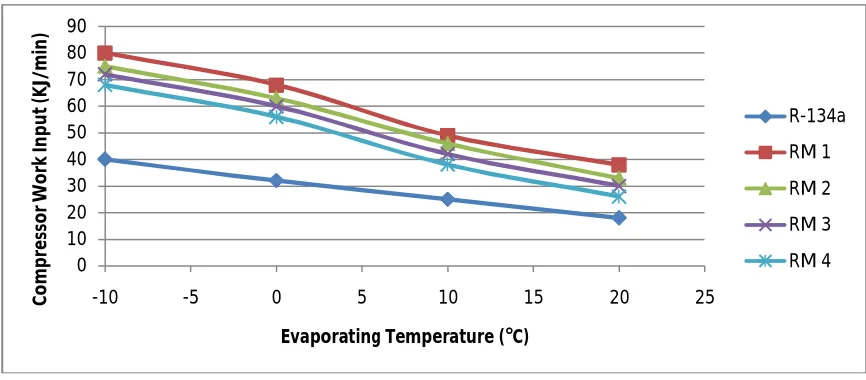
Figure:3 Variation of compressor work input with Evaporating Temperature
0 10 20 30 40 50 60 70 80 90
-10 -5 0 5 10 15 20 25
C o m p re ss o r W o rk In p u t (KJ /m in )
Evaporating Temperature (°C)
R-134a
RM 1
RM 2
RM 3
The variation of compressor work input with evaporating temperature at a condensing temperature of 50°C is shown in Figure 3. The figure shows that the work of compression decreases as the temperature of the evaporator increases. This is due to the fact that when the temperature of the evaporator increases, the suction temperature also increases. At high suction temperatures, the vaporizing pressure is high and, therefore, the density of the suction vapor entering the compressor is high. Hence, the mass of refrigerant circulated through the compressor per unit time increases with the increase in suction temperature for a given piston displacement. The increase in the mass of refrigerant circulated decreases the work of compression. The works of compression using mixtures of R290 and R600a are higher than that of R134a, but they also exhibited much higher refrigerating effects than those of R134a (Figure 2). The lowest compressor work was obtained using RM4 (mass proportion of 50/50).
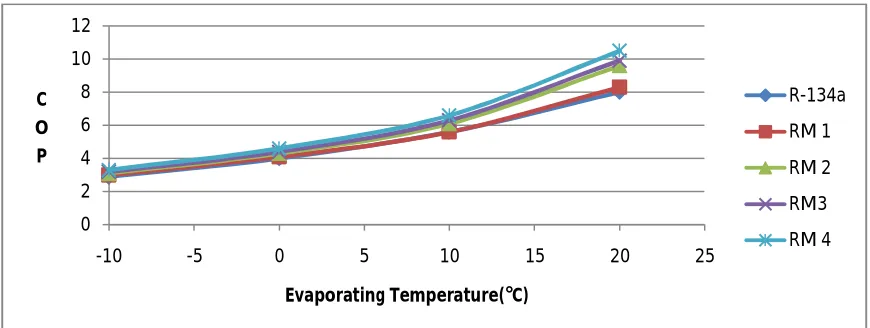
Figure: 4 Variation of COP with Evaporating Temperature
Comparisons of the COP for R290 and R600a mixtures with R134a, as a function of evaporating temperatures at a condensing temperature of 50°C, are shown in Figures 4. Similar trends were observed in the two figures, for all the refrigerants considered, COP increases with an increase in evaporating temperature. The COP of the hydrocarbon mixtures are higher than that of R134a. Again, the highest COP was obtained using RM4.
Figure : 5 Discharge pressures of different refrigerants
0 2 4 6 8 10 12
-10 -5 0 5 10 15 20 25
C O P
Evaporating Temperature(°C)
R-134a
RM 1
RM 2
RM3
RM 4
0 0.5 1 1.5 2
R-134a RM 1 RM 2 RM 3 RM 4
D
is
ch
ar
ge
P
re
ss
u
re
(
M
P
a)
Discharge Pressure
Figure 5 shows the discharge pressure at 50°C condensing temperature for various mass proportion mixtures of propane and iso-butane, and the baseline refrigerant (R134a). Except for RM1, all the hydrocarbon mixtures exhibited lower discharge pressure than R134a. The discharge pressure is an important parameter that affects the performance of a refrigerating system. It influences the stability of the lubricants and compressor components. Therefore, refrigerants with lower discharge pressure are more suitable alternatives, and better than those with high discharge pressure. The lowest discharge pressure was obtained using RM4, which consists of a R290 and R600a mixture in a mass proportion of 50/50.
V.CONCLUSION
In this study, the performance of R290 and R600a mixtures in a vapour compression refrigeration system is conducted by experimental calculation and analysis of performance parameters, and the results obtained were compared with the baseline refrigerant (R134a). Propane (R290) and iso-butane (R600a) are the most prominent hydrocarbon refrigerants presently being used in refrigeration and air-conditioning systems. In order to obtain the performance and the best mass proportion mixture of these refrigerants to match the performance of R134a, mixtures of various proportions by mass of R290 and R600a (80/20, 70/30, 60/40 and 50/50) were selected and their thermodynamic properties were computed experimentally. Performance parameters, such as refrigerating effect, compressor work input, pressure ratio and Coefficient Of Performance (COP), were computed and analyzed at various evaporating and condensing temperatures. The various mixtures of R290 and R600a exhibited higher refrigerating effect than R134a. Therefore, very low mass of refrigerant charge will be required for the same capacity. They also exhibited a higher compressor work input than R134a, but their higher refrigerating effects have compensated for this. All the mixtures, except that of 80/20 mass proportion, exhibited a low discharge pressure, which is more desirable in refrigeration systems. The lowest discharge pressure was obtained using the mixture with 50/50 mass proportion. For both the mixtures and R134a, the COP increased with an increase in evaporating temperature. The COPs of the mixtures were close to that of R134a, with the advantage of higher values. The highest COP was obtained using a mixture of 50/50 mass proportion. The performance parameters (refrigerating effect, compressor work input and COP) were also analyzed at various condensing temperatures and fixed evaporating temperature. The results showed that the system performed better at lower condensing temperatures. The higher the condensing temperature, the higher the compressor work input and the lower the refrigerating effect and the COP. Generally, the overall performance of the selected mixtures was better than that of R134a.. The performance of the mixture with 50/50 mass proportion was better than all other refrigerants considered, in terms of low compressor work and discharge pressure and high COP, at varying evaporating temperatures.
REFERENCES
[1] Richardson, R.N., Butterworth, J.S., The performance of propane/isobutane mixtures in a vapourcompression refrigeration system. International Journal of Refrigeration, vol18 , pp. 1, 58-62, 1995
[2] Maclaine-Cross, I.L., Why hydrocarbons save energy. AIRAH Journal vol.51, pp. 33- 37,1997.
[3] Kim, M.H., Lim, B.H., Chu, E.S., The performance analysis of a hydrocarbon refrigerant R-600a in a househould refrigerator/freezer. KSME International Journal, Vol.12, No.4, pp.753-760. 1998.
[4] Hammad, M.A., Alsaad, M.A., The use of hydrocarbon mixtures as refrigerants in domestic refrigerators. Applied Thermal Engineering vol.19 ,pp.1181-1189,1999.
[5] D. Jung, C.B Kim, "Testing of Propane/isobutene mixture in domestic Refrigerators," International journal of Refrigeration, vol. 23, pp. 517-527, 2000.
[6] Tashtoush, B., Tahat, M., Shudeifat, M.A., Experimental study of new refrigerant mixtures to replace R12 in domestic refrigerators. Applied Thermal Engineering vol. 22 pp. 495-506 ,2002.
[7] Lee, Y.S., Su, C.C., Experimental studies of isobutane (R600a) as the refrigerant in domestic refrigeration system. Applied Thermal Engineering vol. 22 pp. 507-519, 2002
[8] Akash, B.A., Said, S.A., Assessment of LPG as a possible alternative to R-12 in domestic refrigerators. Energy Conversion and Management vol.44 pp.381-388,2003.
[9] Sekhar, S.J., Lal, D.M., HFC134a/HC600a/HC290 mixture a retrofit for CFC12 system. International Journal of Refrigeration vol28 pp. 735-743 (2004).
[10] S. Wongwises, N. Chimres, "Experimental study of hydrocarbon mixtures to replace HFC 134a in a domestic refrigerator," Energy converse. Manage., vol. 46, pp. 85-100, 2005.
[12] M. Fatouh, M. El Kafafy, "Experimental evaluation of a domestic refrigerator working with LPG," Applied thermal engineering, vol. 26, pp. 1593-1603, 2006.
[13] K. Mani, V. Selladurai, "Experimental analysis of a new refrigerant mixture as drop-in replacement for CFC12 and HFC134a," International Journal of Thermal Science, vol. 47, pp. 1490-1495, 2008.