314
BIOMETRIC OBSERVATIONS ON IPOMOEA PURPUREA (L.) ROTH
(CONVOLVULACEAE) LEAVES
Rodica Bercu, Marius Făgăraș
Faculty of Natural and Agricultural Sciences,”Ovidius” University, Constantza
Key words:biometry,measurements, lamina, mathematical calculation, Ipomoea purpurea
ABSTRACT
The paper discloses a research model of leaf investigation, based on biometrical measurements and morphological observations. There are only a few examples of this type of biometrical investigation and analysis model applied on spontaneous plants leaves in literature. The article comprises biometrical investigations on Ipomoea purpurea (L.) Roth leaves. The measurements and observations were performed on 40 mature leaves of the studied genotype, including linear measurements, percentage ratio, angular measurements and the leaf surface as well. The biometric measurements were the basis of a mathematical calculation of the average values on the studied species.
INTRODUCTION
IpomaeaL. is a genus with over 400 climber or prostrate species.Ipomoea purpurea (L.)Roth( syn. Pharbitispurpurea (L.) Voigt), popularly known as the morning glory, is an annual climbing herb of Ipomoea genus,belonging to Convolvulaceae family and is originating in Mexico and Central America.Like all morning glories Ipomoea, it wraps around supports and can grow up to 2-3 m. The plant is well branched from the base and stems are covered with brown hairs. It has large green ovate-cordate-shaped and glabrous or pubescent leaves. The blue, red and violet flower corolla is funnel-shaped and has 2-4 cm in diameter. The fruits are capsules(Henderson, 2001; Everitt et al., 2007).
Meny sets of terms and methods have been devised for describing leaves (e.g. Hably and Zastawniak, 2001; Dale et al. 1971; Dickinson et al., 1987; Hickey 1973; Jensen, 1990; Melville, 1976; Ray, 1992; Roth andDilcher, 1978). The methods and terms for the leaves description form and venation are largely from the leaf architectural system of Mounton (1966a,b, 1967, 1976).
In Romanian literature there are few examples of this type of leaf investigation and analysis model applied on spontaneous plants leaves (Bercu, 2005), mostly of them being paleontological studies (Givulescu, 1999, GivulescuandSoltesz, 2000). Some data refers to general biometric features such as lamina venation, mentioned in lectures and manuals of Botany, Anatomy and morphology of plants or Morphology of plants (e.g. Andrei, 1997; Buia andPéterfi, 1965).
The purpose of this paper is to highlight the features of the leaf of Ipomoea purpureaand to contribute withmore informationto complete the morphological knowledge concerning this species.
MATERIAL AND METHODS
315
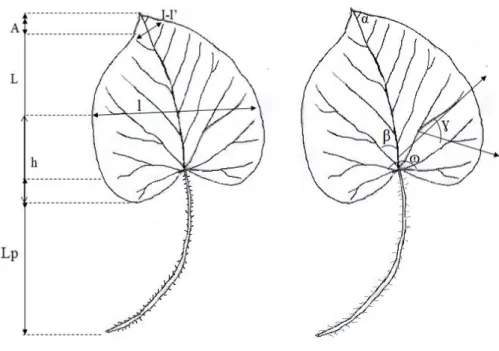
the emergent angle of the secondary veins with primaries, ɣ- the emergent angle of the tertiary veins related to the primary one,ω- the emergent angle of the primary veins and finally other measurements: the number semi-sum of secondary veins pairs (Np) and the lamina surface (S).For each leafwere carried out 15 measurements amounting to 640 performed on all the leaves.
RESULTS AND DISCUSSION
I. Biometric observations.The biometrical measurements performed on Ipomoea purpurea40 leaves (Tables 1, 2, Fig. 1), represented the base for an original mathematical calculation for the average values of measurements (Tables 3, 4).
Fig. 1.Diagramshowing the linear (a) and angular (b) measurements on Ipomoea purpurea leaf.
Liniarmeasuremens (Fig. 1)
mm n
L L
L n L
L n
n
i Ip
Ip 75.12
40 87 ... 67
...
2 1
1 ____
mm n
l l
l n l
l n
n
i Ip
Ip 85.15
40 98 ... 94
...
2 1
1 ____
mm n
h h
h n h
h n
n
i Ip
Ip 20.97
40 24 ... 23 ...
2 1
1 ____
mm n
A A
A n A
A n
n
i Ip
Ip 7.72
40 5 ... 9
...
2 1
1 ____
316
mm n I I I I I I n I I I I n n i IpIp 14.22
40 12 ... 25 ' ... ' ' '
' 1 2
1 ________
mm n Lp Lp Lp n Lp Lp n n i IpIp 84,40
40 118 ... 70 ... 2 1 1 _______
Percentage ratio % 60 . 0 40 88 . 0 ... 71 . 0 ... 2 1 1 ______
n l L l L l L n l L lL n n
i Ip Ip % 09 . 0 40 05 . 0 ... 13 . 0 ... 2 1 1 ______
n L A L A L A n L A LA n n
i Ip Ip % 27 . 0 40 62 . 0 ... 34 . 0 ... 2 1 1 ______
n L h L h L h n L h L h n n i Ip Ip % 50 . 0 40 55 . 0 ... 36 . 0 ' ... ' ' ' ' 2 1 1 ______
nI I A I I A I I A n I I A I I A n n i Ip Ip
Angular measurements (Fig. 1)
o n n i Ip Ip n
n 40 82.75
95 ... 120 ... 2 1 1 ___
o n n i Ip Ip nn 40 38.87
35 ... 70 ... 2 1 1 ___
o n n i Ip Ip nn 40 32
20 ... 45 ... 2 1 1 ___
o n n i Ip Ip nn 40 133
317
2 2
1
1 ___
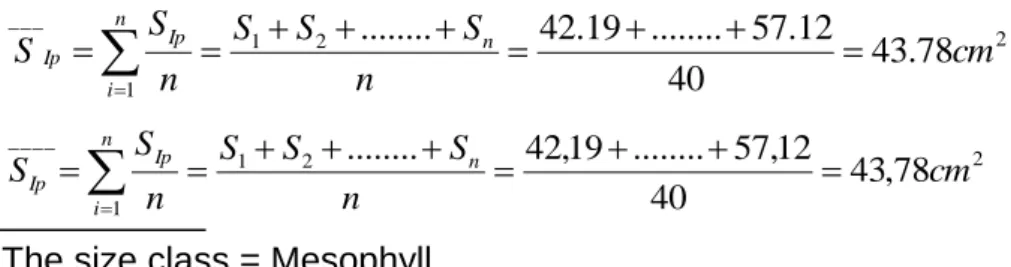
78 . 43 40
12 . 57 ... 19
. 42 ...
cm n
S S
S n S
S n
n
i Ip
Ip
2 2
1
1 ____
78 , 43 40
12 , 57 ... 19
, 42 ...
cm n
S S
S n S
S n
n
i Ip
Ip
The size class = Mesophyll
II. Morphometric description of Ipomoea purpurealeaves.Laminas obovate to cordate, dominant mesophyll (S = 40.03-78.28 cm²) and subordinatenotofil(S = 23.05-39.66 cm²).In literature (Mouton, 1966a) the leaves size class values are registered as: leptophyll (0-0.25 cm2), nanophyll (0.25-2.25 cm2), microphyll (2.25- 20.25 cm²), notophyll (20.25 -40.00 cm²), mesophyll (40.00-182.25 cm2
), macrophyll (182-1640.2 cm2) and megaphyll (over 1600.2 cm2).The pubescent laminas are green with a subacute apex (α = 60o - 120o), cordate base, entire margin and membranous texture.The petiole is normal, cylindrical,green moderate pubescent and quite long (Lp = 50-125 mm) (Fig. 2).Lamina venation is marginal actinodromous, perfect basal with radial primary veins starting from the base.
Fig. 2.de Ipomoea purpurealeaf: upper surface (left) and lower surface (right).
The emergent angle between the primary and the secondary veins is narrow acute to moderate (β = 30o – 70o
) (Figs. 1, 2).From the secondary veins start the tertiary veins, more numerous, reaching almost to the edge of the lamina.The emergent angle of the tertiary veins related to the primary one is subacute (ɣ = 30o– 55o
318
Table 1 Liniar measurements and percentage ratioon Ipomoea purpur leaves
Leaf no. L mm
l mm
h mm
A mm
I-I’ mm
Lp mm
L/l %
A/L %
h/L %
319
Table 2
Angular measurements, other measurements and the size class of
Ipomoea purprealeaves
Table 3
The average of the linear measurements and percentage ratioof Ipomoea purpurea leaves
Specia L (mm)
l (mm)
h (mm)
A (mm)
I-I´ (mm)
Lp (mm)
L/l (%)
A/L (%)
h/L (%)
A/ I-I´ (%)
Ipomaeap urpurea(L.)
Roth
75.12 85.15 20.97 7.72 14.22 84.40 0.65 0.09 0.27 0.50 Leaf no. α° β° γ° ω° Np (cm²) S Size class
320
Table 4
Angular measurements and other measurements of Ipomoea purpurea leaves
Specia ˚ ˚ ˚ ω˚ Np
S
(cm²) Size class
Ipomaea purpurea
(L.) Roth
82.75 38.87 32 133 3.50 43.78 Mesophyll
CONCLUSIONS
The linear measurements of Ipomoea purpurealaminas have high values concerning the length (L) and lower for the apex length (A). The percentage ratio of Ipomoea purpurealeaves indicate a finesse leaf (L/l) and a fine apex (A/I-I’). Lamina venation is marginaactinodromous, perfect basal.Concerningthe leaves angular measurements of Ipomoea purpurea,the apex is subacute (α). The basal angle between the primary (ω) veins is obtuse. The emergent angle between the primary and the secondary veins (β)is narrowing acute to moderate whereas the tertiary to the primaries (ɣ) is subacute. The petiole is cylindrical, green and ratherlong (Lp). Laminas have a more or less large surface area (S) including the species leaves in the mesophyll size class and subordinate in notophyll.
The morphological and morphometrical features such as the ovality ratio, the slightly emarginate tip, the membranoustexture, the venation type and the notophyll size class (small surface area with higher leaf mass per unit area) allow Ipomoea purpurea to be adaptable for the temperate zones, even with air humidity and semi-arid regions.
The usefulness of this particular study is the fact that this method of investigation and the results may be used in plant taxonomy researches, paleontology, researches concerning the effect of environmental factors as well as in the research of evolution.
BIBLIOGRAPHY
1. Andrei M.,1997 -Morfologiagenerală a plantelor, EdituraEnciclopedică, Bucureşti.
2. Bercu R. 2005 - Biometrical and anatomical observations of some Acer L. species leaves, Edit. Belgrad University Press, Faculty of Forestry, University of Belgrade,Belgrade.
3. Buia Al., PéterfiŞt.,1965 - Botanica agricolă. Morfologia, vol. I., Edited by Agro-Silvică, Bucharest.
4.Dale M.B., Groves R.H., Hull V.J., O’Callaghan J.F.,1971 - A new method for describing leaf shape,New Phytologist (London, New York), 70: 437-442.
5.Dickinson T.A., Parker, W.H., Strauss, R.E.,1987 - Another approach to leaf shape comparisons, Taxon (Wien), 36: 1-20.
6.Everitt J.H., Lonard R.L.; Little C.R., 2007 - Weeds in South Texas and Northern Mexico. Lubbock: Texas Tech University Press.
7.Givulescu R.,1999 - Floramică ilustartă a terţiarului din România. Edit.Casa Cărţii de Stiinţă, Cluj-Napoca.
8.Givulescu R., Soltesz, A.,2000 - Observaţii de ordin biometric şi anatomic asupra frunzelor unor specii de Tilia , Nymphaea, Folia nature Bihariae (Oradea), XVIII: 83-89. 9.Hably L., Zastawniak E.,2001 - Distribution and paleoecology of UlmusL. In the hungarianegerian,Studia bot. hung. (Budapest), 32: 13-32.
321
11. Jensen R. J.,1990 - Detecting shape variation in oak leaf morphology: a comparison of rotational-fitmethods, Amer. J. Bot. (St. Louis), 77: 1279-1293.
12. Melville R.,1976 - The terminology of leaf architecture,Taxon (Wien), 25: 549-561. 13. Mouton J.A.,1966a - Les types biologiques foliaires de Raunkiaer. Etat actuel de la question, Bull. Soc. Bot. (Paris), 125: 145-158.
14. Mouton A.,966b - Sur la systématique foliaire en paléobotanique, Bull. Soc. Bot. (Paris), 113(9): 492-503.
15. Mouton J. A., 1976- La biométrie du limbe mise au point de nos connaissances,Bull. Soc. Bot. (Paris), 113: 28-36.
16. Niculescu, Mariana, 2009, Metode de cercetare si prezentare a florei, Ed. Sitech, Craiova
17. Niculescu Mariana, 2009, Morfologia si anatomia plantelor vol.I, Ed. Sitech, Craiova 18. Niculescu, Mariana - Practicum de Botanică sistematică – Partea I, Ed. Universitaria Craiova, 2004, 114 p.