
256
STATE OF THE ART REGARDING CONSERVATIVE TILLAGE
TECHNOLOGIES
VLĂDUŢ I.D.1), BIRIŞ S.ŞT.1), BORUZ S.2), VLĂDUŢ V.3), MARIN E.3), UNGUREANU N.1), SORICĂ C.1),
DUŢU I.1), DUMITRU I.2), CROITORU ŞT.2), VOICEA I.3), MATACHE M.3), CUJBESCU D.3), COVALIU C.1), DANCIU A.3), BRĂCĂCESCU C.3)
1)P.U. Bucharest; 2)University of Craiova; 3)INMA Bucharest
Keywords:conservative, durable, soil, system, technologies
ABSTRACT
Following the expansion of soil degradation processes due to conventional agriculture and technological mistakes, over the years, the so-called conservative agricultural technologies have been studied and implemented in practice. These technologies have contributed substantially to the improvement of soil fertility and productivity and, thus, of other environmental resources. The most important component of conservation technological systems, as in the case of conventional ones, is soil tillage – loosening and processing – and the introduction of seed into the soil. Switching from conventional tillage systems to the conservative ones was not easy and generated a lot of questions that needed relevant answers, scientifically based, some of them being obtained through fundamental and applied research carried out under local specific conditions. Conservative systems are based on the less intense loosening of soil, made by different methods, without furrow return and only while maintaining a given amount of crop residues on soil surface, is being considered for this reason as environmental protection strategies. In this paper is presented an analysis of the state of research on the implementation in agriculture of conservative tillage technologies and the technical-economic and environmental impacts of applying these conservative technologies. Also, there are presented the most advanced research on optimal construction of equipment for soil processing in conservation system.
INTRODUCTION
Soil works have been an integral part of agriculture since the beginning and served several important purposes: seedbed preparation, reducing soil compaction to increase aeration and for better development of the root system of plants, reducing the weeding, incorporation of fertilizers and amendments, crop residue management. [1]
The agricultural system is a set of sectors, technologies, machinery and technological aggregates, in which the soil is used as the main resource for the production of agricultural crops, orchards, vineyards, vegetables, floriculture and animal husbandry. In Europe, in agriculture, depending on the technologies used, their level of intensification, specialization, the quantity and quality of biomass, the relations with the environment, etc, are practiced various systems of agriculture: conventional, sustainable, ecological (biological, organic), precision, extensive. [2]
The conventional agriculture system, product of the over-industrialized society, with strong polluting effects, hardly controllable and unpredictable on the ecological balance, biodiversity and food quality, is the type of powerful but unsustainable farming, found in an alarming stage, due to the exhaustion of fossil fuels and multiple negative effects on society. The beneficial result of industrial agriculture is only the increase of labor productivity and increasing yields, which in the past 4-5 decades have doubled and even
tripled in many countries. This is the dominant system of today’s agriculture, whose
257
The term "sustainable development" was first used by the Prime Minister of Norway, Gro Harlem Brundtland, in 1987. As chairman of the World Commission on Environment and Development, he presented the report "Our Common Future" in which he defined the sustainable development as "the development that meets the needs of the present without
compromising the ability of future generations to meet their own needs". Sustainable
development implies ensuring simultaneous progress on three fronts: economic, social, environmental. In the "environment-economic-social" trinomial system, sustainable development emphasizes the interdependence of components and highlights the need for equality and impartiality between people raised to the rank of "universal citizen". [4]
For the term "sustainable agriculture" has not yet been developed a detailed and universally accepted definition, as agricultural practices which subsumes to this concept and aims to provide sustainable development in rural areas vary in space and time, and
their effectiveness can be properly assessed, especially retrospectively.[38]
Organic farming promotes the systems of sustainable production, diversified and balanced, to prevent the pollution of crops and of the environment. [6]
Organic farming avoids the use of pesticides, herbicides, synthetic fertilizers and
genetic manipulation practices. Regarding animal husbandry, it’s avoided the use of
prophylactic antibiotics and growth hormones and the focus is on animal welfare and on providing food with natural products. [7]
Organic farming can be defined as a holistic approach of the production management system, which promotes and maintains a healthy development of agro-ecosystems, including biodiversity, biological cycles and soil biological activity. The focus is directed to the use of management practices in line with the use of external farm inputs, taking into account the regional conditions to which that systems must adapt. This is accomplished by using, where the conditions allow it, of farming methods, biological and mechanical, as opposed to using synthetic materials. [8]
Precision farming (PA) or satellite farming or site specific crop management (SSCM) is a farming management concept based on observing, measuring and responding to inter and intra-field variability in crops. Crop variability typically has both a spatial and temporal component, which makes statistical/computational treatments quite involved. The holy grail of precision agriculture research will be the ability to define a Decision Support System (DSS) for whole farm management with the goal of optimizing returns on inputs while preserving resources. The reality today is that apparently simple concepts, such as the ability to define management zones, areas where different management practices will apply, for a single crop type on a single field over time are difficult to define. [9], [10]
An agricultural system can be sustainable if the production, the nutrients contained in crop and manure, or lost by erosion, are equal to those introduced in the form of artificial fertilizers, and created by the degradation of the rocks in the base layer. All additional inputs, such as energy, water, chemical preparations should also be durable products. Considering all of the above, it can be concluded that: precision farming is the management method that ensures the strategy of sustainable development in agriculture; precision farming associates geospatial and information technologies in order to use site-specific data, for taking decisions related to agricultural production; precision farming presents a set of technologies for sustainable agriculture. [11]
Extensive agriculture with low-inputs – of subsistence, with less competitive
258
Soil conservation concept consists of a set of activities, measures and technologies that help to maintain soil fertility status without a significant decrease in yields or without high costs. This system covers a wide range of farming methods which mainly aim to preserve the plant residues on the surface of arable soil in order to reduce erosion. [13]
Soil conservative technologies are characterized by the fact that they leave on the soil surface over 30% of plant residues of the previous crop. Crop residues protect the soil surface from water erosion by absorbing raindrops energy, thus reducing the possibility of detachment of soil particles. The layer of crop residues also reduces soil compaction by raindrops and the possibility of crust formation, thus increasing the capacity of water infiltration into the soil. By creation of small dams and obstructions along the water drainage trough, plant residues slow down its flow rate, decreases the amount of carried soil and the amount of additional particles removed by the water. Thus, by reducing the water flow rate, some soil aggregates and particles carried by the water will redeposit. During plant development, crop residues protect the soil from sun and wind, reducing water losses by evaporation and during winter they increase soil moisture by retaining snow on the soil surface. [14]
Soil conservation technologies, which leaves a large part of crop residues on the soil surface, reduce erosion up to 95% (no-till) compared with the conventional processing systems. Crop residues, which are evenly distributed on the soil surface and in higher quantity on sloping soils where erosion is accentuated, by intercepting raindrops, absorb their energy and reduce the detachment process of soil particles (the first step in erosion), slow the water flow on the surface of sloping soils and reduce the transport of soil particles (the second step in erosion). [15]
MATERIAL AND METHOD
Conservative tillage technologies can be: with reduced works (minimum tillage), with works with protective layer (cover crops, catch crops), with works on ridge (ridge-tillage), with works in strips or narrow strips (strip till, zone till), without works or direct sowing (no-tillage). [16]
The European Union faces eight main soil degradation processes: soil erosion, loss
of organic matter content, soil contamination, salinisation, soil compaction, loss of soil
biodiversity, soil sealing, landslides and floods. [17]
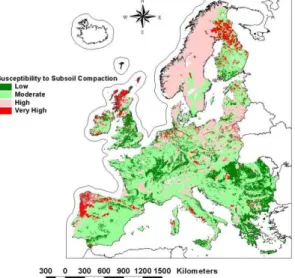
Figure 1 shows a provisional distribution of susceptible subsoils in Europe, a distribution which must not be interpreted as actual vulnerability to compaction.
Fig.1. Provisional map of inherent susceptibility of subsoils in Europe to compaction, based on soil properties alone [18]
259
A spatial analysis of this distribution has revealed the following proportions for the 4 susceptibility classes: low 20 %, moderate 44 %, high 28 %, very high 9 %. Thus more than a third of European subsoils are classified as having high or very high susceptibility to compaction and more than 75 % moderate or high susceptibility. The patterns of high and very high susceptibility are mainly associated with areas of coarse or organic soils. [18]
In Romania, most arable soils are moderately vulnerable (fig. 2) and grasslands in central regions are most vulnerable to soil compaction (fig. 3) [19].
Fig. 2. Vulnerability to compaction of arable soils [19]
Fig. 3. Vulnerability to compaction of soils under grasslands [19]
To decrease these disadvantages, there was a tendency in agricultural practices to minimize the works of soil preparation, for planting and crop care works. [20]
Systems with reduced works (minimum tillage) began to be experienced for the first time in 1950 in the USA, at Ohio University, in wet- warm climates, on flat lands, with fertile soils, rich in humus, permeable, without moisture excess, originally grown in corn monoculture of large productivity [21].
260
Fig. 4. Close-up view of Sundance minimum-tillage bed-conditioning implement used in the Salinas Valley [22]
RESULTS AND DISCUSSIONS
Minimum tillage systems are now an established part of mainstream UK agriculture, accounting for an estimated 40 % of all cultivations, but as across Western Europe as a whole, it’s a concept still in its infancy compared with the activities in North America, Latin America, and Australia, for example [23].
Soil Conservative technologies, leaving much of the plant residues on the soil surface, reduce erosion by a rate of 95% (no-till), as compared to conventional tillage systems [24].
Plant residues left on the soil surface or incorporated in the soil, contribute to the
biological activity, which is an important source of CO2, restores soil structure and
improves its overall drainage, which allows faster infiltration of water into the soil. [25] Romania has the necessary means to introduce the technology of establishing straw cereal crops in minimal tillage system, due to the research conducted by INMA Bucharest, with technical equipment (fig. 5) which performs simultaneously tillage and straw cereals establishment, both on half-prepared and unprepared lands for sowing, leading to a substantial reduction of soil compaction, energy consumption and cost of labor [26].
Fig. 5. Technical equipment endowed with working parts for preparing the soil
and sowing straw cereals [26]
After ploughing, the layer of soil on the surface remains completely discovered, raindrops falling at high speed destroy soil aggregates, soil becomes compact, with much reduced permeability, and the amount of water stored in the deeper layers is reduced. These disadvantages can be removed if on the soil surface is laid a layer of organic matter composed of chopped straw or corn stalks, undecomposed manure, turf etc. During the time when the vegetation layer covers the soil, maintenance works necessary for the crops are performed using special tools that loosen the soil without burying the protective topsoil [27].
261
spherical horizontal disc for cutting the ridge in an area where sowing coulters incorporate the seeds, showed the efficacy of ridge sowing technology of corn [28].
Fig. 6. Ridge cultivator equipped with shanks [28]
Ridge sowing equipment for weeding plants (fig. 7), performs the cutting of plant residues and of soil vertically to the axis of the row to be sown by a flat vertical disk with rim, cutting of the ridge tip and its cleaning by a spherical horizontal disk, the mobilization and soil loosening in strips by a corrugated disk, sowing by the distribution equipment, seed incorporation into the soil, seed coverage and shallow soil compaction [29].
Fig. 7. Ridge sowing equipment for weeding plants [30]
Researches conducted by Ohio State University showed that strip tillage is usually performed in the fall following soybeans or wheat to prepare the ground for corn planting. Tillage is confined to narrow strips where seeds will be planted. The loosened soil in the strip creates a ridge 3 to 4 inches high, which improves soil drainage and warming. By spring, it usually settles down to 1 to 2 inches high, and after planting the field is flat. Row middles are untilled and covered with undisturbed crop residue [31].
In Romania, INMA Bucharest has designed, developed and tested an experimental model of technical equipment for strip tillage, sowing, fertilizing and distributing granular insecticides for innovative technology of establishing weeding crops adapted to specific climatic conditions of Romania’s regions [32].
The equipment (fig. 8) is designed to perform sowing of weeding plants during optimum time, depending on soil and climatic conditions, both on lands worked in "strips" since autumn and sown in spring, and on lands not prepared for sowing [33].
Fig. 8. Technical equipment for soil working on narrow strips, hoeing plants sowing, fertilizing and spreading
262
Direct sowing means putting seed in fallow soil, i.e relinquishing any tillage. The only "processing" is a slot created by the coulters of the sowing machine in which seeds and fertilizers are introduced. In 1974, the U.S. Department of Agriculture estimated that the amount of cropland in the United States under no-tillage culţivation was 2.23 million hectares, and that 62 million hectares or 45 percent of the total U.S. cropland will be under the no-tillage system by 2000 [35].
The implementation of a European Soils Directive is considered to be an important step towards the recognition that conservation tillage and no-tillage are both economical and ecological sustainable methods for agricultural production. It is anticipated that this development will promote the concept of Conservation Agriculture and increase adoption levels throughout Europe [36].
INMA Bucharest carried out research on direct sowing (no-tillage) of straw cereals with a new technical equipment (fig. 9), which consists of working bodies type corrugated disk, for the processing of a narrow strip of soil penetrated by disk coulters which incorporate the seeds at the set depth, in order to prevent the degradation of soil and other environmental resources, and to improve the soils degraded by conventional technologies, to reduce energy consumption, to increase the productive potential of the soil and to increase water use efficiency [37].
Fig. 9. Equipment for direct sowing (no-tillage) of straw cereals [5]
CONCLUSIONS
In latest years, it has been noticed a re-orientation towards the ecological products field, mostly due to cancer-provoking chemical substances which affect the human body. In this context, vegetal extracts containing substances which can induce in treated plant the stimulation of protection mechanism and determine the crops resistance increasing to pathogen microorganisms and pests causing great economic losses and risking to spread infections; represents an efficient solution to pest control.
Extracts of plants may be also used as insecticide for preventing insect attack of certain crops, following the recent studies, being found out that they may represent a future solution to ecological agriculture support.
BIBLIOGRAPHY
1. Lal R., 1987 - Effects of soil erosion on crop productivity, Crit. Rev. Plant Science 5: 303-367;
2. Dumitru M., 2000 - Code of Good Agricultural Practice, Editor Vox, Bucharest;
3. Salontai Al., 2007 - Considerations on sustainable agriculture in the context of
global problems of mankind, agriculture, Agricultural Practice And Science Journal
3-4: 63-64;
4. Bansal P., 2005 - Envolving Sustainably: A Longitudinal Study of Corporate
263
5. Mateescu M., 2009 - Cereals sowing equipment into untilled land, Publishing Terra
Nostra, ISBN 978-973-1888-37-8, 89 pg, Iaşi;
6. Samuil C., 2007 - Technologies for organic farming, FUSPA, http://www.uaiasi.ro/FUSPA/, Iaşi;
7. Codreanu C., 2007 - The concept of organic farming - important basis for the development of sustainable agriculture in Romania, Scientific Papers 50, series Agronomies, USAMV Iaşi;
8. FAO., 2001 - Codex Alimentarius Commission – Guidelines for the production, processing, labeling and marketing of organically produced foods, CAC/GL
32-1999, Rev. 1 – 2001, Joint FAO/WHO Food Standards Programme, Viale delle
Terme di Caracalla, 00153, Italy, Rome;
9. McBratney A., Whelan B., Ancev T., 2005 - Future Directions of Precision Agriculture, Precision Agriculture 6: 7-23;
10. Whelan B.M., McBratney A.B., 2003 - Definition and Interpretation of potential
management zones in Australia, Proceedings of the 11th Australian Agronomy
Conference, Geelong, Victoria;
11. Ionescu Gh., 2004 - Alternative Agriculture in the European Community
(Accessibility by sustainable agriculture, Romanian Agriculture 15(8): 10-14;
12. Duzineanu M., 2013 - Edge geospatial technologies and informational, ergonomically, used in multidisciplinary engineering agricultural, Eighth Edition of Annual Conference ACADEMIC DAYS OF THE ACADEMY OF TECHNICAL SCIENCES OF ROMANIA, Products and technologies for sustainable development, Braşov;
13. Marinca C., 2008 - Dynamics of main soil properties under different agricultural
production, PhD. Thesis, USAMV Bucharest;
14. Stănilă S., 2006 - Influence of soil conservation technologies on water erosion, Agriculture - Science and Practice 3–4: 59-60;
15. Shelton D. and others, 1994 - Water Erosion, Conservation Tillage Systems and Management, MidWest Plan Service, Iowa State University, pp.8-11;
16. Guş P., Rusu T., Bogdan I., 2003 - Conventional and unconventional systems tillage, Editor Risoprint, Cluj-Napoca;
17. Houšková B., Montanarella L., 2007 - Map of Soil Susceptibility to Compaction in
Europe, 5th ESSC International Congress, Palermo;
18. Jones R.J.A., Spoor G., Thomasso A.J., 2003 - Vulnerability of subsoils in Europe
to compaction: a preliminary analysis, Soil and Tillage Research 73(1–2): 131-143;
19. Simota C., 2008 - Development of a geographic information system for the management of the physical condition of the soil under the action of various agricultural management techniques, ICPA Bucharest, http://www.icpa.ro/MOSTA/, Bucharest;
20. Lăzureanu A., 2009 - Soil tillage systems, Agricultural technologies, Ferma
Magazine, 05.02.2009,
http://www.revista-ferma.ro/articole-tehnologii-agricole/sisteme-de-lucrari-minime-ale-solului.html, Timişoara;
21. MacLean Jayne T., 1989 - Conservation tillage, including minimum and no tillage, Beltsville, Md.: U.S. Dept. of Agriculture, National Agricultural Library;
22. Mitchell J., Jackson L., Miyao G., 2004 - Minimum Tillage Vegetable Crop Production in California, Publication 8132, University of California, Agriculture and Natural Resources, ISBN 979-1-6-107-311-2, http://anrcatalog.ucdavis.edu/pdf/8132.pdf;
23. Kuhn Company, 2006 - Brochure MINIMUM TILLAGE GUIDE, Printed in France - 950032 GB - 04/06 - Copyright KUHN-HUARD - 2006 – 3000, KUHN-HUARD S.A. - F44142 Châteaubriant Cedex, www.kuhnsa.com;
24. Shelton D. et al., 1994 - Water Erosion, Conservation Tillage Systems and
264
25. Rusu T., 2005 - Agrotechnics, Editor Risoprint, Cluj-Napoca;
26. Marin E. et al., 2011 - Technical equipment endowed with working parts for preparing the soil and sowing straw cereals, INMATEH – Agricultural Engineering, Vol. 33 (1), Bucharest;
27. Vătămanu V., 2012 - Work the soil with vegetation cover protector, Editor Agrimedia, www.agrimedia.ro/articole/, Bucharest;
28. Gângu V., Cojocaru I., Marin E., Sorica C., Dobrin I., Prodan M., Jinga V., 2008 - Innovative sowing and weeding the plants fertilized ridges or directly into stubble, Scientific Papers (INMATEH), vol. 1, pg. 13-22, Bucharest;
29. Gângu V., Neacşu F., Cojocaru I., Pirnă I., Marin E., Mateescu M., 2010 - Sower for hoeing plants sowing and fertilizing directly in stubble and on heaps, Patent no. 00123563;
30. Marin E. et al., 2007 - Promotion of mechanization innovative designed
technological itineraries for establishing crops hoe, Conference papers
“EXCELLENCE RESEARCH-A WAY TO E.R.A., Technical Publishing Braşov;
31. Sundermeier A., Reeder R., 2000 - AEX-507-00, Fall Strip Tillage Systems: An Introduction, Ohio State University Fact Sheet, Agricultural Engineering, 590 Woody Hayes Dr., Columbus, Ohio 43210;
32. Marin E., Sorica C., Manea D., 2012 - The establishing of corn with the equipment for soil tillage and sowing in narrow strips, 40 Symposium "Actual Tasks on Agricultural Engineering", pg. 231-241 Opatija, Croatia;
33. Marin E., Cojocaru I., Constantin N., Sorica C., 2009 - Technical equipment for strip tillage, planters, fertilized and distributed granular insecticides, Patent demande No. A00918/2009, OSIM Bucharest;
34. Marin E., Sorică C., Manea D., Vezirov Ch., 2010 - Technical equipment designed innovative technology of tillage and crop establishment weeding, basic promotion of sustainable agriculture, INMATEH – Agricultural Engineering 31(2): 87-92;
35. Phillips R., Blevins R., Thomas G., Frye T., Phillips S., 1980 - No-Tillage Agriculture, Science, New Series, Vol. 208, No. 4448, pp 1108-1113;
36. Basch G., Geraghty J., Streit B., Sturny W., 2008 - No-Tillage in Europe - State of the Art Constraints and Perspectives, Publishing The World Association of Soil and Water Conservation (WASWC), ISBN: 978-974-8391-60-1;
37. Gângu V., Cojocaru I., Mateescu M., Marin E., 2004 - Research on the construction and operation of machine sowing cereals untilled field, Scientific Papers (INMATEH) 1: 33-41;
![Fig. 2. Vulnerability to compaction of arable soils [19]](https://thumb-us.123doks.com/thumbv2/123dok_us/8073066.2138655/4.892.246.669.277.913/fig-vulnerability-compaction-arable-soils.webp)
![Fig. 5. Technical equipment endowed with working parts for preparing the soil and sowing straw cereals [26]](https://thumb-us.123doks.com/thumbv2/123dok_us/8073066.2138655/5.892.287.607.695.852/technical-equipment-endowed-working-parts-preparing-sowing-cereals.webp)
![Fig. 8. Technical equipment for soil working on narrow strips, hoeing plants sowing, fertilizing and spreading insecticides [34]](https://thumb-us.123doks.com/thumbv2/123dok_us/8073066.2138655/6.892.298.593.980.1132/technical-equipment-working-narrow-strips-fertilizing-spreading-insecticides.webp)
![Fig. 9. Equipment for direct sowing (no-tillage) of straw cereals [5]](https://thumb-us.123doks.com/thumbv2/123dok_us/8073066.2138655/7.892.300.591.502.667/fig-equipment-direct-sowing-tillage-straw-cereals.webp)
