86
PROTECTED AREAS MANAGEMENT IN AGRICULTURE AND
FORESTRY
EPURE M.1), GĂGEANU I.1), SORICĂ C.1), VOICU P.2), Eng. IVANCU B.1)
1)INMA Bucharest; 2)P.U. Bucharest
Keywords: protectedareas, legislation, park, tourism management, sustainable development
ABSTRACT
The paper presents the main objectives regarding the management of protected areas - "The protected area is a clearly defined geographical space, recognized, designated and managed on the basis of legal documents or other effective means, in order to achieve long-term conservation of nature and also ecosystem services and associated cultural values ". Managing a protected area is designated to protect a species or to encourage natural succession, to preserve a way of life or restore vegetation. Through the study of management was established the legal basis for protected areas, the priorities being the planning, relations with government and local communities, applying research and also current management tasks (monitoring agriculture, particularly forestry, maintaining trails, providing services for visitors, environmental education , training and perfecting the employees). Management of protected areas is a field that has just began to develop, starting with the establishment in 1992 of the Danube Delta Biosphere Reserve (DDBR).
INTRODUCTION
Protected areas are often regarded as something isolated or unrelated to the sustainable development of a nation. In fact, protected areas can play a vital role in supporting the economic and social welfare of the human population - Agenda 21 (from the Association "Assistance and Programs for Sustainable Development) is calling on the Government to adopt a national strategy [1] for sustainable development, to help implement the decisions taken by the Earth Summit and the Convention on Biological Diversity asks to "develop national strategies, plans or programs for the conservation and sustainable use of biological diversity".
Protected areas in agriculture and forestry contribute to sustainable development [2, 3, 4, 5; 6] by:
- Conservation of soil and water in the erosion areas;
- Regularization and purification of the watercourse, in particular by protecting wetlands and forests;
- Protecting people from natural disasters such as floods and storms;
- Maintaining important natural vegetation on inherited soils of low productivity and in sensitive areas;
- Maintenance of wild genetic resources important for medicine, plants or for animal feeding;
- Protecting species that are highly susceptible to damage from people;
- Provide critical habitat for feeding, breeding or resting for species that are very durable; - Ensuring income and employment through tourism.
87
Through management of protected areas from agriculture and forestry two complementary elements are addressed:
First, policies are needed that encourage the growth of local agriculture in sustainable ways through the existence of protected areas. Locals will be able to see the value of protected areas as a source of income and jobs (commercializing local agricultural products, such as: wine, cheese, honey, spring water, having the protected areas named on the label).
Secondly, policies are necessary to implement locals in planning and management of protected areas, both in agriculture and forestry, leading eventually to joint management. This, in practical terms, may mean: management of agricultural and forestry resources for the community, establishing partnerships between the leading bodies of protected areas so that local people to act as caretakers of these areas, financial development fiscal incentives, technical support to encourage farmers, planning the use of land that controls agriculture and forestry.
Land use planning is particularly important because of the great pressure on land for agriculture and forestry through the planning systems, taking into account the needs of protected areas.
MATERIAL AND METHOD Analysis of resources and human impact
In the process of analysis one can speak of two different processes of analysis:
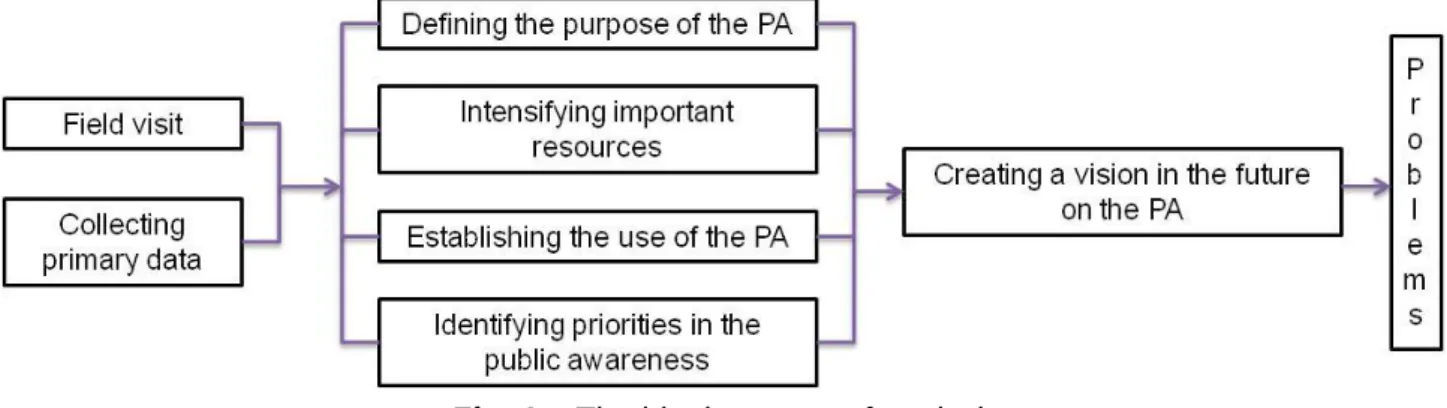
• The ideal process of analysis (fig. 1) which is based on the definition of objectives based on the vision in the future of protected areas. The first stage on which the real process is based on is inviting for discussion of all bodies involved nationally, regionally and locally. The key strategy consists in not addressing in the beginning the problems that the area faces, but on the contrary, to start (after a visit in the field and after collection of primary data) with highlighting bar elements such as: defining the scope of protected areas, identifying significant resources and assessing their importance, determining resource use from protected areas, identifying priorities in public awareness. The next step is the most important and consists in creating a vision for the future of protected areas taking into account the previous information and debates. A vision in which resources are well managed and protected, the main objectives are achieved and the awareness program offers possibilities to achieving them.
Fig. 1 – The ideal process of analysis
88
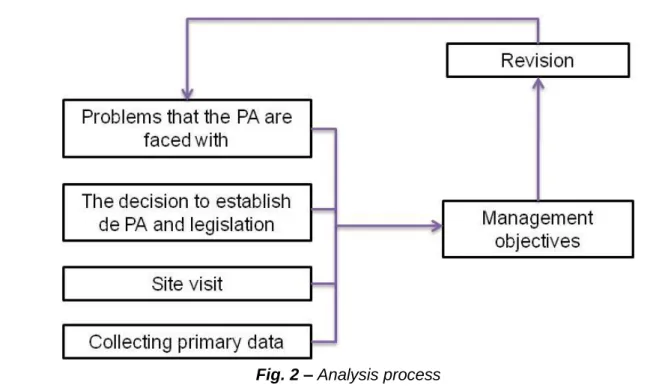
Fig. 2 – Analysis process
It is based on the definition of objectives to solve problems faced by the AP such as area development issues, the issue of access to local resources, issues of ownership and use of resources.
In agriculture, some agricultural lands have intrinsic conservation value as the flora, fauna and landscape depend on the continuing of low intensity, often traditional agriculture. Abandoning this kind of agriculture leads to severe damage to nature and landscape, but also, not all traditional forms of agriculture are ecologically harmless. Most modern farming practices have proved particularly harmful to nature and landscapes. To increase productivity, many rare habitats were destroyed, particularly through wetlands drainage and irrigation of arid areas. In some places, industrial practices almost eradicated plants and wild animals. Intensive use of fertilizers, pesticides and herbicides has led to pollution and destruction of surrounding natural areas - even of the seas nearby [1].
In forestry, the increased deterioration of the environment recorded in the last centuries and the consequences that have followed have highlighted that maintaining the environment as little altered as possible is a fundamental condition to ensure sustainable development. The forestry sector is no exception to this rule, a fact for which in the last decades the interest grew rapidly for sustainable forest management, in close contact with nature and biodiversity conservation [2, 3].
Through its multiple functions - ecological, social and economic, forest had, has and will have a capital importance in the Carpathian-Danubian-Pontic space, a fact revealed since 1886 by forester E. Eustatiu who said that "forest conservation represents even the conservation of the economic and physical being of our country. "
89
RESULTS AND DISCUSSIONS Agriculture
Agriculture means both a land use by itself but also the exertion of a strong influence on rural activities. Agriculture also means major land use in the category V of protected landscapes and is important in many natural reserves of category IV. As main activity on the adjoining fields, it has a profound influence on protected areas in all categories. More than any other sector, agriculture demonstrates that protected areas should be established and administered as part of the overall land use policies and not separately.
Fortunately, policies regarding agriculture are changing. In the past, the goal was to focus on increasing productivity, often ignoring the cost, but food surpluses, especially in the EU, lead to productivity reduction measures - by cutting subsidies, encouraging "rejection" and in other ways. Calls from the General Agreement on Tariffs and Trade (GATT) for Europe have increased pressures to reduce subsidies in production.
The need to reduce productivity still provides a unique opportunity for reducing the intensity of production and for getting land out of agriculture, for the creation, restoration and management of natural habitats at a larger scale. Despite some progress, however, environmental protection is not yet in focus of the reforms in the Common Agricultural Policy of the European Union [5, 6]. Many valuable habitats are still at risk due to intensification of agriculture that is both necessary and harmful for nature and landscape. Similarly, the new democratic governments in Central and Eastern Europe have the opportunity to integrate conservation in agricultural policies and land use. Fundamental changes in agricultural policies can bring great benefits to conservation and protected areas - and to society.
Forestry
Across Europe, only isolated fragments of true natural forests survive and most are in Fennoscandia and the South East. Almost all forests have been altered by human intervention in the last hundreds or even thousands of years. Such alterations can reduce or increase biodiversity, but are always changing the forest structure [5, 6].
Where there are virgin forests, they should be preserved immediately, in the vast majority through protected areas. However, in general, the conservation of forests in Europe refers less to the original forest conservation and more in ensuring that all forest management is sustainable. Natural and semi-natural forests continue to be transformed into more intensive forms of forests (with younger trees, fewer species, less biomass and larger forest fragmentation with marginal effects).
Grazing can devastate forests. Air pollution does not respect any border. Fire may occur from natural causes, but in modified forests it can become devastating, especially if it is followed by intensive grazing.
National policies for sustainable forestry request
- Establishment of a permanent forest legally guaranteed; - Training in forest ecology and management;
- Standards for permitted annual cutting, cutting cycles, harvesting techniques and infrastructure, methods of saving the environment;
- Control of all aspects of forest harvesting and treatment for environmental protection;
- Economic and financial policies that do not require from the forest more than can be supported;
- Policies for reuse, to ensure that the society receives the full benefit (timber, jobs, environmental services, recreation, etc.) from all forests;
- Environmental policies that protect environmental services, biological diversity and a resource base for all those who use the forests;
90
- Effective monitoring of all of the above. (Adapted after "Caring for the Earth", 1991)
Commercial forestry operators – both state and private - should allow a portion of their property to evolve naturally without cutting or planting, for example clearings with old trees along watercourses and roadsides. (in some cases active conservation management may be necessary, for example reducing the number of deer in many parts of Europe). These approaches should constitute part of management that seeks to increase the value of the entire forest for the environment.
It should not be any forest operation in protected areas in the categories I-III. Exploitation of timber should be allowed only in the fourth category if it serves conservation objectives. Forests in the fifth category should be administered as to maintain or to increase their conservation value.
CONCLUSIONS
Protected areas are essential to the conservation of natural and cultural capital because they include the most representative and significant areas in terms of biodiversity, associated natural and cultural values. Management measures in these areas are developed and implemented in such a way as to maintain or even restore, where is needed, natural ecosystems and wildlife populations, while maintaining or seeking the solutions for the sustainable use of natural resources. The establishment of protected areas and their efficient management is a necessity because:
is the most effective in-situ conservation method, being often designated on relatively large surfaces, may include natural and semi-natural representative ecosystems and enable their conservation and monitoring;
are model areas where effective conservation actions for natural and semi-natural ecosystems take place.
BIBLIOGRAPHY
1. Berca, M., 1998 – Strategies for environment protection and resource management,
Ed.Grand, Bucharest, 205 p;
2. Botnariuc, N., Vadineanu A., 1982 - Ecology, Didactic and Pedagogical Publishing,
Bucharest, 672p;
3. Marton, A., 1994 – Applied ecology, environment protection, Publishing for the Society
for Human and Environment Protection, Timişoara, 304 p;
4. Mohan, G., Ardelean, A., 1993 – Ecology and environment protection, Scaiul
Publishing, Bucharest, 349 p;
5. Stugren, B., Killyen, H., 1975 – Ecology general and didactic technology problems,
Didactic and Pedagogical Publishing, Bucharest, 207 p;
6. Stugren, B., 1994 – Theoretical ecology, Sarmis Publishing, Cluj, 187 p;
7. Tufescu, V., Tufescu, M., 1981 – Ecology and human activity, Albatros Publishing,