301
ECO-INNOVATIVE SYSTEM PROVIDED WITH "DEFLECTOR" TO
REDUCE POWDER EMISSIONS AT HOEING PLANTS SOWING
MATEESCU M.1), MARIN E.1),MANEA D.1), GHEORGHE G.1), POPA R.1), POPA V.1), ANDREI P.2) 1)INMA Bucharest, Romania; 2)SC CALORIS SA Bucharest / Romania
E-mail: [email protected]
Keywords: pneumatic, sowing, hoeing plants
ABSTRACT
This paper presents experimental research carried out by INMA Bucharest for the implementation of measures to reduce particulate matter emissions from seeds treated with plant protection chemicals during sowing crops. The work is justified by stringent national and
European requirements to increase the capacity and capability of the R & D system in the agricultural field by
promoting and supporting the
development of eco-innovative systems to mitigate the risks associated with the use of plant protection products.
INTRODUCTION
Sowing the crops is carried out by using pneumatic sowing machines provided with an exhaust. [3] These operations must ensure the equal pacing of seeds in nests on the row, burring the seeds and pressing the soil on them within the limits provided by the agro-technical requirements of that variety [1]. Also, the distance between the rows must be constant and to ensure a high collinearity of the nests on the row [4].
Currently, nationally or internationally, incidents are reported where bees have been affected by exposure to dust particles from seed treatment with insecticides, especially maize, which have been emitted during the sowing process through the orifice for exhausting air from pneumatic seed drills. [5]. This phenomenon can be very dangerous for the operator, environment and pollinating insects, because dust contains dispersed pesticides (insecticides, fungicides, etc.) used to cover corn seeds and other crops [6].
Therefore, when establishing agricultural crops in the field, it is mandatory to observe the norms for the
protection of labor, environment, bees, animals, people, as well as the provisions of the Government Ordinance no.4 of 20.01.1995 modified and supplemented by Ordinance no.41 / 2007.
Pneumatic crop sowing machines manufacturers in the European Union, having concerns in this regard, positioned the deflector at the exhaust exit. In this way the dust released during sowing is directed to the soil to reduce the drift [7].
Bayer CropScience has developed a "SweepAir" system that separates the exhaust air from the pneumatic sowing machine by blowing the air/dust mixture into a cyclone, where the centrifugal force causes the dust particles to hit its inner wall and fall into a bunker, after which they are buried in the soil the same as the seeds, and the clean air is released into the atmosphere, close to the soil [2].
302
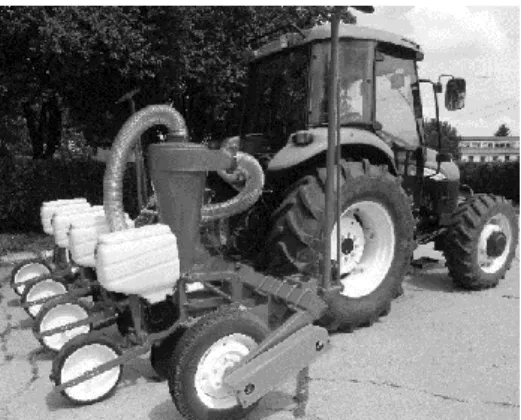
Figure 1. Eco-innovative system with "deflector" to reduce dust emissions when sowing
The main components of the eco-innovative system with "deflector" are shown in figure 2.
Figure 2. Components of an eco-innovative system with a deflector for sowing
(1 - frame, 2 - exhaust, 3 - cardan shaft, 4 - wheel for support and drive, 5 - seeding sections, 6 - transmission for seeds, 7 - hydraulic cylinder device, 8 - trace markers, 9 - pre-exhaust cyclones, 10 - special
tanks, 11 - post-exhaust cyclone, 12 - special tanks, 13 - HEPA filter, 14 - calming room)
Determination of the dust level in real time from seed treatment with insecticides, fungicides, etc., emitted in the environment at the exit of clean air from the post-exhaust cyclone, mg / cm3, was performed with the MICRODUST PRO, using infrared light with wave length (880 nm.) For reporting, data was transferred to a PC using the Casella Insight software [8]. For this paper experimental researches were performed for the following working options:
303
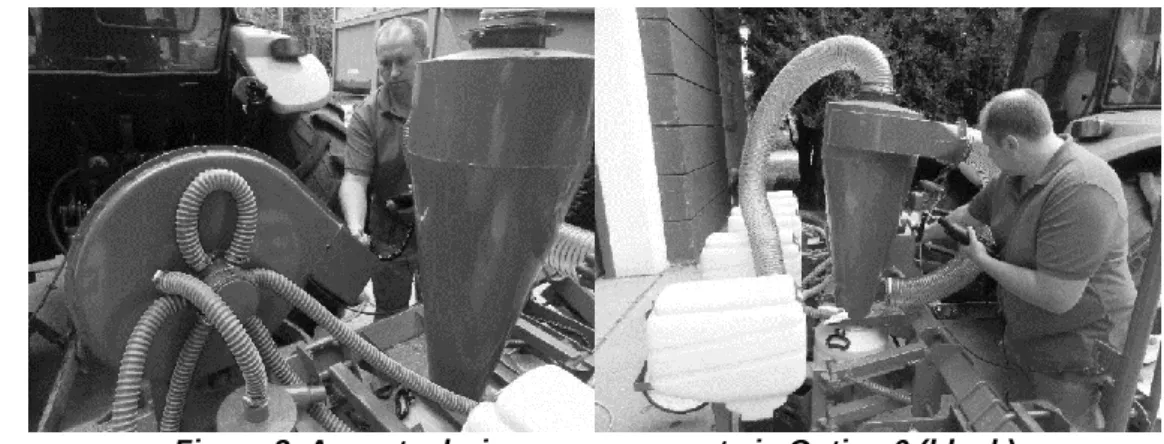
Figure 3. Aspects during measurements in Option 0 (blank)
B. Option 1
Concentration measurements of airborne microparticles were performed in the case when the dust from the seed treatment agent with potentially abrasive insecticides and any dirt resulting from the sowing process were vacuumed,
according to the pneumatic operation principle, by the exhaust component of the sowing system itself, and the air exited from the exhaust was directed in the environment. Figure 4 shows an aspect of the measurements.
Figure 4. Aspect during measurements in Option 1
C. Option 2
Concentration measurements of airborne microparticles were performed in the case when the dust from the seed treatment agent with potentially abrasive insecticides and any dirt resulting from the sowing process were vacuumed by the exhaust component of the sowing system itself, and at the exit passes
through a post-exhaust cyclone, where the separation is due to the centrifugal force that caused the dust particles to hit the inner wall of the cyclone and fall into a special tank, and the clean air was directed as close as possible to the ground . Figure 5 shows an aspect from the measurements in Option 2.
304 the exhaust component of the sowing system itself, passes when entering the exhaust through a pre-exhaust cyclone
6 shows an aspect of the measurements in Option 3.
Figure 6. Aspect during measurements in Option 3
RESULTS AND DISCUSSIONS
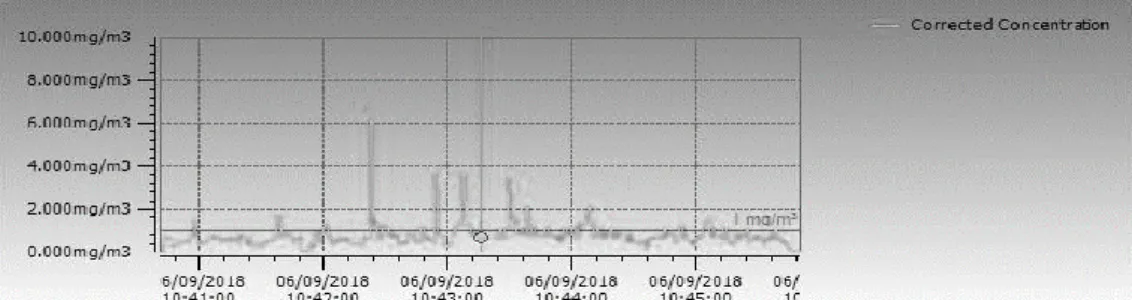
The results recorded for Version 0 (Blank) with the Casella Insight Database Management Software are shown in
Figure 7. The first histogram was
generated by making the measurements for 5 minutes.
Figure 7. Measured values of suspended airborne microparticles in Option 0 (blank)
An average microparticle concentration of 0.770 mg / m³ is observed. As for the maximum concentration of microparticles dispersed in air of 6.13 mg / m³ at that time, it became a risk to the health of the operator and the pollinating insects.
Regarding to measurements made with the available research logistics, the recommendations of the following institutions were taken into account: Occupational Safety and Health
Administration (OSHA) established in 1989 the maximum admissible value level of 5 mg/m3 in the operator area as an average per 8 working hours (HSE Books, EH40 / 2005 Workplace exposure limits, ISBN 978 0 7176 6446 7).
305
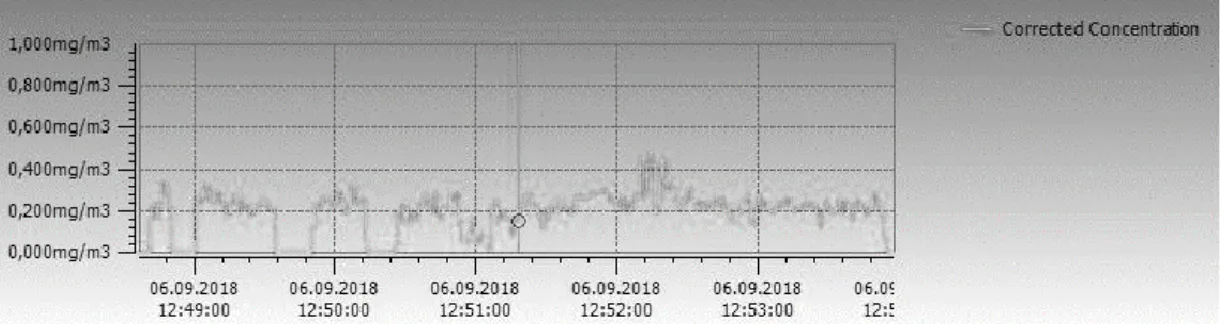
Figure 8. Measured values of suspended airborne microparticles in Option 1
An average microparticle concentration of 0.156 mg / m³ is observed. As for the maximum concentration of microparticles dispersed in air, which was 0.424 mg / m³, meaning there is no risk to the health of the operator and pollinating insects.
The results recorded for variant 2 with the Casella Insight software are shown in Figure 9. The third histogram was generated by performing the measurements for 5 minutes.
Figure 9. Measured values of suspended airborne microparticles in Option 2
An average microparticle concentration of 0.740 mg / m³ is observed. With regard to the maximum concentration of air dispersed microparticles, which was 6.08 mg / m³, meaning that at that time it became a risk to the health of the operator and the pollinating insects, since it was recorded
a maximum microparticle concentration over the normal one.
The results recorded for variant 3 using the Casella Insight Database Management Software are shown in Figure 10. The fourth histogram was generated by making the measurements for 5 minutes.
Fig. 10. Measured values of suspended airborne microparticles in Option 3
An average microparticle concentration of 0.143 mg / m³ was observed. As for the maximum concentration of microparticles
306
average value of the concentration of etc., released into the environment.
ACKNOWLEDGEMENTS
The results were obtained with the support of the Ministry of Research and Innovation through the NUCLEU Program, contract no. 18N / 16.03.2018, AAd no. 1/2018 and AAd no. 2/2018, draft
PN 18 30 01 02 "ECO-INNOVATIVE
SYSTEM PROVIDED WITH
"DEFLECTOR" TO REDUCE POWDER EMISSIONS AT HOEING PLANTS SOWING".
BIBLIOGRAPHY
1. Boac J M, Maghirang R G, Casada M E,
Wilson J D, Jung Y S.,2009,Size Distribution
and Rate of Dust Generated During Grain Elevator Handling. Applied Engineering in Agriculture 25:533‒541.
2. Chapple AC, Vrbka L, Friessleben R,
Schnier H-F, Cantoni A, Arnold AC., 2014,
A novel technical solution to minimize seed dust during the sowing process of maize using vacuum based equipment: principles and an estimate of efficiency. Asp Appl Biol 2014; 122: 119-24.
3. Devarrewaere W, Foqué D, Nuyttens D,
Verboven P., 2014, Modelling dust
distribution fromstatic pneumatic sowing machines. Aspects of Applied Biology 122, International Advances inPesticide Application, pp. 95‒101.
4. Neumann P, Jene B, 2010,Comparison of
measurement methods to assess off-crop drift deposition patterns of seed treatment particles abraded from dressed maize seed, emitted during sowin with a deflector modified pneumatic machine. pp. 1–120. Basle: Bayer CropScience AG, Unpublished Report No : IVADUST12010.
5. Nikolakis A, Chapple A, Friessleben R,
Neumann P, Schad T, Schmuck R, Schnier H-F, Schnorbach H-J, Schöning R, Maus C.,2009, An effective risk management approach to prevent bee damage due to the emission of abraded seed treatment particles during sowing of seeds treated with bee toxic
insecticides. Julius-Kühn-Archiv 423:132– 148.
6. Nuyttens D, Devarrewaere W, Verboven
P, Foqué D., 2013. Pesticide-laden dust
emission and drift from treated seeds during seed drilling: a review. Pest Management Science 69:564–575.
7. Tapparo A, Marton D, Giorio C, et al.,
2012,Assessment of the environmental exposure of honeybees to particulate matter containing neonicotinoid insecticides coming from corn coated seeds. Environ Sci Technol 2012; 46(5): 2592-9.