The Associated User Query Creation to Minimize Annoying Results
from Web
Lenka.Usha Mounika1, G.V.L.Narayana2
#1. M.Tech (CSE) in Department of Computer Science Engineering, Sri Sivani College Of Engineering, #2. Asst.Prof, Department of Computer Science and Engineering, Sri Sivani College Of Engineering,Chilakapalem,
Srikakulam, A.P, India.
Abstract
The huge number of users needs to get some information on web search engines. The developing utilization of search engines empowers us to for the most part portray the information that we look for. Be that as it may, the significant entanglement of generic search motor is that they gives back a similar rundown of results to client which can be superfluous for users require. To address these issue, customized search is thought to support arrangement as it gives significant search results according to user’s information need and intrigue. We contemplate securing privacy in PWS which catches client individual information and produces client profile and yields significant rundown of results. For web searching, client profiles are must for powerful results. However, the utilization of this profile to discover intrigue is a break to secure privacy. To vanquish this issue, securing privacy is important. Thus, we consider the current strategies for security of privacy in customized web search and its adequacy.
Keywords: Privacy protection, personalized web
search, utility, risk, profile, Generalization..
I. Introduction
The measure of information on the Web increments quickly, it makes numerous new difficulties for Web search. At the point when a similar question is put together by various users, a run of the mill search motor returns a similar result, paying little heed to who presented the inquiry. This may not be reasonable for users with various information needs. For instance, for the question "Mac", a few users might be keen on archives managing "Macintosh" as "organic product", while some different users may need records identified with Apple PCs. One approach to disambiguate the words in a question is
to relate a little arrangement of classes with the inquiry. For instance, if the classification "cooking" or the class "natural product" is connected with the question "apple", then the client's goal turns out to be clear [1]. For a given question, a customized Web search can give distinctive search results to various users or arrange search results contrastingly for every client, based upon their interests, inclinations, and information needs [2]. Customized web search contrasts from generic web search, which returns indistinguishable research results to all users for indistinguishable inquiries, paying little mind to differed client interests and information needs [2]. In spite of the appeal of customized search, we have not yet observed expansive scale employments of customized search administrations. This is not on account of such administrations are not accessible, but rather likely on the grounds that users are not happy with the absence of insurance of client privacy [5, 6]. To be sure, there is an inalienable strain between giving customized search and privacy safeguarding since customized search requires gathering and accumulating a considerable measure of client information. In particular, with a specific end goal to customize search, a client profile or client display must be developed to precisely speak to a client's information require. To manufacture an exact client profile, a great deal of client information including question and navigate history is frequently accumulated [3]. Shockingly, such kind of gathered individual information can without much of a stretch uncover whole extent of client's private life. Shielding privacy issues ascending from the absence of assurance for such information, for instance the AOL inquiry logs outrage, raise freeze among individual users, as well as downs the information distributer's energy in offering customized benefit. Truth be told, privacy concerns have turned into the real hindrance for wide utilization of PWS services[4]. Along these lines there has all the
The Associated User Query Creation to Minimize Annoying Results
from Web
Lenka.Usha Mounika1, G.V.L.Narayana2
#1. M.Tech (CSE) in Department of Computer Science Engineering, Sri Sivani College Of Engineering, #2. Asst.Prof, Department of Computer Science and Engineering, Sri Sivani College Of Engineering,Chilakapalem,
Srikakulam, A.P, India.
Abstract
The huge number of users needs to get some information on web search engines. The developing utilization of search engines empowers us to for the most part portray the information that we look for. Be that as it may, the significant entanglement of generic search motor is that they gives back a similar rundown of results to client which can be superfluous for users require. To address these issue, customized search is thought to support arrangement as it gives significant search results according to user’s information need and intrigue. We contemplate securing privacy in PWS which catches client individual information and produces client profile and yields significant rundown of results. For web searching, client profiles are must for powerful results. However, the utilization of this profile to discover intrigue is a break to secure privacy. To vanquish this issue, securing privacy is important. Thus, we consider the current strategies for security of privacy in customized web search and its adequacy.
Keywords: Privacy protection, personalized web
search, utility, risk, profile, Generalization..
I. Introduction
The measure of information on the Web increments quickly, it makes numerous new difficulties for Web search. At the point when a similar question is put together by various users, a run of the mill search motor returns a similar result, paying little heed to who presented the inquiry. This may not be reasonable for users with various information needs. For instance, for the question "Mac", a few users might be keen on archives managing "Macintosh" as "organic product", while some different users may need records identified with Apple PCs. One approach to disambiguate the words in a question is
to relate a little arrangement of classes with the inquiry. For instance, if the classification "cooking" or the class "natural product" is connected with the question "apple", then the client's goal turns out to be clear [1]. For a given question, a customized Web search can give distinctive search results to various users or arrange search results contrastingly for every client, based upon their interests, inclinations, and information needs [2]. Customized web search contrasts from generic web search, which returns indistinguishable research results to all users for indistinguishable inquiries, paying little mind to differed client interests and information needs [2]. In spite of the appeal of customized search, we have not yet observed expansive scale employments of customized search administrations. This is not on account of such administrations are not accessible, but rather likely on the grounds that users are not happy with the absence of insurance of client privacy [5, 6]. To be sure, there is an inalienable strain between giving customized search and privacy safeguarding since customized search requires gathering and accumulating a considerable measure of client information. In particular, with a specific end goal to customize search, a client profile or client display must be developed to precisely speak to a client's information require. To manufacture an exact client profile, a great deal of client information including question and navigate history is frequently accumulated [3]. Shockingly, such kind of gathered individual information can without much of a stretch uncover whole extent of client's private life. Shielding privacy issues ascending from the absence of assurance for such information, for instance the AOL inquiry logs outrage, raise freeze among individual users, as well as downs the information distributer's energy in offering customized benefit. Truth be told, privacy concerns have turned into the real hindrance for wide utilization of PWS services[4]. Along these lines there has all the
The Associated User Query Creation to Minimize Annoying Results
from Web
Lenka.Usha Mounika1, G.V.L.Narayana2
#1. M.Tech (CSE) in Department of Computer Science Engineering, Sri Sivani College Of Engineering, #2. Asst.Prof, Department of Computer Science and Engineering, Sri Sivani College Of Engineering,Chilakapalem,
Srikakulam, A.P, India.
Abstract
The huge number of users needs to get some information on web search engines. The developing utilization of search engines empowers us to for the most part portray the information that we look for. Be that as it may, the significant entanglement of generic search motor is that they gives back a similar rundown of results to client which can be superfluous for users require. To address these issue, customized search is thought to support arrangement as it gives significant search results according to user’s information need and intrigue. We contemplate securing privacy in PWS which catches client individual information and produces client profile and yields significant rundown of results. For web searching, client profiles are must for powerful results. However, the utilization of this profile to discover intrigue is a break to secure privacy. To vanquish this issue, securing privacy is important. Thus, we consider the current strategies for security of privacy in customized web search and its adequacy.
Keywords: Privacy protection, personalized web
search, utility, risk, profile, Generalization..
I. Introduction
The measure of information on the Web increments quickly, it makes numerous new difficulties for Web search. At the point when a similar question is put together by various users, a run of the mill search motor returns a similar result, paying little heed to who presented the inquiry. This may not be reasonable for users with various information needs. For instance, for the question "Mac", a few users might be keen on archives managing "Macintosh" as "organic product", while some different users may need records identified with Apple PCs. One approach to disambiguate the words in a question is
earmarks of being a difficulty: high-exactness Web search requires precise client displaying which expands the danger of privacy encroachment. In reality, the privacy concern is one of the significant obstructions in conveying genuine customized search applications, and how to accomplish customized search while protecting users' privacy is In this paper, we efficiently look at the issue of privacy safeguarding in customized search [3].
II. Related Work
Susan T. Dumais et al [3] presents a search calculation that considers client's earlier cooperations with a wide assortment of substance, to customize their ebb and flow web search. As opposed to depending on the implausible presumption that individuals will decisively determine their purpose while searching, it seeks after strategies that influence verifiable information about the client's advantages. This information is utilized to re-rank web search results inside a pertinence criticism structure. It investigate rich models of client premiums, worked from both search-related information, for example, beforehand issued questions and already went to web pages and other information about the client, for example, reports and email the client has perused and made. The research proposes that rich representations of the client and the corpus are essential for personalization however that it is conceivable to inexact these representations. M. Spertta and S. Gach,[5] deliberately analyzed the issue of privacy conservation in customized search. The four levels of privacy security is recognized, and dissect different programming designs for customized search. This work demonstrated that customer side personalization has favorable circumstances over the current server-side customized search benefits in saving privacy, and imagine conceivable future techniques to completely ensure client privacy. Z. Dou, R. Tune, and J. R Wen [6] examined personalization on disparate vulnerability inquiries for various users under unique research foundation and present a critical valuation structure for customized search base on instability logs, and after that gauge five customized search approach use
(interpersonal organizations). Along these lines, a client creates inquiries and she can submit them straightforwardly to the WSE or she can forward them to her neighbors in the informal community. The proposed framework does not make bunches for submitting inquiries. This speaks to a huge time lessening in correlation with different recommendations in the writing. Likewise, mysterious channels are not utilized. Be that as it may, the proposed plot utilizes a reward instrument. Users who don't participate will be killed from the framework. These works go under class one considering, the privacy of a person. The deficiencies of current arrangements in class one is the high cost acquainted due with the coordinated effort and correspondence. In [10] X. Xiao and Y. Tao, introduced another speculation system in view of the idea of customized namelessness. This system plays out the base speculation for fulfilling everyone's necessities, and hence, holds the biggest measure of information from the microdata. Speculation is a typical way to deal with stay away from the above issue, by changing the Quasi-Identifier (QI) values into less particular structures so that they no more drawn out extraordinarily speak to people.
III. Existing Problems
In this section, the structure of user profile in UPS is introduced and presented the attack model and the problem of privacy preserving profile in generalization.
User Profile
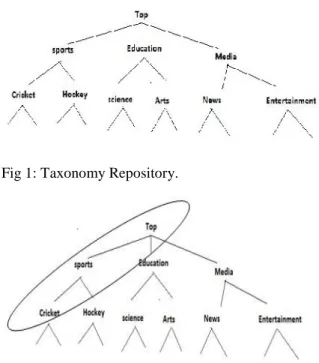
The personalized web search is a framework where the user profile is protected during the search [9]. The profile is created with the help of detail information of users entered queries, browsing history, cookies and so on. As discussed earlier, the user profile can be generated in two phases, online and offline phase and a hierarchical structure is obtained. For instance, consider the following figure(2) which shows the general taxonomy of search from which the user profile is created showed in figure(3) with the sensitive topics.
Fig 1: Taxonomy Repository.
Fig 2: User’s Profile creation from the taxonomy. Offline Phase: The original user profile and customized privacy are constructed in the offline mode [9]. Online Phase: Query mapping and generalization of the profile is done in online phase [9].
Attack Model
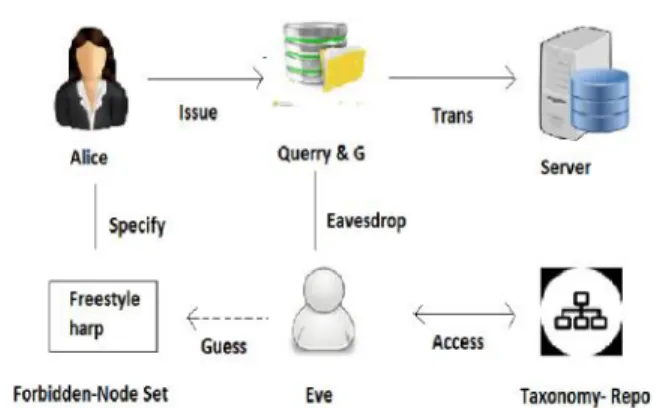
Fig 3: Attack model of personalized web search.
Note that in the attack model, Eve is considered as an adversary satisfying the following assumptions:
Knowledge bounded: The background knowledge of the adversary is limited to the taxonomy repository R. Both the profile H and privacy are defined based on R [7].
Session bounded: None of the previously captured information is available for tracing the same victim in a long duration. In other words, the eavesdropping will be started and ended within a single query session [7].
IV. Proposed Methodology
The proposed system consists of simple, efficient and privacy preserving model which ensures good suggestions as well as promises for effective and relevant information retrieval. We propose a confidentiality-preserving personalized web search framework UPS, which can generalize profiles for each query according to user-specified confidentiality requirements. Relying on the definition of two conflicting metrics, namely personalization utility and confidentiality risk, for hierarchical user profile, we formulate the problem of confidentiality-preserving personalized search as Risk Profile Generalization, with its NP-hardness proved. We develop two simple but effective generalization algorithms, Greedy DP and Greedy IL, to support runtime profiling. While the former tries to maximize the discriminating power (DP), the latter attempts to minimize the information loss (IL). By exploiting a
stability of the search results while avoid the unnecessary exposure of the profile.
Fig 4. Proposed System Architecture Diagram
V. Generalization
Generalization is an extension of context in a very less specific criteria. Generalization helps in avoiding the unnecessary privacy disclosure. Topics which are irrelevant to the current query are considered as noisy topics and they are removed. Generalization technique can be conducted during both online and offline process without actually involving users query. There are certain limitations of offline generalization such as it contains many branches which are irrelevant to queries, whereas online generalization provides flexible solutions.
Metric for Utility
The intention of the utility metric is to guess the search quality of the query q [7] on a generalized profile G [7]. The main reason for the use of utility metric is that the quality of search depends upon users search in the personalized web search engine [9].
Online Decision
GreedyDP and GreedyIL, for runtime generalization. Where GreedyIL significantly outperforms GreedyDP in terms of efficiency. In the UPS, joint with a greedy algorithm i.e. Greedy DP [10] named as Greedy Utility to help online profiling based on predictive metrics of utility and privacy risk [10].
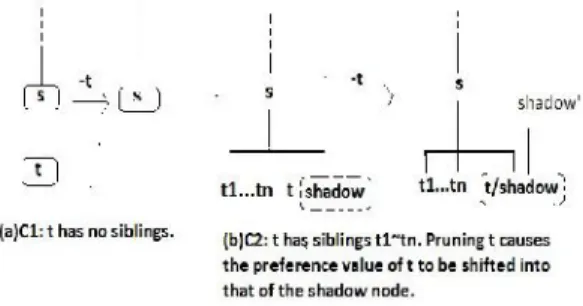
GreedyDP Algorithm: The first greedy algorithm GreedyDP works in a bottom-up manner. Firstly, introduce prune-leaf, which indicates the removal of a leaf topic t from a profile. Formally, denote by G–t Gi+1 (shown in figure 5(a)) the process of pruning leaf t from Gi to obtain Gi+1. Obviously, the optimal profile G* can be generated with a finite-length transitive closure of prune-leaf [7], [10]. Secondly, starting from G0, in every ith iteration, GreedyDP chooses a leaf topic tЄTGi (q) for pruning, trying to maximize the utility of the output of the current iteration, namely Gi+1. During the iterations, maintain the best profile-so-far, which indicates the Gi+1 having the highest discriminating power while satisfying the δ- risk constraint [7],[10]. Finally, the iterative process terminates when the profile is generalized to a root topic. The best-profile-so-far will be the final result (G*) of the algorithm [7], [10].
GreedyIL Algorithm: The GreedyIL algorithm improves the efficiency of the generalization using heuristics based on several findings. One important finding is that any prune-leaf operation reduces the discriminating power of the profile [7], [10].
Fig 5:Cases of prune-leaf on a leaf t
VI. Conclusion
This paper presented a client-side privacy protection framework called UPS for personalized web search. UPS could potentially be adopted by any PWS that captures user profiles in a hierarchical taxonomy. The framework allowed users to specify customized privacy requirements via the hierarchical profiles. In
addition, UPS also performed online generalization on user profiles to protect the personal privacy without compromising the search quality. We proposed two greedy algorithms, namely GreedyDP and GreedyIL, for the online generalization. Our experimental results revealed that UPS could achieve quality search results while preserving user’s customized privacy requirements. The results also confirmed the effectiveness and efficiency of our solution.
References
[1].LidanShou, He Bai, Ke Chen and Gang Chen” Supporting privacy protection in personalized web search” IEEE transaction on knowledge and data engineering vol:26 No:2 year 2014.
[2]. Anton, A.I., Earp, J.B., Young, J.D.: How internet users’ privacy concerns have evolved since 2002. IEEE.Secur. Priv. 8(1), 21–27 (2010)
[3]. X. Shen, B. Tan, and C. Zhai, “Privacy Protection in Personalized Search,” SIGIR Forum, vol. 41, no. 1, pp. 4-17, 2007.
[4]. Wang, Y., Norcie, G., Cranor, L.F.: Who is concerned about what? a study of american, chinese and Indian users’ privacy concerns on social networking sites. In: 4th international conference on trust and trustworthycomputing (TRUST2011), Springer, Pittsburgh 2011
[5]. Acquisti, A., Gross, R.: Imagined communities: Awareness, information sharing, and privacy on the facebook. In: Danezis, G., Golle, P. (eds.) Privacy enhancing technologies, Lecture notes in computerscience, vol. 4258, pp. 36–58. Springer, Berlin (2006).
[6]. Stutzman, F., Kramer-Duffield, J.: Friends only: examining a privacy-enhancing behavior in facebook. In: Mynatt ED, Schoner D, Fitzpatrick G, Hudson SE, Edwards K, Rodden T (eds.) CHI, pp. 1553– 1562.ACM, New York (2010)
[7]. Lewis, K., Kaufman, J., Christakis, N.: The taste for privacy: an analysis of college student privacy settings in an online social network. J. Comput. Mediat.Commun.14 (1), 79–100 (2008)7
SIGIR Conf. Research and Development in Information Retrieval (SIGIR), pp. 449-456, 2005. [9]. K. Sugiyama, K. Hatano, and M. Yoshikawa, “Adaptive Web Search Based on User Profile Constructed without any Effort from Users,” Proc. 13th Int’l Conf. World Wide Web (WWW), 2004