R E V I E W A R T I C L E
Glide path establishing instruments – An overview
Anshida Valiyapalathingal, Sudhanva Mallandhur, Naganath Meena, Vijayalakshmi Prabhakar, N. Naveen Kumar
Department of Conservative Dentistry and Endodontics, Vokkaligara Sangha Dental College and Hospital, Bengaluru, Karnataka, India
Abstract
Background: Mechanical preparation of a root canal system plays a key role in providing a successful and a more predictable endodontic treatment outcome. The intricate anatomy of root canals often poses a challenge for clinicians in aiding this objective.
The preparation of a glide path provides a basis for effective cleaning and shaping,
enabling all the subsequent instruments to move smoothly through the canal till the
apical constriction, unhindered. A reproducible glide path enhances clinicians’ efficacy in understanding root canal anatomy, thus reducing the likelihood of procedural errors.
Aim: This review article illustrates the importance of glide path preparation and also explains the numerous glide path instruments available over the years. Conclusion: Glide path is the key to radicular rotary safety. It is a pre-requisite to achieve the rationale of endodontics. Clinical Significance: Preparing a glide path increases the life span of
rotary instruments, reduce the risk of procedural errors, providing the clinician a more
detailed route map of the canal anatomy.
Keywords: Glide path, NiTi, reciprocating, rotary, stainless steel K-file Correspondence:
Dr. Anshida Valiyapalathingal, Department of Conservative Dentistry and Endodontics, Vokkaligara Sangha Dental College and Hospital, Bengaluru, Karnataka, India. E-mail: [email protected]
Received 03 December 2019; Accepted 30 December 2019
doi: 10.15713/ins.ijcdmr.141
How to cite the article:
Valiyapalathingal A, Mallandhur S, Meena N, Prabhakar V, Kumar NN. Glide path establishing instruments – An overview. Int J Contemp Dent Med Rev, vol.2019, Article ID: 041219, 2019. doi: 10.15713/ins.ijcdmr.141
Introduction
The objectives and techniques established by Schilder, for a predictable and efficient treatment of root canal system, continue
to be profoundly relevant even after all the revolutionary advances dated so far.[1] Due to anatomical variations and complexity of root canal morphology, root canal preparation continues to
be a challenging task for endodontists. Clinicians most often experience procedural complications during canal scouting
and pre-flaring, the initial stages of canal instrumentation.[2,3]
Excellent instrumentation is facilitated by the first scouting with K-files, then creating a hand-generated “glide path,” refining this hand glide path with rotary files and finishing the preparation with the final hand or rotating instrumentation.[4] Preparing a glide path thus allows better canal curvature management, maintaining the original canal morphology, and eliminating
procedural errors associated with canal cleaning and shaping.
Glide path
In aeronautics, glide path is the line of descent to the land of aircraft,
particularly as indicated by the ground radar. Its purpose is to
establish a tightly controlled horizontal and vertical “corridor” at
the end of the runway which will take the incoming aircraft to the correct location.[5] In 2010, John West defined endodontic glide
from the coronal orifice of the canal to the radiographic terminus or electronically determined portal of exit.”[6] He advised, the minimum requirement to be a “super loose No. 10” endodontic K-file. The glide path must be discovered if already present in the
canal anatomy or prepared if it is not present. Glide path can be
short or long, narrow, or wide, essentially straight or curved.[6] It is a refinement of the original canal anatomy, allowing the shaping
instruments to advance more safely.
Significance of Canal Scouting and Preflaring
Initial canal negotiation and glide path preparation help in providing valuable knowledge on the morphology of canals.[7] Blum
et al. suggested the initial construction of a glide path with smaller
stainless steel hand files to ensure that adequate space is available for
the rotary instruments to follow through the root canal.[8] Broadly, NiTi rotary files are manufactured with non-cutting tips and these
instruments are not intended for initial root canal negotiation due
to their extreme flexibility and non-aggressive tip.[9] Gmans et al. claimed, a hand instrument should be previously placed before
the use of any rotary instruments.[10] Berutti et al. reasoned, usage of hand-operated preflaring and glide path preparation before any rotary NiTi instruments aides in the improved longevity of NiTi
instruments along with enhanced torsional resistance.[11] Patiño et
this glide path by stiffer stainless hand files combined with their
aggressive tip presents a greater risk of causing variations in the
geometry of the canal contributing to the formation of ledges, zipping, apical transportation, and even canal perforations.[13]
These procedural errors tend to hamper the anatomic apex of the
tooth and change the original curvature of the canal, especially in narrow, curved, and calcified canals. Although it is acknowledged that establishing a reproducible glide path is crucial, suitable
instrumentation is essential to accomplish this objective. Over the
past 5 years, several manufacturers have introduced small taper (0.01–0.02) rotary NiTi instruments in small sizes (10–20) for
the negotiation and creation of glide paths instead of a glide path prepared by hand instrumentation.
Glide Path Preparation Instruments [Table 1]
Diverse range of glide path preparation instruments are available in
different motions and techniques, which can be categorized under manual, rotary and reciprocating glide path instruments. [Table 1].
Glide Path Preparation Methods
Manual glide path preparation techniques
Manual glide path preparation can be performed by hand using
stainless steel K-files or in combination with a reciprocating
handpiece.
Hand stainless steel K-file
Instrument available for manual glide path preparation is – sizes
ISO 10 (purple) and 15 (white) stainless steel K-files.
In 2006, West recommended the use of an initial watch-winding motion by the K-file, to remove restricted dentin in very narrow canals, followed by a vertical up and down movement
with an amplitude of 1 mm and slowly increasing the amplitude
as the dentinal layer shaves off, guiding the file to progress
toward the apex. Berutti et al. recommended a glide path
preparation such that, the diameter created by glide path should
have a size bigger than the initial shaping rotary instrument tip size.[11] West[14] promotes the balance forced motion by Roane et
al.,[15,16] particularly when the canal demands a greater size glide
path than ISO 10 K-file. This technique described by Roane
et al., advocates turning the file in a CW direction to engage in dentine, followed by a CCW motion while maintaining apical pressure to avoid unscrewing of the file in the canal. This motion is repeated for the apical progression of the file. In 2010, West[17]
further advised that the minimum glide path requirement be a
“super loose” size 10 K-file. If a size 15 or 20 K-file can be moved 3–5 mm from the working length and gently pushed back to the original length unaccompanied by any rotational movement,
establishes a reproducible glide path [Table 2].[18]
Hand files in reciprocating handpiece
In 2008, Kinsey and Mounce described a technique using a reciprocating handpiece attached to small size K-file for glide
Table 1: Glide path instruments
Manual glide path preparation instruments Rotary glide path preparation instruments Reciprocating glide path preparation instruments Hand stainless steel K-files:
C files (Dentsply), C plus FILES(Dentsply, Schwed, Roydent), C pilot files (Dentsply), D finders (MANI), Sendoline K FINDERS, Sendoline S FINDERS, Hi-5 flies (Miltex ), Pathfinder CS (sybronendo), Senseus (dentsply)
PathFiles (Dentsply/Maillefer) WaveOne Gold Glider (Dentsply Sirona)
Hand files in reciprocating handpiece:
M4 Safety reciprocating handpiece (SybronEndo, Coppel, Texas) The Endo-Express® System with the SafeSiders®
X-PLORER™ Canal Navigation NiTi Files (Clinician’sChoice Dental Products Inc., New Milford, USA)
R-pilot (VDW, Munich, Germany)
G-Files (Micro-Mega, Besancon, France) ProGlider (Dentsply/Maillefer)
EndoWave Mechanical Glide Path (MGP) (J Morita, California, USA)
Scout-RaCe files (FKG Dentaire, La Chaux-de-Fonds, Switzerland)
RaCe ISO 10 (FKG Dentaire)
Mtwo NiTi rotary instruments (Sweden and Martina, Padua, Italy)
Hyflex GPF (Coltene)
The Prodesign Logic 25.01 (Easy Equipamentos Odontológicos)
path preparation.[19-25] This technique involves the use of smaller sized k-files embedded in a reciprocating handpiece for glide
path management.[21]
M4 safety reciprocating handpiece (SybronEndo, Coppel, and Texas)
The reciprocating handpiece M4 Safety (SybronEndo, Coppel, and Texas) is contra-angled and fits any slow-speed handpiece connection type E. The handpiece’s reciprocating angle is 30° which effectively replicates the watch winding, oscillating hand
instrumentation movement.[21]
The Endo-express® system with the SafeSiders®
It eliminates the fear of fracture associated with crown-down systems and the typical shortcomings of the step-back process. SafeSiders® are the only instruments with a patented
un-interrupted flat along the entire working length. This flat:
• Reduces instrument engagement with less resistance allowing for faster advancement.
• Creates space for dentinal debris that would otherwise clog
thread lines of conventional reamers and files.
• Reduces compressive and tensile stresses during use enabling improved instrument durability.
• Increased flexibility without sacrificing strength.
• It eliminates separation anxiety [Table 3].
Rotary glide path preparation techniques Pathfiles (Dentsply/Maillefer) - 2009
The system consists of three instruments in ISO sizes (13, 16, and 19) and color (purple, white, and yellow), respectively. Each instrument is available in 21 mm, 25 mm, and 31 mm lengths.
They have a square cross-section with a constant 2% taper.
The gradual increase in tip diameter and low taper, markedly improves their flexibility and resistance to binding stress. The
four cutting edges increase their cutting efficacy, especially in calcified canals. They have a rounded, non-cutting tip with a tip angle of 50° which reduces the risk of ledge formation.
Recommended speed – 300 rpm and at a very high torque, approximately 5–6 N/cm (maximum torque available with the X-Smart, Dentsply Maillefer).
X-PLORER™ canal navigation NiTi files (Clinician’s choice, New Milford, USA) – 2010
They consist of four instruments – #15 file with a 0.01 taper (triangular section), #20 file 0.01 taper (square cross-section), #20 file 0.02 taper (square cross-cross-section), and an optional #25 file 0.02 taper (square cross-section). Each instrument is available in lengths of 21 mm and 25 mm. 15 file
sizes are available in both hand and rotary. They have a
non-cutting tip with a tip angle of 75°. The varying cross-sections and lesser taper help the file in negotiating tortuous anatomy. The narrow taper improves flexibility and makes the files easier to
advance through the canal. By constricting the cutting area to 10
mm from the apex of file, reduces the area of contact, improving the torsional resistance of the file.
Recommended speed – 400 rpm, Torque – 2 N/cm.
G-Files (Micro-Mega, Besancon, France) - 2011
The system consists of two files – ISO 12 and ISO 17 size, each in 21 mm, 25 mm, and 29 mm lengths. They have a constant 3% taper with an asymmetric non cutting tip that guides in the progression of instrument. It is recommended to use the file
in delicate in and out motion till it reaches the working length.
The G-Files™ superior cross-section blends efficiency and
safety. They have cutting edges on three separate radii
(snake-like motion), creating a large and productive area for removing debris upward. The angular offset of the cutting edges creates a different pitch along the blade’s length, preventing any screwing
or engaging impact on the canal walls. The cutting length consists
of three flutes with the same pitch but with three different
apparent pitches (the apparent pitch being the distance between
two consecutive cutting edges). The high degree of flexibility
resulting from the small diameter also contributes to progressive
Table 2: Advantages, disadvantage of manual glide path preparation with stainless steel K-files
Advantages Disadvantages
Excellent tactile sensation.[19] Increased operator fatigue.[21] Small K-files on removing from the
canal guides the clinician by giving the impression of the respective canal.[19,20]
Increased hand fatigue.[22]
Low potential for file separation.[19] Increased time for the preparation of glide path.[22] The stiffness of hand stainless steel
files aids in negotiating blockages and calcifications.[19]
Increased risk of canal aberrations with larger K-file.[22]
Cost effective when compared to other
glide path files. Original anatomy of the canal is altered.[22,23] No specific handpieces required.[21] Piston action of K-files with
push and pull motion results in increased apical debris extrusion.[24]
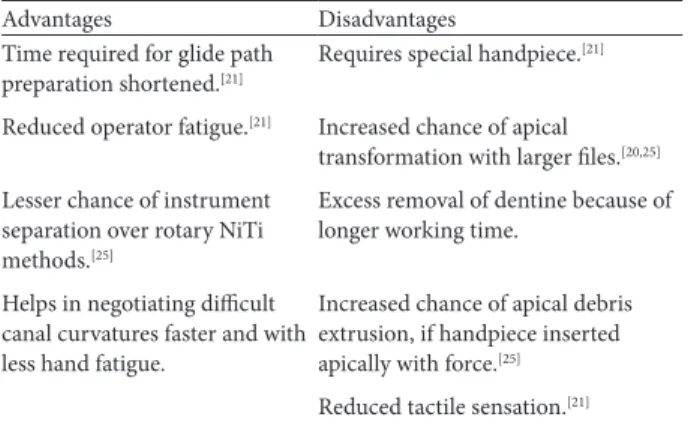
Table 3: Advantages, disadvantage of using hand files in reciprocating handpiece for glide path management Advantages Disadvantages Time required for glide path
preparation shortened.[21] Requires special handpiece. [21]
Reduced operator fatigue.[21] Increased chance of apical transformation with larger files.[20,25] Lesser chance of instrument
separation over rotary NiTi methods.[25]
Excess removal of dentine because of longer working time.
Helps in negotiating difficult canal curvatures faster and with less hand fatigue.
Increased chance of apical debris extrusion, if handpiece inserted apically with force.[25]
safe movement. They are manufactured by micro-milling and electropolished to improve mechanical properties.
Rotation speed: 400 rpm and 1.2 N/cm torque.
One G ((Micro-Mega, Besancon, France)
A single file system meant for single use in continuous rotation
for glide path management. It has an innovative asymmetrical
cross-section with a constant 3% taper, a non-working tip with ISO 14 tip size. A variable pitch between each cutting edge limits the screwing effect. The three cutting edges are situated on three different radii relative to the canal axis giving more space for
better debris elimination.
Recommended speed – 400 rpm and Torque – 1.2 N/cm.
Proglider (Dentsply Sirona) - 2014
A single file system manufactured from M-Wire technology
designed for glide path enlargement. It is available in three
different lengths: 21 mm, 25 mm, and 31 mm. It has a square cross-section, a progressive taper of 2–8%, ISO 16 tip size and,
and a diameter of 0.66 mm at D0 and 0.82 mm at D16.
Rotation: 300 RPM with a torque of 4–5.2 N/cm.
Endowave mechanical glide path (J Morita, California, USA) This system comprises a set of three instruments in ISO size (10, 15, and 20) and color (purple, white, and yellow), respectively.
They have a triangular cross-section with a constant 2% taper.
Rotation: Speed 800 rpm, Torque 30 g/cm–0.3 N/cm.
Scout-race files (FKG Dentaire, Switzerland) – 2014
The system consists of three instruments – ISO tip size 10
(purple), ISO tip size 15 (white), and ISO tip size 20 (yellow) and are available in three lengths: 21 mm, 25 mm, and 31 mm.
They have a quadrangular cross-section with a constant 2% taper and non-cutting tip. They have unique feature of having four alternate cutting edges and are manufactured by micro-milling and electropolishing. They are recommended to use after initial
canal negotiation with an ISO size 6/8 K-file.
Optimal speed: 800 rpm (minimum 600 rpm). Torque: 1.5
N/cm.
Race ISO 10 (FKG Dentaire) - 2010
The kit comprises three instruments – size #10–12% (yellow
disk), size #10–14% (black disk), and size #10–16% (blue disk). They have a quadrangular/square cross-section with the unique
feature of having same apical size and progressively increasing
taper for all the instruments. With the slender design and their exceptional flexibility, the instruments follow the canal’s anatomy perfectly, even in the middle and apical third. They are used
without pressure up to the working length. The progressively increasing taper of the instrument helps in better coronal
pre-flaring. Narrow, obliterated, and abrupted curvatures are ideal indications of this file.
Optimal speed: 800 rpm (minimum 600 rpm), Torque: 1.5 N/cm.
Mtwo NiTi rotary instruments (Sweden and Martina, Padua, Italy) The set consists of two instruments – size #10/04, size #15/05. These files are manufactured from conventional NiTi wire. It has an S-shaped cross-section, a non-working tip, a positive inclination angle, large constant helical angle, more spirals for increased instrument stability, two cutting edges, and different
tapers that prevent fracture and the transportation of debris toward the apex.
Recommended speed – 250–350 rpm, Torque – 1.2–2 N/cm.
Plotino et al. (2006) concluded that the Mtwo rotary instruments might be used safely under clinical conditions in molars with severe curvatures.[26]
HyFlex GPF (coltene)
The HyFlex GPF Controlled Memory Files consists of three
files – 01/15 HyFlex GPF – 10 mm flute, 02/15 HyFlex GPF with CM*-16 mm flute, and 2/20 HyFlex GPF with CM*-16 mm flute. They are available in 21 mm, 25 mm, and 31 mm
lengths.
The instruments can regain their shape during autoclaving (or
treatment in a glass bead heater for 10 s). Nonetheless, caution must be taken if, during use, the instruments start rewinding in the opposite direction, the files will not recover their shape and should be discarded. If a file has multiple spirals after autoclaving that appear lengthened or otherwise seem unfunctional, the file
should be discarded.
Recommended speed – 300 rpm (revolutions per minute), torque setting up to 1.8 N/cm.
The prodesign LOGIC 25.01 (easy equipamentos odontológicos) – 2014
It is a glide path made of both conventional NiTi Wire and CM-Wire. The file is manufactured by micro-milling and undergoes
post-manufacturing heat treatment. It has a square shaped cross-section with a 1% taper and tip size of 0.25 mm.
Recommended speed – 350 rpm. Pre-SAF rotary instruments
They are designed to provide suitable glide path preparation for
the Self-Adjusting Files. The SAF instruments include, Pre-SAF OS (orifice shaper, sized #40/.10), Pre-Pre-SAF 1 (for narrow canals, sized #15/.02), and Pre-SAF 2 (allows glide path for the SAF 1.5mm, sized #20/.04). They have alternate cutting edges which help in reducing the screwing effect. Their tip is rounded to ensure the centralization of the instrument in the canal, for safety reasons. They are highly flexible, making it suitable for
curved canals.
Recommended speed – 500–600 rpm, Torque – 1–1.5 N/cm.
ESX scout (Brasseler USA)
These are rotary NiTi files, with a size 0.15 at the tip available
in 0.02 and 0.04 tapers. They have reduced cutting length
(12 mm), tighter flute structure, triangular cross-section, and
precision safety tip which facilitate negotiation of curved and
Reciprocating glide path preparation techniques Waveone gold glider (Dentsply Sirona) – 2017
It is a single use sterile instrument manufactured from NiTi-Wire
that is subjected to post-manufacturing heat treatment. It is used
in reciprocating motion with a designated motor, before shaping canals with WaveOne Gold instruments. It has a parallelogram
shaped cross-section with a variable taper between 2% (DO) and
6% (D16) and an ISO 15 tip size. The file has a 15 mm active cutting flute with a semi-active tip.
R-PILOT (VDW, Munich, Germany)
A single use glide path instrument manufactured from M-Wire
technology. It is used in reciprocating motion with a designated
drive system that uses the original Reciproc (VDW) settings to
prepare the root canal system before shaping with a rotary or a reciprocating instrument. It has a s-shaped cross-section with a constant taper of 4% and an ISO 12.5 tip-size.
Apical debris extrusion following glide path management
Creation of glide path results in apical extrusion of debris. Although the amount of debris would be very low while creating a glide path,
the initial extruded debris may contain debris of higher toxicity as compared with debris extruded later by the shaping instruments. Post-operative pain may be caused by apical extrusion of debris to
periradicular tissues. The differences in the instrument geometric designs and movement kinematics affect the apical debris extrusion by the file. The piston action of K-files used with a push and pull
motion pumps the irrigating solution and the debris through the
apex as less space is available to flush it out coronally.[27] From the studies conducted so far, it is indicated that a rotary glide path
instrument may be preferred as it extrudes less debris apically.[28,29]
Conclusion
Schilder coined the axiom “what comes out is as important as what goes in,” accenting the flow of a perfect preparation which represents the original canal anatomy, enabling proper irrigation
and obturation. Determining the canal length is not an exact science; it is an art form.[1] The rationale of endodontics requires
the entire length of the root canal system to be cleaned and shaped. Glide path is a prerequisite to this mechanical objective.
As the name suggests, glide path illustrates the gliding movement
of rotary instruments in the canals.[4] The endodontic glide path is the key to radicular rotary safety. When done properly,
it increases the longevity of rotary instruments; resulting in a healthy rotary outcome and a fully regulated endodontic
experience. A glide path helps the clinician with a better understanding of the intricate anatomy of the canal, thereby enhancing the efficacy of the rendered treatment by reducing the
possibility of instrument separation and other procedural errors.
References
1. Schilder H. Cleaning and shaping the root canal. Dent Clin North Am 1974;18:269-96.
2. Hülsmann M, Peters OA, Dummer PM. Mechanical preparation of root canals: Shaping goals, techniques and means. Endod Topics 2005;10:30-76.
3. Jafarzadeh H, Abbott PV. Ledge formation: Review of a great challenge in endodontics. J Endod 2007;33:1155-62.
4. Mounce R. Endodontics-an excellent glide path, the road to smoother endodontics. Oral Health 2004;94:51-8.
5. Korzen BH. Laying the Groundwork for Proper Endodontic Instrumentation. Latin America: Glidepath; 2015.
6. West JD. The endodontic Glidepath: Secret to rotary safety. Dent Today 2010;29:86, 88, 90-3.
7. Young G, Parashos P, Messer H. The principles of techniques for cleaning root canals. Aust Dent J 2007;52:S52-63.
8. Blum JY, Machtou P, Ruddle C, Micallef JP. Analysis of mechanical preparations in extracted teeth using ProTaper rotary instruments: Value of the safety quotient. J Endod 2003;29:567-75.
9. Passi S, Kaler N, Passi N. What is a glide path? Saint’s Int Dent J 2016;2:32.
10. Bregamn L, Van cleynenbreugel J, Wevers M, Lambrechts P. Mechanical root canal preparation with NiTi rotary instruments: Rationale, performance and safety. Am J Dent 2001;14:324-33.
11. Berutti E, Negro AR, Lendini M, Pasqualini D. Influence of manual preflaring and torque on the failure rate of ProTaper rotary instruments. J Endod 2004;30:228-30.
12. Patiño PV, Biedma BM, Liébana CR, Cantatore G, Bahillo JG. The influence of a manual glide path on the separation rate of NiTi rotary instruments. J Endod 2005;31:114-6.
13. Kuhn WG, Carnes DL Jr., Clement DJ, Walker WA. Effect of tip design of nickel-titanium and stainless steel files on root canal preparation. J Endod 1997;23:735-8.
14. West J, Roane J, Goerig A. Cleaning and shaping the root canal system. In: Cohen S, Burns RC, editors. Pathways of the Pulp. 6th
ed. St. Louis: CV Mosby Co.; 1994. p. 179-81.
15. Roane JB, Sabala CL, Duncanson MG. The “balanced force” concept for instrumentation of curved canals. J Endod 1985;11:203-11.
16. Kyomen SM, Caputo AA, White SN. Critical analysis of the balanced force technique in endodontics. J Endod 1994;20:332-7. 17. West J. Endodontic brushing: The secret to mastering rotary
safety. Dent Econ 2010;100:44.
18. Van der Vyver PJ. Creating a glide path for rotary NiTi instruments: Part one. Int Dent SA 2010;13:6-10.
19. Mounce R. Endodontic K-files: Invaluable endangered species or ready for the Smithsonian? Dent Today 2005;24:102-4. 20. Van der Vyver PJ. Creating a glide path for rotary NiTi
instruments: Part two. Endod Prac 2011;13:46-53.
21. Cassim I, Van der Vyver PJ. The importance of glide path preparation in endodontics: A consideration of instruments and literature. SADJ 2013;68:322-7.
22. Berutti E, Cantatore G, Castellucci A, Chiandussi G, Pera F, Migliaretti G, et al. Use of nickel-titanium rotary PathFile to create the glide path: Comparison with manual preflaring in simulated root canals. J Endod 2009;35:408-12.
23. Pasqualini D, Bianchi CC, Paolino DS, Mancini L, Cemenasco A, Cantatore G, et al. Computed micro-tomographic evaluation of glide path with nickel-titanium rotary PathFile in maxillary first molars curved canals. J Endod 2012;38:389-93.
systems-an in vitro study. Contemp Clin Dent 2010;1:234. 25. Kinsey B, Mounce R. Safe and efficient use of the M4 safety
handpiece in endodontics. Roots 2008;4:36-40.
26. Plotino G, Grande NM, Sorci E, Malagnino VA, Somma F. A comparison of cyclic fatigue between used and new Mtwo Ni-Ti rotary instruments. Int Endod J 2006;39:716-23.
27. Al-Omari MA, Dummer PM. Canal blockage and debris extrusion
with eight preparation techniques. J Endod 1995;21:154-8. 28. Sen OG, Bilgin B, Koçak S, Sağlam BC, Koçak MM. Evaluation
of apically extruded debris using continuous rotation, reciprocation, or adaptive motion. Braz Dent J 2018;29:245-8. 29. Ha JH, Kim SK, Kwak SW, El Abed R, Bae YC, Kim HC. Debris
extrusion by glide-path establishing endodontic instruments with different geometries. J Dent Sci 2016;11:136-40.