157 | P a g e
Impact of unrest on Handicraft Industry of Jammu &
Kashmir
Tahir Nazir
1, Dr Sajad Ahmad Rather
21
Research Scholar, Department of Economics, BGSBU Rajouri, J&K.
2
Assistant Professor, Department of Economics, BGSBU Rajouri J&K
ABSTRACT:
Jammu and Kashmir State is having of rich and diverse tradition, beauty, nature, festivals, colors, fragrances,
languages and religions, therefore Kashmiri traditional handicrafts promises everything like beauty, dignity,
form and style. The majestic appeal of Kashmiri arts and crafts lies in its exclusivity and mystical tone, which
leaves people mesmerized. Handicrafts activities occupy a vital position in the economic structure of J&K State.
The handicrafts activities are best suited to the state as these activities are more labour intensive and less
capital intensive in nature, therefore having scope for employment generation opportunities at large scale. But
the main motive of this research paper is to study the impact of unrest on handicraft industry, besides unrest this
sector is suffered by other several problemslike exploitation of intermediaries, this sector does not show any
remarkable growth like other sectors in the last decade. The growth rate of production,export and employment
is declined to a large extent due to political instability. So the government should address the problems and
should take the corrective measures in order to boost this sector.This paper will also deal with the SWOT
analysis about J&K handicraft industry. This research paper is based on the secondary data sources. Data is
mainly collected from J&K economic survey, newspapers, digest of statistics, etc.
Keywords: Handicraft, Kashmir, Production, Unemployment, Unrest
I.
INTRODUCTION:
The state of J&K is famous throughout the world for its scenic beauty, bracing climate, diverse tradition, nature,
festivals, languages, religions and craftsmanship skills. The handicraft activities carried out in Kashmir valley
are famous throughout the world because of their quality, art, and design. This sector has a high potential to
uplift the J&K economy and to generate the gainful employment within the state because of the number of
reasons that handicraft sector is labour intensive sector which needs less amount of capital, is pollution free
industry and completely absence of major Industries in the state. It was during the rule of Sultan
Zain-ul-Abidin, popularly known as Budshah or the great King who ruled Kashmir from 1420-1470 AD that handicrafts
were introduced in Kashmir. The King Zain-ul-Abidin hired skilled artisan from Central Asia to train local
inhabitants in a number of handicrafts which were till then altogether unknown to the people of the state. Since
158 | P a g e
valley, thus skills passing on from generation to generation. Jammu & Kashmir has comparative advantage inproducing high quality and world famous fabrics of Pashmina and Kani shawls, silken, woolen and cotton
fabrics and crafts like Papier-Mache, wood work, Tila work, Sozni, Crewel, etc. These products are famous over
the world because of their unique quality. The handicraft sector however suffered from a number of problems
one of the main obstacle is that political instability & month long unrests, more over the other problem faced by
the this sector are like unorganized structure, constraints of lack of skilled education, low capital, poor
Government support and poor exposure to new technologies, absence of market intelligence, poor infrastructure
and institutional framework.
Everybody is aware about the decadal long Kashmir conflict between India &Pakistan. This conflict is termed as
one of the complicated situation because both the nuclear countries fought war three times over Kashmir. The
economic cost of the conflict is not confined to a particular sector but disturbs every sector of J&K, whether it is
social sector, political sector, or economic sector. But the sector which is badly affected that is economic sector
that is why private sector of the state is lacking behind as compare to its sister states like Himachal Pradesh,
Punjab, and Haryana. Kashmir conflict has affected the important sources of livelihood such as Agriculture,
tourism, handicraft, traders as well. Since last decade there is vicious circle of unrest in the valley, in which
people lost their lives, livelihood sectors were badly suffered, viz tourism, agriculture, and handicraft. Many
studies have been conducted on the handicrafts sector of Jammu and Kashmir since before, but the researchers
pays least interest towards handicraft growth during unrest time. Sharma (2010)in her study revealed the
structure of industries in J&K state. She suggests that the state leans heavily towards the small-scale sector and
to a little extent on medium industries. Heavy industry is completely absent in the state. However, the
small-scale industry has shown a continuous growth from 1973-74 till 2006-07. The author mentions the time period
till further says that among 2007, because after that Kashmir was badly suffered through continuous
unrests.Mohiuddin (2015)suggeststhat handicraft is important contributor of J&K economy, that handicraft
products are not only demanded domestically but also international market, because of their good quality and
great design. He says in order to make our handicraft sector on the good track people should pass this art
generation to generation and should take proper care of this sector. Yasmin & Ahmad (2012) they suggested in
their study that handicrafts of J&K, namely, shawls, Namdha, wooden art-ware, Papier Mache, crewel
embroidery etc. are well known, yet the export from this sector has been of an average of around Rs. 20 crore
per annum. In absence of large-scale industries in the State, handicrafts remained a key economic activity from
times immemorial. Due to the instable political conditions and turmoil in the state, the performance of this
sector was deteriorated.
II.
OBJECTIVES OF THE STUDY:
1) To analyse the impact of unrest on production & export of handicraft industry of J&K.
159 | P a g e
III.
RESEARCH METHODOLOGY:
This study is descriptive and analytical in nature and is based on mainly secondary data source. Data collection
for this study is done through official website of J&K handicraft department, journals, newspapers and so on. To
achieve the first objective of the study to analysis the production and export of handicraft industry of J&K, and
to calculate its annual growth rate from 2006-2007, and particularly during unrest in the Kashmir. The following
formula (1)is used. In addition to calculate the year wise percentage of total production the formula(2) is used.
G.R. of X= {(Xt-Xt-1)/Xt-1}*100 ………….. (1)
Year wise percentage of total prod(X) = (Xt/XT)*100 ……… (2)
Here, G.R. refers to Growth Rate, Xt is the current year value and Xt-1 is the value of previous year, in addition
to find its percentage then whole value is multiplied by 100. Xt in eq. (2) refers value of the current year and XT
refers total value of the all the years.
IV.
EMPIRICAL ANALYSIS:
Production:The handicraft sector has made a great contribution towards Production, Employment and Export
of handicraft products. Lack of large-scale industries in the state has encouraged people to focus more on
small-scale industries like handicrafts, handloom, horticulture etc., which in turn lead to satisfactory performance of
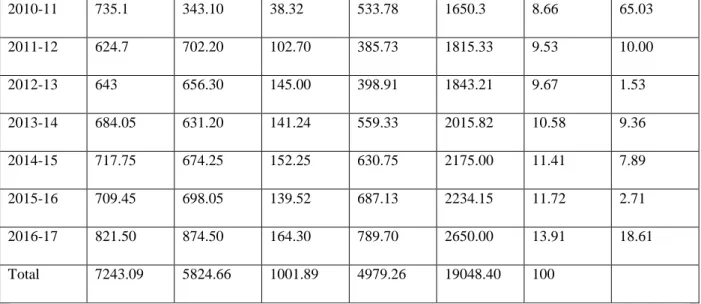
this sector. The production of handicraft industry has been quite encouraging as shown below inⅣ.1 fromthe
table Ⅳ.2 year wise percentage of total production denotes the annual Percentage of the Production and the
Percentage change in production shows the growth in production which may be increase or decrease.
Table Ⅳ.1: Production of handicrafts goods in J&K (Rs. In crores).
Year Carpet Woolen
shawls
Paper
Machie
Other
items
Total Year wise
%age of
TP.
%age
change in
TP
(growth
rate)
2006-07 450.5 320.00 35.00 144.50 950 4.98 ----
2007-08 761.27 420.58 37.92 394.82 1614.59 8.47 69.95
2008-09 457.6 303.45 35.49 303.46 1100 5.77 -31.87
160 | P a g e
2010-11 735.1 343.10 38.32 533.78 1650.3 8.66 65.032011-12 624.7 702.20 102.70 385.73 1815.33 9.53 10.00
2012-13 643 656.30 145.00 398.91 1843.21 9.67 1.53
2013-14 684.05 631.20 141.24 559.33 2015.82 10.58 9.36
2014-15 717.75 674.25 152.25 630.75 2175.00 11.41 7.89
2015-16 709.45 698.05 139.52 687.13 2234.15 11.72 2.71
2016-17 821.50 874.50 164.30 789.70 2650.00 13.91 18.61
Total 7243.09 5824.66 1001.89 4979.26 19048.40 100
Source:- Economic survey J&K, 2016-17
Fig. Ⅳ.1: Year wise percentage of production and Growth rate.
The above fig. Ⅳ.1 indicates that the year wise percentage of total production as well as the growth rate. As is
evident from figure Ⅳ.1 above, the handicraft sector has shown a significant rising trend throughout the years. In
2007-2008 there is a tremendous growth in handicraft production if we compare with the year 2006-2007 with
161 | P a g e
sudden fall in production is being noticed. In 2008-2009 the production is Rs. 1100 crores (-31.87) and in2009-2010 it has again decreased and reached up to Rs. 1000 crores (-9.09). This sudden fall in these two years is
because of turmoil in Kashmir in these two years, political instability, lower incentives etc. In 2008-09 there was
Amarnath land row in the Kashmir valley after that there were hartaals, strikes, and curfew were imposed by the
administration in the Kashmir valley for three-four months, no business activity has been taken place during this
summer season, tourism sector, handicraft sector are mostly affected thus created huge loss to this sector. But
in-order to recover the losses and because of huge demand in the market a significant rise was marked in
productivity which is recorded as Rs. 1650.3 in 2010-2011 with the growth rate of 65.03%. Although there was
also unrest in this year but people had learnt a lesson with the past experience. After that Kashmir had witnessed
with the continuous unrest during summer session by one way or other way that is why handicraft sector does
not make a remarkable growth.After the year 2010-11 till 2015-2016 the growth rate of handicraft production
was below 10%. But year 2016-17 shows 18.61% of growth instead one of the worst year in Kashmir history in
terms of unrest, because all economic activities were shut down for six months. There may a reason of 18.61%
growth rate in handicraft production that is there were 3163 handicraft societies registered as on 31.03.2017
with a membership of 31630 out of which 1402 are active societies. As compared with the last report on
31.03.2014, there were 3005 handicrafts societies registered with a membership of 15084.
Export:The products of the handicrafts sector have attracted the minds of the customers worldwide due to the
quality and unique design of the Goods produced by the handicraft sector. Export of the handicraft products has
the direct impact on the prosperity on the Indian economy in general and on the economy of the Kashmir in
particular.
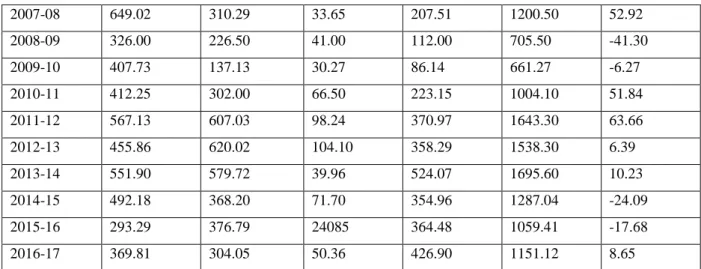
The data given below in Table Ⅳ.2exhibits the export of the handicraft products like carpets, woolen shawls
and paper Machie in the year 2007-2008 with a tremendous export, In 2007-2008 the export is recorded as Rs
1200.50 crores with a growth rate in export 52.92%. In 2008-09 the handicraft sector was badly affected and the
export growth rate with respect to the previous year is -41.42 % with 705.50 crores. Also in 2009-10 the export
is negative i.e., -6.27 % because of the same excuse of unrest in Kashmir. But during the years
2010-11 and 202010-11-12 there was comparatively good handicraft export with the growth percentage of 51% and 63%
respectively. After very low growth in handicraft export in a couple of years then again handicraft export again
declined with a negative growth rate during 2014-15 and 2015-16. So it is clear that handicraft sector is one the
worst hit sector due to regular unrest in the valley in terms of production as well as export.
Table Ⅳ.2 Export of handicraft goods in J&K. (Rs. In crores).
Year Carpet Woolen
shawls
Paper
machie
Other items Total %age
change in
exp.
162 | P a g e
2007-08 649.02 310.29 33.65 207.51 1200.50 52.922008-09 326.00 226.50 41.00 112.00 705.50 -41.30
2009-10 407.73 137.13 30.27 86.14 661.27 -6.27
2010-11 412.25 302.00 66.50 223.15 1004.10 51.84
2011-12 567.13 607.03 98.24 370.97 1643.30 63.66
2012-13 455.86 620.02 104.10 358.29 1538.30 6.39
2013-14 551.90 579.72 39.96 524.07 1695.60 10.23
2014-15 492.18 368.20 71.70 354.96 1287.04 -24.09
2015-16 293.29 376.79 24085 364.48 1059.41 -17.68
2016-17 369.81 304.05 50.36 426.90 1151.12 8.65
Source:- J&K Economic survey 2016-2017
Fig. Ⅳ.2: year wise percentage change in export.
Ⅴ.SWOT ANALYSIS:
J&K handicraft industry is well known for its rich cultural and economic value. Here is an attempt to understand
the commercial aspects of J&K handicrafts with SWOT (Strength, Weakness, Opportunities, and Threats)
163 | P a g e
handicraft societies by one way or other way. It is important for the government to overcome to weakness of thissector and try to best to eradicate all these threats faced by this industry.
The below mentioned table no Ⅴ.1 Shows the strengths, weakness, opportunities and threats of the handicraft
industry of Jammu and Kashmir.
Table: Ⅴ.1 SWOT Analysis of the Handicraft Industry of J&K
Strengths Weakness
Huge Market potential Underdeveloped infrastructure
Flexible Production & design Lack of global exposure
Cheap labour Lack of customer feedback system
Suitable to climatic condition Less interest among youths
Huge employment opportunity Confined mostly to rural areas
Foreign revenue generation Obsolete tools used
Eco-friendly Low wage system in handicrafts
Needs less investment Unorganized sector
Export oriented Political instability in the state
Employment generation Extreme weather
Great quality Lack of promotion of products.
Opportunities Threats
Huge demand in both domestic as well as in
international market
Counterfeiting
Develops tourism industry of J&K Stiff competition ahead
E-commerce to channelize handicraft products of J&K. Deficit balance between supply and demand of J&K
handicrafts
Design sensibility Introducing low skilled labour
164 | P a g e
Handicraft industry of the J&K state faced a lot of problems besides the continuous unrests right from itsbeginning, as everybody knows that J&K state is lacking behind from its sister states viz Himachal Pradesh,
Punjab, Haryana in terms of overall development. Despite the larger portion of the population is associated with
this sector either directly or indirectly, the government is not paying a full attention towards this sector. It’s
important to mention here not only the government sector but also the natural calamities are also responsible for
underdevelopment of this sector.Jammu & Kashmir in general and Kashmir valley in particular faces the
electricity shortage throughout the year due to bad weather conditions or political instability, which directly or
indirectly affects the development of the above said sector. Moreover industrial exposure among the
entrepreneurs is lacking because the government is not providing enough support or attention towards the said
entrepreneurs who fails to upgrade the handicraft sector.
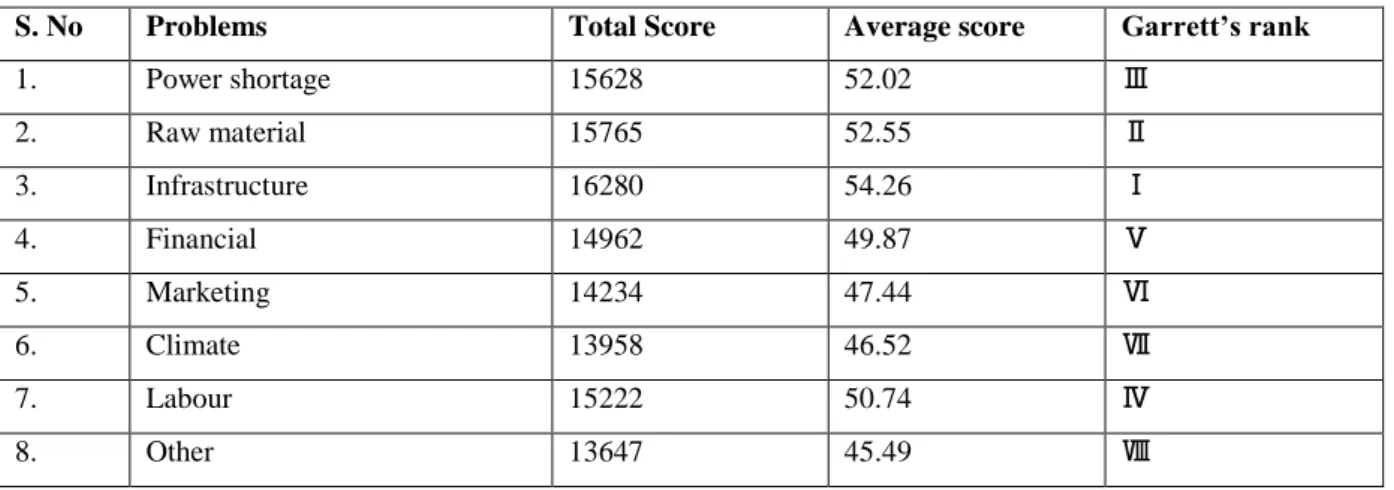
Table Ⅴ.2: Problems faced by the Handicraft Entrepreneurs
S. No Problems Total Score Average score Garrett’s rank
1. Power shortage 15628 52.02 Ⅲ
2. Raw material 15765 52.55 Ⅱ
3. Infrastructure 16280 54.26 Ⅰ
4. Financial 14962 49.87 Ⅴ
5. Marketing 14234 47.44 Ⅵ
6. Climate 13958 46.52 Ⅶ
7. Labour 15222 50.74 Ⅳ
8. Other 13647 45.49 Ⅷ
Source: Field survey conducted by Effat Yasmin & F.A. Bhat in theirresearch paper.
As per the rank given in the above, table no Ⅴ.2 One can easily find the major problems are those of
infrastructure, raw material supply and power shortage. Infrastructure lack of raw material and power shortage
are the main problems faced by the handicraft entrepreneurs.
ⅥFINDING AND CONCLUSION:
The main findings of the study are as under:
While analyzing the yearly growth rate of production and exports in the handicraft sector with 2007 as a base
year it has been observed that the handicraft industry has shown a tremendous overall growth rate in production
165 | P a g e
During the year 2008-2009 and 2009-2010 the overall growth rate in production shows -31.87% & -9.09
respectively.Same was the case with handicraft exports it shows -41.30% and -06.27% respectively. Because of
the continuous unrest in the valley. During these two years not only handicraft sector suffers but all the
economic and social sectors were adversely affected.
After 2010-11 the growth rate in handicraft industry does not increase over 10% except 2016-17, in 2016-17
handicraft production increases over 18% which is not considered as the remarkable growth in this sector.
During the same period of time from 2010-11 to 2015-2016 the export was in negative.
The handicraft industry does not show any remarkable growth after 2008-09 till 2016-2017 because of political
unrest as compare to the other states.
SWOT analysis clearly shows the weakness and threats faced by this sector, so the government need to address
these issues first in order to save this sector.
CONCLUSION:
After agriculture and tourism, handicrafts is the third largest Industry in J&K. J&K is not only home to the vast
cultural and ethnic diversity but also the myriad arts and crafts that have been carefully nurtured for the
centuries. The handicrafts sector of Kashmir is unique in its richness and beauty. About Kashmir Shawls it is
said "Of all Indian textiles none excels in beauty, colour, texture and design as the famous Kashmir Shawl".
Handicrafts activities occupy an important position in the economic structure of J&K State. The handicrafts
activities are best suited to the state as these activities are more labour intensive and less capital intensive in
nature, therefore having scope for employment generation opportunities at large scale.
In addition, there is no private investment in the state. In economic terms it helps in generation of aggregate
employment and raising per capita income of state and hence contributes to State Gross Domestic Product
(SGDP) in particular and National Income in general. This sector has shown a tremendous growth rate in
production, export, and employment generation, but also it is important to mention this sector has shown
negative in export and negligible growth rate in production during the years 2008, 2009, 2010, 2014, 2015
because the of state of J&K and in particular the Kashmir Valley has suffered severe economic setbacks due to
political unrest in the region. Till 2007 there has been an increasing trend in production as well as in export of
handicraft products but thereafter it has declined due to turmoil and unrest during the peak seasons that is,
summer 2008, 2009, 2014, 2010 in Kashmir. Every sector of economy has been affected, like handicrafts sector,
the horticulture sector, medium and small-scale industrial units, the tourism sector etc.
REFRENCES:
[1.] Bhat, B.A. (2006). Impact of Turmoil on Tourist Industry of Jammu and Kashmir, International
a. Journal of Marketing, Financial services and Management Research 1: 124-126.
[2.] Bhat, F.A. Yasmin, E.(2013) An Evaluation of Handicraft Sector of J&K- A Case study of
a. District Budgam. European Academic Journal 1: 367-381.
166 | P a g e
[4.] Management, IT and Social Sciences, 1(4):64-70.[5.] Directorate of Economics & Statistics, J&K. (2014-2015), An annual Economic survey.
[6.] Sharma, S. (2010). Role of handicrafts industry in production, employment and export
a. Promotion: A case study of J&K state. Kashmir journal of social sciences P: 43-61.
[7.] Tiwari, S. Sheikh, S.A. (2014). Skill Development and Vocational Training in the Handicraft
a. Sector in Jammu and Kashmir. Annual Research Journal of Symbiosis Centre for
b. Management Studies, Pune 2: 138-155.
[8.] Hussain, A (2013, July 31) Reviving traditional handicraft of Jammu & Kashmir. Greater
a. Kashmir, P: 7
[9.] J&K handicraft department, official website: “https://www.jkhandicrafts.com”
[10.] Bhat, F. and Yasmin, E.(2012). Impact of turmoil on the handicraft sector of Jammu and
a. Kashmir: An economic analysis.” International NGO Journal 7(5).
[11.] Kathuria, S. (1988). Indian Handicraft Exports: Constraints and Prospects. New Delhi: ICRIER.
[12.] Shah, M. R. (2016). An Assessment of handicraft sector of J&K with reference to Central
i. Kashmir. Arabian Journal of Business and Review. 6(5)
[13.] Economic Review (2008), Directorate of Statistics and Economic planning, J&K Government.
[14.] Economic Survey (2008-09 & 2010-11), Directorate of Statistics and Economic planning, J&K
i. Government.
[15.] J&K Economic survey (2016-2017)- An overview, Page No 160-162
[16.] Greater Kashmir, (2013, 31 July), Reviving traditional handicrafts of J&K. P:13