577
Optimal
Routing
Service
for
Wireless
Network security and Management
V.Senthil vel Assistant professor/CSE
Arulmigu Meenakshi Amman College of Engineering, Kanchipuram.
S.K.Srivatsa Sr.Professor/ECE
St.Joseph College of Engineering,Chennai.
Abstract— WirelessNetwork Environment
poses its unique challenges to the existing Transaction models which are fail to solve.
Wireless ad hoc networks (WANETs)
experience serious security issues even when solutions employ preventive or reactive security mechanisms. In order to support both network operations and security requirements of critical applications, we present SANA, a Secure Ad hoc Network Architecture. Its goal lies in managing adaptively preventive, reactive and tolerant security mechanisms to provide essential services even under attacks, intrusions or failures. We use SANA to design a path selection scheme for WANET routing. The evaluation of this path selection scheme considers scenarios using urban mesh network mobility with urban propagation models, and also random way point mobility with two-ray ground propagation models. Results show the survivability achieved on routing service under different conditions and attacks.
Keywords— Mesh Network, Security
management, wireless ad hoc networks, survivability, routing.
I. INTRODUCTION
Now a days, with the enormous
technological innovations, the low-cost sensor devices development has become possible.
578
network services. Secure routing and cryptographic key distribution. Most of existing security solutions for WANETs [7] employ preventive or reactive security mechanisms, detecting intrusions and thwarting attacks by cryptography, authentication and access control mechanisms [8]. Due to these limitations, researchers have developed intrusion tolerant solutions [9] as a third defense line, to mitigate the impact of attacks and intrusions by fault- tolerance techniques, typically redundancy and recovery mechanisms. However, security solutions remain still focused on one specific issue or layer of the protocol stack, being ineffective to ensure essential services of wireless ad hoc networks. Security management lies in one of the key research challenges on WANETs due to their characteristics, critical application requirements and restrictions on defense lines [10]. Security management consists of mechanisms to control security mechanisms and services, thwarting attacks or intrusions. Since critical applications demand new capabilities from WANETs to support essential services even under attacks and intrusions [11]–[13], the design of new approaches for security management is a demanding task. In this work, we introduce SANA, a Survivable Ad hoc and Mesh Network Architecture, whose goal is the design of survivable essential network services against attacks and intrusions. SANA manages preventive, reactive and tolerant security mechanisms in an adaptive and coordinated way, focusing on the survivability of link-layer connectivity, routing and end-to end communication. We employ SANA for supporting the development of a survival path selection scheme on routing service.
The designed scheme is stand-alone of any protocol and consists in choosing the most survival paths. Hence, the scheme takes into account different criteria that correlate both network conditions and three defense lines. The association of all criteria and inferences is based on fuzzy logic due to its low
computational intensiveness. Considering metrics of Survivability and performance, evaluation results show the mitigation on the impact of different routing attacks yielding a low performance loss for WANETs.
II. RELATED WORK This section starts giving an overview of existing security
management architectures for network
survivability and it finishes presenting related works to route selection, our case study.
A. Security management architectures to network survivability
579
improve network survivability managing mechanisms for tolerating faults and those that propose security management architectures to survive intrusions and attacks [17]–[20]. In [17], security management architecture towards a survivable access control in WANETs is proposed, being the survivability achieved by the creation of secure groups. In [18], an architecture is defined to improve WLAN survivability against attacks that harm access points. In [19] and [20], security management architectures for survivable wireless sensor networks have been designed, focusing on DoS attacks and on multiple attacks, respectively. However, all those architectures handle only one specific service and do not employ more than two defense lines together, being still unable to attain simultaneously all survivable properties, as resistance, recognition, recovery and adaptation. correlate security criteria with other related to network characteristics. Nie et. al [33] proposed the fuzzy logic based security- level (FLSL) routing protocol. It selects the highest security-level routes, calculated by fuzzy logic through the correlation among path length and two security characteristics, cryptographic key length and frequency of key exchanges. However, the initial FLSL proposal defines a single path protocol and it does not address survivability issues.
III. PROPOSED MODEL
In the proposed scheme, each mesh client network is centrally managed by a manager router with gateway.
Each mesh router is assigned a digital certificate by a CA which is used to authenticate the validity of a router. Whenever a new clients enters a network, he receives a digital certificate from its manager router to prove its validity. This certificate could be verified by contacting the CA. Thereafter, the client is asked to enter its SSN (Social Security Number) along with the password through SSL
encrypted web page. After verification the captive portal (government authorized web server which keeps a record of SSN details) authorizes the client to network access and assigns him a UIDN (Unique Identification Number). The UIDN generated is used to keep a record of the client’s SSN, IP address and its manager router (through which it received such information). UIDN may be used to trace the person, in case some attack is detected in the network. The manager router stores the UIDN of the client along with a public key that will be sent to that client to ensure authenticity and integrity of the following messages. The router to router communication is also possible only after exchanging their corresponding digital certificates for the first time. In the second step, both client node and its manager router encrypt the messages by their private keys before sending them to each other. This process authenticates both the nodes. Both of them can verify the authenticity ofeach other by contacting the CA. The secret public key which was sent at the time of assigning the UIDN is used to generate a key through Elliptic curve Diffie-Hellman algorithm that can be used for further communication. ECDH provides desired security level with significantly smaller keys. Now, for future communication the secret keys need not be entered every time. This pair of secret keys is used to provide secure multi- path routing in WMN.
IV. APPLICATION SCENARIO
580
network Here is the proposed solution to the
two major securities reference points:
In the Intra- network
Suppose a new node X comes into the mesh client. First, the manager router sends a digital certificate to prove its authenticity. Upon receiving it, X sends its SSN and password (via SSL) to R, which is sent to the authorized portal for verification. If the information is valid, a UIDN is generated and stored by the portal along with its corresponding SSN, IP Address and router information. This UIDN is then sent to R. R stores the UIDN of that client and sends a secret key to X, this is the first step in the generation of keys using Elliptic Curve
Diffie-Hellman. To engage in secure
communications with ECDH, both X and R chooses – The parameters q, a, and b for an Elliptic Curve based Group Eq(a, b) where q is a prime or an integer of the form 2m.
A base point P є Eq(a, b) whose order is a large value n. The value of n is also a part of the information that must be made publicly available X R .
Choose private key b < n Choose private key a < n
Compute QX = bP Compute QR = aP Send QX to R Send QR to X
Compute K= bQR Compute K =aQX We can see that K = bQR = abP = aQX. Now R and X have the shared secret key K that could subsequently be used for, say, a symmetric-key based communication link. To discover the secret key, an attacker could try to discover the key K from the publicly available base point P and the publicly available QX or QR. But this requires solving the discrete logarithm problem which, for a properly chosen set of curve parameters and P, can be extremely hard. To increase the level of difficulty in solving the discrete logarithm problem, we can select for P, the order which is very large. The order of a point on the elliptic curve is the least number of times G must be added to itself so that we get the identity element 0 of the group Eq(a, b).
In the Inter-network
Most of the traffic in WMN flows through the Gateway for internet access, so the scenario presented would suffice that type of access. But if a client node in one type of network wants to transmit information to a client in another type of network, then a second phase is needed. In the second phase of the security framework, the source manager router and the destination manager router run 2-party ECDH(Elliptic Curve Diffie-Hellman) in parallel with source and destination. Suppose a client A with
manager router R1 wants to transmit
information to B with manager
router R2. If A and R1 possesses a shared secret key abP for transmission and B and R2 possesses a shared secret key cdP. Then, for exchanging the information between A and B, first the message is encrypted using the key, abP from A to R1. Then for transmission from R1 to R2, again ECDH algorithm is executed, where R1’s private key is generated as ab * x and R2’s private key is generated as cd * y ( x and y are randomly generated integers that are
used to enhance the security against
eavesdropping). So the shared secret key between R1 and R2 is which can be used for secured transmission in an inter-network. R2 decrypt it, and again encrypt it using the key and send it to B. After this process, four nodes can communicate securely.
V. MOBILITY AND ADDRESS
MANAGEMENT
581
and the change of location is intimated to the IGW for updating.
VI. SECURITY ANALYSIS
Security is one of the critical concerns of every network. Resource consuming public key cryptography is not feasible for the client nodes. Our proposed mechanism presents an efficient way of reducing the security overheads. ECC used in our model provides the same security as a 1024 bit RSA algorithm, and can be anywhere from 5 to 15 times faster depending on the platform and consumes very less energy [8]. And once, the router is authenticated
And keys are exchanged; all further messages are encrypted with the same keys. If somehow, some attacker succeeds in breaching the security and is detected, he could be traced by its SSN entered at the time of registration and with the help of the UIDN his location can be traced. Thereafter, the SSN is recorded and debarred for any further access to internet through any device. Our mechanism is secure enough that if a node is compromised then the whole network does not get affected by it.
As all nodes communicates with each other with separate secret keys so, if a node is compromised and tries to adverse the network it is not possible for the node to be much hostile to the rest of the network. If there is a compromised node in the network, then there are two possibilities of an adversary node being in the network. In case 1, a node outside the network tries to attack the routing mechanism. Case 2 is the scenario in which the node entering the network is already a compromised node or the node is compromised during its participation in the network (such as due to the lack of physical protection etc). In the first case, the messages by the compromised node would not be accepted by the other nodes as it cannot be authenticated by them. So the adverse messages would be dropped by the
nodes as they cannot verify the adverse node as a member node. The second case can be harmful for the network as other nodes can verify the compromised node as a decent node. This node can communicate with its neighbor nodes and can inject false information in the network. But this compromised node cannot listen to other nodes’ communications and cannot affect them. So if a node is compromised in the network all the other nodes are safe from this node and can communicate with other nodes securely. As our mechanism is for a multi-path routing protocol, hence, the messages are secure from the adversary as there are several paths to evade the compromised nodes. Even if the adversary has ‘n’ compromised nodes with every compromised node is in a different path then with ‘m’ paths in between two nodes, adversary require n m.
F. ROUTING ASSISTANCE UIDN for mobile clients is allocated dynamically by the IGW of that region. This number defines the location of that mobile client i.e. in which ad hoc region the mobile node is present. Our mechanism will help in routing, as the border router manages the addresses and monitors the network, it can help in
Routing decisions. The manager router can find the optimum paths between two nodes detect link losses and find alternate paths within the client mesh network. Geographic routing is possible with the help of UIDN as it helps in making the decisions as to which node it should forward the data to reach the destination.
V. SIMULATION AND ANALYSIS
582
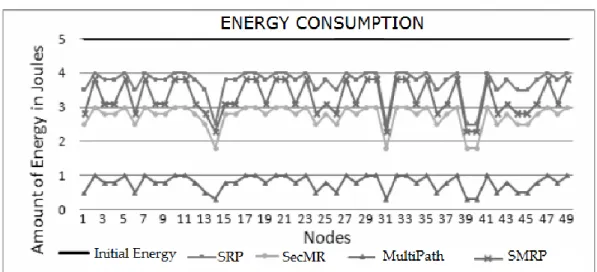
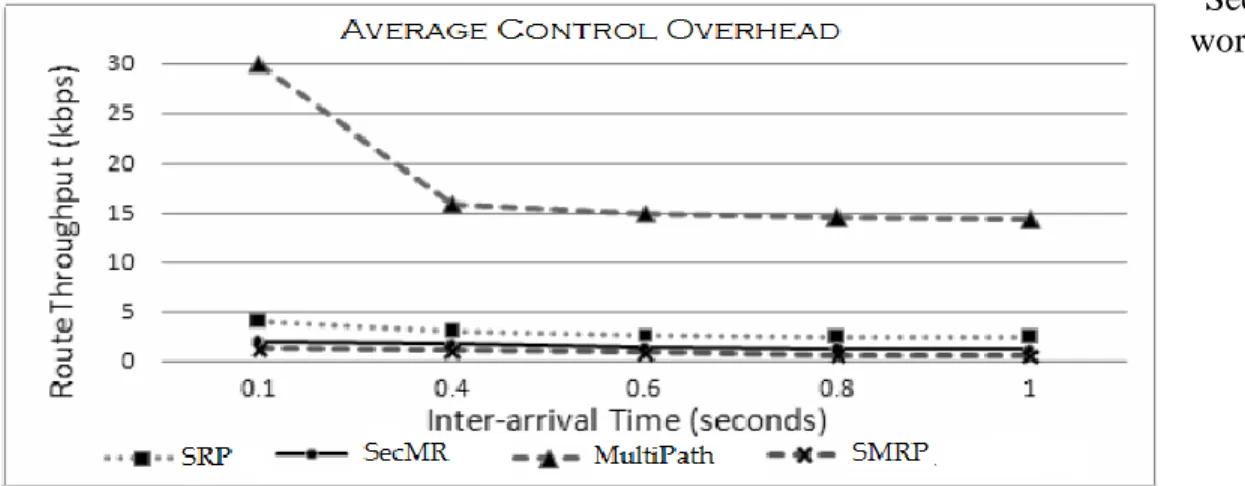
of AODV. We have compared the routing overhead of these schemes and also the amount of energy consumed by these scheme at each node. We performed the simulation in NS-2 [10]. The network model was consisted of 49 client nodes placed randomly within an area of 1000 x 1000 m2. There are 16 mobile router nodes deployed in a grid environment to make up the mesh infrastructure. This scenario
constructed 10 different mobile client
networks. Each node has a propagation range of 150 meters with channel capacity 2 Mbps. The speed of mobile nodes is set to be 0 or 20 m/s. The size of the data payload is 512. Each run of simulation is executed of 900 seconds of simulation time. The medium access control protocol used is IEEE 802.11 DCF. The traffic used is constant bit rate (CBR). From the figures given below, we observe that SRP works better than other schemes as it has less overhead and also consumes very little amount of energy.
However, SRP does not provide optimal security; the intermediate nodes are not authenticated and the messages integrity is ensured by secret key cryptography. All this factors sum up to make SRP not feasible for wireless mesh networks. Scheme shows high
routing overhead as it contains the
neighborhood information and digital signatures with the route request.
This information is increased at every node so the message size increases drastically and produces a huge amount of overhead. This scheme is good for security as well as mutual authentication but its overhead is very high; lot of energy is required at the client nodes and delay in finding the route is also high.
In SecMR, each node mutually authenticates its neighbor node at a periodic interval and public key cryptography is used to ensure security of the messages. Although the
routing phase is separated from this
authentication phase but this authentication is required after a constant interval, hence a considerable amount of energy is wasted in these periodic mutual authentications. Our security mechanism does not require this periodic authentication, instead it uses public key cryptography only once and secret keys are used for further communication. This secret key deployment is not periodic and done after the mutual authentication by using public key
cryptography. This reduces the energy
consumption at each node and the routing overhead is also less than the other schemes.
583
[4] P. Papadimitratos and Z. J. Haas, ― data transmission in mobile ad hoc net
in Proc. 2003 ACM WiSe, pp. 41–50.
Secure works,‖
Figure 2: Amount of Energy Left after 900s simulation
VI. CONCLUSION
In summary, we have presented a security framework for hybrid WMN. Major security requirements for the hybrid mesh network are analyzed and a security framework for the integration of heterogeneous wireless networks is proposed that is secured as well as light weight which means it is suitable for energy constrained mesh client networks like sensor networks. Through simulation we have proved that our scheme is better than the existing ones.
REFERENCES
[1] Y. Hu, D. Johnson, and A. Perrig, ―SEAD: secure efficient distance vector
routing for mobile wireless ad hoc networks,‖
J. Ad Hoc Networks,
vol. 1, pp. 175–192, 2003.
[2] R.Balakrishna, M.Murali Mohan Reddy Dr.U.RajeswarRao,Dr.G.A.Ramachandra, Routing Misbehavior Detection in MANET Using 2ACK‖, in IEEE Advanced Computing
Conference, Thapur University,
Patala,2008.2404–2413.
[3] S. Marti, T. J. Giuli, K. Lai, and M. Baker, ―Mitigating routing misbehavior in mobile ad hoc networks,‖ in Proc. 2000 ACM MobiCom, pp. 255–265.
[5] M. T. Refaei, V. Srivastava, L. DaSilva, and M. Eltoweissy, ―A reputation-based mechanism for isolating selfish nodes in ad hoc networks,‖ in Proc. 2005 MOBIQUITOUS, pp. 3–11.
[6] 2.D.Ganesan, R.Govindan,S.Shenker and Estrin ―Energy Efficient Multipath Routing in Wireless Sensor Networks‖ Mobile Computing and Communication Review,Vol 1,2008.. [7] M. G. Zapata, ―Secure ad hoc on-demand distance vector routing,‖ ACM
SIGMOBILE, vol. 6, no. 3, pp. 106–107, 2002.
[8] I. Akyildiz and X. Wang, ―A survey on wireless mesh networks,‖ IEEE
Commun. Mag., vol. 43, no. 9, pp. 23–30,
2005.
[9] H. Yang, H. Luo, F. Ye, S. Lu, and L. Zhang, ―Security in mobile ad
hoc networks: challenges and solutions,‖ IEEE
Wireless Commun., pp.
38–47, Feb. 2004.
[10] A. Pras, J. Schoenwaelder, M. Burgess, O. Festor, G. Perez, R. Stadler,
and B. Stiller, ―Key research challenges in
network management,‖ IEEE
Commun. Mag., vol. 45, no. 10, pp. 104–110,
584
[11] A. Avizienis, J.-C. Laprie, B. Randell, and C. Landwehr, ―Basic concepts
and taxonomy of dependable and secure computing,‖ IEEE Trans.
Dependable Secure Computer, vol. 1, no. 1, pp.
11–33, 2004.
[12] P. E. Heegaard and K. S. Trivedi, ―Network survivability modeling,‖
Comp. Networks, vol. 53, no. 8, pp. 1215–1234,
2009.
[13] O. Al-Kofahi and A. Kamala,
―Survivability strategies in multichip
Wireless networks,‖ IEEE Wireless Common., vol. 17, no. 5, pp. 71–
80, 2010.
[14] K. John, C. Dennis, H. Alexander, W. Antonio, C. Jonathan, H. Premkumar,
And D. Michael, ―The willow architecture: comprehensive survivability
for large-scale distributed applications,‖ in
2002 DSN.
[15] A. Keromytis, J. Parekh, P. N. Gross, G. Kaiser, V. Misra, J. Nieh,
D. Rubenstein, and S. Stolfo, ―A holistic approach to service survivability,‖
In Proc. 2003 ACM SSRS, pp. 11–22.
[16] F. Wang and R. Uppsala, ―SITAR: a scalable intrusion-tolerant architecture
for distributed services,‖ in Proc. 2003
DISCEX, vol. 2, pp. 153–
155.
[17] T. Aura and S. M¨aki, ―Towards survivable security architecture for
ad-hoc networks,‖ in Proc. 2002 International Workshop on Security
Protocols, pp. 63–73.
[18] M. Virendra, S. Upadhyaya, V. Kumar, and V. Anand, ―SAWAN: a
survivable architecture for wireless LANs,‖ in
Proc. 2005 IEEE IWIA,
pp. 71–82.
[19] D. Kim, C. Yang, and J. Park, ―Adaptation mechanisms for survivable
sensor networks against denial of service attack,‖ in Proc. 2007 ARES,
pp. 575–579.
[20] Y. Qian, K. Lu, and D. Tipper, ―A design for secure and survivable
wireless sensor networks,‖ IEEE Wireless
Commun., vol. 14, no. 5, pp.
30–37, 2007.
[21] P. Papadimitratos, Z. J. Haas, and E. G. Sirer, ―Path set selection in
Mobile ad hoc networks,‖ in Proc. 2002 ACM
MobiHoc, pp. 1–11.
[22] S. Lee and M. Gela, ―Split multipath routing with maximally disjoint
paths in ad hoc networks,‖ in Proc. 2001 IEEE ICC, pp. 3201–3205.
[23] E. Y. Hua and Z. J. Haas, ―Path selection algorithms in homogeneous
mobile ad hoc networks,‖ in Proc. 2006
IWCMC, pp. 275–280.
[24] Y. Han, R. J. La, and H.Zhang, ―Path selection in mobile ad-hoc
networks and distribution of path duration,‖ in
Proc. 2006 IEEE INFOCOM,
pp. 758–762.
[25] M. Kefayati, H. R. Rabiee, S. G. Miremadi, and A. Khonsari, ―Misbehavior resilient multi-path data transmission in mobile ad-hoc networks,‖
in Proc. 2006 ACM SASN, pp. 91–100.
[26] S. Jiang, D. He, and J. Rao, ―A prediction- based link availability estimation
for routing metrics in MANETs,‖ IEEE/ACM
Trans. Networking,
vol. 13, no. 6, pp. 1302–1312, 2005.
[27] Y. Yuan, S. Wong, S. Lu, and W. Arbaugh, ―ROMER: resilient opportunistic mesh routing for wireless mesh networks,‖ in
2005 IEEE
WiMesh.
[28] S. Paris, C. Nita-Rotaru, F. Martignon, and A. Capone, ―Efw: a crosslayer
metric for reliable routing in wireless mesh networks with selfish
participants,‖ in Proc. 2011 IEEE INFOCOM, pp. 576–580.
585
multi-path routing protocol for wireless ad hoc networks,‖ in Proc. 2005
SNPD/SAWN, pp. 468–475.
[30] V. Berman and B. Mukherjee, ―Data security in MANETs using multipath
routing and directional transmission,‖ in Proc.
2006 IEEE ICC,
pp. 2322–2328.
[31] B. Awerbuch, D. Holmer, H. Rubens, and R. D. Kleinberg, ―Provably
competitive adaptive routing.‖ in Proc. 2005
IEEE INFOCOM, pp. 631–
641.
[32] P. Velloso, R. Laufer, D. de O Cunha, O. Duarte, and G. Pujolle, ―Trust
management in mobile ad hoc networks using a scalable maturity-based
model,‖ IEEE Trans. Network and Service
Management, vol. 7, no. 3,
pp. 172–185, 2010.
[33] J. Nie, J. Wen, J. Luo, X. He, and Z. Zhou, ―An adaptive fuzzy logic
based secure routing protocol in mobile ad hoc networks,‖ Fuzzy Sets
and Systems, vol. 157, no. 12, pp. 1704–1712,