What Is Number Theory?
Number theory is the study of the set of positive whole numbers1,2,3,4,5,6,7, . . . ,
which are often called the set ofnatural numbers. We will especially want to study therelationshipsbetween different sorts of numbers. Since ancient times, people have separated the natural numbers into a variety of different types. Here are some familiar and not-so-familiar examples:
odd 1,3,5,7,9,11, . . . even 2,4,6,8,10, . . . square 1,4,9,16,25,36, . . . cube 1,8,27,64,125, . . .
prime 2,3,5,7,11,13,17,19,23,29,31, . . . composite 4,6,8,9,10,12,14,15,16, . . . 1 (modulo 4) 1,5,9,13,17,21,25, . . . 3 (modulo 4) 3,7,11,15,19,23,27, . . . triangular 1,3,6,10,15,21, . . . perfect 6,28,496, . . .
Fibonacci 1,1,2,3,5,8,13,21, . . .
Many of these types of numbers are undoubtedly already known to you. Oth-ers, such as the “modulo 4” numbOth-ers, may not be familiar. A number is said to be congruent to 1 (modulo 4) if it leaves a remainder of 1 when divided by 4, and sim-ilarly for the 3 (modulo 4) numbers. A number is called triangular if that number of pebbles can be arranged in a triangle, with one pebble at the top, two pebbles in the next row, and so on. The Fibonacci numbers are created by starting with 1 and 1. Then, to get the next number in the list, just add the previous two. Finally, a number is perfect if the sum of all its divisors, other than itself, adds back up to the
original number. Thus, the numbers dividing 6 are 1, 2, and 3, and1 + 2 + 3 = 6. Similarly, the divisors of 28 are 1, 2, 4, 7, and 14, and
1 + 2 + 4 + 7 + 14 = 28.
We will encounter all these types of numbers, and many others, in our excursion through the Theory of Numbers.
Some Typical Number Theoretic Questions
The main goal of number theory is to discover interesting and unexpected rela-tionships between different sorts of numbers and to prove that these relarela-tionships are true. In this section we will describe a few typical number theoretic problems, some of which we will eventually solve, some of which have known solutions too difficult for us to include, and some of which remain unsolved to this day.
Sums of Squares I. Can the sum of two squares be a square? The answer is clearly “YES”; for example32+ 42= 52 and52+ 122= 132. These are examples ofPythagorean triples. We will describe all Pythagorean triples in Chapter 2.
Sums of Higher Powers. Can the sum of two cubes be a cube? Can the sum of two fourth powers be a fourth power? In general, can the sum of two nth powers be an nth power? The answer is “NO.” This famous problem, called Fermat’s Last Theorem, was first posed by Pierre de Fermat in the seventeenth century, but was not completely solved until 1994 by Andrew Wiles. Wiles’s proof uses sophisticated mathematical techniques that we will not be able to describe in detail, but in Chapter 30 we will prove that no fourth power is a sum of two fourth powers, and in Chapter 46 we will sketch some of the ideas that go into Wiles’s proof.
Infinitude of Primes. A prime number is a number p whose only factors are 1 andp.
• Are there infinitely many prime numbers?
• Are there infinitely many primes that are 1 modulo 4 numbers?
• Are there infinitely many primes that are 3 modulo 4 numbers? The answer to all these questions is “YES.” We will prove these facts in Chapters 12 and 21 and also discuss a much more general result proved by Lejeune Dirichlet in 1837.
Sums of Squares II. Which numbers are sums of two squares? It often turns out that questions of this sort are easier to answer first for primes, so we ask which (odd) prime numbers are a sum of two squares. For example,
3 =NO, 5 = 12+ 22, 7 =NO, 11 =NO,
13 = 22+ 32, 17 = 12+ 42, 19 =NO, 23 =NO,
29 = 22+ 52, 31 =NO, 37 = 12+ 62, . . .
Do you see a pattern? Possibly not, since this is only a short list, but a longer list leads to the conjecture thatp is a sum of two squares if it is congruent to 1 (modulo 4). In other words, p is a sum of two squares if it leaves a remainder of 1 when divided by 4, and it is not a sum of two squares if it leaves a remainder of 3. We will prove that this is true in Chapter 24.
Number Shapes. The square numbers are the numbers 1, 4, 9, 16, . . . that can be arranged in the shape of a square. The triangular numbers are the num-bers 1, 3, 6, 10, . . . that can be arranged in the shape of a triangle. The first few triangular and square numbers are illustrated in Figure 1.1.
• • •
• • • • • •
• • • • • •
• • • •
1 + 2 = 3 1 + 2 + 3 = 6 1 + 2 + 3 + 4 = 10
Triangular numbers
• • • • • • • • •
• • • • • • • • •
• • • • • • •
• • • •
22= 4 32 = 9 42 = 16
Square numbers
Figure 1.1: Numbers That Form Interesting Shapes
A natural question to ask is whether there are any triangular numbers that are also square numbers (other than 1). The answer is “YES,” the smallest example being
36 = 62 = 1 + 2 + 3 + 4 + 5 + 6 + 7 + 8.
in-finitely many? To search for examples, the following formula is helpful:
1 + 2 + 3 +· · ·+ (n−1) +n= n(n+ 1)
2 .
There is an amusing anecdote associated with this formula. One day when the young Carl Friedrich Gauss (1777–1855) was in grade school, his teacher became so incensed with the class that he set them the task of adding up all the numbers from 1 to 100. As Gauss’s classmates dutifully began to add, Gauss walked up to the teacher and presented the answer, 5050. The story goes that the teacher was neither impressed nor amused, but there’s no record of what the next make-work assignment was!
There is an easy geometric way to verify Gauss’s formula, which may be the way he discovered it himself. The idea is to take two triangles consisting of
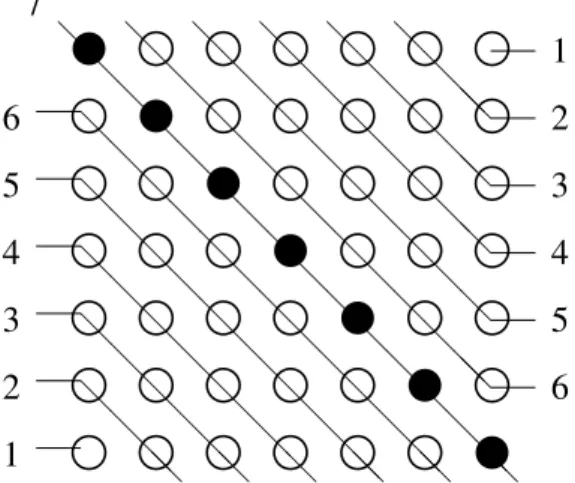
1 + 2 +· · ·+npebbles and fit them together with one additional diagonal ofn+ 1pebbles. Figure 1.2 illustrates this idea forn= 6.
@ @ @ @ @ @ @ @ @ @ @ @@ @ @ @ @ @ @ @ @ @ @@ @ @ @ @ @ @ @ @ @ @ @ @ @@ @ @ @@ @ @ @ @ @ @ @ @ @ @ @ @ @ @ @@ @ @ @ @ @ @ @ @ @ @ @ @@ @ @ @ @ @ @ @ @ @ @ @ @ @ @ @ @ @ @ @ @ @ @ @@ @ @ @@ 6 5 4 3 2 1 7 6 5 4 3 2 1 z j j j j j j j z j j j j j j j z j j j j j j j z j j j j j j j z j j j j j j j z j j j j j j j z
(1 + 2 + 3 + 4 + 5 + 6) + 7 + (6 + 5 + 4 + 3 + 2 + 1) = 72
Figure 1.2: The Sum of the FirstnIntegers
In the figure, we have marked the extran+ 1 = 7pebbles on the diagonal with black dots. The resulting square has sides consisting ofn+ 1pebbles, so in mathematical terms we obtain the formula
2(1 + 2 + 3 +· · ·+n) + (n+ 1) = (n+ 1)2, two triangles +diagonal= square.
Now we can subtractn+ 1 from each side and divide by 2 to get Gauss’s formula.
Twin Primes. In the list of primes it is sometimes true that consecutive odd num-bers are both prime. We have boxed thesetwin primesin the following list of primes less than 100:
3, 5, 7, 11 , 13, 17 , 19 , 23, 29 , 31, 37
41, 43 , 47,53, 59, 61, 67, 71, 73 , 79,83,89,97.
Are there infinitely many twin primes? That is, are there infinitely many prime numberspsuch thatp+ 2is also a prime? At present, no one knows the answer to this question.
Primes of the FormN2+ 1. If we list the numbers of the form N2+ 1 taking
N = 1,2,3, . . ., we find that some of them are prime. Of course, ifN is odd, thenN2+ 1is even, so it won’t be prime unlessN = 1. So it’s really only interesting to take even values ofN. We’ve highlighted the primes in the following list:
22+ 1 =5 42+ 1 =17 62+ 1 =37 82+ 1 = 65 = 5·13 102+ 1 =101 122+ 1 = 145 = 5·29 142+ 1 =197
162+ 1 =257 182+ 1 = 325 = 52·13 202+ 1 =401. It looks like there are quite a few prime values, but if you take larger values ofNyou will find that they become much rarer. So we ask whether there are infinitely many primes of the formN2+ 1. Again, no one presently knows
the answer to this question.
We have now seen some of the types of questions that are studied in the Theory of Numbers. How does one attempt to answer these questions? The answer is that Number Theory is partly experimental and partly theoretical. The experimental part normally comes first; it leads to questions and suggests ways to answer them. The theoretical part follows; in this part one tries to devise an argument that gives a conclusive answer to the questions. In summary, here are the steps to follow:
1. Accumulate data, usually numerical, but sometimes more abstract in nature. 2. Examine the data and try to find patterns and relationships.
3. Formulate conjectures (i.e., guesses) that explain the patterns and relation-ships. These are frequently given by formulas.
4. Test your conjectures by collecting additional data and checking whether the new information fits your conjectures.
5. Devise an argument (i.e., a proof) that your conjectures are correct.
All five steps are important in number theory and in mathematics. More gener-ally, the scientific method always involves at least the first four steps. Be wary of any purported “scientist” who claims to have “proved” something using only the first three. Given any collection of data, it’s generally not too difficult to devise numerous explanations. The true test of a scientific theory is its ability to predict the outcome of experiments that have not yet taken place. In other words, a scien-tific theory only becomes plausible when it has been tested against new data. This is true of all real science. In mathematics one requires the further step of a proof, that is, a logical sequence of assertions, starting from known facts and ending at the desired statement.
Exercises
1.1. The first two numbers that are both squares and triangles are 1 and36. Find the next one and, if possible, the one after that. Can you figure out an efficient way to find triangular–square numbers? Do you think that there are infinitely many?
1.2. Try adding up the first few odd numbers and see if the numbers you get satisfy some sort of pattern. Once you find the pattern, express it as a formula. Give a geometric verification that your formula is correct.
1.3. The consecutive odd numbers 3, 5, and 7 are all primes. Are there infinitely many such “prime triplets”? That is, are there infinitely many prime numberspsuch thatp+ 2
andp+ 4are also primes?
1.4. It is generally believed that infinitely many primes have the formN2+ 1, although
no one knows for sure.
(a) Do you think that there are infinitely many primes of the formN2−1?
(b) Do you think that there are infinitely many primes of the formN2−2?
(c) How about of the formN2−3? How aboutN2−4?
(d) Which values ofado you think give infinitely many primes of the formN2−a?
1.5. The following two lines indicate another way to derive the formula for the sum of the firstnintegers by rearranging the terms in the sum. Fill in the details.
1 + 2 + 3 +· · ·+n= (1 +n) + (2 + (n−1)) + (3 + (n−2)) +· · · = (1 +n) + (1 +n) + (1 +n) +· · · .
How many copies ofn+ 1are in there in the second line? You may need to consider the cases of oddnand evennseparately. If that’s not clear, first try writing it out explicitly for
1.6. For each of the following statements, fill in the blank with an easy-to-check crite-rion:
(a) M is a triangular number if and only if is an odd square.
(b) Nis an odd square if and only if is a triangular number.
Pythagorean Triples
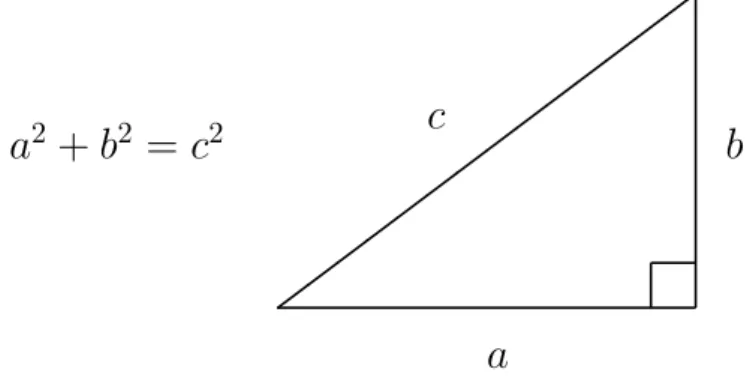
The Pythagorean Theorem, that “beloved” formula of all high school geometry students, says that the sum of the squares of the sides of a right triangle equals the square of the hypotenuse. In symbols,
a
b
c
a
2+
b
2=
c
2Figure 2.1: A Pythagorean Triangle
Since we’re interested in number theory, that is, the theory of the natural num-bers, we will ask whether there are any Pythagorean triangles all of whose sides are natural numbers. There are many such triangles. The most famous has sides 3, 4, and 5. Here are the first few examples:
32+ 42 = 52, 52+ 122 = 132, 82+ 152= 172, 282+ 452 = 532. The study of thesePythagorean triplesbegan long before the time of Pythago-ras. There are Babylonian tablets that contain lists of parts of such triples, including quite large ones, indicating that the Babylonians probably had a systematic method for producing them. Even more amazing is the fact that the Babylonians may have
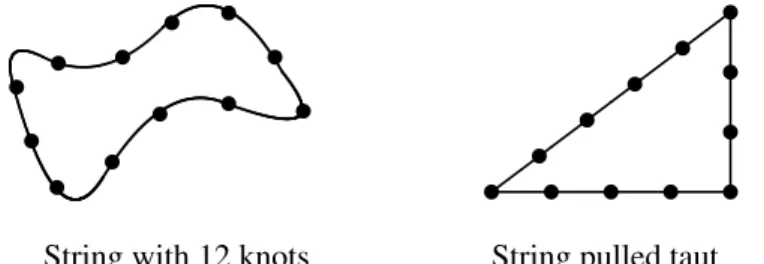
used their lists of Pythagorean triples as primitive trigonometric tables. Pythago-rean triples were also used in ancient Egypt. For example, a rough-and-ready way to produce a right angle is to take a piece of string, mark it into 12 equal segments, tie it into a loop, and hold it taut in the form of a 3-4-5 triangle, as illustrated in Fig-ure 2.2. This provides an inexpensive right angle tool for use on small construction projects (such as marking property boundaries or building pyramids).
t t t t t t t t
t t t t
String pulled taut t
t t t
t t t t t t t t
String with 12 knots
Figure 2.2: Using a knotted string to create a right triangle
The Babylonians and Egyptians had practical reasons for studying Pythagor-ean triples. Do such practical reasons still exist? For this particular problem, the answer is “probably not.” However, there is at least one good reason to study Pythagorean triples, and it’s the same reason why it is worthwhile studying the art of Rembrandt and the music of Beethoven. There is a beauty to the ways in which numbers interact with one another, just as there is a beauty in the composition of a painting or a symphony. To appreciate this beauty, one has to be willing to expend a certain amount of mental energy. But the end result is well worth the effort. Our goal in this book is to understand and appreciate some truly beautiful mathematics, to learn how this mathematics was discovered and proved, and maybe even to make some original contributions of our own.
Enough blathering, you are undoubtedly thinking. Let’s get to the real stuff. Our first naive question is whether there are infinitely manyPythagorean triples, that is, triples of natural numbers(a, b, c)satisfying the equationa2+b2 =c2. The
answer is “YES” for a very silly reason. If we take a Pythagorean triple(a, b, c)
and multiply it by some other numberd, then we obtain a new Pythagorean triple
(da, db, dc). This is true because
(da)2+ (db)2 =d2(a2+b2) =d2c2= (dc)2.
Clearly these new Pythagorean triples are not very interesting. So we will concen-trate our attention on triples with no common factors. We will even give them a name:
Aprimitive Pythagorean triple(or PPT for short) is a triple of num-bers (a, b, c) such that a, b, and c have no common factors1 and satisfy
a2+b2 =c2.
Recall our checklist from Chapter 1. The first step is to accumulate some data. I used a computer to substitute in values foraandband checked ifa2+b2 is a
square. Here are some primitive Pythagorean triples that I found:
(3,4,5), (5,12,13), (8,15,17), (7,24,25),
(20,21,29), (9,40,41), (12,35,37), (11,60,61),
(28,45,53), (33,56,65), (16,63,65).
A few conclusions can easily be drawn even from such a short list. For example, it certainly looks like one ofaandbis odd and the other even. It also seems thatcis always odd.
It’s not hard to prove that these conjectures are correct. First, ifaandbare both even, thencwould also be even. This means thata,b, andcwould have a common factor of 2, so the triple would not be primitive. Next, suppose thataandb are both odd, which means thatc would have to be even. This means that there are numbersx,y, andzsuch that
a= 2x+ 1, b= 2y+ 1, and c= 2z.
We can substitute these into the equationa2+b2 =c2 to get
(2x+ 1)2+ (2y+ 1)2= (2z)2,
4x2+ 4x+ 4y2+ 4y+ 2 = 4z2. Now divide by 2,
2x2+ 2x+ 2y2+ 2y+ 1 = 2z2.
This last equation says that an odd number is equal to an even number, which is impossible, soa and bcannot both be odd. Since we’ve just checked that they cannot both be even and cannot both be odd, it must be true that one is even and
1
Acommon factorofa,b, andcis a numberdsuch that each ofa,b, andcis a multiple ofd. For example, 3 is a common factor of 30, 42, and 105, since30 = 3·10,42 = 3·14, and105 = 3·35, and indeed it is their largest common factor. On the other hand, the numbers 10, 12, and 15 have no common factor (other than 1). Since our goal in this chapter is to explore some interesting and beautiful number theory without getting bogged down in formalities, we will use common factors and divisibility informally and trust our intuition. In Chapter 5 we will return to these questions and develop the theory of divisibility more carefully.
the other is odd. It’s then obvious from the equationa2+b2=c2 thatc is also odd.
We can always switchaandb, so our problem now is to find all solutions in natural numbers to the equation
a2+b2 =c2 with
aodd, beven,
a, b, chaving no common factors.
The tools that we use arefactorizationanddivisibility.
Our first observation is that if(a, b, c) is a primitive Pythagorean triple, then we can factor
a2 =c2−b2= (c−b)(c+b).
Here are a few examples from the list given earlier, where note that we always takeato be odd andbto be even:
32 = 52−42= (5−4)(5 + 4) = 1·9,
152 = 172−82= (17−8)(17 + 8) = 9·25,
352 = 372−122 = (37−12)(37 + 12) = 25·49,
332 = 652−562 = (65−56)(65 + 56) = 9·121.
It looks likec−bandc+bare themselves always squares. We check this obser-vation with a couple more examples:
212 = 292−202 = (29−20)(29 + 20) = 9·49,
632 = 652−162 = (65−16)(65 + 16) = 49·81.
How can we prove thatc−bandc+bare squares? Another observation ap-parent from our list of examples is thatc−bandc+bseem to have no common factors. We can prove this last assertion as follows. Suppose thatdis a common factor ofc−bandc+b; that is,ddivides bothc−bandc+b. Thendalso divides
(c+b) + (c−b) = 2c and (c+b)−(c−b) = 2b.
Thus,d divides2b and2c. But b andchave no common factor because we are assuming that(a, b, c) is a primitive Pythagorean triple. Sodmust equal 1 or2. Butd also divides (c−b)(c+b) =a2, and a is odd, so dmust be 1. In other words, the only number dividing bothc−bandc+bis 1, soc−bandc+bhave no common factor.
We now know that c−b and c+b are positive integers having no common factor, that their product is a square since(c−b)(c+b) =a2. The only way that
this can happen is ifc−bandc+bare themselves squares.2So we can write c+b=s2 and c−b=t2,
wheres > t ≥ 1are odd integers with no common factors. Solving these two equations forbandcyields
c= s 2+t2
2 and b=
s2−t2
2 ,
and then
a=√(c−b)(c+b) =st.
We have (almost) finished our first proof! The following theorem records our accomplishment.
Theorem 2.1(Pythagorean Triples Theorem). We will get every primitive Pytha-gorean triple(a, b, c)withaodd andbeven by using the formulas
a=st, b= s 2−t2
2 , c=
s2+t2
2 ,
wheres > t≥1are chosen to be any odd integers with no common factors. Why did we say that we have “almost” finished the proof? We have shown that if(a, b, c)is a PPT with aodd, then there are odd integerss > t ≥ 1 with no common factors so thata,b, and c are given by the stated formulas. But we still need to check that these formulas always give a PPT. We first use a little bit of algebra to show that the formulas give a Pythagorean triple. Thus
(st)2+
( s2−t2
2
)2
=s2t2+s
4−2s2t2+t4
4 =
s4+ 2s2t2+t4
4 =
( s2+t2
2
)2
.
We also need to check thatst, s2−2t2, and s2+2t2 have no common factors. This is most easily accomplished using an important property of prime numbers, so we postpone the proof until Chapter 7, where you will finish the argument (Exer-cise 7.3).
2
This is intuitively clear if you consider the factorization ofc−bandc+binto primes, since the primes in the factorization ofc−bwill be distinct from the primes in the factorization ofc+b. However, the existence and uniqueness of the factorization into primes is by no means as obvious as it appears. We will discuss this further in Chapter 7.
For example, taking t = 1 in Theorem 2.1 gives a triple (
s,s22−1,s22+1 ) whoseb and c entries differ by 1. This explains many of the examples that we listed. The following table gives all possible triples withs≤9.
s t a=st b= s
2−t2
2 c=
s2+t2
2
3 1 3 4 5
5 1 5 12 13
7 1 7 24 25
9 1 9 40 41
5 3 15 8 17
7 3 21 20 29
7 5 35 12 37
9 5 45 28 53
9 7 63 16 65
A Notational Interlude
Mathematicians have created certain standard notations as a shorthand for various quantities. We will keep our use of such notation to a minimum, but there are a few symbols that are so commonly used and are so useful that it is worthwhile to introduce them here. They are
N=the set of natural numbers= 1,2,3,4, . . . ,
Z=the set of integers=. . .−3,−2,−1,0,1,2,3, . . . ,
Q=the set of rational numbers (i.e., fractions).
In addition, mathematicians often useRto denote the real numbers andCfor the complex numbers, but we will not need these. Why were these letters chosen? The choice ofN,R, andCneeds no explanation. The letterZfor the set of inte-gers comes from the German word “Zahlen,” which means numbers. Similarly,Q comes from the German “Quotient” (which is the same as the English word). We will also use the standard mathematical symbol∈ to mean “is an element of the set.” So, for example,a∈ Nmeans thatais a natural number, andx ∈ Qmeans thatxis a rational number.
Exercises
2.1. (a) We showed that in any primitive Pythagorean triple(a, b, c), eitheraorbis even. Use the same sort of argument to show that eitheraorbmust be a multiple of3.
(b) By examining the above list of primitive Pythagorean triples, make a guess about whena,b, orcis a multiple of5. Try to show that your guess is correct.
2.2. A nonzero integerdis said todividean integer mifm = dkfor some numberk. Show that ifddivides bothmandn, thendalso dividesm−nandm+n.
2.3. For each of the following questions, begin by compiling some data; next examine the data and formulate a conjecture; and finally try to prove that your conjecture is correct. (But don’t worry if you can’t solve every part of this problem; some parts are quite difficult.)
(a) Which odd numbersacan appear in a primitive Pythagorean triple(a, b, c)?
(b) Which even numbersbcan appear in a primitive Pythagorean triple(a, b, c)?
(c) Which numbersccan appear in a primitive Pythagorean triple(a, b, c)?
2.4. In our list of examples are the two primitive Pythagorean triples
332+ 562= 652 and 162+ 632= 652.
Find at least one more example of two primitive Pythagorean triples with the same value ofc. Can you find three primitive Pythagorean triples with the samec? Can you find more than three?
2.5. In Chapter 1 we saw that thenthtriangular numberT
nis given by the formula
Tn= 1 + 2 + 3 +· · ·+n=
n(n+ 1)
2 .
The first few triangular numbers are1,3,6, and10. In the list of the first few Pythagorean triples(a, b, c), we find(3,4,5),(5,12,13),(7,24,25), and(9,40,41). Notice that in each case, the value ofbis four times a triangular number.
(a) Find a primitive Pythagorean triple(a, b, c)withb = 4T5. Do the same forb = 4T6
and forb= 4T7.
(b) Do you think that for every triangular numberTn, there is a primitive Pythagorean triple(a, b, c)withb= 4Tn? If you believe that this is true, then prove it. Otherwise, find some triangular number for which it is not true.
2.6. If you look at the table of primitive Pythagorean triples in this chapter, you will see many triples in whichcis 2 greater thana. For example, the triples(3,4,5),(15,8,17),
(35,12,37), and(63,16,65)all have this property.
(a) Find two more primitive Pythagorean triples(a, b, c)havingc=a+ 2.
(b) Find a primitive Pythagorean triple(a, b, c)havingc=a+ 2andc >1000.
(c) Try to find a formula that describes all primitive Pythagorean triples(a, b, c)having
c=a+ 2.
2.7. For each primitive Pythagorean triple(a, b, c)in the table in this chapter, compute the quantity2c−2a. Do these values seem to have some special form? Try to prove that your observation is true for all primitive Pythagorean triples.
2.8. Letmandnbe numbers that differ by2, and write the sum m1 + 1n as a fraction in lowest terms. For example, 12+14 = 34and13 +15 = 158.
(a) Compute the next three examples.
(b) Examine the numerators and denominators of the fractions in (a) and compare them with the table of Pythagorean triples on page 18. Formulate a conjecture about such fractions.
(c) Prove that your conjecture is correct.
2.9. (a) Read about the Babylonian number system and write a short description, includ-ing the symbols for the numbers1to10and the multiples of10from20to50.
(b) Read about the Babylonian tablet calledPlimpton 322and write a brief report, in-cluding its approximate date of origin.
(c) The second and third columns of Plimpton 322 give pairs of integers(a, c)having the property thatc2−a2is a perfect square. Convert some of these pairs from
Baby-lonian numbers to decimal numbers and compute the value ofbso that(a, b, c)is a Pythagorean triple.
Pythagorean Triples
and the Unit Circle
In the previous chapter we described all solutions toa2+b2=c2
in whole numbersa,b,c. If we divide this equation byc2, we obtain (a
c )2
+
( b c
)2 = 1.
So the pair of rational numbers(a/c, b/c)is a solution to the equation
x2+y2 = 1.
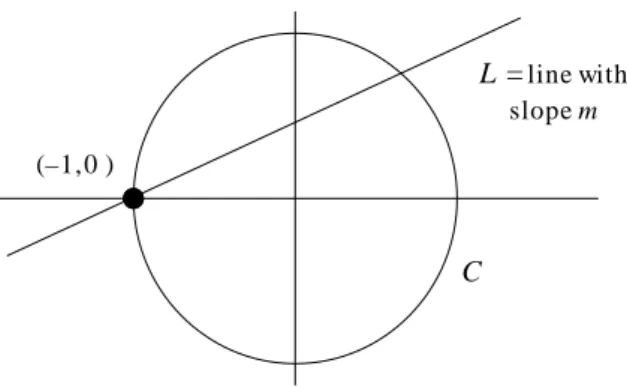
Everyone knows what the equationx2+y2 = 1looks like: It is a circleCof radius 1 with center at(0,0). We are going to use the geometry of the circleCto find all the points onC whosexy-coordinates are rational numbers. Notice that the circle has four obvious points with rational coordinates, (±1,0)and(0,±1). Suppose that we take any (rational) numbermand look at the lineLgoing through the point(−1,0)and having slopem. (See Figure 3.1.) The lineLis given by the equation
L:y=m(x+ 1) (point–slope formula).
It is clear from the picture that the intersectionC∩Lconsists of exactly two points, and one of those points is(−1,0). We want to find the other one.
To find the intersection ofCandL, we need to solve the equations
C
L = line with slope m (–1,0 )
Figure 3.1: The Intersection of a Circle and a Line
for x andy. Substituting the second equation into the first and simplifying, we need to solve
x2+(m(x+ 1))2 = 1
x2+m2(x2+ 2x+ 1) = 1 (m2+ 1)x2+ 2m2x+ (m2−1) = 0.
This is just a quadratic equation, so we could use the quadratic formula to solve forx. But there is a much easier way to find the solution. We know thatx=−1
must be a solution, since the point(−1,0)is on bothCandL. This means that we can divide the quadratic polynomial byx+ 1to find the other root:
(m2+ 1)x+ (m2−1)
x+ 1)(m2+ 1)x2+ 2m2x+ (m2−1).
So the other root is the solution of(m2+ 1)x+ (m2−1) = 0, which means that
x= 1−m 2 1 +m2.
Then we substitute this value ofxinto the equationy=m(x+ 1)of the lineLto find they-coordinate,
y=m(x+ 1) =m (
1−m2
1 +m2 + 1
)
= 2m
1 +m2.
Thus, for every rational numbermwe get a solution in rational numbers (
1−m2
1 +m2, 2m
1 +m2
)
On the other hand, if we have a solution(x1, y1)in rational numbers, then the
slope of the line through(x1, y1) and(−1,0) will be a rational number. So by
taking all possible values form, the process we have described will yield every so-lution tox2+y2 = 1in rational numbers [except for(−1,0), which corresponds to a vertical line having slope “m=∞”]. We summarize our results in the follow-ing theorem.
Theorem 3.1. Every point on the circle x2+y2= 1
whose coordinates are rational numbers can be obtained from the formula (x, y) =
(
1−m2
1 +m2, 2m
1 +m2
)
by substituting in rational numbers form[except for the point(−1,0)which is the limiting value asm→ ∞].
How is this formula for rational points on a circle related to our formula for Pythagorean triples? If we write the rational numbermas a fractionv/u, then our formula becomes
(x, y) =
(
u2−v2 u2+v2,
2uv u2+v2
) , and clearing denominators gives the Pythagorean triple
(a, b, c) = (u2−v2,2uv, u2+v2).
This is another way of describing Pythagorean triples, although to describe only the primitive ones would require some restrictions onuandv. You can relate this description to the formula in Chapter 2 by setting
u= s+t
2 and v=
s−t
2 .
Exercises
3.1. As we have just seen, we get every Pythagorean triple(a, b, c)withbeven from the formula
(a, b, c) = (u2−v2,2uv, u2+v2)
by substituting in different integers foruandv. For example,(u, v) = (2,1) gives the smallest triple(3,4,5).
(a) Ifuandvhave a common factor, explain why(a, b, c)will not be a primitive Pytha-gorean triple.
(b) Find an example of integersu > v > 0that do not have a common factor, yet the Pythagorean triple(u2−v2,2uv, u2+v2)is not primitive.
(c) Make a table of the Pythagorean triples that arise when you substitute in all values ofuandvwith1≤v < u≤10.
(d) Using your table from (c), find some simple conditions onuandv that ensure that the Pythagorean triple(u2−v2,2uv, u2+v2)is primitive.
(e) Prove that your conditions in (d) really work.
3.2. (a) Use the lines through the point(1,1)to describe all the points on the circle
x2+y2= 2
whose coordinates are rational numbers.
(b) What goes wrong if you try to apply the same procedure to find all the points on the circlex2+y2= 3with rational coordinates?
3.3. Find a formula for all the points on the hyperbola
x2−y2= 1
whose coordinates are rational numbers. [Hint. Take the line through the point(−1,0)
having rational slopemand find a formula in terms ofmfor the second point where the line intersects the hyperbola.]
3.4. The curve
y2=x3+ 8
contains the points(1,−3)and(−7/4,13/8). The line through these two points intersects the curve in exactly one other point. Find this third point. Can you explain why the coordinates of this third point are rational numbers?
3.5. Numbers that are both square and triangular numbers were introduced in Chapter 1, and you studied them in Exercise 1.1.
(a) Show that every square–triangular number can be described using the solutions in positive integers to the equationx2−2y2= 1. [Hint. Rearrange the equationm2=
1 2(n
2+n).]
(b) The curvex2−2y2 = 1includes the point(1,0). LetLbe the line through(1,0)
having slopem. Find the other point whereLintersects the curve.
(c) Suppose that you takemto equalm=v/u, where(u, v)is a solution tou2−2v2= 1. Show that the other point that you found in (b) has integer coordinates. Further, changing the signs of the coordinates if necessary, show that you get a solution to
x2−2y2= 1in positive integers.
(d) Starting with the solution(3,2)tox2−2y2= 1, apply (b) and (c) repeatedly to find
several more solutions tox2−2y2= 1. Then use those solutions to find additional examples of square–triangular numbers.
(e) Prove that this procedure leads to infinitely many different square-triangular numbers.
(f) Prove that every square–triangular number can be constructed in this way. (This part is very difficult. Don’t worry if you can’t solve it.)
Sums of Higher Powers
and Fermat’s Last Theorem
In the previous two chapters we discovered that the equationa2+b2=c2
has lots of solutions in whole numbersa, b, c. It is natural to ask whether there are solutions when the exponent 2 is replaced by a higher power. For example, do the equations
a3+b3=c3 and a4+b4=c4 and a5+b5 =c5
have solutions in nonzero integersa, b, c? The answer is “NO.” Sometime around 1637, Pierre de Fermat showed that there is no solution for exponent 4. During the eighteenth and nineteenth centuries, Carl Friedrich Gauss and Leonhard Euler showed that there is no solution for exponent 3 and Lejeune Dirichlet and Adrien Legendre dealt with the exponent 5. The general problem of showing that the equation
an+bn=cn
has no solutions in positive integers ifn ≥ 3is known as “Fermat’s Last Theo-rem.” It has attained almost cult status in the 350 years since Fermat scribbled the following assertion in the margin of one of his books:
It is impossible to separate a cube into two cubes, or a fourth power into two fourth powers, or in general any power higher than the second into powers of
like degree. I have discovered a truly remarkable proof which this margin is too small to contain.1
Few mathematicians today believe that Fermat had a valid proof of his “The-orem,” which is called his Last Theorem because it was the last of his assertions that remained unproved. The history of Fermat’s Last Theorem is fascinating, with literally hundreds of mathematicians making important contributions. Even a brief summary could easily fill a book. This is not our intent in this volume, so we will be content with a few brief remarks.
One of the first general results on Fermat’s Last Theorem, as opposed to verifi-cation for specific exponentsn, was given by Sophie Germain in 1823. She proved that if bothp and2p+ 1are primes then the equation ap +bp = cp has no so-lutions in integersa, b, cwith p not dividing the productabc. A later result of a similar nature, due to A. Wieferich in 1909, is that the same conclusion is true if the quantity2p −2 is not divisible by p2. Meanwhile, during the latter part of the nineteenth century a number of mathematicians, including Richard Dedekind, Leopold Kronecker, and especially Ernst Kummer, developed a new field of math-ematics called algebraic number theory and used their theory to prove Fermat’s Last Theorem for many exponents, although still only a finite list. Then, in 1985, L.M. Adleman, D.R. Heath-Brown, and E. Fouvry used a refinement of Germain’s criterion together with difficult analytic estimates to prove that there are infinitely many primespsuch thatap+bp =cp has no solutions withpnot dividingabc.
Sophie Germain(1776–1831) Sophie Germain was a French mathemati-cian who did important work in number theory and differential equations. She is best known for her work on Fermat’s Last Theorem, where she gave a simple criterion that suffices to show that the equationap+bp =cp has no solutions withabcnot divisible byp. She also did work on acoustics and elasticity, especially the theory of vibrating plates. As a mathematics student, she was forced to take correspondence courses from the ´Ecole Polytechnique in Paris, since they did not accept women as students. For a similar reason, she began her extensive correspondence with Gauss using the pseudonym Monsieur Le Blanc; but when she eventually revealed her identity, Gauss was delighted and sufficiently impressed with her work to recommend her for an honorary degree at the University of G¨ottingen.
In 1986 Gerhard Frey suggested a new line of attack on Fermat’s problem using a notion called modularity. Frey’s idea was refined by Jean-Pierre Serre, and Ken
1
Translated from the Latin: “Cubum autem in duos cubos, aut quadrato quadratum in duos quadrato quadratos, & generaliter nullam in infinitum ultra quadratum potestatem in duos ejusdem nominis fas est dividere; cujus rei demonstrationem mirabilem sane detexi. Hanc marginis exiguitas non caperet.”
Ribet subsequently proved that if the Modularity Conjecture is true, then Fermat’s Last Theorem is true. Precisely, Ribet proved that if every semistable elliptic curve2 is modular3then Fermat’s Last Theorem is true. The Modularity Conjecture, which asserts that every rational elliptic curve is modular, was at that time a conjecture originally formulated by Goro Shimura and Yutaka Taniyama. Finally, in 1994, Andrew Wiles announced a proof that every semistable rational elliptic curve is modular, thereby completing the proof of Fermat’s 350-year-old claim. Wiles’s proof, which is a tour de force using the vast machinery of modern number theory and algebraic geometry, is far too complicated for us to describe in detail, but we will try to convey the flavor of his proof in Chapter 46.
Few mathematical or scientific discoveries arise in a vacuum. Even Sir Isaac Newton, the transcendent genius not noted for his modesty, wrote that “If I have seen further, it is by standing on the shoulders of giants.” Here is a list of some of the giants, all contemporary mathematicians, whose work either directly or in-directly contributed to Wiles’s brilliant proof. The diversified nationalities high-light the international character of modern mathematics. In alphabetical order: Spencer Bloch (USA), Henri Carayol (France), John Coates (Australia), Pierre Deligne (Belgium), Ehud de Shalit (Israel), Fred Diamond (USA), Gerd Falt-ings (Germany), Matthias Flach (Germany), Gerhard Frey (Germany), Alexander Grothendieck (France), Yves Hellegouarch (France), Haruzo Hida (Japan), Ken-kichi Iwasawa (Japan), Kazuya Kato (Japan), Nick Katz (USA), V.A. Kolyvagin (Russia), Ernst Kunz (Germany), Robert Langlands (Canada), Hendrik Lenstra (The Netherlands), Wen-Ch’ing Winnie Li (USA), Barry Mazur (USA), Andr´e N´eron (France), Ravi Ramakrishna (USA), Michel Raynaud (France), Ken Ri-bet (USA), Karl Rubin (USA), Jean-Pierre Serre (France), Goro Shimura (Japan), Yutaka Taniyama (Japan), John Tate (USA), Richard Taylor (England), Jacques Tilouine (France), Jerry Tunnell (USA), Andr´e Weil (France), Andrew Wiles (Eng-land).
Exercises
4.1. Write a one- to two-page biography on one (or more) of the following mathematicians. Be sure to describe their mathematical achievements, especially in number theory, and some details of their lives. Also include a paragraph putting them into an historical context 2An elliptic curve is a certain sort of curve, not an ellipse, given by an equation of the form y2=x3+ax2+bx+c, wherea, b, care integers. The elliptic curve is semistable if the quantities
3b−a2and27c−9ab+ 2a3have no common factors other than 2 and satisfy a few other technical
conditions. We study elliptic curves in Chapters 41–46.
3An elliptic curve is called modular if there is a map to it from another special sort of curve called
by describing the times (scientifically, politically, socially, etc.) during which they lived and worked: (a) Niels Abel, (b) Claude Gaspar Bachet de Meziriac, (c) Richard Dedekind, (d) Diophantus of Alexandria, (e) Lejeune Dirichlet, (f) Eratosthenes, (g) Euclid of Alexan-dria, (h) Leonhard Euler, (i) Pierre de Fermat, (j) Leonardo Fibonacci, (k) Carl Friedrich Gauss, (l) Sophie Germain, (m) David Hilbert, (n) Carl Jacobi, (o) Leopold Kronecker, (p) Ernst Kummer, (q) Joseph-Louis Lagrange, (r) Adrien-Marie Legendre, (s) Joseph Li-ouville, (t) Marin Mersenne, (u) Hermann Minkowski, (v) Sir Isaac Newton, (w) Pythago-ras, (x) Srinivasa Ramanujan, (y) Bernhard Riemann, (z) P.L. Tchebychef (also spelled Chebychev).
4.2. The equationa2+b2=c2has lots of solutions in positive integers, while the equation a3+b3 = c3 has no solutions in positive integers. This exercise asks you to look for
solutions to the equation
a3+b3=c2 (∗)
in integersc≥b≥a≥1.
(a) The equation(∗)has the solution(a, b, c) = (2,2,4). Find three more solutions in positive integers. [Hint. Look for solutions of the form(a, b, c) = (xz, yz, z2). Not
every choice ofx, y, zwill work, of course, so you’ll need to figure out which ones do work.]
(b) If(A, B, C)is a solution to(∗)andnis any integer, show that(n2A, n2B, n3C)is also a solution to(∗). We will say that a solution(a, b, c)to(∗)isprimitiveif it does not look like(n2A, n2B, n3C)for anyn≥2.
(c) Write down four different primitive solutions to(∗). [That is, redo (a) using only primitive solutions.]
(d) The solution(2,2,4)hasa=b. Find all primitive solutions that havea=b.
Divisibility and the Greatest
Common Divisor
As we have already seen in our study of Pythagorean triples, the notions of divis-ibility and factorizations are important tools in number theory. In this chapter we will look at these ideas more closely.
Suppose thatmandnare integers withm̸= 0. We say thatmdividesnifnis a multiple ofm, that is, if there is an integerksuch thatn=mk. Ifmdividesn, we writem|n. Similarly, ifmdoes not dividen, then we writem-n. For example,
3|6 and 12|132, since 6 = 3·2 and 132 = 12·11.
The divisors of 6 are 1, 2, 3, and 6. On the other hand, 5 - 7, since no integer multiple of5is equal to7. A number that dividesnis called adivisor ofn.
If we are given two numbers, we can look for common divisors, that is, num-bers that divide both of them. For example, 4 is a common divisor of 12 and 20, since4|12 and4|20. Notice that 4 is the largest common divisor of 12 and 20. Similarly, 3 is a common divisor of 18 and 30, but it is not the largest, since 6 is also a common divisor. The largest common divisor of two numbers is an ex-tremely important quantity that will frequently appear during our number theoretic excursions.
Thegreatest common divisorof two numbersaandb(not both zero) is the largest number that divides both of them. It is denoted by
gcd(a, b). Ifgcd(a, b) = 1, we say thataandbarerelatively prime.
Two examples that we mentioned above are
Another example is
gcd(225,120) = 15.
We can check that this answer is correct by factoring225 = 32 ·52 and120 = 23·3·5, but, in general, factoringaandbis not an efficient way to compute their greatest common divisor.1
The most efficient method known for finding the greatest common divisors of two numbers is called theEuclidean algorithm. It consists of doing a sequence of divisions with remainder until the remainder is zero. We will illustrate with two examples before describing the general method.
As our first example, we will compute gcd(36,132). The first step is to di-vide 132 by 36, which gives a quotient of 3 and a remainder of 24. We write this as
132 = 3×36 + 24.
The next step is to take 36 and divide it by the remainder 24 from the previous step. This gives
36 = 1×24 + 12. Next we divide 24 by 12, and we find a remainder of 0,
24 = 2×12 + 0.
The Euclidean algorithm says that as soon as you get a remainder of 0, the re-mainder from the previous step is the greatest common divisor of the original two numbers. So in this case we find thatgcd(132,36) = 12.
Let’s do a larger example. We will compute
gcd(1160718174,316258250).
Our reason for doing a large example like this is to help convince you that the Euclidean algorithm gives a far more efficient way to compute gcd’s than factor-ization. We begin by dividing1160718174by 316258250, which gives 3with a remainder of211943424. Next we take316258250and divide it by 211943424. This process continues until we get a remainder of0. The calculations are given in 1An even less efficient way to compute the greatest common divisor ofaandbis the method
taught to my daughter by her fourth grade teacher, who recommended that the students make com-plete lists of all the divisors ofaandband then pick out the largest number that appears on both lists!
the following table:
1160718174 = 3×316258250 + 211943424 316258250 = 1×211943424 + 104314826 211943424 = 2×104314826 + 3313772
104314826 = 31×3313772 + 1587894
3313772 = 2×1587894 + 137984
1587894 = 11×137984 + 70070
137984 = 1×70070 + 67914
70070 = 1×67914 + 2156
67914 = 31×2156 + 1078 ←gcd
2156 = 2×1078 + 0
Notice how at each step we divide a numberAby a numberBto get a quotientQ and a remainderR. In other words,
A=Q×B+R.
Then at the next step we replace our oldAandB with the numbersB andRand continue the process until we get a remainder of0. At that point, the remainderR from the previous step is the greatest common divisor of our original two numbers. So the above calculation shows that
gcd(1160718174,316258250) = 1078.
We can partly check our calculation (always a good idea) by verifying that 1078 is indeed a common divisor. Thus
1160718174 = 1078×1076733 and 316258250 = 1078×293375. There is one more practical matter to be mentioned before we undertake a theoretical analysis of the Euclidean algorithm. If we are givenAandB, how can we find the quotientQand the remainderR? Of course, you can always use long division, but that can be time consuming and subject to arithmetic errors ifAandB are large. A pleasant alternative is to find a calculator or computer program that will automatically computeQandRfor you. However, even if you are only equipped with an inexpensive calculator, there is an easy three-step method to findQandR.
Method to ComputeQandRon a Calculator So ThatA=B×Q+R 1. Use the calculator to divideAbyB. You get a number with decimals. 2. Discard all the digits to the right of the decimal point. This givesQ. 3. To findR, use the formulaR=A−B×Q.
For example, suppose thatA = 12345andB = 417. ThenA/B = 29.6043. . ., soQ= 29andR= 12345−417·29 = 252.
We’re now ready to analyze the Euclidean algorithm. The general method looks like
a= q1×b + r1
b= q2×r1 + r2
r1= q3×r2 + r3
r2= q4×r3 + r4
.. .
rn−3=qn−1×rn−2+rn−1
rn−2= qn×rn−1 + rn ←gcd rn−1= qn+1rn + 0 If we letr0=bandr−1=a, then every line looks like
ri−1 =qi+1×ri+ri+1.
Why is the last nonzero remainderrna common divisor ofaandb? We start from the bottom and work our way up. The last linern−1=qn+1rnshows thatrn dividesrn−1. Then the previous line
rn−2 =qn×rn−1+rn
shows thatrndividesrn−2, since it divides bothrn−1 andrn. Now looking at the line above that, we already know thatrndivides bothrn−1 andrn−2, so we find
thatrnalso dividesrn−3. Moving up line by line, when we reach the second line we
will already know thatrndividesr2andr1. Then the second lineb=q2×r1+r2
tells us thatrn divides b. Finally, we move up to the top line and use the fact thatrndivides bothr1andbto conclude thatrnalso dividesa. This completes our verification that the last nonzero remainderrnis a common divisor ofaandb.
But why isrnthegreatestcommon divisor ofaandb? Suppose thatdis any common divisor ofaandb. We will work our way back down the list of equations. So from the first equationa=q1×b+r1and the fact thatddivides bothaandb,
we see thatdalso divides r1. Then the second equationb=q2r1+r2 shows us
thatdmust divider2. Continuing down line by line, at each stage we will know
thatddivides the previous two remaindersri−1 andri, and then the current line ri−1 =qi+1×ri+ri+1 will tell us thatd also divides the next remainderri+1.
Eventually, we reach the penultimate linern−2 =qn×rn−1+rn, at which point we conclude thatddividesrn. So we have shown that ifdis any common divisor ofaandbthendwill dividern. Therefore,rnmust be the greatest common divisor ofaandb.
This completes our verification that the Euclidean algorithm actually com-putes the greatest common divisor, a fact of sufficient importance to be officially recorded.
Theorem 5.1(Euclidean Algorithm). To compute the greatest common divisor of two numbersaandb, letr−1 = a, letr0 = b, and compute successive quotients
and remainders
ri−1 =qi+1×ri+ri+1
fori= 0,1,2, . . .until some remainderrn+1 is0. The last nonzero remainderrn
is then the greatest common divisor ofaandb.
There remains the question of why the Euclidean algorithm always finishes. In other words, we know that the last nonzero remainder will be the desiredgcd, but how do we know that we ever get a remainder that does equal 0? This is not a silly question, since it is easy to give algorithms that do not terminate; and there are even very simple algorithms for which it is not known whether or not they always terminate. Fortunately, it is easy to see that the Euclidean algorithm always terminates. The reason is simple. Each time we compute a quotient with remainder,
A=Q×B+R,
the remainder will be between 0 andB−1. This is clear, since ifR≥B, then we can add one more onto the quotientQand subtractB fromR. So the successive remainders in the Euclidean algorithm continually decrease:
b=r0 > r1> r2 > r3 >· · · .
But all the remainders are greater than or equal to 0, so we have a strictly decreasing sequence of nonnegative integers. Eventually, we must reach a remainder that equals 0; in fact, it is clear that we will reach a remainder of 0 in at mostbsteps. Fortunately, the Euclidean algorithm is far more efficient than this. You will show in the exercises that the number of steps in the Euclidean algorithm is at most seven times thenumber of digitsinb. So, on a computer, it is quite feasible to compute
gcd(a, b)whenaandbhave hundreds or even thousands of digits!
Exercises
5.1. Use the Euclidean algorithm to compute each of the followinggcd’s.
(a) gcd(12345,67890) (b) gcd(54321,9876)
5.2. Write a program to compute the greatest common divisorgcd(a, b)of two inte-gersaandb. Your program should work even if one ofaorbis zero. Make sure that you don’t go into an infinite loop ifaandbare both zero!
5.3. Letb=r0,r1,r2, . . . be the successive remainders in the Euclidean algorithm applied
toaandb. Show that after every two steps, the remainder is reduced by at least one half. In other words, verify that
ri+2<
1
2ri for everyi= 0,1,2, . . ..
Conclude that the Euclidean algorithm terminates in at most2 log2(b)steps, wherelog2is the logarithm to the base 2. In particular, show that the number of steps is at most seven times the number of digits inb. [Hint. What is the value oflog2(10)?]
5.4. A numberL is called a common multiple ofm andnif both m andndivide L. The smallest suchLis called theleast common multiple ofmand nand is denoted by
LCM(m, n). For example,LCM(3,7) = 21andLCM(12,66) = 132.
(a) Find the following least common multiples.
(i) LCM(8,12) (ii) LCM(20,30) (iii) LCM(51,68) (iv) LCM(23,18).
(b) For each of theLCMs that you computed in (a), compare the value ofLCM(m, n)
to the values ofm,n, andgcd(m, n). Try to find a relationship.
(c) Give an argument proving that the relationship you found is correct for allmandn.
(d) Use your result in (b) to computeLCM(301337,307829).
(e) Suppose thatgcd(m, n) = 18andLCM(m, n) = 720. Findmandn. Is there more than one possibility? If so, find all of them.
5.5. The “3n+ 1algorithm” works as follows. Start with any number n. Ifnis even, divide it by2. Ifnis odd, replace it with3n+ 1. Repeat. So, for example, if we start with5, we get the list of numbers
5,16,8,4,2,1,4,2,1,4,2,1, . . . ,
and if we start with7, we get
7,22,11,34,17,52,26,13,40,20,10,5,16,8,4,2,1,4,2,1, . . . .
Notice that if we ever get to 1 the list just continues to repeat with4,2,1’s. In general, one of the following two possibilities will occur:2
(i) We may end up repeating some numberathat appeared earlier in our list, in which case the block of numbers between the twoa’s will repeat indefinitely. In this case we say that the algorithmterminatesat the last nonrepeated value, and the number of distinct entries in the list is called thelength of the algorithm. For example, the algorithm terminates at 1 for both 5 and 7. The length of the algorithm for 5 is 6, and the length of the algorithm for 7 is 17.
(ii) We may never repeat the same number, in which case we say that the algorithm does not terminate.
2
There is, of course, a third possibility. We may get tired of computing and just stop working, in which case one might say that the algorithm terminates due to exhaustion of the computer!
(a) Find the length and terminating value of the3n+1algorithm for each of the following starting values ofn:
(i)n= 21 (ii)n= 13 (iii)n= 31
(b) Do some further experimentation and try to decide whether the3n+ 1 algorithm always terminates and, if so, at what value(s) it terminates.
(c) Assuming that the algorithm terminates at1, letL(n)be the length of the algorithm for starting valuen. For example,L(5) = 6andL(7) = 17. Show that ifn= 8k+ 4
withk≥1, thenL(n) =L(n+ 1). [Hint. What does the algorithm do to the starting values8k+ 4and8k+ 5?]
(d) Show that ifn= 128k+ 28thenL(n) =L(n+ 1) =L(n+ 2).
(e) Find some other conditions, similar to those in (c) and (d), for which consecutive values ofn have the same length. (It might be helpful to begin by using the next exercise to accumulate some data.)
5.6. Write a program to implement the3n+ 1algorithm described in the previous exercise. The user will inputnand your program should return the lengthL(n)and the terminating valueT(n)of the3n+ 1algorithm. Use your program to create a table giving the length and terminating value for all starting values1≤n≤100.
Linear Equations and the
Greatest Common Divisor
Given two whole numbersaandb, we are going to look at all the possible numbers we can get by adding a multiple ofato a multiple ofb. In other words, we will consider all numbers obtained from the formula
ax+by
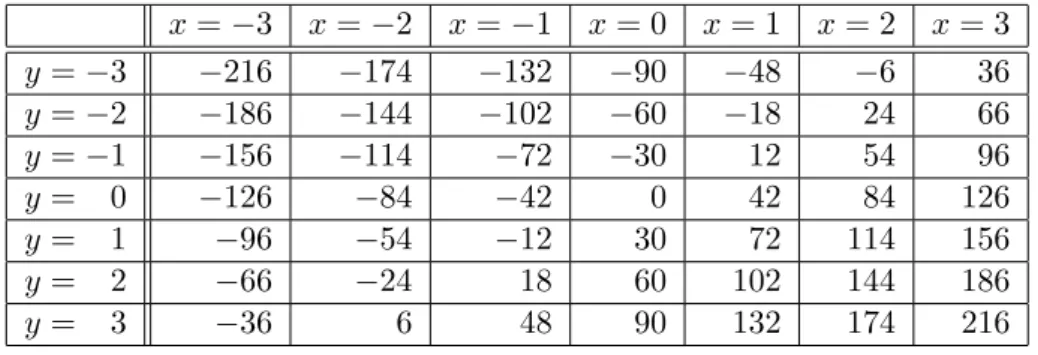
when we substitute all possible integers forx and y. Note that we are going to allow both positive and negative values forxandy. For example, we could take a= 42andb= 30. Some of the values ofax+byfor thisaandbare given in the following table:
x=−3 x=−2 x=−1 x= 0 x= 1 x= 2 x= 3
y=−3 −216 −174 −132 −90 −48 −6 36
y=−2 −186 −144 −102 −60 −18 24 66
y=−1 −156 −114 −72 −30 12 54 96
y= 0 −126 −84 −42 0 42 84 126
y= 1 −96 −54 −12 30 72 114 156
y= 2 −66 −24 18 60 102 144 186
y= 3 −36 6 48 90 132 174 216
Table of Values of42x+ 30y
Our first observation is that every entry in the table is divisible by 6. This is not surprising, since both42 and30 are divisible by6, so every number of the form
42x+ 30y= 6(7x+ 5y) is a multiple of 6. More generally, it is clear that ev-ery number of the formax+by is divisible bygcd(a, b), since bothaandb are divisible bygcd(a, b).
A second observation, which is somewhat more surprising, is that the greatest common divisor of42and30, which is6, actually appears in our table. Thus from the table we see that
42·(−2) + 30·3 = 6 = gcd(42,30). Further examples suggest the following conclusion:
The smallest positive value of ax+by
is equal togcd(a, b).
There are many ways to prove that this is true. We will take a constructive ap-proach, via the Euclidean algorithm, which has the advantage of giving a proce-dure for finding the appropriate values ofxandy. In other words, we are going to describe a method of finding integersxandythat are solutions to the equation
ax+by= gcd(a, b).
Since, as we have already observed, every numberax+byis divisible bygcd(a, b), it will follow that the smallest positive value ofax+byis preciselygcd(a, b).
How might we solve the equationax+by = gcd(a, b)? Ifaandbare small, we might be able to guess a solution. For example, the equation
10x+ 35y = 5
has the solutionx=−3andy = 1, and the equation
7x+ 11y= 1
has the solutionx = −3andy = 2. We also notice that there can be more than one solution, sincex= 8andy=−5is also a solution to7x+ 11y= 1.
However, ifaandbare large, neither guesswork nor trial and error is going to be helpful. We are going to start by illustrating the Euclidean algorithm method for solvingax+by= gcd(a, b)with a particular example. So we are going to try to solve
22x+ 60y= gcd(22,60).
The first step is to perform the Euclidean algorithm to compute thegcd. We find
60 = 2×22 + 16 22 = 1×16 + 6
16 = 2×6 + 4
6 = 1×4 + 2 4 = 2×2 + 0
This shows thatgcd(22,60) = 2, a fact that is clear without recourse to the Eu-clidean algorithm. However, the EuEu-clidean algorithm computation is important because we’re going to use the intermediate quotients and remainders to solve the equation22x+ 60y= 2. The first step is to rewrite the first equation as
16 =a−2b, where we leta= 60andb= 22.
We next substitute this value into the 16 appearing in the second equation. This gives (remember thatb= 22)
b= 1×16 + 6 = 1×(a−2b) + 6. Rearranging this equation to isolate the remainder 6 yields
6 =b−(a−2b) =−a+ 3b.
Now substitute the values 16 and 6 into the next equation,16 = 2×6 + 4: a−2b= 16 = 2×6 + 4 = 2(−a+ 3b) + 4.
Again we isolate the remainder 4, yielding
4 = (a−2b)−2(−a+ 3b) = 3a−8b. Finally, we use the equation6 = 1×4 + 2to get
−a+ 3b= 6 = 1×4 + 2 = 1×(3a−8b) + 2. Rearranging this equation gives the desired solution
−4a+ 11b= 2.
(We should check our solution:−4×60 + 11×22 =−240 + 242 = 2.)
We can summarize the above computation in the following efficient tabular form. Note that the left-hand equations are the Euclidean algorithm, and the right-hand equations compute the solution toax+by= gcd(a, b).
a= 2×b+ 16 16 =a−2b
b= 1×16 + 6 6 =b−1×16
=b−1×(a−2b) =−a+ 3b
16 = 2×6 + 4 4 = 16−2×6
= (a−2b)−2×(−a+ 3b) = 3a−8b
6 = 1×4 + 2 2 = 6−1×4
= (−a+ 3b)−1×(3a−8b) =−4a+ 11b