Key Dimensions and
Processes in the U.S.
Credit Reporting System
:
A r e v i e w o f h o w t h e n a t i o n ’s l a r g e s t c r e d i t
b u r e a u s m a n a g e c o n s u m e r d a t a
Table of Contents
Purpose and Executive Summary ... 2
1.
Introduction ... 5
2.
Credit Bureaus, Credit Files, Credit Reports, and Credit Scores ... 7
3.
Furnishers and Users ... 13
4.
Furnisher and Data Screening ... 18
5.
Compiling Credit Files: “Matching” ... 21
6.
Inaccuracies in Credit Files and Credit Reports... 23
7.
Disputing Credit Report Errors ... 27
8.
Monitoring and Measuring Credit Reporting Accuracy ... 36
Glossary ... 39
Purpose and Executive
Summary
This paper describes the credit reporting infrastructure at the three largest nationwide consumer reporting agencies (NCRAs) – Equifax Information Services LLC (Equifax), TransUnion LLC (TransUnion), and Experian Information Solutions Inc. (Experian) – with a special focus on the infrastructure and processes currently used by the NCRAs to collect, compile, and report information about consumers in the form of credit reports.
Credit reports play an increasingly important role in the lives of American consumers. Most decisions to grant credit – including mortgage loans, auto loans, credit cards, and private student loans – include
information contained in credit reports as part of the lending decision. These reports are also used in other spheres of decision-making, including eligibility for rental housing, setting premiums for auto and
homeowners insurance in some states, or determining whether to hire an applicant for a job. As the range and frequency of decisions that rely on credit reports have increased, so has the importance of assuring the accuracy of these reports. These three NCRAs occupy the hub of what can best be described as a national credit reporting system. They, the entities who report information about borrowers to them (furnishers), providers of public records information, and consumers all play roles which affect the accuracy of the information reported in consumer credit reports.
In its supervision of large banks, the Consumer Financial Protection Bureau (CFPB) has already begun examining the processes institutions use to assure accuracy when furnishing information to the NCRAs and when responding to consumer disputes about information contained in their credit reports. On July 20, 2012 the CFPB published its larger participant rule permitting it to supervise companies with annual receipts from “consumer reporting,” as defined in the rule, of over $7 million. Prior to the rule’s effective date, the CFPB’s Office of Deposits, Cash, Collections and Reporting Markets (DCCR) consulted existing reports, industry, and public sources in order to be able to depict key dimensions of, and processes in, the reporting and disputing of information in the U.S. credit reporting system.
This paper summarizes learnings from DCCR’s research and analysis. It is intended as a public service to provide basic descriptions of, and statistics regarding, the underlying processes by which consumer data is reported, matched to consumer files, and reviewed when consumers dispute its accuracy. The CFPB has not sought to verify information contained in this paper through its supervisory authorities. Nor does the paper represent any learnings or conclusions about whether any specific market participants are in
compliance with particular statutes or policies pertaining to consumer reporting.
This paper depicts the types of information movements and processes that are most essential to the compiling of credit reports and to the management of credit report accuracy. The Fair Credit Reporting Act (FCRA) and its implementing regulations impose legal duties both on
NCRAs and on data furnishers relating to the accuracy of credit report information.1 All parties
to the credit reporting system have a vital interest in achieving accuracy in credit reports. Those who use these reports to make decisions rely upon the accuracy of the information they receive. To the extent the information is inaccurate, that can lead to incorrect decisions to the detriment of decision makers and consumers alike.
Key Learnings
• The U.S. credit reporting system encompasses a vast flow and store of
information. The NCRAs each maintain credit files on over 200,000,000 adults and receive information from approximately 10,000 furnishers of data. On a monthly basis, these furnishers provide information on over 1.3 billion consumer credit accounts or other “trade lines.”
• Furnishing credit information to the NCRAs is a highly concentrated activity, both by institution and by product. The 10 largest institutions furnishing credit information to each of the NCRAs account for more than half of all accounts reflected in consumers’ credit files. Likewise, retail and network-branded revolving credit cards account for nearly 60% of all trade lines.
• The NCRAs have designed a number of processes to standardize, automate, and perform quality controls on incoming data. The NCRAs report that before
accepting information from data furnishers, they perform certain background and quality control checks on would-be-furnishers. Most furnishers – and all new furnishers – provide consumer credit information electronically to one or more NCRAs using a standardized format called Metro 2 that the Consumer Data Industry Association (CDIA) developed and refined over time. When data files are received, the NCRAs also perform quality checks prior to adding the data to credit files.
• The “matching” process by which the NCRAs assign incoming trade line data to consumer-specific credit files represents the central step in the organization of credit data to permit the creation of credit reports on individual consumers. The NCRAs manage this process through unique data architectures each has developed and which vary from each other. The challenge of accurately matching trade line
information to the correct consumer is made complex by the absence of any objective, third party source of information, by similarities in consumers’ names and addresses (particularly among family members), and by limitations, colloquial variations, and inaccuracies in the personally identifying information provided by consumers and furnishers that occur when consumers first apply for credit products.
• Inaccuracies can enter into credit reports in a number of ways. Inaccuracies can occur if consumers provide inaccurate data when applying for a loan or if the creditor who furnishes data to the credit bureau inputs consumer information to its systems inaccurately. Inaccuracies can occur when the bureaus match information about a consumer from a particular data furnisher to the wrong individual consumer’s file. Inaccuracies can also come from errors or the lack of identifying information in government records. Inaccuracies can occur when consumers have become victims of identity fraud or identity theft.
• The extent to which credit reports contain material inaccuracies is uncertain. There have been conflicting reports on this issue. The Federal Trade Commission
(FTC) is expected to release results from its decade-long study on credit report accuracy later this year.
• Consumers’ right to dispute information contained in their credit reports under the FCRA – and furnishers’ and the NCRAs’ obligation to respond – provide important checks on inaccurate credit reports. Among other protections,
consumers also have the right to obtain a copy of their credit file and to receive notice of adverse actions involving credit reports with a resultant right to a free disclosure. These disclosures are one way for consumers to dispute information in their file they believe is not accurate or complete. The CFPB estimates that at least 40,000,000 consumers obtain a copy of their credit file from one or more of the NCRAs annually. • The NCRAs received approximately 8 million contacts from consumers in 2011 to
initiate disputes about the accuracy of one or more items on their credit files. In total, these 8 million contacts resulted in 32 – 38 million disputed items on consumers’ credit files. The rate at which the credit account information depicted in credit files is disputed varies widely based upon the type of data furnished.
• Collections items are a major source of disputes. Items reported by collection agencies reportedly have the highest dispute rates, averaging 1.1% of the trade lines they furnish in a given year. Almost 40% of disputes handled by the NCRAs on average can be linked to collections items.
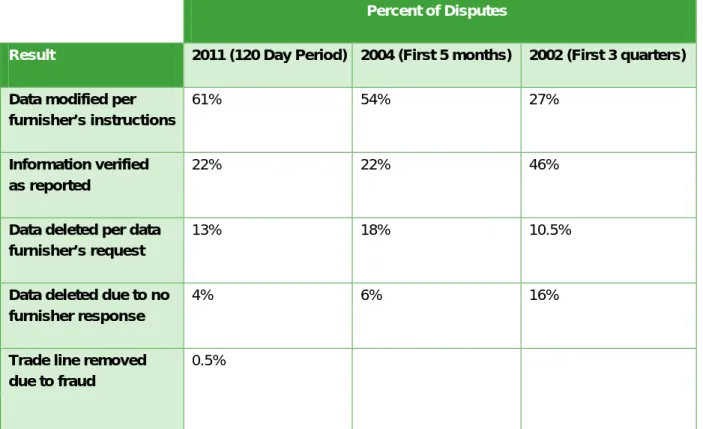
• The NCRAs have created an automated system for handling consumer disputes and forwarding them to data furnishers. Through this automated system – called e-OSCAR – the NCRAs provide furnishers with one or two numeric codes indicating the nature of the consumer’s dispute and in a minority of cases (26%), explanatory text. At present, the NCRAs generally do not forward documentation that consumers submit with mailed disputes or provide a mechanism for consumers to forward supporting documents when filing disputes online or via phone. The NCRAs resolve an average of 15% of trade line disputes internally (without furnisher involvement) and refer the remaining 85% of the disputes they receive from consumers concerning trade lines to data furnishers through e-OSCAR. The furnisher of the disputed data is then required by the FCRA to investigate the dispute and report back to the NCRA.
• The NCRAs’ reliance on furnisher responses as the principal means of resolving disputes is a source of controversy. The NCRAs report that in seeking to maximize accuracy and in resolving disputes, they rely on furnishers meeting their obligations under the FCRA to report information accurately and to respond to disputes
appropriately. Consumer advocates have argued that the NCRAs have an obligation to monitor and manage furnisher practices as part of their broader obligation to achieve credit report accuracy.
• While the measurement of credit report accuracy and the level and causes of inaccuracies present challenges, periodic measurement of credit report accuracy holds promise for establishing baseline accuracy levels and measuring
1. Introduction
In most of the markets for consumer credit, including credit cards, auto loans, mortgages, and student loans, lenders use credit reports as part of their evaluation of a consumer’s application for credit. Companies use credit reports and credit scores derived from the information in credit reporting files to assess a consumer’s likelihood of repaying the loan. Credit reports and scores can be delivered in real time, permitting instant decisions at retailers, auto showrooms, or online. Lists of consumers derived from credit reports are used to make offers of credit. Underwriting processes stipulated by the FHA, VA, Fannie Mae, and Freddie Mac require mortgage lenders to obtain credit reports from a nationwide credit reporting agency (the NCRAs) before these federal agencies and government-sponsored enterprises will insure, guarantee, or purchase their loans. For each of these forms of credit and origination channels, credit reports are used by lenders to help set interest rates and other key credit terms, or determine whether the consumer is offered credit at all. Of 113 million credit card and retail card accounts, auto loans, personal loans, mortgages, and home equity loans originated in the United States in 2011, the vast majority of approval decisions used information furnished by credit reporting agencies.2
Credit reports also are used in spheres of decision-making beyond eligibility for credit. These include eligibility for rental housing,3 setting premiums for auto and other property and casualty insurance where
permitted by law,4 and establishing (along with prior account history) eligibility for checking accounts.5
When an individual applies for a job, a prospective employer may examine his or her credit report upon the individual’s authorization.6 A recent survey by the Society for Human Resource Management of its
membership database found that almost 60% of its member employers used credit reports to screen applicants for at least some of their positions.7
Because of the widespread use of credit reports – often along with credit scores derived from them – in major personal financial decisions, the accuracy of reports has remained an ongoing policy concern. In a 2007 report on credit scores used in lending decisions, the Federal Reserve Board noted the importance of accurate credit reports: “for the full benefits of the credit-reporting system to be realized, credit records must be reasonable, complete, and accurate.”8 Credit scoring models depend on the credit information
contained in consumers’ credit files to be accurate to effectively predict a consumer’s relative risk of delinquency. Inaccurate credit information may cause credit scoring models to understate or overstate a consumer’s credit risk to lenders. Accurate credit information helps decision makers predict certain risks effectively, while inaccurate credit information in credit reports has the potential to compromise the effectiveness and consistency of decisions that rely on them, and the potential to cause material harm to affected consumers. Ultimately, consumer and business confidence in decisions based on credit reports and scores derived from them depends on confidence in the accuracy of the credit information they contain.a
When the FCRA passed in 1970, key provisions of the law focused on assuring the accuracy of credit reports. These key accuracy provisions of the FCRA remain as important today as when the law first passed. They address the quality of data in credit files by requiring credit reporting agencies to establish “reasonable procedures to assure maximum possible accuracy” of their credit reports.9 The FCRA also
includes a number of other provisions that relate to the information in consumer reports such as limits on the period of time during which certain pieces of adverse information can generally be included in a consumer report.10
Credit report accuracy relies on an ongoing ecosystem involving the interaction of NCRAs and other consumer reporting agencies, furnishers of information, public record repositories, users of credit reports, and consumers. An understanding of how this ecosystem operates – including the basic “plumbing” of data flows, the various participants involved, and the economic incentives each group of participants may bring to their respective roles – is foundational knowledge in considering technical and policy options for improving and assuring credit report accuracy.
This paper focuses on the databases of the three largest NCRAs – Equifax, TransUnion, and Experian. It seeks to depict technical processes involved in the collection, screening, and correction of credit information and their broad impact on the accuracy of information provided in credit reports from these NCRAs. It does not seek to characterize or quantify either the general level of accuracy of credit report information, or the harms that may result to consumers affected by credit report inaccuracies. Additionally, the paper does not attempt to weigh the costs and benefits that might be involved in improving the accuracy of credit reports beyond their current levels.
a The issues raised in this discussion of credit report accuracy also generally apply to consumer reports from consumer
reporting agencies as defined under the FCRA. Besides the NCRAs, there are other consumer reporting agencies including the nationwide specialty consumer reporting agencies with rental information databases, check writing/bank databases, medical information databases, insurance claims databases, employment databases, and background screening databases. Each of these specialty databases has its own sources of consumer information. There are also consumer reporting agencies that are not nationwide.
2. Credit Bureaus, Credit
Files, Credit Reports,
and Credit Scores
2.1 Credit Bureaus
The consumer reporting system enables creditors and other providers of consumer services to pool information about their respective customers and use that pooled information to inform their credit and other risk decisions about new applicants and existing customers.
Credit bureaus first emerged in the United States in the late 1800s to support merchant lenders who extended credit to local businesses and individuals.11 At that time, the “credit bureau” consisted of a list of
individuals who had not repaid their debts as agreed and were therefore deemed poor credit risks. Prior to the use of such lists, local merchants extended only very small amounts of credit, and these credit decisions depended largely on the merchant’s direct personal knowledge of the individual borrower’s personal character.
The credit reporting industry grew steadily with growing interest on the part of both consumers and merchants in using credit in purchase transactions. In the 1920s and again in the 1950s, credit bureaus experienced particularly rapid growth with the introduction of retail installment credit and revolving credit accounts,12 in the 1970s and 1980s with the growth of bank credit cards, and in the 1990s with the
automation of mortgage underwriting. By the early 1970s, the industry comprised over 2,250 firms, most with local or regional coverage. As the 1970s progressed, the industry began to consolidate.13 With the
development of computer databases, nationwide credit card issuers, and automated underwriting, the threshold of technological investment required to distribute credit reports increased, as did the importance of offering nationwide coverage. Many of the local bureaus sold their records to the major national bureaus. Today, the consumer reporting landscape includes large national bureaus like the NCRAs; bureaus with credit information such as payday loans, utility and telephone accounts, and other credit relationships; a number of specialized consumer reporting agencies with medical information, employment history, residential history, check writing history, checking account history, insurance claims, and other non-credit relationships; as a well as a few hundred resellers of credit reports.
By 2011, the NCRAs generated U.S. revenues of about $4 billion,14 including revenues from several ancillary
businesses such as the sale of lists and non-credit consumer information for marketing purposes, the sale of credit monitoring services directly to consumers or through resellers, and analytical services that provide credit scores and other modeling tools to creditors.
2.2 The Contents of Consumer Credit Files
For purposes of this paper, credit reports are a form of “consumer report” as defined by the FCRA. Consumer reports generally are communications by a consumer reporting agency “bearing on a consumer’s credit worthiness, credit standing, credit capacity, character, general reputation, personal characteristics, or mode of living” used or expected to be used in determining a consumer’s eligibility for credit or insurance, for employment purposes, or other permissible purposes listed in the statute.15 As defined by the FCRA,the “file,” when used in connection with information on any consumer, means “all of the information on that consumer recorded and retained by a consumer reporting agency regardless of how the information is stored.”16 This paper refers to “credit files” as the information about a consumer that is contained in the
databases of the NCRAs.
2.2.1 File Components
Credit files have some or all of the following components.
1. Header/Identifying Information: The header of a credit file contains the identifying information of the consumer with whom the credit file is associated including an individual’s name (and any other names previously used), current and former addresses, Social Security number (SSN), date of birth, and phone numbers. Not all credit files contain all of these identifying elements.17
2. Trade lines:Trade lines are the accounts in a consumer’s name reported by creditors such as auto lenders, mortgage lenders, or credit card issuers. For each trade line, creditors that furnish information to consumer reporting agencies (referred to as “furnishers” under the FCRA) generally provide the type of credit (e.g., auto loan, mortgage, credit card), the credit limit or loan amount, account balance, the account payment history including the timeliness of payments, whether or not the account is delinquent or in collection, and the dates the account was opened and closed. If more than one consumer is listed as a borrower on a given credit account, the trade line information will appear in both consumers’ credit files ordinarily with information as to the relationship of the consumer to the account, such as authorized user. Trade line information may contain indicators such as whether the account is individual or joint, the account is involved in a bankruptcy filing, the device for accessing the account (e.g., a credit card or PIN) was lost or stolen, and, if closed, the reason for closure (e.g., paid off, closed at the consumer’s request). Credit files do not contain certain terms of the loans or credit lines such as interest rates, points, or fees and do not contain certain performance history such as purchases made using the account or payments made on the account. Additionally, credit reports do not contain information on a consumer’s income or assets.
3. Public record information: The NCRAs’ files include public record data of a financial nature including consumer bankruptcies, judgments, and state and federal tax liens. Records of arrests and convictions generally do not appear on a consumer’s credit file, but other types of consumer reporting agencies, such as employment background screening agencies, include them. Other public records that do not appear in credit reports are marriage records, adoptions, and records of civil suits that have not resulted in judgments.18
4. Collections: Third-party collection items, reported by debt buyers or collections agencies on behalf of a creditor, are considered a separate category on a credit report by at least some of the NCRAs.
5. Inquiries: A consumer’s credit file is required to list every entity that accessed the file in the last two years for employment-related uses and for at least the last year for credit uses and most non-employment uses (e.g., tenant screening, insurance, government licenses or benefits).19 Some of the NCRAs go beyond legal requirements and list
credit inquiries for two years.
The NCRAs have two major classifications of inquiries: “soft” inquiries and “hard” inquiries. Hard inquiries are typically the product of consumer-initiated activities such as applications for credit cards, to rent an apartment, to open a deposit account, or for other services. In contrast, soft inquiries are generally user-initiated inquiries like prescreening.b Only hard inquiries will appear in credit reports obtained by creditors
and other users.
A consumer’s file also has information on whether the consumer has initiated a security freeze, fraud alert, active duty alert, or filed a consumer statement on his or her file.
2.3 Credit Reports
Credit reports are consumer reports provided by NCRAs or other CRAs to lenders and other users. Credit reports generally contain information in the consumer file that is reportable to the end user.
The FCRA limits with some exceptions how long a credit bureau can communicate certain adverse information in a credit report.20 Many adverse items including records of late payments, delinquencies, or
collection items typically stay on a credit report for up to seven years.21 Likewise, civil suits and civil
judgments typically stay on the report for no more than the longer of seven years or the governing statute of limitations, while paid tax liens typically cannot be reported more than seven years after the date of
payment.22 Credit reports generally cannot list bankruptcies for more than 10 years after the order for relief
or date of adjudication, except that repayment plans are only reported for seven years.23 There are also
restrictions on communicating a medical service provider’s name, address, and telephone number pertaining to medical debts in a credit report.24
b The NCRAs treat other types of inquiries as soft inquiries based on business rules – certain insurance inquiries,
utility, and government inquiries relating to licenses or government benefits may be categorized as soft, depending on the business rules for that entity. Employment inquiries are commonly placed in the soft inquiry section. Each listed inquiry will include the date and type of inquiry (e.g., by consumer, review of existing account, for pre-screening). Federal Trade Commission and the Federal Reserve Board, Report to Congress on the Fair Credit Reporting Act Dispute Process, at 4 (August 2006).
Users vary in how they evaluate credit reporting information. For users who view reports for employment purposes, the NCRAs provide a modified credit report, which removes birth date and other information that is sensitive in the employment context and does not include credit scores. Financial services users rely on credit reports as well as proprietary or third-party algorithms – “scoring” models – to interpret the information in a credit report. These algorithms use variables or “attributes” derived from the credit report.
2.4 Credit Scoring
The NCRAs deliver credit reporting information to users in standardized electronic formats so that lenders’ underwriting systems can use reports from more than one bureau interchangeably and so that analytical credit risk models used by the lenders can identify and retrieve relevant pieces of information. More often than not, a credit bureau will also deliver a credit score calculated from the information in a credit report along with variables derived from the credit report (often called attributes). 25 The lender will pay the bureau
a fee for the credit report information and an additional amount for the score. The model used to generate the credit score is selected by the lender as the user.
Lenders use credit scoring systems to assess the relative risk of consumers going delinquent on a loan. For most credit scoring models in use today, the higher the numerical value of a credit score, the lower the credit risk of a consumer. Consumers with very high scores thus are likely to get more favorable interest rates and other more favorable loan terms. In contrast, consumers with lower numerical scores present higher risks of default and may only be able to get loans at higher interest rates or other less favorable terms, if lenders are willing to lend to them at all.
Large national lenders have widely used credit scoring since the 1970s to inform their loan underwriting.26
The NCRAs did not start providing credit scores based on credit bureau data until the late 1980s. In the late 1980s, one bureau built a bankruptcy prediction model. Models supplied by Fair Isaac Corporation (FICO) for use with credit bureau data appeared in 1990 and 1991. Today, scores using models supplied by FICO account for a substantial majority of third-party generic credit scores purchased with credit reports by financial institutions for loan origination decisions.27 In 2006 the NCRAs formed a joint venture,
VantageScore, which offers competing scoring solutions. Additionally, the NCRAs and other third-party development companies develop both generic and custom scoring models. Many lenders also develop and use proprietary scoring models derived from credit report information.
The most common credit scores rank the relative probability that a consumer will become 90 days
delinquent on a new loan within two years. There are a wide variety of credit scores offered by the NCRAs that vary by score provider, by model, and by target industry.28 FICO, alone, has 49 different scoring
models.29 Regardless of the version, credit scoring models tend to share common “attributes” derived from
credit reports, such as a consumer’s bill paying history (e.g., on time, delinquent, in collections), the number and type of credit accounts a consumer has (e.g., bank cards, retail credit cards, installment loans), the amount of available credit that a consumer is using, how long a consumer has had a credit account, and recent credit activity, including inquiries.
Creditors use credit scores to enhance the efficiency and consistency of credit decisioning.30 Credit scores
may also reduce the possibility of subjective decision making by lenders based on impermissible factors under fair lending laws such as the Equal Credit Opportunity Act (ECOA), like marital status, age or national origin. The Federal Reserve noted in its 2007 study on credit scoring, “By providing a low-cost, accurate, and standardized metric of credit risk for a pool of loans, credit scoring has broadened creditors’ access to capital markets, reduced funding costs, and strengthened public and private scrutiny of lending activities.”31
Some have argued that credit scores derived from credit reports have the potential to reinforce the effects of discrimination. They argue that where lending discrimination occurs, minority and other disadvantaged borrowers can wind up in credit products that make default more likely. As a result of higher default rates, their credit reports and scores depict them as bad credit risks, when in fact they would have performed better if they were in better, less expensive products.32
NCRAs can deliver credit reports and scores (using proprietary or third-party models) to those authorized to access a credit report instantly upon request. This makes it possible for lenders to grant instant credit in venues where obtaining credit is often an important part of a consumer’s purchase decision, such as at an auto dealer or a department store. Additionally, incorporating the use of credit scores as a factor in underwriting has enabled the government-sponsored entities, Fannie Mae and Freddie Mac, to introduce automated underwriting systems that allowed mortgage originators to streamline the mortgage underwriting process and provide rapid mortgage approvals.
Because credit scores are derived from the information in credit reports, inaccuracies in credit report information can affect consumers’ credit scores. Some inaccuracies matter more than others. An error in a consumer’s address, the misspelling of a maiden name, or other errors in the consumer’s identification information are generally unlikely to have an impact on a consumer’s credit score or perceived credit worthiness by lenders. However, a public record that inaccurately indicates a consumer is subject to a tax lien, or a trade line that incorrectly states a consumer had a severe delinquency, could cause a lender to deny credit to a consumer altogether, or to treat a consumer it would otherwise consider eligible for a loan at prime interest rates as only eligible for sub-prime rates, costing the consumer thousands of dollars in interest.
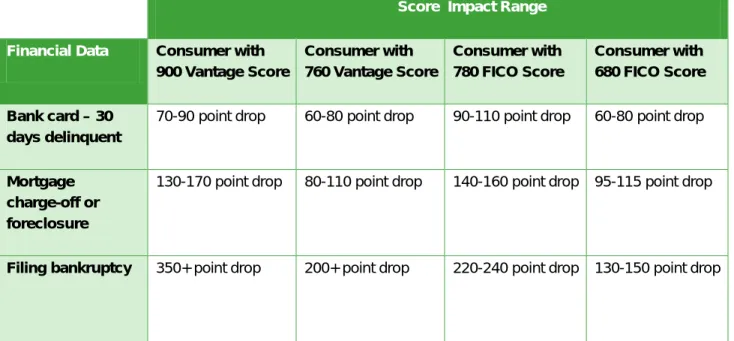
Below is a table showing how credit scores may be affected when specific adverse information appears in a credit report using different starting scores from VantageScore and FICO, two credit score providers. FICO scores generally have a range of 300 to 850, while Vantage scores range from 501 to 990. It is worth noting that these score impacts are hypothetical, and that the impact of an adverse event in any individual’s case varies by the unique characteristics of that consumer’s credit history, including the number and timing of such events.
FIGURE 1: EXAMPLE SCORE IMPACTS
Score Impact Range Financial Data Consumer with
900 Vantage Score
Consumer with 760 Vantage Score
Consumer with 780 FICO Score
Consumer with 680 FICO Score
Bank card – 30 days delinquent
70-90 point drop 60-80 point drop 90-110 point drop 60-80 point drop
Mortgage charge-off or foreclosure
130-170 point drop 80-110 point drop 140-160 point drop 95-115 point drop
Filing bankruptcy 350+ point drop 200+ point drop 220-240 point drop 130-150 point drop
Sources: VantageScore: Sara Davies, Introduction to the VantageScore Model, Ways Consumer Credit Scores Are Impacted and Methods for Score Improvement, Presentation at the Symposium on Credit Scoring and Credit Reporting at Suffolk University Law School (June 6, 2012). FICO: http://www.myfico.com/crediteducation/questions/Credit_Problem_Comparison.aspx.
Other than credit scores, the NCRAs also provide lenders with analytical models using credit report data. These include models that predict the likelihood of accepting a credit offer, of future account utilization, of consumers leaving an existing account, or of collectability on an outstanding debt.
3. Furnishers and Users
In addition to the NCRAs and other CRAs, the most important participants in the credit reporting system are furnishers,users, and consumers. All of these participants have defined roles with specific obligations under the FCRA.
Most furnishers of credit information to NCRAs are creditors who are also users of credit reports. Public records (e.g., judgments, bankruptcy filings, tax liens) are also important sources of information for NCRAs. Figure 2 below is a simplified diagram of the information flows in the credit reporting system.
FIGURE 2: THE CREDIT REPORTING SYSTEM
3.1 Trade Line Furnishers
Each NCRA has a consumer database with over 1.3 billionactive trade lines.33 Financial institutions furnish
the bulk of these trade lines. Approximately 40% of all trade lines of an NCRA’s files are bank card trade lines. Of the remaining trade lines, 18% came from banks that issue retail cards, 13% are accounts in collection reported by collections agencies and debt buyers, 7% from the education industry,c 7% from sales
finance providers (e.g., closed-end loans including auto loans), 7% from mortgage lenders or servicers, 4% from auto lenders, and 4% from other unspecified creditors.34
While the NCRAs receive trade lines from approximately 10,000 furnishers, a small number of very large institutions (typically with multiple lines of business) supply a majority of trade lines. For the NCRAs, the top 10 furnishers provide approximately 57% of the trade lines, the top 50 furnishers provide 72% of the trade lines, and the top 100 furnishers provide 76% of the trade lines in their databases.35 The institutions’
credit offerings can include bank credit cards, retailer credit cards, auto loans, student loans, and mortgages.36 Other furnisher industries, such as collections agencies, tend to be more fragmented.37
Furnishers typically report trade line updates monthly in batch files transmitted electronically to one or more of the NCRAs. Most of the largest furnishers report all or nearly all of their trade lines to each of the largest NCRAs.d These updates generally include changes in balances owed, whether or not payments were
received, changes in available credit lines (in the cases of revolving credit card accounts), and the status of the account (e.g., current, 30+ days late, 60+ days late). The NCRAs provide a standardized data format, called Metro 2, which most of their furnishers use to submit data.e
c Education furnishers are comprised of furnishers from business education schools, colleges, private educational
lenders, technical education universities, vocational and trade schools, and government furnishers including the Department of Education and federal student loan servicers.
d The NCRAs do have some variations in their source data. Some smaller banks and many debt collection agencies do
not send information to all three of the largest NCRAs. See Federal Trade Commission and Federal Reserve Board,
Report to Congress on the Fair Credit Reporting Act Dispute Process, at 5 (August 2006). .
e Innovis, a credit bureau, also is a participant in the Metro reporting system. It offers portfolio management solutions,
3.1.1 Furnisher Incentives and Disincentives
Reporting to credit bureaus and other consumer reporting agencies by creditors is voluntary and historically has been. Not all creditors report information about their borrowers. Some creditors report information about users of some of their credit products, but not others. For example, credit card issuers who issue revolving credit to consumers usually report trade line information monthly on consumer cards but are less likely to report on small business cards even when these are owed by, and underwritten based on, the personal credit history of the business owner.
Furnishers have multiple incentives to contribute data to the NCRAs. Individual contributors recognize that the cross-company, cross-industry visibility into credit risk offered by a credit bureau depends on widespread creditor participation. If a company elects not to contribute data, it runs the risk that its peers will not contribute data, thus reducing a common resource from which creditors benefit. As indicated above, most furnishers of trade line information to the NCRAs are also large users of credit reports. A second reason creditors furnish information on their accounts is to maintain an incentive for their borrowers to make timely repayments. Consumers are more likely to repay creditors if they are aware that a creditor may report late payments or delinquent accounts to the NCRAs, which could negatively affect their credit history and/or credit score. Consumers also get the benefit of having their timely payments reported, which will positively impact lenders’ views of their credit worthiness.
There are also disincentives for creditors to report on their borrowers to the NCRAs.38 For example, the
names of individuals who borrow and make loan payments on time may be included in prescreened lists that NCRAs and other CRAs sell, providing these borrowers with account offers from competing lenders. Reporting to one or more of the NCRAs may require investment in specialized information systems. Further, data furnishers must follow FCRA requirements such as investigating disputes submitted directly39
or indirectly through the NCRAs. Since furnishing data is voluntary, furnishers must consider whether the overall benefits of furnishing outweigh its costs.
3.1.2 Reporting Format
CDIA developed the Metro 2 guidelines in 1997, on behalf of the NCRAs and Innovis, as their standard for the electronic reporting of consumer trade line information. Metro 2 replaced the original Metro format developed in the late 1970s.40 The format forms the basis by which furnishers provide updates on their
borrowers’ account status in bulk file submissions to one or more of the NCRAs, generally on a monthly basis. An obvious benefit of a shared data format is that all furnishers can report trade line information the same way. This simplifies the creation of standardized credit files by each of the NCRAs and simplifies the interpretation of credit information into risk-based credit scores.
Each Metro 2 electronic file submission has a furnisher header record, a series of base records on each borrower, supplementary records describing updates to the furnished trade lines, and a trailer record. A description of the various types of record segments and the information that Metro 2 allows furnishers to provide is offered below.
• Metro 2 Header and Trailer Records: Header and Trailer records form the
bookends of a Metro 2 file submission. The header record is the first record provided in the Metro 2 file submission and is used to identify the furnisher and the activity period. It also contains the furnisher’s unique identifier at the NCRA receiving the
file, the activity date, name, address, and other contact information for the furnisher. Note that this type of header record should be distinguished from the header record on a consumer file maintained by an NCRA that has the consumer’s personal identification information. The trailer record, meanwhile, is the last record in a furnisher’s Metro 2 submission. It includes the sum totals of all the base and supplementary segments submitted.
• Base Segment: The Base segment is used to identify the primary borrower and to provide relevant account information for each trade line. Identification information for the borrower includes first, middle, last name, suffix, generation code, phone number, address, SSN, and date of birth. Account information includes account type (e.g., revolving, installment, mortgage), credit limit, highest credit or original loan amount, duration of credit extended, frequency with which payments are due, account status,f stage of delinquency, date of first delinquency, and date the account closed and
conditions under which it was closed (e.g., closed by consumer, paid full amount due, closed by creditor and paid less than full amount). Additionally, the Base segment contains up to 24 months of the consumer’s payment history on the account. Contrary to a frequent assumption, the Metro 2 format does not contain fields for interest rate information on particular loans or revolving accounts.
• Supplementary Segments: Depending on the furnisher and the type of trade line, the furnisher may have additional data segments to supplement the data in the base segment. These include:
o Associated Consumer Segment: Contains information on consumers who are associated with a credit account besides the primary user, including name, SSN, date of birth, telephone number, and the relation of the consumer to the account. Associated consumers can include authorized users, guarantors,
persons with joint contractual liability, or others. o Original Creditor Name Segment: Has the name of the original credit
grantor, which is necessary to link a consumer debt to the original creditor even after it is outsourced to a third-party collection agency.
o Segment for Accounts Sold to/Purchased from Another Company: Used to report the name of the companies which respectively bought and sold a portfolio of consumer debt.
o Mortgage Information: Used to report any Fannie Mae or Freddie Mac loan number associated with a mortgage account.
o Specialized Payment Information: Has information on deferred payments or balloon payments, if applicable.
o Account Number/Identification Number: Used to report new identification or account numbers.
f Account status reflects the current or final disposition of the account. If the account is delinquent, Metro 2 allows
furnishers to report the level of delinquency such as 30-59 days past due, 60-89 days past due, and up to 180 days or more past due. Where the account is closed, a furnisher can report whether the account closed with a zero balance, was a voluntary surrender, closure surrender, repossession, charge-off, or entered into foreclosure.
o Employment Segment: Contains employment information on the primary borrower, which may come from the consumer’s application for credit or from employment information that the creditor obtained in approving the account.
The Metro 2 format specifies that base segments be reported for each account submitted. Supplementary segments are reported when relevant to the particular trade line or other data that is furnished.
3.2 Public Record Collection
While the NCRAs rely on a multitude of furnishers to supply creditor trade line information, they also receive public records including bankruptcy records, civil court monetary judgments, and government tax liens from publicly available government sources. They obtain these records primarily through LexisNexis Risk Data Retrieval Services LLC (LNRDRS). The use of LNRDRS followed the NCRAs’ decisions to move from direct collection from hundreds of sources and suppliers to a single data retrieval vendor. The NCRAs report they do not use criminal records in their credit reports. Rather, the NCRAs utilize public records representing derogatory items in their credit files. Derogatory is defined as negative information that will likely hurt a consumer’s credit (e.g., late payments, collection accounts, foreclosures, civil judgments).41 While each NCRA has its own criteria, public records are generally removed from credit
reports once the reportable event becomes obsolete (between seven and ten years depending on the type of information and the applicable statute of limitations).
3.2.1 LNRDRS Data Retrieval
LNRDRS retrieves and sends to each of the three NCRAs between 10 and 20 million public record events per year (roughly one third of which are bankruptcies, tax liens, and civil monetary judgments
respectively).42 All bankruptcy records are pulled electronically from the PACER system, an electronic
public access service that allows users to obtain case and docket information from federal appellate, district and bankruptcy courts. Monetary judgments and tax liens are obtained from 10,000 to 12,000 state and local courts and county and state government offices. LNRDRS reports it obtains information on 30% of judgments and liens electronically. For the remaining 70%, LNRDRS deploys a network of independent contractors who manually access public records at government sources and type the local records into a proprietary software system, which screens for duplicates and minimizes typographical errors. A single record collector can typically record approximately 200 events in a day.
In retrieving records for the NCRAs, LNRDRS provides the data in its “raw” form. The NCRAs undertake the responsibility of assigning records to particular consumer files, and adjusting matching criteria for possible errors. Assignment of a court record to a particular consumer can be challenging for the NCRAs because, according to one estimate, SSNs appear on court records only 3% of the time.
4. Furnisher and Data
Screening
The NCRAs employ a number of methods to screen furnishers and incoming information for inaccuracies and anomalies. This section examines the vetting and approving of furnishers and various quality screens performed on data files received from furnishers. These methods focus on identifying formatting errors, logical errors, internal inconsistencies, and anomalies.
4.1 New Furnisher Screening
The NCRAs’ data quality processes start with their screening of new furnishers.
The NCRAs report that a prospective furnisher can initiate a relationship with them by sending a letter of intent to furnish. Due to the resource and economic costs associated with adding a furnisher, the NCRAs will generally require prospective furnishers to report a minimum of 100 to 200 active accounts per month.43
Each NCRA reportedly puts prospective furnishers through an initial security screening. Screening generally includes an inspection of features of each business such as its physical headquarters, phone number, website, and business license, as well as company records such as annual reports. Individual NCRAs also may hire third-party investigation services to screen for illegal or unethical business history. Sole proprietorships and new businesses (e.g., in business less than a year) may receive more specialized screening. An NCRA may require the furnishers to submit test files which it will examine to make sure they are Metro 2 compatible. Approved furnishers are trained on Metro 2.
After these initial inspections, NCRA policies may trigger reinspections after risk events such as consumer complaints, suspicious trade lines, variations in data submissions, odd anomalies, and changes in company ownership. At least one NCRA has policies to reinspect new furnishers six months after they start submitting data to assess for data quality and fraud risk.
The NCRAs report that they continue to monitor for data quality and fraud once a furnisher starts contributing live trade line data. One example of furnisher fraud is when a supposed credit repair
organization represents itself as a furnisher and attempts to boost the credit scores of consumers with bad credit by reporting fictitious trade lines that the consumers purportedly used and paid back on time. Overall, the objective of furnisher screening is to reduce the risk of fraud or of poor data quality by
screening out furnishers whose systems are not able to report accurate data on customers or report it in the Metro 2 format.
4.2 Checking Furnished Data
Having passed this initial screening, furnishers can start providing data. Furnishers generally provide monthly trade line updates through data file transfers that conform to the Metro or Metro 2 format and contain trade line updates on all of the furnishers’ active accounts. All new furnishers are being added under the Metro 2 format, which was first introduced in 1997. Data submitted by a furnisher to an NCRA
generally goes through a multi-stage process to identify data irregularities.
Typical data quality checks will identify issues such as blank fields or logical inconsistencies in the data – both at the level of the data file and at the individual consumer’s trade line. If a furnished account is reported as closed, and then in a subsequent data feed the furnisher reports a new account balance, the NCRA might flag that inconsistency. Other inconsistencies might be account balances higher than the maximum credit line, duplicate instances of information on the same account being furnished, or data patterns inconsistent with the furnisher’s historical pattern of transactions. It is not uncommon for furnishers’ bulk files to be initially rejected by the NCRAs.44 The NCRAs report that furnishers tend to
correct most of the problems causing the file rejection, leaving only a small percentage of files permanently rejected. Some data rejections might not result from an error in the data but from format incompatibility when the furnisher uses the wrong codes to update accounts, or the furnished data shows unfamiliar formats because of system changes at the furnisher.
Within file submissions, individual consumer base records and tradeline updates are similarly screened for formatting errors, logical errors, internal inconsistencies, and anomalies. The rejection rates for incoming trade line data from furnishers appear to vary across multiple dimensions (e.g., by individual furnisher, by furnishing industry, by the NCRA receiving the data). For example, submissions from collections agencies tend to have a higher rejection rate than rejections for credit card trade lines.45
While the NCRAs’ data screens do find errors by identifying anomalies and inconsistencies, these checks rely on underlying furnisher data to be valid. The NCRAs do not conduct independent checks or audits to determine if the data is accurate, such as contacting a consumer to ask if she is properly associated with an account or if the balance reported on an account is true, or checking the record-keeping practices of a furnisher. The NCRAs generally rely on furnishers to report information on consumers that is complete and accurate.
4.3 The Furnisher Rule
In 2009, the Federal Trade Commission, the Federal Reserve Board, the Federal Deposit Insurance
Corporation, the National Credit Union Administration, the Office of the Comptroller of the Currency, and the Office of Thrift Supervision issued a joint rule (“Furnisher Rule”) implementing the accuracy and integrity and direct dispute provisions for furnishers mandated by the Fair and Accurate Credit Transactions Act (FACTA).46 The CFPB has since restated this rule.47
As a result of FACTA and the Furnisher Rule, furnishers have enhanced obligations to supply accurate data. Each furnisher is required to “establish and implement reasonable written policies and procedures
concerning the accuracy and integrity of the information it furnishes to consumer reporting agencies.”48
The procedures should address “deleting, updating, and correcting information in the furnisher’s records, as appropriate, to avoid furnishing inaccurate information.”49 The procedures must be appropriate to the
“nature, size, complexity, and scope of each furnisher’s activities.”50 Appropriate procedures include using
standard data reporting formats, maintaining records for a reasonable period of time, providing appropriate oversight of service providers (e.g., companies that provide core processing systems or software used for recordkeeping and account management), furnishing information in a way that prevents re-aging,g
duplicative reporting, association of information with the wrong consumer, and providing sufficient identifying information about consumers.51
g Re-aging in this context refers to erroneously extending the reporting period of derogatory consumer information by
creating a new, later start date when the derogatory event occurred, thus pushing back the clock for removing the derogatory item from the credit report.
5. Compiling Credit Files:
“Matching”
Once the NCRAs have received trade line information from a furnisher they must assign it to a specific consumer’s identity. Each of the NCRAs has over 200 million active files on individual consumers which are non-duplicative within the particular NCRA.52 The average credit file contains 13 past and current credit
obligations, including nine bank and retail cards and four installment loans (e.g., auto loans, mortgage loans, student loans).53 In a typical month, an NCRA receives updates on over 1.3 billion trade lines.54 With this
much information included in and added to their databases, the NCRAs face technical and operational challenges in attributing information to the proper consumer’s file.
5.1 Identifying the Correct Consumer
To locate and identify a consumer, NCRAs will use various combinations of personal identifying information such as name, address, phone number, date of birth, address, and SSN. A given trade line reported by a furnisher may not contain all of this identifying information. Typically, the furnisher reports the personally identifying information that was provided by the consumer in the consumer’s original
application for credit or through updates (such as for current address or married name) that a consumer may provide in the course of his or her relationship with the furnisher.
The fact that many consumers have the same or similar personal identifiers presents further challenges when a credit bureau tries to match an incoming trade line with the correct consumer’s file. In the United States, according to 2000 census figures (the most recent to have last name statistics available), there are more than 2.3 million Americans with the last name of Smith, 1.8 million Americans with the last name of Johnson, 1 million Americans with the last name of Davis, 850 thousand Americans with the last name of Garcia, and 600 thousand Americans with the last name of Lee.55 As one example, consider the matching challenges
posed by relatives with same first and last name, but different middle names, who reside at the same address, and who do not regularly use their middle name when applying for credit.
Adding to the complexity, millions of individuals change how they identify themselves over time or between furnishers. Each year, a sizeable number of Americans change their name through marriage and divorce. Separately, consumers do not necessarily refer to themselves consistently in credit applications. For
example, a woman named Elizabeth may use her full name on one application and then refer to herself with a nickname “Betty,” “Beth,” “Liz,” or “Eliza” on another credit transaction. Finally, creditor practices may vary as to the personally identifying information they require in their loan or credit applications, with the result that the criteria one creditor uses to identify a consumer in a trade line update may vary from how another creditor identifies him or her.
5.2 Posting and Organizing Account
Information in Consumer Files
Once a trade line has passed the NCRAs’ initial vetting and screening, the NCRAs assign or post that trade line to the credit file of a specific consumer if they believe there is a match. As discussed below,
inaccuracies may result from this process.
The manner in which each NCRA posts incoming data to a consumer’s file, and the way its files are
organized, depends on the particular structure of its database, or its unique “data architecture.” The NCRAs take two different approaches to organizing personal data in their data networks: (1) flat file system and (2) “PINning” technology.
5.2.1 Flat File Systems
At least one NCRA organizes its database like a traditional flat filing system so that each consumer is linked to one file.56 Consumers’ files are distinguished through matching logic using a consumer’s personal
identifiers such as name, address, SSN, and date of birth. Multiple or fragmented files can occur for a single person when information is reported with different identifying information such as a different last name. Fragmented files on the same consumer will remain distinct until the NCRA receives new information about the fragments (e.g., a unifying name, address, phone number) that indicates they should be combined. In some cases, matching algorithms will assign the trade line to a file that, according to the algorithm,
represents the best match even when all of the identifiers do not match up perfectly, or when only a limited number of identifiers are contained with the trade line.
5.2.2 PINning Technology
Another method uses a unique personal identification number (PIN) to organize consumer files.57 Instead
of having a single file for each consumer, it uses the consumer’s assigned PIN to link information on the consumer from multiple databases including inquiry, trade line, employment, public record, and address databases. Each furnished trade line data element, inquiry, or public record is entered into the network with an associated PIN in a relational database. PINs are assigned to trade lines based on algorithms that find the consumer that best matches the personal (header) information accompanying the trade line. When a consumer report is requested by a creditor or a consumer requests a credit report, the NCRA assembles the consumer report in real-time using the PIN as the central link to the different databases.
In this system, matching algorithms are used to assign a new incoming trade line or public record to the PIN that represents the best possible fit based on the personally identifying information associated with the trade line.
6. Inaccuracies in Credit
Files and Credit
Reports
Given the volume of data handled, the challenges of matching tradelines to the correct consumer files, and the number and variety of furnishers, inaccuracies in some credit files inevitably occur. Inaccuracies in credit files and credit reports can occur where information that does not belong to a consumer is attached to his or her file, where information belonging to a consumer is omitted from the file, or where there are factual inaccuracies in trade line or other information in the consumer’s file. Some of these inaccuracies can be attributed to matching challenges in assigning a trade line to a consumer’s file. Other causes of
inaccuracies include data and data entry errors, NCRA system or process inaccuracies, furnisher system or process inaccuracies, identity fraud, or time lags.
6.1 Types of Inaccuracies in Credit Files and
Reports
The following are among the types of inaccuracies that appear in credit files and the reports derived from them.
• Inclusion of accounts or records in a credit file that do not belong to the consumer, commonly called a mixed file: Credit reports can contain trade lines or public records about a consumer other than the one who is the subject of the credit report.
• Omission of accounts or records belonging to the consumer: A credit account or public record that belongs to the consumer’s file can be erroneously placed in another consumer’s file, leading to a mixed file, as described above.58 Alternatively, credit bureau
matching algorithms or gaps in data can lead to a consumer trade line being kept separate from the rest of the consumer’s file.
• Trade line or record inaccurately represents information pertaining to the consumer’s account with the creditor: A credit file can inaccurately depict the terms and status of a valid account such as inaccurately depicting the date an account was closed, the credit limit for the account, or whether a trade line is delinquent. Similarly, a collection item on the report may inaccurately reflect the payment status of the debt or the amount of money owed.
It is worth noting that in some cases consumers are mistaken about the presence of inaccuracies in their account. For example, a consumer may believe he or she paid a bill when it was not paid. A consumer may believe that paying an item in collection removes the collection history from one’s credit report, which it does not. A consumer may believe he or she paid an account on time, when under the terms of the account, it was late. Or a consumer may simply not recognize a trade line even though it is legitimate.
6.2 Causes of Credit File Inaccuracies
The inaccuracies identified in Section 6.1 can come from a variety of causes.• Data and data entry errors: Furnishers can input accurate consumer information incorrectly or make typographical mistakes (e.g., transposing two digits in an SSN, misspelling names, transposing first and middle names).59 Consumers (when applying
for a loan) can provide inaccurate data to furnishers. For both of these types of inaccuracies, the credit bureau could pass along the inaccuracy to the consumer’s file. Data errors can also lead to file matching problems by causing the bureau to put the trade line into a separate or “orphan” file distinct from the consumer’s original credit file, and thus not include it in the consumer’s credit report. Alternatively, data
inaccuracy could cause a consumer’s trade line to be mixed in with another consumer’s file (e.g., when the mistake causes the consumer’s header information to match or resemble the identity of another consumer).
• Bureau file matching inaccuracies: Inaccuracies can occur when a bureau assigns a trade line to a consumer’s file or when it determines the credit file that matches the consumer named in a creditor inquiry. A matching error can occur for a variety of reasons.
o Matching errors may result from creditor inquiries and trade lines that contain a limited set of identifiers relating to the consumer. For example, a lender inquiry may omit information such as date of birth or SSN.
o Family members with similar identity information such as fathers and sons with common names (e.g., Jr., Sr.) can experience commingling of files, especially if they reside at the same addresses and distinguishing information is not provided.
o Unrelated individuals with similar names and identity information get linked together because a name or SSN is incorrectly inputted.
In some cases, when a consumer changes personal information (e.g., his or her name) the bureau will be unable to match the new trade line to an existing file until the bureau has confidence that the new information belongs to the existing consumer. A common example occurs when a consumer changes names after getting married or divorced.
Until the bureau can link the individual pre- and post- name change, that individual’s information might reside in two different files.
• Bureau process errors:An example of a process error would be if a credit bureau failed to prevent the reappearance in a consumer’s credit report of inaccurate data that was removed as a result of a consumer dispute reinvestigation. Such errors can occur despite the bureau maintaining procedures to permanently remove or suppress identified inaccuracies as required by the FCRA.60
• Identity fraud/theft: Identity thieves can compromise a consumer’s credit history by creating new credit, utility, or health care accounts in the consumer’s name and then letting them go unpaid. As these accounts go delinquent and are pushed to collections, the consumer victim’s credit rating can plummet. Fraudsters may also take over existing consumer accounts, often disguising the account theft by changing the billing address of the applicant with the lending institution, or making purchases over the Internet. Additionally, fraudsters can create synthetic identities using an innocent consumer’s SSN or other identifiers like last name and birthdate.61
• Furnisher system or process inaccuracies:Inaccuracies canoccur because of limitations in the processes furnishers and public records providers use in handling consumer transactions. Examples include:
o Attributing ownership to an account on which an individual is only an authorized user;
o Failing to post a payment;
o Assigning a payment to the wrong account;
o Failing to update records (e.g., tax liens or other judgments that are still listed as open even though they have been paid or resolved);
o Failing to permanently change records when a consumer successfully disputes an inaccuracy, with the result that faulty information is re-reported;
o Listing closed accounts as open; o Reporting an incorrect credit limit; and
o Transfering loans from one owner or servicer to another owner or servicer with different record-keeping systems can result in lost data or lost payment records. Furnishers and consumers can disagree on the status of credit accounts (e.g., whether a payment was late). These disagreements can be addressed, if not always resolved, through the dispute processes that consumers have the right to initiate under the Fair Credit Billing Act (e.g., for billing disputes involving credit cards, department store accounts, other open-end credit accounts)62 or the FCRA.
Additionally, certain trade lines may be reported by multiple furnishers over time. Examples include trade lines reported by a debt buyer that were previously reported by a creditor from whom the debt buyer acquired the accounts, or mortgage loans for which the servicing rights were sold from one servicer to another. In these cases, the bureaus not only match the trade line with the correct consumer’s file, but may also determine when the incoming trade line reflects the continuation of a previously reported trade line in the consumer’s file. To facilitate correct depiction of such trade lines over time, the
Metro 2 policy is for furnishers who are new account owners to list the name of the original creditor in file updates. Omission of this information by a furnisher who has bought the debt, and/or failure by account sellers to acknowledge when accounts have been sold, may result in duplicate trade lines in a consumer file.
• Time lags: Differences can occur due to time lags between a consumer transaction and its reporting to a credit bureau file (e.g., paying a past due bill or opening a new
account). Time lags are a significant issue in the updating of public records. According to one industry source, it takes some state courts, on average, two months to transcribe a court judgment into a written court decision.63
6.3 Consumer Impact of Inaccuracies
Each of these types of credit report errors may affect how a creditor or a credit score assesses the credit worthiness of a consumer. Trade line errors can both hurt or help a consumer’s credit score. An omitted current trade line, for example, may lower a credit score. Likewise, a credit score may be unfairly reduced by a negative trade line that belongs to another consumer, or by duplicate trade lines that are treated as two separate credit relationships. On the other hand, if a delinquent trade line was inadvertently assigned to another consumer’s file or if a furnisher incorrectly marked a delinquent trade line as current, the error could help the consumer’s score.
7. Disputing Credit Report
Errors
Recognizing the possibility of inaccuracies, the FCRA gives consumers the right to dispute information they deem inaccurate with an NCRA, a furnisher (in cases covered by the Furnisher Rule), or both. The FCRA requires NCRAs and furnishers to “reinvestigate” information contained in a consumer’s credit file when the consumer disputes its accuracy.64 Further, the statute gives consumers several mechanisms for obtaining
the information contained in their credit files in order to review them for possible inaccuracies. Consumers can get a free credit report, that is, obtain a file disclosure for free, (i) once every 12 months from the NCRAs and nationwide specialty consumer reporting agencies,65 (ii) in connection with risk-based pricing
and adverse action notices,66 (iii) if they are unemployed and intend to apply for employment within 60
days,67 (iv) if they are recipients of welfare assistance,68 (v) if they have reason to believe their credit file is
inaccurate due to fraud,69 (vi) in connection with requested initial or extended fraud alerts,70 or (vii) if
permitted by state law. Consumers can also review their credit files by purchasing them directly or when they receive their credit files as part of a paid credit monitoring service subscription. Consumers sometimes also receive information from reports or copies of reports from a user such as a bank, mortgage broker, or landlord.
The CFPB estimates that as many as 44 million consumers obtained copies of their consumer file disclosure annually in 2010 and 2011 – either as a result of obtaining free annual file disclosures through
annualcreditreport.com (15.9 million);71 through one of many various credit monitoring services (26
million);72 obtaining disclosures directly from the NCRAs after receiving adverse action notices or
risk-based pricing notices (approximately 1 million);73 or from lenders directly or through fraud alerts, requests
based on unemployment or welfare status, and where free under state law (approximately 0.5 million for this catch-all category).74
In 2011, the NCRAs received approximately 8 million consumer contacts disputing the completeness or accuracy of one or more trade lines, public records, or credit header information (identification information) in their files.75h Based on these contacts, the number of credit-active consumers who disputed one or more
items with an NCRA in 2011 ranges from 1.3% to 3.9%. On average across the NCRAs, consumers filed 42% of their disputes online, 44% by mail, and 13% by phone. The remainder of consumers communicated their disputes by fax, walk-ins, or other methods.76 Many of these consumers disputed information about
more than one tradeline or other item in their file, leading to approximately 32 to 38 million dispute reinvestigations.77 This volume has declined significantly since 2007 when consumers were more active in
applying for credit, particularly in the mortgage market. In 2007, a high volume year, the NCRAs received disputes on 47 to 53 million items.78