Implementing a Degree Completion Program at Coastal Carolina University
46th Annual Meeting of Southeastern Chapter of INFORMS Myrtle Beach, SC
October 7-8, 2010 Megan Preis Coastal Carolina University
Department of Management, Marketing, and Resort Tourism PO Box 261954 Conway, SC 29528-6054 USA
843-349-2691, [email protected] Jessica Gunn Coastal Carolina University
Department of Management, Marketing, and Resort Tourism PO Box 261954 Conway, SC 29528-6054 USA
843-349-2691, [email protected] Sean McCawley Coastal Carolina University
Department of Management, Marketing, and Resort Tourism PO Box 261954 Conway, SC 29528-6054 USA
843-349-2691, [email protected] Alyson Smolenski Coastal Carolina University Department of Management, Marketing, and Resort Tourism
PO Box 261954 Conway, SC 29528-6054 USA 843-349-2691, [email protected] Shannon Molloy Coastal Carolina University
Department of Management, Marketing, and Resort Tourism PO Box 261954 Conway, SC 29528-6054 USA
843-349-2691, [email protected] Dr. Michael Latta, Faculty Research Advisor William J. Baxley, Jr. Professor of Applied Research
Coastal Carolina University
E. Craig Wall Sr. College of Business Administration PO Box 261954 Conway, SC 29528-6054 USA
843-349-6476 [email protected]
Michael Latta [Contact]
Undergraduate Student Paper Competition
Implementing a Degree Completion Program at Coastal Carolina University
Abstract
This research project was done to determine what is important to students in deciding whether to transfer or not transfer to CCU in order to complete a Bachelors degree. Data were collected from those who: obtained an Associates Degree from a community college, transferred from another four year school of higher education, or returning to complete an undergraduate degree after previously dropping out. Other objectives were to understand the requirements to enter CCU as a transfer student, and to understand what other majors people are interested in that are not offered at CCU. Qualitative Individual Depth Interviews followed by Quantitative Self-Administered Questionnaires to measure how important 11 transfer policies are and how satisfied students are with those policies. After reviewing the current research, it can be concluded that a degree completion program would benefit Coastal Carolina University and its community members. The program should be designed around weekend and evening classes, easy transfer rules, what jobs in the area are in high demand, offer more internship opportunities and incentives, and allow for flexible time schedules of classes as well as expanding the online class availability.
Introduction
Two trends have been occurring at Coastal Carolina University: Reductions in State of Carolina funding and increasing enrollments. One source of new students that has not been fully tapped is transfer and returning students who represent about 5% of the new students. Consequently a new Department of Admissions Bridge Program was developed to encourage Horry Georgetown Technical College AA graduates to come to Coastal Carolina University to continue their education was developed and a web-based Transfer and Articulation Center was developed by the Commission on Higher Education (www.sctrac.org) to support the transfer of credits from other centers of higher education to Coastal Carolina University, as well as other Four Year South Carolina Universities. At the request of Dr. David Evans, Associate Provost and Director of the Bridge Programs, a research study was completed in the Spring 2010 semester by the Marketing Research class in the Wall College of Business. The objectives were to: determine what is important to students in deciding whether to transfer or not transfer to CCU in order to complete a bachelors degree including students who have obtained an, Associates Degree from a community college, transferred from another four year school of higher education, or who are returning to complete an undergraduate degree after previously dropping out, and to understand what other majors people are interested in that are not offered at CCU.
Method
As part of active learning (Anderson, 1997), the purpose of the team research project in the Marketing Research course was to determine what is important to students in deciding to transfer or not transfer to CCU to complete a bachelors degree after 1) obtaining an Associates Degree
from a community college, transferring from another four year school of higher education, or 3) returning to complete an undergraduate degree after dropping out before graduation. In short, we want to understand the key drivers to Bachelors degree completion at CCU and the barriers to entering CCU as a transfer or former student. The team research project involved two phases: Qualitative followed by Quantitative.
Qualitative
In-depth Interviews (IDIs) were done with equal quota snowball samples of males (30) and females (30) in three segments:
1. AA Degree Recipients (n = 20) 2. Transfer Students (n = 20) 3. Returning Students (n = 20)
Qualitative Interviews Concerning Attitudes
In these individual depth interviews (IDIs), concerning student attitudes were done by asking the following questions:
1.) Why did you transfer to CCU?
2.) Why should there be a tuition repayment program?
3.) Should there be and entrance exam and or placement testing? Why?
4.) Why do you feel there should be a cap on the number of students admitted to CCU?
5.) What other majors should be offered at CCU and why?
6.) If you could design and ‘IDEAL’ Degree Completion Program, what would it look like?
The interview will follow the discussion guide developed in class which appears in the Appendix. Each class member found interview candidates using a snowball approach, asked them the questions, record their answers, and summarized the answers to the discussion guide questions. The team then integrated the interview summaries into the final report including at least 1 verbatim comment from the interviews that supports conclusions concerning each question in the discussion guide. The answers to these questions informed the design and conclusions drawn from the Quantitative survey.
Quantitative Survey Concerning Specific Transfer Policies
Self-administered questionnaires (SAQs) were completed with AA Degree students, transferring undergraduate students, or community members returning to CCU using the same quota system as the one employed in the IDIs. This approach also involved a snowball sample and generated 300 completed questionnaires. The survey instrument is in the Appendix and covered
demographics plus 11 main issues concerning transferring to Coastal Carolina University and degree completion appearing below:
1. Placement Test Required for Transfers to Get Core Classes Credit 2. No Foreign Language Required for Transfers
3. GPA of 2.5 Required for Transfers
4. Forgiveness of Tuition for Transfers Staying in SC After Graduation 5. Impact of Transfers on Value of Four Year Students Degrees
6. Jr. College Transfers Treated the Same as Four Year College Transfers 7. The Number of Transfer Students Should Be Capped
8. A General Business Degree Should Be Offered 9. A Variety of Degrees Should Be Offered 10. Difficulty in Getting Credits Transferred
11. Offering Weekend and Evening Classes to Encourage Transfers, Drop-outs, and Non-traditional Students to Enroll
Each of these 11 issues was measured on a 1 to 5 Likert scale where 1 indicates Not at all Important or Very Dissatisfied and 5 indicates Very Important or Very Satisfied concerning Coastal Carolina’s policy on the issue. Following data collection and analysis of frequencies and crosstabs, BrandMap 7.0 was used to create Importance X Satisfaction Quadrant charts to show where Coastal Carolina needs to improve policies to attract more transfer students.
Summary of Key Findings Qualitative Interviews
Summaries of the main issues covered in the IDIs appear below with supporting verbatim comments from participants.
Community member respondents are interested in a degree completion program because it will allow them to stay close to home while earning a bachelors degree. These respondents also believe a degree completion program will enhance Coastal Carolina University and bring in more out of state students; therefore bringing in more money and attention to the school. Community members who do not want a degree completion program at Coastal Carolina University said that they would like to obtain their bachelors degree in a city or online due to convenience. These respondents had a “no effect” stand on the issue of the value of the degree.
“No harm, no foul”
Everyone was asked about the importance of the requirements to enter the degree completion program and whether or not a placement test should be implemented. All respondents agreed that requirements to get into Coastal were a major factor in the overall image of the school which allows the university to uphold a high academic standing. The placement test was an important factor to those respondents who felt that the tests would help the entering student to place out coursed they have already taken. Other respondents were opposed and said entrance should be based on transcripts alone.
Participants were asked whether or not they planned to stay in South Carolina after college and if an incentive, such as a tuition payback program, would encourage more graduates to stay. Those that claimed they were going to stay local had reasons such as family and prospective jobs. Others said that they planned to attend graduate school elsewhere, had worries about finding a job in the area, or simply had aspirations of moving to a new location.
“It would make more sense to stay, if there were more job’s available.”
Tuition payback changed many of the respondent’s perspectives on staying in South Carolina. Respondents felt that offering a tuition payback program would boost the local economy and decrease the stress of finding a job after college.
“With the unemployment rate so high, it would actually benefit the school to have that as an offer.”
Quantitative SAQs and Maps
In general, studies which focus on policies tend to focus solely on importance of policies or satisfaction with them and do not provide a complete picture of current policies and mission fulfillment. Evaluating importance and satisfaction toward policies are both relevant and need to be considered together. Taken separately, however, it can be difficult to convert such measures into practical strategic responses. The use of Importance-Satisfaction Analysis can help to avoid ‘missing the boat’ and demystify the results in such a way that policy-makers may more easily use the information provided for developing specific policy changes for their organizations.
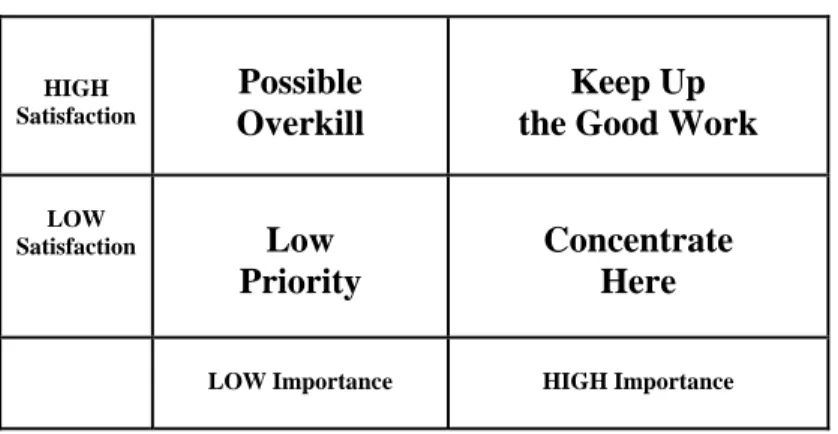
Briefly, Importance-Satisfaction Analysis involves measuring the IMPORTANCE of and the SATISCATION with a policy and then creating a graphical display of the results on a two dimensional (i.e., 2x2) "action grid," such as presented in Figure One. This action grid serves two important purposes. It offers an easily-interpreted visual display of both importance and satisfaction simultaneously. Secondly, and perhaps more importantly, it provides a basis for policy decisions (Chrzan and Malcom, 2003; Martilla and James, 1977; Abell, 1978).
Figure 1: Importance-Satisfaction Action Grid
HIGH Satisfaction
Possible Overkill
Keep Up the Good Work LOW
Satisfaction Low
Priority
Concentrate Here
LOW Importance HIGH Importance
while the left half are those dimensions which are considered of lower importance. The top half of the matrix contains policies where satisfaction is perceived to be at higher levels whereas the bottom half of the action gird contains policies with lower satisfaction levels. The 2x2 Importance-Satisfaction action grid thus contains four quadrants:
1.Concentrate Here – High Importance, Low Satisfaction 2.Keep Up the Good Work - High Importance, High Satisfaction 3.Low Priority – Low Importance, Low Satisfaction
4.Possible Overkill - Low Importance, High Satisfaction
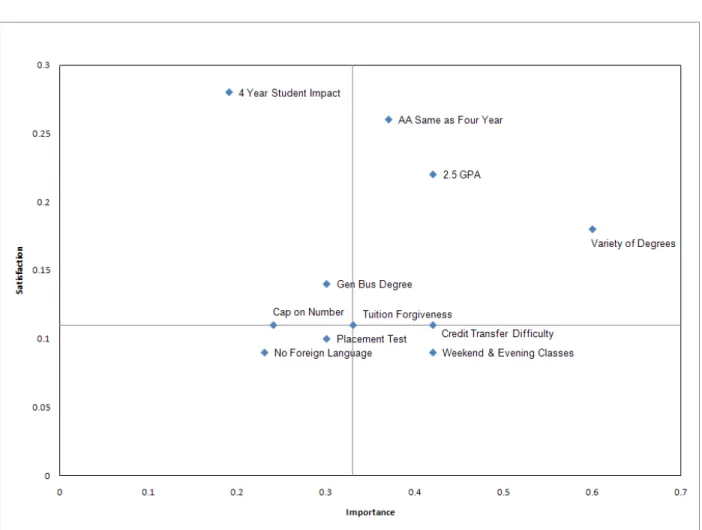
Figure 2 below shows the relationship of importance to satisfaction for the 11 policies in the total sample of 300. Since a traditional Gap Analysis using Brand Map uses only top – box
percentages for both Importance and Satisfaction ratings on each of the 11 policies from the questionnaire, only those data are presented in Table 1 (see the Appendix) and used to construct Figure 2. A clustering of responses in the High-Importance / High-Satisfaction Quadrant is the desired outcome (e.g., keep up the good work!). It indicates polices focus on important matters.
Figure 2: Total Sample Map
Overall, Coastal Carolina University needs to be concerned about the impact of offering weekend and evening classes and difficulties in transferring credits.
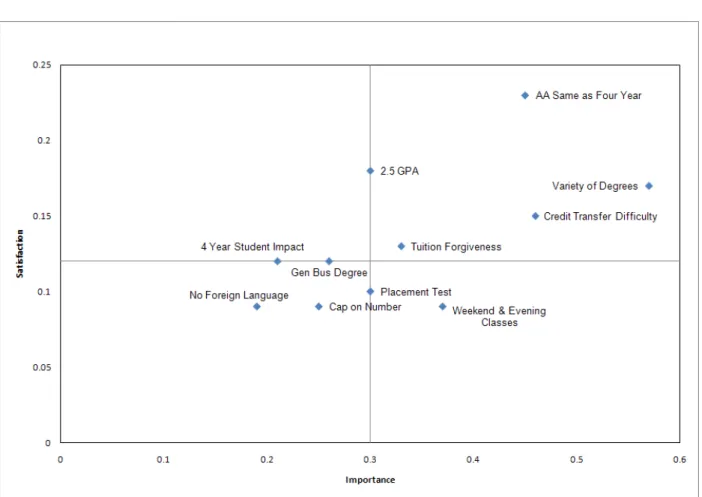
In addition to the Total Sample map, maps were generated for Two-Year Transfer Students, Four-Year Transfer Students, All Transfer Students, and No Transfer Students sub-samples. These maps are compared to see how these different student segments feel about the 11 policies. Figure 3 below shows the relationship of importance to satisfaction for the 11 policies in the total sample of 110 students who have transferred after getting a two-year degree.
Figure 3: Two-Year Transfer Student Map
Compared to the total sample, these two-year transfer students more strongly feel CCU needs to be concerned about the impact of offering weekend and evening classes. They are relatively satisfied with two-year students being treated the same as four-year students, the variety of degrees, credit transfer difficulties and tuition forgiveness.
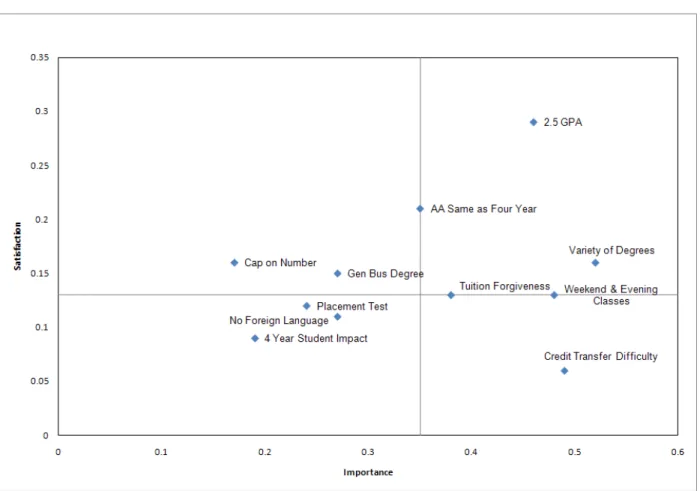
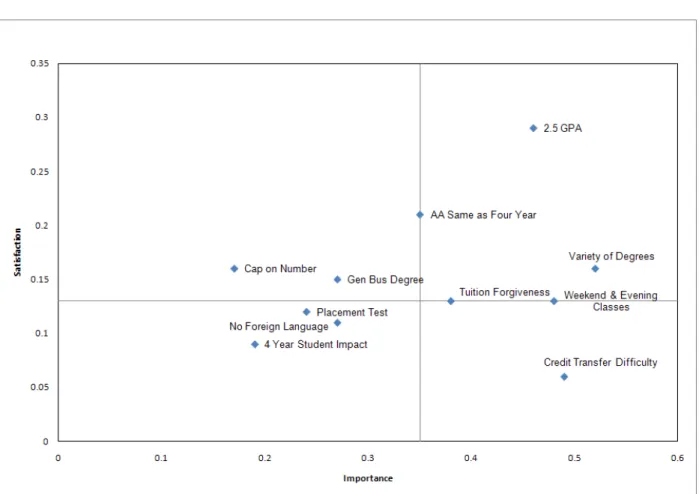
Figure 4 below shows the relationship of importance to satisfaction for the 11 policies in the total sample of 85 four-year transfer students.
Figure 4: Four-Year Transfer Student Map
Compared to two-year transfer students, these four-year transfer students are more concerned about the impact of the 2.5 GPA transfer requirement and are relatively satisfied with the current policy. They also are much less satisfied with difficulties in transferring credits. They are indifferent to two-year transfer students being treated the same as four-year transfer students.
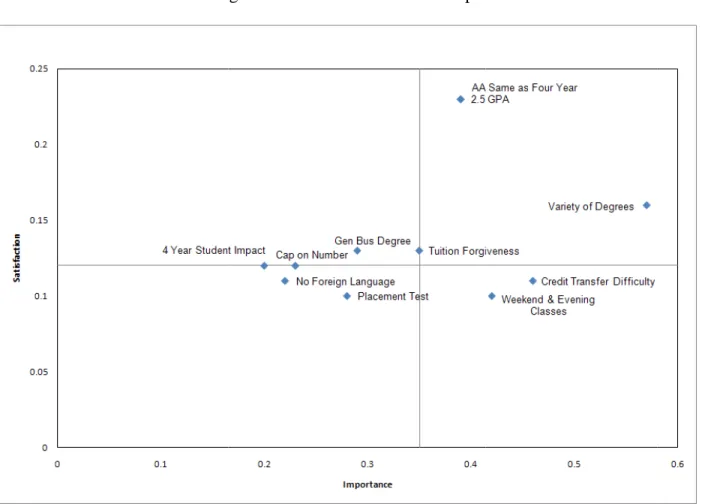
Figure 5 the samp
Compare offering m
below show ple of 169 all
ed to the tota more weeke
ws the relatio l transfer stu
Fi
al sample, th end and even
nship of pol udents.
igure 5: All
is sample of ning classes a
licy importan
Transfer Stu
f all transfer and making
nce to satisfa
udent Map
students fee it easier to t
action for th
el CCU need ransfer cred
e 11 policies
ds to work on its.
s in
Figure 6 below shows the relationship of policy importance to satisfaction for the 11 policies in the sample of 126 students who have not transferred.
Figure 6: No Transfer Student Map
Although these students have not transferred, they also thing CCU needs to work on credit transfer difficulty.
Conclusions and Recommendations
After reviewing the results above, the general conclusion is that a comprehensive degree
completion program would benefit Coastal Carolina University and its community members. In general, it is recommended that the program is designed around more weekend and evening classes, and easy credit transfer rules. In addition, jobs in the area that are in high demand need to be matched to degree programs along with offering more internship opportunities and incentives for staying in South Carolina after graduation, and allowing for flexible time schedules of classes as well as expanding the online class availability
More specifically, Myrtle Beach is not an ideal place to live after graduation. Students outside the education major find it very difficult to find jobs because Myrtle Beach is not a major city where a lot of jobs can be found. However, Coastal Carolina University can change this
jobs right after graduation, more students are likely to stay. Also, if CCU offers a degree completion program, more students are willing to come to Coastal.
In order to offer a degree completion program, CCU needs to follow a few guidelines. Coastal Carolina University needs to only admit students who have completed the necessary core classes with appropriate grades. If they do not have the appropriate grades, transfer students should be required to take a placement test that will allow them to test out of core classes if they meet or exceed the Coastal Carolina University standards. If too many people meet these requirements it is necessary to put a cap on how many students are allowed in each semester. There is a strong desire to look at the student-teacher ratio so that class sizes will stay relatively small. This will allow Coastal to see how quickly it can grow and expand.
Below there are a few suggestions for the ideal degree completion program. The ideal degree completion program will be designed on the following items:
• where jobs are needed
• the ability to only take major classes and not core classes • requiring each student to have an internship
• the ability for credits to transfer more easily
• offer incentives for those that stay in SC after graduation • keep classes sizes small
• tuition must be reasonably priced
• make course hours more flexible and offer more online courses
The degree completion program will be great for Coastal Carolina University to increase the number of transfer students. However, CCU would like to see students stay in South Carolina after graduation. Coastal needs to engage in the process of helping students receive jobs right after graduation. This will boost the economy and create less stress on students finding jobs. Also, Coastal Carolina University needs to offer more degrees to include professions that are growing in demand, such as; engineering, pre-med, pre-law, and public relations. By offering more degree programs, CCU will be appealing to more people, causing a quicker growth rate. In conclusion, it is recommended that Coastal Carolina University offer more programs that are in demand, help students get into Coastal Carolina University with fewer hurdles to go over, require internships that will help students get a job after graduation. If Coastal can implement these elements, students will be more likely to get a job in South Carolina and live and work here.
Limitations
This research has some limitations in terms of design and execution. Because the project was done as part of a Marketing Research class, some short-cuts were taken including:
o Snowball Convenience Sampling provided bias
o Had time constraint of two months
o Sample size is too small to generalize to the population
However, the conclusions provide some guidance to the client, Dr. David Evans, Associate Provost of the Bridge Programs.
References
Abell, Derek F. (1978), “Strategic Windows,” Journal of Marketing. 42(3): 21-26.
Anderson, E.F. (1997), “Active Learning in the Lecture Hall,” Journal of College Science Teaching, 26, 428-429
Cantrall, William (2007), “BrandMap 7.0,” WRC Research Systems, Inc, User Manual.
Chrzan, Keith and Doug Malcom (2007), “An Empirical Test of Alternative Brand Measurement System,” Proceedings of the Sawtooth Software Conference, October, 139 - 154.
Martilla, John A. and John C. James (1977), “Importance-Performance Analysis,” Journal of Marketing, 41(1): 77-79.
www.sctrac.org (The South Carolina Transfer and Articulation Center (SC TRAC) was created as a one-stop shop for transfer students, administrators and advisors/faculty. It was developed by a collaboration of partners, including the South Carolina Commission on Higher Education (CHE) and representatives from the state’s public institutions of higher education)
Appendices Indepth Interview Discussion Guide
Current Students
1A. Did you start at CCU as a freshman or did you transfer to CCU? Why did you transfer to CCU?
Where did you go to school before CCU?
1B. Do you plan to stay in South Carolina after graduation? Why or why not? Community Members
1B. Would you be interested in a Degree Completion Program at CCU? Why or why not? Transfers and Community Members Only
2. Currently, students who earn a Bachelors Degree in Education have their tuition paid if they stay in South Carolina to teach for two years after they graduate. If a Degree Completion Program was available at CCU, how important would it be to have a tuition repayment if a graduate stayed in South Carolina to work after graduation? Why or why not?
3.How important are the requirements for admission to CCU to earn a degree completion Bachelors Degree at CCU?
3A. Would these requirements be the same for students with an AA degree from an accredited junior college, a student from another four year university, and a student from the community who has some college experience after high school? Why or why not?
3B. Should an entrance exam or placement test be required to waive general core courses? Why or why not?
3C. Should there be a cap on the number of students allowed to enter CCU in any semester? Why or why not?
4. CCU now has such a program in Nursing. What other majors should be offered in a Bachelors Degree Completion Program? Why would those be important?
MAJOR 1:
MAJOR 2: MAJOR 3:
5. If a degree completion student earned a degree in one of our current majors, say Bachelors of Science in Business Administration in Marketing. What effect, if any, do you think that would have on students who entered CCU as freshmen and completed all the standard requirements for that degree at CCU? Why would you say that?
DEVALUE: NO EFFECT: ENHANCE:
6. If you could design an ‘IDEAL’ Degree Completion Program, what would it look like?
THANK YOU FOR SHARING YOUR TIME AND OPINIONS WITH OUR MARKETING RESEARCH CLASS.
CCU Degree Completition Program and You
Below is a list of issues concerning transfer students completing degrees at Coastal Carolina University. Please tell us the RELATIVE LEVEL OF IMPORTANCE of each Factor in your opinion of degree completion programs for transfer students at CCU. Next, please tell us your RELATIVE LEVEL OF SATISFACTION with CCU's degree completion programs for transfer students on each Factor.
Circle the number in the boxes below for each Issue listed to indicate your answers.
NOTE: You should provide TWO answers for each Issue listed ... one for IMPORTANCE X and one for SATISFACTION by circling the appropriate number.
How Important is Each Issue In Your Opinion of CCU Degree
Completion Programs?
How Satisfied Are You With CCU's Degree Completion Program Issue?
Degree Completion Program Issue Not Important At All = 1 Not That Important = 2
Neutral = 3 Somewhat Important = 4 Very Important = 5 Very Dissatisfied = 1 Somewhat Dissatisfied = 2
Neutral = 3 Somewhat Satisfied = 4 Very Satisfied = 5 1
Placement Test Required for Transfers to Get Core Classes Credit
1 2 3 4 5 1 2 3 4 5
2 No Foreign Language Required
for Transfers 1 2 3 4 5 1 2 3 4 5
3 GPA of 2.5 Required for
Transfers 1 2 3 4 5 1 2 3 4 5
4
Forgiveness of Tuition for Transfers Staying in SC After Graduation
1 2 3 4 5 1 2 3 4 5
5 Impact of Transfers on Value of
Four Year Students Degrees 1 2 3 4 5 1 2 3 4 5
6
Jr. College Transfers Treated the Same as Four Year College Transfers
How Important is Each Issue In Your Opinion of CCU Degree Completion Programs?
How Satisfied Are You With CCU's Degree Completion Program Issue?
Degree Completion Program Issue Not
Important At All
= 1
Not That Important =
2 Neutral
= 3 Somewhat Important = 4 Very Important = 5 Very Dissatisfied = 1 Somewhat Dissatisfied = 2
Neutral = 3 Somewhat Satisfied = 4 Very Satisfied = 5
7 The Number of Transfer Students
Should Be Capped 1 2 3 4 5 1 2 3 4 5
8
A General Business Degree Should Be
Offered 1 2 3 4 5 1 2 3 4 5
9 A Variety of Degrees Should Be
Offered 1 2 3 4 5 1 2 3 4 5
10
Difficulty in Getting Credits
Transferred 1 2 3 4 5 1 2 3 4 5
11
Offering Weekend and Evening Classes to Encourage Transfers, Drop-outs, and Non-traditional Students to Enroll
Please Check the blank indicating the BEST answer to the following questions.
12. Are you currently a college student? [check one] ____Yes [Continue] ____No [Skip to Question 15] 13. Are you? [check one]
____At CCU ____At HGTC
____At another 4-yr. University ____At another 2-yr. College
14. What is your Class at your current school? [check one]
____Freshman ____Sophomore ____Junior ____Senior ____Grad Student ____None [non-degree]
15. What is your gender? [check one]
____ Male ____ Female
16. Do you pay in-state or out-of-state tuition? [check one]
____ In-state _____ Out-of-State 17. Did you transfer to CCU? [check one]
____ Yes ____ No
18. Where did you transfer from? [check one] _____A 2-yr. school _____A 4-yr. school
19. What is your Employment Status? [check one]
____ Full-time student with no job. ____ Full-time student with a part-time job. ____ Full-time student with a full-time job. ____ Part-time student with no job. ____ Part-time student with a part-time job. ____ Part-time student with a full-time job.
_____Not a student with no job
_____Not a student with a part-time job _____Not a student with a full-time job
20. What is your housing Arrangement? [check one]
____ I live on-campus in the dormitories.
____ I live off-campus in CCU housing (University Place).
____ I live off-campus in non-CCU housing (apartment, townhouse, etc). 21. Do you plan to stay in SC after graduation? [check one]
____ Yes ____ No
22. Please feel free to offer any additional comments below regarding attending Summer School at CCU.
Table 1: Data Used for BrandMap 7.0 Maps
Total Sample Chart 1 n=300
Importance Satisfaction
Placement Test 0.3 0.1
No Foreign Language 0.23 0.09
2.5 GPA 0.42 0.22
Tuition Forgiveness 0.33 0.11
4 Year Student Impact 0.19 0.28
AA Same as Four Year 0.37 0.26
Cap on Number 0.24 0.11
Gen Bus Degree 0.3 0.14
Variety of Degrees 0.6 0.18
Credit Transfer Difficulty 0.42 0.11
Weekend & Evening
Classes 0.42 0.09
2 Yr Transfer Chart 2 n=110
Importance Satisfaction
Placement Test 0.3 0.1
No Foreign Language 0.19 0.09
2.5 GPA 0.3 0.18
Tuition Forgiveness 0.33 0.13
4 Year Student Impact 0.21 0.12
AA Same as Four Year 0.45 0.23
Cap on Number 0.25 0.09
Gen Bus Degree 0.26 0.12
Variety of Degrees 0.57 0.17
Credit Transfer Difficulty 0.46 0.15
Weekend & Evening
Classes 0.37 0.09
4 Yr Transfer Chart 3 n=85 Importance Satisfaction
Placement Test 0.24 0.12
No Foreign Language 0.27 0.11
2.5 GPA 0.46 0.29
Tuition Forgiveness 0.38 0.13
4 Year Student Impact 0.19 0.09
AA Same as Four Year 0.35 0.21
Cap on Number 0.17 0.16
Gen Bus Degree 0.27 0.15
Variety of Degrees 0.52 0.16
Credit Transfer Difficulty 0.49 0.06
Weekend & Evening
Classes 0.48 0.13
All Transfers Chart 4 n=169
Importance Satisfaction
Placement Test 0.28 0.1
No Foreign Language 0.22 0.11
2.5 GPA 0.39 0.23
Tuition Forgiveness 0.35 0.13
4 Year Student Impact 0.2 0.12
AA Same as Four Year 0.39 0.23
Cap on Number 0.23 0.12
Gen Bus Degree 0.29 0.13
Variety of Degrees 0.57 0.16
Credit Transfer Difficulty 0.46 0.11
Weekend & Evening
Classes 0.42 0.1
No Transfers Chart 5 n=126 Importance Satisfaction
Placement Test 0.33 0.1
No Foreign Language 0.25 0.05
2.5 GPA 0.46 0.2
Tuition Forgiveness 0.31 0.09
4 Year Student Impact 0.19 0.03
AA Same as Four Year 0.34 0.12
Cap on Number 0.25 0.1
Gen Bus Degree 0.29 0.15
Variety of Degrees 0.64 0.21
Credit Transfer Difficulty 0.37 0.11
Weekend & Evening