ARTIGO ORIGINAL
RESUMO
Introdução: No contexto de fragilidade que caracteriza a República da Guiné-Bissau constata-se uma ausência de gestão eficaz de recursos humanos da Saúde, impondo-se a reflexão sobre a sua formação. Tivemos por objetivo analisar a oferta formativa de recur-sos humanos da Saúde na República da Guiné-Bissau de 1974 a esta parte, enquadrando-a no contexto nacional e relacionando a análise com o descrito para Estados-Frágeis.
Material e Métodos: Recorrendo a análise de conteúdo dos resultados de entrevistas semi-estruturadas, grupo focal e análise do-cumental, analisámos a oferta de formação de recursos humanos da Saúde em dois pilares – ao nível das estruturas/instituições formadoras; ao nível dos processos de formação. A consideração do contexto em que esta decorre permitiu uma análise integrada na realidade vivida por Estados-Frágeis.
Resultados: Sintetizámos os passos históricos da formação de recursos humanos da Saúde, descrevendo as estruturas e seus procedimentos, concretamente das entidades públicas como a Escola Nacional de Saúde e a Faculdade de Medicina, e também das entidades privadas que proliferam no país.
Discussão: O país enquadra os problemas definidos para a Região Africana, aproximando-se do descrito para Estados-Frágeis, apre-sentando: fraca liderança/governação em saúde; limitação na implementação das estratégias de formação planeadas; inadequada capacidade de formação de recursos humanos; dependência total/parcial no financiamento da formação, proliferação de entidades formadoras privadas, não oficialmente reconhecidas.
Conclusão: Os modelos que emergem como resposta à fragilidade nesta matéria permitem parcialmente responder às necessida-des de formação do país mas negligenciam a qualidade e perpetuam dependências, agravando as fragilidanecessida-des do Estado e do setor público.
Palavras-chave: Guiné-Bissau; Pessoal de Saúde/educação; Prestação de Cuidados de Saúde/recursos humanos
Training of Human Resources for Health in the Republic
of Guinea-Bissau: Evolution of Structures and Processes
in a Fragile State
Formação de Recursos Humanos em Saúde na República
da Guiné-Bissau: Evolução das Estruturas e Processos
num Estado Frágil
1. Centro Colaborador da Organização Mundial de Saúde para Políticas e Planeamento da Força de Trabalho em Saúde. Instituto de Higiene e Medicina Tropical. Universidade NOVA de Lisboa. Lisboa. Portugal.
2. Global Health and Tropical Medicine. Instituto de Higiene e Medicina Tropical. Universidade NOVA de Lisboa. Lisboa. Portugal. Autor correspondente: Cátia Sá Guerreiro. [email protected]
Recebido: 27 de julho de 2018 - Aceite: 18 de outubro de 2018 | Copyright © Ordem dos Médicos 2018
Cátia Sá GUERREIRO1,2, Zulmira HARTZ1,2, Clotilde NEVES1,2, Paulo FERRINHO1,2
Acta Med Port 2018 Dec;31(12):742-753 ▪ https://doi.org/10.20344/amp.11120 ABSTRACT
Introduction: In the context of fragility that characterizes the Republic of Guinea-Bissau, there is an absence of effective management of human resources for Health, which begs reflection regarding training that is provided. The purpose of this study was to analyse the training of human resources for Health in the Republic of Guinea-Bissau since 1974, placing it in the national context and relating the analysis to the situation described for Fragile States.
Material and Methods: Using the content analysis of the results of semi-structured interviews, focus group and documentary analysis, we analysed the training offer on human resources for Health in two pillars - at the level of the structures / training institutions; and at the level of processes. The consideration of the context in which it takes place allowed for an integrated analysis in the reality experienced by Fragile States.
Results: We synthesize the historical steps of the establishment of human resources for Health, describing the structures and their procedures, concretely of the public entities like the National School of Health and the Faculty of Medicine, as well as of the private entities that proliferate in the country.
Discussion: The country reflects the problems that have been identified for the African Region, and for Fragile States in particular, namely: weak health leadership / governance; limitation in the implementation of the planned training strategies; inadequate human resources training capacity; total / partial dependence on training funding, proliferation of private, unofficially recognized training providers.
Conclusion: The models that emerge as a response to the fragility in this area partially allow to respond to the training needs of the country but neglect the quality and perpetuate dependencies, aggravating the weaknesses of the State and of the public sector.
Keywords: Delivery of Health Care/manpower; Guinea-Bissau; Health Personnel/education
INTRODUCTION
Republic of Guinea-Bissau, a fragile state
The Republic of Guinea-Bissau (RGB) has lived through political and institutional turmoil from the eighties,1 leading to
the situation in which it has been considered in 2018 as the 16th most fragile country in the world,3 considering the lack
ARTIGO ORIGINAL
fully dependent on the international community in sectors such as economy, healthcare and education,4 with around
90% financial support in this sector provided by cooperation partners.5,6 The National Health System of the RBG does
not respond to the country’s healthcare demands, due to different factors,7 among which the significant lack of any
efficient management of human resources for health (HRH) at all levels had a major impact.5
The development of health workforce and training has received attention from governments and partners through-out the years. The analysis of what has been done and the results of the deployment of different HRH training initiatives will certainly give a contribution to the proposal of more ad-equate training supply and adapted to the RBG needs. This study aimed at analysing the HRH training supply from 1974 onwards in the RGB, especially focused on the events occurred from 2010 onwards and providing a frame-work for the response given to requirements within the country’s healthcare approach, relating the analysis with what has been described in Fragile States (FS) as regards this subject.
MATERIAL AND METHODS
This study was included in the initiative ‘Analisando re-spostas em saúde num Estado Frágil - o caso da
Guiné-Bissau’ (Analysing health responses in a Fragile State – the case of Guinea-Bissau) in which HRH training was one case-study unit of analysis regarding ‘responses to vulner-ability situations in the RGB as a FS.’
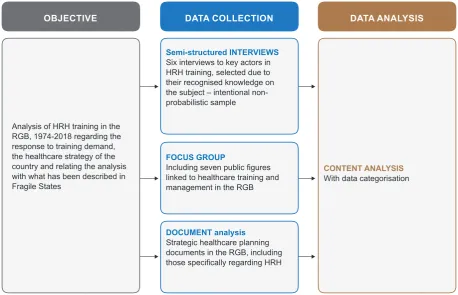
HRH training supply was analysed from two main per-spectives – according to the facility, i.e. training providing institutions and their functioning and according to training process. The context in which training is provided has al-lowed for the analysis embedded into the reality of a FS. The methodology that was used is shown in Fig. 1.
A set of specific training in health provided by the Escola Nacional de Saúde (ENS), by the Faculty of Medicine Raul Diaz Arguellez (FM) and other public or private institutions in RGB has been considered as training supply.
Six semi-structured anonymous interviews8 addressed
to stakeholders in the area of HRH training have been car-ried out, using an intentional non-probabilistic sample.9 The
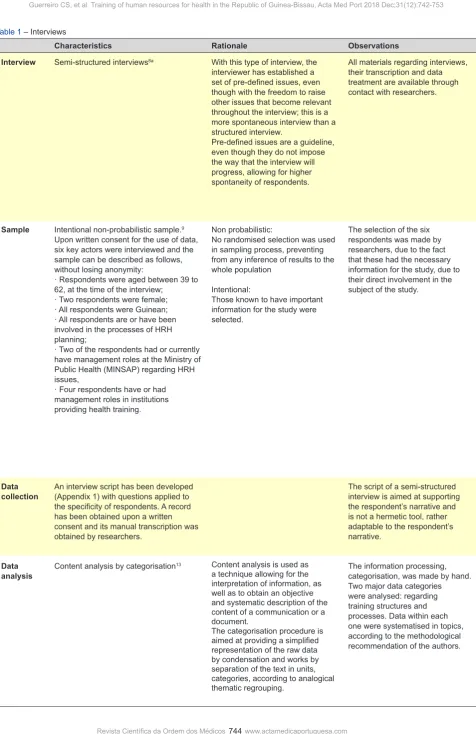
interview process is described in Table 1.
A group of seven public figures related to HRH train-ing and management in the RGB has been developed10,11
including four of the six figures who were previously inter-viewed (Table 2).
The interviews and the focus group were led by two Portuguese researchers in Feb 2016 at the RGB (scripts are shown in Appendix 1 and 2 of this article: Appendix 1: https://www.actamedicaportuguesa.com/revista/index.php/
Figure 1 – Methodological synthesis
Analysis of HRH training in the RGB, 1974-2018 regarding the response to training demand, the healthcare strategy of the country and relating the analysis with what has been described in Fragile States
Semi-structured INTERVIEWS
Six interviews to key actors in HRH training, selected due to their recognised knowledge on the subject – intentional non-probabilistic sample
FOCUS GROUP
Including seven public figures linked to healthcare training and management in the RGB
CONTENT ANALYSIS With data categorisation
DOCUMENT analysis
Strategic healthcare planning documents in the RGB, including those specifically regarding HRH
ARTIGO ORIGINAL
Table 1 – Interviews
Characteristics Rationale Observations
Interview Semi-structured interviews8a With this type of interview, the interviewer has established a set of pre-defined issues, even though with the freedom to raise other issues that become relevant throughout the interview; this is a more spontaneous interview than a structured interview.
Pre-defined issues are a guideline, even though they do not impose the way that the interview will progress, allowing for higher spontaneity of respondents.
All materials regarding interviews, their transcription and data treatment are available through contact with researchers.
Sample Intentional non-probabilistic sample.9 Upon written consent for the use of data, six key actors were interviewed and the sample can be described as follows, without losing anonymity:
· Respondents were aged between 39 to 62, at the time of the interview;
· Two respondents were female; · All respondents were Guinean; · All respondents are or have been involved in the processes of HRH planning;
· Two of the respondents had or currently have management roles at the Ministry of Public Health (MINSAP) regarding HRH issues,
· Four respondents have or had management roles in institutions providing health training.
Non probabilistic:
No randomised selection was used in sampling process, preventing from any inference of results to the whole population
Intentional:
Those known to have important information for the study were selected.
The selection of the six respondents was made by researchers, due to the fact that these had the necessary information for the study, due to their direct involvement in the subject of the study.
Data
collection An interview script has been developed (Appendix 1) with questions applied to the specificity of respondents. A record has been obtained upon a written consent and its manual transcription was obtained by researchers.
The script of a semi-structured interview is aimed at supporting the respondent’s narrative and is not a hermetic tool, rather adaptable to the respondent’s narrative.
Data
analysis Content analysis by categorisation
13 Content analysis is used as
a technique allowing for the interpretation of information, as well as to obtain an objective and systematic description of the content of a communication or a document.
The categorisation procedure is aimed at providing a simplified representation of the raw data by condensation and works by separation of the text in units, categories, according to analogical thematic regrouping.
ARTIGO ORIGINAL
amp/article/view/11120/Apendice_01.pdf and Appendix 2: https://www.actamedicaportuguesa.com/revista/index.php/ amp/article/view/11120/Apendice_02.pdf).
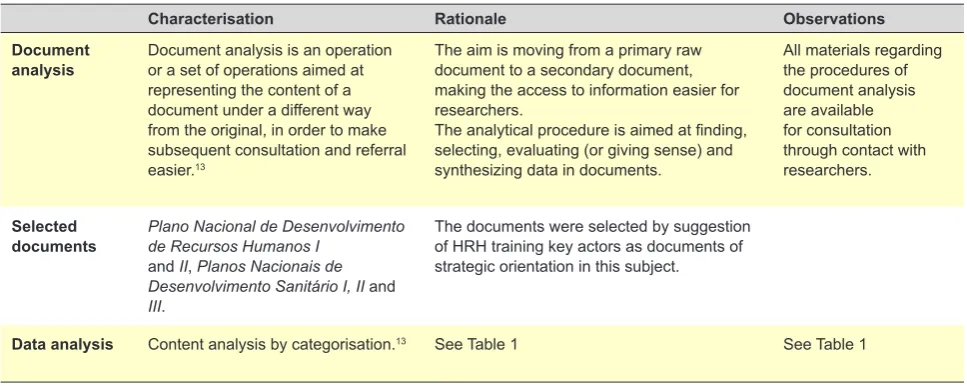
The documents of health strategic planning in the RGB were analysed considering the historical background and including those specifically regarding HRH (document anal-ysis)12 (Table 3).
Content analysis was applied to the qualitative data ob-tained with document analysis, responses to the interviews and focus group interviewing.13
RESULTS Context
Based on the interviews and focus group, data on HRH training in the RGB were obtained, filling in what is included in the official documents that were analysed and widely contributing to the understanding of the different training processes at the current providers.
A National Plan for the Development of Human Re-sources for Health [Plano Nacional de Desenvolvimento de Recursos Humanos da Saúde (PNDRHS)] has been developed14 in which HRH management was theoretically
based up to 2017. This document, which was validated as an attachment to the National Plan for Health Development II [Plano Nacional de Desenvolvimento Sanitário II (PNDS
Table 2 – Characterisation of the focus group
Characterisation Rationale Observations
Focus group This is a data collection method through the group interaction within the discussion of issues prepared by researcher.10,11
The moderator of the focus group assumes a position of facilitator of the discussion process and individual opinions as main focus, debated and detailed as a group.
All materials regarding the focus group, its transcription and data treatment are available through contact with researchers.
Participants Seven public figures linked to healthcare education and to HRH management in the RGB, ensuring anonymity. Four respondents have participated in the focus group.
Participants were selected by researchers due to the fact of being known as key informants in the subject of the study.
Data collection A script has been developed (Appendix 2). Recording, with respondent’s written consent, was obtained and its manual transcription was made by researchers.
The focus group was led by two Portuguese researchers in Feb 2016, at the RGB.
Data analysis Content analysis by categorisation.13 See Table 1 See Table 1
Table 3 – Characterisation of the interviews regarding the document analysis
Characterisation Rationale Observations
Document
analysis Document analysis is an operation or a set of operations aimed at representing the content of a document under a different way from the original, in order to make subsequent consultation and referral easier.13
The aim is moving from a primary raw document to a secondary document, making the access to information easier for researchers.
The analytical procedure is aimed at finding, selecting, evaluating (or giving sense) and synthesizing data in documents.
All materials regarding the procedures of document analysis are available for consultation through contact with researchers.
Selected
documents Plano Nacional de Desenvolvimento de Recursos Humanos I and II, Planos Nacionais de Desenvolvimento Sanitário I, II and III.
The documents were selected by suggestion of HRH training key actors as documents of strategic orientation in this subject.
ARTIGO ORIGINAL II)], was never approved by the Council of Ministers, which has been strictly followed by some institutions while
com-pletely ignored by others. The document was never updated and an update is expected within the implementation of the PNDS III, whose final approval is ongoing and waiting for the approval by the Council of Ministers – and has been technically validated as well as validated by partners. It was recognised that ‘in terms of governance, with a trustworthy leadership, decisions are taken into account and guidelines are met’ even though assuming that ‘empower-ing leadership, as well as HRH leadership, have failed in the RGB’. Names of leaders in this area have emerged, with whom ‘the processes within the PNDRHS and the function-ing of the HRH management department of the Ministry of Public Health [Ministério da Saúde Pública (MINSAP)] ran quite easily.’ In the absence of these leaders, because they have been replaced by political appointment according to the government turnover, ‘an increasing violation of the rules has been found.’
The same sources have also described a poor HRH training in terms of both quality and specificity, not respond-ing to the country’s needs. On one hand, a concern re-garding HRH training in quantity is worth mentioning even though the quality of training was not a priority. On the other hand, there is currently (June 2018) a HRH shortage mainly regarding specialties: “The country has a high number of nurses and there is no quantitative lack of general practi-tioners”. Nevertheless, there is a significant lack of special-ists, corresponding to the poor conditions for training at this level, due to the lack of qualified teachers and resources – equipment and materials, for instance: “How can we train surgeons, neonatologists or cardiologists when there are poor working conditions?”
The relationship between the MINSAP and the Minis-try of Education and Higher Education (Ministério da Edu-cação e do Ensino Superior (MEES)] was also included in the definition of the context. Higher and middle level edu-cation are supervised by the MEES, even though the FM has always been supervised by the MINSAP. “There is a faint relationship between the MEES and the MINSAP, as well as with the Medical Association” as described by one of the respondents. Over time, the supervision of the ENS has
been assigned to each of the ministries and to both at the same time and is currently (June 2018) of the responsibility of the MINSAP, as an organic unit of the National Institute of Public Health (Instituto Nacional de Saúde Pública (INA-SA)] (Table 4).
Historical steps in the development of HRH training in the RGB
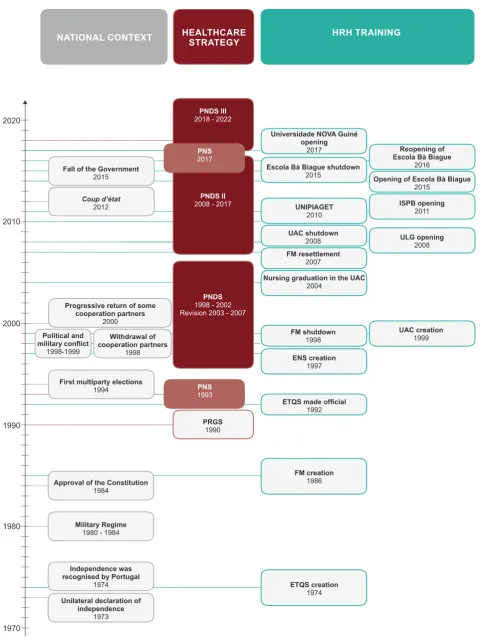
Based on data, we have reached the conclusion that most of the history of HRH training in the RBG was never written or documented and is part of the memory of those who have faced the challenge of responding to the demands of a country affected by instability upon the independence that was recognised in 1974. Based on the information with-in the documents regardwith-ing strategic plannwith-ing with-in health and in the information obtained by the interviews and the focus group, the subsequent steps are summarised in the Fig. 2.
Training facilities
HRH training in the RGB dates back to the national in-dependence in 1974, a time when the Technical School of Healthcare Staff [Escola Técnica de Quadros da Saúde
(ETQS) Dr. Fernando Cabral] was created, even though it was only made official in 1992 by the DL 62-b/92 of 30 Dec. Up to 1974, mainly from 1950 onwards and during the colonial period, nursing auxiliaries were trained at the Na-tional Hospital Simão Mendes, called Hospital Civil de Bis-sau at that time. The best students were sent to Luanda, Angola to attend general nursing courses.
In 1974, a training for the ex-rescuers having fought in the independence war was started at the ETQS in Nhala and then students subsequently went to Bolama where an-other department existed, to attend specific nursing courses for ex-rescuers. The head office of the school was in Bissau where general nursing courses (middle level) were taught. Subsequently, by the end of the eighties, an auxiliary mid-wife course was also taught at the Bissau office while the Nhala and Bolama offices were shut down as the need for training of ex-rescuers has ceased to exist in a post-war scenario. The ETQS remained in action up to the nineties. The ENS was developed in 1997 with the financial support of the World Bank (WB), aimed at assembling the
Table 4 – Instituto Nacional de Saúde Pública (INASA)
INASA - (Instituto Nacional de Saúde Pública) was developed in 2006 as part of the makeover of the Guinean health-care system aimed at facing public health challenges and was officially created in 2009 through the publication of the
Decreto-Lei no. 12/2010 of 26/08/2010 within the BO no. 34, 3rd Supplement and defined as an institute of public law
with technical, administrative, financial and patrimonial autonomy under the authority of the Ministry of Health. Some crucial elements for the development of the INASA already existed within the MINSAP and were working independently and with no organisational plan that would integrate them into sectorial strategic goals. Among these, the following are worth mentioning: Laboratório Nacional de Saúde Pública; Projeto de Saúde Bandim; Centro de Medicina Tropical and
ARTIGO ORIGINAL
Figure 2 – Historical steps in HRH training in the RGB
1970 1980 1990 2000 2010 2020
NATIONAL CONTEXT HEALTHCARE STRATEGY HRH TRAINING
Unilateral declaration of independence
1973
ETQS creation 1974 FM creation
1986 ENS creation
1997
UAC creation 1999 UNIPIAGET
2010
ISPB opening 2011
ULG opening 2008 Universidade NOVA Guiné
opening 2017
Nursing graduation in the UAC 2004
FM shutdown 1998 UAC shutdown
2008
Escola Bà Biague shutdown
2015 Opening of Escola Bà Biague
2015 Reopening of Escola Bà Biague
2016
FM resettlement 2007
ETQS made official
1992
Independence was recognised by Portugal
1974
PRGS 1990
PNS
1993
PNS
2017
PNDS
1998 - 2002 Revision 2003 - 2007
PNDS III
2018 - 2022
PNDS II
2008 - 2017
Military Regime 1980 - 1984 Approval of the Constitution
1984 Fall of the Government
2015
Coup d’état
2012
First multiparty elections 1994
Political and
military conflict
1998-1999
Withdrawal of cooperation partners
1998 Progressive return of some
ARTIGO ORIGINAL whole training that was taught at the ETQS, by then
discon-tinued and at the FM (created in 1986 with the support of the Cuban cooperation) and at merging with the University Amílcar Cabral (UAC) in 2006, even though becoming an organizational unit of the INASA in 2009. The aim was not only at improving training efficiency as providing conditions for the development of a coherent and coordinated national teaching staff according to training requirements of the pub-lic healthcare system.16 However, the FM was not formally
integrated within the ENS, nor the ENS integrated the UAC, remaining as a middle level training centre.
Ever since it was started, the ENS has been training general nurses and mid-level laboratory technicians in Bis-sau. Its supply has been extended from 2008 onwards to midwife training and mid-level radiology and pharmacy technicians and aimed at starting an obstetrics nursing spe-cialist training.5,17 This objective was however replaced by
the option of starting a midwife training, against the recom-mendations of the PNDS II, a category that was planned to be discontinued, according to the PNDRHS.5 Training
at the ENS was decentralised with a project in the south and another in the north with the aim at retaining staff in th poorest regions:17 the project of Technical Training in
Gen-eral Nursing for the South Region [Formação Técnica em Enfermagem Geral para a Região Sul (PFRS)] was devel-oped in 2009 and, in 2010, it was implemented in the Bi-jagós islands, Bolama, in 2012 in the Tombali region, Catió and in 2013 in the Quinará region, Empada. However, these offices have been discontinued as the objectives were met. Staff numbers above what has been estimated by the PNDRHS have been delivered at the ENS with the support of the WB, of the Chinese cooperation and with the rev-enue of tuition and application fees.17 This has showed the
lack of coordination between the ENS and the Department of Human Resources and Health Administration (Direção de Serviços de Recursos Humanos e Administração em Saúde) of the MINSAP, the Ministry of Civil Service [ Minis-tério da Função Pública (MFP)] and the MEES, contributing for HRH surplus. The case of nursing staff delivery is a good example of this reality, as nurses remain unemployed due to a suboptimal capacity of public recruiting: a total of 420 job vacancies existed in 2017, with 600 unemployed nurses and more than 1,000 students by the end of their gradua-tion at the ENS and other nursing training institugradua-tions.5 The
same source has described that, despite this situation, a total of 210 positions were open for the first year of general nursing course in April 2017 at the ENS, without consulting both the MINSAP or the MFP.
The FM has existed from 1986, with both a Guinean and a Cuban dean. The course of Medicine is taught by Cuban teachers, hired under the Cuban cooperation, with a Cuban degree. The educational convergence within the Economic
Community of West African States (ECWAS), according to the assessment of the implementation of the PNDS II,17 is
a challenging task, with the commitment with better quality training, aimed at a higher appropriation of the course by lo-cal teachers and better integration into the country’s higher education system.
A specific HRH was also developed at the UAC and the
Liceu Politécnico SOS Herman. A Public Health and Envi-ronment Sanitation graduation is also offered at the latter.5
The UAC was created by the Dec-lei no. 6/99 of 6 Dec 1999 as a public university with private/autonomous man-agement and was initially managed by the Fundação para Promoção do Ensino e da Cultura, private entity arising from the partnership of the government of the RGB with the
Universidade Lusófona de Humanidades e Tecnologias, a Portuguese private university. From 2006 onwards, the ENS, together with the FM, became also part of the UAC. In 2008, due to the funding inability declared by the Gov-ernment, the UAC was handed over to its partner – Uni-versidade Lusófona de Portugal and to the private sector, at the time when the ENS and the FM withdrew from the UAC and became under an autonomous management once again. The UAC remained inactive from 2008 to 2013 and no courses in health sciences were taught. A nursing course was taught at the UAC from 2004 to 2008.
HRH training was also taught in five private institutions, including the Universidade Lusófona da Guiné (ULG), the
Universidade Jean Piaget (UNIPIAGET) in Bissau, the Insti-tuto Superior Politécnico ‘Benhoblo’ and the Escola Bà Bi-ague (EBB); these latter two were shut down in 2015 due to the lack of conditions for nursing training and were illegally reopened by the end of 20165 and, more recently, training
is also offered in the Universidade Nova da Guiné (UNG). HRH training options in July 2018 are shown in Table 5, updating the information on the document of the PNDS III, based on information obtained by researchers throughout the study.
Historical details of HRH training options are shown in Table 6.
Nursing staff disparities – mid-level training in the ENS and graduation level in private entities – have been found, mostly within the SNS.
Training in these institutions has been based on the de-mand identified by the PNDRHS5,14 and on financial reasons
related to the survival of the institutions and staff wage, with an adequate identification and planning of a response to demands lacking and this issue has been dragging on for a long time.
qual-ARTIGO ORIGINAL
ity standard process by the ECWAS is ongoing.5
HRH training
A more comprehensive description of the ENS and the FM is worth mentioning.
The board of the ENS has remained unchanged from 2009 to 2017, with management based mostly on student’s tuition fees: public education has become a business, re-turn has to be ensured and has been the major criterion on which calls for candidates and vacancies should be based on, always meeting the quantitative objectives of the PN-DRHS, providing the country with healthcare staff and this has been achieved by implementing a plan aimed at an ac-celerated HRH training within the PNDRH.
The Plano Nacional de Desenvolvimento de Recursos Humanos da Saúde (PNDRHS) and the plan of acceler-ated HRH training
An estimated 63% workforce reduction up to 2017 and an estimated 34.4% growth in the effective HRH staff throughout the time period of the PNDRHS have been found, in order to respond to the population growth and
reaching minimal staff allocation in healthcare as estab-lished by the PNDS II.14
The plan of accelerated HRH training was based on these conclusions, with the aim at producing the necessary HRH staff within the public healthcare units in order to in-crease the access of population with an increasing quality up to 2017. The ENS and the Department of Professional Development (Repartição de Desenvolvimento Profission-al) of the Direção de Recursos Humanos e Administração em Saúde at the MINSAP were involved in the implementa-tion of this plan and training was expected to become de-centralised by extending the training activity to the Health-care Regions (Regiões Sanitárias) described as having the adequate conditions for it.18
The new board of the ENS has been following the same strategy as the previous board.
The ENS is located at a new building of the INASA outside Bissau and higher than expected management challenges of the new structure were found. In addition, nursing training is expected to be taught at the other of-fices outside Bissau – Bolama, Empada and Catió – with extra cost, which has been one of the reasons for the recent
Table 5 – HRH training in the Republic of Guinea-Bissau in 2017, described in the Plano Nacional de Desenvolvimento Sanitário III (PNDS
III), updated in June 2018
Entity Training Institutional characterisation Academic Level
Escola Nacional de Saúde · General Nursing
· Pharmacy technician · Laboratory technician · Radiology technician · Midwife
Public education institution Mid-level
Faculdade de Medicina Raul
Diaz Arguellez · Medicine· Integrated General Medicine
Post-graduation
Public education institution Higher education – graduation and post-graduation
Universidade Amílcar Cabral · Nursing Public education institution Higher education –
graduation
Liceu Politécnico SOS Herman · Public Health and Environmental
Sanitation Public education institution
Universidade Lusófona da
Guiné · Nursing· Laboratory technician
· Social service
Private institution Higher education –
graduation
Universidade Jean Piaget de
Bissau · Medicine· Nursing
· Laboratory technician · Nutrition
Private institution Higher education –
graduation
Instituto Superior Politécnico
“Benhoblo” · Nursing Private institution Higher education – graduation
Escola Bà Biague · Nursing Private institution Higher education –
graduation
Universidade NOVA Guiné · Nursing
ARTIGO ORIGINAL
deactivation of these offices.
Internal teachers are included in the teaching staff hired by the MINSAP for the school, mostly including nurses, 14 in total, by June 2018 and visiting teachers (57 in total). The former are paid by the MINSAP with a financial incentive paid by the school and the latter are fully paid by the school. With the support of the WB, nursing, laboratorial techni-cian and pharmacy technitechni-cian curriculum plans have been updated and also a midwife curriculum revision process has also been carried out, with the support of the UNFPA (United Nations Population Fund). Curriculum revision pro-cesses were developed under the intermediation of the In-stituto de Higiene e Medicina Tropical of the Universidade Nova de Lisboa and ensured by a Portuguese nursing high school as consulting entity and curricula were brought into line with those of the African health region, with the par-ticipation of Guinean teachers and experts of the ECWAS.
Curriculum plans that emerged from this revision are those in force in 2018 and are according to the ECWAS recom-mendations aimed at a regional convergence. The acquisi-tion of equipment ensuring IT support and a laboratory for practical classes was also made possible mainly with the support of the WB. A financial support of the UNFPA (tutor training) and of the Camões - Instituto da Cooperação e da Língua Portuguesa, a Portuguese public institution (teacher training) has been granted in 2016.
Examinations for admission to the ENS courses have been supported by candidates, representing an important income source for the ENS.
The FM would theoretically be part of the ENS, even though “this really never happened”. The aim was to pro-mote the autonomy of the faculty regarding the Cuban tuto-rial, although this has not happened until the 2017/18 term. “Conditions of government and leadership” for this never
Table 6 – HRH training in the Republic of Guinea-Bissau, 1974-2018
Entity Foundation year Observations
Escola Técnica de Quadros da Saúde Dr. Fernando Cabral (ETQS)
Created in 1974, became
official in 1992 Has ceased to exist in 1997, at the time when the ENS was created.
Faculdade de Medicina Raul
Diaz Arguellez (FM) 1986 Shut down from 1998 to 2007.
Escola Nacional de Saúde (ENS) 1997 Created with the aim at converging the training taught by the
ETQS and by the FM; the latter has never integrated the ENS. Universidade Amílcar Cabral
(UAC) 19992013 Created with the aim at merging all the country’s higher education entities, was shut down in 2008 and resumed its activity in 2013.
A nursing graduation was made available with a partnership with the Grupo Lusófona from 2004 to 2008.
Liceu Politécnico SOS Herman 2007 The Saúde Pública e Saneamento do Meio course was started
in 2009.
Universidade Lusófona da Guiné 2008 The set-up of the Universidade Lusófona in the RGB was
approved as a higher education institution in November 2008 and students of the nursing course of the UAC were transferred and their studies were completed at the new private university.
Universidade Jean Piaget de
Bissau 2010
Instituto Superior Politécnico
“Benhoblo” 2011 Shut down by the MEES in 2015, due to the lack of a laboratory, no license and inadequate facilities. Resumed in 2016 by the indication of the MEES, even though with unauthorised student admission until further notice.
Escola Bà Biague 2014/2015 Shut down by the MEES in 2015, due to the lack of a laboratory,
no license. Resumed in 2016, authorised by the MEES
Universidade NOVA da Guiné Made official in 2017 and
functional in January 2018 Licensing was questioned by the MEES at the first semester of 2018
All private institutions are working with no license that should be granted by the MEES. All are working under the Law no. 3/2011 of the higher education, according to the Suplemento
do Boletim Oficial – BO no. 13 of 29 March 2011.
ARTIGO ORIGINAL
existed, according to the information provided by respond-ents: Guinean physicians were not able to assume the fac-ulty as they would depend on a public wage and “teach-ers have a very low wage or are not paid at all”. Therefore, those who would have the skills for assuming academia prefer not to do so, in search for better payment conditions. Emerging private training is worth mentioning, frequent-ly taught without the approval of the MEES, with processes that are entirely autonomous from the public education or international regulation entities. According to the informa-tion obtained, this is mainly ‘a profitable business’. A prac-tical component has not existed as internships could not be held at the healthcare public system, as these courses were not recognised. As regards nursing, ‘the presence of these courses apparently does not reduce the search for the ENS”. The training institutions and academic grades have been diversified with these private institutions, mov-ing away from the objectives of the PNDRHS. The fact that nursing courses are taught by private entities is one of the main points of dispute, with no professional internship, con-ferring an academic degree, rather than the same course at the ENS, which is considered as a mid-level course, even though with better professional experience obtained from internships at the healthcare units of the national health system. This has raised payment and career progression issues, for instance, including doubts associated with the functional content of the different categories in nursing ca-reer.
DISCUSSION
The reality of the RGB as a FS, one of the poorest coun-tries in the world and facing continuing political turmoil and lack of stable social and economic institutions for over two decades,19 is the specific framework that is described in
lit-erature regarding HRH, corresponding to a severe, long-lasting crisis affecting HRH in different ways, as shown by this and other articles.20–23
Conditions in the RGB lie within the issues defined by the WHO for the African region at the time when the recom-mendations for the implementation of the Global Strategy on human resources for health: Workforce 2030 were is-sued, with a weak leadership and governance of healthcare staff and suboptimal HRH education and training capacity.24
Even though there is a guideline for HRH management – the PNDRHS, limited implementation and empowerment by different stakeholders is the reality in FS in which plan-ning documents not always reflect a real and coherent work.22 The same authors have also underlined that some
good-quality plans never got off the ground due to the weak-ness of the implementing institution, to conflicting priorities or risky consequences. As described in literature, the
politi-cal environment, the existing implementation capability and constraints should be taken into consideration in order to ensure the development of more realistic and feasible plans regarding any HRH management strategy.22 The lack of
regulation in education leads to the proliferation of training structures, public but mainly private, ignoring any national and regional dictates and regional rules.
As regards training supply, the reality in the RGB is al-most in line with what has been described in other FS. On one hand, HRH training is totally or partially subsidised; whenever public aids and partner’s financial support fail, public training is traded and profit becomes the main moti-vating factor of these training structures.
On the other hand, training lies mostly within the do-main of the public system, of the MINSAP, the MEES or both and, under political turmoil, private training centres have emerged, mainly not approved by any public institu-tion, which may correspond to low quality training whenever adequate resources and capacities lack.21 The same
real-ity as described for the African Region has been found in the RGB: some training schools have not been approved, meaning that quality of education is not ensured; increasing number of training schools in health sciences, in part due to an increasing involvement of the private sector in educa-tion.24
This business related to the proliferation of private train-ing entities has also been described in countries as Afghani-stan, India, Brazil, Central African Republic, Democratic Re-public of Congo, Haiti, Occupied Palestinian Territories and Somalia where professional training is classified as a profit-able business.20 According to the same source, an
increas-ing pressure on the existincreas-ing HRH numbers and a negligible pressure on training quality caused by an absent regulation has been found in these countries, in line with what has been described in the RGB.
Non-regulated privatisation of training centres, lead-ing to the proliferation of HRH that may become integrated in the public sector, aside from any planning that may ex-ist,21 in line with what has been described in the RGB, has
been described by different authors. Competing interests regarding the relationships within and between the Minis-try of Health, Education and training institutions, leading to the fragmentation of efforts with a limited impact on the re-sponse to HRH needs has also been found in the RGB, in line with other FS in the African continent.25
ARTIGO ORIGINAL unquestionable reality. This situation is in line with what has been described in other FS: response to crisis, such as
ver-tical approaches and projects, initially expected as short-term interventions, have become ‘cultural’ and becoming embedded in people’s way of being, beyond vulnerable situations or leading to a continuing vulnerability. A strategic action is needed to correct these tendencies as no solution is spontaneous.21
The diagnosis of HRH issues in terms of strategic plan-ning and traiplan-ning for the African region has been established and the RGB is in line with it.24 Recommendations were
is-sued by WHO Africa, within the Global Strategy on human resources for health: Workforce 2030 and should be taken into consideration in any HRH planning process strategy that is expected to occur in the RGB within the implementa-tion of the PNDS III.
Obtaining systematic and consistent information has been one of the main constraints throughout the present study, as accurate data regarding HRH training were not available. Literature has shown a weak capacity for collect-ing, analysing and using HRH information in the African re-gion. There is scarce information available on HRH in the RGB, in line with what has been described for the region.24
CONCLUSION
HRH training in the RGB was analysed under different perspectives, including different stakeholders and training processes and was put in context, according to the coun-try’s history, its reality and as a FS.
As one of the most fragile countries in the world, real-ity in RGB is in line with what has been described in FS regarding HRH training: there is a limited training capacity leading to a poor response to the country’s needs in
addi-tion to leadership and governance failures with an impact on training processes.
Even though we have found an attempt to plan HRH management, including HRH training – mainly through the PNDRHS -, there is limited implementation of strategies, due to reasons related to the political and institutional insta-bility and its consequences, as to the lack of leadership. This situation has led to the emergence of three busi-ness models: marketing of the public sector; proliferation of a profitable private sector operating as free agents; models of cooperation that perpetuate the dependence from ex-ternal initiative and resources. Even though the country’s needs are in part responded by either of these models, pub-lic vulnerability gets worse by neglecting quality and per-petuating dependences.
HUMAN AND ANIMAL PROTECTION
The authors declare that the followed procedures were according to regulations established by the Ethics and Clini-cal Research Committee and according to the Helsinki Dec-laration of the World Medical Association.
DATA CONFIDENTIALITY
The authors declare that they have followed the proto-cols of their work centre on the publication of patient data. CONFLICTS OF INTEREST
The authors declare that there were no conflicts of inter-est in writing this manuscript.
FINANCIAL SUPPORT
The authors declare that there was no financial support in writing this manuscript.
REFERENCES
1. Ministério da Educação da Guiné Bissau, UNICEF, UNESCO. Relatório do estado do sistema educativo para a reconstrução da escola da Guiné-Bissau sobre novas bases. Bissau: ME; 2015.
2. Newbrander W, Waldman R, Shepherd-Banigan M. Rebuilding and strengthening health systems and providing basic health services in fragile states. Disasters. 2011;35:639–60.
3. Messner JJ, Haken N, Taft P, Blyth H, Maglo M, Fiertz C, et al. The Fragile States Index 2018. Washington: The Fund for Peace; 2018. 4. Dussault G, Fronteira I. Análise dos recursos humanos da saúde (RHS)
nos países africanos de língua oficial portuguesa (PALOP). Geneve: WHO; 2010.
5. Ministério da Saúde Pública da República da Guiné-Bissau. Plano Nacional de Desenvolvimento Sanitário 2018-2022 - PNDS III. Julho 2017. Bissau: MSP; 2017.
6. Escritório Regional Africano da Organização Mundial de Saúde. Estratégia de Cooperação da OMS com os Países: Guiné-Bissau 2009-2013. Cape Town: WHO Africa; 2008.
7. Ministério da Saúde Pública da República da Guiné-Bissau. Plano Nacional de Desenvolvimento Sanitário II 2008-2017. Bissau: MSP; 2007.
8. Flick U. Métodos qualitativos na investigação científica. Lisboa: Monitor; 2005.
9. Marconi M, Lakatos E. Fundamentos de metodologia científica. 2a ed.
São Paulo: Editora Atlas; 2007.
10. Trad LAB. Focal groups: concepts, procedures and reflections based on practical experiences of research works in the health area. Physis Rev Saúde Coletiva. 2009;19:777–96.
11. Gondim SM. Grupos focais como técnica de investigação qualitativa: desafios metodológicos. Paid Ribeirão Preto. 2002;12:149–61. 12. Bowen GA. Document analysis as a qualitative research method. Qual
Res J. 2009;9:27–40.
13. Bardin L. Análise de conteúdo. 5a ed. Lisboa: Edições 70; 2008.
14. Ministério da Saúde Pública da República da Guiné-Bissau. Plano Nacional de Desenvolvimento dos Recursos Humanos da Saúde da Guiné-Bissau 2008-2017. Bissau: MSP; 2007.
15. Instituto Nacional de Saúde Pública, Ministério da Saúde Pública da República da Guiné-Bissau. Relatório de Actividades 2009-2014. April 2015. Bissau: INSP; 2015.
ARTIGO ORIGINAL
recomendações de acções e objectivos a integrar num segundo Plano Nacional de Desenvolvimento Sanitário 2008-2012. Bissau; 2008. 17. Ferrinho P. Subsídios para a Revisão do Plano Nacional de
Desenvolvimento Sanitário 2008-2017 até 2020 - apreciação da sua implementação em Agosto de 2015 e contribuição para um roteiro para a sua revisão. Bissau; 2015.
18. Direcção Geral da Administração do Sistema de Saúde, Direcção de Serviços de Recursos Humanos e Administração da Saúde. Apoio à Aceleração da Formação de Técnicos Médios da Saúde Abril - Setembro de 2011 - Anexo 7 - 1o Relatório Referente a Abril de 2011.
Bissau: DGASS; 2011.
19. Guinea-Bissau Health Sector Diagnostic. World Bank, June 2016. 20. Durham J, Pavignani E, Beesley M, Hill PS. Human resources for health
in six healthcare arenas under stress: a qualitative study. Hum Resour Health. 2015;13:14.
21. Pavignani E, Colombo S. Analysing disrupted health sectors: a modular
manual. Geneva: WHO; 2009.
22. Pavignani E. Human resources for health through conflict and recovery: lessons from African countries. Disasters. 2011;35:661–79.
23. Russo G, Pavignani E, Guerreiro CS, Neves C. Can we halt health workforce deterioration in failed states? Insights from Guinea-Bissau on the nature, persistence and evolution of its HRH crisis. Hum Resour Health. 2017;15:12.
24. Organização Mundial de Saúde - Escritório Regional para a África. Quadro da Região Africana para a Implementação da Estratégia Mundial dos Recursos Humanos da Saúde (Força de Trabalho 2030). Relatório do Secretariado da Sexagésima Sétima Sessão, Setembro 2017. Cape Town. WHO Africa; 2017.