ISSN-L: 2501 - 1235 Available on-line at: www.oapub.org/edu
doi: 10.5281/zenodo.1286422 Volume 4 │ Issue 7 │ 2018
EFFECT OF 4 WEEKS COMPREHENSIVE
REHABILITATION PROGRAM ON FENCERS
WITH FAI (FUNCTIONAL ANKLE INSTABILITY) USING
CAIT (CUMBERLAND ANKLE INSTABILITY TOOL)
Amrinder Singh1,
Prathamesh Nikam2i,
Shweta Shenoy3,
Jaspal Sandhu3
1Assistant Professor, MYAS-GNDU
Department of Sports Sciences and Medicine Guru Nanak Dev University, Amritsar, Punjab, India
2Research Scholar, MYAS-GNDU
Department of Sports Sciences and Medicine Guru Nanak Dev University, Amritsar, Punjab, India
3Professor, Research Scholar, MYAS-GNDU
Department of Sports Sciences and Medicine Guru Nanak Dev University, Amritsar, Punjab, India
Abstract:
Background: The main purpose of this study was to evaluate FAI (functional ankle
instability) in fencers using CAIT (Cumberland ankle instability tool) and to check balance, strength & endurance using SLS (single leg stance test) and CRT (calf raise test). Using ZEBRIS HP Cosmos Gait Analysis System and find out the alterations in the gait parameters and effect of 4 week comprehensive rehabilitation program that targets strength, endurance, flexibility, balance, agility, mind body connection and functional tasks and to reevaluate the effect of the rehabilitation program on each of the above
parameters. Methods: 40 male fencers with FAI with the age groups between 18-25
years. Experimental group (n=20) age (21.55 + 2.08) and the Controlled group (n=20) with age (21.95 + 1.905). Subjects were classified on the severity based upon the scores of CAIT scale. Age, BMI, height, weight were the baseline evaluations. Dominance, side of injury, no. of times ankle was injured, and treatment taken was also documented. The experimental group underwent a 4 weeks rehabilitation program and the control group was not put on any rehab program. Each of the parameters were measured again
after 4 weeks. Conclusions: There were significant differences in the balance, balance
improved significantly in the experimental group (P value of 0.00), the strength and endurance was also improved in the experimental group (P value of 0.00), the CAIT
score was also improved significantly in the experimental group indicating the improvement in the stability of the affected ankle (P value of 0.00). The foot rotation degree showed no significant differences with (P value of 0.34). Step length showed significant differences in the experimental group (P value of 0.00). Stride length also showed significant post rehabilitation in the experimental group (P value of 0.00). No significant differences were seen in step width, step time and cadence. Velocity showed significant differences in the experimental group in post rehab readings (P value of 0.01). Finally the evidence suggests that the 4 weeks rehabilitation program improves the ankle instability in fencers, strength and balance was improved rendering the joint less chances of repeated & concurrent injuries, possibly improves the performance and game quality.
Keywords: functional ankle instability, CAIT (Cumberland ankle instability tool),
exercises and functional ankle instability
1. Introduction
Fencing is an armed combat sport with 3 weapon types and 3 different sets of rules and tactics, Foil- hit valid on torso and with tip of blade, Epee- hit valid on all body surface and with tip of blade. Saber- hit valid from the wait and up, with blade tip, edge and counteredge. There are protective equipment such as 1600N resistant metal grid, polycarbonate transparent masks, 800N resistant KEVLAR jackets, undersleeve, pants, breast or genital protectors, padded gloves and socks. All the parts of body are covered except back of the head and unarmed hand. Despite being an armed combat sport, high-competition fencing is safe activity, provided that the protective gear is completely worn and safety measures are kept all the time. The single most frequent injury type is ankle sprain. We believe in specific ankle strengthening and flexibility exercises as well as posterior shoe support. (14).
Functional ankle instability (FAI) is one of the most deliberating disorders characterized by repeated bouts of injury and ‚symptoms of giving away‛ (2). Functional ankle instability is a condition that occurs after an ankle sprain in some
patients (3). Functional ankle instability has been defined as many ways including the
stability loss and reliable dynamic support of joint (1). No formal descriptions of the
term ‘Giving Away’ have been found it may be described as a feeling of instability after weight bearing, specific corrective measures should must be taken to avoid fall, much like recovery from stumble (10).
Freeman used the term Chronic Ankle Instability (CAI) to distinguish repetitive bouts from acute occurrences, and further stated that there are two causes of chronic
ankle instability mechanical and functional instability. Hertel (2002) indicated that
Functional ankle instability is not merely a result of a single factor such as ligament laxity, muscle weakness, diminished proprioception, or postural control deficits. Rather, CAI has been found to be associated with all of these factors, as well as altered arthrokinematics and joint structure at the talocrural joint. (6, 7)
Ankle Instability is a complex neuromuscular disorder, which affects a large percentage of individuals who have Lateral ankle sprain. The neuromuscular mechanism behind the pathology of ankle instability remains unclear. Although this is a relatively new area of research, several theories exist and have been explored, yet there is no consensus in the literature. However, it is likely that a combination of factors leads to the development of ankle instability including impairments in open- and closed-loop control mechanisms. More research is needed regarding neuromuscular control strategies in ankle instability so that more suitable treatment and rehabilitation programs can be designed, specifically geared towards reducing the incidence and severity of Ankle Instability. (5).
Functional instability was first described by Freeman et al 1965 who attributed
impaired balance in individuals with lateral ankle sprain to damaged mechanoreceptors in lateral ankle ligaments, which resulted in the proprioceptive deficits. Further these deficits in acute or recurrent ankle sprains have been demonstrated by quantifying proprioception, cutaneous sensation, nerve conduction velocity, neuromuscular response times, postural control and strength (8).
As the ankle sprains are the single most and highest, occurring injuries in the game of fencing a fencer is exposed to repetitive ankle sprains after a first initial injury. As a result of recurrent injuries a fencer develops functional ankle instability which affects his performance leading to deterioration in his game quality and his career entirely is affected (14). Thus a reliable and valid treatment protocol has to be designed which targets all the factors that cause functional ankle instability and will tackle all the deficits and insufficiencies caused by the functional ankle instability which will be simple, easy to remember, effective and can be inculcated in the daily training program of the fencers.
Thus, the main purpose of this study was to see the effect of 4 weeks comprehensive rehabilitation program on fencers with functional ankle instability and to determine its effect on balance, strength and gait parameters.
2. Methodology
surgical history of lower limb, lower back pain. Baseline information like age, sex, height, weight and BMI were recorded. SLS (Single Leg Stance Test) was done for evaluation of static balance, the subjects had to stand on one leg with their hands resting to the side and the time was recorded, test was done on the sides i.e. affected and non-affected side. 3 trails were done and average was calculated.
CRT (Calf Raise Test) was done to check strength and endurance of gastronemius and soleus muscles. The subject had to stand on one leg same as in the SLS position and were allowed to take the support of examiners shoulder with one finger touch and do as many repetitions of calf raise as possible. Test was terminated if subject lost balance or got tired and was unable to do the repetitions any more. Gait analysis was done using ZEBRIS HP Cosmos Gait Analysis System d which gave you accurate readings of gait parameters, the following gait parameters were recorded degree of foot rotation, step length, stride length, step width, step time, cadence and velocity of affected and non-affected side as well.
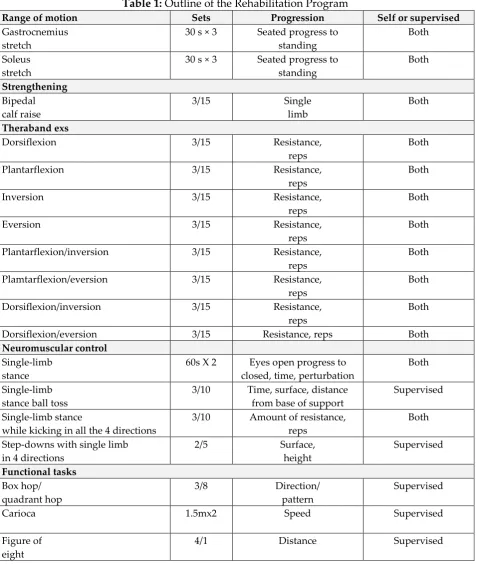
20 fencers selected randomly were put on a 4 weeks comprehensive program that targeted range of motion, strength, neuromuscular control, and functional tasks and the other 20 fencers were assigned to a controlled group where no rehabilitation protocol was given. The 4 weeks rehabilitation program consisted of 6 visits to the laboratory. During weeks 1 and 2, subjects reported to the laboratory twice a week. During weeks 3 and 4, subjects reported to the laboratory once each week. Subjects were also given a home exercise program and were instructed to perform the home program 5 times each week. Subjects were given a log to track their compliance. According to the logs, subjects completed the home exercise an average of 3.5 times each week. During the supervised laboratory rehabilitation sessions, subjects participated in flexibility, strength, and balance activities for approximately 30 minutes. The program was progressive and subjects advanced through the various stages. With the exception of the few bipedal tasks (bipedal calf raise, carioca, and figure of eights), all therapeutic exercise was completed on the involved limb only. Supervised sessions were also used to review and advance the home Exercise program as needed to ensure proper technique and to maintain an appropriate level of difficulty.
Table 1: Outline of the Rehabilitation Program
Range of motion Sets Progression Self or supervised
Gastrocnemius stretch
30 s × 3 Seated progress to standing
Both
Soleus stretch
30 s × 3 Seated progress to standing
Both
Strengthening Bipedal calf raise
3/15 Single
limb
Both
Theraband exs
Dorsiflexion 3/15 Resistance,
reps
Both
Plantarflexion 3/15 Resistance,
reps
Both
Inversion 3/15 Resistance,
reps
Both
Eversion 3/15 Resistance,
reps
Both
Plantarflexion/inversion 3/15 Resistance, reps
Both
Plamtarflexion/eversion 3/15 Resistance, reps
Both
Dorsiflexion/inversion 3/15 Resistance, reps
Both
Dorsiflexion/eversion 3/15 Resistance, reps Both
Neuromuscular control Single-limb
stance
60s X 2 Eyes open progress to closed, time, perturbation
Both
Single-limb stance ball toss
3/10 Time, surface, distance from base of support
Supervised
Single-limb stance
while kicking in all the 4 directions
3/10 Amount of resistance, reps
Both
Step-downs with single limb in 4 directions
2/5 Surface,
height
Supervised
Functional tasks Box hop/
quadrant hop
3/8 Direction/
pattern
Supervised
Carioca 1.5mx2 Speed Supervised
Figure of eight
3. Results
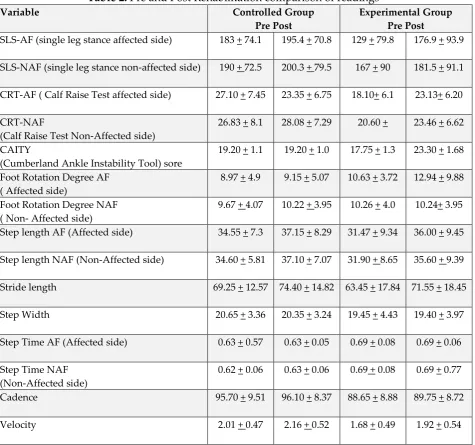
Table 2: Pre and Post Rehabilitation comparison of readings
Variable Controlled Group
Pre Post
Experimental Group Pre Post
SLS-AF (single leg stance affected side) 183 + 74.1 195.4 + 70.8 129 + 79.8 176.9 + 93.9
SLS-NAF (single leg stance non-affected side) 190 + 72.5 200.3 + 79.5 167 + 90 181.5 + 91.1
CRT-AF ( Calf Raise Test affected side) 27.10 + 7.45 23.35 + 6.75 18.10+ 6.1 23.13+ 6.20
CRT-NAF
(Calf Raise Test Non-Affected side)
26.83 + 8.1 28.08 + 7.29 20.60 + 23.46 + 6.62
CAITY
(Cumberland Ankle Instability Tool) sore
19.20 + 1.1 19.20 + 1.0 17.75 + 1.3 23.30 + 1.68
Foot Rotation Degree AF ( Affected side)
8.97 + 4.9 9.15 + 5.07 10.63 + 3.72 12.94 + 9.88
Foot Rotation Degree NAF ( Non- Affected side)
9.67 + 4.07 10.22 + 3.95 10.26 + 4.0 10.24+ 3.95
Step length AF (Affected side) 34.55 + 7.3 37.15 + 8.29 31.47 + 9.34 36.00 + 9.45
Step length NAF (Non-Affected side) 34.60 + 5.81 37.10 + 7.07 31.90 + 8.65 35.60 + 9.39
Stride length 69.25 + 12.57 74.40 + 14.82 63.45 + 17.84 71.55 + 18.45
Step Width 20.65 + 3.36 20.35 + 3.24 19.45 + 4.43 19.40 + 3.97
Step Time AF (Affected side) 0.63 + 0.57 0.63 + 0.05 0.69 + 0.08 0.69 + 0.06
Step Time NAF (Non-Affected side)
0.62 + 0.06 0.63 + 0.06 0.69 + 0.08 0.69 + 0.77
Cadence 95.70 + 9.51 96.10 + 8.37 88.65 + 8.88 89.75 + 8.72
Velocity 2.01 + 0.47 2.16 + 0.52 1.68 + 0.49 1.92 + 0.54
In SLS (single leg stance) there is a significant difference in the single leg stance test timings in the experimental group with a P value of 0.00 and mean difference of - 47.48 where as in controlled group there is no significant difference in the single leg stance timing readings pre and post rehabilitation.
In CAITY (Cumberland Ankle Instability Tool) scores there was a significant difference the scoring of CAIT in experimental group with a P value of 0.00 and a mean difference of -5.55 where as in the control group there were no significant differences in the pre and post values of CAIT score with a P value of 1.00 and a mean difference of 0.00.
In Foot rotation degreethere were no significant differences on the affected side,
with a p value of 0.34 and a mean difference of -2.32 and no significant differences on the non-affected side, with a p value of 0.92 and a mean difference of 0.03 were seen in the experimental group. There were no significant differences in the degree of foot rotation on affected side, with a p value of 0.33 and a mean difference of -0.18 and no significant differences on the non-affected side, with a p value of 0.05 and a mean difference of - 0.55 in the control group.
There is a significant difference in the step length on the affected side in pre and post readings with a p value of 0.00 and a mean difference of - 4.53 and also a significant difference in the step length on the non-affected side in pre and post readings with a p value of 0.01 and a mean difference of -3.70 in experimental group where as in control group no significant difference in the step length in pre and post readings with a P value of 0.06 and a mean difference of -2.60, 0.06 and a mean difference of -2.50 respectively.
Stride length significantly is differing in pre and post readings of the
experimental group with the P value of 0.00, and a mean difference of - 8.15 in the experimental group and No significant differences in the stride length in the control group. With a P value of 0.06 and a mean difference of -5.15.
No significant differences in the step width in the experimental group. With a P value of 0.88 and a mean difference of - 0.05 and with a P value of 0.22 and a mean difference of - 0.30 in controlled group.
No significant differences in the step time in the experimental group on the affected side With a P value of 1.00 and a mean difference of 0.00 and with a P value of 0.49 and a mean difference of - 0.01 on non-affected side.
No significant differences in the step time in the control group. With a P value of 0.71 and a mean difference of 0.00 on affected side and with a P value of 0.66 and a mean difference of 0.00 on the non-affected side.
No significant difference of cadence in pre and post readings in experimental group, with a P value of 0.50 and a mean difference of -1.10 in the experimental group and with a P value of 0.80 and a mean difference of - 0.40 in control group.
There is a significant difference in the velocity in pre and post readings in the experimental group with a p value of 0.01 and a mean difference of -0.24 and in the control group there is no significant difference in the velocity in pre and post readings with a p value of 0.01 and a mean difference of -0.16.
4. Discussion
The single most frequent injury in fencing is ankle sprain thus specific ankle strengthening and flexibility exercises are very important in this sport (14). Our study observed significant changes in the pre and post reading parameters between the experimental and controlled group. There is a significant improvement in the static balance i.e. in the SLS readings. Thus, balance training is very important and essential factor in the rehabilitation of functional ankle instability and prophylactic balance training substantially reduces risk of recurrent ankle sprains with greater effect in history of previous sprains (11).
There was a significant improvement in the CRT repetitions post 4 weeks
rehabilitation program as ankle inversion control is affected in FAI (12,13) Rehabilitation programs that trains range of motion, strength and neuromuscular control improves functional limitations in athletes with functional ankle instability (7). There was a very high improvement in CAIT score in the experimental group which indicates the improvement in the stability of ankle and the reduction of disability and symptoms related to functional ankle instability CAIT is a simple valid reliable tool to measure the severity of functional ankle instability (9).
Gait initiation may not be a challenging enough task to evoke postural control
deficits in individuals with functional ankle instability. The Gait initiation program likely remains unaffected by the development of functional ankle instability and these individuals are likely able to compensate for any functional deficits as they may experience (4).
There were no significant differences in the degree of foot rotations in the fencers
with functional ankle instability post 4 week rehabilitation program in experimental and controlled groups as well. Step length was significantly improved post 4 weeks rehabilitation in experimental group on affected as well as non-affected sides. The stride length has also increased significantly in experimental group after the 4 weeks rehabilitation. The step width showed no significant differences pre and post training in experimental as well as in controlled groups. Step time also showed no significant differences pre and post rehabilitation in experimental as well as controlled groups respectively.
Cadence was also not altered significantly in experimental as well as controlled
5.Conclusion
There is a significant difference in the single leg stance test timings on the affected side in the experimental group with a P value of 0.00 and mean difference of -47.48, significant difference in the repetitions of CRT on the affected side post 4 weeks rehabilitation in the experimental group with a P value of 0.00 and a mean difference of -5.03 as well as on the non-affected side with a P value of 0.00.
Significant difference in the scoring of CAIT in experimental group with a P value of 0.00 and a mean difference of -5.55, significant difference in the step length on the affected side in the experimental group in pre and post readings with a P value of 0.00 and a mean difference of -4.53 and on the non-affected side in the experimental pre and post readings with a p value of 0.01 and a mean difference of -3.70.
Stride length significantly differing in pre and post readings in the experimental
group with the P value of 0.00, and a mean difference of -8.15 and there is a significant difference in the velocity in pre and post readings in the experimental group with a p value of 0.01 and a mean difference of -0.24, thus the 4 week rehabilitation program improves the stability of unstable ankles, static balance, strength and endurance, step length, stride length, cadence and velocity in fencers with Functional ankle instability and probably improves their performance and reduces the chance of re injury.
References
1. Buchanan A. S., Dochery C. L., Schrader J. 2008, Functional performance testing
in participants with functional ankle instability and healthy group. J Athl Train. ;43:342-346.
2. Dayakidis M. K., Budolos K., 2006. Ground reaction force data in functional
ankle instability during two cutting movements. Clinical Biomech; 21:405-411.
3. Freeman M., Dean M., Hanham I., 1965. The etiology and prevention of
functional ankle instability. J Bone Joint Surg; 47B: 678-685.
4. Gigi R., Haim A., Luger E., Segal G., Melamed E., Beer Y., Nof M., Nysk M.,
Elbaz A. 2105 Deviations in gait metrics in patients with chronic ankle instability: a case control study. Journal of Foot and Ankle Research 8;1.
5. Gutierrez G., Kaminaski T., 2009 Neuromuscular control and ankle instability.
PM&R vol 1, iss 4.
6. Hale S., Hertel J., Olmsted L. 2007 The effect of 4 week comprehensive
rehabilitation program on postural control and lower extremity function in individuals with chronic ankle instability. Journal of Orthopaedic & Sports Physical therapy vol 37, number 6.
7. Hale S., Hertel J. 2005 Reliability and sensitivity of the foot and ankle disability
8. Hartsell H. D., Spaulding SJ. 1999, Ecentic/concentric ratios at selected velocities for the invertor and evertor muscles of chronically unstable ankle. J Sports Med; 33:255-258.
9. Hiller C., Refshauge K., Bunday A., Herbert R., Kilberth S., 2006 The Cumberland
Ankle Instability Tool: report of validity and reliability testing. Arch phys Med rehabil vol 87.
10.Leanderson J., Wykman A., Erikssom E. 1993 Ankle sprain and postural sway in
basketball players. J Knee Surg Sports Traumato Arthrosc 1; 203-205.
11.Pederson K. 2008 Investigating the Relationship between FAI Questionnaires and
Measures of Static and Dynamic Postural Stability. American journal of physical therapy.
12.Refshauge K. and Hiller C., 2012 Assessment of functional ankle instability.
Journal of Foot and Ankle Research, 5(Suppl 1):I2. 7(Suppl 1):A90.
13.Refshauge K., Bunday A. 2009 The Lower Extremity Functional Scale has good
clinimetric properties in people with ankle fracture. American journal of Physical therapy; 89:580-588.
14.Rodriguez R., Perez-Caballer A., De Pedro Moro Antonio J. 2009 Injury patterns
in world championship and Olympic fencing competition. 10th EFORT congress
Creative Commons licensing terms