Automatic Category Label Coarsening for Syntax-Based Machine
Translation
Greg Hanneman and Alon Lavie Language Technologies Institute
Carnegie Mellon University Pittsburgh, PA 15213 USA
{ghannema, alavie}@cs.cmu.edu
Abstract
We consider SCFG-based MT systems that get syntactic category labels from parsing both the source and target sides of parallel train-ing data. The resulttrain-ing joint nonterminals of-ten lead to needlessly large label sets that are not optimized for an MT scenario. This pa-per presents a method of iteratively coarsening a label set for a particular language pair and training corpus. We apply this label collaps-ing on Chinese–English and French–English grammars, obtaining test-set improvements of up to 2.8 BLEU, 5.2 TER, and 0.9 METEOR on Chinese–English translation. An analysis of label collapsing’s effect on the grammar and the decoding process is also given.
1 Introduction
A common modeling choice among syntax-based statistical machine translation systems is the use of synchronous context-free grammar (SCFG), where a source-language string and a target-language string are produced simultaneously by applying a series of re-write rules. Given a parallel corpus that has been statistically word-aligned and annotated with con-stituency structure on one or both sides, SCFG mod-els for MT can be learned via a variety of methods. Parsing may be applied on the source side (Liu et al., 2006), on the target side (Galley et al., 2004), or on both sides of the parallel corpus (Lavie et al., 2008; Zhechev and Way, 2008).
In any of these cases, using the raw label set from source- and/or target-side parsers can be undesir-able. Label sets used in statistical parsers are usu-ally inherited directly from monolingual treebank
projects, where the inventory of category labels was designed by independent teams of human linguists. These labels sets are not necessarily ideal for sta-tistical parsing, let alone for bilingual syntax-based translation models. Further, the side(s) on which syntax is represented defines the nonterminal label space used by the resulting SCFG. A pair of aligned adjectives, for example, may be labeled ADJ if only source-side syntax is used, JJ if only target-side syn-tax is used, or ADJ::JJ if synsyn-tax from both sides is used in the grammar. Beyond such differences, however, most existing SCFG-based MT systems do not further modify the nonterminal label set in use. Those that do require either specialized de-coders or complicated parameter tuning, or the la-bel set may be unsatisfactory from a computational point of view (Section 2).
We believe that representing both source-side and target-side syntax is important. Even assuming two monolingually perfect label sets for the source and target languages, using label information from only one side ignores any meaningful constraints ex-pressed in the labels of the other. On the other hand, using the default node labels from both sides gener-ates a joint nonterminal set of thousands of unique labels, not all of which may be useful. Our real pref-erence is to use a joint nonterminal set adapted to our particular language pair or translation task.
In this paper, we present the first step towards a tailored label set: collapsing syntactic categories to remove the most redundant labels and shrink the overall source–target nonterminal set.1 There are
1The complementary operation, splitting existing labels, is
two problems with an overly large label set:
First, it encourages labeling ambiguity among rules, a well-known practical problem in SCFG-based MT. Most simply, the same right-hand side may be observed in rule extraction with a variety of left-hand-side labels, each leading to a unique rule in the grammar. The grammar may further contain many rules with the same structure and reordering pattern that differ only with respect to the actual la-bels in use. Together, these properties can cause an SCFG-based MT system to process a large number of alternative syntactic derivations that use different rules but produce identical output strings. Limiting the possible number of variant labelings cuts down on ambiguous derivations.
Second, a large label set leads to rule sparsity. A rule whose right-hand side can only apply on a very tightly specified set of labels is unlikely to be es-timated reliably from a parallel corpus or to apply in all needed cases at test time. However, a coarser version of its application constraints may be more frequently observed in training data and more likely to apply on test data.
We therefore introduce a method for automati-cally clustering and collapsing category labels, on either one or both sides of SCFG rules, for any lan-guage pair and choice of statistical parsers (Section 3). Turning to alignments between source and tar-get parse nodes as an additional source of informa-tion, we calculate a distance metric between any two labels in one language based on the difference in alignment probabilities to labels in the other lan-guage. We then apply a greedy label collapsing al-gorithm that repeatedly merges the two labels with the closest distance until some stopping criterion is reached. The resulting coarsened labels are used in the SCFG rules of a syntactic machine translation system in place of the original labels.
In experiments on Chinese–English translation (Section 4), we find significantly improved perfor-mance of up to 2.8 BLEU points, 5.2 TER points, and 0.9 METEOR points by applying varying de-grees of label collapsing to a baseline syntax-based MT system (Section 5). In our analysis of the results (Section 6), we find that the largest immediate effect of coarsening the label set is to reduce the number of fully abstract hierarchical SCFG rules present in the grammar. These rules’ increased permissiveness, in
turn, directs the decoder’s search into a largely dis-joint realm from the search space explored by the baseline system. A full summary and ideas for fu-ture work are given in Section 7.
2 Related Work
One example of modifying the SCFG nonterminal set is seen in the Syntax-Augmented MT (SAMT) system of Zollmann and Venugopal (2006). In SAMT rule extraction, rules whose left-hand sides correspond exactly to a target-side parse nodet re-tain that label in the grammar. Additional nontermi-nal labels of the form t1+t2 are created for rules spanning two adjacent parse nodes, while catego-rial grammar–style nonterminalst1/t2andt1\t2are used for rules spanning a partialt1node that is miss-ing at2node to its right or left.
These compound nonterminals in practice lead to a very large label set. Probability estimates for rules with the same structure up to labeling can be com-bined with the use of a preference grammar (Venu-gopal et al., 2009), which replaces the variant label-ings with a single SCFG rule using generic “X” la-bels. The generic rule’s “preference” over possible labelings is stored as a probability distribution inside the rule for use at decoding time. Preference gram-mars thus reduce the label set size to one for the pur-poses of some feature calculations — which avoids the fragmentation of rule scores due to labeling am-biguity — but the original labels persist for specify-ing which rules may combine with which others.
Chiang (2010) extended SAMT-style labels to both source- and target-side parses, also introducing a mechanism by which SCFG rules may apply at run time even if their labels do not match. Under Chi-ang’s soft matching constraint, a rule headed by a la-bel A::Z may still plug into a substitution site lala-beled B::Y by paying additional model costs substB→A
and substY→Z. This is an on-the-fly method of
JJ JJR JJS
Figure 1: Alignment distributions over French labels for the English adjective labels JJ, JJR, and JJS.
3 Label Collapsing Algorithm
We begin with an initial set of SCFG rules extracted from a parallel parsed corpus, whereS denotes the set of labels used on the source side andT denotes the set of labels used on the target side. Each rule has a left-hand side of the forms:: t, wheres∈S and
t∈T, meaning that a node labeledswas aligned to a node labeledtin a parallel sentence. From the left-hand sides of all extracted rule instances, we com-pute label alignment distributionP(s|t)by simple counting and normalizing:
P(s|t) =#(s::t)
#(t) (1)
We use an analogous equation to calculateP(t|s). For two target-language labels t1 and t2, we have an equally simple metric of alignment distribution differenced: the total of the absolute differences in likelihood for each aligned source-language label.
d(t1, t2) =
X
s∈S
|P(s|t1)−P(s|t2)| (2)
Again, the calculation ford(s1, s2)is analogous. If t1 and t2 are plotted as points in |S| -dimensional space such that each point’s position in dimensionsis equal toP(s|t), then this metric is equivalent to theL1 distance betweent1andt2.
Sample alignment distributions into French for three English adjective labels are shown in Figure 1. Bars in the chart represent alignment probabili-ties between French and English according to Equa-tion 1, with the various French labels as s and JJ, JJR, or JJS ast. To compute anL1 alignment dis-tribution difference between a pair of English ad-jective tags, we sum the absolute differences in bar
heights for each column of two graphs, as in Equa-tion 2. It is already visually clear from Figure 1 that all three English labels are somewhat related in terms of distribution, but it appears that JJR and JJS are more closely related to each other than either is to JJ. This is reflected in the actualL1 distances:
d(JJ,JJR) = 0.9941andd(JJ,JJS) = 0.8730, but
d(JJR,JJS) = 0.3996.
Given the above method for computing an align-ment distribution difference for any pair of labels, we develop an iterative greedy method for label col-lapsing. At each step, we compute theL1 distance between all pairs of labels, then collapse the pair with the smallest distance into a single label. Then
L1 distances are recomputed over the new, smaller label set, and again the label pair with the smallest distance is collapsed. This process continues until some stopping criterion is reached. Label pairs be-ing considered for collapsbe-ing may be only source-side labels, only target-source-side labels, or both. In gen-eral, we choose to allow label collapsing to apply on either side during each iteration of our algorithm.
In the limit, label collapsing can be applied it-eratively until all syntactic categories on both the source and target sides have been collapsed into a single label. In Section 5, we explore several earlier and more meaningful stopping points.
4 Experimental Setup
parser (Petrov and Klein, 2007).
Given a parsed and word-aligned parallel sen-tence, we extract SCFG rules from it following the procedure of Lavie et al. (2008). The method first identifies node alignments between the two parse trees according to support from the word alignments. A node in the source parse tree will be aligned to a node in the target parse tree if all the words in the yield of the source node are either all aligned to words within the yield of the target node or have no alignments at all. Then SCFG rules can be extracted from adjacent levels of aligned nodes, which spec-ify points at which the tree pair can be decomposed into minimal SCFG rules. In addition to producing a minimal rule, each decomposition point also pro-duces a phrase pair rule with the node pair’s yields as the right-hand side, as long as the length of the yield is less than a specified threshold.
Following grammar extraction, labels are option-ally clustered and collapsed according to the algo-rithm in Section 3. The grammar is re-written with the modified nonterminals, then scored as usual ac-cording to our translation model features. Feature weights themselves are learned via minimum error rate training as implemented in Z-MERT (Zaidan, 2009) with the BLEU metric (Papineni et al., 2002). Decoding is carried out with Joshua (Li et al., 2009), an open-source platform for SCFG-based MT.
Due to engineering limitations in decoding with a large grammar, we apply three additional error-correction and filtering steps to every system. First, we observed that the syntactic parsers were most likely to make labeling errors for cardinal numbers in English and punctuation marks in all languages. We thus post-process the parses of our training data to tag all English cardinal numbers as CD and to overwrite the labels of various punctuation marks with the correct labels as defined by each language’s label set. Second, after rule extraction, we com-pute the distribution of left-hand-side labels for each unique labeled right-hand side in the grammar, and we remove the labels in the least frequent 10% of the distribution. This puts a general-purpose limit on la-beling ambiguity. Third, we filter and prune the final scored grammar to each individual development and test set before decoding: all matching phrase pairs are retained, along with the most frequent 10,000 hi-erarchical grammar rules.
5 Experiments and Results
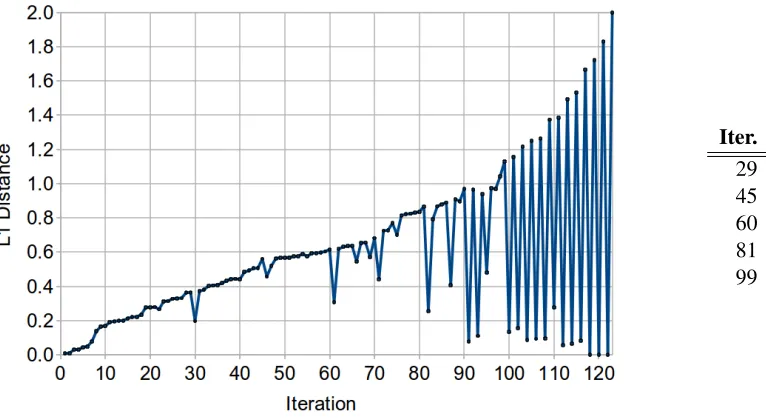
In our first set of experiments, we sought to explore the effect of increasing degrees of label collapsing on a baseline system and to determine a reasonable stopping point. Starting with the baseline grammar, we ran the label collapsing algorithm of Section 3 until all the constituent labels on each side had been collapsed into a single category. We next examined the L1 distances between the label pairs that had been merged in each iteration of the algorithm. This data is shown in Figure 2 as a plot ofL1 distance versus iteration number. The distances between the successive labels merged in the first 29 iterations of the algorithm are nearly monotonically increasing, followed by a much larger discontinuity at iteration 30. Similar patterns emerge for iterations 30 to 45 and for iterations 46 to 60. The next regions of the graph, from iterations 61 to 81 and from iterations 82 to 99, show an increasing prevalence of disconti-nuities. Finally, from iterations 100 to 123, the suc-cessiveL1distances entirely alternate between very high and very low values.
Discontinuities are merely the result of a label pair in one language suddenly scoring much lower on the distribution difference metric than previously, thanks to some change that has occurred in the la-bel set of the other language. Looking back to Fig-ure 1, for example, we could bring the distributions for JJ and JJS much closer together by merging A and ADV on the French side. Although such sudden drops in distribution difference value are expected, they may provide an indication of when the label collapsing algorithm has progressed too far, since we have so reduced the label set that categories pre-viously very different have become much less dis-tinguishable. On the other hand, further reduction of the label set may have a variety of pratical benefits.
Iter. L1Dist. 29 0.3646 45 0.5607 60 0.6155 81 0.8665 99 1.1303
Figure 2: ObservedL1distance values for the labels merged in each iteration of our algorithm on a Chinese–English
SCFG. We divide the graph into six distinct regions using the cutoffs at right.
Chinese–English MT 2003 Test Set MT 2008 Test Set System METEOR BLEU TER METEOR BLEU TER
Baseline 54.35 24.39 68.01 45.68 18.27 69.18
Collapsed, 29 iterations 55.24 27.03 63.77 46.25 19.78 65.88
Collapsed, 45 iterations 54.65 26.69 62.76 46.02 19.60 64.88
Collapsed, 60 iterations 55.11 27.23 63.06 46.30 20.19 65.18
Collapsed, 81 iterations 54.87 26.87 64.92 45.70 20.48 66.75
[image:5.612.124.490.314.414.2]Collapsed, 99 iterations 54.86 26.16 64.17 45.87 19.52 65.61
Table 1: Results of applying increasing degrees of label collapsing on our Chinese–English baseline system. Bold figures indicate the best score in each column.
references.) Table 1 reports automatic metric results for version 1.0 of METEOR (Lavie and Denkowski, 2009) using the default settings, uncased IBM-style BLEU (Papineni et al., 2002), and uncased TER ver-sion 0.7 (Snover et al., 2006).
No matter the degree of label collapsing, we find significant improvements in BLEU and TER scores on both test sets. On the MT 2003 set, label-collapsed systems score 1.77 to 2.84 BLEU points and 3.09 to 5.25 TER points better than the baseline. On MT 2008, improvements range from 1.25 to 2.21 points on BLEU and from 2.43 to 4.30 points on TER. Improvements on both sets according to ME-TEOR, though smaller, are still noticable (up to 0.89 points). In the case of BLEU, we verified the sig-nificance of the improvements by conducting paired bootstrap resampling (Koehn, 2004) on the MT 2003
output. Withn= 1000andp <0.05, all five label-collapsed systems were statistically significant im-provements over the baseline, and all other collapsed systems were significant improvements over the 99-iteration system.
Thus, though the system that provides the highest score changes across metrics and test sets, the over-all pattern of scores suggests that over-collapsing la-bels may start to weaken results. A more moderate stopping point is thus preferable, but beyond that we suspect the best result is determined more by the test set, automatic metric choice, and MERT instability than systematic changes in the label set.
6 Analysis
seek to further understand where this benefit comes from, tracing the effects of label collapsing via its modification of labels themselves, the differences in the resulting grammars, and collapsing’s effect on decoding and output.
6.1 Labels Selected for Collapsing
Our first concern is for the size of the grammar’s overall nonterminal set. The baseline system uses a total of 55 labels on the Chinese side and 71 on the English side, leading to an observed joint nontermi-nal set of 1556 unique labels. After 29 iterations of label collapsing, this is reduced to 46 Chinese, 51 English, and 1035 joint labels — a reduction of 33%. In the grammar of our most collapsed gram-mar variant (99 iterations), the nonterminal set is re-duced to 14 English and 14 Chinese labels, for a to-tal of 106 joint labels and a reduction of 93% from the baseline grammar. This demonstrates one facet of our introductory claim from Section 1: since we have improved translation results by removing the vast majority of our grammar nonterminals, most of the initial joint Chinese–English syntactic categories were not necessary for Chinese–English translation. We identify three broad trends in the sets of labels that are collapsed:
• Full Subtype Collapsing. The Chinese-side parses include six phrase-level tags for various types of verb compounds. As label collapsing progresses, these labels are all combined with each other at relatively lowL1distances.
• Partial Subtype Collapsing. In English, three of the four noun labels (NN, NNS, and NNPS) form a cohesive cluster early on in Chinese– English collapsing. However, the fourth tag (NNP, for singular proper nouns) remains sep-arate, then later joins a cluster for more adjective-like labels.
• Combination by Syntactic Function. In French–English label collapsing (see below), we find the creation of a combined label in English for reduced relative clauses (RRC), adjective phrases headed by a wh-adjective (WHADJP), and interjections (INTJ). Even though these tags are unrelated in surface form,
at some level they all represent parenthetical in-sertions or explanatory phrases.
The formulation of theL1distance metric in Sec-tion 3 means that our label collapsing algorithm will naturally produce different label clusters for differ-ent input grammars — any change in the Viterbi word alignments, underlying parallel corpus, initial label set, or choice of automatic parser will neces-sarily change the label alignment distributions on which the collapsing algorithm is based. In par-ticular, the label clusters formed in one language are likely to be markedly different depending on which other language it is paired with. We exam-ine these differences in more detail for the case of English when paired with either Chinese or with French. Our 29-iteration run of label collapsing for Chinese–English merged labels on the English side 19 times. For an exact comparison, we run iterations of label collapsing on a large-scale French–English grammar, extracted in the same way as the Chinese– English grammar, until the same number of English-side merges have been carried out, then examine the results.
Table 2 shows the English label clusters cre-ated from the Chinese–English and French–English grammars, arranged by broad syntactic categories. The differences in English label clusters hint at dif-ferences in the source-side label sets, as well as structural divergences relevant for translating Chi-nese versus French into English.
Cluster Chinese–English French–English
Nouns NN NNS NNPS # NN NNS $
Verbs VB VBG VBN VB VBD VBN VBP VBZ MD
Adverbs RB RBR RBR RBS
Punctuation LRB RRB “ ” , . “ ”
Prepositions IN TO SYM
Determiners DT PRP$
Noun phrases NP NX QP UCP NAC NP WHNP NX WHADVP NAC
Adjective phrases ADJP WHADJP
Adverb phrases ADVP WHADVP
Prepositional phrases PP WHPP
[image:7.612.127.489.60.208.2]Sentences S SINV SBARQ FRAG S SQ SBARQ
Table 2: English-side label clusters created after partial label collapsing of a Chinese–English and a French–English grammar. In each case, the algorithm has been run until merges have occurred 19 times on the English side.
6.2 Effect on the Grammar
With a smaller label set, we also expect a reduc-tion in the overall size of our various label-collapsed grammars as labeling ambiguity is removed. In the aggregate, however, even 99 iterations of Chinese– English label collapsing has a minimal effect on the total number of unique rules in the resulting SCFG. A clearer picture emerges when we sepa-rate rules according to their form. Figure 3 parti-tions the grammar into three parts: one for phrase pairs, where the rules’ right-hand sides are made up entirely of terminals (“P-type” rules); one for hier-archical rules whose right-hand sides are made up entirely of nonterminals (abstract or “A-type” rules); and one for hierarchical rules whose right-hand sides include a mix of terminals and nonterminals (re-maining grammar or “G-type” rules).
This separation reveals two interesting facts. First, although the size of the label set continues to shrink considerably between iterations 29 and 81, the number of unique rules in the grammar remains relatively unchanged. Second, the reduction in the size of the grammar is largely due to a reduction in the number of fully abstract grammar rules, rather than phrase pairs or partially lexicalized grammar rules. From these observations, we infer that the ma-jor practical benefit of label collapsing is a reduction in rule sparsity rather than a reduction in left-hand-side labeling ambiguity. Many highly ambiguous rules have had their possible left-hand-side labels ef-fectively pruned down by the pre-processing steps we described in Section 4, which in preliminary
ex-Figure 3: The effect of label collapsing on the number of unique phrase pairs, partially lexicalized grammar rules, and fully abstract grammar rules.
periments had a larger effect on the overall size of the grammar than label collapsing. As a more com-plementary technique, increasing the applicability of the fully abstract rules via label collapsing is impor-tant for performance. Such rules make up 49% to 59% of the hierarchical rules retained at decoding time, and they account for 76% to 87% of the rule application instances on the MT 2003 test set.
6.3 Effect on Decoding and Output
[image:7.612.314.538.264.441.2]60-iteration collapsed versions scored highly ac-cording to automatic metrics. Nevertheless, the 45-iteration system used 32% and 38% more rule appli-cations than the baseline on the MT 2003 and MT 2008 test sets, respectively, while the 60-iteration system used 15% and 11% fewer. The number of unique rule types and the number of reordering rules applied on a test set may also go up or down.
Instead, the practical effect of making the gram-mar more permissive seems to be a significant change in the search space explored during decod-ing. This can be seen superficially via an exam-ination of output n-best lists. On both test sets combined (2276 sentences), the 60-iteration label-collapsed system’s top-best output appears in the baseline’s 100-best list in only 81 sentences. When it does appear in the baseline, the improved system’s translation is ranked fairly highly — always 30th place or higher. Conversely, the baseline’s top-best output tends to be ranked lower in the improved sys-tem’sn-best list: among the 114 times it appears, it is placed as low as 87th.
We ran a small follow-up analysis on the transla-tion fragments explored during decoding. Using a modified version of the Joshua decoder, we dumped lists of hypergraph entries that were explored by cube pruning during Joshua’s lazy generation of a 100-best list. These entries represent the decoder’s approximative search through the larger space of translations licenced by the grammar for each test sentence. We then compared the hypergraph entries, excluding glue rules, produced on the first 100 sen-tences of the MT 2003 test set by both the baseline and the 60-iteration label-collapsed system.
A full 90% of the entries produced by the label-collapsed system had no analogue in the baseline system. The average length of the entries that do match is 2.3 source words, compared with an aver-age of 6.2 words for the non-matched entries. We believe that the increased permissiveness of the hi-erarchical grammar rules is again the root cause of these results. Low-level constituents are more likely to be matched in both the baseline and the label-collapsed system, but different applications of the grammar rules, perhaps combined with retuned fea-ture weights, leads the search for larger translation fragments into new areas.
7 Conclusions and Future Work
This paper has presented a language-specific method for automatically coarsening the label set used in an SCFG-based MT system. Our motivation for collapsing labels comes from the intuition that the full cross-product of joint source–target labels, as produced by statistical parsers, is too large and not specifically created for bilingual MT modeling. The greedy collapsing algorithm we developed is based on iterative merging of the two single-language la-bels whose alignment distributions are most similar according to a simpleL1 distance metric.
In applying varying degrees of label collapsing to a baseline MT system, we found significantly im-proved automatic metric results even when the size of the joint label set had been reduced by 93%. The best results, however, were obtained with more mod-erate coarsening. The coarser labels that our method produces are syntactically meaningful and represent specific cross-language behaviors of the language pair involved. At the grammar level, label collaps-ing primarily caused a reduction in the number of rules whose right-hand sides are made up entirely of nonterminals. The coarser labels made the grammar more permissive, cutting down on the problem of rule sparsity. Labeling ambiguity, on the other hand, was more effectively addressed by pre-processing we applied to the grammar beforehand. At run time, the more permissive collapsed grammar allowed the decoder to search a markedly different region of the allowable translation space than in the baseline sys-tem, generally leading to improved output.
ap-plying larger rules.
Another dimension to be explored is the trade-off between greedy collapsing and other methods that cluster all labels at once. K-means clustering could be a reasonable contrast in this respect; its down-side would be that all labels in one language must be assigned to clusters without knowledge of what clusters are being formed in the other language.
Finally, label collapsing is only the first step in a broader exploration of SCFG labeling for MT. We also plan to investigate methods for refining exist-ing category labels in order to find finer-grained sub-types that are useful for translating a particular lan-guage pair. By running label collapsing and refining together, our end goal is to be able to adapt standard parser labels to individual translation scenarios.
Acknowledgments
This research was supported in part by U.S. Na-tional Science Foundation grants IIS-0713402 and IIS-0915327 and by the DARPA GALE program. Thanks to Chris Dyer for providing the word-aligned and preprocessed FBIS corpus we used in our Chinese–English experiments, and to Jon Clark for suggesting and setting up the hypergraph com-parison analysis. We also thank Yahoo! for the use of the M45 research computing cluster, where we ran many steps of our experimental pipeline.
References
David Chiang. 2010. Learning to translate with source and target syntax. InProceedings of the 48th Annual Meeting of the Association for Computational Linguis-tics, pages 1443–1452, Uppsala, Sweden, July.
Michel Galley, Mark Hopkins, Kevin Knight, and Daniel Marcu. 2004. What’s in a translation rule? In HLT-NAACL 2004: Main Proceedings, pages 273– 280, Boston, MA, May.
Philipp Koehn. 2004. Statistical significance tests for machine translation evaluation. In Proceedings of EMNLP 2004, pages 388–395, Barcelona, Spain, July. Alon Lavie and Michael J. Denkowski. 2009. The METEOR metric for automatic evaluation of machine translation. Machine Translation, 23(2–3):105–115.
Alon Lavie, Alok Parlikar, and Vamshi Ambati. 2008. Syntax-driven learning of sub-sentential translation equivalents and translation rules from parsed parallel
corpora. In Proceedings of the Second ACL Work-shop on Syntax and Structure in Statistical Transla-tion, pages 87–95, Columbus, OH, June.
Zhifei Li, Chris Callison-Burch, Chris Dyer, Juri Ganitkevitch, Sanjeev Khudanpur, Lane Schwartz, Wren N.G. Thornton, Jonathan Weese, and Omar F. Zaidan. 2009. Joshua: An open source toolkit for parsing-based machine translation. InProceedings of the Fourth Workshop on Statistical Machine Transla-tion, pages 135–139, Athens, Greece, March.
Yang Liu, Qun Liu, and Shouxun Lin. 2006. Tree-to-string alignment template for statistical machine trans-lation. InProceedings of the 21st International Con-ference on Computational Linguistics and 44th Annual Meeting of the ACL, pages 609–616, Sydney, Aus-tralia, July.
Kishore Papineni, Salim Roukos, Todd Ward, and Wei-Jing Zhu. 2002. BLEU: A method for automatic eva-lution of machine translation. InProceedings of the 40th Annual Meeting of the Association for Computa-tional Linguistics, pages 311–318, Philadelphia, PA, July.
Slav Petrov and Dan Klein. 2007. Improved inference for unlexicalized parsing. InProceedings of NAACL HLT 2007, pages 404–411, Rochester, NY, April. Matthew Snover, Bonnie Dorr, Richard Schwartz, Linnea
Micciulla, and John Makhoul. 2006. A study of trans-lation edit rate with targeted human annotation. In Proceedings of the Seventh Conference of the Associ-ation for Machine TranslAssoci-ation in the Americas, pages 223–231, Cambridge, MA, August.
Ashish Venugopal, Andreas Zollmann, Noah A. Smith, and Stephan Vogel. 2009. Preference grammars: Soft-ening syntactic constraints to improve statistical ma-chine translation. InHuman Language Technologies: The 2009 Annual Conference of the North American Chapter of the ACL, pages 236–244, Boulder, CO, June.
Omar F. Zaidan. 2009. Z-MERT: A fully configurable open source tool for minimum error rate training of machine translation systems. The Prague Bulletin of Mathematical Linguistics, 91:79–88.
Ventsislav Zhechev and Andy Way. 2008. Automatic generation of parallel treebanks. InProceedings of the 22nd International Conference on Computational Lin-guistics, pages 1105–1112, Manchester, England, Au-gust.