International Journal Advances in Social Science and Humanities
Available online at: www.ijassh.com
RESEARCH ARTICLE
Awareness Levels of Possible Health Hazards Associated with the
Wearing of Lipsticks among Female Students at University of
Education, Winneba, Ghana
B.V Samlafo
Department of Chemistry Education, University of Education, Winneba, Winneba, Ghana.
Abstract
It appears people find many reasons for applying various chemical preparations such as cosmetics to their body. This study explores the reasons why female students in University of Education, Winneba (UEW) wear lipsticks and whether or not they are aware of the presence of lead (Pb) in these products, and its possible health hazards. The participants (358) were all female students in the Faculty of Science Education from levels 100 to 600 and within age bracket of 18- 20 years to above 36 years. The study revealed that, the use of lipsticks among UEW female students was common with 74.86% ( n= 268) of the participants patronising the products and 25,14% (n=90) not utilizing the products on grounds of religious and personal principles. The main reason behind the wearing of lipstick among UEW female students was self-esteem, contrary to the perception that, lipsticks are worn by female students to attract the opposite sex. However, 81.56% (n=292) of the participants were unaware of the presence of lead in lipsticks. The 18.44% of participants who claimed to be aware of the presence of lead in lipsticks could not demonstrate a basic test to show that a given product contained lead. Only 2.23% (n=8) of the participants gave the correct test for the presence of lead in a given product, though none of the 8 participants could give an example of the health implications of lead in consumable products. A total of 95.81%, (n=343) of the participants have on idea about the test for the presence of lead in lipstick. Poor reading culture and lack of scientific literacy were suspected to be some of the reasons behind female students not knowing the possible health hazards associated with the wearing of lipsticks. Hence, a cosmetic producer in business today, scarcely receive a letter of complaint saying your product has cause damage to my body.
Keywords: Cosmetic, Lipstick, Winneba, Health, Hazard, University, Female, Lead.
Introduction
Cosmetics are among several preparations
(excluding soap) that are applied to the human body for beautifying, preserving, or altering the appearance or for cleansing, colouring, conditioning, or protecting the skin, hair, nails, lips, eyes [1].
Cosmetics include skin-care creams, lotions, powders, perfumes, lipsticks, fingernail and toe nail polish,etc. The history and use of cosmetics first started in China around 3000 BC, however, the earliest records on cosmetics were found in Egypt probably because writing first started in Egypt [2] Lipstick is a subset of cosmetics called "make-up," which refers primarily to
colouring products intended to alter the user’s appearance, not exclusively worn by female [1].
Lipstick
Constituents
and
Preparation
Lipsticks are perfumed to give pleasant odour and taste. The colour of the lipsticks usually come from a dye or ‘lake’ from eosin group of dyes. A lake is a precipitate of
heavy metal ions such as Fe3+, Ni2+, Co2+,
Pb2+ Cr, Al, Cd etc. Although traces of heavy
metals are allowed in lipstick preparations, the levels should not be above the permissible levels. The metal ion enhances the colour or changes the colour of the dye. The two suitable dyes, used with their lakes are dibromo fluorecein (yellow) and tetrabromo fluorescein (red). The skin on human lips is covered by a very thin corneal layer which is free from fat and easily dries out. In order to protect the drying effects of wind and air, female students wear lipsticks (they may have other purposes in mind-beauty).
Paraffin oil, used as moisturizer in lipsticks, seals off the skin, creating a barrier which feels slick, but does not allow the skin to breath, thus preventing the organ from performing its essential functions. This ultimately causes slowing down of the skin’s function and normal cell development, resulting in premature aging and many other health and skin disorders such as contact dermatitis [3].
Synthetic fragrances or perfumes which impact pleasant tastes to the lipstick can have as many as 200 ingredients. Some problems caused by these chemicals include hormonal disruption, headaches, dizziness, rash, hyperpigmentation, violent coughing, vomiting, and skin irritation [3].
Butylated hydroxyanisole (BHA) and the
related compound butylated hydroxyl
toluene (BHT) are phenolic compounds that are added to lipstick formulations as
preservatives. BHA and BHT are
antioxidants. Oxygen reacts preferentially with BHA or BHT rather than oxidizing fats or oils, thereby protecting lipsticks from spoilage and extending the shelf - life span. These compounds are carcinogens and hormone disruptors, and may cause liver damage. The presence of lead in synthetic lipsticks led to the formulation of herbal lipsticks (natural) which are taught to be lead free [4,5]. However, some of the
chemical compounds in the synthetic formulations are also present in the herbal
formulations such as paraffin wax,
fragrance, surfactant, flavouring agent and anti-oxidant to extend shelf- life span [4], [5].
Dyes and pigments that add colour can be synthetically produced from “coal tar” dyes, which may add harmful metals to the lipstick. Minerals such as titanium dioxide, iron oxide, and mica are also used as colour additives [6].
Fragrance is sometimes added to mask the odour of other ingredients or enhance the smell of flavoured lipstick products. Ingredients for synthetic fragrances are not required on the label and may contain allergens or irritants. Natural fragrances include vanilla and peppermint [6].
Trimethylsiloxysilicate (TMS) has a great potential for enhancing wear, delivering a glossy effect and increasing adherence to the lips. It is used in some lipsticks as a film-former. Its net-like structure and adhesive properties means it holds pigments in place, displays water-resistance and improves wear [7].
The presence of lanolin and lead (Pb) in lipstick formulations raised some possible health concerns for the consumers especially female. The waxy texture of lanolin allows bacteria in air to fall on it and gets hold onto it. These bacteria have a high tendency to be ingested unconsciously after licking the lip during the process of eating or drinking and hence results in health implications.
Impact of Lead on Health
People are generally exposed to lead by three major ways: inhalation, ingestion and absorption. Routes of exposure to lead include contaminated air, water, soil, food, and other consumer products.
cardiovascular, renal, gastrointestinal, haematological and reproductive effects. Children of six years old and below are more
at risk[8] .
Adults that are exposed to high levels of lead can experience anaemia, nervous system dysfunction, weakness, hypertension, kidney problems, decreased fertility, increased level of miscarriages, low birth weight, hormonal changes or menstrual irregularities and premature deliveries. Children exposed to high levels of lead show similar symptoms,
such as anaemia, kidney damage,
neurological impairment, and impaired vitamin D metabolism. Lead is cumulative, it builds up in the body. Throughout our life we can be exposed to it from many sources and no safe level of lead exposure has been determined. According to World Health Organization, no blood lead level is safe WHO, [9].
According to a study by Sah, Ram Charitra, [8], lead poisoning causes a wide range of problems from low intelligence quotient (IQ) and slowed growth in children to memory loss, and mood disorders. Exposure to lead can also cause a range of deleterious health effect from behavioural problem and learning disabilities to seizures and death. Pregnant female and young children are particularly vulnerable to lead exposure because lead easily crosses the placenta and may enter the foetal brain, where it interferes with normal development. Lead has also been linked to reduced fertility in both men and female, as well as hormonal changes, and delays in the onset of puberty. In the same study, Sah, Ram Charitra [8], concluded that lead also builds up in the
body over time and lead‐containing lipsticks
applied several times a day, every day, combined with lead in water and other sources, could add up to significant exposure
levels. Female inadvertently eat about 1.8kg
of lipsticks in a lifetime.
Empirical Evidence of Lead Levels in Lipsticks
A study by a US consumer group’ Campaign for Safe Cosmetics’, in October 2007 found 60 percent of lipsticks tested to contain trace amounts of lead, especially in red lipsticks.
The levels of lead varied from 0.03ppm to 0.65 ppm. One third of the lipsticks containing lead exceeded the 0.1 ppm limit set by the U.S. Food and Drug Administration (USFDA) for lead in candy. Lead is used in lipstick mainly for the required pigments to obtain the needed colours. [8]. According to Sah Ram Charitra [8], lead content of all the 8 lipsticks analysed ranged from 90ppm to 125 ppm. The Lead content also varies across brands and shades/colour. None of these samples labelled lead as an ingredient in their product. The study concluded that, besides the lack of awareness among all active as well as passive consumers of lipsticks, Children, pregnant and breast feeding mothers are the major groups affected. There is no exact guideline for lead in cosmetics. However some comparative, guidelines are used to limit the lead in lipstick. U.S. Food and Drug Administration, has set up 0.1 ppm limit for lead in candy- to protect the people from directly ingesting the lead which is used for lipstick as well [8].
In a study conducted by Nancy M. et al [10],
laboratory analysis for the total lead concentration in studied brands of the lipsticks can be summarized as follows. All tested samples (100%) exceeded the US Food and Drugs Administration’s standard for lead in candy of 0.1 (ppm), ranging from 30 ppm to 145 ppm. The highest value of 145 ppm was found in Sample NPA4 (M.A.C. Brand). This is 1,450 times more than the permitted 0.1 ppm. The Least of 30 ppm was found in sample NPA2 (Loreal Paris Brand). This is again 300 times more than the standard value.
Similarly, Health Canada Product Safety Laboratory while reviewing and analysing the results of heavy metal testing on a number of 15 cosmetics sold in Canada reported that, lead level exceeding 10 ppm is considered technically avoidable. They found
detectable levels of lead, cadmium,
chromium, aluminium and five other metals in the products.
There are no government agencies in Ghana responsible for regulating lead in cosmetics. Neither a government agency nor the private sector monitors the heavy metal impurities in cosmetics imported, produced, marketed, distributed and used in Ghana. Thus no institution seems to bother about the content and even labelling as well as expiry dates of such products.
Basic Test for Lead in Lipstick
One can test for lead in lipstick product by
rubbing the product on a foil and using a tissue paper to clean it. If the product contains lead, the tissue paper would be darken. The levels of lead in the product determine the intensity of the darkness. The theory behind the test is that tissue paper contains sulphur by design. The sulphur in the tissue paper react with the lead in the lipstick to give a black precipitate of PbS. [
Pb2+ + S2- → PbS (black precipitate)]. Others
claimed you can also use the gold ring test. This survey explores reasons why female student in the Faculty of Science Education, in the University of Education, Winneba wear lipsticks and their awareness levels of lead in the product and the possible health hazards associated with the wearing of lipsticks.
Methodology
Study Area
The University of Education, Winneba (UEW) was established in 1992, with the core mandate of training teachers. It is a multi-sited campus university. It has six campuses, Three at Winneba and one at Ajumako all in Central region of Ghana, and the other two at Kumasi and Mampong all in the Ashanti Region of Ghana. The Faculty of Science Education is located at the South campus at Winneba. UEW is charged with the responsibility of teacher education and
producing professional educators to
spearhead a new national vision of education aimed at redirecting Ghana's efforts along the path of rapid economic and social development.
UEW is expected to play a leading role in Ghana's drive to produce scholars whose
knowledge would be fully responsive to the realities and exigencies of contemporary Ghana. The University has twenty-nine academic departments and centres and eleven faculties. It also has 20 distance education study centres throughout Ghana. The Faculty of science has nine academic departments.
Research Design
The study adopted the purposive sampling design where selected participants have a science, background. The participants were all female students, drawn from the Science Education Faculty of the University of Education, Winneba.
Instrument
An in-depth interview was conducted among participants from levels 100 to 600 and aged between 18- 20 years to above 36 years. The interview took 15-20 minute for a participant. The interview explored a wide range of topics such as consumption patterns, product quality, brand, expiry dates on products and whether or not the
consumer check for ingredients or
composition of the products. The interviews were taped and transcribed. The transcripts were analysed for repeated themes, which were further explored to develop a quasi-structured questionnaire.
Methodology and Data Collection
The participants were selected at random from levels 100 to level 600 in each academic department.
Results and Discussion
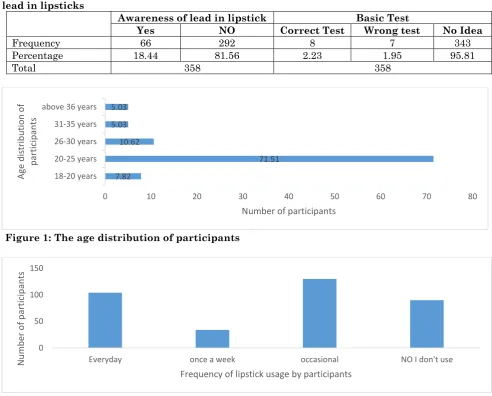
The participants reflected an even spread across the 18- 20 years ( undergraduate) to above 36 years ( postgraduate) age group. (Table 1)
Table 1: Age distribution of the participants
Age group/years Frequency Percentage
18- 20 28 7.82
20-25 256 71.51
26-30 38 10.62
31-35 18 5.03
Above 36 18 5.03
Total 538 100
In investigating the frequency of wearing the lipstick, (Table 2), 29.05%, representing 104 participants claimed they used the product every day, while 9.49% representing 34 participants used the product once a week and 36.31% representing 130
participants used the product on occasions.
However, 25.14% representing 90
participants claimed they do not use the
product. From the survey, most of the participants who do not use the product based their reasons on religious grounds, while others do not use it as a matter of principle.
Table 2: Frequency of lipstick usage by participants
Rate of usage Frequency Percentage
Everyday 104 29.05
Once a week 34 9.49
Occasional 130 36.31
NO I do not use it 90 25.14
Total 358 100
In exploring how female feel when they wore lipstick, the result suggested that the wearing of lipstick for the purpose of attracting the opposite sex as suggested by
literature or perceived (Ogilvie Madeleine et
al [13]), was not as high as self –esteem and
confidence. Hundred and two (102) participants representing 38.06%, felt good
when they wore lipstick. While 22 participants representing 8.21%, felt as complete women when the lipstick is worn. Others, 120 participants representing 44.78%, felt presentable when they wore
lipstick. However, 22 participants
representing 8.21%, thought they felt confident on wearing lipstick and 2 participants representing 0.75% consider themselves powerful when they wore lipstick ( Table 3).
Table 3: How participants feel when they wear lipstick
Self-esteem Frequency Percentage
Good 102 38.06
Complete woman 22 8.21
Presentable 120 44.78
Confident 22 8.21
Powerful 2 0.75
Total 268 100
lead (Pb) in the products (Table 4), 292 participants representing 81.56%, including consumers and non-consumers claimed they were not aware of the presence of lead in the products and therefore do not know the possible health hazards associated with the use of the products. In a qualitative interview with the users of the products, some of the participants said that, even if they know that their products contain lead, they do not know the health implications of lead in consumable products.
While 66 participants representing 18.44%, claimed that they were aware of the presence of lead in lipsticks, majority of them do not know the basic test to demonstrate the presence of lead in lipstick.
Seven participants representing 1.95%, gave wrong tests in demonstrating a basic test to show that a given lipstick product contains lead. It was only 8 participants representing 2.23%,that gave the correct test to demonstrate that a give product contained lead. Interestingly, those who gave the correct test do not know the hazardous nature of lead in consumable products or when their products would expire. According to this group of consumers, they heard the test for lead in lipsticks from peers and
friends. However, 343 participants
representing 95.81%, claimed to have no idea about the test for the presence of lead in lipsticks. Poor reading culture and poor scientific literacy among University female student have been suspected to be the main reasons for not reading labels on products purchased.
Table 4: Awareness levels of Lead in lipsticks and the basic test to determine the presence of lead in lipsticks
Awareness of lead in lipstick Basic Test
Yes NO Correct Test Wrong test No Idea
Frequency 66 292 8 7 343
Percentage 18.44 81.56 2.23 1.95 95.81
Total 358 358
Figure 1: The age distribution of participants
Figure 2: The frequency of lipstick usage by participants
7.82
71.51 10.62
5.03 5.03
0 10 20 30 40 50 60 70 80
18-20 years 20-25 years 26-30 years 31-35 years above 36 years
Number of participants
Age
d
is
trib
u
tio
n
o
f
p
articipan
ts
0 50 100 150
Everyday once a week occasional NO I don't use
N
u
m
b
er
o
f p
ar
ticip
an
ts
Conclusions
From the survey, it became clear that apart from religious reasons and personal principles, lipstick is seen by some University female student as a vehicle for transformation to achieve self-esteem. It is perceived by University female student as an important factor in their daily grooming practices and considered by many as an essential addition to their faces in order to feel presentable, good and powerful. Awareness levels of female student were found to be generally poor with 81.56% not knowing the presence of lead in the product they use. Even those who claimed to have known, do not know the health implications of lead. These figures are worrying especially considering the fact that these
results are emanating from a University- an enlighten environment.
The study thus highlights the need to extend the research to female who are illiterates or have low levels of education since their
University counterpart with science
backgrounds who should have known better showed complete lack of scientific literacy and poor reading culture especially in reading product labels on consumer products.
Acknowledgments
The author is grateful to Bobobee, a senior lecturer at Department of Chemistry Education, Winneba and other colleagues for
reading through the manuscript
References
1.http://www.britannica.com/art/cosmetic Retrieved 6-02-2016
2.http://www.encyclopedia.com/topic/cosmetics.aspx Retrieved 6-02-2016
3.Wondering About Lead in Lipstick? (http://www.natural-living-for-female.com/lead-in-lipstick.html
4.Meher Deepali Avinash, Alai Manoj Hari, Nikam Shreya Pradeep(2011). Herbal lipstick formulation: A new Approach, International journal of Research in Ayurveda &Pharmacy, 2(6),1795-1797.www.ijrap.net.
5.Swetha Kruthika, V, Sai Ram,S, Shaik Azhar Ahmed, Shaik Sadiq, Sraddha Deb Mallick, and Ramya Sree, T. (2014). Formulation and Evaluation of Natural Lipstick from Coloured Pigments of Beta vulgaris Taproot. Research and Review: Journal of pharmacy and pharmaceutical Sciences, 3(3), 65-71.
6. www.enotes.com/homework-help/what-lipstick-how-made-468049hape
7.http://greenopedia.com/article/what-is-in-lipstick
8.Sah, Ram Charitra (2012) Poisonous Cosmetics, the Problem of Lead in Lipstick in Nepal, Kathmandu: CEPHED, 1-18.
9.WHO (2010) Preventing disease through healthy environment, Exposure to lead: a major public health
concern, Geneva, Switzerland p-1-6
www.who.int/ipc/assessment/public_health/lead/en/
10.Nancy M. Hepp, William R. Mindak, and John Cheng,(2009). Determination of total lead in lipstick: Development and validation of a microwave-assisted digestion, inductively coupled plasma–mass spectrometric method, Journal of Cosmetics Science., 60, 405–414.
11.Guidance to Heavy metal impurities in cosmetics. http://www.hc-sc.gc.ca/cps-spc/pubs/indust/heavy_metals-metaux_lourds/index-eng.php
12.UEW (2015) Basic statistics at 20th congregation, UEW, 6.