AUSTRALIAN JOURNAL OF BASIC AND
APPLIED SCIENCES
ISSN:1991-8178 EISSN: 2309-8414 Journal home page: www.ajbasweb.com
Open Access Journal
Published BY AENSI Publication
© 2017 AENSI Publisher All rights reserved
This work is licensed under the Creative Commons Attribution International License (CC BY).
http://creativecommons.org/licenses/by/4.0/
To Cite This Article: Kouloughli Imen and Berber Sihem, Sari Zaki., Validation of single and double cycle models and Performance evaluation of a multi-aisle AS / RS. Aust. J. Basic & Appl. Sci., 11(5): 187-195, 2017
Validation of single and double cycle models and Performance evaluation
of a multi-aisle AS / RS
1Kouloughli Imen and 2Berber Sihem, 3Sari Zaki
1,2,3University of Tlemcen, Manufacturing Engineering Laboratory of Tlemcen, BP. 230 Faculty of Technology Tlemcen Algeria
Address For Correspondence:
Kouloughli Imen, University of Tlemcen, Manufacturing Engineering Laboratory of Tlemcen, BP. 230 Faculty of Technology Tlemcen Algeria.
A R T I C L E I N F O A B S T R A C T Article history:
Received 18 January 2017 Accepted 28 April 2017
Available online 25 April 2017
Keywords:
Manufacturing system, multi-aisle AS/RS, simulation, analytical approach
In this paper we are interested in multi aisle automated storage/retrieval system (AS/RS). Multi-aisle AS/RS is characterized by aisle used for circulation for a single storage/retrieval machine. The aim of the work is to simulate a multi-aisle AS/RS to evaluate the cycle time and to compare the results obtained with the analytical results. In this paper we are interested in multi aisle automated storage/retrieval system (AS/RS). Multi-aisle AS/RS is characterized by aisle used for circulation for a single storage/retrieval machine. The aim of the work is to simulate a multi-aisle AS/RS to evaluate the cycle time and to compare the results obtained with the analytical results.
INTRODUCTION
Flexible Manufacturing Systems can quickly change products or manufacturing sequences, without losing of their productivities, provided to have the possibility to acquire the good product: palette, support, or tool, at the right place and time. For this to become possible, it is required to have an efficient system that regulates the storage/retrieval operation and transport. An integrated system, consisting of a Flexible Manufacturing System, an Automated Guided Vehicle System and an AS/RS system, allows a very effective production of a great variety of products in small and average quantities.
Material Handling Institute (1977) defines an automated storage/retrieval system (AS/RS) as follows: «It is a combination of equipment and control systems that take in charge, store and retrieve products with precision, accuracy and speed under a certain degree of automation ».
The basic formofanAS/RSconsistsof an aisle whichhas arackon each side. Eachrackhas a certain number of small bins. The aisleis served byaStorage/Retrievalmachine(S/R) whose role is to store products in bins and then retrieve them. This is called a Unit Load AS/RS which is the most studied system. Automated Storage/Retrieval Systems can be classifiedaccording to the position of the storage binsand the number ofS/R machinesservingthese bins. Some of these are: unit load AS/RS, multi-aisle AS/RS, sliding-rack AS/RS, miniload AS/RS, carousel AS/RS, man-on-board AS/RS, deep-lane AS/RS, flow rack AS/RS, … The unit load AS/RS is a generic system, multi-aisle AS/RS, whereas the miniload, man-on-board, deep-lane, gravity conveyor, sliding-rack, …In this work, we are interested in multi-aisle AS/RS systems.
Many studies have been devoted to the cycle times of an S/R machine. Most of them concerned unit-load AS/RS. Hausman et al. (1976) were among the pioneers to develop an analytical model to study unit-load AS/RS. They addressed the problem of optimal storage assignment. They considered three strategies: random storage, dedicated storage and class-based storage.
They showed an important reduction in the cycle time that was obtained in dedicated storage compared to a purely random storage. Bozer and White (1984) used a continuous approximation of the storage rack in order to develop a mathematical expression that allows the calculation of single and dual cycle times. The AS/RS considered are of a unit-load type, with a rectangular rack and a random storage strategy. They studied several positions of the input/output point. Han et al. (1987) developed a mathematical expression that evaluates the time of a dual cycle, under the nearest-neighbor rule. Under this rule, the requests of the nearest storage and retrieval are matched in order to minimize the time of a dual cycle. In Hwang et Ko (1988), the authors suggested a mathematical expression for multi-path AS/RS, where they considered each rack as a continuous face and for each rack they developed an analytical expression of the cycle time. Lerher et al. (2005) suggested an analytical model for the cycle time of a multi-path AS/RS in which the authors took into consideration the acceleration and deceleration of the S/R machine. The authors, in Sari et al. (2003) and Sari (2005), considered flow rack AS/RS systems, for which they developed a continuous mathematical expression of the cycle time. Park et al. (2006) studied theperformancesof different types ofAS/RSbased on class-based storage. Roodbergen(2009)presented aliterature review in the fields ofdesign, estimation of cycle times,storage policies, and dwell point position ofStorage/Retrieval machines as well as the scheduling of Storage/Retrieval requests.
In our previous works, we determined the optimal dimensions of a multi-aisle Automated Storage Retrieval System (AS/RS) for a minimal single cycle time (Kouloughli et al., 2010) and for a minimal dual cycle time (Kouloughli et al., 2011), using single and dual cycle analytical expressions established by Ghomri et al. (2008, 2009). These expressions have got three real variables. In addition to the causality constraints of horizontal and vertical transport durations, we face another constraint on the system size and its constancy. This brought us back to optimization problems over two real numbers of functions with three variables, with constraints. In order to optimize these functions, a relaxation of the constraint on the system size was made possible through some variable changes. This helped to reduce them to two-variable functions.
In another work (kouloughli et al., 2015) we consider additional constraints to our optimization problem (kouloughli et al., 2010, 2011): one or two dimensions of the systems are fixed to a constant
In the first part of this work we consider the discrete analytic expressions of the single and dual mean cycle times of a multi-aisle AS/RS established by (Sari 2003), which allows us to calculate the analytical values of the cycle time.
We then proceed to a simulation which consists in constructing a model of a multi-aisle storage/retrieval system and conducting experiments on this model for different sizes and load rates, with the aim of Validate the discrete expressions of the cycle time.
We will therefore determine the relative differences between the analytical approach and the simulation. In the second part we propose a heuristic to optimize the travel times of the S/R machine by taking into account the location of the product to be removed before choosing the storage bin and consequently the Cycle time will be reduced.
Description Of Multi Aisle As/Rs:
According to Material Handling Institute (1977) an automated storage/retrieval system (AS/RS) can be defined:
A combination of equipment and control systems that take in charge, store and retrieve products with precision, accuracy and speed under a certain degree of automation.
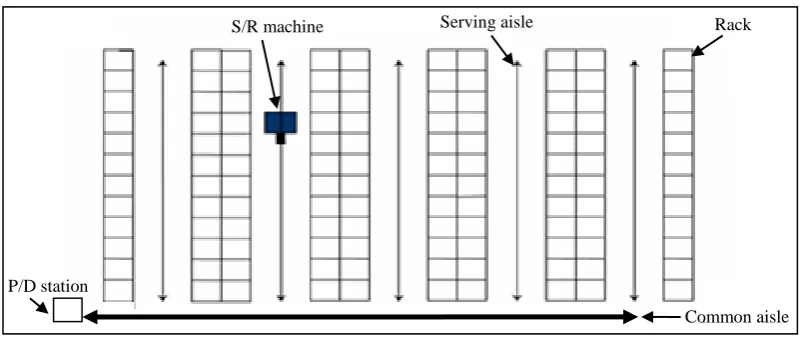
A multi-aisle AS/RS is composed of a set of fixed racks, arranged in pairs in a parallel way and separated by aisles. Each of these aisles, called a serving aisle, gives access to the two racks. A common aisle, perpendicular to racks, links all serving aisles (figure 1). A storage/retrieval machine serves all racks. It moves along three axes: vertically, along the columns making the racks; horizontally, along the serving aisles; and crosswise, along the common aisle where one end is supplied with a Pickup/Delivery (P/D) station.
Fig. 1: Multi aisle AS/RS
The S/R machine can operatein single ordual cycle:
Inasinglecycle,the machine movesfrom the pick-up and deposit (P/D) station to the Storage/Retrieval bin, where it drops or recovers theproductand returns back to the P/D station.
Inadualcycle,the storage andretrievaloperations areperformedsimultaneously. After the storage operation, the S/R machinedoes not return tothe P/D station butgoes to retrievalbin to perform a retrievaloperation, so it recovers the product and returns to the P/Dstation.
Expression Analytique Du Temps De Cycle D’un As/Rs Multi Allees :
In this section we present a discrete analytic expression for multi-aisle AS/RS (Sari 2003).
The discrete approach is an exact approach, based on the determination of the transport times of all the bins and the calculation of the average of these times.
Either a multi-aisle AS/RS consisting of M aisle, Nl horizontal bins and Nh vertical bins per rack, where tp is
displacement time from P/D station to the last aisle, th is time for horizontal displacement from the first to the
last bin in a rack and tv is time for vertical displacement from the first to the last bin in a rack. We can write:
M
t
t'
p
pl h
N
t
t'
hh v
N
t
t'
vt’h: The horizontal travelling time from a bin to the next one;
t’v : The vertical travelling time from a bin to the next one;
t’p : The travelling time from an aisle to the nearest one in a Multi aisle AS/RS;
)
(
SC
E
: Average single cycle time;)
(
DC
E
:Average dual cycle time; N: The entire number of bins; N=2*(M*Nl*Nh)The average cycle time is determined to be the average of the transport times of all the bins in the system.
Average Single Cycle Time :
The average single cycle time includes the travel time from the S/R machine to the storage/retrieval bin and the return time from that same bin to the P/D station.
Rack S/R machine
Common aisle Serving aisle
P/D station
/21 1 1
v p
h
│
0
-
i
│
(k
-
1)
t'
),
t'
│
1
-
j
│
]
t'
(
[
max
)
/
4
(
)
(
M
k Nl
i Nh
j
N
Average Dual Cycle Time:
The average dual cycle time therefore includes the travel time from the S/R machine to the storage bin (E(SC1)), the travel time from the S/R machine of the storage bin to the retrieval bin (E(TB)) and the return time of the S/R machine from this retrieval compartment to the P/D station (E(SC2)).
- If the storage and destocking are done on the same aisle (k1 = k2)
- If the storage and the retrieval are done on two different aisles (k1 ≠ k2)
Simulation Of A Multi Aisle As/ Rs By The Software Arena :
Simulation with events discrete allows the reproduction of the behavior of complexes systems not easily controllable and possibly subjected to random phenomena. The real system behavior with all its components (physics, informational, decisional) is thus replaced by a virtual model having a similar behavior. The utilized simulator is a computer program making it possible to carry out experiments in order to apprehend the behavior of the real system, to evaluate its performances and to help with the anticipation of possible drifts. The aim of our simulation is to validate the analytical expressions suggested in precedent sections. For that, it was necessary a model making it possible for us to simulate the behavior of system having unspecified sizes. More than a simple simulator, we needed a tool allowing the automatic generation of M-AS/RS model.
To simulate the studied mobile storage system we chose to use the Arena software of Rockwell Software. The system ARENA is an integrated support of modeling, it making possible to build detailed models for a wide range of possible applications. ARENA also integrates all the functions related to simulation, such as: animation, data analysis of input, the checking of the model and analysis of the results in only one environment of modeling.
Organizational Chart Of Simulated Models :
Figure 2 which follow represent the flow organizational chart of the steps of the storage operation in a multi-aisle system.
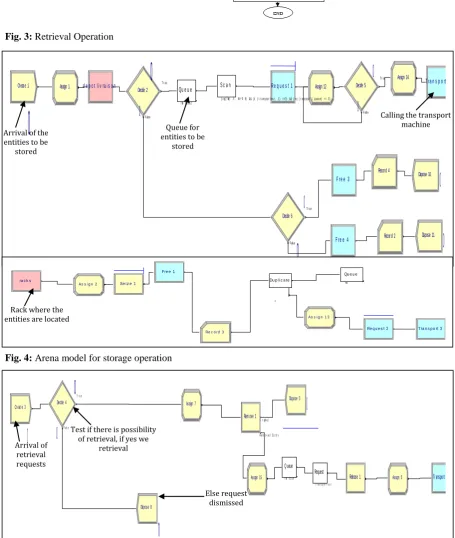
Figure 3 shows the flow organizational chart of the steps of the retrieval operation in a multi-aisle system. The storage methodology specifies the location of the products according to imposed rules. There are two modes for storage systems: dedicated systems where each product has its own well-defined location and open systems where random storage occurs.
In this work we are interested in random storage because it is generally used as reference in different studies, in this type of storage, any product can be stored in any bin. A very elaborate control system stores the addresses of each type of product.
Fig. 2: Storage Operation
E(TB) = max (t’h. |i2-i1|, t’v. |j2 – j1|)
E(TB)= max [(t’h|i2+i1|+ t’p.|k2-k1|), t’v|j2-j1|] knowing that (i1+i2) =│i1-i2│+2min (i1, i2)
│] j -1 │ t' ); t' 1) -(k │ 0 -i │ t' ( max[ ] │ j -1 │ t' ), T ; t' 1) -(k max( │ i -0 │ t' ( [ max ) / 2 ( )
( h p v
2 /
1 1 1
v r p
h
Fig. 3: Retrieval Operation
Fig. 4: Arena model for storage operation
Create 1 Assign 1 d e p o t l i v ra i s o n Re q u e s t 1 T ra n s p o rt 1
Decide 2
Tr ue
Fals e
Assign 12 Decide 5
Tr ue
Fals e f ile s c an2
Qu e u e
( nq( f ile) . lt . 64* 0. 9) && ( it ( t r ans por t eur , 1) ==0) && ( nq ( r eques t 1. queue) == 0)
S c a n
F re e 3 Dispose 10
Decide 6
Tr ue
Fals e F re e 4
Dispose 11 Assign 14
Record 2 Record 4
0
0
0
0
0
0
0
0
0
Arrival of the entities to be
stored
Queue for entities to be
stored
Calling the transport machine
ra c k s
Fre e 1 Se i z e 1
A s s i g n 2
Tra n s p o rt 3 1
Du p l i c a te
A s s i g n 1 3
f ile
Qu e u e
Re q u e s t 2
Re c o rd 3
Rack where the entities are located
Release 1 Assign 5 Transport 2
Assign 7 Dispose 5
O r ig in a l Re m o v e d En t it y
Rem ove 1
Cr eat e 3 Decide 4
T r u e
F a ls e
Dispose 8
T r a n s p o r t e u r
Request
f ile s c a n
Q ueue Assign 15
0
0
0
0
0
Arrival of retrieval requests
Test if there is possibility of retrieval, if yes we
retrieval
Fig. 5: Arena model for retrieval operation
Arena Model For Storage Operation (Figure4):
The entities to be stored are of the same type and arrive at every 20 units of time to the system according to an exponential distribution law (create1).
The depot / delivery station represents the entry point to the system for the products to be stored and the point of exit for the products to be retrieval
For a product to be stored the following conditions must be met:
- The number of products waiting in the queue must be less than 90% of the total system storage space. The transport machine must be empty
If one of these conditions is not verified, the product will be placed in the queue of products to be stored or rejected if the queue is full.
We prioritize storage and retrieval operations:
If the filling rate of the system is less than 90% then the storage operation takes priority, else the retrieval operation becomes the priority. (These priorities serve to maintain a balance in the storage system).
To store, the choice of the bin is made randomly, we must just verify that the bin chosen contains noresource, otherwise we will have to choose another bin.
The station (racks) contains all the stations that represent the storage bins. After each storage or retrieval operation the transport machine must be released.
Each stored item is duplicated, one is put in the queue to be retrieval on demand and the other (virtual type) is used to return the transport machine to the Pickup/Delivery (P/D) station.
Arena Model For Retrieval Operation (Figure5):
Retrieval requests come every 20 units of time to the system according to an exponential distribution law (create 3).
We test if the retrieval has priority then we retrieve, else the request is rejected (disposes 8).
The product to be retrieval is chosen randomly. It is removed from the queue of the already stored products (2nd module queue),the resource located in the bin is then released.
The transport machine sends the product to the P/D station
Results And Interpretation :
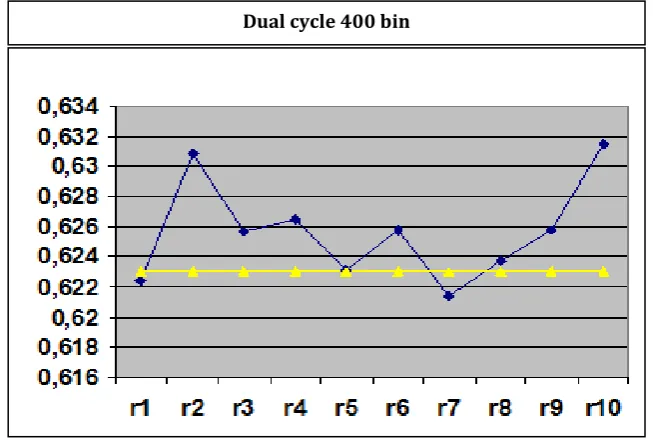
We have simulated three systems of different sizes (system with 64 bins, system with 100 bins and system with 400 bins) we give here below curves representing the cycle time of the system to 400 bins for the two cases single(figure 6) and dual cycle(figure 7).
Create 4
ra c k s . c a s i e r > = 4 0 0 *9 0 / 1 0 0
Scan
Assign 11
Dispose 9
0
0
Arrival of a single entity of virtual type that will serve us to know the moment or the 90% of the total storage space will be used. At this moment the retrieval will be priority
Number of replications of the simulation
Fig. 6 : Representation of the results of the system with 400 bins for the case of the single cycle
Number of replications of the simulation
Fig. 7: Representation of the results of the system with 400 bins for the case of the dual cycle
Table 1: Analytical value and result of the simulation
System of Analytical value Average of 10 replications
of simulation
Différence
64 bins (storage simple cycle) 0.20625 0.206631 0.381 0/
00
64 bins (retrieval simple cycle) 0.20625 0.206649 0.399 0/
00
64 bins (dual cycle) 0.332459 0.326663 5.796 0/
00
100 bins (storage single cycle) 0.2350 0.234707 0.293 0/
00
100 bins (retrieval single cycle) 0.2350 0.234636 0.364 0/
00
100 bins (dual cycle) 0.37869 0.374823 3.867 0/
00
400 bins (storage single cycle) 0.388750 0.386658 2.092 0/
00
400 bins (retrieval single cycle) 0.388750 0.386636 2.114 0/
00
400 bins (dual cycle) 0.622976 0.625657 2.681 0/
00
The results given by the simulation are very close to the values calculated by the analytical expressions, the most important difference is 5.796 0/
00 which confirms a good simulation.
Storage graph Single cycle 400 bin
Retrieval graph Analytical value
Value estimated by the simulation
Improving The Cycle Time By A Heuristic :
In order to reduce the cycle time of the multi-aisle AS/RS, we also simulated a system that behaves more particularly before a request for storage or retrieval. (table2)
In the system that uses the heuristic, the transport machine is initially at the P/D station. When a retrieval request is received, a bin containing an entity is chosen randomly from the rack (retrieval bin).
Before the retrieval operation can be carried out, the transport machine must first store and therefore the storage bin will be chosen as follows:
It is a priority to store in a bin having the same address as the retrieval bin, ie: a opposit bin in the adjacent rack.
If this bin is occupied, we then look for a storage bin on the way to the transporter to access the retrieval bin.
If we still have not found an empty bin, we continue our search on the bins closest to the retrieval bin (The closer the bin is to the retrieval bin, the more priority it has).
Table 2: Value of the cycle time before and after use of the heuristic
Load Rate 10% 20% 30% 40% 50% 60% 70% 80% 90% 98%
Without heuristic 0.312 0.32 0.322 0.324 0.325 0.325 0.326 0.325 0.326 0.327
With heuristic 0.276 0.26 0.257 0.256 0.251 0.248 0.247 0.245 0.244 0.250
Difference 3.57% 5.51% 6.46% 6.76% 7.32% 7.76% 7.97% 8.07% 8.24% 7.63%
Conclusion:
The detailed study of AS/RS has highlighted their importance in the field of industry and production, and has confirmed its performances in the various fields of application, namely, a better stock management, by minimizing the single cycle time of the S/R machine and optimizing security.
The multi-aisle AS / RS is characterized by the existence of several racks separated by aisles used for the circulation of the S/R machine.
In this work, the two analytical expressions of the cycle time were used, the first for a multi-aisle storage /retrieval system operating in single cycle, and the second for a system operating in a dual cycle.
The simulation of these systems allowed us to compare with the values given by the analytical expressions. The results obtained by the simulation were very close to the values calculated by the analytical expressions. The largest margin of error between these two approaches is 1.743%.
REFERENCES
Material Handling Institute., 1977 « Consideration for planning and installing an automated storage/retrieval systems », Inc AS/RS document, 100 7M.
Hausman, W.H., L.B. Schwarz, S.C. Graves, 1976, « Optimal storage assignment in automatic warehousing systems », Management Science, 22(6): 629-638.
Bozer,Y.A., J.A. White, 1984. « Travel time for automated storage/ retrieval systems », IIE transactions, 16(4): 329-338.
Han, M.H., L.F. McGinnis, J.S. Shieh, J.A. White, 1987. « On sequencing retrievals in an automated storage/ retrieval system », IIE transactions, 19: 56-66.
Hwang, H., C.S. Ko, 1988. « A study on multi aisle system served by a single storage/ retrieval machine », International journal of production research, 26(11): 1727-1737.
Lerher, T., M. Sraml, J. Kramberger, I. Potrc, M. Borovinsek and B. Zmazek, 2005. «Analytical travel time models for multi aisle automated storage and retrieval systems» International Journal Advanced Manufacturing Technology, 30(3): 340-356.
Sari, Z., 2003. “Modélisation, analyse et évaluation des performances d’un AS/RS à convoyeur gravitationnel”. Thèse de doctorat d’état, Université de Tlemcen Algérie.
Sari,Z.,C. Saygin, N. Ghouali, 2005. “Travel-time models for flow-rack automated storage and retrieval systems”. International journal Advanced Manufacturing Technology, 25: 979-987.
Park,B.C., 2006. « Performance of automated storage/retrieval systems with non-square-in-time racks and two-class storage ». International journal of production research, 44: 1107-1123.
Roodbergen, K.J. et I.F.A. VIS, 2009. «A survey of literature on automated storage and retrieval systems, », European Journal of Operational Research, 194: 343-362.
Kouloughli, S., Z. Sari, 2011. “Optimisation de deux dimensions d’un AS/RS multi allées en fixant la troisième pour minimiser le temps de cycle”. Acte des 7e Conférence Internationale de Conception et Production
Intégrée, Hammemet.
Kouloughli, S. and Z. Sari, 2015. « Multi-aisle AS/RS dimensions optimization for cycle timeminimization », International Journal of Advanced Manufacturing Technology IJAMT,vol 76, DOI 10.1007/s00170-014-6709-3, ISSN 0268-3768.
Ghomri, L., Z. Sari, A. Guezzan, T. Sari, 2008. « Modèle analytique du temps de simple cycle d’un AS/RS multi allées », conférence internationale de modélisation et simulation, Paris.