I J H S
Original Article
International Journal of Health Studies
The Relationship between Workplace Stress with Burnout and Quality of Work Life
among Managers and Staffs of the University of Medical Sciences (with an Emphasizing
on the Mediating Role of Job Burnout and Workplace Stress)
Mahjoobe Motie1, Seyed Reza Balaghat1*
1 Dept.of Educational Planning and Management, School of Psychology and Educational Sciences, University of Sistan and Baluchestan, Iran.
Received: 12 July 2018 Accepted: 1 October 2018
Abstract
Background: This study was designed to examine the relationship
between workplace stress and burnout and the quality of work life.
Methods: This was a descriptive-surveying study with a correlational
approach. The sample included managers and staff were selected by a census method based on the Morgan table and a total of 300 male and female employees were chosen through a stratified random sampling methodology using Morgan table. We used the Jagdish job stress questionnaire to measure the levels of job stress, while the burnout rate was assessed through Volfar job burnout scale. The Elena's quality of work life inventory was also applied to evaluate the quality of work life of the employees and managers.
Results: We studied 352 samples. The mean age of the participants was
equal to 32±3 years. There was a positive relationship between workplace stress and job burnout (P<0.01, r=0.31). A negative relation was also found between the workplace stress and quality of life (P<0.01, r=-0.62). Accordingly, the job burnout can reduce the quality of work life (P<0.01, r=-0.39). The mean value of the job stress of female managers and employees (66.69) was higher than male managers and employees (68.14), but the difference was not significant (P>0.05, df=350, t=2.03).
Conclusions: The results did not confirm the mediatory role of job
burnout in the correlation between job stress and quality of work life; however, a significant mediatory role of the stress was found and confirmed in the relationship between burnout and quality of work life.
Keywords: Job stress, Job burnout, Quality of life.
*Corresponding to: SR Balaghat, Email: [email protected]
Please cite this paper as: Motie M, Balaghat SR. The relationship between workplace stress with burnout and quality of work life among managers and staffs of the university of medical sciences (with an emphasizing on the mediating role of job burnout and workplace stress). Int J Health Stud 2018;4(1):25-32.
I
ntroduction
Due to the prevalence of stress in today’s daily life, some are encouraged to call it the century’s epidemic.1 Despite the term use by various people for different reasons, all refer to the psychological stress, which raises a lot of concern. For many, stress covers a set of negative emotions such as tension, anxiety, anger, and unrest.2 Stress can be defined as the negative outcome of physiological stress affecting the internal system of individuals, which has been stimulated by external stimuli or stressors. For instance, events like divorce, failure in an important exam, or the death of a family member act as a stressful situation, which can cause agitate people.3 Some have a positive image of stress. Success in marriage or bringing a child is stressful events in a person’s life as well. Stress has come to the focus of attention recently as an influencing factor
satisfaction will enhance, leading to reduced work-related stress. The quality of work life indeed introduces a kind of organizational culture and management style, which brings the employees a sense of ownership, autonomy, responsibility, and self-esteem. Quality of work life is one of the major origins of organizational development (OD), an integrated evolution of science and art, which is both a specialized field of social performance and a realm of scientific exploration. The scientific dimensions (OD) of working groups formation along with high levels of organization management, structural and fundamental changes in the working systems, as well as occupational enrichment programs at a manufacturing institution, all encompass various activities, including a variety of different and numerous related types. Similarly, the study (OD) provides a wide range of topics, like the effects of change, methods of organizational change, and the factors affecting success (OD).13 Thus, the main question is as follows: Does the stress of work environment along with burnout relate to the quality of life of managers and staff of Zabul University of Medical Sciences?
Materials and Methods
Performed on May 2013, this study was a descriptive-surveying-correlational research. We used Morgan table to determine the sample size. A census sampling method was used to select the managers, while the staffs were chosen by a one-stage stratified random sampling method. A stratified sampling method was also employed for gender segregation (male and female). The exact population, samples, and sampling methods shown in the table below:
Table 1. Population and sample of research
Society Samples
Women Men Total Women Men Total
Managers 12 40 52 12 40 52
Staffs 537 763 1300 124 176 300
The study statistical population included 1352 individuals, consisting of 52 male and female managers and 1300 employees working in Zabol University of Medical Sciences. The managers were selected by a census method. Also, a total of 300 male and female employees were chosen through stratified random sampling method based on the Morgan table. All employees could participate in the study; however, the exclusion criteria were heavy smoking, the use of any psychotic drug, pregnancy, and any death in the family.
The Jagdish job Stress Questionnaire (1994) was used to assess the job stress. The burnout rate was determined by employing Volfar job burnout questionnaire (1989). In addition, Elena's quality of work life scale (1995) was applied to measure the quality of work life of employees and managers. The Job Stress Questionnaire includes 20 questions (with a scale of 1 to 5: I totally disagree, I disagree, I have no idea, I agree, I totally agree), while the job burnout questionnaire consists of 20 questions (with a scale of 1 to 5: I totally disagree, I disagree, I have no idea, I agree, I totally agree). The quality of work life questionnaire has 25 questions (with a scale of 1 to 5: Never, rarely, sometimes, often, always). Several questionnaires were distributed among professors and experts to make major changes in the questionnaire measures. According to their viewpoints, the validity of the questionnaire was verified. Moreover, parts of the questionnaires were
distributed among the staff and managers of Zabol University of Medical Sciences to confirm their reliability.
The face validity of the questionnaire was confirmed by 10 experts in the field of education and psychology. Also, distributing some parts of the questionnaires among the staff and managers of Zabol University of Medical Sciences, the reliability was examined and verified. Then, the questionnaires were collected. The reliability coefficient and Cronbach's alpha score of the job stress questionnaire were calculated as 0.86, which was equal to 0.76 for the burnout questionnaire and 0.91 in the case of the quality of life questionnaire. Thus, the reliability of the questionnaires was confirmed.
In a research entitled “Investigating the Consequences of Organizational Silence on Behavioral Variables: Pars Oil and Gas Co.”, the reliability of Job Stress Questionnaire has been verified confirmed by Cronbach's alpha of 0.954. Using the factor analysis, the validity of the questionnaire was also confirmed.14
The reliability and validity of the burnout inventory questionnaire have been also examined and verified in Babayan, in a research entitled as “Psychological well-being, social adjustment, and job satisfaction with job satisfaction among staff of Urban district and Urban district”. Based on this research, the questionnaire benefits from a formal validity with it’s a reliability higher than 0.70 via Cronbach's alpha.15
In Ghoranik Research, the reliability and validity of the quality of work life questionnaire have been evaluated.16A relationship was found between organizational culture and quality of work life among the employees of the youth and sport department of Golestan province based on the face validity of the questionnaire, which reliability was also confirmed through Cronbach's alpha (higher than 0.7).
model. This index evaluates the magnitude of the improvement through comparing a so-called independent model where no relation is found between the variables and the suggested model. The CFI index is meaningful, such as the NFI, except that it penalizes the size of the sample group (table 4).
Results
In this study, the sample included 53.5% (N=189) women and 46.5% (N=164) men with a mean age of 32±3 years. The Pearson correlation of coefficient determined the correlation between different variables among the employees, managers, and the staff. The results are given in tables (2), (3), (4), and (5). Due to the significant positive correlation between job stress and job burnout among the employees (r=0.31, P<0.01), the increased job stress would lead to enhanced job burnout. We obtained identical results regarding the managers (r=0.22, P<0.05) and staff (r=0.25, P<0.01). (Table 2)
The reduction in the rate of job stress increases the impact on the quality of work life among the employees due to the significant negative correlation (r=-0.69, P<0.01). We obtained identical results regarding the managers (r=-0.62, P<0.01). (Table 3)
Table 3. Workplace stress and quality of work life for managers and staffs
Variable Managers and staffsQuality of work LifeManagers Staffs
Stress Correlation P.V -0.69 0.00 -0.62 0.00 -0.68 0.00
Size 352 52 300
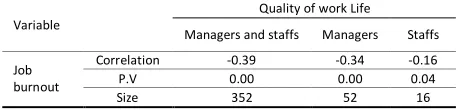
A reduction in the job burnout and stress led to increased effect on the working life quality among the employees as a result of a significant negative correlation (r=-0.39, P<0.01). We obtained identical results regarding the managers (r=-0.34, P<0.01) and staff (r=-0.16, P<0.05). (Table 4)
Table 4. Job Burnout and quality of work life for managers and staffs
Variable Managers and staffs Quality of work Life Managers Staffs
Job burnout
Correlation -0.39 -0.34 -0.16
P.V 0.00 0.00 0.04
Size 352 52 16
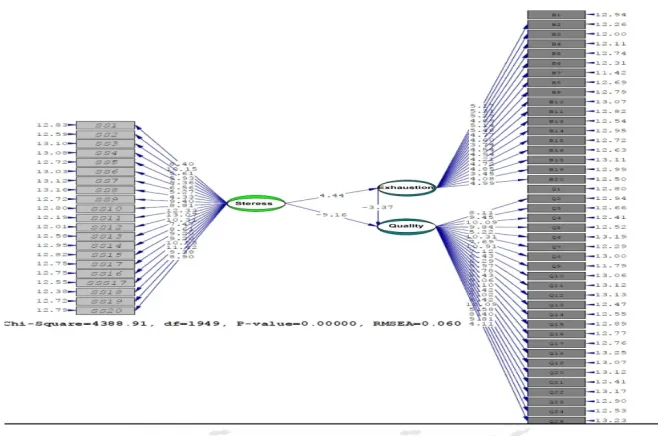
In table (5), we see the effect of job burnout as a mediatory variable for job stress and working life quality. Also, figure (1) represents the standard coefficients of the model. As the impact value of job stress on the working life quality and job burnout is -0.68 and 0.39, respectively, while the effect value of job burnout on the working life quality is equal to -0.21, the job burnout cannot act as a mediator variable for the relationship between job stress and working life quality. (Figure 1)
The t-value coefficient in the structural equation model verified the relationship between the variables (if it is greater than 2) or rejected the relationship (if it is smaller than 2). This
value for the correlation between job stress and working life quality was equal to -9.16, while it was 4.44 and -3.37 for relationship between job stress and job burnout and between job burnout and working life quality, respectively. The t-value coefficients are higher than 2 for all the variables in the model, indicating the correlation between variables as seen in figure 2.
The overall model in figure 3 showed the mediator variable (workplace stress) for the relationship between job burnout and working life quality as well as the fit of the model. Based on this model, job stress is the mediator variable for the correlation found between job burnout and working life quality. Figure (3) shows the standard coefficient of the relationships between variables in the model.
Job burnout imposes a significant negative impact on the working life quality (-0.21, P<0/05) a positive direct significant effect on the job stress (0.4, P<0/05). Job stress negatively and directly affects the working life quality significantly (-0.68, P<0/01). The indirect effect of job burnout on the quality of work life is more highlighted that the job stress as a mediator variable for their correlation. (Figure 3)Figure 4 shows the t-value coefficients of the correlations. As seen in figure (4), the coefficients for all relationships are higher than 2. This, the variables are correlated with each other in this model. The t-value coefficient of the relationship between job burnout and working life quality equals to -4.03; it was calculated as 5.31 and for the correlation between job stress and job burnout and the relationship between job stress and working life quality, respectively.
We conducted an independent sample t-test to compare the mean values of job stress, job burnout, and the working life quality between males and females in all samples. The results are given in table (6). According to the results, women have more job stress than men. This phenomenon was statistically significant (P<0.05, df=350, t=2.03).
Women also showed more job burnout than the men, which was not statistically significant (P>0.05, df=350, t=0.57). (table 6). Men represented a higher quality of working life than women, which was not statistically significant (P>0.05, df=350, t=1.61).
An independent sample t-test was done to compare the mean values of job stress, job burnout, and the working life quality between male and female managers. The results are shown in table (7). Female managers had higher rates of job stress than male managers, but it was not statistically significant (P>0.05, df=50, t=0.53). The rate of job burnout was higher in female managers compared to the male managers, which was not statistically significant either (P>0.05, df=50, t=0.11).
Table 2. Workplace stress and job burnout of manager and staffs
Variable Managers and staffsJob burnoutManagers Staffs
Stress Correlation P.V 0.31 0.00 0.22 0.03 0.25 0.00
Size 352 52 300
Table 5. Indices of SEM (Structural equation modeling) analysis provided Goodness of the Model in model with job burnout as a mediatory variable
Indicator Index Value
RMSEA Root mean square error 0.06
chi – Square (df) Chi two (Degrees of freedom) 4388.91 (1949)
GFI Goodness of fit Index 0.75
CFI Comparative Fit Index 0.81
International Journal of Health Studies 2018;4(1) | 28
Figure 1. Standard coefficient of the mediatory role of job burnout in the relationship between workplace stress and quality of working life.
Figure 3. Standard coefficient of the model of mediating role of work environment stress in the relationship between job burnout and quality of working life.
Table 6. Comparison of Job stress , job burnout and quality of life between males and females among all samples
Variable Number Average Standard deviation df t P.V
Job burnout − Female
− Male 188 164 59.98 59.40 10.18 8.65 350 0.57 0.17
Job stress − Female
− Male 188 164 72.02 74.45 10.54 9.99 350 2.03 0.82
Quality of working life
− Female 188 52.65 14.08 350 1.61 0.68
− Male 164 50.40 14.09
Table 7. Comparison of Job stress , job burnout and quality of life between males and females among managers
Variable Number Average Standard deviation df t P.V
Job burnout − Female − Male
50 0.11 0.22
12 49.76 4.86
40 49.37 5.91
Job stress − Female
− Male 50 0.53 0.51
12 76.15 7.41
40 74.72 8.68
Quality of working life
− Female 12 85.35 14.05 50 0.28 0.92
− Male 40 84.10 13.57
Table 8. Comparison of Job stress , job burnout and quality of life between males and females among staffs
Variable Number Average standard deviation df t P.V
Job burnout − Female − Male
298 1.15 0.54
176 57.51 8.64
124 58.66 8.44
Job stress − Female
− Male 176 124 66.69 68.14 10.46 10.29 298 1.18 0.79
Quality of working life
− Female 176 71.03 13.60 298 0.19 0.85
− Male 124 71.34 12.81
Female managers showed a higher quality of working life than the male managers; this phenomenon was not statistically significant (P>0.05, df=50, t=0.28).
Although the male staff had more job burnout than the female staff, the phenomenon was not statistically significant (P>0.05, df=298, t=1.15) (table 8).
Discussion
This was aimed at examining the relationship between workplace stress and burnout with the quality of work life. The research results indicated a negative and significant relationship between workplace stress and burnout with the quality of working life. According to the findings, a positive and significant relationship is seen between the workplace stress and job burnout. No mediatory role of job burnout was found in the relationship between job stress and the quality of work life, but, we found a mediatory role for stress in the correlation between burnout and the quality of work life, which was significant and confirmed. According to the results, no significant differences appeared between the workplace stress, job burnout, and the quality of work life among managers and male and female employees. Hence, one can conclude that there are different forms of stress and pressure on all people working in different occupations. The factors affect someone
individually and cause disturbances, worries or anxieties may include occupational changes such as organizational changes, transfers, promotions, salary changes, wages, occupational punishments, and social changes. The Physical burnout and tensions affect the human body are different and not so clear, which have adverse effects on the organizationally trained human resources. It seems that the organizations need to improve the tolerance of their employees to neutralize the influence of different factors and avoid lower tensions. Enhancing the employees' ability to cope with occupational and organizational stresses can save time, power, and the capability of the staff, which finally increase the individual productivity.
drivers. Their study was a cross-sectional descriptive-analytic one, which was done on 67 locomotive drivers of Railroad Company in 2017. They used the British HSE standard questionnaire and job burnout scale to evaluate the level of occupational stress. The participation in the study was optional. The self-reported information was collected. According to them, job stress appeared to have a negative effect on the burnout of locomotive drivers. Due to the nature of this stressful occupation, it was suggested to the organization to identify the relevant stressors and design proper interventions to minimize the occupational stress and subsequent job burnout.
Kavehet al.12 studied the relationship between job quality and job burnout and the human resources productivity in a case study of Golestan Province in an Educational Organization. The study statistical population included 250 employees in Golestan province educational organization. The sample size was 152 subjects, which were selected based on Kerjesi and Morgan table. The findings indicated a significant relationship between job quality and job burnout. In addition, a significant relationship was found between the quality of work life and human resources productivity.
A research performed by Khamisaet al.18 on the effect of personal stress and work environment on job burnout, job satisfaction, and general health of hospital nurses in South Africa included 1,200 nurses randomly selected to participate in the study. Of which, 895 agreed to complete the questionnaires within 3 weeks. According to the results, personal stress and work environment had a significant relationship with job burnout and general health as well as with the job satisfaction. Da Costa and Pinto19 published a paper entitled as "Stress, Burnout, and Coping in Health Care Professionals." The article reviewed databases such as Pab Fashion, books, and articles in Portuguese, English and Spanish. The research findings proved that stress has an inverse relationship with burnout and coping in the health professions.
The results of this study seem to be consistent with the studies by Kavehet et al.,12Abbasi and Anabestani20 as well as the ideas of Hassanzadeh's21suggesting that job stress can lead to burnout and the resulting disadvantages such as resignation, recurrent absence, lowered energy and income, and the reduced quality of working life. Put it differently, stress is highly related to the quality of work life. Hence, the quality of life is expected to increase by decreasing occupational stress. The research findings imply the presence of a significant negative relationship between workplace stress and burnout with the quality of work life of managers and staff of Zabol University of Medical Sciences. This suggests that decreasing the occupational stress and burnout will improve the quality of work life. Thus, we recommend the officials of the Ministry of the Environment male efforts to reduce the rate of work stress by targeted participating them in the process of decision-making, their empowerment, helping them gain experience at work, and training them to enrich the occupation (trying to feel more empathy, succession included in the job). Those managers able to identify and understand the obstacles more efficiently will succeed in overcome the problems in their jobs. Proper planning, understanding the dimensions of work, enjoying the work, time-out rest, physical activity, appropriate
diet and healthy food can be used as means to fight the job stress. Some other measures can include the followings:
- Organizing regular meetings for staff and encouraging them to express their problems and difficulties in the work environment
- Resolving the discussed problems
- Performing further studies on the causes of occupational stress followed by providing applied solutions to reduce the stressors
- Increasing the awareness and compatibility levels of personnel exposed to stressful occupational factors
- The establishment of mental health counseling centers in the workplace
- Enhancing the level of awareness of employers and
managers in the field by more proper planning and reducing the stress in the workplace.
It is also suggested to reduce the burnout of officials of the Ministry of Environment to achieve the following objectives: Providing opportunities to familiarize them with the goals of the organization and help them to understand these goals, Establishing healthy communication networks in the organization and bilateral communication in all the organization levels, Enabling the managers to focus on the affairs and welfare of the employees, Full utilization of individuals in performing their duties, Clarifying the role of everyone in the organization and what they are expected to do, Increasing the individuals satisfaction with the organization or their job, Providing facilities and opportunities required for the growth and promotion of individuals in the organization, Transferring the responsibilities, Making a balance between the salaries and benefits with the workload of staff, Improving the capability to assess the performance of individuals based on criteria other than relations, Providing appropriate and effective training for managers and staff, Employing scientific research methodologies, Selecting the best individuals to transfer organizational resources to qualified people, Full familiarity with job tasks.
Acknowledgement
This thesis was conducted in the University of Sistan and Baluchestan, Faculty of Psychology and Educational Sciences.
Conflict of Interest
The authors declared that they have no conflict of interest.
References
1. Barer M. Why are some people healthy and others not?. Routledge; 2017 Jul 5.
2.Amaral AP, Soares MJ, Pinto AM, Pereira AT, Madeira N, Bos SC, et al. Sleep difficulties in college students: The role of stress, affect and cognitive processes. Psychiatry Res 2018;260:331-7.doi:10.1016/j.psychres.2017.11.072
3. Mervian Hosseini Z, Lari Dasht Beyaz M. Investigating the role of burnout in relationship between stress and job performance of auditors. Health Accounting 2015:4(1);57-80. [Persian].
4. Scandura TA. Essentials of organizational behavior: An evidence-based approach. Sage; 2017 Dec 13.
6. Bagheri N. Factors Affecting Job Stress. Management development 2004;3(62):12 (62); 17.12.
7. Dean JS. Demography, environment, and subsistence stress: In Evolving complexity and environmental risk in the prehistoric Southwest. CRC ; 2018 May 4.
8. Dean JS. Demography, environment, and subsistence stress. InEvolving complexity and environmental risk in the prehistoric Southwest 2018 May 4 (pp. 25-56). CRC Press.
9. Schaufeli WB, Maslach C. Historical and conceptual development of burnout. InProfessional burnout 2017 Jun 26 (pp. 1-16). Routledge.
10. Heinemann LV, Heinemann T. Burnout Research: Emergence and scientific investigation of a contested diagnosis. Sage Open 2017;7(1):1-12.
doi:10.1177/2158244017697154
11. Rasouli Z. Investigating the relationship between job stress and burnout with productivity of pilots. Journal of Army University of Medical Sciences of the Islamic Republic of Iran 2012;10 (2):133-7.
12. Kaveh H, Fekri A, Fekri A, Karimi F. Investigating the relationship between quality of work life and job burnout and human resources. Case study of Golestan province educational organization. Second International Congress of Humanities, Cultural Studies. 2017: Center for the Empowerment of Social and Cultural Skills. [Persian].
13. Kasaei M. Attitude of employees to the quality of work life and its relationship with performance. Administrative Transformation 2004;7(47):119-33.
14. Moradi, M. Investigating the Consequences of Organizational Silence on Behavioral Variables: Pars Oil and Gas Co. Quarterly Journal of Human Resources Management in Oil Industry. 2016: 7 (27); 27-50.
15. Babayan, Sh. Relationship between psychological well-being, social adjustment and job satisfaction among employees of Urmia city and urban planning department. Master's thesis, Azad University. 2013: Marvdasht Branch, Faculty of Educational Sciences and Psychology.
16. Ghoranik, C.. Relationship between organizational culture and quality of work life among employees of sport and youth department of Golestan province. Master's thesis. 2012: Mazandaran University, Faculty of Physical Education and Sport Sciences.
17. Bahrami, Karami, Dehdashti A. Evaluation of occupational stress level and its relationship with job burnout in women. 2017: The 10th Student Conference on Health Sciences, Shaheed Beheshti University of Medical Sciences.
18. Khamisa N, Peltzer K, Ilic D, Oldenburg B. Effect of personal and work stress on burnout, job satisfaction and general health of hospital nurses in South Africa. Health SA Gesondheid 2017;22(1):252-8.
19. Da Costa B, Pinto I. Stress, burnout and coping in health professionals: a literature review. J Psychol Brain Stud 2017;1(1):1-8.
20. Abbasi M, Anabestani T. The role of quality of work life in burnout of physical education teachers in Mashhad. The 3rd National Conference on Sport Sciences and Physical Education of Iran. 2017: Association for the Development and Promotion of Basic Sciences and Techniques. [Persian].