ISSN-L: 2501 - 1235 Available on-line at: www.oapub.org/edu
doi: 10.5281/zenodo.1997613 Volume 5 │ Issue 2 │ 2018
EXAMINING THE EFFECTS OF THE PLIOMETRIC (JUMP SQUAT)
EXERCISE ON VERTICAL JUMP IN FEMALE VOLLEYBALL PLAYERS
Cemali Çankaya1,
Ramiz Arabacı1,
Esra Kurt2i,
Seray Doğan3,
Sadettin Erol1,
Ahmet Nazım Gürak1,
Faruk Korkmaz1
1Uludag University,
Faculty of Sports Sciences, Turkey
2Physical Education Teacher,
College of Osmangazi, Bursa, Turkey
3Coach, Volleyball Second League,
Turkey
Abstract:
The aim of present study was to examine the effects of plyometric jump (jump squat) exercises on vertical jump, and to investigate the relation between these exercises and some physical fitness and other defining characteristics in female volleyball players. The sampling of the study consisted of 10 voluntary female players, who were active
licensed players at Bursa Nova Sports Club in Turkey Volleyball 2nd League, and who
had the following defining characteristics; age: 16±0.8 years; sports age: 9.5±0.1 years; height: 176±6.7 cm; body weight: 65.8±5.7 kg; fat %: 26.9±4.3; fat amount: 17.7±4.2 kg; lean weight 47.6 ± 3.1 kg, total body fluid 34.9±2.3. The participants did not face any disabilities or diseases in the past six months; and participated in the training program regularly. They applied a normal diet during the entire study process. A total of 6 trainings a week, 3 sets in each training, 30 jumps in each set, which means a total of a total of 24 trainings, 72 sets and 2160 plyometric jumps (jump squat) were added to the seasonal training programs of the players for 4 weeks. The Bosco Test was used. On Sunday, one day before the plyometric studies were started, the other 4 Vertical Jump Measurement Tests (T2, T3, T4, T5) -including the determining the vertical jump measurements test (T1) - were carried out on Sundays every weekend. The body composition was determined by the Tanita Body Composition Analyzer TBF-300. The
data that were obtained in this way were analyzed with One-Way ANOVA and Pearson Correlations Coefficient tests in the SPSS for Windows 22 Statistical Program. As a result, a statistically significant relation was detected between the vertical jump, which is one of the descriptive characteristics of volleyball players, and the amount of fat %
and fat (p˂0.05). The vertical jump arithmetic averages were determined to be T1
33.8±4.8 cm; T2 34.4±4.5 cm; T3 35.2±4.7 cm; T4 36.5±4.9 cm; T5 36.4±4.7 cm (F=34.353; p<0.05). The effects of the plyometric exercises on vertical jump were found to be F=34.353 (p<0.001). It can be claimed that the plyometric exercises that were applied on the volleyball players have positive effects and an inversely-proportional relation with body fat %, fat amount, and vertical jump.
Keywords: volleyball, plyometric, physical fitness, vertical jump
1. Introduction
In general, genetic characteristics, age, gender, ethnicity, the sport that is dealt with, and nutrition affect the physical structure of players (Yaprak and Durgun, 2009; Akgün, 1994). Especially for the volleyball sport, the physical and physiological structure, which are required by a specific sports branch, have a significant place in being successful (Lale et al., 2003). In the context of physical fitness, the anthropometric features and jumping skills are important factors in the success of a team in terms of performance (Eyuboğlu et al., 2016). Physical features, mental characteristics, and the parameters like technical-tactical ones and experiences of volleyball players are also important criteria to achieve success (Gökdemir and Koç, 2000). In their studies, sports scientists have reported that height and weight are important physical criteria in volleyball, height and vertical jump height of in volleyball provide important advantages to the player in designing-planning basic technique and tactics like attacks and blocks (Açıkada and Ergen, 1986; Şimşek et al., 2007).
The motor characteristics, which are necessary for almost every sports branch, differ according to each branch (Gündüz, 1995). Like it is the case in other sports branches, volleyball is also one of the sports branches which require developed physical fitness, motoric and anthropometric characteristics (Göral et al., 2009; Vurat, 2000). When the playing time and the need for quick and accurate play are considered, it becomes clear that there is a need for all the basic motor characteristics like force, speed, endurance, mobility, skill and coordination. However, like it is the case in all team sports, it is seen that coordinating skills like rapid force and sustaining strength come to the forefront in the struggle to have the ball in the game (Koç et al., 2007).
success are implemented in the training sessions during the preparation periods for competitions. One of the most important of these exercises is the plyometric exercises.
Plyometric training, which is also called as depth training, is generally defined as the exercises that are applied as sequential exercises with the focus on functions like body weight and gravity like standing and depth jumps, short and long-time jumps, bouncing, strong or reactive explosive movements, which, altogether involve speed and force (Bompa, 1994; Kramer et al., 2001). Is it related to the vertical jump values of some physical fitness parameters and plyometric (jump squat) exercises? Is it not? Does it effect? Does it not affect it? Is there a significant relationship at a statistical level? Is there not? Such issues are wondered.
The study was conducted to determine whether the plyometrics (jump squats), which were added to the training programs of volleyball women’s team players of
Bursa Nova Sport Club in Turkey Volleyball Women’s 2nd League, affect the vertical
jump parameters of the players. Another purpose of the present study was to determine whether some physical fitness and descriptive characteristics of volleyball players, which might be effective for being more successful in volleyball trainings and competitions, were related with the vertical jump values.
The importance of the present study is very high when the relations between vertical jump parameters of volleyball players and coaches and some physical fitness are considered, and when the effects of plyometric exercises on training programs are taken into consideration. It is also important in that it is a source for studies in this field.
2. Material and Method
2.1 Subjects
The subjects were 10 volunteering and licensed female players of the Bursa Nova Sports
Club, which operates in Turkey 2nd Volleyball League.
2.2 Experimental Procedure
The participants did not experience any disabilities or diseases during the past six
ground). Then the player jumped back from the ground to the platform with double feet, and again, jumped back to the ground where the movement started. This exercise was applied in the form of stepping on one ground 15 times and 15 times on the other ground.
2.3 Measurements
The Bosco Test was employed to obtain the vertical jump measurements. On Sunday, one day before the plyometric studies were started, the other 4 Vertical Jump Measurement Tests (T2, T3, T4, T5) - including the determining the vertical jump measurements test (T1) - were carried out on Sundays every weekend.
These exercises were applied approximately 15 minutes before the measurement tests began. The participating players warmed-up with the same procedure. The warm-up was in the form of jogging and were part of opening-stretching exercises whose repetition did not last more than 5-6 seconds each. Before the tests were performed, the participants were explained how to apply the tests, the position in which the body should be, and the time in which the exercises should be done. The vertical jump measurements were made with two rights to perform the jump and 2-3 minutes resting time was given at intervals and the best jump value was recorded. The measurements were made with Polar V800 watch, and Polar Stride Bluetooth Sensor (which measured as based on time of staying on the air). The participant stood on the Bosco Platform and the sensor that measured the jump was attached to the waist, and the Polar clock that recorded the jump values was worn on the arm.
The measurements that were related to the body composition were carried out in the morning hours without the players eating any food. The jump squat was performed as follows; the players were again asked to jump when they were in the
fixed position in 90o with hands on the floor (Tamer, 2000; Zorba, 1999).
The body composition was determined with the Tanita Body Composition Analyzer TBF-300. Height measurements were made with a Holtaine (the UK) brand stadiometer with a sensitivity of 0.1 cm.
The data that were obtained in this way were analyzed with the One Way ANOVA and Pearson Correlations Coefficient tests in the SPSS for Windows 22 Statistical Program. The significance level was accepted as p<0.05.
2.4 Findings
Table 1: The descriptive characteristics of the participants of the study (the volleyball players) (n=10)
Variables Mın Max x SD
Age (years) 15 17 16 0,8
Sport age (years) 8 11 9.5 0,1
Height (cm) 165 187 176 6,7
Body weight (kg) 56.6 74.9 65.8 5,7
Fat % 22.7 37.9 26.9 4.3
Fat Amount (kg) 14 28.4 17.7 4.2
Fat-free Weight (kg) 42.4 52.7 47.6 3.1
Total Body Weight 31 38.6 34.9 2.3
The following values were determined as; age 16 ± 0.8 years, sport age 9.5±0,1 years, height 176±6.7 cm., body weight 65.8±5.7 kg., fat % 26,9±4.3, fat amount 17.7±4.2 kg., Fat-free weight 47.6±3.1 kg., total body fluid 34.9±2.3
Table 2: The Relation between Vertical Jump and Descriptive Characteristics
Height Weight BMI BMR Fat % Fat
Amount Fat-free Weight Total Body Fluid Sport Age Vertical Jump
r ,180 -,371 -,459 -,191 -,668* -,619* ,161 ,161 ,192
p ,619 ,292 ,182 ,598 ,035 ,047 ,657 ,656 ,594
As seen in Table 2, there is a statistically significant relation between Vertical Jump and
Fat% and Fat Amount (p˂0.05).
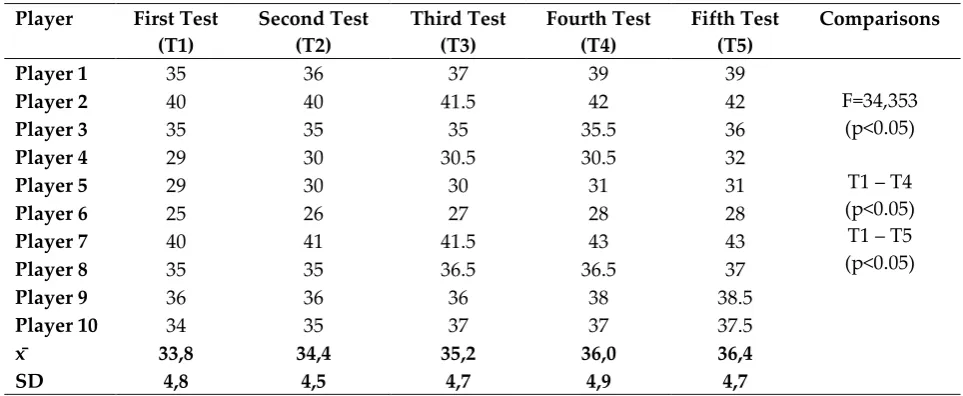
Table 3: The Vertical Jump Measurement Results, Arithmetic Average and Standard Deviation of the Participants (cm)
As seen in Table 2, a statistically significant difference was detected between T1 and T4 and T5 (p<0.05).
Player First Test
(T1) Second Test (T2) Third Test (T3) Fourth Test (T4) Fifth Test (T5) Comparisons
Player 1 35 36 37 39 39
F=34,353 (p<0.05)
T1 – T4 (p<0.05) T1 – T5 (p<0.05)
Player 2 40 40 41.5 42 42
Player 3 35 35 35 35.5 36
Player 4 29 30 30.5 30.5 32
Player 5 29 30 30 31 31
Player 6 25 26 27 28 28
Player 7 40 41 41.5 43 43
Player 8 35 35 36.5 36.5 37
Player 9 36 36 36 38 38.5
Player 10 34 35 37 37 37.5
x 33,8 34,4 35,2 36,0 36,4
Graphic 1: The effects of plyometric exercises on Vertical Jump (F=34,353 (p<0.05)
3. Discussion and Conclusion
The Descriptive Characteristics of the women volleyball players, who participated in the study (Table 1) were determined as age 16 ± 0.8 years, sport age 9.5±0,1 years, height 176±6.7 cm., body weight 65.8±5.7 kg., fat % 26,9±4.3, fat amount 17.7±4.2 kg., Fat-free weight 47.6±3.1 kg., total body fluid 34.9±2.3.
In the literature, when the study that was conducted by Koç et al. (2007) is considered, it is seen that the average age of the women volleyball players was 22.40 years, body weight was 59.10 kg and height was 170.30 cm.; in the study that was conducted by Koç and Aslan (2010) these values were 20.10 years, 65.80 kg and 177.50 cm, respectively; in the study that was conducted by Önder and Eler (2008) these were 24.21 years, 68.00 kg and 182.05 cm, respectively; in the study that was conducted by Baktaal (2008) these values were 19.20 years, 67.80 kg and 175.00 cm, in the study that was conducted by Atan et al. (2012) these values were 21.15 years, 62.25 kg and 174.05 cm, respectively. It was determined in our study that the average age of the volleyball players was approximately 4 years smaller than the average of the female volleyball players in previous studies; and there were similar measurements in terms of height and body weight.
relation between the Vertical Jump values and Fat% and Fat Amount (p˂0.05), as seen in Table 2; and there were no significant relations between the other Descriptive Characteristics.
When we consider the studies that were conducted on the motoric characteristics of women volleyball players, we determined that Atan et al. (2012) found the Vertical Jump average as 28.99 cm, and Baktaal (2008) found it as 27.66 cm and 29.25 cm. As seen in Table 3, the averages almost the same in the first Vertical Jump with T1 33.8 ± 4.8 cm, T2 34,4 ± 4,5 cm, T3 35,2 ± 4, 7 cm and T4 36,05 ± 4,9 cm, T5 36,4 ± 4,7 cm averages, which is overlap with and are supported by the references.
In Graphic 1 and Table 3, when 5 vertical Jump measurements, which were made to volleyball players separately, were compared with each other, while there were no statistical relations at significant level between the First Jump and second and third Jumps, there was a significant relation between the fourth and fifth Jumps. Despite the study conducted by Baktaal (2008) showing that there were no significant differences as a result of the force trainings that involved 6-week plyometric strength training with female volleyball players, Özveren et al. (2016) reported that there was a significant increase in the parameters of the female volleyball players who did extra plyometric training in terms of speed, jump and other force parameters.
As a result, in the present study of ours, it was determined that the 4-week plyometric (jump squat) exercises that were applied to female volleyball players of Bursa Nova Sport Club in addition to their preparation period training programs did not have any effects in the first two weeks; however, in the fourth and fifth weeks, it was determined that there appeared a statistically significant relationship between the T1, T4 and T5 (p<0.05). There is a statistically significant relation between the Vertical
Jumps and Fat% and Fat Amount of the players (p˂0.05). As the Fat% and Fat Amounts
decreased, the Vertical Jump values increased.
Because of the structure of the volleyball sport competitions, it becomes obvious that the characteristics of players must be improved with plyometric studies as it is the case in other important characteristics of the performance, considering the importance of some physical fitness and vertical jump values.
References
Açıkada, C., Ergen, E. (1986). Another Point in High Performance, Physical Structure, Science and Technology Journal, Ankara, (2): 39.
Akgun, N. (1994). Exercise and Sports Physiology. Ege University Press, Izmir, 5 (1): 202evi 203.
Baktaal, D.G. (2008). Determination of the Effects of Pliometric Studies on Vertical Splash in Women 16-22 Years Old (Master Thesis). Cukurova University Institute of Health Sciences, Department of Physical Education and Sports. Adana.
Bompa, T. (1994). Theory and Methodology of training.Kendall / Hunt Publishing Company, P. 29-38.
Cınkıllı, E., (2011). Determination of somatotype and body composition in volleyball players. University Graduate School of Social Sciences. Ankara.
Çavlıca, B., Bereket Yücel, S., Darcin, N., Mirzai, İ.T., Erbüyün, K. (2009). The relationship between menstrual cycle and pain sensation in professional women volleyball players. Pain. 21 (1), 29-35.
Ergun, N., Baltaci G., Yilmaz I. (1994). Analysis of physical structure, suitability and performance level of an elite volleyball team i, Volleyball science and technology magazine, October, 2, S: 26-27. Ankara.
Eyuboglu, E., Dalkiran, O., Aslan, C. S. (2016). The effect of 7 week preparation period on body composition, strength, elasticity and aerobic resistance of a women's volleyball team. Journal of Human Sciences, 13 (3), 6071-6079.
Foran, Bill. (2001). Hıgh Performance Sports Clinic. Human Kinetics. S: 83-87). Gündüz, N. (1995). Training Information. Saray Medical Bookstores, 73-84. İzmir.
Gökdemir, K., Koç, H. (2000). Comparison of some physical and physiological characteristics of elite basketball and volleyball women athletes. Dumlupınar University Journal of Social Sciences. 4, 297-303.
Göral, K., Saygın, Ö., Karacabey, K., Gelen, E. (2009). Comparison of some physical fitness characteristics of tennis players and volleyball players. New World Sciences Academy. 4 (3), 227-235.
Koç, H., Özcan, K., Pulur, A., Ayaz, A. (2007). Comparison of some physical and physiological parameters of elite women handball players and volleyball players. Spormetre Journal of Physical Education and Sports Sciences, 5 (3). 123-128.
Koç, H., Aslan, C.S. (2010). Comparative physical and physiological parameters. 10th Scientific Conference Education Perspectives in Physical Education and Sport Education Book of Abstracts, Constanta, Romania.
Kraemer, J. William, Gomez L. (2001). Ana, Hıgh-Performance Sports Clinic; Ed.: Foran Blyl; Human Kinetics; 83-95.
Lale, B., Muniroglu, S., Coruh, E.E., Sunay, H. (2003). Examination of the somatotype properties of Turkish men's volleyball national team. Spormetre Bed. Egin. and Journal of Sport Sciences. 1 (1), 53-56.
Önder, H.U., Eler, S. (2008). Examination of some physical and physiological parameters of female volleyball players playing in the first league teams of Ankara province. Atatürk Journal of Physical Education and Sport Sciences (ATABESBD). 10 (3), 15-22.
Özveren, Y., Emine Kutlay, E., Ozcaldiran, B., Ozsu, İ. (2016). The effects of 12-week plyometric training on some biomotor abilities in young female volleyball
players. 14th International Sport Sciences Congress Proceedings Book, Antalya.
Şimsek, B., Ertan, H., Goktepe, A. S., Yazicioglu, K. (2007). The Effect of Knee Muscle Strength on Leap Height in Women Volleyball Players. Journal of Exercise, 1 (1): 37.
Tamer, K. (2000). Measurement and Evaluation of Physical-Physiological Performance in Sport. Ankara. P.143.
Murat, M. (2000). Volleyball. Bağırgan Publishing House, P.13-17. Ankara.
Yaprak, Y., Durgun, B. (2009). The Comparison of Anthropometric Properties of Young Persons Attending the Special Skills Exam. Niğde University Journal of Physical Education and Sport Sciences. 3 (2): 120-130.
Creative Commons licensing terms
Authors will retain the copyright of their published articles agreeing that a Creative Commons Attribution 4.0 International License (CC BY 4.0) terms will be applied to their work. Under the terms of this license, no permission is required from the author(s) or publisher for members of the community to copy, distribute, transmit or adapt the article content, providing a proper, prominent and unambiguous attribution to the authors in a manner that makes clear that the materials are being reused under permission of a Creative Commons License. Views, opinions and conclusions expressed in this research article are views, opinions and conclusions of the author(s). Open Access Publishing Group and European Journal of Physical Education and Sport Science shall not be responsible or answerable for any loss, damage or liability caused in relation to/arising out of conflict of interests, copyright violations and inappropriate or inaccurate use of any kind content related or integrated on the research work. All the published works are meeting the Open Access Publishing requirements and can be freely accessed, shared, modified, distributed and used in educational, commercial and