ISSN: 2501 - 1235 ISSN-L: 2501 - 1235 Available on-line at: www.oapub.org/edu
doi: 10.5281/zenodo.1471519 Volume 4 │ Issue 12 │ 2018
COMPARATIVE STUDY OF SNAGS AND MAITLAND’S
MOBILIZATION IN CHRONIC LOW BACK PAIN
Shabana Khan1,
Nezar Al Torairi2,
Sharick Shamsi3i
1Physiotherapist,
Prince Sultan Military Medical City, Riyadh, KSA
2Clinical Supervisor,
Ortho OPD, Prince Sultan Military Medical City, Riyadh, KSA
3Dr., Senior Physiotherapist,
Prince Sultan Military Medical City, Riyadh, KSA
Abstract:
Objectives: Comparative Study of Snags and Maitland’s Mobilization in Chronic Low Back Pain. Design: Randomized Control Trial. Methodology: A total of 60 patients were included as per pre define inclusion and exclusion criteria and randomly assigned into two groups each having 30 patients. Group A was given SNAG consisted of stretching strengthening and postural correction exercises while Group B was given Maitland’s mobilization consisted of stretching strengthening and postural correction exercises for 4 weeks, 3 sessions per week one session per day. The patient’s outcome measures were assessed by visual analog scale, ODI and Goniometry of Lumbar Range of Motion. Measurements were recorded before and after the end of the treatment period. Results: Results revealed that means and S.D of both group were significant
(p=.000 ) statically but clinically the Group of patients treated with SNAGS along with
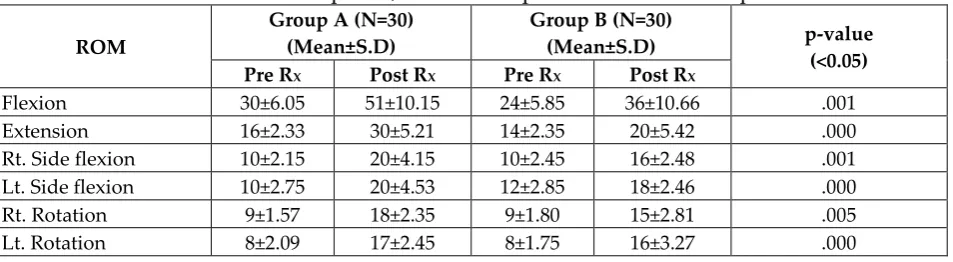
stretching strengthening and postural correction exercises managed pain (pre=7.81±1.16, post=0.35±0.37), ODI (pre=40±19.18, post=9±4.39) and range of motion (flexion pre=30±6.05, post=51±10.15, extension pre=16±2.33, post=30±5.21 Rt side flexion pre=10±2.15, post=20±4.15 and lt. side flexion pre=10±2.75, post=20±4.53, Rt side rotation pre= 9±1.57, post=18±2.35) lt. side rotation pre=8±2.09, post=17±2.45 better than group of patient treated with Maitland’s mobilization along with stretching strengthening and postural correction exercises in terms of pain (pre=6.27±1.31, post=2.73±1.19), ODI (pre=42±20.52, post=24±11.7) and range of motion (flexion pre=24±5.85, post=36±10.66, extension pre=14±2.35, post=20±5.42, Rt side flexion pre=10±2.45 post=16±2.48, lt Side
flexion pre=12±2.85, post=18±2.46, Rt side rotation pre=9±1.80 post=15.±2.81, lt Side rotation pre=8±1.75, post=16±3.27. Conclusion: The result of study suggests that both SNAG and Maitland’s improves the symptoms of chronic low back pain. Better improvement was shown by SNAG group than Maitland’s group. Based on these results SNAG and Exercise should be the treatment of choice for chronic Low back pain rather than Maitland’s with Exercise.
Keywords: SNAGS, chronic low back pain, Maitland’s, exercise
1. Introduction
Low back pain is a condition that continues to place a great deal of stress on the healthcare system. Globally one out of three people suffer from low back pain. Lifetime prevalence of low back pain is estimated to be at least 60-70%1. Low back pain (LBP) is a major health problem because of its high prevalence worldwide2. It affects almost every adult person at least once throughout his or her life span3. Low back pain is considered a multidimensional medical problem having multiple risk and causative factors4,5. Pain in region between bottom of ribs and buttock crease is referred as low back pain (LBP). Low back pain is umbrella of conditions. 80% of adults estimated to experience LBP at some point during their life6. More than 60% of consultation in private physiotherapy clinics is because of low back pain7. Male and female individuals are affected equally8 It is a major problem that causes activity restriction, work absence and financial burden on families, communities, industries and government. Diagnostic triage is use to differentiate between non spinal or serious spinal disorder and those with pain of musculoskeletal cause by means of history and examination with special emphasis on red flags9. Clinical presentation can differ but majority of patients will complain pain that either centralizes or radiates to lower extremities10.
Mechanical low back pain is a general term used to refer pain that does not have any specific cause or that is not related to any serious spinal pathology11. 90% of patients presenting to primary care are sufferers of mechanical low back pain and these are the majority of the individuals that present to physiotherapy. Common symptom is the pain that gets worse with activity and relieved by rest12.
A wide range of managements is available, with different treatments specifically targeted toward different causes. A balanced approach, which deals with patient psychosocial factors and includes multidisciplinary care, increases the probability of success from back pain interventions13. Medication, physical therapy, and surgery are most commonly used managements of mechanical low back pain.
Posture involvement is evident in back pain rule of thumb is that pain leads to bad postures and bad postures further aggravates pain13. When bad posture is fixed it decreases pain significantly.
Involvement of thoracic spine posture in chronic low back pain is proved from literature but rare evidence is present on treatment of posture correction to low back pain. This study is conducted to add to literature the effects of posture correction on low back pain Effects of lumbar Mulligan sustained natural apophyseal glides on patients with nonspecific low back pain is evident in literature15. SNAG involves application of accessory passive glide to lumbar vertebrae by physiotherapist while patient will simultaneously perform an active movement. Glide given is in the direction of plane of facet joints and technique is usually performed in weight bearing position like standing, sitting9,12,16.
Maitland mobilization technique are thought to benefit patients with lumbar mechanical pain through the stimulation of joint mechanoreceptors .These receptors are believed to alter the pain-spasm cycle through the presynaptic inhibition of nociceptive fibers in associated structures and the inhibition of hypertonic muscles ,which ultimately improve functional abilities17.
2.Material and Methods
The study was designed as Randomized Control Trial and has two groups Group A was given SNAG consisted of stretching, strengthening and postural correction exercises while Group B was given Maitland’s consisted of stretching, strengthening and postural correction exercises. It was conducted at Physical Therapy Department of Prince Sultan Military Medical City- Riyadh Saudi Arabia.
2.1 Inclusion criteria1,17:
Duration of illness more than three months Ability to perform at least 40° of trunk flexion. Aged 17 to 45 years.
Suffering from chronic LBD based on referral from orthopedic surgeon
2.2 Exclusion criteria29,30:
traumatic injury to spine, any
neurological involvement ex. Radiculopathy, infective conditions of spine ,
autoimmune disorders, malignancy,
any history of spinal surgery,
loss of lordosis &/or listing suggestive of inter-vertebral disc prolapse, spinal deformity, osteoporosis
Cardiopulmonary disease with decreased activity tolerance.
Goniometry was done respectively for Pain, Function and Lumbar range of motion for both groups.
SNAGS were applied in flexion, extension and rotation. SNAGS were applied for few seconds with 3 repetitions on first day and 10 repetitions from next visit. Study also included active as well as therapist facilitated stretches. Stretches were maintained for 15 -20 seconds with 10 repetitions of each stretch per session12. Maitland’s mobilization Frequency: 6 repetitions to 3 spinous processes were given once in a day. Sessions were given 4 weeks, 3 sessions per week one session per day to both groups. Home plan consisted of exercise therapy i.e. knee to chest, bridging, back extension exercises for both groups for once a day with 10 repetitions of each exercise every day.
2.3 SNAGS Technique
SNAG technique was applied from a sitting position on the edge of the table while both feet were on a foot rest. A specialized Mulligan belt was used around the patient’s waist and therapist’s hips. The mobilizing force was applied parallel to the facet joint plane (cephalic direction) and over the spinous processes of the respective symptomatic spinal levels (Fig.1). The patients were asked to lean forward as much as possible during application of the mobilizing force and then return to the starting position while the therapist maintained his mobilizing force until the end. The symptomatic level was determined clinically by using the standardized objective examination combining active trunk movements and posteroanterior mobilization of the lumbar vertebrae. The SNAG dose for each level was SNAGS were applied in flexion, extension and rotation. SNAGS were applied for few seconds with 3 repetitions on first day and 10 repetitions from next visit 3 times per week for 4 weeks. Study also included active as well as therapist facilitated stretches. Stretches were maintained for 15 -20 seconds with 10 repetitions of each stretch per session. It was performed before the conventional program12,18.
2.4 Maitland’s Mobilization procedure and technique
Patient–Prone with hands either by his side or above his head & with head turned comfortably to one side.
Position of therapist: Standing on right side of patient with ulnar border of hand between pisiform & hook of hamate directly over the spinous process. The therapist shoulder were directly over the point of contact of spinous process & full wrist extension was maintained with forearm in neutral between supination & pronation (fig 2)1,19.
Direction: The direction of mobilization was posteroanterior. Grade I and II joint oscillations for 30 seconds each. Grade I joint mobilizations were administered consecutively to the 3 spinous processes that surround the pathologic area with 30 seconds of rest in between, followed by grade II joint mobilizations performed1,19.
Frequency: 6 repetitions to 3 spinous processes were given once in a day.
Follow-up: The treatment was given 4 weeks 3 visits per week once a day.
2.5Maitland’s grades of oscillatory mobilizations20:
Grade 1: Small amplitude movement performed at the beginning of motion. Grade 2: Large amplitude movement performed within the range.
Grade 3: Large amplitude movement performed up to the limit of the range. Grade 4: Small amplitude movement performed at the limit of range.
Grade 5: High velocity thrust performed at the limit of the range.
2.6 Exercise therapy
Exercise therapy appears to be slightly effective for decreasing pain and improving function in adults with chronic LBP. The intervention included 12 stretching exercises (i.e., gastrocnemius, soleus, quadriceps, posterior and inferior shoulder, upper trapezius, hip flexor, back extension, back rotation, hamstrings, hip external rotators, back flexion), plus 3 additional stretches (hip internal rotators, hip adductors and hip flexors). Each stretching exercise was held for approximately 60 seconds and repeated once. In addition to a complete set (15) of full-body stretches, the class began with five minute warm-up period consisting of basic aerobics steps (i.e., one minute each of walking in place, marching, lateral shuffling, turning and reaching, and box step) and also included four exercises to strengthen back, abdomen and hips (i.e., squats, crunches, oblique crunches, back extensions)12,21 .
2.7 Posture correction exercises included
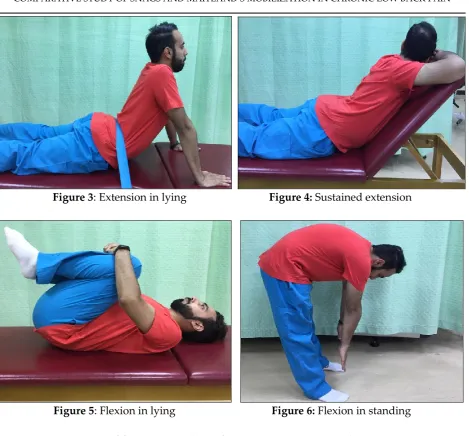
Correction of sitting posture by teaching him 'slouch overcorrect procedure'. Maintenance of corrected posture was achieved by advising the lumbar roll while sitting & active control of the lordosis. Correction of standing posture by teaching posterior pelvic tilt exercise with tightening of abdominal muscles. Correction of lying posture was achieved by using a lumbar roll. Posture correction was given once a day with 15-20 times in each session till the corrected posture became automatic. Patients were given flexion or extension exercises depending on their 'directional preference1,22. Patients preferring extension over flexion received1,23 Lying prone 10 min Lying prone in extension for 10 min Extension in lying extension is progressed to maximum possible extension range, repeated about 10 times Sustained extension with couch inclined at 1 to 2 inches for 5 to 10 min & then lowered & slowly returned to horizontal Extension in standing If patient was free of pain after 5 days, flexion exercises were commenced followed by extension. Patients preferring flexion over extension received Posture correction exercises Flexion in lying repeated for 10 times Flexion in standing: The patient bent forward to touch his toes about 10 times .It was ensured that patients return to neutral standing after flexion. If patient was free of pain after 5 days, extension exercises were commenced followed by flexion1. (Fig. 3, 4, 5, 6)
2.8 Data Analysis
Data was analyzed with SPSS 20. Outcome measures were calculated as mean and standard deviation and compared by using paired and independent sample t-test. P-value of less than 0.05 was taken as significant. The study was approved by PSMMC Ethical Review Committee and Physical Therapy Department of PSMMC. Informed consent was taken from all patients before enrollment in the study to assure willingness, confidentiality of information and to aware the patients about all procedure and interventions.
3.Results
In this study, 60 patients participated with a mean age of 45.25±14.30 in group A and 45.35±15.40 in Group B ranging from 17 to 45 years. (Table 1)
3.1 Mean reduction in VAS
Both groups had significant difference in pre Rx to Post RX values as t and p values for group A and B were t=17.76, p=0.000 and t=11.27,p=0.000 respectively. (Table 2)
3.2 Mean reduction in ODI
Both groups had significant difference in pre Rx to Post RX p=0.000 respectively (Table 3)
3.3 Mean reduction in ROM
Both groups had significant difference in pre Rx to Post RX p=0.000 respectively (Table 4)
4.Discussion
A study was done to investigate effects of SNAGs mobilization consisted of stretching strengthening and postural correction exercises to lumbar stabilization exercises in patients of chronic low back pain. 60 subjects with chronic low back were recruited. Balance, stabilization and pain were assessed. Results of this study concluded that there are greater effects on SNAGs of lumbar region, pain relief and improvement of function consisted of stretching strengthening and postural correction exercises combined with thoracic mobilization were given to patients of CLBP. Results of this study favors this study results of decrease of pain levels and increase in functional levels when SNAGs mobilization consisted of stretching strengthening and postural correction exercises was given for back pain12,24.
The results on RE agreed with previous a previous recommendations. This study investigated the effects of another manual technique (Gong’s mobilization) on RE. The comparison between both studies was not accurate because the Gong study was performed on healthy participants, whereas the present study was conducted on chronic nonspecific LBP patients.12,26
Lumbar degenerative kyphosis (LDK) is condition in which there is kyphosis or marked loss of lumbar lordosis. It is common in middle aged and elderly population due to degenerative conditions. A retrospective study was done to establish post-surgical co relation between thoracic and lumbar sagittal curves in LDK. Reciprocal relationship was found between lumbar lordosis and thoracic kyphosis. Surgical correction of lumbar lordosis in LDK shows significant improvement in thoracic kyphosis12,27.
Exercise therapy is one promising treatment option, but there is still no consensus upon which kind is the most effective12,28 .
The significant decrease in pain in Maitland group could be due to42the stimulation of mechanoreceptors at the facet joint and within the joint capsules of the facet which inhibits the nociceptive fibres in the area, thereby disrupting the pain-spasm cycle. Therefore, manual therapy techniques may influence the joint receptors and disrupt or modulate the pain-spasm cycle1,19.
This study shows that both the Maitland protocols are effective in improving the PPT and ROM. They are equally effective in improving the PPT but 3 repetitions of 1 minute were more effective in improving the ROM than 1 repetition of 3 minutes. Mobilizations produce a multitude of beneficial effects through stimulation of peripheral mechanoreceptors, inhibition of nociceptors, and an increase in synovial nutrition, thus helping to reduce pain29,30.
Oscillatory movements performed during mobilization are believed to produce mechanical effects, such as the realignment of collagen, increase in fiber glide, and the breakup of adhesions, which help to restore normal mobility29,31. Maitland mobilization is effective in improving ROM in Subjects with Unilateral Tibiofemoral Osteoarthritis29,32.
This study was designed as a double blinded randomized controlled pilot research to compare effects of SNAG and PA mobilization manual methods on flexion and extension ROMs of people with chronic nonspecific low back pain. The results revealed that SNAG technique on lumbar spine might improve flexion ROMs better than the PA mobilization. In contrast, the Maitland PA mobilization might improve extension ROM in these patients33.
Briefly it can be summarized that there exist evidence on SNAGs consist of stretching and strengthening exercises involvement in low back pain.so if SNAGs along with stretching and strengthening exercises treatment for low back pain is given it will lead to better outcome measures. This study favors same conclusion that when SNAGS consist of stretching and strengthening exercises were given better results were obtained in terms of pain reduction, improved function and increased ranges of lumbar spine.
5. Conclusion
This study provides evidence that adding lumbar SNAG to a conventional LBP program consisting of stretching strengthening and postural correction exercises is more effective in the treatment of chronic LBP in terms of RE, pain, and functional level.
5.1 Limitations
However, there were few limitations that hindered more accurate results such as the sample size was small consisting of only male patients. Similarly, duration of study was short which leads to investigate short term effects only.
About the Authors
Mrs. Shabana Khan holds MPT (Sports Medicine) from Jamia Humdard University, Delhi India, Presently working as Physiotherapist with Prince Sultan Military Medical city, Riyadh KSA, She worked as researcher with King Saud University- Riyadh KSA, as well she worked as Lecturer with Raj Nursing and paramedical college Gorakhpur, She published more than 10 article in different journal as well she written Book also, she is reviewer of many journals. She is life time member of IAP and active member of SPTA. Mr. Nezar Al Torairi holds MPT in Orthopedics from King Saud University, Riyadh KSA, Presently working as Senior Physiotherapist and clinical supervisor of Physiotherapy orthopedics clinic at Prince Sultan Military Medical city, Riyadh KSA; He published many articles as well as Book. He is active member of SPTA.
Dr. Sharick Shamsi holds PhD in Physiotherapy from MVGU University Jaipur, India, Presently working as senior physiotherapist with Prince Sultan Military Medical city, Riyadh KSA, He published many articles as well as Book. He is life time member of IAP and active member of SPTA.
References
1. Pallavi Chopade, 2018, Comparison of Maitland's mobilisation and Mckenzie therapy in patients with nonspecific low back pain, Int J Biol Med Res.;9(2):6270-6277.
3. Brosseau L., Milne S., Robinson V., et al. 2002, Efficacy of the transcutaneous electrical nerve stimulation for the treatment of chronic low back pain: a meta-analysis. Spine. 27(6):596-603.
4. Airaksinen O., Brox J.I., Cedraschi C., et al. 2006 Chapter 4. European guidelines for the management of chronic nonspecific low back pain. Eur Spine J. 2006; 15(sup l 2):S192-S300.
5. Luomajoki H., Saner J. 2012, Movement control impairment as a subgroup of non-specific low back pain. Man Med.; 50(5):387.
6. Palmer K.T., Walsh K., Bendall H., Cooper C., Coggon D.. 2000, Back pain in Britain: comparison of two prevalence surveys at an interval of 10 years. Bmj. 320(7249):1577-8.
7. Bogduk N. 2012 Radiological and Clinical Anatomy of the Lumbar Spine. 5th ed ed. China: Churchill Livingstone.
8. Heliövaara M. 1989 Risk factors for low back pain and sciatica. Annals of medicine. 21(4):257-64.
9. Heggannavar A., Kale A. 2015, Immediate Effect Of Modified Lumbar Snags In Non-Specific Chronic Low Back Patients: A Pilot Study. Int J Physiother Res.
3(3):1018-23. Available from:
http://www.physio-pedia.com/Chronic_Low_Back_Pain.
10.Burton A.K., Tillotson K.M., Main C.J., Hollis S. 1995, Psychosocial predictors of outcome in acute and subchronic low back trouble. Spine. 20(6):722-8.
11.Nourah A., A.L. Muhanna, Shabana Khan, 2018 Effectiveness of Snags Mobilization in Chronic Mechanical Low Back Pain, Journal of Advances and Scholarly Researches in Allied Education Vol. XV, Issue No. 6, 153-158.
12.Chien J.J., Bajwa Z.H. 2008, What is mechanical back pain and how best to treat it? Current pain and headache reports. 12(6):406-11.
13.Griegel-Morris P., Larson K., Mueller-Klaus K., Oatis C.A. 1992. Incidence of common postural abnormalities in the cervical, shoulder, and thoracic regions and their association with pain in two age groups of healthy subjects. Physical therapy. 72(6):425-31.
14.Sueki D.G., Cleland J.A., Wainner RS 2013. A regional interdependence model of musculoskeletal dysfunction: research, mechanisms, and clinical implications. Journal of Manual & Manipulative Therapy. 21(2):90-102.
15.Hidalgo B., Pitance L., Hall T., Detrembleur C., Nielens H. 2015. Short-Term Effects of Mulligan Mobilization with Movement on Pain, Disability, and Kinematic Spinal Movements in Patients with Nonspecific Low Back Pain: A Randomized Placebo-Controlled Trial. Journal of manipulative and physiological therapeutics.38(6):365-74.
17.Hisham Mohamed Hussien, Neveen Abdellatif Abdel-Raoof, Omaima Mohamed Kattabei, Hassan Hussien Ahmed, 2017 -Effect of Mulligan Concept Lumbar SNAG on Chronic Nonspecific Low Back Pain, Journal of Chiropractic Medicine Volume 16, Issue 2, 94-102.
18.Sean Hanrahan, Bonnie L. Van Lunen, Michael Tamburello, and Martha L Walker 2005: The Short-Term Effects of Joint Mobilizations on Acute Mechanical Low Back Dysfunction in Collegiate Athletes: J Athl Train. 40(2): 88–93.
19.Shashank Ghai, Ishan Ghai 2014, Role of various mobilization maneuvers in the management of low back pain, RRBS, 8(10).
20.Khan Shabana, Shamsi Sharick, Alyaemni Asmaa A.A., Abdelkader Samiha 2013, Effect of Ultrasound and Exercise Combined and Exercise alone in the Treatment of Chronic back pain, IJPOT, Volume: 7, Issue: 2, 202-206.
21.Clare H.A., Adams R., Maher C.G. 2004: A systematic review of efficacy of McKenzie therapy for spinal pain. Aust J Physiother. 2004; 50(4):209-16. The Lumbar Spine, Mechanical Diagnosis & Therapy: R.A. McKenzie.
22.Heo M.-Y., Kim K, Hur B.-Y., Nam C.-W. 2015. The effect of lumbar stabilization exercises and thoracic mobilization and exercises on chronic low back pain patients. Journal of physical therapy science. 27(12):3843-6.
23.Sung Y.-B., Lee J.-H., Park Y.-H. 2014. Effects of thoracic mobilization and manipulation on function and mental state in chronic lower back pain. Journal of physical therapy science. 26(11):1711.
24.Gong W. 2014 The influence of lumbar joint mobilization on joint position sense in normal adults. J Phys Ther Sci. 26(12): 1985-1987.
25.Jang J.-S., Lee S.-H., Min J.-H., Maeng D.H. 2009 Influence of lumbar lordosis restoration on thoracic curve and sagittal position in lumbar degenerative kyphosis patients. Spine. 34(3):280-4.
26.Hayden J.A., van Tulder MW, Malmivaara AV, Koes BW 2005: Meta-analysis: exercise therapy for nonspecific low back pain. Annals of Internal Medicine, 142:765-775.
27.Priya Singh Rangey, Megha S. Sheth, Neeta J. Vyas, 2015 Comparison of Immediate Effect of Two Different Maitland Mobilization Protocols on Pain and Range Of Motion in Subjects with Osteoarthritis of Knee, IJMHR, Volume: 1, Issue: 2, 26-29.
28.Melzack R., Wall P.D. Pain mechanisms: a new theory Science 1965; 150:971-979. 29.Frank C., Akeson W.H., Woo S.L., Amiel D., Coutts R.D. 1984. Physiology and
therapeutic value of passive joint motion. Clin Orthop Relat Res, 13-125.
30.Sambandam C.E., Sailor S.N., Alagesan J. 2011 Effect of Mulligan Mobilization and Maitland Mobilization in Subjects with Unilateral Tibiofemoral Osteoarthritis - Randomized Controlled Trial. Journal of Pharmaceutical and Biomedical Sciences. 11(17).
Range of Motion in Patients With Chronic Nonspecific Low Back Pain: A Randomized Pilot Study, JMR, vol. 11, 2, 127-132.
32.Hidalgo B., Pitance L., Hall T., Detrembleur C., Nielens H. 2015 Short-term effects of Mulligan mobilization with movement on pain, disability, and kinematic spinal movements in patients with nonspecific low back pain: A randomized placebo-controlled trial. Journal of Manipulative and Physiological Therapeutics. 38(6):365-74. doi: 10.1016/j. jmpt.2015.06.013
Appendix
Figure 1: Start and end positions for lumbar sustained natural apophyseal glide (SNAG)
Figure 3: Extension in lying Figure 4: Sustained extension
Figure 5: Flexion in lying Figure 6: Flexion in standing
Table 1: Mean and SD of age between group A and B
Group A (N=30) Mean±SD
Group B (N=30) Mean±SD
Age (Yrs) 45.25±14.30 45.35±15.40
Table 2: Mean reduction in VAS values between group A and B. Mean and standard deviation at pre RX, Post RX and pre RX to Post RX with t and p values
Groups Pre RX Post RX
Pre Rx to Post RX
Mean±SD Paired
t value p value
Group A (N=30)
Mean±SD 7.81±1.16 0.35±0.37 6.31±1.21 17.56 0.005
Group B (N=30)
Table 3: Mean reduction in ODI values between group A and B. Mean and standard deviation at pre RX, Post RX and pre RX to Post RX with p values
Groups Pre RX Post RX P Value
Group A (N=30) Mean±SD
40±19.18 9±4.39 0.000
Group B (N=30) Mean±SD
42±20.52 24±11.7 0.000
Table 4: Mean reduction in ROM values between group A and B. Mean and standard deviation at pre RX, Post RX and pre RX to Post RX with p values
ROM
Group A (N=30) (Mean±S.D)
Group B (N=30)
(Mean±S.D) p-value
(<0.05)
Pre RX Post RX Pre RX Post RX
Flexion 30±6.05 51±10.15 24±5.85 36±10.66 .001
Extension 16±2.33 30±5.21 14±2.35 20±5.42 .000
Rt. Side flexion 10±2.15 20±4.15 10±2.45 16±2.48 .001 Lt. Side flexion 10±2.75 20±4.53 12±2.85 18±2.46 .000
Rt. Rotation 9±1.57 18±2.35 9±1.80 15±2.81 .005
Creative Commons licensing terms