The University of San Francisco
USF Scholarship: a digital repository @ Gleeson Library |
Geschke Center
Master's Theses Theses, Dissertations, Capstones and Projects
Fall 12-15-2017
Transfer Student Experiences at Stanford
University and the University of California,
Berkeley
Rachael Madison
Follow this and additional works at:https://repository.usfca.edu/thes Part of theEducational Leadership Commons
This Thesis is brought to you for free and open access by the Theses, Dissertations, Capstones and Projects at USF Scholarship: a digital repository @ Gleeson Library | Geschke Center. It has been accepted for inclusion in Master's Theses by an authorized administrator of USF Scholarship: a digital repository @ Gleeson Library | Geschke Center. For more information, please [email protected].
Recommended Citation
Madison, Rachael, "Transfer Student Experiences at Stanford University and the University of California, Berkeley" (2017).Master's Theses. 1087.
The University of San Francisco
TRANSFER STUDENT EXPERIENCES AT STANFORD UNIVERSITY AND THE UNIVERSITY OF CALIFORNIA, BERKELEY
A Master’s Thesis
Presented to the Faculty of the Department of Leadership Studies
School of Education
University of San Francisco
In partial fulfillment of the requirements for the degree of
MASTER OF ARTS
in
Organization and Leadership
by
Rachael Madison
This thesis, written by
Rachael Madison
University of San Francisco
November 1, 2017
under the guidance of the Thesis Committee, and approved by all its members, has been accepted in partial fulfillment
of the requirements for the degree of
MASTER OF ARTS
Organization and Leadership
____________________________________________
(Instructor)
____________________________________________
(Faculty Advisor)
____________________________________________
DEDICATION
ACKNOWLEDGEMENTS
I would like to acknowledge a number of special individuals who have aided and inspired
my educational journey. My most sincere thanks to my thesis advisor, Dr. Danfeng Soto-Vigil
Koon; your guidance, knowledge, and encouragement enabled me to persevere and see this
project through a successful conclusion. I extend my thanks also to my graduate advisor, Dr.
Genevieve Negrón-Gonzales, for being an incredible educator and opening my eyes to the higher
education world. I am grateful as well to the entire University of San Francisco faculty for
providing such an enriching experience and helping me become the scholar I am today.
I would also like to recognize my community college advisor, Jay Jackson, for his
support and encouragement during my years at Cabrillo College and for helping me to
successfully transfer to San Jose State University. In addition, I would also like to thank my
greatest inspiration, Dr. Kathleen Roe, for being an incredible leader and positive light in my
life, providing unyielding support and continued friendship through many major milestones in
my educational and professional career.
I would also like to thank my loving parents, my stepmother, and my stepfather who have
always believed in me and provided the solid foundation for all that I have attempted. I extend
my appreciation to Lauren de Vore for her guidance and edits that allowed this paper to come to
fruition. My thanks also go out to the rest of my family, my close friends, and my colleagues,
with special thanks to Charles Bullock, Caroline Statsulat, and Sandy Costa, who have supported
ABSTRACT
Elite institutions have a long history of serving students from high socioeconomic status
families. Transfer students who begin their college career at community colleges are typically
from low-income, first-generation, and underrepresented minority status families. This
population of students has historically been underrepresented at elite colleges. The purpose of
this study was to examine the community college transfer student experience at two elite
universities, one public and one private, and how institutional programs and structures affect the
transfer student experience. The study gathered information from eight community college
transfer students, four from each elite university, interviewed in one-on-one semi-structured
interviews. Four university administrators, two from each university, were also interviewed to
gather information on the transfer student experience from the institutional perspective. This
study provides insight into the transfer student population and their particular needs. The study
also identifies ways in which universities can create stronger programming and more inclusive
systems for transfer students to enhance their university experience and the likelihood of their
TABLE OF CONTENTS
DEDICATION iii
ACKNOWLEDGMENTS iv
ABSTRACT v
TABLE OF CONTENTS vi
LIST OF TABLES ix
LIST OF APPENDICES ix
CHAPTER I 1
THE RESEARCH PROBLEM 1
Statement of the Problem 1
Background and Need 2
Purpose of the Study 3
Research Questions 3
Significance of the Study 4
Limitations of the Study 4
Definitions of Terms 6
CHAPTER II 8
REVIEW OF THE LITERATURE 8
Higher Education and Stratification 8
Elite Higher Education 9
Community Colleges 11
The Community College Transfer Student Experience 17
Institutional Approach to Transfer Students 18
Summary 20
CHAPTER III 22
METHODOLOGY 22
Research Method and Approach 22
Research Setting 23
Data Collection 25
Interview Participants 25
Recruitment of Participants 26
Sample Population 27
Protection of Human Subjects 28
Documents and Web Research 29
Data Analysis 29
Researcher Background 30
CHAPTER IV 31
RESULTS 31
Age and Life Experience 31
Institutional Factors 36
Orientation 39
Academic Planning and Support 42
Housing 47
Summary of Results 50
CHAPTER V 51
DISCUSSION, RECOMMENDATIONS, LIMITATIONS, AND CONCLUSION 51
Discussion 52
Institutional Factors 54
Two-Year Timeline 55
University Programming 55
Housing and Space 55
Study Recommendations 56
Pre-Orientation 57
Orientation 57
Academic Planning 58
Housing and Space 59
Addressing Disconnection 59
Study Limitations and Recommendations for Future Research 61
Conclusion 64
REFERENCES 66
LIST OF TABLES
Table 1 Acceptance Rates for Transfer Students Entering Fall 2012 at Ten of
the Top-Ranked U.S. Universities (US News and World Report, 2014) 14 Table 2. University Profile Information for the 2015-2015 Academic Year 23
Table 3. Student Participant Profile Information 27
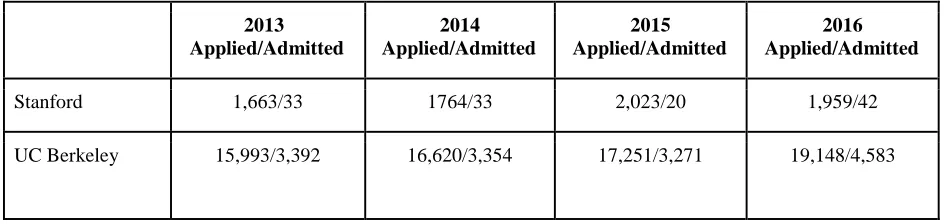
Table 4. Transfer Student Admissions Rates for Stanford and UC Berkeley 35
LIST OF APPENDICES
Appendix A. Sample Interview Questions for University Administrators
and Transfer Students 68
Appendix B. Transfer Student Background Survey Questions 70
Appendix C. Approval from the University of San Francisco Institutional Review
Board for the Protection of Human Subjects 72
Appendix D. Sample Informed Consent Form 73
CHAPTER I
THE RESEARCH PROBLEM
Statement of the Problem
Nearly half of all students embarking on post-secondary education start at a community
college (Melguizo, Kienzl, Alfonso, 2011). Community colleges are the largest U.S.
post-secondary network within higher education (Handel, 2012). These open-access colleges serve
significant numbers of students from low-income, first-generation, and underrepresented racial
minority backgrounds (Handel, 2012; Wang, 2016), providing students access to affordable
post-secondary education. In many cases, the community colleges serve as a stepping stone for
students aiming to transfer to a four-year college to complete their undergraduate degree.
Although the community colleges were originally created to prepare high school graduates for
delayed entry to four-year colleges and to separate students who were deemed capable of
traditional college from students who were inferior candidates for higher education (Beach,
2010), the purpose of these colleges has evolved to provide expanded access by serving as a
critical point of entry for disadvantaged students pursuing their post-secondary studies. As a
result, community colleges are heavily populated by underserved students who are largely absent
from sectors of higher education including the elite institutions.
Although community college students represent a significant share of students in higher
education, they comprise a small portion of students enrolled in elite universities, particularly
those from low-income backgrounds (Dowd et al., 2008). Elite higher education institutions are
defined as “private, selective, or highly selective colleges and universities that have high costs of
attendance and typically lengthy histories serving predominantly upper and middle upper
students with superior educational resources, direct pathways to graduate school, higher
post-graduate earnings, greater social status, and greater overall economic power (Hillman, 2012;
Hearn & Rosinger, 2014; Wang, 2016). The disconnect between elite universities and
community colleges has several implications, including a lack of sociocultural diversity on elite
campuses and reinforced social class stratification through the higher education system.
Background and Need
Various researchers have explored how educational systems are contributing to and
perpetuating social class inequalities, through social class reproduction (Astin & Oseguera, 2004;
Lee, 2013; Hearn & Rosinger, 2014). Inequalities within higher education are connected to the
K-12 system where students of higher socioeconomic status are generally enrolled in school
systems with more resources and greater opportunities for pre-college preparation and entry into
selective institutions. Consequently, students of higher socioeconomic status typically attend
highly selective or elite universities, whereas students of lower socioeconomic status attend less
selective institutions including community colleges, resulting in a stratified higher education
system.
Given the small number of transfer students entering elite universities, there is limited
information about the community college transfer students’ experience at these universities. By
studying how transfer students experience elite universities, higher education as a whole can
better understand the challenges these students face at elite institutions and can use this
information to improve institutional structures and programs to better meet the needs of transfer
students, which will help address inequity and the stratification in the higher education system.
Previous research documents the various challenges transfer students face when they
Cox, 2012; Walker & Okpala, 2017). Research has also documented the growing concern over
institutional structures that pose challenges for transfer students (Miller, 2013; Tobolowsky &
Cox, 2012; Walker & Okpala, 2017). Collectively, these studies highlight the need to better
understand the community college transfer student experience and the factors that affect their
experience. Most previous studies were conducted at large public research universities, and thus
there is lack of information about the transfer student experience at elite private universities.
Purpose of the Study
The purpose of this study is threefold. First is to explore the community college transfer
student experience at elite universities. Second is to examine how institutional structures and
programs at the universities affect the transfer student experience. Third is to examine the
differences between the experience of transfer students attending a public elite university and
those attending a nearby private elite university.
Information for this study is obtained through interviews of community college transfer
students from Stanford University and the University of California (UC) Berkeley. The students,
four from each university, describe their experiences at their elite university, including how
institutional factors such as orientation, housing, and academic planning affects their experience.
Information is gathered from interviews of four administrative staff members, two from each
university, to understand the transfer student experience from the institutional perspective.
Research Questions
This study seeks to answer the following questions:
1. What are the common themes and experiences among community college transfer
2. How do institutional differences between the public and private universities affect the
community college transfer student experience?
Significance of the Study
Equitable access in higher education is essential to the vitality and sustainability of a
democratic society. Providing opportunities for students to attend universities based on academic
ability rather than socioeconomic status is critical to achieving equitable access in higher
education (Dowd et al., 2008). Because community college transfer students come largely from
minority and lower socioeconomic status backgrounds, the lack of such students at elite
universities is a serious concern in terms of addressing inequalities in higher education, enabling
social mobility, and promoting the civic ideals of equal treatment and opportunity (Dowd et al.,
2008). The results of this study will help inform stakeholders of higher education institutions and
policymakers as to the importance of socioeconomic diversity in higher education through the
lens of the experience of community college transfer students at two elite universities. Both
community colleges and elite universities can benefit from better understanding the transfer
students’ experience at elite institutions.
Limitations of the Study
This study provides a snapshot of the community college transfer student experience at
elite universities. A total of eight students were interviewed for this study. However the transfer
student experience varies greatly, and collecting information from a larger number of transfer
students would provide a more complete picture of the larger issue of community college transfer
students at elite universities.
While some studies have focused on a single university for an in-depth investigation, this
Berkeley) and one private (Stanford University). This study provides insight into the differences
and similarities of transfer student experiences between a private and a public elite university
located in the same geographic region. However, universities across the United States differ in
their institutional structures, campus environment, academics, operating systems, and
foundational histories. Thus, examining additional universities in different regions of the country
would provide a more complete picture of the transfer student experience.
Another limitation of the study is that while participants came from a range of
socio-economic backgrounds, there was less racial diversity among participants. Five of the eight
participants were white. Students of color, and African American students in particular, may
have different transfer experiences from those shared in this study. Future research could focus
on specific underrepresented groups to explore how transfer students of different socioeconomic
and ethnic/racial backgrounds vary in their experience at four-year universities, including elite
institutions.
The study is directed and informed by the researcher. The two institutions chosen are
selected due to the researcher’s place of employment (Stanford University), which influences
access to information. In order to address the imbalance of information access, the researcher
interviewed an equal number of participants at both universities and examined
transfer-student-related institutional aspects of the two universities to collectively examine information and
Definition of Terms
The terms for this study are defined as follows:
Community college, two-year college, junior college: The terms community college,
two-year college, and junior college are used interchangeably to denote institutions that provide
two-year degrees among other learning opportunities.
Elite university, highly selective university: As defined by Lee (2013), these are
institutions that have high costs of attendance and typically lengthy histories serving
predominantly upper and middle upper socioeconomic status students.
Four-year student: These are students who are admitted into universities as freshmen on
a typical four-year undergraduate track.
Low-income student: These are students in the bottom quartile of socioeconomic status.
Nontraditional student: This term encompasses a wide variety of students. According to
the National Center for Education Statistics (NCES), there are seven characteristics of a
nontraditional student, namely those who: (1) do not immediately continue their education after
high school, (2) attend college part time, (3) are financially independent, (4) have children or
dependents other than their spouse, (5) are a single parent, (6) work full time, and (7) have a
GED certificate instead of a high-school diploma.
Socioeconomic status: This is an overarching term that includes income, educational
attainment, financial security, and subjective perceptions of social class.
Top university, highly ranked university: University rankings incorporate multiple
factors such as academic reputation, wealth, research excellence, admissions rates, employer
to refer to a top four-year university or use published rankings such as those from US News and World Report.
Transfer student: Although students may transfer from one four-year university to
another, in this study, the term transfer student is used to denote those students who transfer from
a community college to a four-year university.
Traditional student: This term is used to describe students who have enrolled at a
CHAPTER II
REVIEW OF THE LITERATURE
Higher Education and Stratification
Researchers since the 1970s have studied how social class inequalities are linked to the
outcomes of the nation's higher education system (Bowles & Gintis, 1976). According to Lee
(2013), elite universities have historically been known for their socioeconomic reproduction, in
that the institutions maintain systems of wealth and privilege across generations. It is common
for students of higher socioeconomic status to attend highly selective and elite universities and
for students of lower socioeconomic status to attend colleges that are less selective, including
community colleges, resulting in a stratified higher education system.
The sorting mechanism of socioeconomic status within higher education creates unequal
treatment based on an individual’s socioeconomic status rather than their academic achievement
and potential. According to Dowd, Cheslock, and Melguizo (2008), only 3% of freshmen
entering 146 highly selective institutions came from the lowest quartile of the socioeconomic
status index, whereas nearly 75% of students enrolled in these institutions came from the highest
quartile. Stratification in higher education can be traced back to the K-12 system, where students
of higher socioeconomic status are typically enrolled in school systems with more resources and
opportunities that allow for pre-college preparation and entry into more selective colleges.
Low-income students rarely enter the elite pipelines and largely remain in educational systems that
perpetuate their low socioeconomic status. Furthermore, elite universities historically have low
admittance rates for community college transfer students who typically come from lower
This literature review covers four topics. First is the student population within elite
universities and how those universities function within the higher education system. Second is
the function of the community colleges within the system of higher education. Third is the
relationship between elite universities and community colleges. Fourth is the lack of information
about community college transfer students at elite universities.
Elite Higher Education
Elite higher education institutions are defined by Lee (2013) as “private, selective, or
highly selective colleges and universities that have high costs of attendance and typically lengthy
histories serving predominantly upper and middle upper socioeconomic status students.”
Although elite institutions educate a very small percentage of college students, they offer
substantial academic and financial returns for those students. Attending an elite or highly
selective university provides students with the best educational resources, direct pathways to
graduate school, higher post-graduate earnings, greater social status, and greater economic power
(Hillman, 2012; Hearn & Rosinger, 2014; Wang, 2016). Additionally, as the selectivity of a
university increases, the student’s likelihood of attaining a degree increases by 10% or more
(Long, 2008). Compared to less-selective universities, elite institutions invest more than three
times per student (Brezis & Hellier, 2017). Attending an elite university is associated with great
prestige and power (Dowd et al., 2008). Elite institutions place a disproportionate number of
graduates into high-profile jobs, including political office and positions with political influence;
for example, Supreme Court Justices have predominantly come from four elite colleges:
Stanford, Princeton, Harvard, and Georgetown (Lee, 2013). Although there are many
high-achieving low-income students who qualify for admittance, elite universities predominantly
Elite universities have a long history of enrolling students from wealthy families.
Beginning in the early 20th century, elite institutions would admit students from private feeder
schools and would include specific admissions requirements that few schools outside the feeder
system could meet (Karabel, 2005). In the 1950s through the 1970s, the pool of qualified
applicants grew, and elite universities were pressured to broaden their student admissions pool
(Lee, 2013). Their admissions tactics shifted from a focus on entrance exam scores to more
subjective measures such as extracurricular activities and intangibles like personality and “the
right fit” (Lee, 2013; Karabel, 2005). They also used “need-blind” admissions processes that
gave the appearance of class impartiality. Despite these changes, the elite universities maintained
their primary student population of students from high socioeconomic backgrounds.
Nearly 72% of students at the nation’s most selective institutions come from families in
the wealthiest quartile (Giancola et al., 2016). According to the Pell Institute (2015), families in
the wealthiest quartile have annual incomes of $108,650 and above; those in the lowest quartile
have annual incomes of less than $34,160. The highly selective universities serve as
congregating venues for students who have something in common: namely, they are primarily
from very wealthy families. Federal Pell grants are the largest form of need-based student
financial aid, and participation is seen at all major colleges and universities (Hearn & Rosinger,
2014). Thus, Pell grants are a good indicator of the number of low-income students at a
university. Although many universities increased their Pell grants between 2000 and 2013, the
number of Pell grants at the most selective universities has remained virtually unchanged (16%
in 2000 vs. 17% in 2013) (Dowd et al., 2008).
Students of high socioeconomic status enter their educational elite pipelines in a manner
students of privilege typically enter their highly selective universities directly out of high school,
whereas low-income students are more likely to delay entry into college after high school or only
enroll part time (Hearn & Rosinger, 2014). Since elite students with direct access to elite
universities are those with the most direct access to further education and high-paying jobs, they
often become leaders in society, even though, because of their privileged background, they do
not represent the majority of Americans. Thus the stratified system of higher education
perpetuates social class stratification.
Education scholars have long been concerned about the lack of sociocultural diversity at
elite universities. The lack of diverse perspectives among this country’s economic and business
leaders results in a disconnect between them and the rest of society. As Dowd et al. (2008)
explains, “The exclusion of poor working class, racial ethnic minority students from elite
institutions reduces the probability that these students will enter positions of power. It also
decreases the likelihood that graduates of elite institutions will interact with a diverse set of peers
while in college.”
Social class inequalities result in unequal educational outcomes, which create and
perpetuate larger scale issues such as the rising income inequality. To understand the stratified
higher education system, it is important to explore how different sectors of the system serve
different student populations and act as a sorting mechanism for students based on
socioeconomic background.
Community Colleges
Situated within this stratified higher education system are the community colleges.
Founded in 1901, Joliet Junior College in Illinois was the first public two-year college (Beach
high-school students into the four-year universities and to separate students who were deemed capable
of traditional college from students who were deemed to be inferior candidates (Beach, 2010).
What started out as the “normal school,” whose primary purpose was to educate public school
teachers, evolved into the junior college in the 1900s (Beach, 2010). The junior college expanded
throughout the 20th century and, as its mission and purpose evolved, the two-year college was
renamed the community college to reflect its role not only in higher education but in the
surrounding community as well.
Nearly half of all U.S. students beginning post-secondary education start at a community
college (Melguizo, Kienzl, Alfonso, 2011), and an increasing number of community college
students are from low-income, first-generation, and underrepresented racial minority
backgrounds (Wang, 2016). Despite the growing number of minority students attending
community colleges, these students remain largely underrepresented at elite universities.
According to Fortin (2016), between 1995 and 2009, African American and Latino enrollment
increased an average of 46% at community colleges, yet these students saw an average increase
of only 8% at the nation’s top four-year universities. In contrast, while white student enrollment
remained constant at the community colleges over this same time period, it increased nearly 72%
at the top universities (Fortin, 2016). Even though community colleges are serving a
disproportionate number of minority students, the pipeline to elite universities for these students
remains limited.
According to the American Association of Community Colleges (AACC, 2016), there are
1,108 community colleges in the U.S., making them the largest public post-secondary network in
the nation (Handel, 2012). With their open admissions system, the community colleges serve as a
to four-year universities. Following this path, students typically complete their first two years of
lower division coursework at a community college and then transfer to a four-year college to
complete the remaining two years of their upper division course work and earn their
baccalaureate degree. Some states have implemented transfer agreements between the
community colleges and the state’s public universities. In California, matriculation agreements
facilitate the entry every year of a significant number of community college transfer students into
the University of California (UC) and California State University (CSU) system. In the
2015-2016 academic year, approximately 73,000 students transferred from California community
colleges to UC and CSU campuses.
Community colleges are, comparatively speaking, affordable and thus serve a high
number of low-income students. In the 2015-2016 academic year, the average annual tuition and
fees for a public in-state four-year university was $9,410 vs. $3,430 for an in-state community
college (AACC, 2016). Tuition and fees at a private four-year university can range from
$33,000 upwards, depending on the school and major. At roughly one-third the cost of an
average in-state public university, community colleges provide the least expensive option for
higher education. Federal Pell grant data indicate that a large portion of low-income students
attend community college; in 2013-2014, 33% of all Pell grants were directed to these two-year
colleges (College Board, 2014).
Community colleges also serve a significant proportion of student groups who have
historically been underrepresented in higher education, enrolling large numbers of African
American, Latino/Chicano American, and Native American students as well as low-income and
first-generation college-going students (Handel, 2007; Fortin, 2016). Given the need to
starting their college careers at community colleges, these two-year institutions are a crucial
springboard for students aiming to earn a four-year degree. As the community colleges have
become leading providers of higher education (Fortin, 2016) and serve a large portion of the
nation’s minority population, the lack of representation of community college transfer students at
elite universities is a serious concern.
Barriers into Elite Universities
Even though community colleges admit and serve large and growing numbers of students
who intend to transfer to four-year universities, few community college transfer students are
admitted to elite colleges (Dowd et al, 2008). Elite universities have historically admitted
extremely low rates of low-income students. Cheslock (2004) studied transfer student enrollment
differences between public and private institutions and found that transfer student enrollment
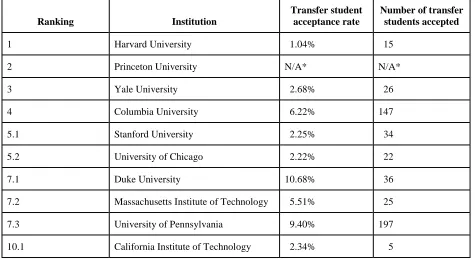
decreased as the university’s selectivity increased. In examining US News and World Report top 50 colleges and universities and their transfer admissions rates, all but two of the top 12 schools
admitted fewer than 100 transfer students per year, representing less than 10% of their
undergraduate enrollment (see Table 1). Although there are millions of community college
students across the U.S., their representation at top universities is negligible.
Students from the lowest economic quartile represent a mere 3% of enrollment within
selective universities (Giancola et al., 2016). Although community colleges serve as a gateway to
four-year universities for many low income students, these students encounter a range of barriers
that prevent them from entering the elite pipeline. According to researchers, these barriers are
located at both the student and the institutional level and include social factors, pre-college
Table 1. Acceptance Rates for Transfer Students Entering Fall 2012 at Ten of the Top-Ranked U.S. Universities (US News and World Report, 2014).
Ranking Institution
Transfer student acceptance rate
Number of transfer students accepted
1 Harvard University 1.04% 15
2 Princeton University N/A* N/A*
3 Yale University 2.68% 26
4 Columbia University 6.22% 147
5.1 Stanford University 2.25% 34
5.2 University of Chicago 2.22% 22
7.1 Duke University 10.68% 36
7.2 Massachusetts Institute of Technology 5.51% 25
7.3 University of Pennsylvania 9.40% 197
10.1 California Institute of Technology 2.34% 5
* Princeton had not accepted any transfer students since 1991; this transfer ban policy was lifted starting in 2018. Website source: http://transferweb.com/stats/transfer-acceptance-rates/.
Family affluence has a clear impact on where a student attends college or if they attend
college at all. Unlike students with parents who have post-secondary experience and are
knowledgeable about planning for and financing their children’s college education, low-income
students typically come from families with little or no background in post-secondary education
and are often the first to attend college. According to Astin and Oseguera (2004), students with
highly educated parents have a 500% greater likelihood of being admitted to a highly selective
university than students from low-income backgrounds.
One reason for this disparity is that students from low-income backgrounds have much
less access to pre-college preparation. They are likely to attend schools with fewer resources and
minimal information about the college-application and financial-aid processes, which stymies
counselors or administrative support staff who can assist students with pre-college readiness.
Perhaps as a result, low-income students are only one-third as likely to take advanced placement
courses as students from more affluent backgrounds (Giancola et al., 2016).
Barriers at the university level also contribute to low rates of low-income and
transfer-student admissions to elite institutions. For example, admissions criteria often include ambiguous
factors such as the “right fit” and extracurricular activities like sports and performing arts (Lee,
2013). Students from low-income backgrounds may either not have access or cannot afford to
participate in costly extracurricular activities. In addition, even though standardized test scores
are heavily weighted in the application process, studies have shown that low-income students
with high SAT scores are rarely admitted to elite universities; admissions instead tend to favor
legacy students (children of alumni or donors) (Dowd et al., 2008).
High-achieving students from low-income backgrounds may not even consider elite
universities because of the cost. These students are typically unaware of the various financial aid
opportunities that could make an elite university, private or public, affordable (Giancola et al.,
2016). As a result, high-achieving low-income students end up attending less selective
universities and doing so without any financial aid. Although, many elite colleges make
need-blind admissions decisions, which means that the student's financial situation is not taken into
consideration during the admissions process, this attempt to avoid discrimination based on
socioeconomic status has not resulted in the admission of more low-income students. Because
low-income students and their families are unaware of the need-blind process which could
benefit them, these students end up enrolling in public two-year or four-year universities which
opportunities and prestige. The cumulative effect of these barriers is that very few low-income
students, including community college transfer students, are admitted to elite universities.
The Community College Transfer Student Experience
A growing body of research documents the challenges community college transfer
students encounter when they transfer to four-year universities (Townsend & Wilson, 2006;
Townsend, 2008; Tobolowsky & Cox, 2012; Walker & Okpala, 2017). Research has also
documented the challenges that institutional structures can pose for transfer students (Miller,
2013; Tobolowsky & Cox, 2012; Walker & Okpala, 2017). Students who transfer from
community college are among the nearly 60% of college students who attend more than one
university (Jenkins & Fink, 2015). Thus it is important to understand the community college
transfer student experience and the effect of institutional structures on that experience.
Unlike traditional four-year students, transfer students are a distinct student group with
wide variety in their characteristics. These characteristics include part-time or full-time
enrollment, commuting or living on campus, full-time or part-time employment, single or
married or with children, and a wide range of ages and backgrounds. Tobolowsky and Cox
(2012) noted that the variability of transfer students extends to their student status, in that they
may enter their new university as a first-year, junior- or senior-level student, may be co-enrolled
(enrolled in more than one institution), or may even reverse transfer (switch from a four-year to a
two-year institution). This diversity makes the transfer student group highly complex and less
predictable than traditional four-year students, who typically enter college directly after high
school with little no prior college experience.
Beyond these differences, transfer students encounter additional challenges when
experience a lack of engagement at their new university, have problems with financial-aid
systems, or lose credits for courses taken at their previous college and have to take additional
“make up” courses at their new university. They may have particular needs, such as extended
hours for classes, support for student parents, and transportation support if they live off campus
(Miller, 2013). Such academic adjustment difficulties have been described as “transfer shock,” a
term coined by Hills (1965), which often manifests as a temporary decline in the student’s grade
point average (GPA). Lastly, transfer students are typically on a two-year timeline to graduation,
which greatly compresses their university experience.
A number of studies have documented the difficulties transfer students experience at
four-year institutions. A recent qualitative study at a public midsized historically black college
and university (HBCU) collected data from transfer students about their experience, factors that
impacted their retention, and how the university could better support the transfer student
population (Walker & Okpala, 2017). The findings revealed a lack of specific efforts at the
community college and university level aimed at meeting the needs of transfer students. The
study participants expressed feelings of isolation and invisibility and of how vastly different they
were from traditional four-year students. The study participants described an institutional
one-size-fits-all approach to student programs and services aimed almost exclusively at traditional
four-year students. The transfer students in the study also expressed a desire to be recognized for
their differences and the challenges they face, and they had suggestions for the university and
wanted their voices to contribute to institutional change.
Institutional Approach to Transfer Students
Other studies have explored the effect of institutional structures at four-year universities
and Cox (2012) interviewed several administrators and personnel at the selected university to
understand how their perspectives and formal policies shaped the institution’s approach to
transfer students. The researchers found that the transfer student experience is often shaped by a
variety of invisible and subtle institutional influences and that misconceptions, stereotypes, and
inconsistencies among university personnel created fragmented perspectives about transfer
students. Information about transfer student needs and data about the transfer student population
were not readily available or accessible, and thus transfer student needs were often lost within
the needs of the larger student body.
With their smaller numbers, transfer students were not a priority for the university, since
that student population’s success had minimal impact on the university’s reputation. The study
explained how first-time, full-time students’ data, such as ACT/SAT scores and retention rates,
drove the university’s ranking and public reputation. Thus more institutional programming was
devoted to those efforts, and there was little fiscal or market incentive for programming aimed at
transfer students. Although administrators at this university were fully aware of transfer student
issues, they also expressed uncertainty as to appropriate support for transfer students. This study
clearly showed that transfer students are not a well-understood group at the institutional level and
that unless a university intentionally creates and implements comprehensive programming for
transfer students, there will be gaps in service and inconsistent support for the transfer student
population.
Identifying transfer student needs and distinguishing the transfer student population from
the traditional four-year cohort are essential to ensuring transfer student success, yet this
something four-year universities struggle with. Continuing the common campus culture of
overlooks the transfer student group entirely. Without proper support for transfer students
throughout the transfer process and during their time at their four-year institution, universities
will fail to meet the needs of this growing and increasingly important population of students.
Summary
Higher education stratification presents many concerns. Class and income inequalities
continue to expand, and it is important to understand how systems such as higher education
perpetuate large-scale social inequities. Although the ethos of American democracy regards
post-secondary educational attainment as a critical mechanism for overcoming low socioeconomic
origins and improving social mobility (Schudde & Goldrick, 2010), research continues to show
how socioeconomic background can predict educational attainment.
The sorting of social classes within higher education creates unequal treatment based on
class rather than achievement and potential. Elite universities have low acceptance rates of
community college transfer students, who typically come from lower socioeconomic
backgrounds. As a result, low-income students rarely enter the elite pipelines and largely remain
in those that perpetuate their low socioeconomic status. The research summarized above
explored the transfer student experience and revealed the need for institutional programs and
structures tailored to the needs of transfer students. These studies were conducted in
predominantly large, public four-year institutions. Research has indicated a lack of information
about community college transfer students within elite universities (Dowd et al., 2008; Wang,
2016). Elite universities admit low numbers of students from low-income backgrounds and low
numbers of transfer students. However the ability of students to transfer from community college
to elite universities is important in enabling social mobility, enhancing civic participation, and
understand the community college transfer student experience and to examine how elite
universities are serving these students at the institutional level.
Research into the transfer student experience has highlighted the need for more support
for the transfer student population (Miller, 2013; Rhine, Milligan & Nelson, 2000; Townsend &
Wilson, 2006; Tobolowsky & Cox, 2012; Walker & Okpala, 2017), but few studies have
explored how institutional structures affect the transfer student experience. Furthermore, research
about institutional structures has generally focused on single institutions, despite the fact that
universities across the U.S. operate very differently depending on their status as a public, private
or for-profit institution, their religious affiliation if any, their geographic location and
demographics, and their mission as an institution. Since not all practices or recommendations
work for every institution, it is important to highlight best practices and configure those concepts
to each university’s particular setting.
The purpose of this study is to fill the gap of research surrounding the transfer student
experience within elite intuitions by examining both public and private four-year institutions.
Additionally, this study seeks to explore how institutional functions impact the transfer student
CHAPTER III
METHODOLOGY
Research Method and Approach
This study used a qualitative interview-based approach to answer the research questions.
The qualitative approach was appropriate as this study sought to explore the human experience,
identify how certain events shape that experience, and provide personal information and
explanations (Miles & Huberman, 1994). Other methods, such as quantitative research, were not
used since the researcher wanted to capture student experiences in an open-ended setting to allow
participants to share their experiences in a holistic way.
Interviewing is the main technique used in qualitative research (Farrelly, 2013). This
study used a semi-structured interviewing technique, in which predetermined questions guided
the interviews while allowing the researcher and participant flexibility in discussing topics and
identifying main points. Interviews were used instead of other techniques, such as focus groups,
because the researcher wanted to obtain the individual accounts that are key to understanding
human experiences and identifying connecting themes. In addition to participant interviews, the
researcher used other sources of information to further inform the study, including a variety of
online published information about the two universities and their associated programs.
By comparing two elite four-year institutions, one public and one private, this study
sought to understand the community college transfer student experience at the elite universities
and how the two universities’ different institutional structures and programs shaped the transfer
student experience. While some research studies have focused on a single institution for an
universities not only vary in their institutional programming but also how those differences
impact and shape the transfer student experience.
This study posed the following research questions:
1. What are the common themes and experiences among community college transfer
students attending the two elite universities?
2. How do institutional differences between the public and the private universities affect the
community college transfer student experience?
Research Setting
The study included participants from Stanford University and University of California
(UC) at Berkeley. Stanford University is a private research university located on the peninsula
south of San Francisco, California. It was founded in 1885 and in 1891 was established as a
coeducational, nondenominational institution. The university’s enrollment is roughly 60%
graduate students and 40% undergraduates. At 8,180 acres, the campus is one of the largest in
the U.S.
Founded in 1868, UC Berkeley is the oldest of the 10 research universities in the
University of California system. The 1,232-acre campus is located within the City of Berkeley,
which is approximately 40 miles northeast of Stanford. This public research university (also
known as Cal), has a total enrollment more than double that of Stanford’s and consists of roughly
70% undergraduates and 30% graduate students.
2017). In addition to their outstanding academics, Stanford and UC Berkeley are members of the
PAC-12 athletic conference and are arch rivals in football.
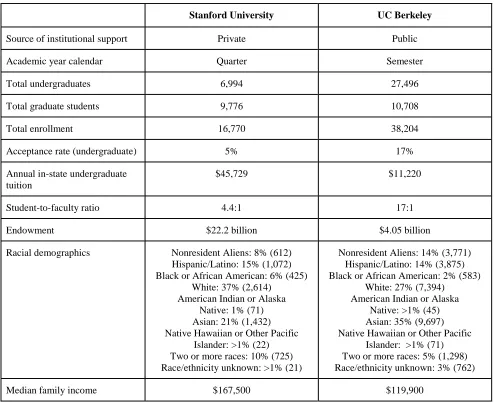
University profile information for Stanford and UC Berkeley is given in Table 2,
including enrollment, acceptance rates, tuition, endowments, student-to-faculty ratios, and
student demographics, and reveals notable differences between these two elite universities.
Table 2. University Profile Information for the 2015-2016 Academic Year.
Stanford University UC Berkeley
Source of institutional support Private Public
Academic year calendar Quarter Semester
Total undergraduates 6,994 27,496
Total graduate students 9,776 10,708
Total enrollment 16,770 38,204
Acceptance rate (undergraduate) 5% 17%
Annual in-state undergraduate tuition
$45,729 $11,220
Student-to-faculty ratio 4.4:1 17:1
Endowment $22.2 billion $4.05 billion
Racial demographics Nonresident Aliens: 8% (612) Hispanic/Latino: 15% (1,072) Black or African American: 6% (425)
White: 37% (2,614) American Indian or Alaska
Native: 1% (71) Asian: 21% (1,432) Native Hawaiian or Other Pacific
Islander: >1% (22) Two or more races: 10% (725) Race/ethnicity unknown: >1% (21)
Nonresident Aliens: 14% (3,771) Hispanic/Latino: 14% (3,875) Black or African American: 2% (583)
White: 27% (7,394) American Indian or Alaska
Native: >1% (45) Asian: 35% (9,697) Native Hawaiian or Other Pacific
Islander: >1% (71) Two or more races: 5% (1,298) Race/ethnicity unknown: 3% (762)
Median family income $167,500 $119,900
Information obtained from: http://opa.berkeley.edu/campus-data/common-data-set, https://ucomm.stanford.edu/cds/, https://www.nytimes.com/interactive/projects/college-mobility/,
For example, Stanford’s acceptance rate is lower than UC Berkeley’s. UC Berkeley has a much
larger student population. Both universities’ enrollment consists of less than 10% Black or
African American students. UC Berkeley enrolls a larger share of nonresident aliens
(classification assigned to non-U.S. citizens) than Stanford. The median annual family income
for Stanford and UC Berkeley students is two to three times the U.S. median yearly family
income (U.S. Census Bureau, 2016).
Data Collection
Interview Participants
Twelve participants total were interviewed, six from Stanford University and six from
UC Berkeley. Of the six participants from each university, four were community college transfer
students and two were university administrators who supported transfer students. The
administrators interviewed for this study worked directly with transfer students in a variety of
capacities, including advising and various student support programs. UC Berkeley and Stanford
differ in their structures for transfer student support, and thus the administrator roles at the two
universities also differed. Because of the small number of administrators who worked with
transfer students, information characterizing the administrators or their job titles is not disclosed
to maintain confidentiality. The community college transfer students interviewed for this study
included first-, second-, and third-year transfer students. Interviews questions for both
administrators and students are given in Appendix A.
Semi-structured interviews were held with the administrators to understand how their
roles and their universities’ institutional programs supported the transfer student population.
Interview topics included the allocation of services for transfer students, institutional structures
Semi-structured interviews were held with the community college transfer students to
understand their university experience and how their experience was shaped by their universities’
institutional structures and programs. The interview questions were designed to explore
differences and similarities of the transfer student experience between the elite private university
and the elite public university. Both administrators and transfer students were asked how the
university experience and support services were different for transfer students versus four-year
students.
Interviews with the transfer students were conducted either in person and over the phone
at the convenience of the participant. In-person interviews took place on the Stanford and UC
Berkeley campuses in quiet, distraction-free locations of the interviewee’s choosing. Phone
interviews were conducted when scheduling constraints on the part of the interviewee or the
researcher precluded in-person interviews.
Recruitment of Participants
Various outreach efforts were used to recruit participants. To connect with administrators
at Stanford and UC Berkeley, the researcher reached out via email and requested interviews. The
researcher used convenience sampling at Stanford since she had professional contacts with
Stanford administrators. At UC Berkeley, the researcher identified administrators who worked
with transfer students via web searches of the UC Berkeley website.
Recruiting transfer students for the study was accomplished via convenience sampling.
At Stanford, the researcher requested transfer student referrals from the Stanford administrators.
The recruitment of UC Berkeley transfer students was accomplished via referrals from the UC
contacted all transfer student referrals by email and requested their voluntary participation in the
study.
Sample Population
Equal numbers of students and administrators from each university were selected for
participation in the study. The student population included an equal number of male and female
participants, with representation of different age groups and different stages in progress toward
degree. Each student participant completed a short demographic survey to ensure the student
participant population had a variety of community college transfer backgrounds.
Four university administrators participated in the study, two from UC Berkeley and two
from Stanford. The four administrators worked with transfer students in different roles, giving
them different perspectives of the transfer student experience within their specific university.
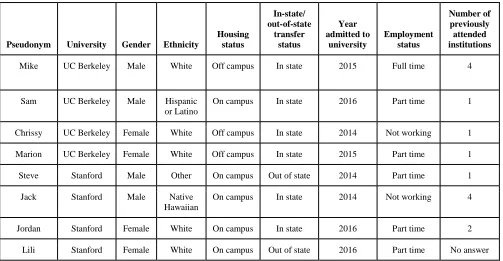
Four female and four male transfer students were selected for the study ranging in age from 24 to
59. The sample population demographics show over half of the student participants are white,
with one Hispanic/Latino student, one native Hawaiian, and one indicating “other.” Declared
majors for the students included classics, architecture, English, political science, psychology,
geography, international relations, and interdisciplinary studies.Four students identified as
first-generation college attendees, four were from low-income backgrounds, two were military
veterans, and one was a student parent. All participants were returning students, having had
breaks in their college attendance prior to enrolling at their current university. Their mean
self-reported grade point average (GPA) was 3.76, ranging from 3.4 to 4.0. Table 3 summarizes the
student participants’ characteristics; A copy of the student survey is given in Appendix B. Due to
the small size of the transfer student population at Stanford, age and major are not listed in Table
Table 3. Student Participant Profile Information.
Pseudonym University Gender Ethnicity
Housing status In-state/ out-of-state transfer status Year admitted to university Employment status Number of previously attended institutions
Mike UC Berkeley Male White Off campus In state 2015 Full time 4
Sam UC Berkeley Male Hispanic or Latino
On campus In state 2016 Part time 1
Chrissy UC Berkeley Female White Off campus In state 2014 Not working 1
Marion UC Berkeley Female White Off campus In state 2015 Part time 1
Steve Stanford Male Other On campus Out of state 2014 Part time 1
Jack Stanford Male Native Hawaiian
On campus In state 2014 Not working 4
Jordan Stanford Female White On campus In state 2016 Part time 2
Lili Stanford Female White On campus Out of state 2016 Part time No answer
Protection of Human Subjects
Great care was taken to ensure the protection of the participants’ identity and
information. The study was reviewed and approved by the University of San Francisco (USF)
Institutional Review Board for the Protection of Human Subjects (IRBPHS), and a copy of the
approval letter was filed in the Office of the Dean of the School of Education (see Appendix C).
All participants voluntarily agreed to participate in the study. All participants were made
aware of their rights as research participants, including the right to stop the interview at any time
and to skip any questions during the interview. The participants were emailed details of the study
before their interviews. The researcher reviewed the purpose of the study before the start of each
interview. All participants agreed to have the interviews recorded for accuracy purposes, and the
participants were ensured that the recordings and all data collected would be kept secure. The
their identity, including the use of pseudonyms. A sample informed consent form is provided in
Appendix D.
Documents and Web Research
In addition to interviews with transfer students and administrators at both institutions, the
researcher drew upon other sources of information, including web research and communications
with university support functions, to further inform the study. The Stanford and UC Berkeley
websites were reviewed for information on orientation, major declaration, and student services.
The researcher also contacted via email the two universities’ housing offices, orientation
coordinators, and academic advisors to better understand each university’s institutional
programming and systems.
Data Analysis
After all interviews were completed, the researcher reviewed each of the twelve
recordings and selected six to be submitted to the Rev audio transcription company
(https://www.rev.com/transcription). The transcribed recordings were analyzed, coded, and
organized in order to identify and present the findings. The interviews that were not transcribed
were summarized to capture main ideas, critical quotes, and findings.
Once all transcribed and recorded interviews were collected, the researcher reviewed the
twelve interviews to identify common themes and patterns that addressed the two research
questions. According to Ryan and Bernard (2003), text analysis includes theme identification,
producing a manageable subset of themes, organizing themes or codes, and linking those themes
back to the research. Each of the twelve recordings was reviewed twice. In the first review, the
researcher captured overall concepts, main themes, and reemerging patterns. If, during the first
capture central ideas and patterns for the second review. In the second review, the researcher
extracted quotes and identified additional themes. The researcher created codes to label patterns
and key ideas that addressed the research questions. An example of a selected code was TIME,
which included the accounts of students and administrators discussing the transfer student
timeline, lack of time, and the overall perception of time with regard to the transfer student
timeline. Both transcribed and nontranscribed interviews were coded and the data organized into
themes and coded categories. The codes used are presented in Appendix E.
Researcher Background
The researcher is a working professional, born and raised in the San Francisco Bay Area.
She attended Cabrillo College and then transferred to San Jose State University, where she
completed her Bachelor’s degree in Health Science. She worked in higher education in both the
public and private sector for a number of years before enrolling at the University of San
Francisco to earn her Master’s degree in Education.
As a community college transfer student herself, the researcher is interested in ways
universities can expand their support of and improve institutional programming for transfer
students. She recognizes the important pathway to a college degree that community colleges
provide for many students, including first-generation college students, underrepresented
minorities, veterans, low-income students, and students from nontraditional backgrounds. It is
the researcher's hope that with a better understanding of the community college transfer student
experience, universities can improve their institutional practices to better serve this growing,
CHAPTER IV
RESULTS
As described in the previous chapter, eight community college transfer students and four
administrations, half from Stanford University and half from UC Berkeley, were interviewed to
gather information about the transfer student experience at elite universities. The findings
identified both common and different experiences at the two institutions.
Two features common to these students stood out. The first was the transfer students’
greater age compared to traditional four-year students. The second was the transfer students’
notable and more varied life experience prior to their university enrollment, far beyond that of
the four-year students. (The term “life experience” refers to the students’ backgrounds and what
they experienced, typically in nonacademic settings, prior to transferring to university.) The
differences identified in the transfer student experience were largely the result of institutional
policies and practices at the two universities. Of particular importance were those related to the
transfer student timeline, academic planning and support, orientation, and housing.
Age and Life Experience
Although the two universities consider both transfer students and four-year students to be
undergraduates, the transfer students typically have vastly different backgrounds and arrive at
university in different stages of their lives and their academic careers. Three of the four transfer
students from UC Berkeley and all four Stanford transfer students spoke about age difference.
Although UC Berkeley and Stanford are distinctly different institutions, age was repeatedly cited
as something that set the transfer students apart from the larger student population.
At UC Berkeley, transfer students comprise 22-23% of the total undergraduate
factor that differentiated them from other new students, in large part because of the different
stage of life they were in and thus their different needs and priorities. For example, when asked
about differences between freshmen and transfer students, Sam, a 24-year-old recent transfer to
UC Berkeley, said: “Transfer students are older, [we have a] different position in life, different
priorities.” Chrissy, another UC Berkeley transfer student, echoed this sentiment:
I think I have a different set of needs from the typical college student…Across the board, you
could say that my colleagues who are transfer students are older than those who are not, and in
that way we have a broader sense of the world and, I guess, ourselves.
Chrissy continued to say that she and her fellow transfer students shared common backgrounds
such as their broader life experience and work experience and the fact that they each had decided
to pursue their undergraduate degrees for various personal reasons.
Marion, also from UC Berkeley, described how age created a sense of being an outsider:
“I am a minority because of my age, [the] majority of people at Cal are 20 years old…I don’t
have peers that I can relate to, and I haven’t met anyone my age going to school for the first
time.” For many students, the ability to have a sense of belonging and relatability to peers is
important. Marion clearly felt that age affected her perception of how she fit into the college
setting and how she related to the students around her.
Marion, Chrissy, and Sam all recognized that age separated them from the four-year
students, particularly the freshmen. They also recognized that it wasn’t just their greater age that
set them apart but also the greater and more varied life experience their extra years had given
them. Being older and in a different stage of life, they had a different view of what they needed
from their university experience. For example, transfer students may not be looking for social
careers after graduation. Transfer students also may have more experience in the workforce and
thus may be focused on developing greater skill sets for career purposes. As a result of their age
and life experience, transfer students do not enter the university setting with the same set of
outlooks, needs, or priorities as traditional four-year students and thus feel disconnected from the
general undergraduate population.
Compared to UC Berkeley, Stanford’s transfer student population is very small,
numbering approximately 100 out of almost 17,000 enrolled undergraduates in 2016. The
number of transfer students at Stanford has remained relatively low due to the university’s
overall low admittance rates. All four Stanford transfer students who were interviewed
commented on how age set them apart. For example, Steve shared:
At least at community colleges there’s people my age or older. Here that’s not really the case.
The transfers are probably the only older group. Finding people my age was hard, and I think for
me it was awkward getting used to being around students that were so much younger than me.
Steve noted that his age was never an issue at community college since the population there was
made up of students of all ages. His perception that transfer students were the only older student
group on campus made it difficult for him to find peers his age. He reported feeling awkward
around the younger students, which created a sense of disconnection between himself and the
other students.
Lili, who was in her first quarter at Stanford, also described how age was a factor that
influenced her university experience:
I think a lot of times, transfer students especially just feel like we stick out in this huge way for
various reasons either because we’re older or we don’t look like we grew up in California or all of
Since there were so few transfer students at Stanford, they were typically the only older student
in their classes. At a university where class sizes are generally small, being one of the only
transfer students and markedly older created feelings of disconnection and isolation.
When asked whether transfer students felt any insecurities about transferring to Stanford,
Jack said one of them was his age: “I feel like being an older person, a student at 28, makes me
well behind the curve.” When comparing himself to students who arrived as freshmen and to
younger students who were at his same academic level, Jack equated his older age with being
behind.
Jordan, another Stanford transfer student, shared a different take on age, describing how
four-year students reacted to her:
Usually they’re like, “Oh my gosh. I thought you were like 26 not [Jordan's age],” or they’ll be like, “So does it feel weird being [Jordan's age]?” So that’s kind of funny, and they’ll be like, “Are you going to have kids?”
Jordan noted that this reaction was quite common when the four-year students discovered her
age. Such a reaction may have arisen for several reasons. It may have been due to the
uncommonness of older undergraduates at Stanford. The weirdness comment may have been a
reflection of the younger students’ concept of a “normal” Stanford undergraduate. Because the
traditional Stanford four-year student’s age is consistent with that of a recent high-school
graduate, Jordan’s age difference was a surprise for the younger students.
When asked about other differences between themselves and four-year students, transfer
students from both Stanford and UC Berkeley described how their life experiences played an
important role in who they were and how it made them different from the other undergraduates.