ISSN-L: 2501 - 1235 Available on-line at: www.oapub.org/edu
doi: 10.5281/zenodo.3364055 Volume 5 │ Issue 11 │ 2019
FACTORS HAVING EFFECTS ON PEOPLE WHO
DO ORIENTEERING SPORT IN TURKEY, START
THIS SPORT AND THEIR EXPECTATIONS
Sinemis Çetin Dağlı1, Zekiye Özkan2i, Ersin Arslan2, Mehmet Baytaş2 1Yüzüncü Yıl Üniversity, Medical School,
Public Health Department, Turkey 2 Yüzüncü Yıl Üniversity, School of Physical Education and Sport, Turkey
Abstract:
Purpose: The purpose of this study is to determine factors encouraging people who do orienteering sport in Turkey to start this sport and their expectations. Material and Method: The survey used in the study was developed Sunay and Saracoglu and was applied to other branches, and its validity and reliability were accepted(Sunay & Saracoglu, 2003). For this survey applied to orienteering branch, expert opinions were taken, and required regulations were done. This study was carried out with 258 people, who do orienteering sport and whose age average was 26,77 ± 8.029. Because data did not show normal distribution as a result of Kolmogorov-Smirnov normality test, “Non-parametric” test was used. For multiple comparisons Kruskal Wallis H test and Mann-Whitney U test and descriptive statistics in analysis of distinction between groups were used in the situations in which normality and homogeneity of variances were not
provided. Significance level for comparisons was determined as p<0,05. Findings:
While friend and peer group was in the first place among factors encouraging people to start orienteering sport, effect of television channels on directing to sport was found very low. Among the reasons why they do the sport, liking orienteering sport is in the first place, and attending to a friend group is in the last places. While it has been seen that expectations of being chosen for National Team and playing for National Team are in the first places, expectations of being a refree are in the last places. When total points related to factors encouraging people to do sport, the reasons why they do sport and their expectations were evaluated, a significant difference between sex and sport years
was not seen. A significant difference between the reasons why they do this sport and father’s educational level was seen (p<0.05). Between the reasons why they do this sport and father’s educational level, a negative relation was seen. A significant difference between the reasons why they do this sport and father’s profession. It was seen that individuals whose fathers were self-employment made for orienteering sport mostly. A significant relation between mother’s profession, mother’s educational level, sport year and factors encouraging people to do sport, the reasons why they do sport and their
expectations was not determined. Conclusion: It is thought that positive approaches
such as being chosen for national team and being a national player, friend and peer group and liking this branch provide positive contributions for individuals to make for orienteering branch.
Keywords: orienteering, sport, expectation, encouragement
1. Introduction
As orienteering may be applied in nature and many fields, it is done in many forms. Because of this feature, it has been a sport branch that is indigenised and performed willingly by many people nowadays.
It has gained great importance in our lives from past to present. Throughout the history, people marked their rotas of land, sea and air voyages on the map and reached their destinations by finding their directions with the help of compasses (Tanrıkulu, 2011). Orienteering is a sport branch that has spread quickly recently and that draws attention of many people from 7 to 70.
“Orienteering is a nature sport that can be performed on every sort of terrain and that athletes try to find the checkpoints with the help of maps and compasses. It is performed either individually or as a team and generally at forestlands. The aim of the athletes is to find the targets that are placed on the terrain and marked on the map previously, by running and with least mistake’’ (Karaca, 2013). With another description, orienteering is to use the skills of map reading in a flawless manner, complete concentration, and quick decision-making alltogether by choosing the best rota between starting, check and finish points on mountainous and steep terrains. This open area hiking provides a unique and unbelievable experience (Güler, 2003). Orienteering is a pretty healthy sport that requires intelligence as well as activating the body. It doesnt only foster the physique, it also improves your thinking and problem-solving skills when you are under pressure and stress (Deniz et al., 2012).
like map reading, evaluating the rota choice, the use of compass, concentration under stress, quick decision-making, and working at a natural terrain (IOF, 2011). Orienteering is a sport that is performed individually only on the terrain by using compass map and various techniques and tactics and following each target on the checkpoints one by one (Palııchuk et al., 2018). Orienteering is a lifelong activity. The educators can motivate the students and improve their physical activity by using orienteering (Beighle & Davst, 2004, cited by Hammes, 2007). It is also useful to use orienteering at physical education activities (Hammes, 2007).
2. Materıal and Method
The questionnaire that was used in the study was developed by Sunay and Saraçoğlu and was applied to the different branches and the validity and the reliability of the test was accepted (Sunay & Saraçoğlu, 2003). Expert opinions have been taken into consideration for this questionnaire that was adapted to the orienteering branch and necessary adjustments have been done. The study was applied to 258 orienteering sporters whose age average was 26,77±8.029 in the 2018 season. Non-parametric methods were applied as the data didnt have a normality distribution after the Kolmogorov-Smirnov normality test. When the homogeneity of normality and the variances weren’t ensured, Kruskal Wallis H test was used for multiple comparisons, Mann-Whitney U test was used alongside with arithmetic mean and descriptive statics for binary groups. The significance level for comparisons was determined as p<0.05.
3. Fındıngs
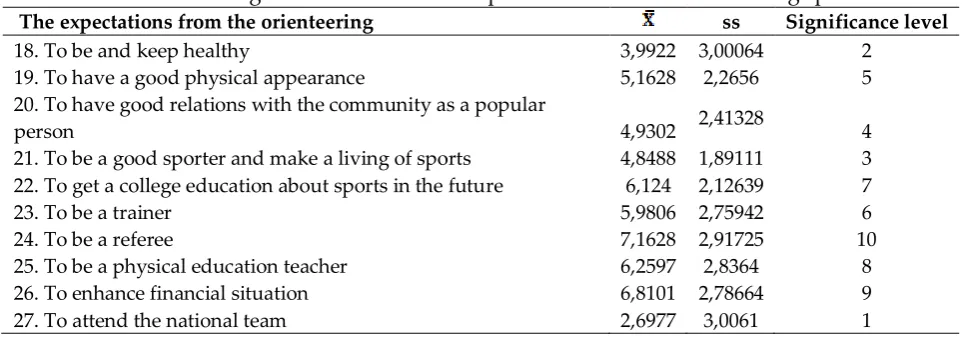
Statistical values of the data about this study that was performed to show the factors encouraging people to do orienteering sport in Turkey and their expectations are represented on the table below.
Table 1: The results of significance level of factors encouraging for orienteering sport
The factors encouraging for the orienteering sport ss Significance level
1. The family members’ effect on encouraging for the sport 3,062 2,53459 3 2. The effect of the neighbourhood 3,876 1,61707 4 3. The effect of friends and peer group 2,8876 1,5071 1 4. The effect of the physical education teacher 3,031 1,85438 2
5. The effect of media organs 6,2209 1,60545 7
6. The effect of television channels 6,6899 1,83904 8 7. The effect of the sports facilities and equipmants at school 5,0465 1,5921 6 8. The effect of a trainor in the immediate surrounding 4,9186 1,95204 5
Table 2: The results of significance level of the reasons for doing orienteering
The reasons for doing orienteering ss Significance level
9. To enhance financial situation 7,2597 2,39455 9
10. The interest in orienteering sport 2,5814 2,12891 1 11. The awareness of the positive contributions of the sport 4,2636 1,97856 3 12. To be involved in a friend group easily 6,8876 2,41593 8 13. To make use of their spare time 5,3721 2,0177 6 14. To be healthy by doing orienteering 4,469 1,73121 5 15. To gain prestige by friends as a sporter 4,2946 2,15509 4
16. To delight in succeeding 3,5853 2,58597 2
17. To act with a team spirit with friends 5,7636 2,43242 7
When we look at the significance levels for the reasons of doing orienteering, it has been seen that it is the interest in orienteering at the 1. level, to delight in succeeding at the 2. level, and the awarenees of the positive contributions of sport at the 3. level.
Table 3: The significance level of the expectations from the orienteering sport
The expectations from the orienteering ss Significance level
18. To be and keep healthy 3,9922 3,00064 2
19. To have a good physical appearance 5,1628 2,2656 5 20. To have good relations with the community as a popular
person 4,9302 2,41328 4
21. To be a good sporter and make a living of sports 4,8488 1,89111 3 22. To get a college education about sports in the future 6,124 2,12639 7
23. To be a trainer 5,9806 2,75942 6
24. To be a referee 7,1628 2,91725 10
25. To be a physical education teacher 6,2597 2,8364 8 26. To enhance financial situation 6,8101 2,78664 9
27. To attend the national team 2,6977 3,0061 1
When we look at the significance levels of the expectations from orienteering, it is seen that to attend the national team is at the 1. level, to be and keep healthy at the 2. level, and to be a good sporter and get a living of sports at the 3. level.
Table 4: Evaluating the education level of the father and the reasons for doing sport (Kruskal Wallis H)
The father’s
education level n
Mean
Rank sd P Significant difference
Primary School 52 122.58
2 7.87 0.19* Between primary school and university,
between high school and university High School 106 123.37
University 100 139.60 p<0.05*
Table 5: Evaluating the father’s occupation and the eaxpectations from the sport (Kruskal Wallis H)
Father’s Occupation n Mean Rank sd P Significant difference
Self-employment 81 118.36
2 7.23 0.27* Between self-employment
and civil officer Private sector 50 131.51
Civil officer 127 135.81 p<0.05*
When we look at the eavaluation of the father occupation and the expectations from the sport, it is seen that there is a significant difference in favor of those fathers who are self-employed p<0.05.
4. Dıscussıon
Orienteering takes the first place among the sport branches that are in demand both in Turkey and the world recently. There are various factors encouraging for doing orienteering as in the other sport branches. In this study, the aim is to state the significance level of the factors encouraging for orienteering. Having looked at the findings got in tis study, the effect of friends and peer group on encouraging in doing sports is on the first rank with the 1. level. Çon et al (1997) state that primarily group of friends, family, sport clubs, physical education teachers, and the sports facilities of schools have most effect on encouraging people to do Akandere et al., (2009) state that social circle and financial situation have effect on starting and succeeding sports.
Bayraktar and Sunay (2007) claim that physical education teacher has the effect on encouraging people in volleyball at the first level, while Şimşek and Gökdemir (2006) claim the same thing for high school students in terms of athletism branch. In this study, it is found out that the physical education teacher has an effect on encouraging to do sports at the 2. level.
In our study, having looked at the significance level of the reasons for doing orienteering, it is seen that interest in the sport comes at the 1. level, delighting at the 2.level, and the awareness of the positive contributions of the sport at the 3.level. It can be said that the sport which is performed willingly has some contributions like bringing along continuousness and success alongside with teaching how to use time more efficiently and quick decision making. Beside, delighting in succeeding also has great effect on doing orienteering. The sports that are performed individually in nature are more embraced by people nowadays. Each success reinforces the sporters’ competitor identity and is a source of motivation fort he sporters when it is known by the society. Developing self-confidence becomes more prominent in orienteering. Having looked at the distribution of the reasons of doing orienteering, it is seen that the interest is at the first place. The studies applied to different sample groups in the literature support the results of our study (Arslan et al., 2017., Alibaz et al., 2006., Bayraktar and Sunay, 2007., Ölçücü et al, 2012, Salman and Sunay, 2012., Yıldırım and Sunay, 2009). It is pointed out that people have different expectations from the sport branches and these expectations are associated with various factors.
Having looked at the importance level of expectations, it is seen that to attend national team comes at the 1. level, to be and keep healthy comes at the 2.level, and to be a good sporter and make aliving out of sports at the 3. level. In the literature studies as well which support our study, to become a national team player is placed at the top (Binboğa ve ark., 2013, Salman ve Sunay, 2012). In this study, the aim of the sporters doing orienteering to be a referee comes last. In the study performed by Atlı et al., (2017), also had the same results. In our study, there was a significant difference between the reasons for doing orienteering and the education levels of fathers p<0.05. There was a negative connection between the education level of fathers and the reasons for doing this sport. There was a significant difference between the reasons for doing this sport and the fathers’ occupations. It has been observed that those whose father is a self-employed are more inclined to do orienteering. In the study Yücel et al., (2015) performed, the place, level of the parents’education and income, the feding behaviours and some other factors are more effective in choosing sports branches. As a result, it has been seen that there are various factors for encouraging people to orienteering in Turkey. The orienteering done in different categories in our country has gained speed with weekend activities especially in big cities. The effect of friend and peer groups on encouraging in doing sports at the 1.level is also an indicator. Among the reasons of doing the sport, liking the sport is also an important indicator. Being a nature sport enables it to be performed willingly and with pleasure.
References
Akandere, M., Baştuğ, G. & Akdoğan, Z. (2009). Investigating The Hopelessness And
Alibaz, A., Gündüz, N. & Şentunay M. (2006). Motives That Prompt Advanced Taekwondo, Karate and Kick-Box Sportsmen to Prefer These Sports Branches, Reasons to be Active in These Branches and Their Expectations Fort he Future.
Spormetre Journal of Physical Education and Sport Sciences 4.3: 91-102.
Arpa, D. K. (2014). The Reasons of Turkish Students Interested in Karate and Taekwondo Why They Choose This Sport and Their Expectation (City of Istanbul). Haliç University Health Sciences Institute Masters Degress.
Arslan, B. (2012). Profiles of Women’s Soccer Players in Turkey. Bahcesehir University Social Sciences Institute. Masters degress.
Arslan, E., Atlı, M., Özkan, Z., Kaplan, Ş. (2017). In Turkey, factors which urge physically handicapped sporters to start badminton sport and their expectations. HS Web Conf. (37), ERPA International
Atlı, M., Arslan, E., Özkan, Z., & Kızılet, A. The Factors That Affect Female Football Players to Get Involced With Sports and Their Expectations From Sport in Turkey . İstanbul University Journal of Sports Sciences, 7(1), 54-61.
Bayraktar, B. & Sunay, H. (2007). The Factors Affecting Turkish Elite Men and Women Volleyball Players’ Starting Sports and Their Expectations. Spormetre Journal of Physical Education and Sport Sciences, 5, 2.
Binboğa, M., Kılıç, İ. & Gökdemir, K. (2013). Motives of junior volleyball players to start and continue volleyball and their expectations for the future. Spor ve Performans Araştırmaları Dergisi, 4, 2.
Çon, M., Yetim, A., Ağaoğlu, Ş. A. & Taşmektepligil, M. Y. (1997). The Effects of Primary and Secondary Schools as an Organisation upon Beginning to Sports of
Their Students Who are Today’s Elite Athletes. Physical Education and Journal of
Sport Sciences, 2, 1: 41-53.
Deniz., E, Karaman, G., Bektas, F., Yoncali N, O., Güler, V., Kılınç, A., & Ateş, A. (2012).
Çocuklarda oryantiring eğitimi. Kültür Ajans Yayınları, Ankara.
Güler, V. (2003). Oryantiring ve çocuklar için oryantiring eğitimi Gazi üniversitesi beden eğitimi ve spor yüksekokulu antrenörlük eğitimi bölümü lisans bitirme Tezi
Hammes, R. (2007). Orienteering with Adventure Education: New Games for the 21st Century. Strategies, 20(5), 7-13.
International Orienteering Federation (2011). Competition Rules For İnternational
Orienteering Federation (IOF) Foot Orienteering events.
Kara, E. & Pulur, A. (2003). Studying The Reason of University Students Tendency on
Mountaineering ( Example of Yuzuncu Yil University). Physical Education and
Journal of Sport Sciences, 5 (2).
Karaca, F. (2013). 10 soruda oryantring TOHAD. Ankara.
Ölçücü, B., Erdil, G., Bostancı, Ö., Canikli, A. & Aybek, A. (2012). The Reasons of Athletes Who Participate in Intercolegiate Tennis Competitions For Taking Up
Tennis and Their and Their Expectations. Journal of Sports and Performance
Ölçücü, B., Özen, Ş. & Altınkök, M. (2014). Sports Education Reasons to Start Playing and Expectations From Volleyball of the Volleyball Players in Volleyball Teams of Tokat. International Journal of Turkish Education Sciences.
Özbek, O. &. Şanli, E. (2011). Causes of Propensity for Elite Athletes in Universities to
Take Up Karate and Their Expectations. Nigde University Physical Education and
Journal of Sport Sciences, 5, 3.
Paliichuk, Y., Dotsyuk, L., Kyselytsia, O., Moseychuk, Y., Martyniv, O., Yarmak, O., & Galan, Y. (2018). The influence of means of orienteering on the psychophysiological state of girls aged 15-16-years.
Salman, Ö. & Sunay, H. (2012). Reason to Begin Between the Ages of 14-16 the Branches
of Basketball Players and Their expectations in Ankara. Spormetre Journal of
Physical Education and Sport Sciences, 10, 1.
Sunay, H. & Saraçoğlu, A. S. (2003). The Factors Direct to the Branches of Turkish
Athletes and Their Expectations. Spormetre Journal of Physical Education and Sport
Sciences, 1 (1), 43-48.
Şimşek, D. & Gökdemir, K. (2006). The Reasons of Students Doing Athletics in
Secondary Scholl Tending to Athletics and Their Exectations. Spormetre Journal of
Physical Education and Sport Sciences, 4 (3), 83-90.
Tanrıkulu, M. (2011). Harita ve Pusulanın Farklı Bir Kullanım Alanı: Oryantiring. Milli
Eğitim Dergisi, 41(191), 120-126.
Wolfonden, L. & Holt N. (2005) Talent development in elite junior tennis: Perceptions of
Players, Parents, and Coaches, Journal of Applied Sport Psychology, 17: 108-126
Yıldırım, Y. &. Sunay, H. (2009). The Expectations and The Reasons For Choosing The Performance Tennis in Turkey. Spormetre Journal of Physical Education and Sport Sciences, 7, 3.
Yücel, A. S., Kılıç B., Korkmaz M. & Göral, K. (2015). Sports Preferences f Children and
Analysis of Some Factors Affecting the Preferences. International Refereed
Creative Commons licensing terms