ASSESSMENT OF SYNTHETIC PYRETHROIDS RESIDUES IN
THE WATERS AND SEDIMENTS FROM THE WEIJA LAKE IN
GHANA
Samuel Afful
[a],*, Johannes A. M. Awudza
[b], Shiloh Osae
[a]and Stevester K. Twumasi
[b]Keywords: synthetic pyrethroid residues; Weija lake, sediment, lake water
The spectrum and levels of synthetic pyrethroids in the Weija Lake waters and sediments have been investigated as a case study. Sampling was done at eight sampling locations along the Lake. Liquid-liquid extraction using 3:1 acetone/hexane mixture and soxhlet extraction were used for extraction of the pyrethroid from the water and sediment samples respectively. Analysis of the pyrethroids extracts was done with gas chromatography equipped with electron capture detector. In all, seven synthetic pyrethroids namely, fenpropathrin, cyfluthrin, cypermethrin, fenvalerate, deltamethrin, allethrin, and permethrin were detected in the Lake waters. In addition to the above pyrethroids, bifenthrin and lambda cyhalothrin were detected in the sediments. Cyfluthrin was the most ubiquitous pyrethroid in the Weija water with 100 percent occurrence, while, cyfluthrin, fenvalerate were the most ubiquitous pyrethroids. Both were detected with 87.5 percent occurrence. The concentrations of the detected pyrethroids ranged from 0.10 – 3.50 ng L-1 and 0.15 – 6.60 ng g-1 for the water and sediment samples respectively. The concentrations of detected pyrethroids in the Weija waters were far below maximum residue limits set by European Union (EU) and the Japanese Government. The results therefore suggest that pyrethroids residue concentration in the Weija waters may not pose health hazard in terms of synthetic pyrethroid pollution.
*Corresponding Authors
E-Mail: [email protected] Mobile: +233275809933
Fax: +233400807
[a] Nuclear Chemistry Environmental Research Center, Ghana Atomic Energy Commission, Box LG. 80, Legon, Accra, Ghana
[b] Chemistry Department, Kwame Nkrumah University of Science & Technology, Kumasi, Ghana
Introduction
Synthetic pyrethroids are organic compounds similar to the natural pyrethrins which are synthesized derivatives of naturally occurring pyrethrins. They are produced from pyrethrum, the oleoresin extract of dried chrysanthemum flower. The insecticidal properties of pyrethrins are derived from ketoalcoholic esters of chrysanthemic and pyrethronic acids.1 Pyrethroids now constitute the majority of commercial household insecticides.2 Natural pyrethrins and synthetic pyrethroids though chemically and toxicologically similar, pyrethrins are extremely sensitive to light, heat and moisture. In direct sunlight, half-lives can be measured in hours. However, synthetic pyrethroids were developed to capture the effective insecticidal activity of botanical insecticide, with increased stability in light, yielding longer residence time.3 In the concentrations used in such products, they may also have insect repellent properties and are generally harmless to human beings in low doses but can harm sensitive individuals. They are usually broken apart by sunlight and the atmosphere in one or two days, and do not significantly affect groundwater quality.4 Pyrethroids are however toxic to aquatic organism.
Synthetic pyrethroids were introduced in the late 1900 by a team of Rothamsted Research scientists following the elucidation of the structures of pyrethrin by Hermann
pyrethroids therefore represent a major advancement in the chemistry that synthesized the analog of the natural version found in pyrethrum. Their development coincided with the identification of problems with DDT use. Their work involved identifying the most active components of pyrethrum, extracted from East African chrysanthemum5. The first generation pyrethroids, developed in the 1960s, include bioallethrin, tetramethrin, resmethrin and bioresmethrin. These are more active than the natural pyrethrum but are unstable in sunlight. Activity of pyrethrum and the first generation pyrethroids is often enhanced by addition of the synergist such as piperonyl butoxide
Synthetic pyrethroids residues in the waters and sediments Section B-Research Paper Many pyrethroids have been linked to disruption of the
endocrine system, which can adversely affect reproduction and sexual development, interfere with immune system and increase chances of breast cancer. Pyrethroids contain xenoestrogens which can increase the amount of estrogen in the body.7 When tested, certain pyrethroids demonstrate significant estrogenicity and increase the levels of estrogen in breast cancer cell.8 Synthetic pyrethroids interfere with ionic conductance of nerve membranes by prolonging the sodium current. This stimulates the nerves to discharge repeatedly causing hyper-excitability in poised animals. The WHO explain that synthetic pyrethroids are neuropoisons acting on the axons in the peripheral and central nervous systems by interacting with sodium channels in mammals.9
In Ghana, the Weija Lake is among the important water resources that the nation can boast of. The Weija Lake was created by damming the Densu river to provide potable water for the residents of western Accra, for irrigation and also to increase the fishery potential of the river system. As a result of availability of water for irrigation, vegetables cultivation at the catchment of the lake has become lucrative. Thus, communities dotted around the Lake are engaged in vegetable crop cultivation. In their effort to fight the menace of insects, synthetic pyrethroids and related pesticides are used by the farmers to spray their crops. Residues of these pesticides are therefore likely to be washed into the lake through run-off from the farm lands. There is therefore the need to assess the burden of pyrethroid residues in the Lake to establish the water quality and health status of the lake in terms synthetic pyrethroid pollution.
The study area
Weija Lake lies 17 km west of Accra between 50 331 to 5o 401 N and 00 201 to 00 241 W in the coastal savannah thicket and grassland vegetation zone in southern Ghana. The lake is shallow with a maximum water level of 15.3 m Odinary Datum (OD) during the peak of the rainy season and covers an area of about 33.6 km2. Area of water shed is 2264 km2 with mean surface water level of 14.3 m. Principally, the vegetation consists of dense thickets interspersed with patches of grass. The nature of the soils in the catchments have been reported to be well drained, friable, porous loam savannah ochrosols which are low in nutrients especially phosphorus and nitrogen.10-11. Also, the soils in the catchment are sodium uleisols and lithosols. 12-13In the Lake District rainfall is low, averaging 840 mm a year, erratic and two–packed occurring mainly from May to June and in October. The catchment area for the Weija Lake, however, extends into much higher rainfall areas of the country14. The hottest months are in February to April with the highest mean monthly temperature of 320C occurring in March, whilst the lowest mean monthly temperature of 21.70C occurs in August. The occupation of the people in the catchment of the lake includes fishing, animal rearing and crops farming. The main economic activities of the people in the catchment of the lake includes fishing (small-scale canoe fishing), animal rearing, stone quarrying and crops farming. Major crops include maize, cassava, sugarcane and vegetables. The normal surface elevation is estimated at 14.37 km with maximum of 15.24 km.15To protect the Lake, the dam and the buffer zone and to minimize the effects of
possible flooding, the government in 1977, under the State Lands Act, 1962 (Act 125), acquired a total area of 13,580 acres around the site, for which compensation was duly paid.
Materials and Methods
Sampling and sample treatment
Sampling were done in eight sampling locations, namely Weija water works, Weija village, Machigen, Amanfro, Domeabra, Soga kope, Jomo and Afuaman of the Lake. Fishman fishing canoe was used to reach the sampling points. Surface water samples were collected by using 500 ml plastic bottles. At sampling point the sampling bottle with the lid on was lowered into the water and then opened while under the water to fill the bottle after which it was covered with the lid immediately. Sediment samples were collected at various points in the neighborhood of the place where the water samples were collected using Eckman grab while sitting in the fisherman canoe. Sediment samples were taken from a depth of about 20 cm. The samples were wrapped in aluminium foil and then bagged in polyethylene bags. At each sampling point, three samples were collected. In the laboratory the water samples were kept in fridge and the sediment samples were dried at room temperature. The sediments were then milled with pestle and mortar and sieved with 500 μm mesh size sieve to remove stones and other debris. The sieved samples were then wrapped in aluminium foil and kept at room temperature in a clean cupboard.
Chemicals and Reagents
All chemicas and reagents used in this study were of high purity and were of analytical grade. Hexane (95+ %), acetone (99.8 %) were from Sigma –Aldrich, Germany. Florisil adsorbent was from Hopkin and Williams, England. The reference pesticide standards (allethrin, bifenthrin, fenpropathrin, lambda-cyhalothrin, permethrin, cyfluthrin, cypermethrin, fenvalerate, deltamethrin), were from Dr. EhrenstorferGmbH of Augsburg in Germany.
Extraction for synthetic pyrethroids
Liquid-liquid extraction with hexane was used for the extraction of the extractable pyrethroids from the water samples. Twenty ml portion of the water sample was shaken with 20 ml of hexane as extraction solvent in 100 ml separating funnel. The hexane extract (organic layer) was separated from the aqueous layer. Extraction was repeated three times and the organic layers were put together and dried over anhydrous sodium sulphate.
Synthetic pyrethroids residues in the waters and sediments Section B-Research Paper
Florisil clean up of extracts
Clean-up analysis was carried out according to the procedure of Afful et al with slight modifications16. Florisil solid phase extraction columns were prepared by packing 6 ml extraction column with 1 g pre-activated florisil adsorbent with 0.5 g anhydrous sodium sulphate packed on top of the florisil. The colums were each conditioned with 10 ml hexane. The extracts from the samples, blanks and spiked samples were eluted through the column and the eluate collected into 50 ml flask. The column was further eluted with 10 ml hexane. The eluate was concentrated on rotary evaporator to almost dryness and extracted in 1.5 ml ethyl acetate for GC analysis.
Gas chromatography analysis
A Varian CP-3800 Gas Chromatograph equipped with electron capture detector was used for analysis. A volume of 1µl aliquots of extract was injected. The operation conditions were capillary column: VF – 5mS, 40m x 0.25mm x 0.25μm, temperature programme: 70 0C (2min) to 180 0C (1min) 25 0C min-1 to 300 0C at 5 0C min-1, injector temperature: 270 0C, detector temperature: 300 0C, carrier gas: N2 at 1.0ml min-1, make up: nitrogen at 29ml min-1.
The pesticide residues were identified based on comparison of relative retention times to those of known standards and quantified by external standard method using peak area. The limit of quantification (LOD) was estimated as ten times the signal to noise ratio of the blank.
Results and Discussion
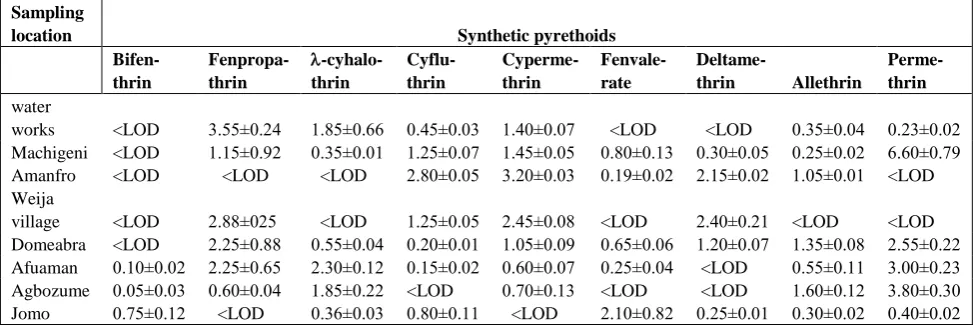
Tables 1 and 2 show the levels of synthetic pyrethroid detected in the study area. Margins of errors of the concentrations measured are standard deviation based on
namely, fenpropathrin, cyfluthrin, cypermethrin, fenvalerate, deltamethrin, allethrin, and permethrin were detected in the Lake waters. In addition to the above mentioned pyrethroids, bifenthrin and -cyhalothrin were detected in the sediments as well. Indeed the levels of bifenthrin and lambda cyhalothrin in the water samples were below the detection limit.
The detection of these compounds shows wide use of pyrethroids in the catchment of the Weija Lake. Frimpong17 similarly detected these nine pyrethroids in cocoa beans from Ghana. This is not surprising at all since the use of pyrethroids has now become phenomenal in Ghana for vegetable and other cash cultivation after the ban on organochlorine pesticides.17
In general, the concentrations of the compounds in the sediments were more prominent compared to the water samples. Thus the trends of the pyrethroids distribution in the Lake water and sediments indicate higher pyrethroid concentration in sediments than in water. In an aquatic medium, pesticides residues tend to settle more in sediments than remain in the overlying water. Sediments therefore serve as sink for pesticide residue. The concentration of the detected pyrethroids ranged from 0.10 – 3.50 ng L-1 for the water samples. The highest concentration of 3.50 ng L-1 was detected for fenpropathrin at Amanfro and Weija village whiles the lowest concentration of 0.01 ngL-1 was also recorded for fenvalerate sampled at Afuaman. In the case of the sediment mean pyrethroid concentrations range from 0.15 – 6.6 ngg -1 with the highest concentration of 6.60 ng g -1 recorded for permethrin sampled from Machigeni.
Frimpong et al reported a higher concentration range of 11.9 – 29.4 ng g-1 for synthetic pyrethroid residues in cocoa
Sampling locations
Compounds
Bifen- thrin
Fenpro-pathrin
-cyhalo-thrin
Cyflu-thrin
Cyper-methrin
Fenva-lerate
Delta-methrin
Allethrin Permeth-rin
water works
<LOD <LOD <LOD <LOD 0.05±0.01 <LOD <LOD <LOD <LOD
Machigeni <LOD 1.65±0.24 <LOD 0.65±0.20 0.35±0.22 <LOD <LOD 0.60±0.08 <LOD Amanfro <LOD 3.50±0.72 <LOD 3.00±0.40 0.25±0.02 <LOD 0.20±0.03 0.40±0.03 <LOD Weija
village
<LOD 3.50±0.61 <LOD 2.30±0.12 0.10±0.02 <LOD <LOD 1.50±0.24 <LOD
Domeabra <LOD <LOD <LOD 0.25±0.32 0.55±0.07 3.10±0.12 0.70±0.11 0.25±0.04 0.20±0.01 Afuaman <LOD <LOD <LOD 0.55±0.10 0.30±0.06 0.10±0.02 <LOD <LOD 0.45±0.06 Agbozume <LOD <LOD <LOD 0.20±0.05 0.15±0.03 0.15±0.01 0.30±0.01 <LOD <LOD Jomo <LOD <LOD <LOD 0.20±0.04 <LOD o.10±0.02 <LOD <LOD <LOD
Table 2. Concentrations ( ng g-1) of synthetic pyrethroids in the sediments from the Weija Lake
Sampling
location Synthetic pyrethoids
Bifen-thrin
Fenpropa-thrin
-cyhalo-thrin
Cyflu-thrin
Cyperme- thrin
Fenvale-rate
Deltame-thrin Allethrin
Perme-thrin
water
works <LOD 3.55±0.24 1.85±0.66 0.45±0.03 1.40±0.07 <LOD <LOD 0.35±0.04 0.23±0.02 Machigeni <LOD 1.15±0.92 0.35±0.01 1.25±0.07 1.45±0.05 0.80±0.13 0.30±0.05 0.25±0.02 6.60±0.79 Amanfro <LOD <LOD <LOD 2.80±0.05 3.20±0.03 0.19±0.02 2.15±0.02 1.05±0.01 <LOD Weija
Synthetic pyrethroids residues in the waters and sediments Section B-Research Paper
Figure 1. Total synthetic pyrethroid load at the various sampling locations along the Weija Lake.
Figure 1 shows the total pyrethroid load (sum of the levels of all the individual pyrethroids) at the eight sampling locations on the Weija Lake. The highest total pyrethroid load recorded for the sediments was 11.15ng g-1 at Machigeni. This came as no surprise as the inhabitants at Machigeni are engaged mainly in vegetable growing. Residue of these chemicals left on the field after use are likely to be washed into the Lake by surface run-off. The lowest pyrethroid load in the sediments was recorded at Jomo, a predorminant fishing community, with a pyrethroid load of 4.96 ng g-1. In the case of the water samples the highest pyrethroid load of 7.65ng ml-1 obtained at Weija village.
Figure 2. Percentage occurrence of the pyrethroids in the waters and sediments from the Weija Lake
Figure 2 presents percentage occurrence of the compounds in the Lake water and sediments. Cyfluthrin was the most ubiquitous pyrethroid in the Weija water with 100 percent occurrence, while permethrin was found to be the least ubiquitous with percentage occurrence of 25.0 %. In the case of the sediments, cyfluthrin, fenvalerate were the most ubiquitous pyrethroids. Both were detected with 87.5 % occurrence. Bifenthrin was the least ubiquitous pyrethroid in the sediments with 37.5 % occurrence.
Comparison of Pyrethroid residue levels to International standards
Table 3 compares mean pyrethroid concentration of the compounds in the present study to European Union (EU) and Japanese maximum residue limit (MRL)17. Residue levels reported in the present study represent the sum of individual pyrethroid in all the eight sampling locations. Generally, the levels of the pyrethroids in the Weija waters were far below maximum residue limits set by European Union (EU) and the Japanese Government. The results are therefore a suggestive that pyrethroids residue concentration in the Weija waters may not pose health hazard in the waters of the Lake in terms of synthetic pyrethoid pollution.
References
1Reigart, J. M. D., Recognition and management of pesticides poisonings, USEPA. 1999
2Metcalf R, L., Encyclopedia of Industrial Chemistry, Wiley- VCH, Weinheim, 2002.
3Gosselin, R. E.. Clinical Toxicology of commercial products. Williams and Wilkin, Baltmores, 1984.
4USEPA, "Permethrin, resmethrin, sumithrin, synthetic pyrethroids for mosquito control". http://www.epa.gov/pesticides/he-alth/mosquitoes/pyrethroids4mosquitoes.htm. 2002, Retrie-ved 2008-04-04.
5Pyrethroids – Wikipedia,. C:\Document and Setting\DIGIT|Desk-top\pyrethroids-the free encyclo-pedia
6EPA Ghana. Register of pesticides as at 31st December 2009 under Part 11 of the environmental protection agency act, (Act 490), 2009.
7Garey, J. and Wolff, M.. Biochem Biophys Res Commun. 1998, 251(3), 859.
8Go, V., Env. Health Perspect. 1999,107, 3.
9World Health Organization (WHO). D-Phenothrin, Environ. Health Criteria, Geneva, 1990.
10 Boateng, E. A., A Geography of Ghana, 2nd Edition, Cambridge University Press, London, 1970.
11Dickson, K. B., Benneh, G.. A new Geography of Ghana, 1st Edition, Longman,1970
12Ameka, G. K., G. K., De Graft-Johnson, K. A. A., Akuamoah, R. K.. J.of the Ghana Sci. Assoc.. 2000, 2(2), 147.
13Ayibotele, N. B., Tuffour-Darko, T., Sediment load in southern rivers, Publication of Water Resources Research, Accra,
1979.
Table 3. Comparison of concentrations (ppb) synthetic pyrethoids in the Weija Lake waters to maximum residue limits (MRL) stipulated by EU and Japan.17
Synthetic pyrethroid
This work (ppb)
EU MRL (ppb)
Japanese MRL (ppb)
Bifenthrin <LOD 100 100 Fenpropathrin 8.65 20 10
14Hall, J. B., Swaine, M. D. Forest and vegetation in Ghana, Dr.W. Junk Publication, 1981
15Nukunya, G.K., Boateng, E. A., A report submitted to the Canadian International Development Agency, I.S.S.E.R.
1979.
16 Afful, S., Anim, A.K., Serfor - Armah, Y., J. Env. Earth Sci.
2010, 2(3), 133.
17Frimpong, S. K., Yeboah, P. O., Fletcher, J. J., Pwamang, J.and Adomako, D., Elix. Food Sci, 2012, 49, 9875.
Received: 12.12.2012.