INVESTIGATION ON THE EFFECT OF PARTICLE SIZE AND
ADSORPTION KINETICS FOR THE REMOVAL OF Cr(VI)
FROM THE AQUEOUS SOLUTIONS USING LOW COST
SORBENT.
R. Hema Krishna
[a]*and A. V. V. S. Swamy
[b]Keywords: Adsorption, Cr (VI) ions, powder of calcined brick, Particle size, Adsorption Kinetics, Langmuir Lagergren rate constant.
The potential to remove Chromium (VI) from aqueous solutions through sorption using powder of calcined brick (PCB) was investigated using batch tests. The influence of physico-chemical key parameters such as the initial metal ion concentration, agitation time and the particle size of adsorbent have been considered in batch tests. The optimum results were determined at an initial metal ion concentration was10 mg L-1, agitation time – 60 min, and the particle size ( 0.6 mm). The % adsorption, Lagergren rate constant (K
ad (min-1)=6.60 x 10⁻²
for Cr(VI)10 mg L-1) were determined for the adsorption system as a function of sorbate concentration . The kinetic data obtained were
fitted to pseudo first order model.
* Corresponding Authors Tel; 001-6475026323
E-Mail: [email protected]; [email protected]
[a] Department of chemistry, University of Toronto, Ontario, Canada. M3J 1P3
[b] Department of Environmental Sciences, Acharya Nagarjuna University, India-522510.
Introduction
Heavy metal pollution has been increasing with the diversifying industrial activity. Industries such as textiles, dye industry, drugs and pharmaceutical industries, tanning, electroplating, etc., use heavy metals in considerable quantities. The heavy metals are used as catalysts and are recovered as far as possible and ultimately discharged along with the wastewater generated in the industry. Their abuse harms the living systems. For that matter any ‘matter’ in a wrong concentration, in a wrong place and in a wrong time is named as a ‘pollutant’. The modern technology developed by the man, not only depleted the wealth of nature but also created environmental degradation. The problem of water pollution due to heavy metals and their impact on environment is presently the focus of international attention. The removal of heavy metals was also tried with zeolite and crystal gravel in combination with porous iron. The removal was tried not only from aqueous solutions but also from the urban storm water. The presence of heavy metals in the sewage water had been the main problem in the sewage treatment plants of the urban areas. Hence there have been efforts to remove the heavy metals from the sewage before they are let out in to the natural systems1 have studied the
efficiency of the porous iron individually and in combination with zeolite and crystal gravel, in the removal of coexistent heavy metals from simulated urban storm water. The equilibrium data of their study demonstrated a good fit with the Freundlich model and showed affinity in the order: Cd > Zn > Ni > Cu > As > Cr studied2 the
removal of Cr(VI) using hydrous concrete particles which had Si, Al, Fe, Ca and Mg as Major components. They compared the adsorption free energy of HCrO4- and CrO42-
and reported hydrous concrete particles good adsorbent. Low cost materials like linseed straw, pressed sludge cake, coal dust, pyrolysed tyre, and sugar beet pulp and leather hide powder had been used. Modified cellulose was also reported in literature by Navarro3 and Bandyopadhyay4
studied removal of Cr(VI) on sand as well as in combination with activated carbon too. They came out with some interesting facts that mixed adsorbent becomes effective at high dosage (≥2.5 g/100 ml) and also in good agreement with Langmuir adsorption isotherm. They concluded that adsorption is more favorable for mixed adsorbent as compared to activated carbon alone. In choosing a waste water treatment technology, factors like nature of pollutants, permissible limits and economy of the treatment method have to be considered. Recent research of selective and sensitive methods for the determination of metals in water at trace levels. Among available methods, adsorption appears to have least adverse effects. The use of waste material from industries and agriculture for the removal of metal ions which reduces the treatment cost, and also provides a solution for the solid waste management of the industries. Most of the industries cannot afford to use conventional wastewater treatment methods due to their high cost. It is expected that the present work in this publication may fulfill the aforesaid requirement partially. The present study includes the studies on the effect of particle size and adsorption kinetics on removal of chromium(VI) ions using powder of calcined brick. The efficiency of this adsorbent was studied and maximum adsorption and lowest equilibrium time for this adsorbent was recorded. The present work helps the individual organizations to remove the excess concentrations of the chromium(VI) from their effluents within their premises without much effort and time.
Experimental
Powder of calcined brick (PCB): The calcined bricks were collected from the kiln and powdered. The powder was soaked for 24 hours in distilled water and then thoroughly washed for 4 to 5 times. The powder was in air and sieved to select 0.6 mm sized particles.
Measurement of moisture content: Ten grams of the adsorbent powder was taken into a Petri dish and overheated for two hours. After heating the plates were instantaneously placed in a desiccator. The powder thus cooled and weighted. The difference between initial and final weights was taken as the moisture content.
Preparation of metal-ion solution: The chromium(VI) was estimated using standard methods. AR grade chemicals and double distilled water were used for all the analyses. The concentrations of the metal ions were estimated using UV-visible spectrophotometer (ELICO SL 150)
Standard chromium Solution: Potassium dichromate AR grade was used to prepared standard chromium(VI) solution. 2.830 g of potassium dichromate was weighed and taken into 1000 ml volumetric flask.
Analysis of chromium(VI): The metal ion concentrations were estimated by adoption the procedures described in the methods. Chromium(VI) was estimated using UV–VIS spectrophotometer (ELICO-SL 150) by diphenyl carbazide (DPC) method. Different dilutions of Cr(VI) solutions containing less than 30 mg L-1 of chromium concentrations
were added with 2.5 ml of diphenyl carbazide solution. The diphenyl carbazide solution was prepared by dissolving 200 mg of diphenyl carbazide in 100 ml of 95% alcohol. The contents were mixed with an acid solution of 40 ml of concentrated H2SO4 and 360 ml of distilled water. The
contents were refrigerated for not less than 24 hrs, and to a maximum of one month. The absorbance was measured in the UV–visible spectrophotometer at 540 nm. The reagent blank was also measured following the same procedure. A calibration curve was prepared for Cr(VI) standard solutions and absorbance. The concentration in the sample was established by reading from the calibration curve. The results for a heavy metal concentrations were expressed in mg L-1 while those of the concentration equilibrium,
equilibrium time, and adsorption capacity etc., were compared with the Langmuir and Freundlich isotherms
Batch equilibrium method: All experiments were carried out at room temperature (27 0C) in batch mode. Batch mode
was selected because of its simplicity and reliability. The experiments were carried out by taking 50 ml metal ion sample (AR grade) in a 100 ml Erlenmeyer flask and after pH adjustments; a known quantity of dried adsorbent was added. The flasks were agitated at 165 rpm for predetermined time intervals using a mechanical shaker until equilibrium conditions were reached. After shaking, the suspension was allowed to settle. The residual mass adsorbed with metal ion was filtered using whatman 42 filter paper (Whatman International Ltd., Maid Stone, England), filtrate was collected and subjected for metal ion estimation using UV-visible spectrophotometer (ELICO SL 150). The values of percent metal uptake by the sorbent (sorption
efficiency, ζ) and the amount of metal ion adsorbed (qe) has
been calculated using the following relationships
100 i f
i
C C
C
(1)
qe Ci Cf v
m
(2)
where,
Ci- initial concentration of metal ion in the solution, mg L-1
Cf - final concentration of metal ion in the solution, mg L-1
m - mass of adsorbent, g L-1
v - volume of solution (lit)
qe - amount of metal ion adsorbed per gram of
adsorbent.
Control experiments were carried out and the average values of duplicate runs were obtained and analyzed (error: ±1-2% for percentage removal and ±0.005-0.01 mg g-1 for
amount adsorbed). The adsorbents selected were very common and eco-friendly. The work mainly helps in bringing bio sorbents into use to handle the heavy metals.
Results and Discussion
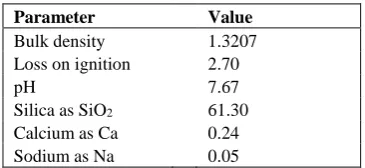
The characteristics of PCB like bulk density, loss on ignition, pH, and silica as SiO2 were discussed in the Table
1.
Table -1 Characteristics of PCB
Effect of Initial Metal Ion Concentration and Equilibrium Time
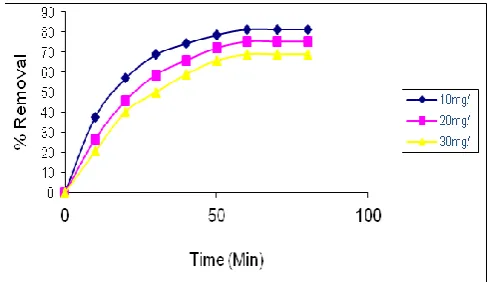
Equilibrium experiments were carried out by agitating 50ml of different concentrations of chromium(VI) solutions (10-30 mg L-1) adjusted to pH 2.0 with 200 mg of adsorbent. After equilibrating for different time periods, the solutions were centrifuged and analyzed for chromium (VI) content. Cr(VI) adsorption as a function of time and different concentrations were shown in (Table 2). It was evident that the equilibrium time was independent of initial concentration. The rate of uptake was rapid in the beginning and became slow in the later stages of the adsorption process.
Parameter Value
Bulk density 1.3207
Loss on ignition 2.70
pH 7.67
Silica as SiO2 61.30
Calcium as Ca 0.24
Table 2 Adsorption of Cr (VI) and % of removal for different agitation times.
Table 3. Adsorption of chromium (VI) on different particle sizes (mm) of the adsorbent
Particle size in mm
Agitation time, min
0.6 mm 0.8 mm 1.7 mm
q, mg L-1 q
e-q ζ, % q, mg L-1 qe-q ζ, % q, mg L-1 qe-q ζ, %
10 1.33 1.68 40.18 1.13 1.53 34.20 0.94 1.40 28.40
20 2.09 0.92 62.75 1.75 0.91 52.50 1.47 0.87 44.22
30 2.48 0.53 74.69 2.12 0.54 63.85 1.82 0.52 54.74
40 2.77 0.24 83.11 2.43 0.23 72.95 2.08 0.26 62.50
50 2.94 0.07 78.02 2.60 0.06 78.02 2.21 0.13 66.46
60 3.01 - 90.58 2.66 - 80.05 2.34 - 70.13
70 3.01 - 90.58 2.66 - 80.05 2.34 - 70.13
80 3.01 - 90.58 2.66 - 80.05 2.34 - 70.13
The adsorbate metal ions preferentially, occupied many of the active sites in a random manner resulting in rapid uptake of Cr(VI) ions. As the time passed, the active sites were blocked and hence the rate decreased. For maximum removal of chromium(VI) by the adsorbent, the solutions should be equilibrated for 60 min irrespective of the initial concentration. The curves observed in (Figure 1) were single, smooth and continuous indicating the formation of monolayer coverage of the adsorbate on the surface of the adsorbent.
Figure 1 The relationship between time of agitation and % removal
Similar trend has been reported for bituminous coal and photo film waste by Nagesh et al5 and Selvaraj et al.6 The
amounts of Cr(VI) adsorbed were found to be 2.03, 3.75 and 5.16 mg g-1 for chromium (VI) at the concentrations of 10,
20 and 30 mg L-1, respectively, by PCB.
Effect of Particle Size
To study the effect of particle size, adsorbent particles of sizes 0.6 mm, 0.8 mm and 1.7 mm were used. In each study 150 mg of adsorbent in 50 ml of 10 mg L-1 of Cr(VI)
solution was agitated to equilibrium time of 60 min, the adsorbent was separated and the supernatant solution was analyzed for chromium concentration and the values are noted in (Table 3), the amounts adsorbed for 0.6 mm, 0.8 mm and 1.7 mm particle size were 3.01, 2.66 and 2.34 mg g-1, respectively. It is evident from (Fig. 2). That increase in
particle size decreased the percent removal. At a fixed adsorbent dosage, the decrease in particle size increases the metal uptake. The increase in the uptake by smaller particles was due to the greater accessibility to pores and to the greater surface area for bulk adsorption per unit mass of the adsorbent.
Similar trend had been observed on removal of Cr(VI) by using Pitchellobium dulce benth.7
Concentration of Chromium (VI) in mg L-1
Agitation time, min 10 mg L-1 20 mg L-1 30 mg L-1
q, mg L-1 q
e-q ζ, % q, mg L-1 qe-q ζ, % q, mg L-1 qe-q ζ, %
10 0.94 1.09 37.76 1.34 2.41 26.81 1.54 3.62 20.60
20 1.47 0.56 56.98 2.28 1.47 45.78 3.02 2.14 40.33
30 1.72 0.31 68.80 2.93 0.82 58.65 3.75 1.41 50.04
40 1.86 0.17 74.40 3.28 0.47 65.79 4.41 0.75 58.92
50 1.96 0.07 78.66 3.59 0.16 71.87 4.92 0.24 65.71
60 2.03 - 81.37 3.75 - 75.07 5.16 - 68.80
70 2.03 - 81.37 3.75 - 75.07 5.16 - 68.80
0 20 40 60 80 100
0 50 100
TIME (min)
%
R
E
M
O
V
A
L 0.6mm
0.8mm
1.7mm
Figure 2 Relationship between particle size,% removal at different times.
Adsorption Kinetics
The kinetics of Cr (VI) adsorption followed the first order rate. Eqn. (1) given by Lagergren was:
(3)
where q and qe were the amounts of metal ion adsorbed (mg
g-1) at time t (min) and at equilibrium time, respectively and
Kad was the rate constant of adsorption (min-1). From the
Fig. 3 it was evident that, the linear plots of lg(qe-q) vs time
at different concentrations show the applicability of the Lagergren equation. Lagergren rate constants using equation (4) were determined. Plots of lg(qe-q) vs t for different initial
metal ion concentrations are shown in Fig. 3 and rate constants calculated for the adsorption of Cr(VI) were given in Table 4.
Figure 3 Relation between log values of initial concentration and different times
The rate constants were more or less constant. The rate constants are comparable with those reported in the literature.8
Table 4 Calculated rate constants for different chromium(VI) concentrations
Cr(VI) (mg L-1) Rate Constant K
ad (min-1)
10 6.60 x 10⁻²
20 6.49 x 10⁻²
30 6.37 x 10⁻²
Effect of Particles Size on Lagergren Rate Constant
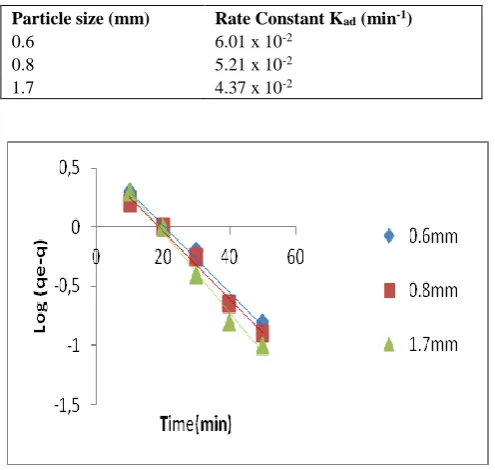
The effect of particle size on the rate of adsorption was shown in (Fig. 4) and the rate constant Kad values calculated
are given in Table 5. For the adsorption of Cr(VI), increase in particle size from 0.6 mm to 1.7 mm decreased the rate of adsorption from 6.01 x 10⁻² to 4.37 x 10⁻² min-1. The higher
rate of metal uptake by smaller particles was due to greater accessibility to pores and greater surface area for bulk adsorption per unit weight of the adsorbent9 have stated that
the breaking up of larger particles to form smaller ones opens some tiny sealed channels that will be available for adsorption and therefore the rate of uptake by smaller particles was higher than that larger particle.
Table 5 Lagergren rate constants calculated for different particle sizes (mm)
Particle size (mm) Rate Constant Kad (min-1)
0.6 6.01 x 10⁻²
0.8 5.21 x 10⁻²
1.7 4.37 x 10⁻²
Figure 4. Relationship between different particle size and time of adsorption.
Conclusion
In this study the batch removal of toxic hexavalent chromium ions from aqueous solutions using powder calcined brick was investigated.
K
lg( ) lg
2.303 ad
e e
It is evident that decrease in particle size increases the percent removal haxavalent Cr (VI) ions. The 81.37%
removal of chromium (VI) was observed at 10mg/50 ml of adsorbent dose. The higher kinetic rate of metal uptake by smaller particles was due to greater accessibility to pores and greater surface area for bulk adsorption per unit weight of the adsorbent .The chromium(VI) uptake by the powder of calcined brick followed pseudo first order rate model. Hexavalent chromium metal removal with the above adsorbent appears to be technically feasible, user-friendly, eco-friendly, economical process and with high efficacy.
Acknowledgement
The authors would like to thank to Prof.Z. Vishnuvarthan, BOS Chairman, Department of Environmental Sciences, Acharya Nagarjuna University, India., for his co-operation and encouragement. Our special thanks also reserved for our family members and friends who stand always by our side in all our endeavors.
References
1Wu, P. and Yu-shan, Zhou, J. Hazard Mater., 2009, 168(2-3),
674.
2Weng, C.H., Huang, C. P. Allen H. C. andSanders, P. F., J. Environ. Eng.,2000, 127, 1124.
3Navarro, R. R., Fuji, K. S. N. and Matsumuta, M., Water Res., 1996, 30, 2488.
4Bandyopadhyay, A. and Biswas, M. N., Indian J. Environ. Protect., 1998, 18(9), 662.
5Nagesh, N. and Krishnaiah, A., Indian J. Environ. Protect., 1989.
9(4): 301 -303.
6Selvaraj, K., Chandramohan V. and Pattabhi, S., Indian J. Environ. Protect.,1998, 18(9), 641.
7Nagarajan, P., Elizabeth V. D. and Isaiah, S., Indian J. Environ. Protect., 2006, 26(1), 30.
8Kannan, N. and Vanangamudi, A., Indian J. Environ. Protect. II, 1991, 4, 241.
9Weber, W. J. Jr., and Morris, J., Sanitary Eng. Div. ASCE., 1963, 89(SA2), 31.