International Journal of Advances in Management, Economics and Entrepreneurship Available online at: www.ijamee.info
RESEARCH ARTICLE
Bolivian Alamos de la Andes Co-op: An Empirical Case Analysis of
Ethnic Women Identifying an Ethical Market Economy Path to
Improve Their Financial Well-being
Efosa C. Idemudia*, Ralph Ferguson, Denise Bean
1Arkansas Tech University, College of Business, Russellville, Arkansas. 2Texas Tech University, Lubbock, TX 79409-1030.
3Texas Tech University, Entrepreneur, Lubbock, TX.
Abstract
Increasingly the empirical challenges to transform an emerging nation economy require the engagement of gender diversity to expand monetary activity in the local market. Hence, we investigate the factors that influence gross pay in the Knitting industry using Bolivia as a case study. Women in Bolivia use the local practice of hand-knitting to establish a light industry that enriches the national economy. Global markets are capital-centered financial stability in emerging markets is inextricably link to greater gender inclusion. Conversion of aboriginal survival practices with such items as food, food preparation, knitting, weaving, music, and art into commerce provides found revenue to insert into the local market at minimal cost to the national government. Los Alamos de la Andes organize traditional hand-knitting skill to increase wealth building opportunities among Quechua and Aymara Indian women in Bolivia.
Keywords: Knitting, Women, Market economy, Gross pay, Financial well-being
Introduction
The integration of technology into emerging markets influence urban sprawl among populations that want to lift themselves above subsistence. A key step to improve income to benefit lifestyle is to transition work done free by women to sustain the household into an earnings model that may not disrupt the family. The case in Bolivia affirms a cooperative that trains women utilizing a basic skill can contribute to the household income.
The absence of women from employment cost a nation capital yield from more than 50% of its population denied complete market access to jobs due to customs and practices trusted to be the affirmative traction in the society. As capital-centered markets need growth to insure government stability, emerging economies may find it easier to signal
expansion through supporting gender
initiatives that refresh traditional products to be introduced to global buyers. Though
there are traditions that must be set-aside, inclusions require rethinking factors that have prohibited change in emerging markets. Los Alamos de la Andes in Bolivia is not the first group of women to advance market practices while navigating traditionalism to build wealth. Supriya Bally [1] in India observed that the emergent discourse supports the notion women’s participation offered opportunities for the women to increase their responsibility towards the development of the community. Whether South America or India global activity indicates influence for significant shift in patriarchal societies to define a greater role for women.
This organization is not exempt from challenges imbedded in their culture that fail to encourage cultivation of a business aptitude. On the other side of the world in an article about the women of China, Tania Branigan [2] reported interviewee cogent comments about gender that there are many laws protecting the rights of women-the problem is traditions and customs. Despite the reality of traditional and culture, the women of Bolivia manage to thrive using their traditional skills to make a market for their products. The case study finds the women of Los Alamos de la Andes did not abandon traditional functions to achieve
income generation through the cooperative. In Bolivia, they include knitting projects in their routine by multi-tasking whether in the rural or urban areas of the country. In traditional emerging economies globally, Siyu Li [3] outlines principle activities where women engage while being change agents that include nutrition, agriculture, collecting water, firewood, gather medicine plants, etc. The path to inclusion by women in developing markets around the world affirms commitment to transition toward progressive traditional and cultural practices as shown in
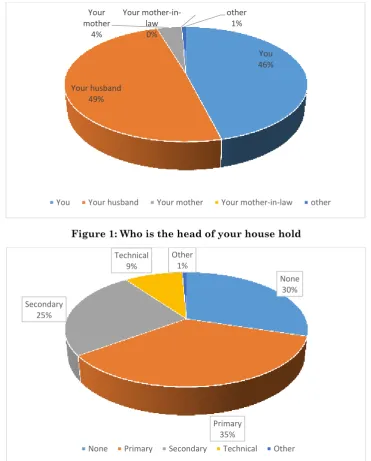
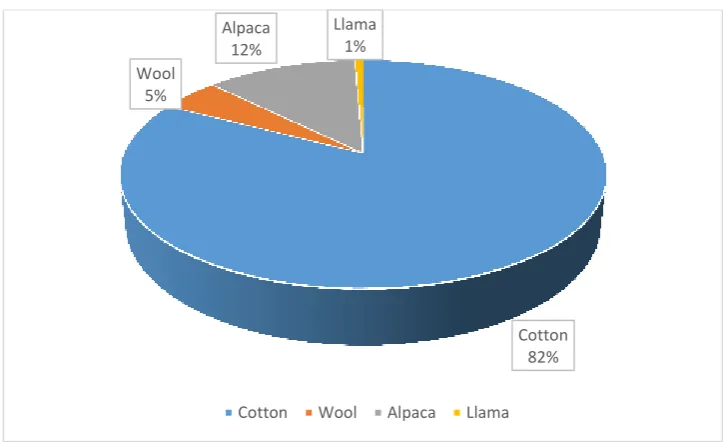
Figures 1, 2, and 3.
Figure 1: Who is the head of your house hold
Figure 2: Highest educational level obtained before participation in a knitting
You 46%
Your husband 49% Your mother
4%
Your mother-in-law
0%
other 1%
You Your husband Your mother Your mother-in-law other
None 30%
Primary 35% Secondary
25%
Technical 9%
Other 1%
Figure 3: What fiber do you mostly use in your knitting As gender equity global voice matures, the
Bolivian cooperative for broader female engagement in the economy may signal a creep closer to their involvement becoming a trade barometer. Transitional emerging economies that look more similar than dissimilar to establish hegemonic economies may have less difficulty with trade partnerships. Due to monetary exchange for goods, this over-time influence the status of an organization in the local economy. The production of goods from Bolivia are premium hand-knit materials that retail in the U.S. and Europe at a higher price point. This provides dominance for their products in the local tourist market a result of global brand recognition. Since Los Alamos de la Andes products are not assembly copies from mechanize manufacturing, each product for the season becomes a limited edition that weighs on the wholesale price structure when international apparel buyers shop for goods to retail in their stores.
The effort to transition for women in Bolivia moves consistent with ability to sustain and increase their numbers in the electoral political arena. Jimena Costa Benavides [4] reports that in Bolivia female political participation began 1947-1949, universal suffrage in 1956, and domestic women’s organization gained the requirement that parties have at least 30% females on their national list of candidates. With 1 in 3 voters’ female, Benavides [4] indicates in the
data this improves the likelihood of women achieving elective office in Bolivia. The case study indicates that the continuous energy spent for political empowerment influence the will of Bolivian women to manage their inclusion in the market that benefits the national interest long term. Leny Olivera Rojas [5] finds that climate change is an impending crisis in Bolivia that may severely hurt agricultural production and forces distress families to migrate into cities for employment or government subsidies. Given Los Alamos de la Andes remains on its trajectory in domestic and international markets, the cooperative will insulate many members from the stress forthcoming with climate change.
The data affirms the success of the cooperative is the personal technique use to connect with their members in rural and urban centers. Los Alamos de la Andes practices the train the trainer model. This is an efficient training method since it does not require its more than 1000 members to learn in one place. The lead trainer teaches new product patterns to the team leader for a week or more. The team leader returns to the group to demonstrate techniques to complete the pattern. The cooperative may have as many as a 100 different patterns knitted simultaneously. Since the patterns are identical, the knitters produce high quality goods in various sizes that may be sold in the international market. If there is
Cotton 82% Wool
5%
Alpaca 12%
Llama 1%
doubt about a technique, the lead trainer may address the challenge with a telephone conversation. Each member learns how to read patterns by reviewing the questionable technique problems are solve quickly. This
piece-meal labor intensive process
contributes positive cash-flow to members’
households. Individuals and teams
generating an array of products for retail sales are the manufacturing arm of the cooperative. When the market demands a select style, the cooperative may provide material for members to produce additional stock. Los Alamos de la Andes fulfill many needs of the membership as a social group and income generator solidly earning revenue to benefit citizens in one of the poorest countries in the western hemisphere. Emerging nations that by-pass greater gender participation in the market risk instability and loss opportunities through international partnerships. Gradually, inclusion will be a hallmark as influence of
cooperatives increase among global
businesses.
Methodology
To develop the case study to gain insight about the operations Los Alamos de la Andes,
152 members completed survey for
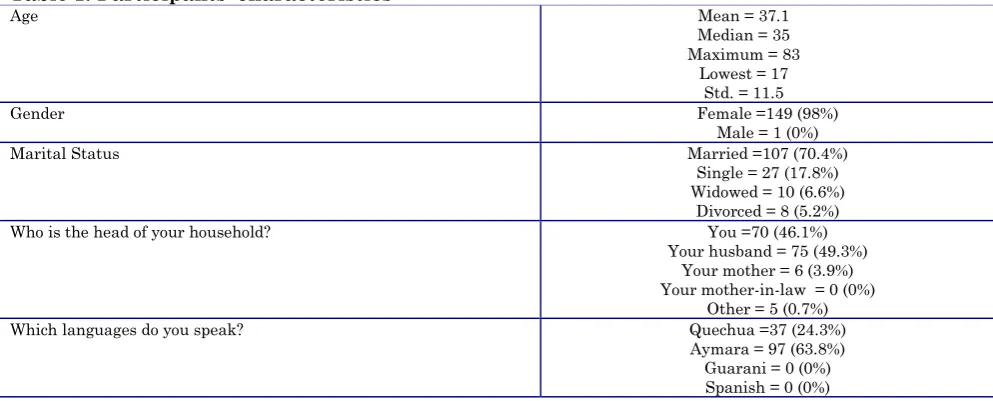
assessment. The Participants’
Characteristics are shown in Table 1. Literacy is a challenge in Bolivia. The survey was presented in Spanish the commercial language of the country. When participants were unable to read Spanish, a member read the material to the individuals. Members self-identified that they wanted to be part of the study. A cross-section of urban and rural members completed the survey to assist bringing clarity to membership in the cooperative. Though Los Alamos de la Andes provide support with training, members need to earn a certificate that confirms their proficiency as a knitter. The dataset for the study include the following:
Age
Gender
Marital status
Head of household
Languages spoken
Languages one can write
Number of children
Live rural
Live urban
Income
Education
Health insurance
Dental insurance
Chores
Number of years knitting
Knit training
Fiber preference for knitting
Attitude toward work
Cell phone
Land line phone
Cultural tribal identity
Table 1: Participants’ characteristics
Age Mean = 37.1
Median = 35 Maximum = 83
Lowest = 17 Std. = 11.5
Gender Female =149 (98%)
Male = 1 (0%)
Marital Status Married =107 (70.4%)
Single = 27 (17.8%) Widowed = 10 (6.6%)
Divorced = 8 (5.2%)
Who is the head of your household? You =70 (46.1%)
Your husband = 75 (49.3%) Your mother = 6 (3.9%) Your mother-in-law = 0 (0%)
Other = 5 (0.7%)
Which languages do you speak? Quechua =37 (24.3%)
Other = 18 (11.8%)
How many children have you given birth to? Mean = 4
Median = 4 Maximum = 12
Lowest = 0 Std. = 2.5
Do you have family living in the Campo? Yes =120 (78.9%)
No = 23 (15.1%)
Highest educational level obtained before participation in a knitting None = 45 (29.8)
Primary = 53 (35.1%) Secondary = 38 (25.2%)
Technical = 14 (9.3%) Other = 1(0.7%)
Note: The sample size is 152.
Analytics to Develop
English Spanish Title
Aq3 a3 marital status
Aq5 a5 languages spoken
Aq7 a7 languages written
Aq11 a11 urban/rural
Bq4 b4 urban/rural savings
English Spanish Title
Bq5 b5 debt
Bq6 b6 education level
Bq7 b7 present level of education
Cq3 c3 activities while knitting
Cq7 c7 training
Cq8 c8 skill improvement
Cq9 c9 finishing technique
Cq12 c12 knit for family
Cq20 c20 main income
Dq1 d1 attitude rural/urban (D thru C)
Data Analysis
To answer the question on what are the factors that influence your gross income we
implemented the Generalized Linear
Regression using IBM SPSS Modeler as shown in Figure 4. We investigated if the following variables have influence on gross income:
Marital status
Highest educational level obtained
Years of knitting experiences
Hours spent per day knitting
Fiber you used mostly in knitting
Percentage of the items you design for knitting
Figure 4: IBM SPSS model for generalized linear regression
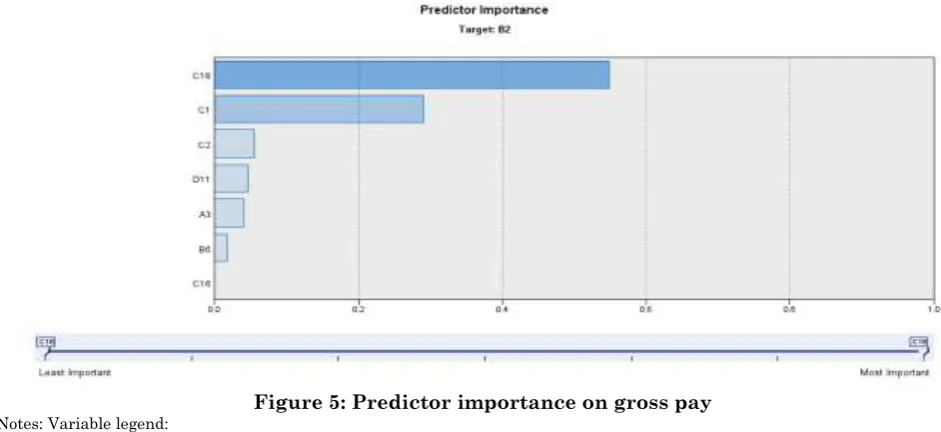
Figure 5, shows the impact of all the variables on Gross Pay; and C18 (i.e. what percent do you design of all the items you knit) has the most impact on Gross Pay. It should be noted that C16 (i.e. what fiber do you mostly used in your knitting) has the
least impact on Gross Pay. Also, of all the variables in Figure 5, only C1 (i.e. years of experience knitting) and C18 (i.e. hours spent per day knitting) have a significant and positive impact on Gross Pay. C1 is significant at 0.006 and C18 is significant at 0.023.
Figure 5: Predictor importance on gross pay Notes: Variable legend:
A3: marital status B2: gross pay
B6: highest educational level obtained C1: years of experience knitting C2: hours spent per day knitting C16: fiber mostly use in knitting
C18: percentage you design of all items you knit D11: Overall, satisfaction with my job as a knitter
Conclusion
Income from knitting by members in the co-op is a positive enhancement to gross pay. This is significant as financial yield relates to the sum of time allocated by members to knit. Los Alamos de la Andes has several pathways for members to influence their
gross pay through vendor contracts,
replenishment of products due to
Emerging nations that establish laws to support gender initiatives without an applied strategy to promote and encourage forfeit the wealth building opportunity from fifty percent of its population. Gender industries as in Bolivia may create a cultural product market that can grow exponentially as demand increases. The production of the Los Alamos de la Andes co-op is in conjunction with traditional domestic function where advance training transition cultural designs and skillset to market standards.
Symmetrical internal management to lift sustainability in local economies emerging nations may yield greater economic fortitude by supporting regional programs that increase market participation of women. Or, developing nations risk indenture servitude to hegemonic economies trying to identify a niche for a systemic partnership in global trade producing product components for advance industrial manufacturers. Failure to strengthen the structure of a vibrant local base leaves emerging economies vulnerable to the weaknesses of their external partners. Los Alamos de la Andes in Bolivia serves as an economic engineer that employs women to use traditional skills to manufacture apparel products with global appeal. Female co-ops generate found revenue to feed into the local economy to increase monetary disbursements for goods and serves across the competitive
market. These micro-economies are
immeasurable benefits to emerging
economies that supports transition into globalization. Gender based enterprises may galvanize market fissures where challenges
make it difficult to distinguish market distinction to the best service of the populace. In short, privatization has relevance in maturing markets but the consideration of at any cost may be removed from the transition effort by governmental leadership.
Globalization is not at a crest, however, has arrived at crest that will redefine how to go forward by hegemonic nations. This makes low-cost gender businesses increasing more valuable to their nations. Climate change agreements reduce the dynamics of the global economy. There is sufficient data to affirm emerging nations may not replicate historical development practices of hegemonic nations
without contributing to irreconcilable
ecological damage. Yet, they must evolve to improve the quality of life in their countries.
The under-pinning to free-trade is constant growth, which is not reasonable due to over-production that suppresses cost. Simply, when your component to sale in the competitive market is tin all other regional tin manufacturers do not cease making the product. Everyone loses when there is market saturation with excessive inventory to sell cheap. To incorporate gender-based businesses in the national economic strategy provides a window of opportunity to design growth a model that harnesses population and ecological well-being with hegemonic partners. This case study demonstrates there is an effective path forward for nations that assess the advantages of leveraging female production as an attribute for success [6].
References
1 Bally S (2013) Deconstructing gatekeepers discourse in the
establishment of self-help groups for women in rural India.
Community Development Journal 49(4):589-602
doi:10.1093/cdj/bst059.
2 Branigan T (2015) For richer, for poorer: how China’s laws
put women second. http://www,the guardian.com/ world /2015/ feb /24/ Chinese women-equality-laws-land-housing. (Accessed 7/23/2015).
3 Li S (2011) Indigenous women and forest management in
yulong county, China the case of shitou township. www.tebtebba.org, www.indigenousclimate.org.
4 Benavides JC (2003) Women’s poitical participation in
Bolivia: progress and obstacles. www.quotaproject.org/cs/cs-costa_bolivia_25-n-2003pdf.
5 Rojas LO (2014) Climate change and women in Bolivia: A
view from the
ground.http://www.democracyctr.org/climateresilientwomen/ essay.php?n=leny&lang=en.(Accessed 8/5/2015.)