136
THE CONTENT AND PREDICTIVE VALIDITY OF PNEUMA ENGINEERING APTITUDETEST
J.A. ODUKOYA, Covenant University (NIGERIA) [email protected]
&
A. OSORE,
Federal Polytechnic, Ilaro (NIGERIA) [email protected]
& F. OSORE,
Federal Polytechnic, Ilaro (NIGERIA)
&
O.B. OKUNLOLA Covenant University (NIGERIA)
[email protected] +2348035777233
Abstract
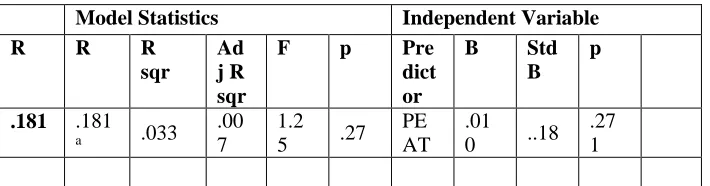
It is apparent that engineering is applied science. It can also be argued that knowledge that is not applied is virtually wasted knowledge. The real essence of education is learning to accumulate and apply knowledge for solving life’s problems and so make the world a better place to live. Engineering is one of the formidable fields fulfilling this role. However, admitting students into tertiary institutions without professionally screening them for aptitude in requisite engineering skills is apt to frustrate the achievement of this laudable aspiration. Engineering Aptitude tests are promising assessment tools designed for this purpose. However, psychological tools are of little value, and could even prove fatal, if un-validated. This study, therefore, made an attempt at validating the Pneuma Engineering Aptitude Test [PEAT] for admitting students into tertiary institutions using Federal Polytechnic, Ilaro in Nigeria as case study. For the Ordinary National Diploma [OND] students,PEAT’s predictive power was 51% [R = .507 and r = .507 at p = .001]. For the Higher National Diploma [HND] students, however, PEAT’s predictive power was 18% [R = .181 and r = .181 at p = .271]. This suggests that the predictive validity of PEAT tends to wan with passage of time in tertiary institutions. The implication of this finding was discussed and recommendation for further studies was made in the light of limited data.
Key Words: Engineering Aptitude, Predictive Validity, Content Validity, Polytechnic, Nigeria
Introduction
It is apparent that remarkable community and national development emanated from concerted application of scientific methods. This trend is virtually applicable in all fields of life. The quality of empirical research therefore naturally determines the quality of productivity and development. This probably informs the slow spate of development in emerging countries like Nigeria. Scientific effort in developing standardized psychological instruments like the Pneuma Engineering Aptitude Tests [PEAT], therefore is apt to make significant contribution in evolving sustainable solutions in the country.
137
admitted or appointed into courses/positions they lack aptitude for. The outcome of this practice is inefficiency, redundancy, frustration and developmental retrogression. It is a situation that calls for concern, hence the effort in this study at developing a reliable and valid psychological instrument for admission purpose.The Schwartz group recommended that assessment methods used within the admissions system should be reliable and valid. Among its wider recommendations the Schwartz report encouraged the commissioning of research to evaluate the ability of aptitude tests to assess the potential for higher education:
“Admissions policies and procedures should be informed and guided by current research and good practice. Where possible, universities and colleges using quantifiable measures should use tests and approaches that have already been shown to predict undergraduate success. Where existing tests are unsuited to a course’s entry requirements, institutions may develop alternatives, but should be able to demonstrate that their methods are relevant, reliable and valid”. (Admissions to Higher Education Steering Group, 2004, p. 8)
One reason for the failure of the Scholastic Aptitude Test [SAT] to add any significant predictive power is that it is possible that the underlying constructs assessed by the SAT and A levels are now too similar. In an earlier study reported in 2001 (McDonald et al., 2001) using an earlier version of the SAT, it was concluded that it was assessing a somewhat distinct construct from A levels. Changes to the SAT in 2005, with the introduction of the essay and some higher order mathematics items, may have weakened the underlying difference between the SAT and A levels.
Scholars have therefore continued to find the predictive value of aptitude tests, to measure what it purports to measure. In a study of “Predictive validity of the UK clinical aptitude test in the final years of medical school”, Husbands, Mathieson, Dowel & Mackenzie (2014) attempted to find the predictive validity
of the UK Clinical Aptitude Test (UKCAT), to predict performance of students from Aberdeen and Dundee medical schools in the UK. The UKCAT scores of years 4 and 5 students as compared to their scores on their UCAS forms and interview scores were compared. UCAS represents the institution which operates and harmonizes all admissions procedures across different universities in the United Kingdom (Peter& Denis, 2003). The results from Husbands, et al (2014) showed that neither UCAS form nor interview scores were statistically significant predictors of examination performance. Conversely, the UKCAT yielded statistically significant validity coefficients between .24 and .36 in four of five assessments investigated. Multiple regression analysis showed the UKCAT made a statistically significant unique contribution to variance in examination performance in the senior years.
Similarly, MacKenzie, Cleland, Ayansina, & Nicholson (2016) conducted a large sample study on the ability of UKCAT to predict performance of 6294 medical students from 30 UK medical programmes who took the exams from 2006 to 2008. In the students’ final year, it was evident that students, who performed well at the aptitude test, still maintained good grades. They therefore concluded that the test not only had a significant predictive value, but that such tests were important to predict outcomes of students in medical schools.
These studies strengthen the fact that it is imperative that psychological instruments used for assessment purposes in any sphere of life be reliable and valid. Anything short of this is apt to lead to wastage of colossal resources, confusion and frustration for all stakeholders. The long term effect of such practice is better imagined than experienced. It should be avoided at all costs. This point tends to justify the significance of this study. It is an effort at validating a proposed engineering aptitude test. Such validation exercise is apt to ultimately catalyze national productivity and development.
Objectives
The core objectives of this study are:
138
Research QuestionWhat is the content validity of the Pneuma Engineering Aptitude Test? Hypotheses
1. There is no significant relationship significant correlation in the performance of Ordinary National Diploma [OND] students in PEAT and their OND-1 GPA score.
2. There is no significant relationship significant correlation in the performance of Higher National Diploma [HND] students in PEAT and their HND-1 GPA score.
Method
With the nature and objective of the study, the correlational research design is the most relevant. The sample
for the study were seventy nine (79) year one students of 2014/15 academic session(OND [40] and HND [39]), whose ages ranged between 16 and 24 years. The purposive sampling technique was adopted. The main instrument for this study was the Pneuma Engineering Aptitude Test [PEAT]. It has 50 engineering related items to be done in one and half hours. The content validity of the instrument was ascertained by experts’ judgment – subject and psychometric experts.
The instrument was administered on the OND-1 and HND-1 students of the Federal Polytechnic, Ilaro, Ogun state, Nigeria after obtaining due permission and consent from the school authorities and concerned students respectively.
Data analyses were done using the Pearson Product Moment correlation coefficient and Linear Regression analysis.
Results & Discussion
Predictive Validity of PEAT on OND-1 GPA
Table 1: Regression Result for OND 1 Students
Predictor: PneumaEngineering Aptitude Test [PEAT] Score
Dependent Variable: OND1_GPA
The result in Table 1 indicates that PEAT’s predictive power is 51% [R = .507 and r = .507 at p = .001]. In other words, the Pneuma Engineering Aptitude Test offered significant prediction of OND students’ performance in engineering programme at the Polytechnic. The predictive power of PEAT tend to be higher at lower levels of tertiary institution, as observed here.
Predictive Validity of PEAT on HND-1 GPA
Model Statistics Independent Variable
r R R
sqr
Ad j R sqr
F p Pre
dict or
B Std B
p
.50 7
.507 .257 .23 8
13. 17
.00 1
EA T
.05 2
.50 7
139
Table 2: Regression Result for HND 1 StudentsThe result in Table 2 indicates that EAT’s predictive power for HND-1 students was 18% [R = .181 and r = .181 at p = .271]. In other words, the Engineering Aptitude Test could not offer significant prediction of HND students’ performance in engineering programme at the Polytechnic. When compared with the OND result, this tend to suggest that the predictive validity of EAT tends to wan with passage of time in tertiary institutions. Husbands et al (2014) tend to make the same findings in a similar study with UK Clinical students. Year 4 and 5 medical students furnished coefficients between .24 and .36. It appears as students move to higher classes in tertiary institutions, the predictive power of aptitude tests tend to dwindle. It could also be attributable to increasing extraneous variable that were introduced as students mature and adapted to the environment. The nature-nurture theory applies here. These observations are worth further study for affirmation.
Recommendation & Conclusion
The implication of this finding is that the predictive validity of PEAT tends to wan with passage of time in tertiary institutions. Apparently there are other factors working to determine students’ performance in engineering courses as they progress in their study. It is therefore strongly recommended that test developers should consider attributes that may intervene in the test’s ability to make valid prediction of students’ academic outcomes. This will go a long way in eliminating stress and frustration for students who are not cut out for engineering programmes. This in turn prevents wastage of time and precious resources. The ultimate benefit of valid assessment of students’ engineering aptitude is that it will catalyze productivity and national development. This point could be reliably extended to usage of this same psychological instrument in job recruitment.
Model Statistics Independent Variable
R R R
sqr
Ad j R sqr
F p Pre
dict or
B Std B
p
.181 .181
a .033
.00 7
1.2 5 .27
PE AT
.01
140
ReferencesAdmissions to Higher Education Steering Group (2004). Fair Admissions to Higher
Education: Recommendations for Good Practice [Schwartz Review]. London: DfES [online]. Available: http://www.admissions-review.org.uk/downloads/finalreport.pdf [24 October.2017]. Husbands, A., Mathieson, A., Dowel, J. & Mackenzie, R. (2014). “Predictive validity of the
UK clinical aptitude test in the final years of medical school” BMC Medical Education
http://www.biomedcentral.com/1472-6920/14/88
MacKenzie, R., Cleland, J., Ayansina, D. & Nicholas, S. (2016). Does the UKCAT predict performance on exit from medical school? A national cohort study. BMJ Open;6:e011313. doi:10.1136/bmjopen-2016- 011313
Mattern, K.D., Patterson, B.F., Shaw, E.J., Kobrin, J.L. and Barbuti, S.M. (2008). Differential
Validity and Prediction of the SAT® (College Board Research Report No. 2008-4). New York, NY: The College Board [online]. Available:
http://professionals.collegeboard.com/profdownload/Differential_Validity_and_Prediction_of_the _SAT.pdf .
McDonald, A.S., Newton, P.E. and Whetton, C. (2001). A Pilot of Aptitude Testing for University Entrance. Slough: NFER.